
What this is
- Mitochondrial calcium (Ca) homeostasis is crucial for cellular function and aging.
- This research investigates how reducing mitochondrial Ca uptake affects lifespan and health in Caenorhabditis elegans.
- Findings indicate that decreased mitochondrial Ca levels extend lifespan and improve motility, though early-life survival may be compromised.
Essence
- Reducing mitochondrial calcium uptake enhances lifespan and motility in C. elegans, linked to transient increases in reactive oxygen species (ROS) that activate antioxidant pathways.
Key takeaways
- Reducing mitochondrial Ca uptake via RNA interference extends lifespan in C. elegans. Lifespan increases significantly when intervention occurs before day 14 of adulthood.
- A transient rise in ROS levels after mitochondrial Ca reduction activates signaling pathways involving p38 MAPK, FOXO, and NRF2, enhancing antioxidant defenses and preserving mitochondrial integrity.
- Pharmacological inhibition of mitochondrial Ca uptake using mitoxantrone mimics the effects of genetic knockdown, suggesting potential therapeutic applications for aging.
Caveats
- Early-life survival is compromised when mitochondrial Ca uptake is reduced, indicating potential trade-offs in lifespan extension strategies.
- The study primarily uses C. elegans, and while findings show translational relevance to human cells, results may not fully apply to complex mammalian systems.
Definitions
- mitohormesis: A process where mild stress, such as increased ROS, promotes beneficial adaptations, enhancing cellular health and longevity.
Simplified
Introduction
Mitochondrial calcium (Ca2+) plays a central role in regulating numerous cellular functions, including metabolism, signaling, and the balance between cellular survival and death. Thereby, mitochondrial Ca2+ homeostasis is a delicate balance. Both excessive and insufficient Ca2+ uptake can disrupt mitochondrial function and may lead to cellular dysfunction. For instance, mitochondrial Ca2+ is essential to boost the activity of dehydrogenases of the tricarboxylic acid (TCA) cycle (Tawfik et al. 2022), while excessive mitochondrial Ca2+ load leads to apoptosis (Madreiter‐Sokolowski et al. 2016).
As a result, dysregulation of mitochondrial Ca2+ can significantly accelerate physiological decline and is increasingly recognized as a major contributor to aging and age‐related diseases, including neurodegeneration, cardiovascular disease, and metabolic disorders (Madreiter‐Sokolowski et al. 2024). During the aging process, changes in the expression and function of proteins that regulate mitochondrial Ca2+ handling (Madreiter‐Sokolowski et al. 2019; Uzhachenko et al. 2017; Yang et al. 2021) lead to an imbalance in mitochondrial Ca2+ homeostasis, resulting in age‐related deterioration. For example, a decline in mitochondrial Ca2+ retention capacity has been linked to age‐related impairments in muscle function (Cefis et al. 2025). In addition, elevated basal mitochondrial Ca2+ levels—potentially due to increased physical interaction between the endoplasmic reticulum and mitochondria—have been associated with mitochondrial dysfunction and are increasingly recognized as both features and potential drivers of cellular senescence (Madreiter‐Sokolowski et al. 2019; Margand et al. 2025). Interestingly, also in Caenorhabditis elegans (C. elegans), increased mitochondrial Ca2+ levels have been shown to contribute to health decline, pointing toward a detrimental role of increased mitochondrial Ca2+ levels in aged organisms (Higashitani et al. 2023).
Aging‐related alterations in mitochondrial Ca2+ handling not only affect different organisms but also various cell types, contributing to age‐related organ dysfunction. For example, mitochondrial Ca2+ overload in aged neurons is associated with glutamate‐induced excitotoxicity and excessive reactive oxygen species (ROS) generation—events that ultimately trigger apoptotic neuronal death and contribute to diseases such as Alzheimer's and Parkinson's disease (Madreiter‐Sokolowski et al. 2024). Mitochondrial Ca2+ dysregulation is also a key factor in ischemia–reperfusion events, where mitochondrial Ca2+ overload leads to the opening of the mitochondrial permeability transition pore, triggering cell death pathways in cardiomyocytes and cardiac injury after reperfusion (Rozich et al. 2025). Moreover, pancreatic beta‐cell insulin secretion relies on mitochondrial Ca2+ uptake, which links glucose metabolism to ATP production and triggers Ca2+‐dependent exocytosis of insulin, a process that is strongly affected by age‐related alterations in mitochondrial Ca2+ homeostasis, potentially serving as a trigger for the development of metabolic diseases like type 2 diabetes mellitus (Mammucari et al. 2018).
Therefore, a tight control of mitochondrial Ca2+ uptake and homeostasis is essential to maintain intact cellular function and prevent age‐related pathologies. This regulation is primarily mediated by a specialized set of proteins that govern mitochondrial Ca2+ entry. The outer mitochondrial membrane is largely permeable to Ca2+ through the voltage‐dependent anion channel (Shoshan‐Barmatz et al. 2018). In contrast, the uptake of Ca2+ into the mitochondrial matrix is tightly regulated by the mitochondrial calcium uniporter (MCU), a highly selective channel located in the inner mitochondrial membrane (Kirichok et al. 2004). The MCU is functionally linked to the essential MCU regulator (EMRE) (Sancak et al. 2013), which connects it to the regulatory proteins mitochondrial Ca2+ uptake 1 and 2 (MICU1 and MICU2) (Perocchi et al. 2010; Plovanich et al. 2013). Furthermore, the dominant‐negative pore‐forming subunit MCUb and the scaffold factor MCU regulator 1 modulate mitochondrial Ca2+ uptake via MCU (Madreiter‐Sokolowski et al. 2020). Notably, MCU is also a pharmacologically accessible target, and several MCU inhibitors, including the ruthenium red derivatives Ru265 and mitoxantrone, are available. Mitoxantrone has been approved by the Food and Drug Administration (FDA) and the European Medicines Agency for use in humans as an anticancer therapeutic due to its action on DNA topoisomerase II. Additionally, there are reports of the neuroprotective potential of this compound, which could also explain its potential repurposing as a drug to reduce the relapse rate and progression of multiple sclerosis (Marmolejo‐Garza et al. 2023).
In C. elegans, MCU‐1 is essential for rapid mitochondrial Ca2+ uptake and for the generation of ROS following wounding (Xu and Chisholm 2014). Furthermore, carbachol‐induced muscle stimulation was reported to cause a smaller and shorter mitochondrial Ca2+ increase in worms defective in mcu‐1 (Alvarez‐Illera et al. 2020). Additional known components of the MCU complex in C. elegans are emre‐1 and micu‐1 (Alvarez‐Illera et al. 2020). While their function remains elusive, the micu‐1(null) mutation has been associated with longevity (Jackson et al. 2022).
Mitochondrial Ca2+ enhances the activity of dehydrogenases in the TCA cycle (Denton 2009) and increases the production of the reducing equivalents nicotinamide adenine dinucleotide (NADH) and flavin adenine dinucleotide, which fuel the electron transport chain (ETC). While this process is essential for adenosine triphosphate (ATP) production, the transfer of electrons through the ETC also generates ROS as byproducts. ROS, such as superoxide and hydrogen peroxide (H2O2), are reactive molecules that can, if not adequately regulated, damage proteins, lipids, DNA, and other biomolecules. Therefore, ROS must be detoxified by mitochondrial superoxide dismutase 2 (SOD2) and cytosolic SOD1, which convert it to H2O2. This H2O2 is then further processed to water and oxygen by catalase (CAT) or to water and oxidized glutathione (GSSG) by glutathione peroxidase. Moreover, reduced peroxiredoxins have also been reported to catalyze the reduction of H2O2 to H2O (Madreiter‐Sokolowski et al. 2020). Orthologs for all these human enzymes have also been identified in C. elegans, and their role has been extensively investigated regarding life‐ and healthspan‐related signaling cascades in nematodes (Lin et al. 2023). In C. elegans, reduced glucose availability has been shown, for instance, to trigger a temporary increase in ROS, which in turn enhances the organism's resistance to oxidative stress and extends lifespan through mitochondrial adaptation—a phenomenon called mitohormesis (Schulz et al. 2007) and not restricted to nematodes. In mice, time‐restricted depletion of SOD2 during embryonic development associated with significant oxidative stress led to increased mitochondrial biogenesis and expression of antioxidant genes, ultimately resulting in lower ROS levels in the adapted adult animals (Cox et al. 2018). Even in humans, exercise‐induced oxidative stress has been found to improve insulin sensitivity and stimulate the body's own antioxidant defense potential—effects that are blocked when external antioxidants are administered (Ristow et al. 2009). Collectively, these findings highlight that ROS are not merely harmful byproducts of metabolism but also serve as important signaling molecules in different organisms. They activate specific signaling pathways and transcription factors that upregulate genes involved in antioxidant protection. This adaptive response helps against the excessive ROS accumulation associated with aging, which is often driven by mitochondrial dysfunction, such as defects in the ETC (Ristow and Zarse 2010).
Given the central role of mitochondrial Ca2+ in regulating the activity of mitochondria, specifically mitochondrial respiration, we assumed that disturbances in mitochondrial Ca2+ homeostasis may critically influence redox balance and cellular aging in further consequence. Therefore, this study aimed to investigate how targeted inhibition of mitochondrial Ca2+ uptake affects ROS homeostasis and functional decline associated with aging.
Results
Decreased Mitochondrial CaLevels Prolong Lifespan and Enhance Motility 2+
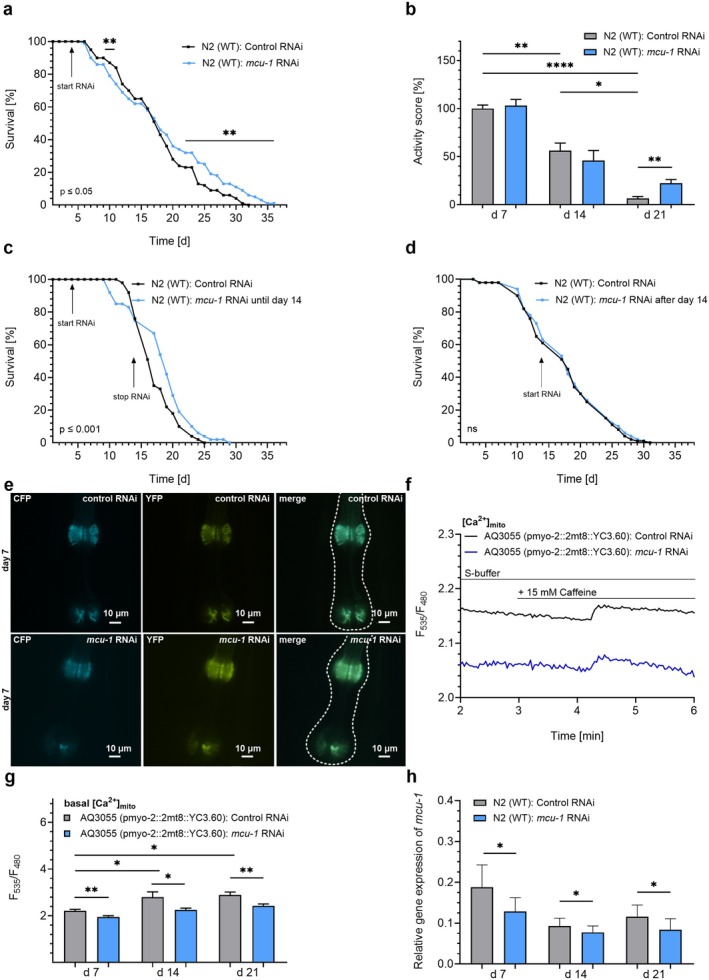
To evaluate the broader effects of mitochondrial Ca2+ modulation, RNA interference (RNAi)‐mediated knockdown of mcu‐1 was initiated in N2 nematodes on day 4 of adulthood. While mcu‐1 RNAi reduced survival in early adulthood, the remaining worms experienced a significant extension in lifespan compared to controls (Figure 1a; for statistical details, see Table 1). Next, we assessed motility, measured as body bends per minute, as an indicator of health. While motility declined significantly with age, N2 nematodes treated with mcu‐1 RNAi exhibited a marked improvement in late adulthood (day 21) (Figure 1b). To pinpoint when mitochondrial Ca2+ modulation is most beneficial, mcu‐1 knockdown was induced during specific life stages. RNAi treatment initiated before day 14 significantly extended lifespan (Figure 1c, Table 1), while lifespan extension was not observed when mcu‐1 RNAi was applied after day 14 (Figure 1d, Table 1). These results suggest that early adulthood is a critical period for gaining the beneficial effects of reduced mitochondrial Ca2+ uptake. To verify reduced mitochondrial Ca2+ levels upon mcu‐1 knockdown, we performed live‐cell imaging in the nematode strain AQ3055 treated with control RNAi or RNAi against mcu‐1 on days 7, 14, and 21. This strain expresses the mitochondrial‐targeted Ca2+ biosensor YC3.60—a genetically encoded Förster resonance energy transfer (FRET)‐based sensor composed of cyan fluorescent protein (CFP) and yellow fluorescent protein (YFP)—in muscle tissues of the pharynx (Figure 1e, Figure S1). We determined basal mitochondrial Ca2+ levels and mitochondrial Ca2+ uptake after stimulation with caffeine [15 mM] in worms treated with control or mcu‐1 RNAi (Figure 1f). Live‐cell imaging revealed a statistical increase in basal mitochondrial Ca2+ levels from day 7 to days 14 and 21. In addition, there was a significant reduction in basal mitochondrial Ca2+ levels at days 7, 14, and 21 through mcu‐1 knockdown (Figure 1g). Additionally, caffeine‐induced mitochondrial Ca2+ uptake tended to be decreased in nematodes treated with mcu‐1 RNAi (Figure S1). Quantitative real‐time PCR (qRT‐PCR) confirmed that RNAi‐induced mcu‐1 knockdown resulted in a significant reduction of mRNA expression levels at days 7, 14, and 21 (Figure 1h).
In summary, these findings suggest that reducing mitochondrial Ca2+ levels through RNAi‐mediated mcu‐1 knockdown extends lifespan and enhances motility in old nematodes, though it may impair survival during early adulthood.
![Knockdown ofprolongs lifespan and motility of. (a) Lifespan analyses of N2 nematodes in the presence of control RNAi (L4440) (black) andRNAi (blue) ( = 5). (b) Bar graphs (mean ± SEM) represent activity score (%), based on body bends per min, in N2 nematodes on days 7, 14, and 21 following the treatment with control RNAi (L4440) (gray) orRNAi (blue) ( = 3). (c) Lifespan analysis of N2strain treated with control RNAi (black) orRNAi (blue) until day 14. (d) Lifespan analysis of N2strain treated with control RNAi (black) orRNAi (blue) after day 14. RNAi treatments are indicated by arrows labeled "start RNAi" and, when applicable, "stop RNAi" to mark the beginning and end of the treatment period. (e) Confocal images showing fluorescence emission at 480 nm (CFP) (left) and 535 nm (YFP) (middle), as well as the merge (right), in the pharynx (marked with dashed lines in the merge) of thestrain AQ3055, which expresses the mitochondrial Casensor YC3.60 under a muscle‐specific promoter, following treatment with either control RNAi (top panels) or RNAi targeting(bottom panels) on day 7. (f) Representative curves showing [Ca]levels in the AQ3055strain, treated with control RNAi or RNAi against, expressing YC3.60 under basal conditions and after stimulation with caffeine [15 mM]. (g) Bar graphs (mean ± SEM) represent basal [Ca]levels of the AQ3055strain on days 7, 14, and 21, treated with control RNAi (L4440) (gray) and orRNAi (blue) ( = 5). (h) Bar graphs (mean ± SEM) represent the relative expression levels of themRNA in N2 nematodes on days 7, 14, and 21, treated with control RNAi (L4440) (gray) and orRNAi (blue) ( = 9). N‐numbers are presented as biological replicates. For details, see Table . For comparing significant distributions between different groups in the lifespan assays, statistical calculations were carried out using the log‐rank test. If applicable, significant differences were assessed via one‐way ANOVA or paired‐test and presented as specificvalues (* ≤ 0.05, ** ≤ 0.01, **** ≤ 0.0001). mcu‐1 mcu‐1 n mcu‐1 n mcu‐1 mcu‐1 mcu‐1 mcu‐1 mcu‐1 n mcu‐1 mcu‐1 n t p p p p C. elegans C. elegans C. elegans C. elegans C. elegans C. elegans 2+ 2+ 2+ mito mito 1](https://europepmc.org/articles/PMC12608091/bin/ACEL-24-e70247-g003.jpg "Click to view full size")
Knockdown ofprolongs lifespan and motility of. (a) Lifespan analyses of N2 nematodes in the presence of control RNAi (L4440) (black) andRNAi (blue) ( = 5). (b) Bar graphs (mean ± SEM) represent activity score (%), based on body bends per min, in N2 nematodes on days 7, 14, and 21 following the treatment with control RNAi (L4440) (gray) orRNAi (blue) ( = 3). (c) Lifespan analysis of N2strain treated with control RNAi (black) orRNAi (blue) until day 14. (d) Lifespan analysis of N2strain treated with control RNAi (black) orRNAi (blue) after day 14. RNAi treatments are indicated by arrows labeled "start RNAi" and, when applicable, "stop RNAi" to mark the beginning and end of the treatment period. (e) Confocal images showing fluorescence emission at 480 nm (CFP) (left) and 535 nm (YFP) (middle), as well as the merge (right), in the pharynx (marked with dashed lines in the merge) of thestrain AQ3055, which expresses the mitochondrial Casensor YC3.60 under a muscle‐specific promoter, following treatment with either control RNAi (top panels) or RNAi targeting(bottom panels) on day 7. (f) Representative curves showing [Ca]levels in the AQ3055strain, treated with control RNAi or RNAi against, expressing YC3.60 under basal conditions and after stimulation with caffeine [15 mM]. (g) Bar graphs (mean ± SEM) represent basal [Ca]levels of the AQ3055strain on days 7, 14, and 21, treated with control RNAi (L4440) (gray) and orRNAi (blue) ( = 5). (h) Bar graphs (mean ± SEM) represent the relative expression levels of themRNA in N2 nematodes on days 7, 14, and 21, treated with control RNAi (L4440) (gray) and orRNAi (blue) ( = 9). N‐numbers are presented as biological replicates. For details, see Table . For comparing significant distributions between different groups in the lifespan assays, statistical calculations were carried out using the log‐rank test. If applicable, significant differences were assessed via one‐way ANOVA or paired‐test and presented as specificvalues (* ≤ 0.05, ** ≤ 0.01, **** ≤ 0.0001). mcu‐1 mcu‐1 n mcu‐1 n mcu‐1 mcu‐1 mcu‐1 mcu‐1 mcu‐1 n mcu‐1 mcu‐1 n t p p p p C. elegans C. elegans C. elegans C. elegans C. elegans C. elegans 2+ 2+ 2+ mito mito 1
| Strain, RNAi, compound | Maximum lifespan [d + SEM] | Mean lifespan [d + SEM] | values: treatment vs. controlp | Number of experiments ()n | Number of total (and censored) nematodes ()n | Change of maximum lifespan [%] |
|---|---|---|---|---|---|---|
| N2: wild type, control RNAi | 31.50 ± 0.56 | 15.9 ± 0.31 | 4 | 348 (22) | ||
| N2: wild type,RNAimcu‐1 | 35.67 ± 0.67 | 17.8 ± 0.41 | 0.032 | 4 | 379 (42) | 13.24 |
| N2: wild type, control RNAi, NAC [100 nM] | 27.78 ± 0.74 | 16.7 ± 0.25 | 3 | 402 (26) | ||
| N2: wild type,RNAi, NAC [100 nM]mcu‐1 | 27.44 ± 0.75 | 16.4 ± 0.24 | 0.082 | 3 | 404 (12) | −1.22 |
| N2: wild type, control RNAi, MitoTEMPO [100 nM] | 26.75 ± 0.41 | 15.6 ± 0.22 | 3 | 391 (26) | ||
| N2: wild type,RNAi, MitoTEMPO [100 nM]mcu‐1 | 27.00 ± 0.42 | 15.4 ± 0.22 | 0.724 | 3 | 391 (29) | 0.93 |
| N2: wild type, control RNAi, respective control to treatment from day 14 | 29.78 ± 0.98 | 16.4 ± 0.30 | 3 | 388 (24) | ||
| N2: wild type,RNAi, treatment from day 14mcu‐1 | 29.67 ± 1.14 | 16.3 ± 0.32 | 0.323 | 3 | 394 (52) | −0.37 |
| N2: wild type, control RNAi, respective control to treatment until day 14 | 26.33 ± 0.33 | 16.6 ± 0.17 | 4 | 400 (10) | ||
| N2: wild type,RNAi, treatment until day 14mcu‐1 | 28.92 ± 0.36 | 15.6 ± 0.21 | 0 | 4 | 358 (8) | 8.06 |
| KU25:(km25), control RNAipmk‐1 | 31 ± 1.51 | 14.9 ± 0.33 | 3 | 389 (60) | ||
| KU25:(km25),RNAipmk‐1mcu‐1 | 30.5 ± 1.6 | 16.0 ± 0.35 | 0.001 | 3 | 408 (62) | −1.61 |
| CF1058:(mu86), control RNAidaf‐16 | 23.50 ± 1.12 | 10.4 ± 0.22 | 4 | 310 (28) | ||
| CF1058:(mu86),RNAidaf‐16mcu‐1 | 24.17 ± 0.98 | 10.3 ± 0.25 | 0.077 | 4 | 296 (27) | 2.65 |
| EU31:(zu135), control RNAiskn‐1 | 23.89 ± 1.14 | 6.65 ± 0.34 | 3 | 143 (0) | ||
| EU31:(zu135),RNAiskn‐1mcu‐1 | 23.78 ± 1.10 | 6.80 ± 0.36 | 0.62 | 3 | 140 (0) | −0.46 |
| GA184:(gk257), control RNAisod‐2 | 31.63 ± 1.0 | 10.5 ± 0.37 | 3 | 243 (17) | ||
| GA184:(gk257),RNAisod‐2mcu‐1 | 31.38 ± 0.84 | 10.1 ± 0.39 | 0.527 | 3 | 253 (29) | −0.79 |
| WM118:[myo‐3::HA::RDE‐1 + rol‐6(su1006)], control RNAineIs9 | 28.33 ± 0.59 | 17.8 ± 0.27 | 4 | 451 (45) | ||
| WM118:[myo‐3::HA::RDE‐1 + rol‐6(su1006)],RNAineIs9mcu‐1 | 30.75 ± 0.39 | 17.4 ± 0.29 | 0 | 4 | 450 (47) | 8.54 |
| N2: wild type, control RNAi, DMSO [0.001%] | 29.5 ± 0.92 | 19.5 ± 0.28 | 4 | 318 (9) | ||
| N2: wild type, control RNAi, mitoxantrone [10 nM] | 31.42 ± 1.27 | 20.4 ± 0.34 | 0.014 | 4 | 320 (36) | 6.5 |
| N2: wild type, control RNAi, respective control to mitoxantrone [10 nM] after day 14 | 29.89 ± 0.56 | 20.4 ± 0.20 | 3 | 320 (19) | ||
| N2: wild type, control RNAi, mitoxantrone [10 nM] after day 14 | 29.56 ± 0.47 | 20.2 ± 0.20 | 0.373 | 3 | 320 (6) | −1.10 |
| N2: wild type, control RNAi, respective control to mitoxantrone [10 nM] until day 14 | 26.11 ± 0.26 | 16.7 ± 0.17 | 3 | 397 (10) | ||
| N2: wild type, control RNAi, mitoxantrone [10 nM] until day 14 | 29.22 ± 0.46 | 17.7 ± 0.23 | 0 | 3 | 399 (13) | 8.41 |
| VP303:[nhx‐2p::rde‐1 + rol‐6(su1006)], control RNAikbIs7 | 28.33 ± 0.69 | 18.6 ± 0.22 | 3 | 474 (50) | ||
| VP303:[nhx‐2p::rde‐1 + rol‐6(su1006)],RNAikbIs7mcu‐1 | 28.89 ± 0.70 | 17.1 ± 0.27 | 0.24 | 3 | 453 (55) | 1.98 |
| Mir248:(ok524), control RNAiaak‐2 | 19.44 ± 0.29 | 11.4 ± 0.16 | 1 | 326 (28) | ||
| Mir248:(ok524),RNAiaak‐2mcu‐1 | 22.33 ± 0.60 | 13.9 ± 0.19 | 0.736 | 1 | 128 (0) | 14.87 |
| Mir14:(ok434), control RNAisir‐2.1 | 23.40 ± 1.07 | 11.8 ± 0.23 | 4 | 134 (0) | ||
| Mir14:(ok434),RNAisir‐2.1mcu‐1 | 29.00 ± 1.61 | 14.3 ± 0.35 | 0.054 | 4 | 253 (4) | 23.93 |
Reduced Mitochondrial CaLevels ImpairCycle andActivity, Leading to a TransientRise 2+ TCA ETC ROS
Since mitochondrial Ca2+ is crucial for the activity of TCA cycle dehydrogenases (Denton and McCormack 1986) and, thus, the activity of the ETC (Mitchell 1961), we assessed the activities of the pyruvate dehydrogenase (PDH) and ETC complexes. In response to mcu‐1 RNAi treatment, we found a significant reduction in PDH activity (Figure 2a). Sequential substrate and inhibitor titrations further revealed markedly decreased activities of complexes I, II, and III, along with reduced maximal respiration (Figure 2b). Such impairments in ETC function can promote electron leakage and elevated ROS production (Zorov et al. 2014). Therefore, we performed an Amplex Red assay. H2O2 levels increased progressively from day 7 to day 21 in N2 nematodes. Notably, mcu‐1 RNAi treatment led to a significant rise in H2O2 at day 14, followed by reduced levels in late life (day 21) compared to controls (Figure 2c). To further investigate alterations in cytosolic H2O2 levels, live‐cell imaging was performed in the JV1 strain treated with control RNAi or RNAi against mcu‐1 on day 14. This strain expresses the H2O2 sensor HyPer under a ribosomal promoter and was excited at both 455 nm and 505 nm, while excitation was acquired between 500 and 521 nm (Figure 2d). The respective strain was used to assess basal cytosolic H2O2 levels and the response after H2O2 application in living nematodes at day 14 under control conditions or with mcu‐1 knockdown (Figure 2e). This approach confirmed the transient increase in cytosolic H2O2 levels at day 14 (Figure 2f). Consequently, we further investigated whether alterations in H2O2 levels are associated with lifespan extension induced by mcu‐1 RNAi. Treatment with 1 mM of the ROS scavenger N‐acetyl cysteine (NAC) (Schulz et al. 2007) abolished the lifespan‐extending effects of mcu‐1 RNAi in N2 nematodes (Figure 2g and Table 1), as did the mitochondrial‐specific antioxidant MitoTEMPO [100 nM] (Ewald et al. 2017) (Figure 2h; Table 1). These results suggest that a transient increase in ROS levels may trigger a signaling cascade that promotes longevity and improves fitness in older worms.
![Knockdown ofmodulates TCA, ETC, and HOlevels. (a) Bar graphs (mean ± SEM) represent levels of PDH activity per min in isolated mitochondria of N2 nematodes on day 7, treated with control RNAi (L4440) (gray) orRNAi (blue) ( = 6). (b) Bar graphs (mean ± SEM) show the results of respirometry of isolated mitochondria of N2 nematodes on day 7, treated with control RNAi (L4440) (gray) orRNAi (blue). Vertical lines indicate additions of compounds, including pyruvate [5 mM] + malate [2 mM], adenosine diphosphate (ADP) + Mg[2.5 mM], cytochrome c [10 μM], glutamate [10 mM], succinate [10 mM], CCCP [0.5 μM], rotenone [0.5 μM], antimycin A [2.5 μM], ascorbate [2 mM] + TMPD [0.5 mM], and NaN3 [≥ 100 mM] ( = 6). (c) Bar graphs (mean ± SEM) represent HOlevels measured by Amplex Red assay in the N2strain on days 7, 14, or 21, treated with control RNAi (gray) orRNAi (blue) ( = 5). (d) Live‐cell imaging of the pharynx in the JV1strain expressing the HyPer sensor under a ribosomal promoter, showing emission at 500–521 nm following excitation at either 505 nm (left) or 455 nm (middle) or in the merge (right). Images are presented after treatment with control RNAi (top panels) or RNAi targeting(bottom panels). (e) Representative curves showing cytosolic HOlevels in nematodes treated with control RNAi or RNAi againstexpressing HyPer under basal conditions and after the addition of HO[40 mM]. (f) Bar graphs (mean ± SEM) represent HOlevels in JV1 nematodes on day 14 following treatment with control RNAi (gray) orRNAi (blue) ( = 5). (g) Lifespan analysis of N2 nematodes treated with control RNAi (black) orRNAi (blue) in the presence of 1 mM NAC ( = 3). (h) Lifespan analyses of N2 nematodes in the presence of control RNAi (black) andRNAi (blue) in the presence of 100 nM MitoTEMPO ( = 3). RNAi treatments are indicated by arrows labeled "start RNAi" and, when applicable, "stop RNAi" to mark the beginning and end of the treatment period. N‐numbers are presented as biological replicates. For details, see Table . For comparing significant distributions between different groups in the lifespan assays, statistical calculations were carried out using the log‐rank test. If applicable, significant differences were assessed via one‐way ANOVA or unpaired‐test and presented as specificvalues (* ≤ 0.05). mcu‐1 mcu‐1 n mcu‐1 n mcu‐1 n mcu‐1 mcu‐1 mcu‐1 n mcu‐1 n mcu‐1 n t p p 2 2 2 2 2 2 2 2 2 2 2+ C. elegans C. elegans 1](https://europepmc.org/articles/PMC12608091/bin/ACEL-24-e70247-g002.jpg "Click to view full size")
Knockdown ofmodulates TCA, ETC, and HOlevels. (a) Bar graphs (mean ± SEM) represent levels of PDH activity per min in isolated mitochondria of N2 nematodes on day 7, treated with control RNAi (L4440) (gray) orRNAi (blue) ( = 6). (b) Bar graphs (mean ± SEM) show the results of respirometry of isolated mitochondria of N2 nematodes on day 7, treated with control RNAi (L4440) (gray) orRNAi (blue). Vertical lines indicate additions of compounds, including pyruvate [5 mM] + malate [2 mM], adenosine diphosphate (ADP) + Mg[2.5 mM], cytochrome c [10 μM], glutamate [10 mM], succinate [10 mM], CCCP [0.5 μM], rotenone [0.5 μM], antimycin A [2.5 μM], ascorbate [2 mM] + TMPD [0.5 mM], and NaN3 [≥ 100 mM] ( = 6). (c) Bar graphs (mean ± SEM) represent HOlevels measured by Amplex Red assay in the N2strain on days 7, 14, or 21, treated with control RNAi (gray) orRNAi (blue) ( = 5). (d) Live‐cell imaging of the pharynx in the JV1strain expressing the HyPer sensor under a ribosomal promoter, showing emission at 500–521 nm following excitation at either 505 nm (left) or 455 nm (middle) or in the merge (right). Images are presented after treatment with control RNAi (top panels) or RNAi targeting(bottom panels). (e) Representative curves showing cytosolic HOlevels in nematodes treated with control RNAi or RNAi againstexpressing HyPer under basal conditions and after the addition of HO[40 mM]. (f) Bar graphs (mean ± SEM) represent HOlevels in JV1 nematodes on day 14 following treatment with control RNAi (gray) orRNAi (blue) ( = 5). (g) Lifespan analysis of N2 nematodes treated with control RNAi (black) orRNAi (blue) in the presence of 1 mM NAC ( = 3). (h) Lifespan analyses of N2 nematodes in the presence of control RNAi (black) andRNAi (blue) in the presence of 100 nM MitoTEMPO ( = 3). RNAi treatments are indicated by arrows labeled "start RNAi" and, when applicable, "stop RNAi" to mark the beginning and end of the treatment period. N‐numbers are presented as biological replicates. For details, see Table . For comparing significant distributions between different groups in the lifespan assays, statistical calculations were carried out using the log‐rank test. If applicable, significant differences were assessed via one‐way ANOVA or unpaired‐test and presented as specificvalues (* ≤ 0.05). mcu‐1 mcu‐1 n mcu‐1 n mcu‐1 n mcu‐1 mcu‐1 mcu‐1 n mcu‐1 n mcu‐1 n t p p 2 2 2 2 2 2 2 2 2 2 2+ C. elegans C. elegans 1
Reduced Mitochondrial CaLevels Induce Lifespan Extension Through a‐Activated Signaling Pathway 2+ ROS
To investigate whether lifespan extension caused by mcu‐1 knockdown is dependent on ROS‐sensitive signaling pathways, we tested worms deficient in pmk‐1, daf‐16, and skn‐1, the respective nematode orthologs of human p38 mitogen‐activated protein kinases (MAPK) (Inoue et al. 2005), forkhead box transcription factor class O (FOXO), and nuclear factor erythroid 2‐related factor 2 (NRF2) (Tian et al. 2021). In pmk‐1‐deficient worms, mcu‐1 RNAi failed to extend lifespan (Figure 3a; Table 1), as it also did in worms deficient in daf‐16 (Figure 3b; Table 1) and skn‐1 (Figure 3c; Table 1). Notably, deficiency in AMP‐activated protein kinase (AMPK) (aak‐2) or sirtuins (sir‐2.1) could not prevent lifespan extension induced by mcu‐1 RNAi (Figure S2), suggesting that the effect is mediated by a signaling cascade triggered by transient ROS fluctuations rather than by nutrient‐sensing pathways. Since DAF‐16 and SKN‐1 promote antioxidant defense mechanisms, we also tested worms deficient in superoxide dismutase (sod‐2). Results from respective experiments demonstrate that both the lifespan‐extending (Figure 3d; Table 1) and fitness‐enhancing (Figure 3e) effects of mcu‐1 RNAi were abolished in sod‐2 deficient worms, which did not exhibit the characteristic H2O2 rise as seen in N2 nematodes during aging or in response to mcu‐1 RNAi at day 14 (Figure 3f). Next, the JV2 strain (Back et al. 2012) was used to assess the basal ratio of oxidized to reduced glutathione (GSSG/GSH) levels, before and after the addition of H2O2 in nematodes with and without knockdown of mcu‐1 (Figure 3g). During aging, the GSSG/GSH ratio increased in JV2 nematodes. Notably, GSSG levels increased during middle age in nematodes treated with mcu‐1 RNAi, while a reduced GSSG/GSH ratio was observed in old age in treated worms (Figure 3h). In parallel, we examined the expression of two established DNA damage markers, the programmed cell death activator egl‐1 and cell death protein 3 subunit p17 (ced‐3) (Greiss et al. 2008), which showed a tendency to be upregulated with age but were significantly downregulated at day 21 in worms treated with mcu‐1 RNAi, supporting the notion that ROS‐induced signaling pathways involving FOXO and NRF2 counteract age‐associated genotoxic stress (Figure S2).
In summary, these results indicate a shift in ROS homeostasis through mitochondrial Ca2+ modulation, involving pmk‐1, daf‐16, and skn‐1, which lead to enhanced antioxidant defense mechanisms and lifespan extension following mcu‐1 RNAi treatment.
![The ROS‐mediated signaling cascade triggered byRNAi involves, and. (a) Lifespan analyses of the KU25 (/km25 deficiency)strain in the presence of control RNAi (L4440) (black) orRNAi (blue) ( = 3). (b) Lifespan analyses of the CF1038 (/mu86 deficient)strain in the presence of control RNAi (black) orRNAi (blue) ( = 3). (c) Lifespan analyses of the EU31 (/zu135)strain in the presence of control RNAi (black) orRNAi (blue) ( = 3). (d) Lifespan analyses of the GA184 (/gk257 deficiency)strain in the presence of control RNAi (black) orRNAi (blue) ( = 3). RNAi treatments are indicated by arrows labeled "start RNAi" and, when applicable, "stop RNAi" to mark the beginning and end of the treatment period. (e) Bar graphs (mean ± SEM) represent activity score (%), based on body bends per min, in the GA184 (/gk257 deficiency)strain on day 7, 14, and 21 following the treatment with control RNAi (L4440) (gray) orRNAi (blue) ( = 3). (f) Bar graphs (mean ± SEM) represent HOlevels measured by Amplex Red assay in the GA184 (/gk257 deficiency)strain on days 7, 14, or 21, treated with control RNAi (gray) orRNAi (blue). (g) Representative curves showing the oxidized/reduced Grx1‐roGFP2 levels [GSSG/GSH] in the JV2strain, after treatment with control RNAi (black) or RNAi against(blue), under basal conditions and after the addition of HO[40 mM]. (h) Bar graphs (mean ± SEM) represent oxidized/reduced GRX‐1‐roGFP2 levels in the JV2strain on days 7, 14, and 21, treated with control RNAi (gray) orRNAi (blue) ( = 4). N‐numbers are presented as biological replicates. For details, see Table . For comparing significant distributions between different groups in the lifespan assays, statistical calculations were carried out using the log‐rank test. If applicable, significant differences were assessed via one‐way ANOVA or unpaired‐test and presented as specificvalues (* ≤ 0.05, ** ≤ 0.01, *** ≤ 0.001). mcu‐1 pmk‐1, daf‐16 skn‐1 pmk‐1 mcu‐1 n daf‐16 mcu‐1 n skn‐1 mcu‐1 n sod‐2 mcu‐1 n sod‐2 mcu‐1 n sod‐2 mcu‐1 mcu‐1 mcu‐1 n t p p p p C. elegans C. elegans C. elegans C. elegans C. elegans C. elegans C. elegans C. elegans 2 2 2 2 1](https://europepmc.org/articles/PMC12608091/bin/ACEL-24-e70247-g001.jpg "Click to view full size")
The ROS‐mediated signaling cascade triggered byRNAi involves, and. (a) Lifespan analyses of the KU25 (/km25 deficiency)strain in the presence of control RNAi (L4440) (black) orRNAi (blue) ( = 3). (b) Lifespan analyses of the CF1038 (/mu86 deficient)strain in the presence of control RNAi (black) orRNAi (blue) ( = 3). (c) Lifespan analyses of the EU31 (/zu135)strain in the presence of control RNAi (black) orRNAi (blue) ( = 3). (d) Lifespan analyses of the GA184 (/gk257 deficiency)strain in the presence of control RNAi (black) orRNAi (blue) ( = 3). RNAi treatments are indicated by arrows labeled "start RNAi" and, when applicable, "stop RNAi" to mark the beginning and end of the treatment period. (e) Bar graphs (mean ± SEM) represent activity score (%), based on body bends per min, in the GA184 (/gk257 deficiency)strain on day 7, 14, and 21 following the treatment with control RNAi (L4440) (gray) orRNAi (blue) ( = 3). (f) Bar graphs (mean ± SEM) represent HOlevels measured by Amplex Red assay in the GA184 (/gk257 deficiency)strain on days 7, 14, or 21, treated with control RNAi (gray) orRNAi (blue). (g) Representative curves showing the oxidized/reduced Grx1‐roGFP2 levels [GSSG/GSH] in the JV2strain, after treatment with control RNAi (black) or RNAi against(blue), under basal conditions and after the addition of HO[40 mM]. (h) Bar graphs (mean ± SEM) represent oxidized/reduced GRX‐1‐roGFP2 levels in the JV2strain on days 7, 14, and 21, treated with control RNAi (gray) orRNAi (blue) ( = 4). N‐numbers are presented as biological replicates. For details, see Table . For comparing significant distributions between different groups in the lifespan assays, statistical calculations were carried out using the log‐rank test. If applicable, significant differences were assessed via one‐way ANOVA or unpaired‐test and presented as specificvalues (* ≤ 0.05, ** ≤ 0.01, *** ≤ 0.001). mcu‐1 pmk‐1, daf‐16 skn‐1 pmk‐1 mcu‐1 n daf‐16 mcu‐1 n skn‐1 mcu‐1 n sod‐2 mcu‐1 n sod‐2 mcu‐1 n sod‐2 mcu‐1 mcu‐1 mcu‐1 n t p p p p C. elegans C. elegans C. elegans C. elegans C. elegans C. elegans C. elegans C. elegans 2 2 2 2 1
Reduced Mitochondrial CaLevels Normalize Mitochondrial Structure and Function in Aged Nematodes 2+
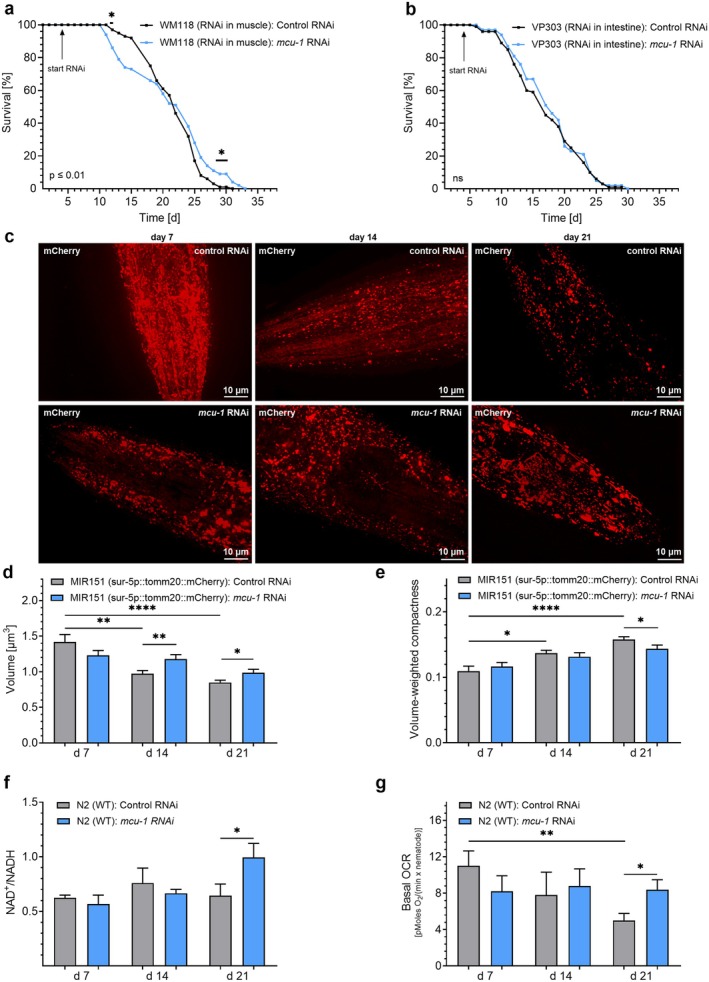
Next, we utilized the W118 strain to test whether muscle‐specific knockdown of mcu‐1 is sufficient to extend lifespan. Indeed, overall lifespan was found to be significantly increased by mcu‐1 RNAi in this strain (Figure 4a, Table 1), while no lifespan extension was found in the VP303 strain with specific mcu‐1 knockdown in the intestine (Figure 4b, Table 1). Since muscle function is strongly relying on mitochondrial function (Gan et al. 2018; Wu et al. 2023) and NRF2 activation has been linked to increased mitochondrial biogenesis (Kraft et al. 2006), we also investigated mitochondrial structure by confocal microscopy throughout aging and in response to mcu‐1 RNAi in the newly developed worm strain MIR151 expressing mCherry under the sur‐5 promotor in the mitochondrial matrix (Figure 4c). Mitochondrial volume (Figure 4d) and surface area (Figure S3) declined, while volume‐weighted compactness (Figure 4e) and volume‐weighted sphericity (Figure S3) increased during aging, indicating a shift toward smaller, more spherical mitochondria consistent with progressive mitochondrial fragmentation during aging. Knockdown of mcu‐1 mitigated these age‐related alterations, restoring normal mitochondrial morphology by day 21 (Figures 4d,e and S3). Notably, treatment with mcu‐1 RNAi mitigated these age‐associated structural changes, maintaining larger and more interconnected mitochondria at both day 14 and day 21 (Figures 4c and S3). Functionally, mcu‐1 RNAi‐treated N2 worms showed an improved NAD+/NADH ratio at day 21 (Figure 4f). Moreover, mcu‐1 RNAi caused an increase in basal oxygen consumption rate (OCR) in N2 nematodes at day 21, counteracting the age‐related decrease in OCR (Figure 4g).
These data suggest that reduced mitochondrial Ca2+ uptake not only preserves mitochondrial structure but also enhances mitochondrial function in late adulthood.
![RNAi‐inducedknockdown normalizes mitochondrial structure and function in aged nematodes. (a) Lifespan analyses of the WM118strain, allowing muscle‐specific RNAi knockdown, in the presence of control RNAi (L4440) (black) orRNAi (blue) ( = 3). (b) Lifespan analyses of the VP303strain, allowing intestine‐specific RNAi knockdown, in the presence of control RNAi (L4440) (black) orRNAi (blue) ( = 3). RNAi treatments are indicated by arrows labeled "start RNAi" and, when applicable, "stop RNAi" to mark the beginning and end of the treatment period. (c) Confocal microscopy picture showing the emission at 540 nm in nematodes of the MIR151 strain, expressing mCherry sensor fused to the mitochondrion targeting sequence (tomm‐20(AA1‐55)) under the ubiquitous sur‐5 promoter, after treatment with control RNAi (top panels) or RNAi against(bottom panels) on days 7 (left), 14 (middle), and 21 (right). Bar graphs represent (d) mitochondrial volume [μm] and (e) volume‐weighted compactness in the MIR151strain on days 7, 14, and 21, treated with control RNAi (gray) orRNAi (blue) ( = 4). (f) Bar graphs represent NAD/NADH + Hlevels in N2 nematodes on days 7, 14, and 21, treated with control RNAi (gray) orRNAi (blue) ( = 3). (g) Bar graphs show basal OCR assessed by the Seahorse XF Cell Mito stress assay in N2 nematodes on days 7, 14, and 21, treated with control RNAi (gray) orRNAi (blue) ( = 3).numbers are presented as biological replicates. For details, see Table . For comparing significant distributions between different groups in the lifespan assays, statistical calculations were carried out using the log‐rank test. If applicable, significant differences were assessed via one‐way ANOVA or unpaired‐test and presented as specificvalues (* ≤ 0.05, ** ≤ 0.01, **** ≤ 0.0001). mcu‐1 mcu‐1 n mcu‐1 n mcu‐1 mcu‐1 n mcu‐1 n mcu‐1 n N t p p p p C. elegans C. elegans C. elegans 3 + + 1](https://europepmc.org/articles/PMC12608091/bin/ACEL-24-e70247-g006.jpg "Click to view full size")
RNAi‐inducedknockdown normalizes mitochondrial structure and function in aged nematodes. (a) Lifespan analyses of the WM118strain, allowing muscle‐specific RNAi knockdown, in the presence of control RNAi (L4440) (black) orRNAi (blue) ( = 3). (b) Lifespan analyses of the VP303strain, allowing intestine‐specific RNAi knockdown, in the presence of control RNAi (L4440) (black) orRNAi (blue) ( = 3). RNAi treatments are indicated by arrows labeled "start RNAi" and, when applicable, "stop RNAi" to mark the beginning and end of the treatment period. (c) Confocal microscopy picture showing the emission at 540 nm in nematodes of the MIR151 strain, expressing mCherry sensor fused to the mitochondrion targeting sequence (tomm‐20(AA1‐55)) under the ubiquitous sur‐5 promoter, after treatment with control RNAi (top panels) or RNAi against(bottom panels) on days 7 (left), 14 (middle), and 21 (right). Bar graphs represent (d) mitochondrial volume [μm] and (e) volume‐weighted compactness in the MIR151strain on days 7, 14, and 21, treated with control RNAi (gray) orRNAi (blue) ( = 4). (f) Bar graphs represent NAD/NADH + Hlevels in N2 nematodes on days 7, 14, and 21, treated with control RNAi (gray) orRNAi (blue) ( = 3). (g) Bar graphs show basal OCR assessed by the Seahorse XF Cell Mito stress assay in N2 nematodes on days 7, 14, and 21, treated with control RNAi (gray) orRNAi (blue) ( = 3).numbers are presented as biological replicates. For details, see Table . For comparing significant distributions between different groups in the lifespan assays, statistical calculations were carried out using the log‐rank test. If applicable, significant differences were assessed via one‐way ANOVA or unpaired‐test and presented as specificvalues (* ≤ 0.05, ** ≤ 0.01, **** ≤ 0.0001). mcu‐1 mcu‐1 n mcu‐1 n mcu‐1 mcu‐1 n mcu‐1 n mcu‐1 n N t p p p p C. elegans C. elegans C. elegans 3 + + 1
Pharmacological Inhibition of theComplex MimicsKnockdown in Nematodes MCU MCU‐1
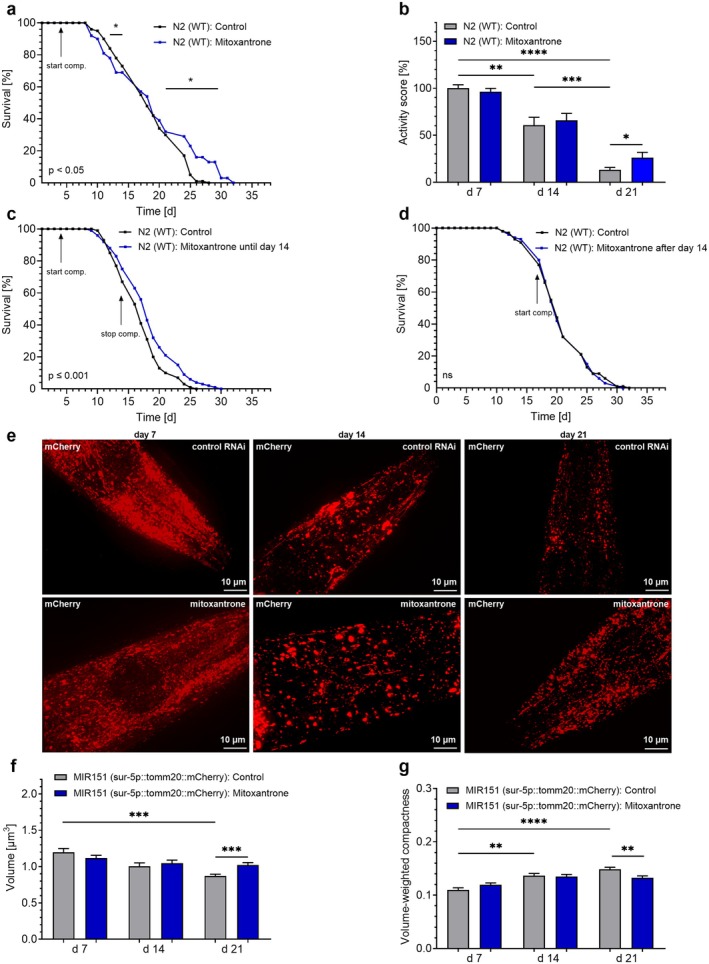
Given the FDA's approval for the use of the MCU inhibitor mitoxantrone in humans (Fox 2004), we used this compound to test whether a low dosage of mitoxantrone could replicate the effects of mcu‐1 RNAi. Treatment with 10 nM mitoxantrone reduced lifespan during middle age significantly (days 12–14) but extended the lifespan of surviving N2 worms (Figure 5a, Table 1) and improved motility in aged nematodes at day 21 (Figure 5b, Table 1), similar to the effects observed with mcu‐1 RNAi. Like mcu‐1 RNAi, mitoxantrone significantly extended the N2 nematodes' lifespan when administered until day 14 (Figure 5c, Table 1) but was ineffective when applied after day 14 (Figure 5d, Table 1). As for mcu‐1 knockdown worms, confocal microscopy of the MIR151 strain treated with dimethyl sulfoxide (DMSO) or mitoxantrone revealed that mitoxantrone increased mitochondrial volume (Figure 5f) and surface area (Figure S4), while decreasing volume‐weighted compactness (Figure 5g) and volume‐weighted sphericity (Figure S4) on day 21, indicating a shift toward more elongated and less spherical mitochondrial morphology.
These findings indicate that the FDA‐approved drug mitoxantrone, at low doses, may mimic the effects of mcu‐1 RNAi.

Pharmacological inhibition of MCU‐1 mimics the effects ofRNAi in nematodes. Lifespan analyses of N2 nematodes in the presence of DMSO (0.001%) (black) or mitoxantrone (10 nM) (blue) ( = 3). (b) Bar graphs (mean ± SEM) represent activity score (%), based on body bends per min, in N2 nematodes on days 7, 14, and 21 following the treatment with DMSO (0.001%) (black) or mitoxantrone (10 nM) (blue) ( = 3). (c) Lifespan analyses of N2 nematodes treated with DMSO (0.001%) (black) or mitoxantrone (10 nM) (blue) until day 14 ( = 3). (d) Lifespan analyses of N2 nematodes treated with DMSO (0.001%) (black) or mitoxantrone (10 nM) (blue) after day 14 ( = 3). Compound treatments are indicated by arrows labeled "start comp" and, when applicable, "stop comp" to mark the beginning and end of the treatment. (e) Confocal microscopy picture showing the emission at 540 nm in nematodes of the MIR151 strain, expressing mCherry sensor fused to the mitochondrion targeting sequence (tomm‐20(AA1‐55)) under ubiquitous sur‐5 promoter, after treatment with DMSO (0.001%) (top panels) or mitoxantrone (10 nM) (bottom panels) on days 7 (left), 14 (middle), and 21 (right). Bar graphs represent (f) mitochondrial volume (μm) and (g) volume‐weighted compactness in the MIR151strain on days 7, 14, and 21, treated with DMSO (0.001%) (gray) or mitoxantrone (10 nM) (blue) ( = 3). N‐numbers are presented as biological replicates. For details, see Table . For comparing significant distributions between different groups in the lifespan assays, statistical calculations were carried out using the log‐rank test. If applicable, significant differences were assessed via one‐way ANOVA or unpaired‐test and presented as specificvalues (* ≤ 0.05, ** ≤ 0.01, *** ≤ 0.001, **** ≤ 0.0001). mcu‐1 n n n n n t p p p p p 3 C. elegans 1
Reduced Mitochondrial CaUptake Induces Transient Oxidative Stress and Antioxidant Adaptation in‐1 Cells 2+ HFF
To assess the translatability of our findings from nematodes to mammalian cells, we measured organellar Ca2+ and H2O2 levels in HFF‐1 cells following short‐term (3 h) treatment with a low dose [100 nM] of mitoxantrone. Live‐cell imaging of HFF‐1 cells expressing the mitochondrial Ca2+ sensor mtD1GO (Figure 6a) demonstrated significantly reduced basal mitochondrial Ca2+ levels (Figure 6b) and decreased mitochondrial Ca2+ uptake in response to 100 μM histamine (Figure 6c) after 3 h of mitoxantrone treatment. As in nematodes, reduced mitochondrial Ca2+ uptake in HFF‐1 cells was accompanied by a significant reduction in the activity of complex I, II, and III, as well as of complex IV (Figures 6d and S5). Live‐cell imaging utilizing the mitochondrial Hyper7 sensor also revealed increased mitochondrial H2O2 levels in HFF‐1 cells after 3 h of mitoxantrone [100 nM] treatment (Figure 6e). Similar to findings in nematodes, mitoxantrone treatment induced a transient decline in cell survival, with significantly reduced viability observed 24 h after the 3 h treatment with 100 nM mitoxantrone (Figure 6f). Proliferation analyses revealed that although many cells underwent sustained growth arrest due to mitoxantrone treatment, a subset continued to divide (Figures 6g and S5). This heterogeneous response may reflect a limited adaptive capacity that enables survival and partial regrowth within the more resistant cell fraction. As a mitohormetic response is typically characterized by enhanced antioxidant defenses following transient stress, we next assessed the expression and activity of key antioxidant enzymes after exposure to mitoxantrone. Notably, mRNA levels of SOD2 (Figure 6h), SOD1 (Figure 6i), and CAT (Figure 6j) were significantly elevated at 24 h and increased further at 48 h posttreatment. Consistently, the enzymatic activity of SODs was significantly elevated only at 48 h (Figure 6k), whereas CAT activity increased as early as 24 h and remained elevated at 48 h (Figure 6l).
These findings indicate that impaired mitochondrial Ca2+ uptake triggers a transient rise in ROS levels, followed by an adaptive response characterized by upregulation of the cellular antioxidant defense system. Consequently, targeting mitochondrial Ca2+ uptake may represent a promising therapeutic strategy to enhance health and lifespan.
![Mitoxantrone‐induced mitochondrial Cadysregulation triggers adaptive antioxidant responses in HFF‐1 cells. Representative curves showing [Ca]levels in HFF‐1 cells expressing mtD1GO treated with DMSO (0.001%) (black) or mitoxantrone (100 nM) (blue) for 3 h, under basal conditions and after application of 100 μM histamine. (b) Bar graphs represent basal [Ca]levels in HFF‐1 cells treated with DMSO (0.001%) (control) or mitoxantrone (control = 25/3; mitoxantrone = 30/3). (c) Bar graphs represent [Ca]uptake in HFF‐1 cells treated with DMSO (0.001%) (control) or mitoxantrone (control = 25/3; mitoxantrone = 30/3). (d) Bar graphs (mean ± SEM) show specific flux per mass in isolated mitochondria of HFF‐1 cells treated with DMSO (0.001%) (gray) or mitoxantrone (100 nM) (blue) for 3 h. Vertical lines indicate additions of compounds, including pyruvate (5 mM) + malate (2 mM), adenosine diphosphate (ADP) + Mg(2.5 mM), cytochrome c (10 μM), glutamate (10 mM), succinate (10 mM), CCCP (0.5 μM), rotenone (0.5 μM), antimycin A (2.5 μM), ascorbate (2 mM) + TMPD (0.5 mM), and NaN(≥ 100 mM). (e) Bar graphs (mean ± SEM) represent mitochondrial HOproduction of HFF‐1 cells expressing HyPer in mitochondria, treated with DMSO (0.001%) (control) or mitoxantrone (100 nM) (control = 43/4; mitoxantrone = 40/4). (f) Bar graphs (mean ± SEM) show cell viability of HFF‐1 cells 24 h after treatment with DMSO (0.001%) (gray) or mitoxantrone (100 nM) (blue) ( = 4). (g) Proliferation rates (mean ± range) presented as percentage of confluency of cells within 72 h after treatment with DMSO (0.001%) (gray) or mitoxantrone (100 nM) (blue) ( = 5). Bar graphs (mean ± SEM) represent the relative expression levels of (h) SOD2, (i) SOD1, and (j) CAT in HFF‐1 cells before and 0 h, 24 h, and 48 h after treatment with DMSO (0.001%) (gray) and mitoxantrone (100 nM) (blue) ( = 4). Bar graphs represent enzymatic activity levels of (k) SODs and (l) CAT 24 h and 48 h after treatment with DMSO (0.001%) (gray) and mitoxantrone (100 nM) (blue) ( = 4). If applicable, significant differences were assessed via unpaired‐test and presented as specificvalues (* ≤ 0.05, ** ≤ 0.01, *** ≤ 0.001, **** ≤ 0.0001). 2+ 2+ 2+ 2+ 2+ mito mito mito 3 2 2 n n n n n n n n n n t p p p p p](https://europepmc.org/articles/PMC12608091/bin/ACEL-24-e70247-g005.jpg "Click to view full size")
Mitoxantrone‐induced mitochondrial Cadysregulation triggers adaptive antioxidant responses in HFF‐1 cells. Representative curves showing [Ca]levels in HFF‐1 cells expressing mtD1GO treated with DMSO (0.001%) (black) or mitoxantrone (100 nM) (blue) for 3 h, under basal conditions and after application of 100 μM histamine. (b) Bar graphs represent basal [Ca]levels in HFF‐1 cells treated with DMSO (0.001%) (control) or mitoxantrone (control = 25/3; mitoxantrone = 30/3). (c) Bar graphs represent [Ca]uptake in HFF‐1 cells treated with DMSO (0.001%) (control) or mitoxantrone (control = 25/3; mitoxantrone = 30/3). (d) Bar graphs (mean ± SEM) show specific flux per mass in isolated mitochondria of HFF‐1 cells treated with DMSO (0.001%) (gray) or mitoxantrone (100 nM) (blue) for 3 h. Vertical lines indicate additions of compounds, including pyruvate (5 mM) + malate (2 mM), adenosine diphosphate (ADP) + Mg(2.5 mM), cytochrome c (10 μM), glutamate (10 mM), succinate (10 mM), CCCP (0.5 μM), rotenone (0.5 μM), antimycin A (2.5 μM), ascorbate (2 mM) + TMPD (0.5 mM), and NaN(≥ 100 mM). (e) Bar graphs (mean ± SEM) represent mitochondrial HOproduction of HFF‐1 cells expressing HyPer in mitochondria, treated with DMSO (0.001%) (control) or mitoxantrone (100 nM) (control = 43/4; mitoxantrone = 40/4). (f) Bar graphs (mean ± SEM) show cell viability of HFF‐1 cells 24 h after treatment with DMSO (0.001%) (gray) or mitoxantrone (100 nM) (blue) ( = 4). (g) Proliferation rates (mean ± range) presented as percentage of confluency of cells within 72 h after treatment with DMSO (0.001%) (gray) or mitoxantrone (100 nM) (blue) ( = 5). Bar graphs (mean ± SEM) represent the relative expression levels of (h) SOD2, (i) SOD1, and (j) CAT in HFF‐1 cells before and 0 h, 24 h, and 48 h after treatment with DMSO (0.001%) (gray) and mitoxantrone (100 nM) (blue) ( = 4). Bar graphs represent enzymatic activity levels of (k) SODs and (l) CAT 24 h and 48 h after treatment with DMSO (0.001%) (gray) and mitoxantrone (100 nM) (blue) ( = 4). If applicable, significant differences were assessed via unpaired‐test and presented as specificvalues (* ≤ 0.05, ** ≤ 0.01, *** ≤ 0.001, **** ≤ 0.0001). 2+ 2+ 2+ 2+ 2+ mito mito mito 3 2 2 n n n n n n n n n n t p p p p p
Discussion
Our findings demonstrate that reducing mitochondrial Ca2+ uptake modestly via mcu‐1 RNAi extends lifespan and enhances motility in aged nematodes, despite impairing survival during early adulthood. This lifespan extension is linked to a transient increase in mitochondrial H2O2 levels, which initiates a signaling cascade involving pmk‐1 (p38 MAPK), daf‐16 (FOXO), and skn‐1 (NRF2). This pathway enhances antioxidant defense, mitigates oxidative stress, and preserves mitochondrial integrity during the aging process. Importantly, pharmacological inhibition of mitochondrial Ca2+ uptake with mitoxantrone mirrored the beneficial effects of mcu‐1 RNAi in nematodes and human HFF‐1 cells, further demonstrating the promising therapeutic potential of targeting mitochondrial Ca2+ regulation in aging and possibly in age‐related diseases.
A previous study using the mcu‐1(ju1154) mutant strain demonstrated that stable mcu‐1 deficiency extends lifespan and enhances motility up to day 13. This report suggested that inhibiting MCU‐1 function preserves muscle health during aging by mitigating age‐related mitochondrial Ca2+ accumulation and subsequent activation of mitophagy (Higashitani et al. 2023). While our experiments confirmed an age‐related mitochondrial Ca2+ increase, even until day 21 (Figure 1g), we observed a biphasic response to mcu‐1 RNAi during the lifespan of C. elegans, with reduced survival during middle age and extended lifespan (Figure 1a), accompanied by increased motility during old age (Figure 1b). Notably, we found that hampering mitochondrial Ca2+ uptake until day 14 is sufficient to provoke longevity (Figure 1c), while mcu‐1 RNAi treatment initiated only in old age failed to extend lifespan (Figure 1d). These results underscore the importance of adaptational mechanisms activated during middle age by transient mcu‐1 knockdown in driving longevity. The previously used mcu‐1(ju1154) mutant may have already acquired these mechanisms related to ROS defense due to long‐term adaptations, which could have contributed to enhanced motility during middle age (Higashitani et al. 2023).
Our data also revealed that mitochondrial Ca2+ uptake is associated with decreased activity of the PDH (Figure 2a) and the ETC (Figure 2b), which is the key site of ROS production (Madreiter‐Sokolowski et al. 2020). To obtain the large number of nematodes required for mitochondrial isolation in these assays, we switched from plate culture to liquid culture. We acknowledge that liquid culture conditions can introduce physiological differences (Hibshman et al. 2021; Laranjeiro et al. 2017). Therefore, all comparisons were made against control samples grown under the same liquid culture conditions to assess accurately the effects of impaired mitochondrial Ca2+ uptake.
While the exact species of ROS induced by mitochondrial Ca2+ uptake inhibition remains elusive due to a lack of appropriate methods (Griendling et al. 2016), a transient rise in H2O2 has been found in middle‐aged worms treated with mcu‐1 RNAi by Amplex Red assay (Figure 2c) and live‐cell imaging (Figure 2f). Prevention of mcu‐1 RNAi‐induced lifespan extension by the global ROS scavenger NAC (Figure 2g) and the mitochondria‐specific antioxidant MitoTEMPO (Figure 2h) further highlighted the crucial role of ROS in the lifespan extension provoked by mitochondrial Ca2+ uptake inhibition. Notably, NAC and MitoTEMPO scavenge different types of ROS. While NAC primarily scavenges H2O2 and hydroxyl radicals (Aruoma et al. 1989), MitoTEMPO specifically scavenges mitochondrial superoxide anions (McCarthy and Kenny 2016). Consequently, these findings suggest that multiple types of ROS may contribute to the lifespan extension induced by mitochondrial Ca2+ uptake inhibition. Given that H2O2 is the primary activator of p38 MAPK (Angeloni et al. 2011), other ROS likely influence p38 MAPK indirectly through their conversion to H2O2.
Over the past decade, the so‐called mitohormetic signaling, induced by transient ROS increases and linked to enhanced antioxidant defenses, has emerged as a key driver of longevity in different organisms (Ristow and Schmeisser 2014). In line with previously reported ROS‐induced signaling cascades, mitochondrial Ca2+ uptake inhibition‐induced longevity was also related to pmk‐1 (p38 MAPK) (Figure 3a) and the transcription factors daf‐16 (FOXO) (Figure 3b) and skn‐1 (NRF2) (Figure 3c), which were associated with enhanced antioxidant enzyme activity like sod‐2 (Figure 3d–f). Previous results also found that the induction of AMPK (aak‐2) and sirtuins (sir‐2.1) by inhibiting the ETC (Tian et al. 2021) is an essential part of ROS‐induced longevity signaling. Interestingly, lifespan extension induced by mcu‐1 knockdown was observed even in worms deficient in AMPK (aak‐2) or sirtuins (sir‐2.1) (Figure S2), suggesting that mitochondrial Ca2+ uptake inhibition does not increase cytosolic levels of AMP and NAD+ necessary to activate AMPK and sirtuins.
While ROS levels increased at day 14 in mcu‐1 knockdown nematodes, genes associated with DNA damage were not upregulated (Figure S2), suggesting that activation of the DNA damage response is not the primary cause of the observed reduction in early‐life survival (Figure 1a). We propose that the transient decrease in survival is more likely due to short‐term mitochondrial dysfunction, possibly involving redox imbalance and oxidation of critical proteins, rather than genotoxic stress. Interestingly, by day 21, DNA damage response genes were consistently downregulated in mcu‐1 knockdown nematodes compared to controls (Figure S2), potentially indicating improved genomic stability later in life. This may result from enhanced cellular stress resistance, in line with the concept of mitohormesis.
Confocal microscopy revealed that mcu‐1 RNAi (Figures 4c,e and S3), as well as mitoxantrone treatment (Figures 5e–g and S4), reverses age‐associated mitochondrial fragmentation, which was in line with enhanced mitochondrial functional activity in mcu‐1 knockdown nematodes (Figure 4f,g). These data align with previous findings suggesting improved mitochondrial structure due to mcu‐1 deficiency. However, as mentioned above, the beneficial effects were observed at an earlier stage in the mcu‐1 deficient strain (Higashitani et al. 2023), potentially due to previously acquired adaptive mechanisms.
The availability of compounds modulating mitochondrial Ca2+ uptake, including several substances targeting MCU (Wang et al. 2025) and MICU1 (Di Marco et al. 2020), underscores the feasibility of pharmacological interventions targeting mitochondrial Ca2+ homeostasis in humans. Mitoxantrone, for example, is even FDA‐approved for the treatment of specific cancer types and multiple sclerosis (Fox 2004). Nevertheless, its potential adverse effects necessitate careful evaluation before considering any application beyond established indications, such as in the context of aging research. Our findings suggest that mitoxantrone's potential as an antiaging drug may rely on much lower concentrations than those used in cancer therapy, which could also reduce potential side effects. A concentration of 10 nM mitoxantrone mimicked the effects of mcu‐1 RNAi in nematodes, causing a biphasic lifespan response (Figure 5a), enhanced motility in old age (Figure 5b), early‐age‐specific lifespan effects not observed with treatment initiated in old age (Figure 5c,d), as well as preservation of mitochondrial structure during old age (Figures 5e–g and S4). Based on previously reported results, 0.2 μM mitoxantrone has been shown to impair the proliferation of human cancer cells (Almeida et al. 2018), and a concentration of 10 μM has achieved half‐maximal inhibition of mitochondrial Ca2+ uptake (Arduino et al. 2017). However, our experiments showed that treating noncancerous HFF‐1 for 3 h with 100 nM mitoxantrone was sufficient to reduce basal mitochondrial Ca2+ levels and uptake (Figure 6a–c), block ETC complexes (Figure 6d), and increase ROS levels (Figure 6e). The temporal pattern observed in subsequent viability assays and experiments to assess antioxidant defense mechanisms suggests a heterogeneous cellular response to mitoxantrone‐induced stress. The marked decline in cell viability at 24 h (Figure 6f) likely reflects acute cytotoxic effects due to oxidative stress. While a substantial fraction of cells appeared to undergo sustained growth arrest, some cells retained limited proliferative potential (Figures 6g and S5). This effect is consistent with the dual pharmacological profile of mitoxantrone, which, in addition to inhibiting MCU activity, acts as a potent topoisomerase II inhibitor and DNA intercalator, leading to cell cycle arrest (Evison et al. 2016). The delayed upregulation of antioxidant defense enzymes (Figure 6h–j) may therefore represent an adaptive response in the more resistant cells, aimed at restoring redox balance and enabling partial regrowth despite the overall adverse impact of mitoxantrone. Interestingly, transcriptional induction of SOD2 (Figure 6h), SOD1 (Figure 6i), and CAT (Figure 6j) mRNA was already evident at 24 h, yet enzymatic activity followed distinct kinetics. SOD activity increased only after 48 h (Figure 6k), suggesting a time lag between transcriptional activation, protein synthesis, and maturation of functional enzymes. In contrast, CAT activity was significantly elevated as early as 24 h after treatment (Figure 6l), indicating that catalase may undergo rapid posttranslational activation. Given catalase's primary role in decomposing H2O2, its early activation could reflect an immediate need to detoxify excess H2O2 generated during the acute oxidative stress phase, whereas SOD activation becomes more prominent later to mitigate superoxide accumulation during recovery.
Importantly, the discrepancy between the beneficial effects observed in C. elegans and the partly adverse outcomes in human fibroblasts may, at least in part, also reflect the proliferative status of the cells: nematode somatic cells are largely postmitotic, whereas HFF‐1 cells are proliferative. Thus, mitoxantrone may exert more favorable effects in postmitotic contexts by modulating mitochondrial Ca2+ handling, while in proliferating cells, the predominant outcome for a significant fraction of cells is growth arrest due to topoisomerase II inhibition (Evison et al. 2016).
To effectively induce a mitohormetic response without side effects by inhibiting mitochondrial Ca2+ uptake in human cells, both the specificity of the compound and the timing of its application need to be carefully optimized. Specifically, compounds with minimal off‐target effects that selectively inhibit MCU are preferable. The cytotoxic effects of mitoxantrone due to its ability to inhibit topoisomerase II (Evison et al. 2016), for instance, limit its suitability as an antiaging compound that modulates mitochondrial Ca2+ handling. This underscores the need for identifying more specific MCU‐targeting agents—potentially derivatives of Ruthenium Red or novel small‐molecule inhibitors of the mitochondrial Ca2+ uptake machinery (Marta et al. 2021).
In summary, this study reveals that genetically and pharmacologically decreased mitochondrial Ca2+ uptake triggers a ROS‐mediated signaling cascade that preserves mitochondrial function and delays the onset of age‐related mitochondrial deterioration, which results in the longevity and enhanced motility of C. elegans. Given the parallels between nematode and mammalian Ca2+ and ROS homeostasis, as well as the partial translatability of viability results to human cells, our data highlight the therapeutic relevance of targeting mitochondrial Ca2+ uptake for preventing age‐related mitochondrial dysfunction and promoting healthy aging.
Methods
Nematode Strain and Culture Conditions
C. elegans strains were obtained from the Caenorhabditis Genetics Center (CGC, University of Minnesota, US). The strains used in the present study involved N2 wild type (Bristol), KU25 (pmk‐1/km25), GA184 (sod‐2/gk257), CF1038 (daf‐16/mu86), EU31 (skn‐1/zu135), Mir248 (aak‐2/ok524), Mir14 (sir‐2.1/ok434), JV1 (jrIs1 [rpl‐17p::HyPer + unc‐119(+)] stable transgene expressing YFP‐based hydrogen peroxide sensor HyPer under ribosomal promotor) (Back et al. 2012), VP303 (kbIs7 [nhx‐2p::rde‐1 + rol‐6(su1006)]. Rollers. RNAi effective only in intestine), WM118 (neIs9 [myo‐3::HA::rde‐1 + rol‐6(su1006)] X. Transgene rescues muscle RNAi defect. Rollers.), and JV2 (jrIs2 [rpl‐17p::Grx1‐roGFP2 + unc‐119(+)] stable transgene ubiquitously expressing the roGFP2 sensor under a ribosomal promoter for in vivo estimation of GSSG/GSH ratios) (Back et al. 2012).
MIR151 (risIs10[sur‐5p::tomm20(AA1‐55)::mCherry + unc119(+)]) expressing mitochondrial mCherry sensor was generated by microparticle bombardment of strain HT1593 (unc‐119(ed3) III) with a suitable expression vector (Grigolon et al. 2022). Briefly, the expression vector was generated by Gateway cloning using pENTRY‐sur‐5p, pENTRY‐tomm20(AA1‐55)::mCherry, and pDEST‐ZK001 (modified pDEST‐MB14, lacking GFP).
AQ3055 expressing mitochondrial‐targeted YC3.60 sensor as an extrachromosomal array on the pharynx under the myo‐2 promoter (pmyo‐2::2mt8::YC3.60) was a kind gift from Javier Alvarez (Alvarez‐Illera et al. 2017).
Nematodes were grown at 20°C on agar plates with nematode growth media (NGM) with high gel strength agar (SERVA, Germany), which was spotted with Escherichia coli (E. coli), using the OP50 strain to maintain the strains as described previously (Brenner 1974; Schulz et al. 2007).
and Compound Treatment RNAi
Nematodes were treated from day 4 on, after development. RNAi‐induced knockdown was performed as described (Oh et al. 2006). The HT115(DE3) E. coli strain transformed with the L4440 vector (empty vector) was used as a control, and the K02B2.3 vector with RNAi targeting mcu‐1 was used for RNAi treatment (Kamath and Ahringer 2003). Plates were supplemented with 1 mM isopropyl β‐D‐1‐thiogalactopyranoside (IPTG) (Roth, Austria) and ampicillin (100 mg/mL) (Roth, Austria) unless stated otherwise. The RNAi feeding protocol began on day 4 to avoid disrupting developmental processes (De‐Souza et al. 2019).
Compound treatment of nematodes was carried out on NGM agar plates containing mitoxantrone (10 nM) and control plates with the corresponding solvent, 0.001% DMSO (Roth, Austria) (Schmeisser et al. 2011). The antioxidants mitoTEMPO and NAC (Merck KGaA, Germany) were applied at a final concentrations of 100 nM and 1 mM, respectively (Zarse et al. 2012).
Lifespan Analysis
To obtain a synchronized nematode population, worms were allowed to lay eggs for 5 days at 20 C on agar plates and then removed with S‐buffer. Eggs were subsequently transferred to fresh NGM plates. After 4 days, 50 L4‐stage worms were manually placed on fresh NGM plates (50 worms/plate, three replicates per condition). Worms were transferred daily to new plates, and survival was monitored by counting live and dead animals. Assays were conducted at 20°C. When testing different strains, N2 worms served as controls. Statistical significance was assessed using the log‐rank test (Schulz et al. 2007).
Motility Assay
The motility of the worms was measured on days 7, 14, and 21 using a wMicrotracker device (NemaMetrix, US) (Statzer et al. 2022). For each condition, at least three wells of a 96‐well plate were prepared, each containing 15 worms suspended in 90 μL of S‐buffer. Motility was recorded for 2 h at 20°C using the wMicrotracker software. The results were expressed as the percentage of body bends per minute over a 1 h measurement, normalized to control worms on day 7.
‐ qRT PCR
Total RNA from C. elegans was extracted via S‐buffer washing, 3–4 freeze–thaw cycles (liquid nitrogen/37°C), and TRIzol (1 mL; Thermo Fisher) treatment. After adding 200 μL chloroform, samples were incubated (3 min) and centrifuged (120,000 rpm); the aqueous phase was collected, RNA precipitated with 500 μL isopropanol, centrifuged (10 min, 4°C), and the pellet resuspended in 25 μL RNase‐free water (Rio et al. 2010). RNA concentration was determined with a UviLine 9400 spectrophotometer (Schott). For cDNA synthesis, 1 μg RNA was reverse‐transcribed using the Applied Biosystems kit (Thermo Fisher) per the manufacturer's protocol. mRNA levels were measured via qRT‐PCR (QuantiFast SYBR Green; Qiagen). Act‐1 and HPRT1 (Qiagen, Cat No. QT0059066) were used as reference genes for nematode and human samples, respectively. Primers (see Table 2) were obtained from Invitrogen (Austria). qRT‐PCR was performed on a LightCycler 480 (Roche), and gene expression normalized to housekeeping genes and shown as relative expression.
| Name | Forward | Reverse |
|---|---|---|
| act‐1 | gctcttgccccatcaaccat | gccggactcgtcgtattctt |
| mcu‐1 | cacaacaacagcctcctcaa | ggcaaggctcatttcttgac |
| egl‐1 | caggacttctcctcgtgtgaagattc | gaagtcatcgcacattgctgcta |
| ced‐3 | tgaaacagatgccagagatgaca | cgaaagagaactgggggaga |
| SOD1 | ggcctgcatggattccatgttc | agtctccaacatgcctctcttc |
| SOD2 | cctcacatcaacgcgcagatca | cctcggtgacgttcaggttgt |
| CAT | cctatcctgacactcaccgcca | agttggccactcgagcacggta |
Quantification of HO 2 2
H2O2 levels were determined by the Amplex Red assay kit (Thermo Fisher Scientific, Austria), as described (Thomas et al. 2023). Synchronized and appropriately treated nematodes were incubated with 100 μM Amplex Red (Invitrogen, Carlsbad, USA) and 0.2 U/mL horseradish peroxidase in a sodium‐phosphate buffer for 3 h. Fluorescence was then measured using a CLARIOstar microplate reader (BMG Labtech, Germany). The results were normalized to protein content using the Pierce BCA protein assay (Thermo Fisher Scientific, Austria).
Basal Oxygen Consumption Rate () OCR
Synchronized nematodes were diluted in M9 buffer, anesthetized with 25 μM tetramisole hydrochloride, and plated in Seahorse XF24 culture plates with approximately 40 worms per well before measuring basal OCR as described (Thomas et al. 2023).
Confocal Microscopy to Assess Mitochondrial Morphology and Glutathione Levels
Nematodes were anesthetized with 5 mM levamisole in S‐buffer on empty NGM plates, then immobilized on 0.05 μm Polybead‐coated slides under a 5% agar pad. Imaging was performed on a Nikon Eclipse Ti2 microscope with a 100×/1.45 NA oil objective, standard filters, and dual Kinetix CMOS cameras (PhotoMetrics, US). Mitochondrial imaging used the MIR151 strain (mitochondrial mCherry; HT1593 background). Excitation was at 435 nm (Celesta Light Engine; Lumencor, US); emission was collected at 501–521 nm. Images (2 × 2 binning, 500 ms exposure, 0.2 μm Z‐steps) were acquired at days 7, 14, and 21 of adulthood (10 worms/condition, 5 replicates). Images were blind deconvoluted, and mitochondrial morphology was analyzed with a custom ImageJ macro. Background subtraction (rolling ball) and global/local Otsu thresholding enabled segmentation. Subsequently, the 3D ImageJ Suite plugins (Ollion et al. 2013) were used to assess mitochondrial volume, surface area, compactness, and sphericity (Gottschalk et al. 2019).
To determine GSSG/GSH ratios, the JV2 nematode strain (jrIs2[Prpl‐17p::Grx1‐roGFP2+ unc‐119(+)]) expressing the Grx1‐roGFP2 biosensor under a ribosomal promoter was used. Measurements were performed using the Nikon Eclipse Ti2 microscope with the same optical setup. Excitation was provided by 400 nm and 475 nm laser light (Celesta, Light Engine; Lumencor, US), and emission was collected at 501–521 nm. Fluorescence signals were background‐subtracted using a defined region of interest (ROI), corrected for photobleaching via exponential decay fitting, and presented as F475/F400 (Tawfik et al. 2022).
Live‐Cell Imaging to Determine Mitochondrial Caand CytosolicLevels in Nematodes 2+ HO 2 2
To image the mitochondrial Ca2+ sensor YC3.60, the AQ3055 strain was analyzed using an inverted Olympus IX73 microscope (Olympus, Austria) equipped with a UPlanSApo 40×/1.25 silicon objective (Olympus, Austria), a CCD QImaging Retiga R1 camera (PhotoMetrics, US), and a LedHUB illumination system (Omicron‐Laserage Laserprodukte, Rodgau‐Dudenhof, Germany) with a 455/505 nm LED and a CFP/YFP filter set (Olympus, Austria). For FRET measurements, emission was split into two channels using a dual‐channel beam splitter DV2 (PhotoMetrics, US) and a CFP/YFP beamsplitter (505DCXR, Chroma Technologies, Bellows Falls, VT, USA). Basal mitochondrial Ca2+ levels were measured in S‐buffer for 2 min, followed by mitochondrial Ca2+ uptake assessment upon caffeine [15 mM] application. Data were background‐subtracted using a defined region of interest, corrected for photobleaching using an exponential decay fit, and presented as F535/F480.
Cytosolic H2O2 levels were measured in the JV1 strain (jrIs1 [rpl‐17p::HyPer + unc‐119(+)]) on day 14. Imaging was performed using the same Olympus IX73 microscope setup with a UPlanSApo 40×/1.25 silicon objective, CCD QImaging Retiga R1 camera, and a LedHUB illumination system equipped with a 455/505 nm LED and a CFP/YFP filter set. Excitation was achieved with either 455 nm or 505 nm, and emission was collected at 501–521 nm. Background subtraction was applied using a defined ROI, and bleaching correction was performed using an exponential decay fit. H2O2 measurement results are expressed as F505/F455 (Brugger et al. 2023).
Culturing, Seeding, and Treatment of Human Foreskin Fibroblasts‐1 HFF
Human diploid fibroblasts (HFF‐1; ATCC SCRC‐1041) were cultured in DMEM (D5546; Sigma, Germany) with 10% heat‐inactivated FBS, 4 mM L‐glutamine, and 1% penicillin–streptomycin (Thermo Fisher, Austria) at 37°C, 5% CO2. Cells (passages 2–15) were passaged using 0.05% trypsin–EDTA, centrifuged (1500 rpm), counted in a Neubauer chamber, and seeded at the desired density (Cavinato et al. 2021). Mitoxantrone dihydrochloride (Merck, Germany) was prepared as a 10 mM DMSO stock. Cells were treated with 100 nM mitoxantrone [0.001% DMSO] or DMSO control for 3 h before measurements.
Cell Viability Analysis of‐1 Cells HFF
Cell viability was measured with the fluorometric CellTiter‐Blue Cell Viability Assay (Promega, Austria), which is based on the resazurin reduction method (Chen et al. 2018). HFF‐1 cells were seeded at a density of 3200 cells per well in flat‐bottom 96‐well plates. The cells were treated for 3 h with 100 nM mitoxantrone or DMSO as a control. Afterwards, the cells were washed two times with phosphate‐buffered saline (PBS), and 100 μL fresh media was added to each well. For the assay, 20 μL of CellTiter‐Blue reagent was added to four technical repeats of four different passages of either condition, 24 h or 48 h postmitoxantrone incubation. Following a 30‐min incubation at 37°C, fluorescence (excitation at 560 nm/emission at 590 nm) was measured, and cell viability was normalized to the respective control.
Proliferation Analysis of‐1 Cells HFF
Cell proliferation of fibroblasts was monitored using the CellCyte X—Live Cell Imager and Analyzer (Cytena GmbH, Germany) (Kalinova et al. 2025). HFF‐1 were seeded at a density of 40,000 cells per well in 12‐well plates. The cells were treated for 3 h with 100 nM mitoxantrone or DMSO as a control. Afterwards, the cells were washed twice with PBS, and 2 mL of fresh media was added to each well. Subsequently, the plates were placed into the CellCyte X—Live Cell Imager and Analyzer within an incubator (37°C, 5% CO2). Enhanced contour pictures of the fibroblasts were taken every 6 h, and the confluency was analyzed with the CellCyte Studio Software (Cytena GmbH, Germany).
Measurements of Mitochondrial Caand Mitochondrialin‐1 Cells 2+ HO 2 2 HFF
For live‐cell imaging, cells were seeded on 30 mm glass coverslips in 6‐well plates. Transfection with 0.5 μg mitoHyPer7 plasmid (Pak et al. 2020) and 3 μL Polyjet (SignaGen, US) in 1 mL serum−/antibiotic‐free medium was performed 2 days before imaging. To normalize maximal mitochondrial H2O2 levels, 150 μM H2O2 was added at the end of each measurement. Imaging was performed on a Nikon Eclipse Ti2 microscope (Nikon, Austria) with a 100×/1.45 NA oil objective, standard filters, and two Kinetix CMOS cameras (PhotoMetrics, US). Excitation was at 400 nm or 475 nm (Celesta Light Engine; Lumencor, US), and emission was collected at 501–521 nm. Data were background‐subtracted using a ROI and bleaching‐corrected via exponential decay fitting. H2O2 levels are shown as F475/F400 (Tawfik et al. 2022).
To assess mitochondrial Ca2+ levels, HFF‐1 were transfected via viral transduction with the FRET‐based mitochondrial Ca2+ sensor mtD1GO‐Cam (Waldeck‐Weiermair et al. 2012). After 2 days, the basal Ca2+ level and the response upon histamine stimulation were assessed on an inverted wide‐field microscope (Observer.A1; Carl Zeiss GmbH, Austria) as described previously (Waldeck‐Weiermair et al. 2012). Emission was collected with a 505dcxr beamsplitter on two sides of the camera (CCD camera, Coolsnap Dyno; PhotoMetrics, US). The biosensor mtD1Go‐Cam was excited with a wavelength of 477 nm (440AF21; Omega Optical, US), and emission was captured at 560 and 510 nm (480AF30 and 535AF26; Omega Optical, US). Results are shown as F560/F510.
Activity Assays of Antioxidant Defense Enzymes
HFF‐1 cells (100,000/well) were seeded in 6‐well plates and treated for 3 h with 100 nM mitoxantrone or DMSO (control). After two PBS washes, 2 mL fresh medium was added. At 24 h and 48 h posttreatment, cells were washed with ice‐cold PBS, scraped, and centrifuged (4 C, 2000 rpm, 8 min). Pellets were resuspended in 150 μL cold lysis buffer (50 mM potassium phosphate, 0.1 mM EDTA, 0.5% Triton X‐100), subjected to two freeze–thaw cycles, and centrifuged (12,000 rcf, 5 min, 4°C). Protein concentration was determined using the Pierce BCA Protein Assay Kit (Thermo Fisher). For SOD (MAK528) and catalase (219265) activity assays (Sigma‐Aldrich, Austria), 6 μg protein was used per reaction. Activities were measured according to the manufacturer's instructions, calculated via standard curves, and normalized to controls.
Mitochondrial Isolation
Nematodes were harvested from S‐buffer liquid culture on day 7, following treatment from day 4 with 25 μM 5‐fluorodeoxyuridine, 1 mM IPTG, and 100 μg/mL ampicillin (Roth, Austria), and the respective bacteria.
Worm pellets were resuspended in 5 mL IMBc buffer (200 mM sucrose, 10 mM Tris/MOPS, 10 mM EGTA/Tris, pH 7.4) and homogenized by passing them six times through an Isobiotec cell homogenizer (12 μm clearance; Isobiotec, Germany) using a 5 mL syringe. After centrifugation at 600 × g (15 min, 4°C) to remove debris, the supernatant was spun twice at 9000 × g (15 min, 4°C). The resulting mitochondrial pellet was resuspended in 100 μL IMBc for PDH assays or 300 μL MIR05 for respirometry (Sladowska et al. 2021).
HFF‐1 mitochondria were isolated in a similar manner. Cells were detached with 0.05% trypsin–EDTA, resuspended in 1 mL IMBc, and homogenized using the Isobiotec cell homogenizer with 6 μm clearance.
Assay PDH
A commercially available activity kit (ab109902; Abcam, US) was used to determine the PDH activity of isolated mitochondria from nematode samples. PDH was immunocaptured within the wells of a microplate, and the activity was determined by the reduction of NAD+ to NADH + H+, coupled to a reporter dye, which was measured at an absorbance of 450 nm. The protein concentration was determined by a BCA protein assay. Each sample was adjusted to 100 μg of protein per well. The assay is reflecting in a kinetic mode for 1 h. The rate (ΔmOD/min) was then calculated by using the following formula: Rate (mOD/min) = (Absorbance 2‐ Absorbance 1) / time (min) (Shimada et al. 2022).
Respirometry
Isolated mitochondria (50–100 μg) from nematodes and HFF‐1 cells were resuspended in 300 μL MIR05 respiration medium and added to an Oxygraph‐2 k respirometer chamber (Oroboros, Austria), prefilled with MIR05 at 20°C. Respiration was assessed using the SUIT‐008 protocol. Complex I activity was stimulated with 5 mM pyruvate, 2 mM malate, 2.5 mM ADP, and Mg2+. Membrane integrity was tested with 10 μM cytochrome c. Complex II was assessed after 0.05 μM rotenone inhibition using 10 mM glutamate and 10 mM succinate. Maximal respiration was induced with 0.5 μM CCCP. Complex IV activity was analyzed after inhibiting complexes I and III (0.5 μM rotenone, 2.5 μM antimycin A), using 2 mM ascorbate and 0.5 mM tetramethyl phenylenediamine (TMPD), followed by inhibition with 50 mM NaN3. O2 flux was normalized to protein content and analyzed using DatLab 7 (Oroboros) (Sladowska et al. 2021).
Statistical Analyses
Data were processed in Excel 2010 and analyzed using GraphPad Prism 9.3.1. Results are shown as mean ± SEM from at least three independent experiments. Two‐tailed Student's t‐tests were used for pairwise comparisons and one‐way ANOVA for multiple groups. For comparing significant distributions between different groups in the lifespan assays, statistical calculations were carried out using the log‐rank test. Nematode sample sizes are listed in Table 1. Cell sample sizes from live‐cell imaging are noted in the respective Figure's legend, providing the number of total cells measured and the number of independent experiments. Significance was set at *p ≤ 0.05, **p ≤ 0.01, ***p ≤ 0.001, and ****p ≤ 0.0001.
Author Contributions
All authors participated in analyzing and interpreting the data. C.T.M.‐S. and D.B. designed the experiments. D.B., I.T., L.W., S.L., and F.M. performed lifespan assays. D.B., M.H., S.G., and K.K. performed live‐cell imaging experiments. J.O. performed qRT‐PCRs. K.Z. and M.R. established the novel worm strain MIR151. D.B. performed all other experiments. K.Z., M.R., E.M., M.H., and M.S. consolidated experimental procedures and edited the manuscript. C.T.M.‐S. supervised the project and wrote the manuscript in consultation with the other authors.
Conflicts of Interest
The authors declare no conflicts of interest.
 Longevity & Aging