Approximately 75% of the human genome is transcribed into various RNAs, yet less than 5% of these sequences encode proteins. The majority of genomic DNA is transcribed into non-coding RNAs (ncRNAs) Chen and Kim 2024. ncRNAs represent a highly complex family of molecules that are deeply integrated into regulatory networks and play crucial roles in diverse cellular processes. Their expression is disease-, tissue-, and cell-type-specific, making them attractive candidates for targeted therapies and personalized medicine Chen and Kim 2024.
Among ncRNAs, long non-coding RNAs (lncRNAs) constitute a major class, defined as transcripts longer than 200 nucleotides, and account for 80%–90% of all ncRNAs Statello et al., 2021. Although lncRNAs generally lack protein-coding capacity due to the absence of a valid open reading frame, their splicing processes resemble those of messenger RNAs (mRNAs) Statello et al., 2021. Compared with other ncRNAs, lncRNAs exhibit greater diversity in biogenesis, molecular function, and cellular impact, which has made them a central focus of both basic and translational research Statello et al., 2021. Their expression specificity provides opportunities for precise therapeutic targeting and prognostic evaluation; however, their relatively low sequence conservation and expression abundance compared with mRNAs pose challenges for detection, quantification, and functional characterization in disease contexts Coan et al., 2024.
Functional studies of lncRNAs currently rely heavily on multi-omics approaches (such as RNA sequencing and transcriptome microarrays) as well as perturbation-based strategies for target discovery Coan et al., 2024. Among these, direct perturbation of lncRNA expression or activity remains the most informative, as it enables a clear evaluation of their roles in cellular phenotypes Coan et al., 2024. RNA interference (RNAi) was once widely used for such purposes, but due to high costs, annotation issues, and limited scalability, it has been applied only in a small number of systematic screens Coan et al., 2024. More recently, CRISPR-based technologies—including CRISPR knockout, CRISPR interference (CRISPRi), and CRISPR activation (CRISPRa)—have been adopted for lncRNA screening, filling critical gaps in the field. These methods enable transient, reversible, and direct regulation of lncRNA expression, allowing efficient high-throughput functional identification Coan et al., 2024. However, the DNA-targeting nature of CRISPR-Cas9 limits its ability to effectively disrupt lncRNAs with a single guide RNA. Complete knockout often requires dual sgRNAs to induce large genomic deletions or the generation of homozygous knockout cell lines via monoclonal screening. This process is inefficient, prone to off-target effects, and may inadvertently disrupt adjacent or overlapping protein-coding genes Coan et al., 2024.
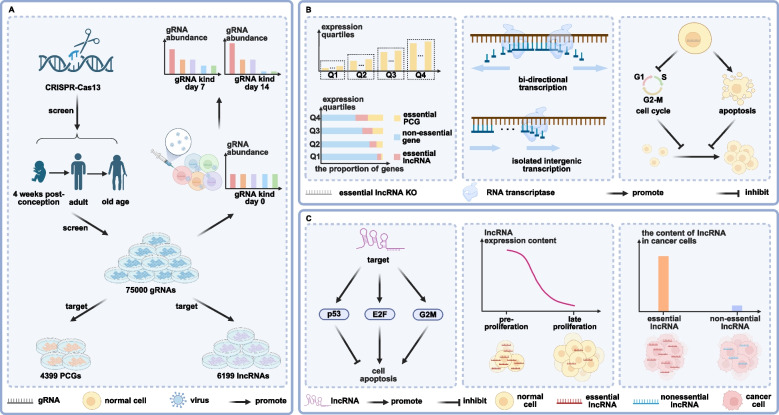
To overcome these challenges, Neville E. Sanjana's team developed CaRPool-seq (Cas13 RNA Perturb-seq), a transcriptome-scale CRISPR screening platform based on CRISPR-Cas13 Liang et al., 2024. Unlike Cas9, Cas13 targets RNA directly, enabling specific guide RNAs (gRNAs) to bind and silence lncRNAs at the transcript level. This approach minimizes nonspecific DNA editing, reduces off-target interference, and enhances the precision of functional ncRNA discovery.
To further explore the spatiotemporal roles of lncRNAs, the team integrated CaRPool-seq with single-cell transcriptome analysis (Fig. 1B). This revealed that depletion of essential lncRNAs impaired cell-cycle progression and promoted apoptosis. Gene set enrichment analysis (GSEA) indicated strong associations with pathways governing proliferation, including MYC, mTOR, and p53, independent of PCG regulation. Many essential lncRNAs also exhibited dynamic developmental expression patterns (Fig. 1C): highly expressed during early embryogenesis, then downregulated over time, with notable enrichment in proliferative tissues such as brain, heart, liver, and kidney. Analysis of ~ 9,000 tumor transcriptomes further revealed aberrant lncRNA expression signatures in cancers, co-expression with oncogenic drivers, and correlations with patient survival outcomes.
This study marks a significant advance in lncRNA biology by demonstrating that transcriptome-scale, RNA-targeting CRISPR-Cas13 screens can identify essential lncRNAs with high precision. Beyond lncRNAs, this approach can be extended to other ncRNAs, including microRNAs and circular RNAs. Nonetheless, challenges remain: the structural complexity of lncRNAs complicates gRNA design; current libraries lack full transcriptome coverage; and downstream validation in disease-relevant models is still needed. Future progress will depend on more sophisticated bioinformatics tools—potentially integrating artificial intelligence with RNA structural modeling—to optimize gRNA design, reduce off-target effects, and enhance scalability.
In summary, this study reveals the indispensable roles of lncRNAs in cellular survival and development, highlights their disease relevance, and provides a powerful RNA-focused CRISPR-Cas13 platform for functional genomics. With continued improvements in screening technologies and expanded clinical validation, these advances may accelerate the translation of lncRNA research into precision diagnostics and therapies.