
What this is
- This research investigates the link between and new-onset .
- It analyzes data from a large healthcare database involving over 127 million patients.
- The study compares risks of developing among vaccinated and unvaccinated individuals with .
Essence
- Unvaccinated individuals with have an increased risk of developing new-onset , particularly anterior , while vaccinated individuals show no increased risk.
Key takeaways
- Unvaccinated patients have a 2.01× higher risk of developing any at 1 year compared to unvaccinated patients without .
- The risk of anterior is notably elevated in unvaccinated patients, with a 1.96× higher risk at 1 year.
- Vaccinated individuals with do not have an increased risk of compared to vaccinated individuals without .
Caveats
- The study does not establish causation between and development, only an association.
- Differences in baseline risk factors between cohorts may not have been fully accounted for, limiting comparative conclusions.
Definitions
- uveitis: Pathological inflammation of the uveal tract in the eye, which includes the iris, ciliary body, and choroid.
- long COVID: Continuation or development of new symptoms at least three months after initial COVID-19 diagnosis.
Simplified
Introduction
Uveitis refers to the pathological inflammation of the uveal tract, consisting of the iris, ciliary body and choroid [1]. The etiology of uveitis is often not clear, with estimates ranging from 30%−89% of new uveitis diagnoses being classified as idiopathic/undifferentiated [2 –4]. Nonetheless, of its known associations, a common thread in affected patients is an underlying, persistent dysregulation of the immune system. This can be noted by the marked association of uveitis with HLA-B27-associated systemic diagnoses, uveitis following the reactivation of latent infections, and uveitis following abrupt CD4 + cell count recovery [5 –8]. Currently, acute COVID-19 infection has been implicated as a risk factor for the development of both new-onset and recurrent bouts of uveitis [9].
Long COVID (also termed "post-acute sequelae of COVID-19") is defined by the World Health Organization as the continuation or development of new symptoms three months following an initial SARS-CoV-2 diagnosis, with symptoms lasting for at least 2 months [10]. Long COVID has been associated with long-term perturbations of the immune system including reduced CD4 + and CD8 + effector T-cell counts, and abnormal long-term elevations in pro-inflammatory mediators [11 –13].
The role of COVID-19 vaccination in developing new or recurrent uveitis has been analyzed. Several reports have posited associations between COVID-19 vaccination and the development of new or recurrent uveitis [14 –18]. However, a recent report by Kim et al. found no increased risk of uveitis in vaccine recipients [19]. Thus, conflicting reports make it difficult to characterize the exact role of COVID-19 vaccination in the subsequent development of uveitis.
Given the underlying immune dysregulation associated with long COVID, we sought to analyze the association between long COVID and the development of new-onset uveitis. Furthermore, we also sought to separately characterize this relationship amongst vaccinated individuals and unvaccinated individuals.
Methods
Standard protocol approvals and principles
The University of Arkansas for Medical Sciences Institutional Review Board exempted this study due to the de-identified nature of the collected data. This study adhered to the principles of the Declaration of Helinski (version 2013).
Study design
We conducted a population-based retrospective cohort study using TriNetX, an aggregate healthcare database of over 127 million deidentified patients spanning across 95 healthcare institutions. We accessed data from the TriNetX's COVID-19 Research network on May 17, 2024. To conduct our research queries, we employed codes from the International Classification of Diseases, 10th Revision (ICD-10).
Participants, cohorts, and propensity score matching
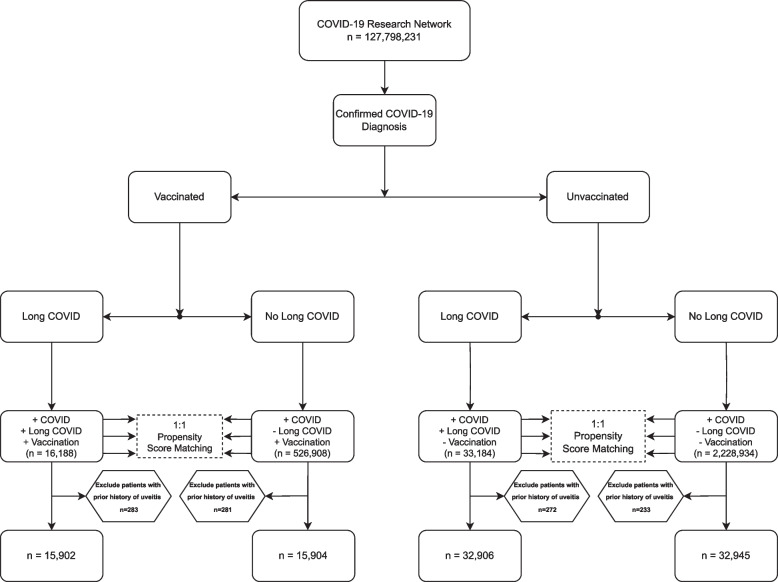
We identified all patients 18 years and older who had undergone COVID-19 testing from between 03/01/2021 to 03/01/2023. COVID-19 diagnosis was confirmed via positive ribonucleic acid (RNA) COVID-19 test result or confirmed clinical diagnosis of COVID-19 (ICD-10: U07.1). Amongst these COVID-19 positive patients, we identified those who went on to develop long COVID using a published approach by the FDA Sentinel Initiative on strategy for the identification of patients with long COVID on TriNetX (ICD-10: B94.8 or U09.9) [20]. Furthermore, we also identified if patients had ever received a vaccination against COVID-19. Amongst our vaccinated study population, patients were only designated as "vaccinated" if they received at least one dose a minimum of one month before their diagnosis of COVID-19, to allow a buffer time in recipients for vaccines to take effect. We excluded patients who received unspecified COVID vaccinations (CVX: 213).

Cohort design, characteristics, and comparisons of COVID-19 positive, patients stratified by long COVID diagnosis and vaccination status
| Before Matching | After Matching | |||||||
| Baseline Patient Characteristics | Unvaccinated, Long COVID( = 33,184)n | Unvaccinated, no Long COVID( = 2,228,934)n | Std Diff | -ValueP | Unvaccinated, Long COVID( = 33,178)n | Unvaccinated, no Long COVID( = 33,178)n | Std. Diff | -ValueP |
| Age, mean (SD) | 54.5 (16.8) | 48.5 (19.5) | 0.329 | < 0.001 | 54.5 (16.8) | 54.5 (16.9) | 0.002 | 0.801 |
| Sex, No. (%) | ||||||||
| Female | 20,459 (61.6) | 1,244,283 (55.8) | 0.119 | < 0.001 | 20,457 (61.7) | 20,464 (61.7) | < 0.001 | 0.955 |
| Male | 10,740 (32.4) | 912,895 (41.0) | 0.179 | < 0.001 | 10,739 (32.4) | 10,738 (32.4) | < 0.001 | 0.993 |
| Not Reported | 1985 (6.0) | 71,756 (3.2) | 0.132 | < 0.001 | 1982 (6.0) | 1976 (6.0) | 0.001 | 0.922 |
| Race, No. (%) | ||||||||
| White | 22,783 (68.7) | 1,316,469 (59.1) | 0.201 | < 0.001 | 22,780 (68.7) | 22,911 (69.1) | 0.009 | 0.272 |
| Black or African American | 3461 (10.4) | 321,367 (14.4) | 0.121 | < 0.001 | 3461 (10.4) | 3423 (10.3) | 0.004 | 0.629 |
| Asian | 1022 (3.1) | 63,787 (2.9) | 0.013 | 0.018 | 1022 (3.1) | 1007 (3.0) | 0.003 | 0.735 |
| Native Hawaiian or Other Pacific Islander | 289 (0.9) | 14,012 (0.6) | 0.028 | < 0.001 | 289 (0.9) | 282 (0.9) | 0.002 | 0.769 |
| American Indian or Alaska Native | 162 (0.5) | 8377 (0.4) | 0.017 | < 0.001 | 162 (0.5) | 163 (0.5) | < 0.001 | 0.956 |
| Other Race | 1170 (3.5) | 97,928 (4.4) | 0.045 | < 0.001 | 1170 (3.5) | 1136 (3.4) | 0.006 | 0.471 |
| Unknown Race | 4297 (13.0) | 406,994 (18.3) | 0.147 | < 0.001 | 4294 (12.9) | 4256 (12.8) | 0.003 | 0.66 |
| Ethnicity, No. (%) | ||||||||
| Hispanic or Latino | 2297 (6.9) | 182,724 (8.2) | 0.048 | < 0.001 | 2297 (6.9) | 2255 (6.8) | 0.005 | 0.519 |
| Not Hispanic or Latino | 24,863 (74.9) | 1,377,741 (61.8) | 0.285 | < 0.001 | 24,860 (74.9) | 24,962 (75.2) | 0.007 | 0.36 |
| Unknown Ethnicity | 6024 (18.2) | 668,469 (30.0) | 0.28 | < 0.001 | 6021 (18.2) | 5961 (17.8) | 0.005 | 0.545 |
| Comorbidities and Risk Factors | Unvaccinated, Long COVID( = 33,184)n | Unvaccinated, no Long COVID( = 2,228,934)n | Std Diff | -ValueP | Unvaccinated, Long COVID( = 33,178)n | Unvaccinated, no Long COVID( = 33,178)n | Std. Diff | -ValueP |
| Overweight and obesity [E66] | 13,009 (39.2) | 369,862 (16.6) | 0.521 | < 0.001 | 13,003 (39.2) | 13,111 (39.5) | 0.007 | 0.391 |
| Diabetes mellitus [E08-E13] | 8902 (26.8) | 293,058 (13.2) | 0.347 | < 0.001 | 8898 (26.8) | 9004 (27.1) | 0.007 | 0.354 |
| Tobacco use [Z72.0] | 3606 (10.9) | 129,322 (5.8) | 0.184 | < 0.001 | 3603 (10.9) | 3708 (11.2) | 0.01 | 0.193 |
| Other disorders of cartilage [M94] | 2847 (8.6) | 72,930 (3.3) | 0.226 | < 0.001 | 2844 (8.6) | 2834 (8.5) | 0.001 | 0.89 |
| Systemic connective tissue disorders [M30-36] | 2743 (8.3) | 58,693 (2.6) | 0.25 | < 0.001 | 2737 (8.3) | 2678 (8.1) | 0.006 | 0.403 |
| Other rheumatoid arthritis [M06] | 1675 (5.1) | 37,944 (1.7) | 0.186 | < 0.001 | 1670 (5.0) | 1521 (4.6) | 0.021 | 0.007 |
| Other thrombophilia [D68.6] | 594 (1.8) | 9091 (0.4) | 0.133 | < 0.001 | 591 (1.8) | 531 (1.6) | 0.014 | 0.071 |
| Unspecified inflammatory spondylopathy [M46.9] | 543 (1.6) | 10,881 (0.5) | 0.112 | < 0.001 | 539 (1.6) | 501 (1.5) | 0.009 | 0.235 |
| Rheumatoid arthritis with rheumatoid factor [M05] | 460 (1.4) | 9526 (0.4) | 0.101 | < 0.001 | 458 (1.4) | 377 (1.1) | 0.022 | 0.005 |
| Sarcoidosis [D86] | 277 (0.8) | 6785 (0.3) | 0.071 | < 0.001 | 277 (0.8) | 253 (0.8) | 0.008 | 0.295 |
| Ankylosing spondylitis [M45] | 186 (0.6) | 3558 (0.2) | 0.067 | < 0.001 | 182 (0.6) | 153 (0.5) | 0.012 | 0.112 |
| Juvenile arthritis [M08] | 81 (0.2) | 1530 (0.1) | 0.044 | < 0.001 | 77 (0.2) | 60 (0.2) | 0.011 | 0.146 |
| Reiter's disease [M02.3] | 50 (0.2) | 705 (0.0) | 0.039 | < 0.001 | 49 (0.2) | 34 (0.1) | 0.013 | 0.099 |
| Enteropathic arthropathies [M07] | 24 (0.1) | 452 (0.0) | 0.024 | < 0.001 | 24 (0.1) | 19 (0.1) | 0.006 | 0.446 |
| Other reactive arthropathies [M02.8] | 10 (0.0) | 54 (0.0) | 0.022 | < 0.001 | 10 (0.0) | 0 (0.0) | 0.025 | 0.002 |
| Reactive arthropathy, unspecified [M02.9] | 10 (0.0) | 171 (0.0) | 0.016 | < 0.001 | 10 (0.0) | 10 (0.0) | < 0.001 | 1 |
| Relapsing polychondritis [M94.1] | 10 (0.0) | 150 (0.0) | 0.017 | < 0.001 | 10 (0.0) | 10 (0.0) | < 0.001 | 1 |
| Before Matching | After Matching | |||||||
| Uveitis Outcomes (1 year) | Unvaccinated, Long COVID( = 33,184)n | Absolute Risk (%) | Unvaccinated, no Long COVID( = 2,228,934)n | Absolute Risk (%) | Unvaccinated, Long COVID( = 33,178)n | Absolute Risk (%) | Unvaccinated, Long COVID( = 33,178)n | Absolute Risk (%) |
| Uveitis (Total) | 42 | 0.13% | 1133 | 0.05% | 42 | 0.13% | 21 | 0.06% |
| Anterior Uveitis | 37 | 0.11% | 962 | 0.04% | 37 | 0.11% | 19 | 0.06% |
| Intermediate Uveitis | ≤ 10 | 0.03% | 45 | 0.002% | ≤ 10 | 0.03% | 0 | 0% |
| Posterior Uveitis | ≤ 10 | 0.03% | 201 | 0.009% | ≤ 10 | 0.03% | ≤ 10 | 0.03% |
| Panuveitis | ≤ 10 | 0.03% | 40 | 0.002% | ≤ 10 | 0.03% | 0 | 0% |
| Uveitis Outcomes (2 years) | Unvaccinated, Long COVID( = 33,184)n | Absolute Risk (%) | Unvaccinated, no Long COVID( = 2,228,934)n | Absolute Risk (%) | Unvaccinated, Long COVID( = 33,178)n | Absolute Risk (%) | Unvaccinated, Long COVID( = 33,178)n | Absolute Risk (%) |
| Uveitis (Total) | 61 | 0.19% | 1877 | 0.08% | 61 | 0.19% | 42 | 0.13% |
| Anterior Uveitis | 56 | 0.17% | 1634 | 0.07% | 56 | 0.17% | 39 | 0.12% |
| Intermediate Uveitis | ≤ 10 | 0.03% | 65 | 0.003% | ≤ 10 | 0.03% | ≤ 10 | 0.03% |
| Posterior Uveitis | ≤ 10 | 0.03% | 297 | 0.01% | ≤ 10 | 0.03% | ≤ 10 | 0.03% |
| Panuveitis | ≤ 10 | 0.03% | 79 | 0.004% | ≤ 10 | 0.03% | ≤ 10 | 0.03% |
| Before Matching | After Matching | |||||||
| Baseline Patient Characteristics | Vaccinated, Long COVID( = 16,188)n | Vaccinated, no Long COVID( = 526,908)n | Std Diff | -ValueP | Vaccinated, Long COVID( = 16,185)n | Vaccinated, no Long COVID( = 16,185)n | Std. Diff | -ValueP |
| Age, mean (SD) | 57.2 (16.7) | 53.2 (19.1) | 0.223 | < 0.001 | 57.2 (16.7) | 57.4 (16.8) | 0.011 | 0.302 |
| Sex, No. (%) | ||||||||
| Female | 10,541 (65.1) | 316,210 (60.0) | 0.106 | < 0.001 | 10,538 (65.1) | 10,519 (65.0) | 0.002 | 0.825 |
| Male | 5127 (31.7) | 198,379 (37.7) | 0.126 | < 0.001 | 5127 (31.7) | 5150 (31.8) | 0.003 | 0.784 |
| Not Reported | 621 (3.8) | 33,325 (6.3) | 0.114 | < 0.001 | 621 (3.8) | 595 (3.7) | 0.008 | 0.447 |
| Race, No. (%) | ||||||||
| White | 11,533 (71.2) | 350,667 (66.6) | 0.101 | < 0.001 | 11,530 (71.2) | 11,580 (71.5) | 0.007 | 0.539 |
| Black or African American | 1206 (7.5) | 46,725 (8.9) | 0.052 | < 0.001 | 1206 (7.5) | 1176 (7.3) | 0.007 | 0.523 |
| Asian | 520 (3.2) | 12,319 (2.3) | 0.053 | < 0.001 | 520 (3.2) | 516 (3.2) | 0.001 | 0.899 |
| Native Hawaiian or Other Pacific Islander | 94 (0.6) | 3182 (0.6) | 0.003 | 0.71 | 94 (0.6) | 109 (0.7) | 0.012 | 0.291 |
| American Indian or Alaska Native | 65 (0.4) | 1662 (0.3) | 0.014 | 0.06 | 65 (0.4) | 66 (0.4) | 0.001 | 0.93 |
| Other Race | 612 (3.8) | 23,992 (4.6) | 0.039 | < 0.001 | 612 (3.8) | 583 (3.6) | 0.01 | 0.393 |
| Not Reported | 1545 (9.5) | 54,337 (10.3) | 0.026 | < 0.001 | 1545 (9.5) | 1507 (9.3) | 0.008 | 0.47 |
| Ethnicity, No. (%) | ||||||||
| Hispanic or Latino | 1121 (6.9) | 47,573 (9.0) | 0.078 | < 0.001 | 1121 (6.9) | 1067 (6.6) | 0.013 | 0.232 |
| Not Hispanic or Latino | 13,522 (83.5) | 424,998 (80.7) | 0.075 | < 0.001 | 13,519 (83.5) | 13,611 (84.1) | 0.015 | 0.165 |
| Not Reported | 2057 (12.7) | 67,355 (12.8) | 0.002 | 0.78 | 2057 (12.7) | 2076 (12.8) | 0.004 | 0.752 |
| Comorbidities and Risk Factors | ||||||||
| Overweight and obesity [E66] | 8029 (49.6) | 167,103 (31.7) | 0.37 | < 0.001 | 8026 (49.6) | 8065 (49.8) | 0.005 | 0.665 |
| Diabetes mellitus [E08-E13] | 5853 (36.2) | 129,878 (24.6) | 0.252 | < 0.001 | 5851 (36.2) | 5886 (36.4) | 0.004 | 0.686 |
| Tobacco use [Z72.0] | 3412 (21.1) | 77,772 (14.8) | 0.165 | < 0.001 | 3410 (21.1) | 3468 (21.4) | 0.009 | 0.431 |
| Other disorders of cartilage [M94] | 2364 (14.6) | 37,543 (7.1) | 0.242 | < 0.001 | 2361 (14.6) | 2342 (14.5) | 0.003 | 0.764 |
| Systemic connective tissue disorders [M30-36] | 1883 (11.6) | 36,483 (6.9) | 0.163 | < 0.001 | 1880 (11.6) | 1856 (11.5) | 0.005 | 0.676 |
| Other rheumatoid arthritis [M06] | 1199 (7.4) | 19,747 (3.7) | 0.16 | < 0.001 | 1196 (7.4) | 1132 (7.0) | 0.015 | 0.169 |
| Other thrombophilia [D68.6] | 447 (2.8) | 7147 (1.4) | 0.099 | < 0.001 | 446 (2.8) | 395 (2.4) | 0.02 | 0.075 |
| Unspecified inflammatory spondylopathy [M46.9] | 355 (2.2) | 5710 (1.1) | 0.087 | < 0.001 | 354 (2.2) | 325 (2.0) | 0.013 | 0.261 |
| Rheumatoid arthritis with rheumatoid factor [M05] | 328 (2.0) | 4371 (0.8) | 0.101 | < 0.001 | 325 (2.0) | 284 (1.8) | 0.019 | 0.093 |
| Sarcoidosis [D86] | 224 (1.4) | 3602 (0.7) | 0.069 | < 0.001 | 223 (1.4) | 199 (1.2) | 0.013 | 0.24 |
| Ankylosing spondylitis [M45] | 121 (0.8) | 1967 (0.4) | 0.05 | < 0.001 | 119 (0.7) | 90 (0.6) | 0.022 | 0.044 |
| Juvenile arthritis [M08] | 38 (0.2) | 831 (0.2) | 0.017 | 0.02 | 38 (0.2) | 28 (0.2) | 0.014 | 0.218 |
| Reiter's disease [M02.3] | 27 (0.2) | 352 (0.1) | 0.029 | < 0.001 | 27 (0.2) | 21 (0.1) | 0.01 | 0.386 |
| Enteropathic arthropathies [M07] | 23 (0.1) | 363 (0.1) | 0.023 | < 0.001 | 22 (0.1) | 17 (0.1) | 0.009 | 0.423 |
| Other reactive arthropathies [M02.8] | 14 (0.1) | 145 (0.0) | 0.025 | < 0.001 | 13 (0.1) | 10 (0.1) | 0.007 | 0.531 |
| Reactive arthropathy, unspecified [M02.9] | 10 (0.1) | 27 (0.0) | 0.031 | < 0.001 | 10 (0.1) | 0 (0.0) | 0.035 | 0.002 |
| Relapsing polychondritis [M94.1] | 10 (0.1) | 103 (0.0) | 0.021 | < 0.001 | 10 (0.1) | 10 (0.1) | < 0.001 | 1 |
| Before Matching | After Matching | |||||||
| Uveitis Outcomes (1 year) | Vaccinated, Long COVID( = 16,188)n | Absolute Risk (%) | Vaccinated, no Long COVID( = 526,908)n | Absolute Risk (%) | Vaccinated, Long COVID( = 16,185)n | Absolute Risk (%) | Vaccinated, no Long COVID( = 16,185)n | Absolute Risk (%) |
| Uveitis (Total) | 30 | 0.19% | 672 | 0.13% | 30 | 0.19% | 34 | 0.21% |
| Anterior Uveitis | 30 | 0.19% | 582 | 0.11% | 30 | 0.19% | 32 | 0.20% |
| Intermediate Uveitis | ≤ 10 | 0.062% | 24 | 0.005% | 0 | 0% | ≤ 10 | 0.062% |
| Posterior Uveitis | ≤ 10 | 0.062% | 104 | 0.02% | 0 | 0% | ≤ 10 | 0.062% |
| Panuveitis | 0 | 0% | 29 | 0.006% | 0 | 0% | ≤ 10 | 0.062% |
| Uveitis Outcomes (2 years) | Vaccinated, Long COVID( = 16,188)n | Absolute Risk (%) | Vaccinated, no Long COVID( = 526,908)n | Absolute Risk (%) | Vaccinated, Long COVID( = 16,185)n | Absolute Risk (%) | Vaccinated, no Long COVID( = 16,185)n | Absolute Risk (%) |
| Uveitis (Total) | 44 | 0.28% | 1040 | 0.20% | 43 | 0.27% | 52 | 0.33% |
| Anterior Uveitis | 43 | 0.27% | 902 | 0.17% | 43 | 0.27% | 46 | 0.29% |
| Intermediate Uveitis | ≤ 10 | 0.062% | 39 | 0.007% | ≤ 10 | 0.062% | ≤ 10 | 0.062% |
| Posterior Uveitis | ≤ 10 | 0.062% | 171 | 0.03% | ≤ 10 | 0.062% | ≤ 10 | 0.062% |
| Panuveitis | 0 | 0% | 44 | 0.008% | 0 | 0% | ≤ 10 | 0.062% |
Outcomes
The primary outcome of the study was the development of new-onset uveitis at 1 and 2 years following initial COVID diagnosis. We also conducted a secondary analysis of the anatomical type of uveitis.
Statistical analysis
We presented the baseline characteristics as means with standard variations for continuous variables and counts with relative cohort percentages for binary variables. We reported the selected characteristics before and after propensity score matching. Thereafter, we sought to quantify the risk of developing new-onset uveitis between cohorts. We utilized Cox proportional hazard models to calculate adjusted hazard ratios (aHR) and their associated 95% confidence intervals (CI) at 1 and 2-year time points. All statistical tests between cohorts were two-sided, and we set the threshold for statistical significance at P <.05.
Results
Patient characteristics
The mean age of vaccinated patients was 57 years of age, and the mean age of unvaccinated patients was 54 years of age. Females comprised a modest majority of our unvaccinated cohort (61.7%) and vaccinated cohort (65.0%) after matching (see Tables 1 and 2). The three most common comorbidities identified amongst both vaccinated and unvaccinated long COVID patients were obesity, diabetes mellitus, and tobacco use.
The role of long COVID on uveitis development in an unvaccinated patient cohort
Our first cohort comparison involved analyzing the rates of new uveitis development in long COVID patients who never received a COVID vaccination. We identified 33,184 unvaccinated patients who developed long COVID following a confirmed COVID diagnosis, and 2,228,934 unvaccinated patients who did not develop long COVID following a confirmed COVID diagnosis. None of these patients had a documented history of uveitis before their initial diagnosis of COVID.
Before propensity score matching, we found the overall risk for developing uveitis in unvaccinated patients with long COVID was 0.13% at 1 year, and 0.18% at 2 years. The overall risk for developing uveitis in unvaccinated patients with no long COVID was 0.05% at 1 year, and 0.08% at 2 years. After propensity score matching, there were 33,178 (long COVID) vs 33,178 (no long COVID) patients in our comparison cohorts (Table 1). Our Cox proportional hazards regression model showed a higher risk of developing any type of uveitis in unvaccinated long COVID patients vs unvaccinated no long COVID patients, at 1 year (aHR 2.01, 95% CI: 1.19–3.38, P =.01) and 2 years (aHR: 1.60, 95% CI: 1.08–2.37, P =.02).
On secondary analysis, the most common subtype of uveitis developed at 1 and 2 years was anterior uveitis, representing 58.3% and 61.3% of total recorded uveitis diagnoses, respectively. Risk for anterior uveitis was also increased in unvaccinated long COVID patients at 1 year (aHR: 1.96, 95% CI: 1.13–3.41, P =.02) and 2 years (aHR: 1.59, 95% CI: 1.06–2.40, P =.02). The risk of intermediate, posterior, and pan- uveitides were not elevated at 1 or 2 years.
The role of long COVID on uveitis development in a vaccinated patient cohort
Our second comparison involved analyzing the rates of new uveitis development in long COVID patients who were vaccinated against COVID-19. We identified 16,188 vaccinated patients who developed long COVID following a confirmed COVID diagnosis, and 526,908 vaccinated patients who did not develop long COVID following a confirmed COVID diagnosis. None of these patients had a documented history of uveitis before their initial COVID diagnosis or vaccination.
Before propensity score matching, we found the overall risk for developing uveitis in vaccinated patients with long COVID was 0.19% at 1 year and 0.28% at 2 years. The overall risk for developing uveitis in vaccinated patients with no long COVID was 0.13% at 1 year, and 0.20% at 2 years. After propensity score matching, there were 16,185 (long COVID) and 16,185 (no long COVID) patients in our comparison cohorts. Table 2 shows cohorts before and after propensity score matching.
Our Cox proportional hazards regression model showed no elevated risk for developing any type of uveitis in vaccinated long COVID patients as compared to no long COVID vaccinated patients at 1 year (aHR: 0.95, 95% CI: 0.58–1.55, P =.76) or 2 years (aHR: 0.97, 95% CI: 0.65–1.46, P =.88). On subsequent secondary analysis, there was no elevated risk of developing any subtype of uveitis.
Discussion
This population-based retrospective cohort study examined the role of long COVID in patients developing new-onset uveitis. We found an increased risk of anterior uveitis in long COVID patients compared to patients without long COVID among unvaccinated individuals. There was no increased risk of other types of uveitis. Among vaccinated individuals, there was no significant difference in uveitis risk by long COVID status. Of note, vaccinated individuals had an overall higher rate of uveitis.
Though no studies have analyzed the role of long COVID as a risk factor for developing uveitis, acute COVID-19 infection has been implicated as a risk factor for the development of uveitis. In a case series by Feng et al., subjects demonstrated an increased risk of developing uveitis within one month of COVID-19 infection [9]. In a larger study by Hsia et al., COVID-19 patients demonstrated an increased risk of uveitis up to 24 months after infection, when compared to patients without COVID-19 [21]. Though Hsia and colleagues did not consider long COVID in their analysis, our timeline for increased risk was similar; we noted an increased risk of developing new-onset uveitis up to 24 months after a long COVID diagnosis.
In comparison to COVID-19 infection, studies examining the association between COVID-19 vaccinations and uveitis are more prevalent in the literature. A nationwide retrospective cohort study by Chang et al. noted a modest increased risk in non-anterior uveitis up to 6 months after vaccination, but concluded given the modest effect size they would still recommend vaccination to patients [22]. A more recent 2024 study of nearly 8 million individuals by Kim et al. found no increased risk of uveitis following the first dose of COVID-19 vaccination [19].
Age may also be a related factor, which may contribute to uveitis risk. Yeung et al. demonstrated that uveitis occurred at a greater rate in females who were above the age of 50, citing that females over 50 had a greater predisposition than males to develop an autoimmune condition, which may precipitate the development of uveitis [23]. As demonstrated in Tables 1 and 2, the mean age of uveitis patients in our study was over 50 years of age on average and were female. Thus, our findings mirrored these trends. Amongst our noted patient risk factors, it is also important to mention that the top three most common risk factors amongst long COVID patients were obesity, diabetes mellitus, and tobacco use. All three factors have been documented to increase the risk for development of long COVID [24 –26]. In addition to developing long COVID, proinflammatory components in tobacco smoke, and a persistent low-grade inflammation noted in diabetes and obesity may also increase the risk of developing uveitis [27 –31].
Our sub analysis demonstrated an increased risk of anterior uveitis in unvaccinated, long COVID patients, but noted no other appreciable risk increase for other subtypes. Anterior uveitis has frequently been implicated in autoimmune conditions, and systemic autoimmune diseases may result in a breakdown of the eye's anterior chamber-associated immune deviation (ACAID) mechanism, which works to suppress overt inflammation in the anterior chamber and preserve tissue transparency [32]. Thus, given the aforementioned systemic autoimmunity that may occur in long COVID, this may explain why this subtype was most common in long COVID patients in our study [5, 33]. Nevertheless, the connection between long COVID and uveitis is invariably complex, and factors including sex, gender, environment, and other comorbidities may also play a role.
While our study did not demonstrate vaccination to increase the risk of uveitis among long COVID patients, an important consideration established by prior research has demonstrated that patient anxiety and concern regarding vaccination can influence the perception and reporting of symptoms, potentially amplifying subjective symptom severity without objective disease progression [34]. This underscores the importance of physicians addressing patient concerns and providing psychological reassurance when discussing vaccination. Alleviating anxiety not only enhances patient mental well-being but may also mitigate the perception of physical symptoms, fostering greater confidence in vaccination and adherence to care plans.
Our study has several limitations. First, our study does not establish cause and effect. Rather we analyzed the rates of occurrence between co-occurring conditions and sought to establish an association between long COVID and uveitis. Further studies are warranted on a direct causal link between long COVID and uveitis. Second, differences in baseline risk factors may have existed between our cohorts that were not able to be accounted for between cohorts. We did seek to mitigate these differences via TriNetX's analytics platform to match cohorts via propensity score matching, However, our study involved the use of separate propensity score matching for each cohort, which confines the applicability of comparative risks to intra-cohort analyses (by vaccination status). While this method allows for robust comparisons within each cohort (e.g., unvaccinated patients with long COVID vs. unvaccinated patients without long COVID), it precludes the ability to draw conclusions between cohorts (e.g., unvaccinated vs. vaccinated patients). This is because each cohort's propensity score matching is tailored to its own set of baseline characteristics and risk factors, rendering inter-cohort comparisons non-applicable. Third, our study made use of specified diagnosis codes to identify patients with defined outcomes, yet at times diagnosis codes may be limited as they may confine patients to particular codes that may not fully describe the scope of their condition. This is true with relation to the definition of long COVID and its associated ICD-10 codes – thus we utilized an analytical approach from a published report on how to best capture long COVID patients from the international database we utilized [20]. Furthermore, our study analyzed nearly 2.9 million patient records, and thus our large sample size may have provided value in reducing potential ICD-10 reporting errors or inaccuracies.
In conclusion, our population-based retrospective cohort study demonstrated an increased risk of the development of new uveitis in unvaccinated, long COVID patients. An increased risk of anterior uveitis, in particular, was noted in this cohort. Amongst vaccinated patients, no increased risk of developing new uveitis was noted, regardless of if they developed long COVID. COVID-19 vaccination appeared to be protective against new uveitis in this cohort.
Supplementary Information
Supplementary Material 1: E-Supplement 1. Diagnosis codes utilized to define outcomes, and comorbid/risk factors used for propensity score matching for confirmed COVID-19 positive patients, stratified by long COVID diagnosis and vaccination status.
 Long Covid