
What this is
- This research investigates how early life factors influence longevity in Caenorhabditis elegans.
- It examines the relationship between , lipid metabolism, and the effectiveness of pro-longevity interventions.
- Findings suggest that specific splicing factors are critical for determining individual responses to aging interventions.
Essence
- Early activity of factors REPO-1 and SFA-1 is essential for the efficacy of longevity interventions in C. elegans. Their influence on lipid metabolism may explain individual variations in treatment response.
Key takeaways
- REPO-1 and SFA-1 activity early in life is necessary for effective responses to longevity interventions. Their knockdown suppresses lifespan extension via dietary restriction and TORC1 inhibition.
- Differential linked to lipid metabolism correlates with life expectancy. Animals with specific splicing patterns show significant differences in lipid-related gene expression.
- The study proposes that splicing factors establish a cellular environment early in life that influences the effectiveness of aging interventions, potentially applicable to understanding human aging.
Caveats
- The research is based on a model organism, which may not fully translate to human aging. Further studies are needed to confirm findings in mammals.
- Variability in individual responses to interventions remains a challenge, as the study does not identify a universal lipid signature linked to longevity.
Definitions
- Geroscience: The field focused on understanding and targeting the biological processes of aging to extend healthspan.
- RNA splicing: The process of modifying pre-mRNA to produce mature mRNA, which can influence gene expression and protein production.
Simplified
Introduction
Aging is the key risk factor for most noncommunicable chronic diseases. In the last 20 years, the field of geroscience has discovered genetic, metabolic, and pharmacological pro-longevity interventions that delay aging in multiple species and might be used to promote healthspan in the elderly. These interventions include dietary restriction (DR), intermittent fasting, and genetic or pharmacological modulation of key metabolic and stress response pathways [1]. However, the effectiveness of these interventions is highly variable between individuals, sexes, and genotypes [2]. Given the greater heterogeneity in humans compared to laboratory model organisms, such variance currently limits effective translation of geroscience discoveries to usable therapeutics for the elderly. Understanding the biological mechanisms that underpin heterogeneity of treatment response is therefore needed if we are to leverage the discovery of anti-aging regimens to alleviate diseases of aging in people.
Results
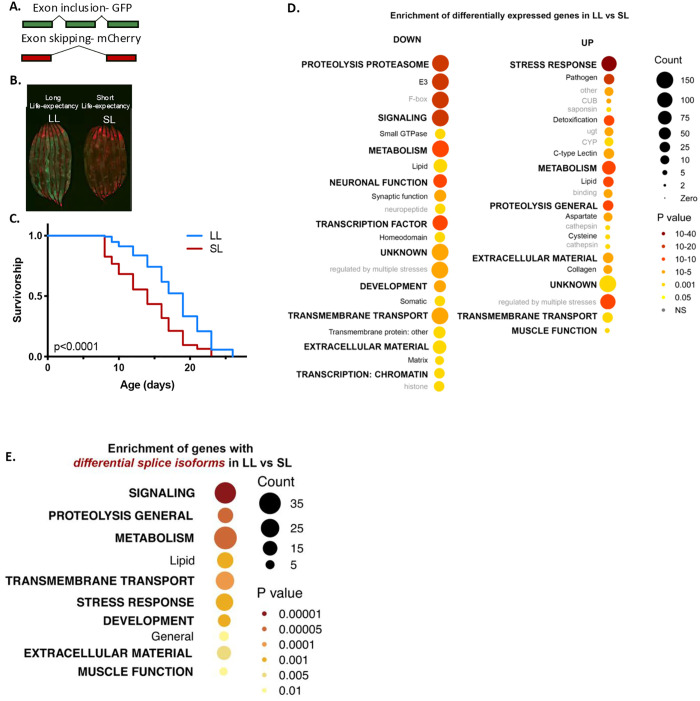
Deregulation of pre-mRNA splicing has been implicated in multiple age-related chronic diseases [3], and changes in expression of key splicing regulators and splicing of their targets are associated with longevity in mice and humans [4,5]. Moreover, specific RNA splicing factors have been shown to be causally linked to the effects of pro-longevity interventions in Caenorhabditis elegans [6 –8]. We therefore hypothesized that changes in alternative splicing of specific pre-mRNAs might be coupled to both the rate of biological aging and response to longevity interventions. To test this, we first sought to define early RNA processing events that correlate with subsequent life expectancy. Fluorescent mini gene reporters of a single exon 5 skipping event in ret-1 [9] in C. elegans can be used to sort isogenic animals at day 6 of adulthood into subpopulations with short or long life (LL) expectancies, identifying animals that are naturally aging poorly or well [6]. Animals with prevalent ret-1 exon 5 inclusion (GFP) at day 6 show life span extension compared to isogenic animals with exon 5 skipping (mCherry), defined therefore as having LL expectancy versus short life (SL) expectancy, respectively (Fig 1A–1C). We isolated LL or SL subpopulations at day 6 day in sextuplicate (Figs 1C and S1A) and performed 75-bp paired-end RNA-Seq followed by analysis of gene expression and differential isoform usage (S1–S3 Tables). This allowed us to define genes in which either expression level or isoform usage differed between LL versus SL animals.
First, we used WormCat [10] to identify functional signatures in genes significantly up- or downregulated in the LL expectancy animals (Fig 1D; S3 Table). LL animals have decreased expression of multiple functional categories including genes regulating signaling and the proteosome, while genes required for stress response/detoxification and proteolysis, processes known to be longevity-related, are increased. LL animals also show widespread changes in genes required for lipid metabolism, with subsets of lipid metabolic genes showing increased expression, suggesting differences in their lipid metabolism or composition (S1B–S1E Fig). Differential isoform usage between LL and SL animals is enriched for pathways implicated in aging such as signaling, proteolysis, and lipid metabolism further suggesting that splicing of pre-mRNAs specifically linked to these pathways is coupled to life expectancy (Figs 1E and S1F; S4 Table). Notably, differential transcript usage in SL versus LL groups includes genes specific to lipid metabolism, such as cpt-5, cpt-6, acox-3, and lpb-1. Instead of a generalized loss of splicing fidelity in animals that are aging poorly, these data suggest that heterogeneity in expression and splicing of genes in specific functional categories, including lipid metabolism and proteolysis, early in the life of an individual is coupled to life expectancy.
If heterogeneity in RNA splicing of specific functional classes of pre-mRNAs is linked to life expectancy, we reasoned that specific RNA splicing-mediated processes may also underlie variation in response to longevity interventions. Previously, we identified causal roles for the RNA splicing factors SFA-1 and REPO-1 in life span extension by DR and suppression of the target of rapamycin complex 1 (TORC1) in C. elegans [6]. REPO-1 is a component of the SF3A subunit in the U2snRNP of the spliceosome whereas SFA-1/SFA-1 is a branch-point binding protein that interacts with the UAF proteins and recruits U2 snRNP in the 3′ splice site recognition during early spliceosome assembly [11]. The link between DR and RNA splicing appears conserved, as upregulation of spliceosome components including SF3A in the liver is a signature of DR in rhesus monkeys [12]. We sought to define how these RNA splicing factors causally modulate aging, and whether splicing status in an individual might impact its responsiveness to various pro-longevity interventions.
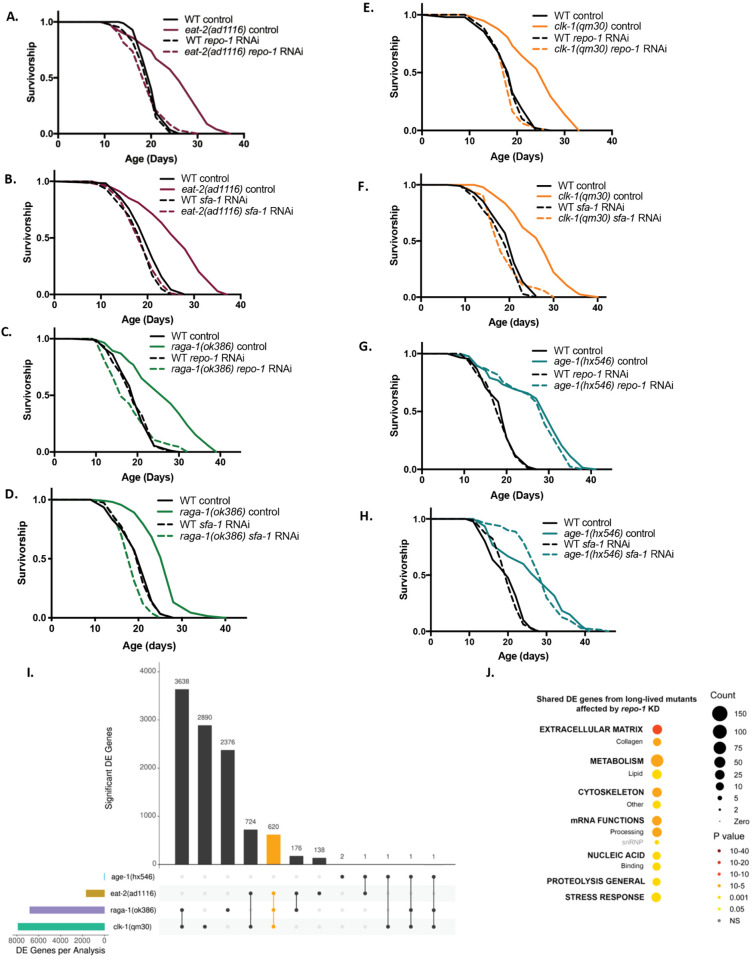
To define whether REPO-1 and SFA-1 activity modulates the efficacy of all longevity interventions or shows specificity, we designed RNAi clones that inhibit REPO-1 or SFA-1 in C. elegans without impacting neighboring gene expression (S2 Fig). Using these specific RNAi clones, we examined the role of REPO-1 and SFA-1 in a series of long-lived C. elegans mutants, targeting distinct longevity pathways. RNAi of REPO-1 and SFA-1 fully suppresses life span extension via the DR mimic eat-2(ad1116) (Fig 2A and 2B), and mutations to multiple components of the TORC1 pathway (raga-1(ok386), rsks-1(ok1255)) (Figs 2C, 2D, and S3A) [6] and electron transport machinery (clk-1(qm30), isp-1(qm150), nuo-6(qm200)) (Figs 2E, 2F and S3B–S3D). However, knockdown of REPO-1 or SFA-1 had no effect on life span extension via mutations to multiple components of the insulin/insulin-like growth factor signaling (IIS) pathway (age-1(hx546)/PI3K, daf-2(e1370)/InR) (Figs 2G, 2H, and S3E) [6], despite blocking life span extension by overexpression of the IIS mediator DAF-16/FOXO (S3F and S3G Fig). We confirmed repo-1 RNAi inhibited repo-1 expression equally in both longevity-responsive and nonresponsive mutations (S3H Fig). REPO-1 and SFA-1 activity thus determines responsiveness to specific longevity interventions, rather than modulating global changes that render animals refractory to life span extension by any means.
We leveraged this longevity intervention specificity to define the mechanisms underpinning the effects of REPO-1 on lifespan extension. We examined the transcriptional effects of repo-1 RNAi on wild-type (WT) animals and a panel of long-lived mutants that either require REPO-1 and SFA-1 for their effects (splicing factor "SF"-dependent) or are refractory to them (SF-independent). We performed four replicates of 75-bp paired-end RNA-Seq on WT (N2), three SF-dependent mutants, eat-2(ad1116), raga-1(ok386), clk-1(qm30), and one SF-independent mutant, age-1(hx546), with and without repo-1 RNAi (S5 Table). Principal component analysis showed that the transcriptomes of WT, age-1(hx546) and raga-1(ok386) cluster most tightly, suggesting they share more similarity to each other than to eat-2(ad1116) and clk-1(qm30) (S3I Fig). Interestingly, repo-1 RNAi drove significant changes specifically in eat-2(ad1116), raga-1(ok386), and clk-1(qm30) mutants yet had a less pronounced effect on WT and age-1(hx546) worms, closely mirroring the specific longevity effects of repo-1 knockdown (S3I Fig). To identify those changes in gene expression resulting from loss of repo-1 that are specific to each long-lived mutant, we compared the transcriptional effects of repo-1 knockdown on each long-lived mutant to the effects of repo-1 knockdown on WT worms. We identified genes whose expression responded differently to repo-1 RNAi in the long-lived mutants compared to WT (S6 Table). These genes were further categorized and grouped based on the mutant in which they were found (Fig 2I). Interestingly, in contrast to the widespread differences induced by repo-1 RNAi in each of the SF-dependent mutants, only 6 genes responded differently on repo-1 knockdown in the SF-independent mutant age-1(hx546) compared to WT worms (Fig 2Iand S6 Table). Together, these data suggest that REPO-1 has unique functional roles in the physiology of SF-dependent mutants not seen in WT or IIS mutants, further supporting the idea that REPO-1 activity mediates responsiveness to specific longevity interventions.
We sought to identify the unique role of REPO-1 in SF-dependent longevity interventions (Fig 2I yellow). We reasoned that processes by which REPO-1 mediates longevity might be reflected in the 620 genes that are differentially regulated by repo-1 RNAi across all SF-dependent long-lived mutants (S6 Table). We used the WormCat platform [10] to identify signatures in these shared 620 differentially regulated genes. REPO-1 dependent gene categories enriched across all splicing sensitive pathways included RNA processing, suggesting indirect or compensatory changes in the posttranscriptional machinery on loss of REPO-1 specifically in these longevity pathways. Strikingly, metabolism was one of the most significantly enriched REPO-1 dependent terms, with lipid metabolism being one of the most enriched sub-categories (Figs 2J and S4A–S4D; S7 Table). These data mirror processes coupled to heterogeneity in life expectancy (Fig 1). In addition, we showed previously that loss of SFA-1 specifically reverses expression of lipid metabolism genes induced by DR [6]. Altogether, these data suggest altered lipid metabolism is associated with the effect of REPO-1 and SFA-1 on the aging process and response to treatment.
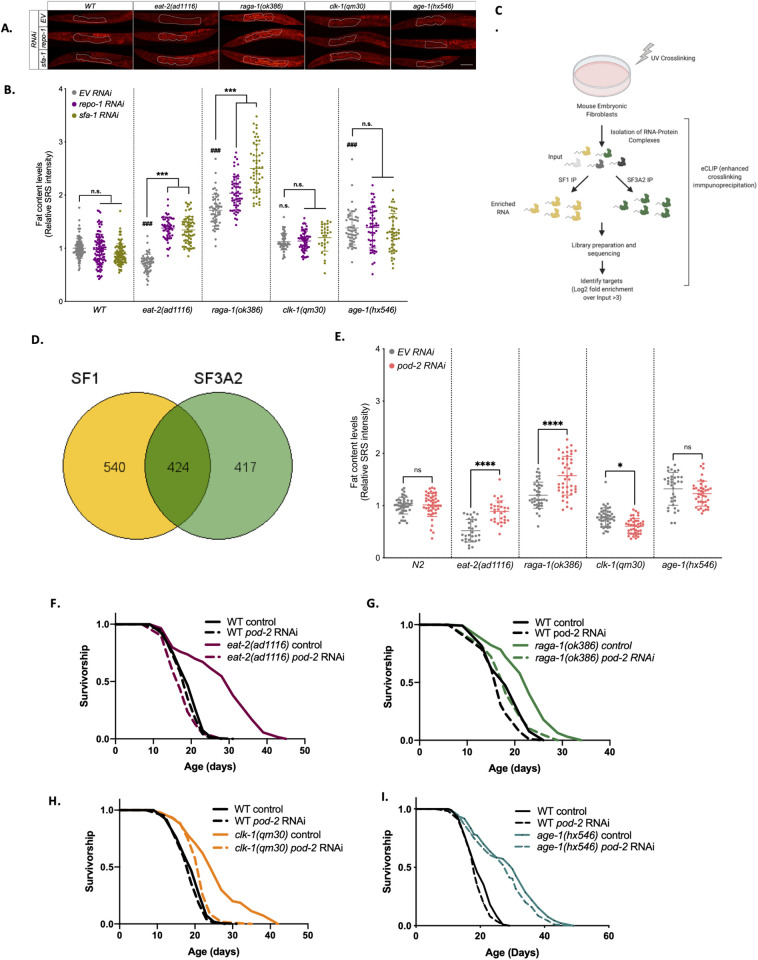
Next, we examined directly how lipid levels are impacted by repo-1 and sfa-1 RNAi in WT and long-lived mutants. Stimulated Raman scattering (SRS) microscopy in live animals showed that neither sfa-1 and repo-1 RNAi had any effect on lipid content in the intestine of WT C. elegans, yet significantly increased lipid levels in the SF-dependent mutants eat-2(ad1116) and raga-1(ok386) mutants (Fig 3A and 3B). Lipid levels were not affected by loss of REPO-1 or SFA-1 in the splicing-resistant mutant age-1(hx546). Interestingly, sfa-1 and repo-1 RNAi also had no effect on the lipid content of the splicing-sensitive clk-1(qm30) mutant, which have impaired mitochondrial function (Fig 3B), suggesting the mechanism by which these splicing factors impact lipid levels might be linked to mitochondrial function. To further characterize the effect of repo-1 knockdown on lipid metabolism, we performed lipidomics by LC/MS in the long-lived mutants with and without repo-1 RNAi. (S8 Table). We did not observe major differences in the lipidome between strains or with repo-1 RNAi (S5A Fig) Interestingly, neither WT nor age-1(hx546) had any lipid species that significantly changed upon repo-1 knockdown, while all SF-dependent lines, eat-2(ad1116), raga-1(ok386), and clk-1(qm30) did, suggesting that the repo-1 effect on lipid metabolism may be specific to SF-dependent pathways in which REPO-1 is required for longevity (S5C Fig). We examined total triacylglycerol concentration and, analogous to our SRS microscopy, eat-2(ad1116) and raga-1(ok386) trended toward increased triacylglycerides upon loss of REPO-1, although only raga-1(ok386) changes were significant (p-value 0.02) (S5B Fig). Together, these data suggest that the activity of these splicing factors not only specifically regulates expression and splicing of lipid metabolic genes in SF-dependent interventions but also lipid content itself. However, we did not identify a consensus group of lipid species that changed in all SF-dependent mutants. Thus, we looked for shared regulators of lipid metabolism that might represent a causal link between SFA-1/REPO-1 and longevity.
To understand the mechanism by which SFA-1 and REPO-1 modulate lipid remodeling and longevity, we identified their direct pre-mRNA targets by enhanced cross-linking immunoprecipitation (eCLIP) [13]. We performed eCLIP in both C. elegans and mouse embryonic fibroblast (MEF) cell lines, speculating that true targets that impact life span would be shared between the two splicing factors and conserved across organisms. MEFs were cross-linked followed by IP with SF1 (mammalian SFA-1) and SF3A2 (mammalian REPO-1) antibodies (Fig 3C). True peaks were defined as those showing enrichment of log2 fold change ≥ 2 and −log10(p-value) ≥ 2 over input (S9 Table). Sequencing identified ~964 and ~841 genes targeted by SF1 and SF3A2 in MEFs, respectively. Four hundred twenty-four genes, representing ~50% of total targets, are shared, suggesting that SF1 and SF3A2 act together to regulate splicing (Fig 3D; S9 Table). eCLIP in C. elegans shows that many targets of REPO-1 and SFA-1 are also shared in worms, including tos-1 (Target of Splicing 1), a known and direct target of SFA-1 [14,15] (S4E–S4G Fig; S10 Table). Interestingly, in both MEFs and in C. elegans, we find an enrichment of shared target genes involved in RNA processing and in lipid metabolism. One such target involved in lipid metabolism is Acetyl CoA Carboxylase 1 (ACC1), the rate-limiting enzyme of the fatty acid biosynthetic pathway. ACC1 is a target of both SF1 and SF3A2 in MEFs (S8 Table), and the pre-mRNA for POD-2, the C. elegans orthologue of ACC1, was identified as a shared target of SFA-1 and REPO-1 in C. elegans (S10 Table).
POD-2/ACC1 converts acetyl-CoA to malonyl-CoA, thus catalyzing the first step in the formation of de novo lipids. We therefore reasoned that dysfunctional POD-2/ACC1 might alter lipid stores in SFA-1 and REPO-1-depleted animals, and that this might modulate the aging effects in SF-sensitive pro-longevity mutants. To test this, first, we measured lipid content changes through SRS microscopy on the different longevity mutants upon pod-2 RNAi. pod-2 is the ortholog of human ACACA (acetyl-CoA carboxylase alpha), which catalyzes the rate-limiting step in fatty acid synthesis. We therefore hypothesized that upon POD-2 knockdown, lipid content would be suppressed. However, in contrast, POD-2 knockdown phenocopies REPO-1 knockdown (Fig 3E); with eat-2(ad1116) and raga-1(ok386) animals showing increased lipid content upon POD-2 knockdown, and no effect in WT or age-1(hx546) animals, or in clk-1(qm30), a background that is splicing factor sensitive for its effects on longevity, but shows no changes to lipid content by SRS with knockdown of sfa-1 and repo-1. Next, we inhibited life span extension of SF-dependent and SF-independent mutants with and without RNAi of ACC/POD-2. Again, inhibition of POD-2 mirrors completely the longevity intervention specificity of SFA-1 and REPO-1. pod-2 RNAi from day 1 of adulthood fully suppresses life span extension of SF-sensitive eat-2(ad1116), raga-1(ok386), and clk-1(qm30) (Fig 3F–3H) mutants but does not suppress life span in the SF-resistant age-1(hx546) (Fig 3I) mutants. Together, these data reveal a striking similarity in the specificity of both the lipid accumulation phenotypes and the responses to specific longevity interventions resulting from knockdown of SFA-1/REPO-1 and by knockdown of their direct target ACC/POD-2. However, our finding that not all SF-sensitive interventions show parallel changes to lipid content or profile after knockdown of repo-1 or sfa-1 (or pod-2) suggests that the underlying mechanism by which splicing factor activity confers longevity may be more complex than through gross changes to lipid abundance.
Disruption of mitochondrial ETC function and DR/TORC1 inhibition operate in temporally distinct time windows to slow aging in C. elegans. Knockdown of ETC complexes only during the L3–L4 stages of larval development increases longevity, while DR and TORC1 inhibition confer longevity benefits in adulthood [16,17]. To understand how REPO-1 and SFA-1 modulate longevity and lipid metabolism across seemingly mechanistically unrelated longevity interventions, we asked when in life these splicing factors act to modulate life span. We fluorescently tagged endogenous REPO-1 and SFA-1 by CRISPR knock-in of wrmScarlet and GFP, respectively. Both splicing factors are expressed in nuclei of all cells (S6A Fig), throughout all life stages (S6B Fig), and ages of C. elegans (S6C–S6E Fig). Neither repo-1 mRNA nor REPO-1 total protein diminish with age during adulthood (S6C and S6D Fig). However, REPO-1 levels peak during early development, hinting that splicing factors such as REPO-1 play an important role in early life stages of C. elegans (Figs 4A and S6F).
To define the temporal window in which REPO-1 and SFA-1 mediate DR, TORC1, and ETC longevity, we subjected eat-2(ad1116), raga-1(ok386), and clk-1(qm30) animals to repo-1 and sfa-1 RNAi from hatch or Day 1 of adulthood (D1-onset). Despite western analysis confirming equal knockdown efficiency by day 3 of adulthood in both conditions (S6G–S6J Fig), their effect on longevity was strikingly different; knockdown of both repo-1 and sfa-1 in development fully suppresses longevity in all SF-sensitive mutants. However, adult-onset inhibition had no impact on aging regardless of the timing requirement of the SF-dependent intervention itself (Fig 4B–4G). Adult-onset knockdown of REPO-1 also has no effect on the accumulation of lipids as measured by SRS microscopy (Fig 4H). Together, these data suggest REPO-1 and SFA-1 modulate the cellular landscape early in life and that this permissive landscape may contribute to the efficacy of subsequent longevity interventions. Supporting this concept, adult-onset RNAi of raga-1 is sufficient to prolong life span yet has no effect on animals with prior inhibition of either repo-1 or sfa-1 during development (Fig 4I and 4J).

Early life alternative splicing of mRNAs related to lipid metabolism and known longevity pathway correlate with subsequent life expectancy. Schematic illustrating the fluorescence expression pattern ofsplicing reporter worm. Inclusion/exclusion of exon 5 results in GFP/mCherry expression, respectively.Representative images offedreporter worms segregated at Day 6 based on their splicing pattern.Survivorship of the worm sub-populations separated at Day 6 ( < 0.0001, 1 of 6 replicates). Worms that age slowly are marked "LL" (Long Life-expectancy) and worms that age rapidly as "SL" (Short Life-expectancy).WormCat visualization of categories enriched in down and upregulated genes in LL vs. SL worms. Padj < 0.01 and fold change >1.5 was used as cutoff to mark differentially expressed genes.WormCat visualization of categories enriched in genes that exhibit differential isoform usage in LL vs. SL worms. Data underlying the graphs in this figure can be found in. A. B. C. D. E. ret-1 ad-libitum ret-1 P S1 Data

REPO-1 and SFA-1 are required for life span extension in DR, TORC1, and ETC mutant longevity but dispensable for IIS longevity. Survivorship of wild-type (WT) andworms −/+RNAi ( = 0.8753) andRNAi ( = 0.5658) (values comparing wild-type N2 on RNAi vs.on RNAi, ≥ 3 replicates).Survivorship of WT andworms −/+RNAi ( = 0.5407) andRNAi ( = 0.002) (values comparing wild-type N2 on RNAi vs.on RNAi, ≥3 replicates).andRNAi were administered from hatch.Survivorship of wild-type (WT) andworms −/+RNAi ( = 0.1838 andRNAi ( = 0.86) (values comparing wild-type N2 on RNAi vs.on RNAi, ≥3 replicates).andRNAi were administered from hatch.Survivorship curve of wild-type (WT) andworms −/+RNAi ( < 0.0001) andRNAi ( < 0.0001) (values comparing wild-type N2 on RNAi vs.on RNAi, ≥3 replicates).andRNAi were administered from hatch. I. UpSet plot (UpSetR R package) quantifying genes in different longevity mutants that respond differently onknockdown compared to wild-type N2 worms. Category of genes shared by SF-dependent mutants are highlighted in yellow. J. WormCat visualization of categories enriched in 620 shared genes that are differentially affected on loss of REPO-1 in splicing factor-dependent pathways compared to wild-type N2 worms. Data underlying the graphs in this figure can be found in. A, B. C, D. E, F. G, H. eat-2(ad1116) repo-1 P sfa-1 P p- eat-2(ad1116) raga-1(ok386) repo-1 P sfa-1 P p- raga-1(ok386) repo-1 sfa-1 clk-1(qm30) repo-1 P sfa-1 P p- clk-1(qm30) repo-1 sfa-1 age-1(hx546) repo-1 P sfa-1 P p- age-1(hx546) repo-1 sfa-1 repo-1 S2 Data

Loss of REPO-1 specifically affects lipid metabolism in splicing factor-sensitive longevity pathways. Representative images of SRS microscopy showing fat levels in wild-type N2,,,, andon control,andRNAi. Worms were fed on RNAi from hatch and imaged 24 hours post-L4 stage.Quantification of SRS signal using ImageJ (pooled data quantifying anterior intestine of = 20−30 worms, = 3; ###<0.001 long-lived mutant vs. wildtype on control EV RNAi; ***<0.001 control EV vs.RNAi; n.s. > 0.05).Schematic of enhanced crosslinking immunoprecipitation (eCLIP) in Mouse Embryonic Fibroblasts (MEFs).A..Venn diagram showing targets of SF1 (mammalian SFA-1 ortholog) and SF3A2 (mammalian REPO-1 ortholog) and their overlap in MEFs. True gene targets identified as peaks in IP over input sample that had a log2 fold enrichment > 2 and −log10(-value) > 2, = 2. Plot generated using GeneVenn.Quantification of SRS signal using Image J. Animals were fed withRNAi at day 1 and imaged at day 4 of adulthood (pooled data quantifying anterior intestine of = 10−30, = 3, ***<0.001 control/empty vector vs.RNAi; * = 0.0256; n.s > 0.05).Survivorship curves −/+RNAi of wildtype (WT) and( = 0.057, 2 replicates);( = 0.1923, 4 replicates);( < 0.0001, 2 replicates), and.( < 0.0001, 3 replicates). RNAi initiated at Day 1 of adulthood.-values reflect comparison of wild-type N2 fed withRNAi vs. long-lived mutant withRNAi. Data underlying the graphs in this figure can be found in. A. B. C. D. E. F–I. F. G. H. I eat-2(ad1116) raga-1(ok386) clk-1(qm30) age-1(hx546) repo-1 sfa-1 n N P P repo-1/sfa-1 P Created in BioRender. SHARMA, (2025) https://BioRender.com/0v2egpn p N pod-2 n Caenorhabditis elegans N P pod-2 P P pod-2 eat-2(ad1116) P raga-1(ok386) P clk-1(qm30) P age-1(hx546) P p pod-2 pod-2 S3 Data

REPO-1 and SFA-1 create a permissive landscape during the early stages of development to mediate longevity benefits later in life. Quantification of bands from western blot of CRISPR-tagged endogenous 3XFLAG::REPO-1 worms at early (L1-L2) and late (L3-L4) larval stages and at Day 1 and Day 15 of adulthood. Blots probed with 3XFLAG and actin antibodies. Quantification done using ImageJ, normalized to intensity of actin band and plotted as percent of expression at Day 1 of adulthood (**** ≤ 0.0001, *** ≤ 0.001, ** ≤ 0.01, * ≤ 0.05; ns > 0.05; = 3).Survivorship of wild-type (WT) and long-lived mutants;, and−/+from hatch (- - -) or Day 1 of adulthood (D1-onset) (…).= 0.5315, 0.0285, 0.2672 for WTRNAi hatch vs.,andmutants onRNAi hatch respectively).= <0.0001, <0.0001, <0.0001 for WTRNAi D1-onset vs.,, andmutants onRNAi D1-onset, respectively). Survivorship of wild-type (WT) and long-lived mutants;, and−/+from hatch (- - -) or Day 1 of adulthood (D1-onset) (…).= 0.5658, 0.002, <0.0001 for WTRNAi hatch vs.,, andmutants onRNAi hatch, respectively).= <0.0001, <0.0001, <0.0001 for WTRNAi D1-onset vs.,, andmutants onRNAi D1-onset, respectively).Quantification of SRS signal using ImageJ (pooled data quantifying anterior intestine of = 20−30 worms, = 3; n.s. > 0.05 control EV vs.RNAi). repo-1 RNAi was started on day 1 of adulthood and images were taken on day 4.Survivorship curve of wild-type N2 worms −/+RNAi in the larval stages −/+RNAi from Day 1 of adulthood ( = 0.0244 wild-type N2 onRNAi (larval) vs. wild-type N2 onRNAi (larval)+RNAi (D1-onset), 3 replicates).Survivorship curve of wild-type N2 worms −/+RNAi in the larval stages −/+RNAi from Day 1 of adulthood ( = 0.2480 wild-type N2 onRNAi (larval) vs. wild-type N2 onRNAi (larval)+RNAi (D1-onset), 2 replicates). Data underlying the graphs in this figure can be found in. A. B–G. B. D. F. C. E. G. H. I. J. P P P P P n eat-2(ad1116) raga-1(ok386) clk-1(qm30) repo-1 P repo-1 eat-2(da1116) raga-1(ok386) clk-1(qm30) repo-1 P repo-1 eat-2(da1116) raga-1(ok386) clk-1(qm30) repo-1 eat-2(ad1116) raga-1(ok386) clk-1(qm30) sfa-1 P sfa-1 eat-2(da1116) raga-1(ok386) clk-1(qm30) sfa-1 P sfa-1 eat-2(da1116) raga-1(ok386) clk-1(qm30) sfa-1 n N P repo-1 repo-1 raga-1 P repo-1 repo-1 raga-1 sfa-1 raga-1 P sfa-1 sfa-1 raga-1 S4 Data
Discussion
Geroscience approaches over the last 20 years have shown that environmental conditions and genetic manipulation can strongly influence the rate of physiological aging. In particular, DR has a strong beneficial effect in a wide variety of organisms tested to date, not only increasing longevity but also protecting against many chronic diseases. Harnessing the molecular and cellular processes mediating the plasticity of aging in response to DR has the potential to yield novel therapeutics that broadly reduce disease incidence in the elderly. However, while there has been much research into the molecular mechanisms mediating longevity interventions using model organisms, little emphasis has been placed on predicting and understanding variance in their efficacy [2]. This is critical, since the same therapeutic treatment can be beneficial or harmful, depending on the sex, genotype, and physiological state of the individual to which it is applied. For example, dosage levels of pharmacological treatments or DR have very different longevity effects in different genotypes [18,19]. Such genotype by diet interaction may well explain the opposing results of two longitudinal life span studies of DR on rhesus monkeys [20].
Beyond inter-genotype variation to longevity interventions, substantial variation also exists in inter-individual responses. Even within isogenic populations of C. elegans, or inbred Drosophila and mouse strains, high variance exists both for life span itself and response to DR/DR mimetics. Indeed, for interventions such as methionine restriction, though median life span of mice and rats is increased, a sub-population dies earlier than non-restricted controls [21]. A "one size fits all" approach to DR or DR mimetics is therefore unlikely to be useful therapeutically. Successfully translating geroscience to human application requires accurately predicting a given individual's response to a given treatment, depending on the genotype and physiology of the individual. Such an approach will allow treatments to be assigned to each individual in a personalized way, maximizing health benefits. The first step toward this end is to identify biological variables that predict individual-specific optimal aging interventions in model organisms, to provide the foundation for a personalized medicine approach to healthy aging therapeutics in humans.
Here, we show that in C. elegans, a single RNA exon skipping event can predict the life expectancy of isogenic animals. We leveraged this finding to define functional categories of genes that are differentially expressed or spliced in isogenic animals that long- or short-lived. Animals that naturally age well show gene expression and RNA splicing changes enriched in specific ontology classes, including signaling, proteolysis, and lipid metabolism. We utilized splicing factor-dependent and independent longevity pathways to define RNA splicing-mediated processes coupled to variation in response to anti-aging interventions in C. elegans. Regulation of genes tied to lipid metabolism was a shared process correlated to both WT life expectancy and response to treatment. REPO-1 and SFA-1 activity modulate lipid levels in SF-dependent mutants and bind to POD-2/ACC pod-2 transcripts directly. REPO-1, SFA-1, and POD-2 specifically modulate efficacy of the same pro-longevity mutations and show similar effects on lipid content. Lastly, we show that modulating the activity of REPO-1 and SFA-1 early in life determines whether subsequent application of a pro-longevity intervention, in this case inhibition of RAGA-1, successfully slows aging.
Our data reveal a link between the early life activity of splicing factors and the efficacy of certain longevity interventions, as well as to context-dependent changes in lipid accumulation. Yet, we were not able to identify any common lipid signature or change in lipid abundance that links a specific lipid alteration to longevity. More work is needed to determine if a common change in SF-sensitive mutants can explain the role of pod-2 in life span. Interestingly, POD-2 has also been linked to longevity seen in germlineless glp-1 mutants, which also have lipid phenotypes [22]. This will likely require further work to dissect the tissues and cell types in which splicing factors and POD-2 act to modulate aging, and more nuanced examination of lipid composition changes at defined locations in those cell types.
This work demonstrates that the efficacy of a pro-longevity intervention can be strongly influenced by prior events, in this case the activity of a splicing factor earlier in the life of the individual. If this phenomenon is conserved in mammals, it raises important questions about how we design and implement anti-aging therapeutics. Ultimately, it might be possible to predict response to treatment and optimize the intervention via analysis of a subset of RNA splicing events. Such an approach is key if we are to move beyond biomarkers of physiological age towards biomarkers that facilitate precision medicine approaches to interventional geroscience.
 Longevity & Aging