
What this is
- This research investigates how meal timing changes in older adults and its links to health outcomes.
- It analyzes data from 2945 community-dwelling older adults over several decades.
- Key findings include associations between later meal times, increased morbidity, and higher mortality risk.
Essence
- Meal timing shifts toward later hours as adults age, particularly for breakfast and dinner. Later breakfast is associated with greater health issues and increased mortality risk.
Key takeaways
- Older age correlates with later breakfast and dinner times, a delayed eating midpoint, and a shorter daily eating window.
- Later breakfast timing is linked to higher rates of physical and psychological illnesses, including multimorbidity and increased mortality risk.
- Genetic profiles associated with evening chronotype are connected to later meal times, while obesity-related genetic factors do not show a similar influence.
Caveats
- The study's observational design limits causal interpretations between meal timing and health outcomes.
- The reliance on self-reported meal timing may not accurately reflect actual eating behaviors.
- Findings may not be generalizable beyond the specific cohort of British European ancestry older adults studied.
Definitions
- Chrononutrition: The study of how the timing of eating affects health and disease risk.
Simplified
Introduction
Chrononutrition, the study of the timing of eating, has emerged as a modifiable risk factor for adverse health outcomes1,2. The relevance of the timing of dietary intake on health and mortality was initially demonstrated in animal and human studies in the late 1970s3. Recent studies in rodents indicating greater fat mass accumulation when high-fat diets are consumed during atypical periods (i.e., inactive phases) compared to typical times (i.e., active phases), have renewed interest in this area4. Subsequent human studies showed that later meal times may diminish the efficacy of behavioral weight loss interventions and that late eating is associated with metabolic changes leading to higher body mass index (BMI) and body fat accumulation5–8. In addition, experimental studies showed that endogenous melatonin in circulation in the evening impairs glucose tolerance9. The role of eating schedules is biologically relevant as dietary intake acts as an environmental cue influencing the circadian clocks of peripheral metabolic tissues and therefore can contribute to circadian misalignment and internal desynchrony2,10. The emerging evidence largely suggests that later meal times, particularly eating during the biological evening, is detrimental to health, and that eating at night is expected to be among the leading factors mediating the link between night shift work and higher risk of disease2,11. However, the role of chrononutrition in older adults remains underexplored1,12.
Older adults constitute a vulnerable population for mistimed food intake because of the onset of multimorbidity and the environmental changes that often accompany aging. Current chrononutrition studies in older adults are limited to cross-sectional analyses comparing older to younger adults13–17. Eating times are expected to shift in older adulthood, partly because of documented behavioral changes, such as earlier bed and wake times18,19. In addition, older adults are at risk of dysphagia, dehydration, impaired swallowing and declining oral health, all of which can negatively impact overall diet and increase the risk of malnutrition20. Transitioning to retirement or assisted living facilities can further affect nutritional status21. A key priority of the NIH Common Fund's Nutrition for Precision Health, the NHLBI nutrition research priorities, and the NIH Sleep Research Plan is to advocate for meal times that align with the circadian system1,22. Carefully characterizing meal timing in older adults can inform relevant food timing countermeasures to support healthy aging.
No longitudinal study has yet described lifetime trajectories of mealtime patterns in older adults, and few studies have explored the broader factors influencing meal timing in this population23. Existing research on meal timing has disproportionately focused on younger healthy adults and night shift workers2. Key factors known to influence meal timing include intrinsic elements, such as medication use, sleep disorders, genetics, and chronotype, as well as extrinsic factors like cultural practices, environmental conditions, food availability, and work schedules23. This longitudinal analysis aims to characterize meal timing trajectories in older adults and investigate their associations with morbidity, behaviors, genetic profiles, and all-cause mortality, utilizing data from the University of Manchester Longitudinal Study of Cognition in Normal Healthy Old Age (UMLCHA) cohort.
The study shows that meal timing shifts with older age, particularly toward later breakfast and dinner, a delayed eating midpoint, and a shorter eating window. Later breakfast timing is associated with greater physical and psychological illness, multimorbidity, evening chronotype genetic profiles, and increased mortality risk. These findings suggest that shifts in meal timing may reflect underlying health and aging processes in older adults.
Methods
University of Manchester Longitudinal Study of Cognition in Normal Healthy Old Age
The University of Manchester Longitudinal Study of Cognition in Normal Healthy Old Age (UMLCHA) recruited 6375 individuals aged 42–94 years old from Newcastle and Manchester, UK, starting in 1983 through 199324. All participants were followed until 2017, and therefore follow-up durations varying based on each participant's enrollment date. Over the course of the study, participants were invited to complete optional questionnaires including those on sociodemographic, health status, and lifestyle19. Between 1999 and 2004, a subset of participants also provided whole blood samples. The study was approved by the University Research Ethics Committee at the University of Manchester (Ref: 2021-11274-17829), and all participants gave written informed consent prior to study procedures.
Assessment of meal timing and sleep habits
The Personal Details Questionnaire, a cohort-specific survey that included questions on meal and sleep habits, sociodemographics, occupation, and subjective health, consistent with those used in other cohorts, was administered to participants up to five times. The initial administration occurred in person at enrollment, beginning in 1983 (baseline). The questionnaire was subsequently readministered to enrolled participants by mail at multiple points during the study: between 1984 and 1996 (second administration), 2001 and 2003 (third administration), 2007 (fourth administration), and 2010 (fifth and final administration). Due to variation in enrollment dates and follow-up participation, not all participants completed every questionnaire.
In the Personal Details Questionnaire, participants responded to questions pertaining to the timing of meals and sleep. Participants responded to the question, "What time do you eat [breakfast/lunch/dinner]?" In addition, participants responded to the questions, "Generally, at what time do you [go to bed at night/get up in the morning]?" and "On average, how many hours of sleep do you get every night?" Responses were used to calculate the time interval between waking and breakfast, the time interval between dinner and bed, the time interval between breakfast and dinner (i.e., daily eating window), and the midpoint between breakfast and dinner (i.e., eating midpoint).
Mortality and other measures
Mortality data were obtained from the England NHS Digital death registry from the NHS England's Secure Data Environment service for England (https://digital.nhs.uk/services/secure-data-environment-service↗). Access to the data was granted following approval of a data access request in adherence to the NHS Digital's data governance and security protocols. The record data included information on the date of death up until August 2017.
At baseline, participants reported demographic information such as birth year, sex, socioeconomic status (based on the Standard Occupational Classification 2000), and education level (categorized using the International Standard Classification of Education 1997). On each of the five assessment occasions, participants also provided updates on their employment status (full-time, part-time, or unemployed/retired), smoking status, marital status, alcohol consumption, and subjective health status (rated on a scale from 1 (very bad) to 5 (very good)). Clinical measurements, including height and weight, were collected in-person for a subset of participants (n = 493 of the analytical sample). Through the repeated Personal Details Questionnaire, participants also reported daily cumulative time spent preparing meals (in hours) and whether they experienced any difficulty in meal preparation (yes/no). In addition, during their enrollment, participants completed the Pittsburgh Sleep Quality Index (PSQI) once and responses to the survey were used to compute scores reflecting sleep quality based on accepted thresholds25.
To assess symptoms of physical and psychological illness (i.e., morbidity), the Cornell Medical Index (CMI) was administered on four occasions, covering 19 general areas of symptomatology26. A participant was considered to have a health problem if they responded "yes" to any question corresponding to a specific health category within the CMI. A multimorbidity index was calculated by summing the number of health conditions reported by participants at each assessment.
Polygenic scores
In a subset of participants, DNA was extracted from blood samples collected between 1999 and 2004, and genotyping was performed at the Wellcome Trust Clinical Research Facility Genetics Core, Western General Hospital, Edinburgh, using the Illumina610-Quadv1 chip (Illumina, San Diego, CA). Imputation was performed using the Haplotype Reference Consortium panel (GRCh37-hg19 genome assembly)7. Standard quality control was conducted: variants with >20% missing genotypes, variants not in Hardy-Weinberg Equilibrium, and individuals with a SNP call rate <80% were removed. Variants with frequency <0.1% were further excluded24. Population substructure correction was performed by calculating the principal components of ancestry using TRACE and the Human Genome Diversity Project27,28.
Genome-wide polygenic scores for eveningness (i.e., later chronotype) and obesity (i.e., higher BMI), scores with known associations with meal timing29,30, were calculated for each participant using PRS-CS (Polygenic Risk Score–Continuous Shrinkage), a Bayesian regression framework that places a continuous shrinkage prior on SNP effect sizes31. The UK Biobank EUR-ancestry linkage disequilibrium (LD) panel was used as the reference. The publicly available UK Biobank linkage disequilibrium matrices were obtained from Broad Institute's Amazon repository (s3://broad-alkesgroup-ukbb-ld/UKBB_LD/). Effect estimates for the polygenic score were derived from the large genome-wide association study for evening preference in UK Biobank participants of European ancestry and the meta-analysis of genome-wide association studies for BMI in approximately 700,000 individuals of European ancestry by the Genetic Investigation of ANthropometric Traits (GIANT) consortium32,33. Each polygenic score was standardized to have a mean of 0 and a standard deviation of 1.
Statistics and reproducibility
Participants who provided responses to all meal and sleep timing questions at baseline and had at least one additional meal timing response at any of the four subsequent occasions were included in the analysis. Descriptive statistics are presented as mean and standard deviations for continuous variables and frequency and percentages for categorical variables.
Changes in meal timing variables (dependent variables) with age (time-varying predictor) were assessed using linear mixed-effects models, as conducted previously34. An interaction term between age and wave was included to account for varying effects of age across different waves. Participant ID was also included as a random intercept to account for repeated measurements. The basic model (Model 1) adjusted for sex as a time-independent variable. The full model (Model 2) included additional time-independent variables such as socioeconomic status and education level, and time-dependent variables including sleep duration, employment status, smoking status, marital status, alcohol consumption, and subjective health status. Effects are reported per 10-years increase in age, with corresponding regression coefficients and 95% confidence intervals. For time-dependent variables with missing data in later cycles, values were carried forward once from previous cycles using the last observation carried forward approach. If still missing after the first carry-forward, the data were treated as missing (<5% missingness).
Latent class analysis was performed for meal timing to identify subgroups with distinct meal timing trajectories using LatentGOLD 5.1 (Statistical Innovations, Belmont, MA). The best-fitting model was determined by evaluating the average latent class posterior probability, Akaike Information Criterion (AIC) and Bayesian Information Criterion (BIC) with each added subgroup, ensuring that each subgroup included at least 5% of participants, and demonstrated meaningful distinction between subgroups (Supplementary Table ). A two-cluster model was identified as the best fit. Meal timing variables were compared between the latent classes. The associations between the latent classes with the meal timing variables were also assessed using linear mixed-effects models as previously described. 1
The associations between physical and psychological illness (derived from the CMI) and meal-related behaviors (daily cumulative hours spent preparing meals and difficulty in meal preparation) with meal timing variables were analyzed using linear mixed-effects models, accounting for the covariates mentioned earlier with the inclusion of the age by wave interaction term in both models 1 and 2. Associations between PSQI score (sleep quality) with meal timing variables were analyzed using linear regression models, accounting for the same covariates. Linear mixed-effects models were also used to quantify the relationship between the scaled polygenic scores and meal timing variables accounting for the covariates mentioned above in the subset of 1226 participants with genetic data and 5 principal components of ancestry to account for population substructure. As confirmatory analyses, the polygenic score for evening chronotype was tested for associations with sleep midpoint, previously described as the midpoint between bed and wake times19, and the polygenic score for obesity was tested for associations with measured BMI. In sensitivity analyses, all model 1 analyses were further adjusted for the polygenic score for evening chronotype.
Meal timing trajectories and their associations with all-cause mortality were assessed using mixed-effects Cox regression models. For participants who died during follow-up, the time variable was defined as the period from recruitment to the date of death. For surviving participants, the time variable was defined as the period from recruitment to August 2017. The basic model (Model 1) only adjusted for sex as a time-independent variable and age as a time-dependent variable, whereas the full model (Model 2) additionally included time-independent variables such as socioeconomic status and education level, and time-dependent variables such as sleep duration, smoking status, and alcohol consumption. Results are presented as hazard ratios and 95% confidence intervals. For the meal timing clusters, Kaplan-Meier survival curves were generated, and log-rank tests were performed.
Associations with a two-sided p value < 0.05 were considered statistically significant. All analyses were two-tailed and performed using R version 4.3.1 (The R Foundation for Statistical Computing Platform, 2023) and the latest version of RStudio (Posit Software, PBC, Boston, MA).
Reporting summary
Further information on research design is available in the linked to this article. Nature Portfolio Reporting Summary
Results
Meal timing trajectories across the older adult lifespan
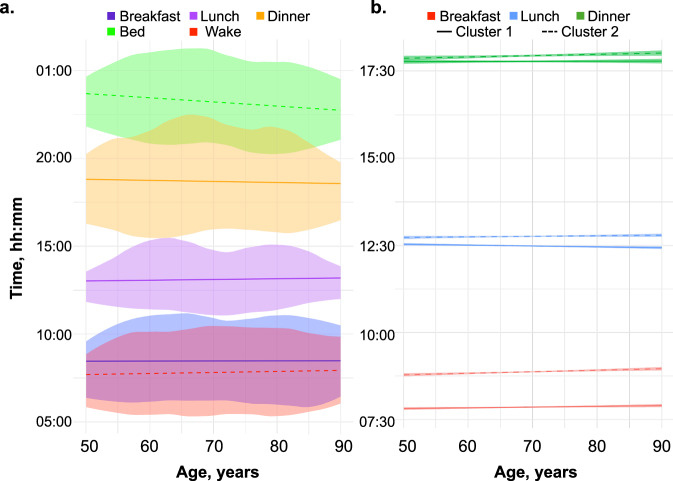
Latent class analysis of meal timing trajectories indicated heterogeneity in age-related changes in meal timing among older adults (Supplementary Tables 1 and 2). The analysis identified a two-cluster model as the best fit to capture the distinct meal timing patterns. The two clusters exhibited notable differences in their meal timing trajectories (Fig. 1b). The early eating subgroup (n = 1391) had consistently earlier meal times with aging, whereas the late eating subgroup (n = 1554) displayed generally later meal times with aging (Supplementary Table 3).

Trajectories in meal and bed times in older adults. Age-related changes in meal and bed times (), and latent class differences in meal times and trajectory (). The lines display model-predicted values from the linear mixed-effect models, with the shaded region indicating the 95% confidence interval of the estimates. a b
| Mean (SD) or(%)n | |
|---|---|
| Age at recruitment, years | 64.0 (6.6) |
| Gender, female,(%)n | 2107 (71.5) |
| Subjective health status,(%)n | |
| Very bad | 10 (0.3) |
| Bad | 65 (2.2) |
| Fair | 608 (20.7) |
| Good | 1460 (49.7) |
| Very good | 792 (27.0) |
| Social class, professional occupations,(%)n | 1219 (41.4) |
| Education level,(%)n | |
| Lower secondary education | 1010 (34.3) |
| Upper secondary education | 547 (18.6) |
| Post secondary non-tertiary education | 647 (22.0) |
| Tertiary education first stage | 720 (24.5) |
| Tertiary education second stage | 17 (0.6) |
| Marital status,(%)n | |
| Single | 270 (9.2) |
| Separated | 169 (5.7) |
| Married | 1832 (62.3) |
| Widowed | 671 (22.8) |
| Employment status,(%)n | |
| Unemployed | 2437 (83.3) |
| Part-time employment | 314 (10.7) |
| Full-time employment | 176 (6.0) |
| Smoking status,(%)n | |
| Never | 1129 (38.5) |
| Past | 1341 (45.8) |
| Current | 461 (15.7) |
| Breakfast time, hh:mm | 08:22 (0:43) |
| Lunch time, hh:mm | 12:38 (0:30) |
| Dinner time, hh:mm | 17:51 (0:53) |
| Interval from wake up to breakfast, hh:mm | 0:31 (0:29) |
| Interval from dinner to bed, hh:mm | 05:23 (1:04) |
| Model 1 | Model 2 | |||
|---|---|---|---|---|
| Beta (95% CI) | valuep | Beta (95% CI) | valuep | |
| Time of breakfast | 7.94 (5.56, 10.31) | <0.001 | 2.89 (0.31, 5.46) | 0.028 |
| Time of lunch | −0.64 (−2.27, 0.99) | 0.441 | −0.35 (−2.19, 1.49) | 0.71 |
| Time of dinner | 0.21 (−2.58, 3) | 0.882 | 3.67 (0.6, 6.75) | 0.019 |
| Midpoint of eating | 4.12 (1.85, 6.4) | <0.001 | 3.09 (0.53, 5.65) | 0.018 |
| Interval from wake up to breakfast | 0.9 (−0.8, 2.59) | 0.299 | 0.58 (−1.35, 2.51) | 0.556 |
| Interval from dinner to bed | −3.43 (−6.85, −0.01) | 0.05 | −8.98 (−12.77, −5.19) | <0.001 |
| Daily eating window | −7.65 (4.2, 11.11) | <0.001 | 0.87 (−4.61, 2.87) | 0.649 |
Longitudinal associations of physical and psychological illness, behaviors, and genetic profiles with changes in meal timing
Self-reported data on meal preparation behaviors and survey-derived sleep quality provided insight into additional lifestyle factors associated with meal timing trajectories. In linear mixed-effects models, longer meal preparation times were associated with a later dinner, a later eating midpoint, and a longer interval between waking and breakfast (model 2 only) (Supplementary Data ). In addition, having difficulty preparing meals was associated with a later breakfast, a later eating midpoint, and a shorter daily eating window. In model 2, only the association with later breakfast remained significant. Lastly, higher PSQI score reflecting worse sleep quality was associated with a later breakfast and a shorter daily eating window in model 2 only (Supplementary Data ). 4 4

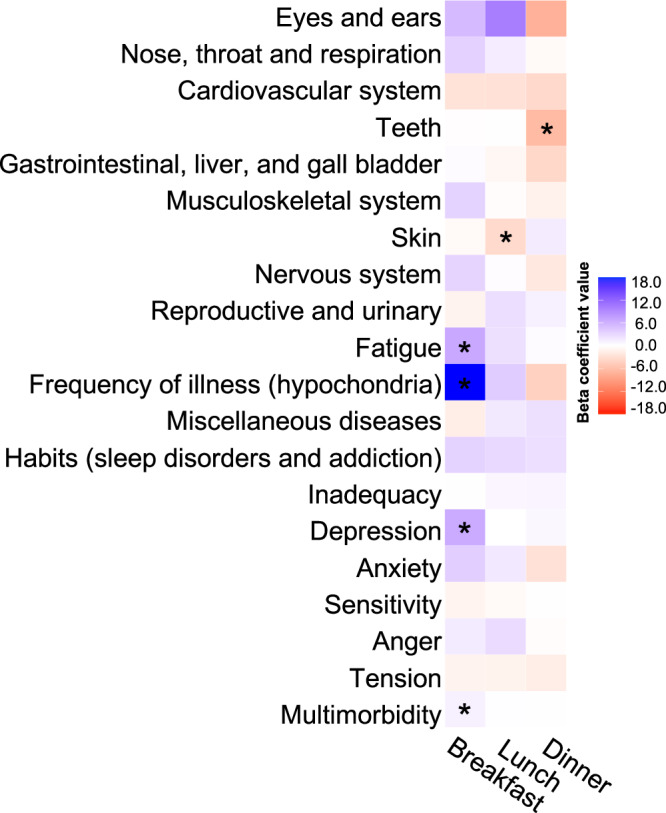
Heatmap of associations between physical and psychological illnesses and multimorbidity from the Cornell Medical Index with meal timing. Results are reported as regression coefficient (95% confidence interval) in minutes from model 1 adjusted for sex only. Positive coefficients indicate later meals; negative coefficients indicate earlier meals. Full association results are shown in tabular format in Supplementary Data . 1

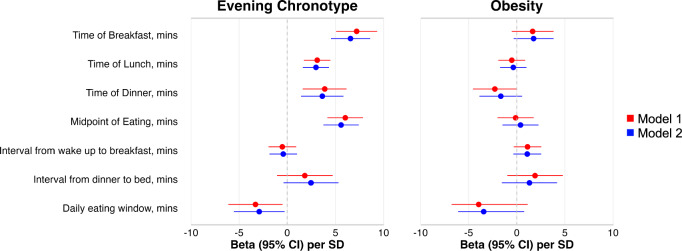
Evening chronotype and obesity polygenic scores associations with meal timing in older adults. Associations are adjusted beta values reflecting difference in meal timing in minutes per standard deviation of the polygenic scores. Model 1 is only adjusted for sex and 5 principal components of ancestry to account for population substructure as a time-independent variable and age as a time-dependent variable; model 2 additionally included time-independent variables such as socioeconomic status and education level, and time-dependent variables such as sleep duration, employment status, smoking status, marital status, alcohol consumption, and subjective health status. Association results are shown in tabular format in Supplementary Data . 5
Meal timing and all-cause mortality

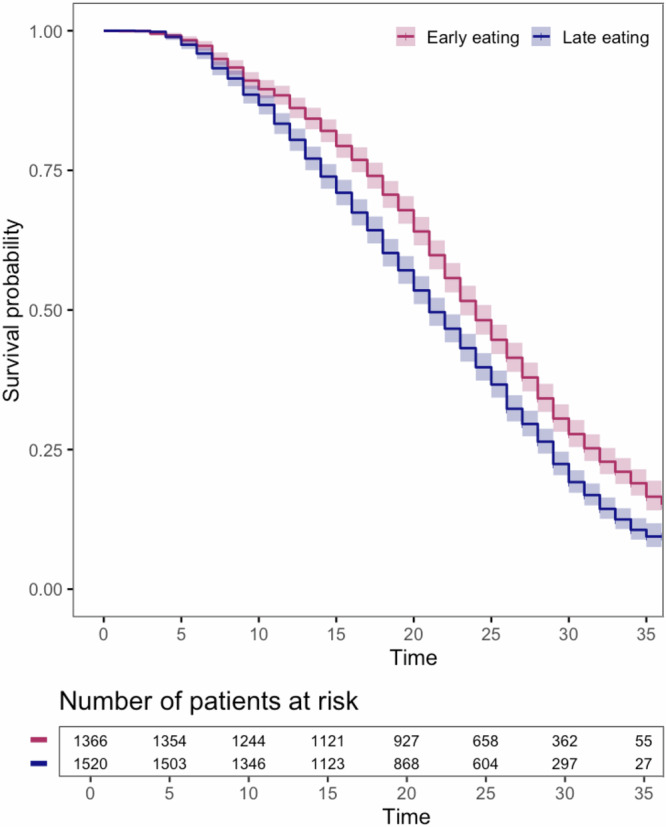
Kaplan–Meier survival curve for meal timing clusters and mortality. Kaplan–Meier survival estimates are shown as solid lines, with shaded regions representing the 95% confidence intervals at each time point.
| Model 1 | Model 2 | |||
|---|---|---|---|---|
| Hazard ratio (95% CI) | valuep | Hazard ratio (95% CI) | valuep | |
| Time of breakfast | 1.11 (1.03, 1.18) | 0.01 | 1.08 (1, 1.17) | 0.05 |
| Time of lunch | 1.05 (0.95, 1.15) | 0.3 | 1.05 (0.94, 1.15) | 0.39 |
| Time of dinner | 1.03 (0.97, 1.09) | 0.35 | 1.05 (0.99, 1.12) | 0.12 |
| Midpoint of eating | 1.06 (0.99, 1.13) | 0.084 | 1.07 (1, 1.15) | 0.052 |
| Interval from wake up to breakfast | 1.05 (0.96, 1.14) | 0.31 | 1.05 (0.95, 1.15) | 0.34 |
| Interval from dinner to bed | 0.98 (0.93, 1.03) | 0.45 | 0.76 (−1.96, 1.96) | >0.999 |
| Daily eating window | 0.97 (0.93, 1.02) | 0.41 | 1.00 (0.95, 1.05) | 0.91 |
Discussion
Longitudinal data from a large cohort of community-dwelling older adults, followed for over 20 years, showed gradual shifts in meal timing with aging, specifically toward later breakfast, dinner, and eating midpoint and a shorter interval between dinner and sleep. The onset of physical and psychological illnesses including multimorbidity, challenges with meal preparation and worse sleep, and genetic predispositions partly contributed to the observed shifts in meal timing. Distinct meal timing trajectories, particularly those characterized by later breakfast, were associated with increased mortality risk.
There is growing evidence to suggest that eating behaviors, including eating times, shift with aging13–17. Few cross-sectional studies compared meal timing in older and younger adults, although with mixed results. For example, data from the National Health and Nutrition Examination Survey (NHANES) suggest that older adults skip breakfast less frequently and have a later eating midpoint compared to younger individuals14. Conversely, other studies from the US and Japan report earlier meal times in older adults compared to younger adults16,17. The present study extends these findings by providing longitudinal data with repeat assessments of meal timing showing that meal timing continues to change throughout older adulthood. Specifically, the data suggest later breakfast and dinner times and a later eating midpoint with age, while lunch timing remains stable likely due to limited variability in lunch schedules across participants35. Although the per-decade shifts in meal timing were modest, they accumulate to a more substantial difference (approximately 45 min for breakfast timing) when considered across the full age range of participants spanning over five decades. The concurrent assessment of bed and wake times with the timing of traditional meals allowed for other relevant meal timing measures to be examined in this study, such as the interval from wake-up to breakfast and from dinner to bedtime. Consistent with prior studies, the data suggest shorter intervals between dinner and bed with aging independent of sleep changes16.
Morbidity may contribute to changes in meal timing among older adults. The systematic analysis of 19 illnesses indicated notable associations for depression, anxiety, and fatigue, and declining oral health with later meals. Furthermore, multimorbidity is also associated with later eating. Late eating in younger and older adults has previously been implicated in obesity and other metabolic disorders such as diabetes8,15,36. Limited evidence also suggests that meal timing also impacts physical health in older adults. For example, in a larger observational study of older adults, later eating was associated with lower grip strength, and a shorter eating interval was associated with lower muscle mass12. In another study, short-term time-restricted eating in older adults did not lead to physical or mental fatigue37. Although the observational design cannot establish directionality, it is more likely that the onset of disease leads to shifts in meal timing rather than shifts in meal timing contributing to the onset of disease. Overall, the results suggest that age-related physical and psychological health factors, including worse sleep, may play a role in shaping meal timing in aging populations, with multimorbidity potentially exacerbating these changes.
Genetic profiles for evening chronotype and obesity have been previously implicated with meal timing including later breakfast and breakfast skipping29,30,38. The present findings are consistent with findings in younger adults, demonstrating robust associations between evening chronotype genetic profiles and later meal times. The genetic analyses also corroborates epidemiological data indicating later eating among evening-type older adults39. The findings do not suggest that obesity-implicated genetic variants that are known to influence eating behaviors such as satiety and taste preferences further influence eating times in older adults29. Associations between both evening chronotype and obesity genetic risks with shorter eating windows may indicate post-meal snacking behavior among individuals at higher genetic risk. Overall, these findings suggest that individuals with genetic predispositions toward evening chronotype may be at the highest risk for late eating behaviors.
In the present study, later breakfast is associated with an increased risk of mortality, although the association was attenuated when considering the effects of important confounders. This finding is consistent with a previous study showing associations between breakfast skipping and increased mortality in older adults40. No associations with mortality were evident for the timing of lunch or dinner, length of the eating window, or the proximity of meals to sleep. In addition, the late eating cluster was associated with a lower survival rate compared to the early eating cluster. Age-related changes in the microbiome are known to influence energy utilization and appetite, which may partially mediate the observed associations41.
Anorexia of aging is a prevalent geriatric syndrome, characterized by a loss of appetite and reduced food intake, and is associated with undernutrition42,43. Established causes of anorexia of aging are changes in oral health, alterations in chemosensory and gastrointestinal functions such as swallowing disorders, cognitive decline and dementia, social factors, and medication side effects that may alter taste and smell or induce dryness and constipation42,43. The present findings suggest that the onset of anorexia of aging may be also accompanied by shifts toward later meal times, particularly breakfast. However, given the modest effect sizes observed, established screening approaches for anorexia of aging, such as regular weight monitoring and dietary assessment, remain essential for tracking overall health decline in older adults. Aging is known to dampen the entraining effects of behavioral cues, such as meal timing, thereby reducing the sensitivity of peripheral tissues to nutrients44. Based on the present findings, gradual delays in meal timing with age may mediate the observed effect. The results support the hypothesis that maintaining consistent eating schedules, including breakfast times, could restore circadian rhythms in older adults45. Addressing the onset of pathologies such as depression and fatigue that may lead to meal delays may support robust rhythms in older adults.
A major strength of this study is the repeated assessment of meal timing in a large cohort of community-dwelling older adults (though most participants had only two assessments given the aging nature of this older adult cohort) allowing for the consideration of both inter- and intra-individual variation in meal timing patterns.
Additionally, the concurrent assessment of sleep and relevant sociodemographic factors allowed for the inclusion of other meal timing variables in the longitudinal analyses. However, several limitations should be noted. Currently, there are no standard methodologies or established variables for chrononutrition, making it difficult to compare results across studies and cohorts46. Furthermore, the study was unable to derive other common meal timing variables, such as eating frequency, meal timing variability, and the first and last eating occasions, which may capture snack consumption outside traditional meal times12. However, previous studies using 24-h recalls in older adults indicate that most tend to consume three primary meals, justifying the focus on the traditional meals in the analysis47. In addition, while some research suggests considerable day-to-day variation in meal timing among older adults48, others have not17. Therefore, the questions on mealtimes and bedtime routines may not accurately reflect participants' actual behavioral patterns, and assumptions about typical eating habits based on other populations may not apply to the present sample. Additionally, meal frequency and skipping behaviors, areas of interest in older adults and chrononutrition, were not examined as missing meal timing data could have been misinterpreted as skipped meals. Moreover, the timing of specific nutrients, including protein content, which has been shown to associate with skeletal muscle mass in older adults when ingested before sleep, was not evaluated in this study49,50. Another limitation is the reliance on the CMI for capturing morbidity, which, although correlated with clinical diagnoses, may not identify asymptomatic conditions that could only be detected through laboratory tests or physical examinations51. The cohort recruited healthy, community-dwelling older adults of British European ancestry, which may limit the generalizability of the findings. Non-random attrition and dropout effects in this older adult population may have introduced bias because participants with poorer health may have fewer repeated assessments52. Lastly, although our models accounted for several potential confounders, they did not include physical activity, and residual confounding remains possible.
In summary, the findings suggest that meal timing shifts with aging and is associated with morbidity and mortality in older adults. Future research, including randomized controlled trials, is needed to explore the potential of meal timing as a strategy to promote longevity in aging populations.
Supplementary information
Supplementary Information Description of Additional Supplementary Files Supplementary Data 1 Supplementary Data 2 Supplementary Data 3 Supplementary Data 4 Supplementary Data 5 Reporting Summary