
What this is
- This research investigates the effects of SARS-CoV-2 Omicron BA.5 infection in BALB/c mice.
- It focuses on acute disease symptoms and the development of post-acute lung fibrosis.
- The study highlights the potential for monoclonal antibodies to prevent lung disease following BA.5 infection.
Essence
- SARS-CoV-2 BA.5 infection in mice leads to significant acute lung injury and post-acute fibrosis, with potential for monoclonal antibodies to mitigate disease.
Key takeaways
- BA.5 infection in aged mice causes severe weight loss, reaching up to 80% by 4 days post-infection, indicating high pathogenicity.
- Monoclonal antibodies administered before infection significantly reduced weight loss and lung disease severity, demonstrating potential for therapeutic intervention.
- Survivors of BA.5 infection exhibited chronic lung fibrosis with associated tertiary lymphoid structures, suggesting long-term health implications.
Caveats
- The study primarily uses female mice, which may not fully represent disease outcomes in male mice, where different disease severities have been observed.
- Results may not directly translate to human disease due to species differences in immune response and disease progression.
Definitions
- post-acute sequelae of SARS-CoV-2 (PASC): A chronic condition affecting multiple organ systems that persists for weeks to years in some COVID-19 survivors.
Simplified
INTRODUCTION
Severe acute respiratory syndrome coronavirus 2 (SARS-CoV-2) virions contain an approximately 30 kb positive-sense single-stranded viral genome that encodes numerous structural proteins (spike, membrane, envelope, and nucleocapsid), non-structural proteins (nsp1–16), and several accessory genes (1, 2). Following its emergence in late 2019, SARS-CoV-2 rapidly evolved into numerous variants of interest and variants of concern (VOC). The Omicron B.1.1.529 VOC (BA.1) was of significant interest because it encoded a substantial number of amino acid changes within the main antigenic site, the spike gene (S), especially within the receptor-binding domain (RBD), and the receptor-binding motif (RBM). BA.5, which emerged in early 2022, is a descendant lineage of Omicron that contained additional alterations within the RBD/RBM protein sequence. Due to the role of the spike protein (S) in cellular attachment to angiotensin-converting enzyme 2 (ACE2) and subsequent viral entry following its cleavage by transmembrane protease serine 2 (TMPRSS2), the expanded spike variation was associated with enhanced receptor binding, antibody evasion, and reduced efficacy of both natural and vaccine-induced immunity (3). Amino acid mutations in these domains enabled escape from neutralizing antibodies (4–9).
Inconsistent results in mouse models using BA.5 isolates were observed by different research groups regarding the degree of pathogenicity as compared to BA.1 or previous ancestral viruses (10, 11). However, in both cases, disease severity was overall attenuated compared to early VOCs, like Alpha and Delta, likely mitigated by differences in the clinical isolate, inoculum dose, mouse strain, sex, and age of animals (12–14). Consequently, we generated recombinant SARS-CoV-2 viruses to study the effect of the BA.5 S protein in pathogenicity. As such, we utilized a reverse genetics infectious clone system in order to replace the spike gene of our previously described MA10 virus with the spike gene sequence from BA.5 (designated BA.5 MA) (15–17). In parallel, we also recovered a derivative strain without mouse adaptations in which the viral ORF7a was replaced with a gene encoding the reporter protein nanoluciferase (nLuc) to be used as an indicator virus in live-virus neutralization assays (BA.5 nLuc) (15–20). BA.5 MA infection in young (14- to 16-week-old) or aged (10- to 12-month-old) female BALB/c mice caused severe diffuse alveolar damage with accompanying mortality and high virus titers in the lungs and nasal turbinates, which was significantly attenuated by prophylactic administration of monoclonal antibodies (mAbs). In contrast, we also produced viruses expressing the BA.2 Omicron S protein on the same viral backbones to be used in in vivo and in vitro assays as were performed with BA.5. Infection of aged female BALB/c mice with BA.2 MA failed to produce overt disease symptoms such as weight loss and mortality but did replicate to high viral titers in both the lungs and nasal turbinates.
SARS-CoV-2 symptomatic or asymptomatic infection may progress to post-acute sequelae of SARS-CoV-2 (PASC), a frequent chronic disease syndrome that includes a continuous, relapsing and remitting, or progressive disease state that affects one or more organ systems and lasts for weeks to years in about ~10% of SARS-CoV-2 survivors (21–23). In the respiratory tract, shortness of breath, cough, persistent fatigue, post-exertional malaise, and diagnosable conditions like interstitial lung disease and hypoxemia are among the most frequent chronic disease phenotypes. Omicron-related infections are reported to cause less frequent PASC disease in humans as compared to ancestral VOCs (24). To begin to dissect potential virus-centric differences in PASC disease potential, we first sought to develop Omicron-based models of acute and post-acute lung pathogenesis using mouse-adapted SARS-CoV-2 bearing BA.5 or BA.2 S proteins. We show that S is a major driver of acute pathogenesis and that severe acute disease can drive post-acute lung sequelae. The humoral immune response was dominated by homotypic responses, and the magnitude of heterotypic neutralizing responses correlated with genetic relatedness to Omicron. We also demonstrate these models can be used to evaluate antiviral therapies. Altogether, these models can be leveraged to study pathogenic mechanisms of acute and long COVID and whether pre-existing long COVID conditions impact acute/chronic disease potential for future SARS-CoV-2 VOC or even other respiratory virus infections.
RESULTS
Recovery of Omicron recombinant viruses
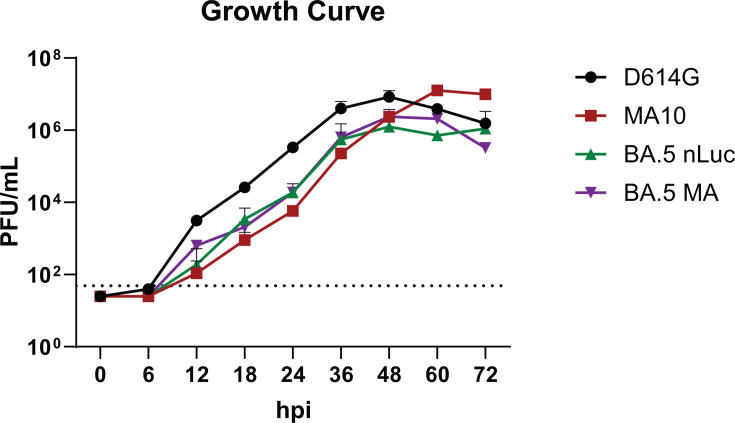
Using reverse genetics, we generated a mouse-adapted SARS-CoV-2 MA10 recombinant bearing the BA.2 or BA.5 subvariant spike (BA.2 MA and BA.5 MA) and a related reporter virus where we replaced ORF7a with nanoluciferase (BA.2 nLuc and BA.5 nLuc) (15–17). Genome schematics of the infectious clone constructs are shown in Fig. S1. To assess replication kinetics, the growth of the two BA.5 recombinant viruses was compared to that of the ancestral strains SARS-CoV-2 MA10 and D614G nLuc, at an MOI of 0.001 on Vero E6 cells. The growth kinetics of BA.5 MA and BA.5 nLuc were the same, indicating that replication was not impacted by the inclusion of the reporter gene. The ancestral pandemic strain (SARS-CoV-2 D614G) had a growth advantage over both BA.5 viruses at most times assessed (Fig. 1). Importantly, parental SARS-CoV-2 MA10 virus grew similarly to both BA.5 viruses early in the kinetic, yet parental MA10 titers exceeded those of BA.5 viruses at later timepoints (Fig. 1). Altogether, these data demonstrate that our BA.5. spike recombinant viruses grew efficiently in Vero cells.

Growth curve analysis identifies replication competency of BA.5 MA and nLuc. Growth dynamics for the recombinant BA.5 MA and BA.5 nLuc viruses were compared to ancestral counterparts (D614G nLuc and MA10) to assess for replication competency and equivalent or attenuated replication. Maximal virus titers were reached between 48 and 60 hours post-infection with an MOI of 0.001. Both parental viruses achieved maximal titers ~10-fold higher than those of the recombinant BA.5 viruses.
Pathological features of BA.5 MA infection in young mice
We have previously established a model of SARS-CoV-2 pathogenesis using mouse-adapted SARS-CoV-2 MA10 in female BALB/c mice (15). To evaluate BA.5 MA pathogenesis in a similar model, we infected 14- to 16-week-old adult female BALB/c mice intranasally with different doses, 104 or 105 plaque-forming units (PFUs), evaluating dose-dependent disease outcomes. While both cohorts experienced weight loss, the low-dose cohort only experienced a 10.7% group mean weight loss nadir at 4 days post-infection (dpi). In contrast, the high-dose cohort continued to lose weight throughout the study, eventually exceeding 20% of starting group mean weights (Fig. 2A). Gross lung discoloration (GLD) score is a semi-quantitative measure of acute lung damage associated with emerging CoV replication, indicative of edema and diffuse alveolar damage (15, 25). Like weight loss, GLD scores were significantly increased in the high-dose cohort as compared to the low-dose group (Fig. 2B). Similarly, mortality was only observed in the high-dose group (Fig. 2C). Regardless of inoculum dosage, the levels of viral replication within the lungs and nasal turbinates showed no significant difference between the two cohorts (Fig. 2D and E). Acute lung injury (Fig. 2F) and diffuse alveolar damage (Fig. 2G) were assessed using histological scoring schema that have been utilized for multiple emerging CoVs (15, 25). Both scoring metrics (Fig. 2F and G) revealed that acute lung injury was significantly elevated regardless of virus dose, which was evident in photomicrographs of representative mock-infected (phosphate buffered saline [PBS] inoculation) (Fig. 2H), 104 PFU (Fig. 2I), and 105 PFU (Fig. 2J) infected animals sacrificed at 4 dpi.

Dose-dependent pathogenicity in young mice following BA.5 MA challenge. Pathogenicity of the BA.5 MA virus was assessed in 14- to 16-week-old female BALB/c mice to determine their applicability as a model system for pathogenicity studies. () Weight loss was tracked daily for PBS control cohorts, as well as 10and 10PFU BA.5-MA-infected mice. Dashed line represents 20% wt loss, and solid line represents 30% wt loss, a humane euthanasia criterion. () GLD was evaluated and scored at the indicated timepoints of 2, 4, and 7 dpi. () Survival analysis of mice in the seven dpi cohorts identified only a dose of 10PFU resulted in mortality. () Virus titers were determined for replication-competent virus by plaque assay following homogenization of lung or nasal turbinate tissues. Dashed line represents limit of detection. () Lung damage was evaluated by two metrics, either Matute-Bello acute lung injury scoring in panel F or by diffuse alveolar damage scores in panel G. (H–J) Representative histopathological sections of lungs from PBS (), 10PFU BA.5 MA (), or 10PFU BA.5 MA-infected mice () at 4 days post-infection are shown (A, alveoli; Br, bronchiole; BV, blood vessel; stippled arrows, proteinaceous debris; ⁎⁎, hypercellular alveoli; solid arrow, presence of infiltrating cells in alveolar spaces). Scale bar represents 200 µm. Symbols in panels B and D–G denote statistically significant relationships at the respective levels: *,< 0.05; **,< 0.01; ***,< 0.001; ****,< 0.0001. A B C D and E F and G H I J 4 5 5 4 5 P P P P
Pathological features of infection in aged mice
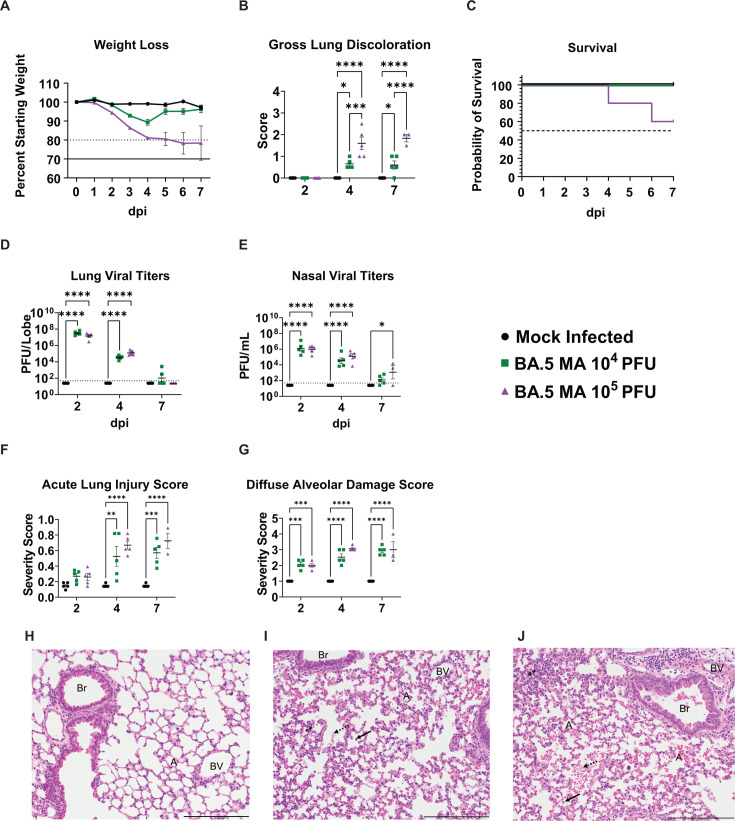
Viral pathogenesis was then evaluated in 10- to 12-month-old mice infected with 104 or 105 PFU of BA.5 MA. Both high- and low-dose cohorts rapidly lost weight approaching 80% of starting weight by 4 dpi (Fig. 3A). GLD scores were elevated in the high-dose cohort as compared to the low-dose group (Fig. 3B). Although trends in body weight loss were similar up to 5 dpi, high-dose infection was uniformly lethal (Fig. 3C), while the majority of low-dose infected animals survived out to 15 dpi. As observed in the younger mice above, lung and nasal titers between the infected groups did not differ significantly, regardless of dose (Fig. 3D and E). As expected, infection was associated with increases in the histopathological measures of acute lung injury (Fig. 3F) and diffuse alveolar damage (Fig. 3G). Lung tissue sections were evaluated for fibrotic lesions by Picrosirius red staining (26). Like acute lung injury scores, the frequency of profibrotic lesions increased with infection (Fig. 3H). At later times post-infection (7, 15 dpi), we evaluated tissue sections for the prevalence of pro-fibrotic regions (Fig. 3H). Like before, only the low-dose group had elevated fibrosis scores over mock-infected animals, and importantly, no high-dose animals survived to 15 dpi and thus could not be included in this analysis. Counterintuitively, the low-dose group had elevated histological scores (Fig. 3F through H) as compared to the high-dose group, but this was likely driven by survivor bias since the few high-dose infected animals that survived to later times post-infection likely had diminished disease severity compared to those that perished at earlier times. Histologic manifestations of acute lung injury, including accumulation of proteinaceous debris in the airways, inflammatory cell infiltration, and alveolar septal thickening are shown in Fig. 3I through K.

BA.5 MA induces pro-fibrotic lesions in aged mice following acute phase disease resolution. 10- to 12-month-old female BALB/c mice were used to evaluate the pathogenicity after receiving a dose of either 10or 10PFU of BA.5 MA. () Weight loss was recorded daily over the course of the study. The dashed line represents 20% wt loss, and the solid line represents 30% wt loss, a humane euthanasia criterion. () GLD was recorded at each harvest timepoint. () Mortality of a representative cohort of five mice per group that were followed until the end of the study at 15 dpi (). Plaque assays were conducted on lung and nasal turbinate tissues to determine replication-competent virus burden. Dashed lines represent the limit of detection. () Histopathological examination was conducted on fixed lung sections to determine lung damage as a result of challenge. () Prevalence of pro-fibrotic lesions was scored for lungs from subjects following Picrosirius red staining (0 = none; 1 = <5% of parenchyma; 2 = 6 to 10%; 3 = 11% to 50%; 4 = 51% to 95%, 5 = >95%). () Representative images are shown at 4 dpi for mice inoculated with PBS, 10PFU, or 10PFU (A, alveoli; Br, bronchiole; BV, blood vessel; stippled arrows, proteinaceous debris; ⁎⁎, hypercellular alveoli; solid arrow, presence of infiltrating cells in alveolar spaces). Scale bar represents 200 µm. Symbols in panels B–H denote statistically significant relationships at the respective levels: *,< 0.05; **,< 0.01; ***,< 0.001; ****,< 0.0001. 4 5 4 5 A B C D and E F and G H I–K P P P P
Monoclonal antibody treatment abrogates BA.5 MA-inflicted disease
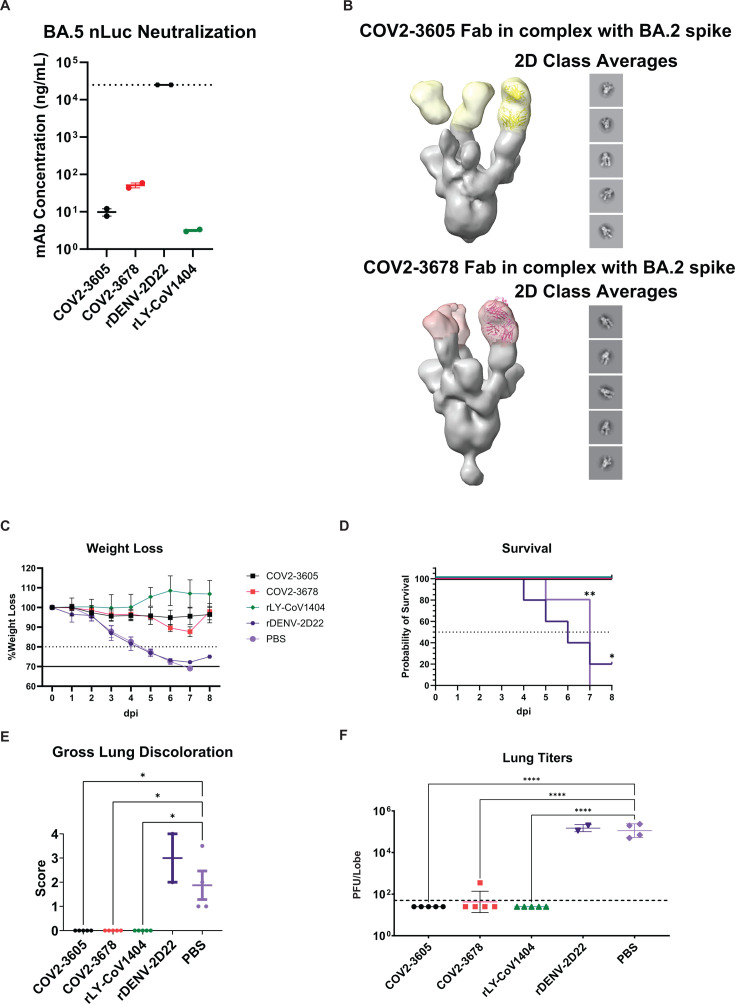
From a selected panel of representative SARS-CoV-2 reactive human monoclonal antibodies (mAbs), we identified two that showed robust neutralization titers against BA.5 nLuc (Fig. 4A). Two mAbs (COV2-3605 and COV2-3678) were compared against a recombinant version of a neutralizing SARS-CoV-2 monoclonal antibody (rLY-CoV1404) that served as a positive control, and an isotype-matched recombinant version of a human mAb antibody recognizing the unrelated dengue virus envelope protein (rDENV-2D22) that served as a negative control. In addition, a mock treatment group received an equivalent volume of PBS. In a neutralization assay against BA.5 nLuc, all three SARS-CoV-2 antibodies potently neutralized the virus, with IC50 titers of 9.7 ng/mL for COV2-3605, 51.7 ng/mL for COV2-3678, and 3.2 ng/mL for rLY-CoV1404 (Fig. 4A). Both, COV2-3605 and COV2-3678 are encoded by the human antibody variable gene segment IGHV3-53. Many IGHV3-53- and IGHV3-66-encoded mAbs constitute a public clonotype, and this class of antibodies has been recurrently isolated from human subjects following SARS-CoV-2 infection or vaccination (27–30). Negative-stain electron microscopy (EM) revealed COV2-3605 Fab and COV2-3678 Fab bound to RBDs in the open conformation of the spike, consistent with the fact that members of this public clonotype target the semi-cryptic class I antigenic site (Fig. 4B) (31). Negative-stain EM data collection statistics are provided in Table S1.
To assess the prophylactic efficacy of mAbs, 10- to 12-month-old female BALB/c mice were treated with antibodies via intraperitoneal injection of 200 µg of mAb, and 12 hours later, mice were inoculated with a lethal dose of 105 PFU of BA.5 MA. Mice treated with COV2-3605 or rLY-CoV1404 showed minimal or no weight loss. In contrast, ~10% transient weight loss was observed at 5 and 6 dpi for the COV2-3678-treated cohort (Fig. 4C). Importantly, negative control group mice (i.e., PBS or isotype-matched control mAb rDENV-2D22) showed rapid weight loss through 7 dpi, with all animals succumbing to infection or reaching humane endpoints for euthanasia by 7–8 dpi (Fig. 4D). Similarly, only negative control group animals had elevated GLD scores (Fig. 4E). Minimal breakthrough infection was noted in the COV2-3678-treated mice, with one of five mice exhibiting low replicating virus at 4 dpi (Fig. 4F). In contrast, no live virus was detected in the COV2-3605 and rLY-CoV1404 mAb-treated cohorts. Viral titers in mAb-treated cohorts were significantly reduced compared to PBS-treated cohorts, which had titers approaching 105 PFU/lobe (P < 0.0001).

Candidate monoclonal antibodies abrogate disease pathology. 10- to 12-month-old female mice were dosed prophylactically with 200 µg of mAb or PBS intraperitoneally 12 hours prior to challenge. () Neutralization potency of mAbs was assessed against BA.5 nLuc. () Negative-stain EM of COV2-3605 and COV2-3678 Fabs in complex with BA.2 S protein shows these mAbs recognize the RBD in the up conformation and likely bind the Class I antigenic site. () Weight loss was recorded daily over the course of the study. The dashed line represents 20% wt loss, while the solid line represents 30% wt loss, a humane euthanasia criterion. () Cohort survival was evaluated for a subset of mice (= 5) that was followed for the entire duration of the study. () GLD was observed at the time of mouse sacrifice. () Lung titers were determined via plaque assay to assess the quantity of replication-competent virus in lung tissue taken from mice sacrificed at 4 dpi. The dashed line represents the limit of detection. Symbols in panels D–F denote statistically significant relationships at the respective levels: *,< 0.05; **,< 0.01; ****,< 0.0001. A B C D E F n P P P
Modeling Omicron-associated post-acute lung pathology with BA.2 and BA.5 MA
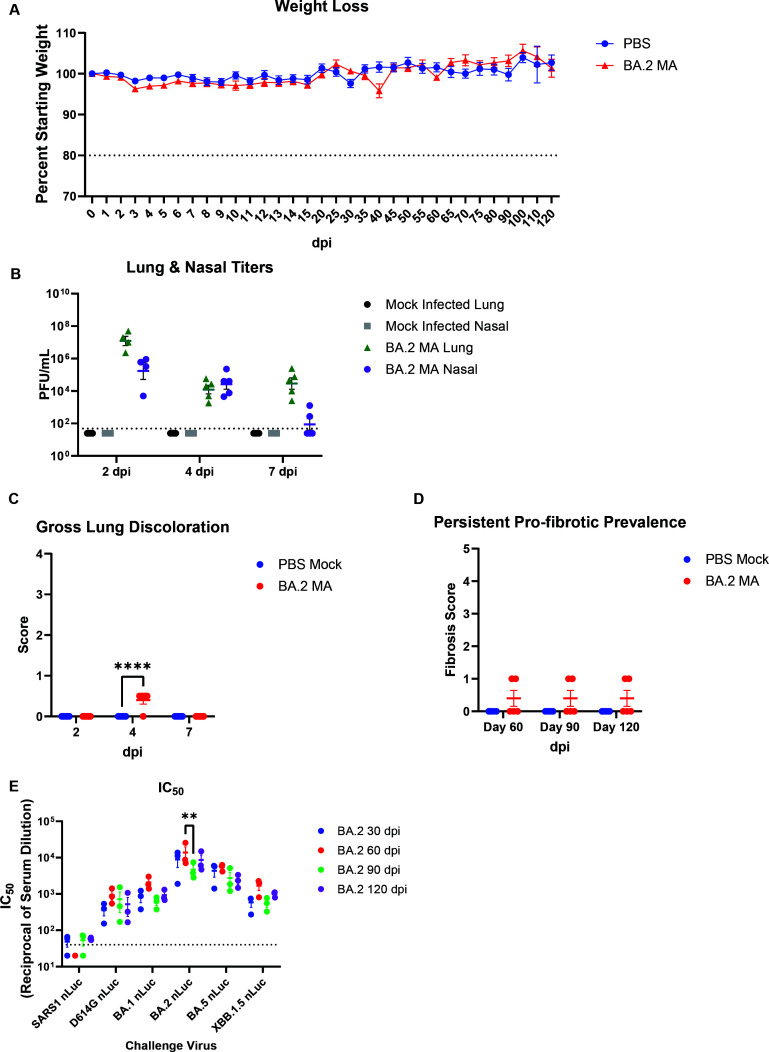
We have previously developed a model of PASC-like lung pathology using a mouse-adapted ancestral pandemic strain SARS-CoV-2 MA10 in aged mice (26). Omicron-related infections are reported to cause less frequent PASC disease in humans as compared to ancestral VOCs (24). To understand the potential role of spike protein variation in this disease process, we generated a mouse-adapted recombinant BA.2 Omicron spike virus (BA.2 MA) that is different in 4 amino acids in the spike gene from the BA.5 MA spike-containing virus. To understand BA.2 MA PASC potential, we infected cohorts of 10- to 12-month-old female BALB/c mice with PBS (mock) or 105 PFU of BA.2 MA and followed animals through 120 dpi (BA.2 MA) to evaluate virologic and pathologic outcomes. Unlike with the BA.5 MA infection noted above, BA.2 MA-infected mice exhibited minimal weight loss (Fig. 5A), despite viral replication in both the lung and nasal turbinates achieving comparable levels to those seen in the BA.5 MA-infected mice described above, demonstrating the role of spike protein variation on disease progression and severity (Fig. 5B). Congruent with body weight loss, gross pathology (Fig. 5C), and histologic measures of lung fibrosis (Fig. 5D) were largely absent and non-remarkable post-BA.2 MA infections. We next measured the magnitude and durability of the neutralizing antibody response in BA.2 MA challenged mice using antigenically homologous (BA.2 nLuc) or heterologous (SARS-CoV-1 nLuc, SARS-CoV-2 D614G nLuc, SARS-CoV-2 BA.1 nLuc, SARS-CoV-2 BA.5 nLuc, and SARS-CoV-2 XBB.1.5 nLuc) Sarbecoviruses (20). As expected, the homotypic neutralization response against BA.2 was the most robust (~10,000 IC50) (Fig. 5E). The magnitude of the heterotypic responses varied by genetic proximity to BA.2, where responses were 10-fold lower to ancestral pandemic strains (D614G) and were also reduced against more future emerging Omicron variants (e.g., BA.5, XBB1.5) (Fig. 5E). To understand the long-term consequences of BA.5 MA infection, we infected similarly aged mice noted above with PBS or 10-fold less virus (104 PFU) to ensure disease with the majority of animals surviving. Congruent with Fig. 3, BA.5-infected animals lost an average of 17.4% ± 7.6% by 7 dpi but recovered by 30 dpi (Fig. 6A) with approximately 60% survival (Fig. 6B). Gross pathology GLD scores, which are most evident during the acute phase of infection (Fig. 3B), were low but measurable at 15 dpi and waned over time (Fig. 6C). Neither replication-competent virus via plaque assay nor viral RNA via quantitative reverse transcription-PCR was detected in lung tissue, and viral nucleocapsid antigen was not detected in lung, liver, kidney, or spleen tissue sections at any times assessed (data not shown). Lung fibrosis was evident by Picrosirius red staining with mean scores averaging between ~2 and 3 over time, indicating fibrotic lesions involving 6% to 50% of the lung parenchyma (Fig. 6D). By day 107, about 20% of the BA.5 MA virus-infected mice had resolved the most prominent long COVID lesions. Unlike mock-infected animals, BA.5 infection was associated with subpleural chronic alveolitis with scattered tertiary lymphoid structures and areas of PSR-stained interstitial fibrosis in the alveolar parenchyma at both 30 and 107 dpi (Fig. S2), thus confirming an association between chronic inflammation and fibrosis. Like BA.2 infection, homotypic neutralizing antibody responses were most robust at 30 dpi and waned through 107 dpi (Fig. 6E). As before, BA.5 serum poorly neutralized ancestral and more contemporary SARS-CoV-2 VOC and zoonotic strains. Overall, the magnitude of the heterotypic responses was driven by genetic proximity to the homotypic antigen like BA.2 above and demonstrated that Omicron spike variation can have a profound impact on acute and post-acute pathogenesis in our mouse model.

Acute and chronic disease trajectory of BA.2 MA-infected mice. 10- to 12-month-old female mice were inoculated with 10PFU of BA.2 MA. Following challenge cohorts of mice were observed out to 120 dpi with planned sacrifices at 2, 4, 7, 15, 30, 60, 90, and 120 dpi. () Mouse weights were recorded daily through the first 15 days of the experiment, after which monitoring was conducted every 5 days until day 80, and subsequently every 10 days until the terminal harvest. () Lung and nasal turbinate titers were assessed in cohort members at 2, 4, and 7 dpi and compared to mock-infected controls. The dashed line indicates the limit of detection. () GLD scores were evaluated at the acute infection timepoints. () Fibrotic scores of the lung parenchyma were assessed on samples collected at 60, 90, and 120 dpi. () Live-virus neutralization assays were performed on serum collected from mice at the indicated collection timepoints. Sera were assayed against SARS-CoV and SARS-CoV-2 viruses expressing the D614G S protein or Omicron BA.1, BA.2, BA.5, and XBB.1.5 S proteins. Symbols denote statistically significant relationships at the respective levels: **,< 0.01 and ****,< 0.0001. 5 A B C D E P P

BA.5 MA induces chronic lung disease phenotypes and induces persistent homotypic neutralizing antibodies. 10- to 12-month-old female mice were inoculated with 10PFU of BA.5 MA and followed for 107 days. () Weight loss was tracked daily over the acute phase of the infection (15 days), after which it was recorded every 5 days. () Survival was recorded for mice from the 107 dpi cohort. () Lung discoloration was evaluated at the indicated timepoints. () Histopathological examination was performed on Picrosirius red-stained lung sections to determine the presence of fibrotic lesions in the lung parenchyma. () Live-virus neutralization assays were performed on blood serum collected from mice at the indicated collection timepoints. Sera were assayed against SARS-CoV or SARS-CoV-2 viruses expressing the D614G spike or Omicron BA.1, BA.5, and XBB.1.5 S proteins. Dashed line represents limit of detection. Symbols denote statistically significant relationships at the respective levels: *,< 0.05; **,< 0.01; ****,< 0.0001. 4 A B C D E P P P
DISCUSSION
SARS-CoV-2, the etiological agent responsible for the COVID-19 pandemic, has caused significant global morbidity and mortality, with excess mortality estimates approaching 20–25 million or more (32). In most populations, Omicron acute disease severity is reduced compared to ancestral VOCs but nevertheless continues to cause a significant disease burden with an estimated 32,000 to 50,000 deaths from October 2024 through June 2025 primarily concentrated among the elderly and certain immunocompromised populations (33–35). Both ancestral and contemporary SARS-CoV-2 VOC infections can cause chronic multiorgan system-level disease phenotypes, which have been termed long COVID or PASC. Long COVID disease symptoms can persist for months after resolution of acute infection (36, 37). Although long COVID symptoms are more likely to occur after primary infection and the overall rates of long COVID diagnoses are decreasing over time, millions of people have been impacted by long COVID, and there remains a risk of post-acute sequelae associated with reinfection (36, 38, 39). While some human studies suggest that persistence of viral RNA is a principal driver of PASC, the vast minority of chronic cases have little if any detection of persistent viral RNA, and a 15-day antiviral treatment with Paxlovid did not improve outcomes suggesting that at least persistent replication was not playing a major role in PASC (40, 41). Our data, and those of others, suggest that aberrant epithelial-immune cell interactions and/or lung repair defects drive chronic post-acute lung disease (42, 43). Altogether, these data show that important questions remain regarding the pathogenic mechanisms of long COVID and whether pre-existing long COVID conditions impact acute/chronic disease potential for future SARS-CoV-2 VOC or even other respiratory virus infections. Our ancestral and contemporary SARS-CoV-2 acute and chronic disease models presented herein provide a platform to systematically address these issues and assess the impact of medical countermeasures in models with more contemporary strains.
BA.5 MA infection in mice causes severe acute infection with histologic manifestations of acute lung injury (e.g., diffuse alveolar damage) reminiscent of infection with SARS-CoV-2 MA10, a mouse-adapted virus based on the original pandemic strain. Here, we find that BA.5 and BA.2 spike glycoprotein genes attenuate MA10 pathogenesis in vivo in aged mice, which is uniformly lethal at 104 or greater dose in aged animals (15). We show an age-related exacerbation of pathogenesis like that observed in humans. Nevertheless, in humans, females are more likely to develop long COVID, and we aimed to generate data sets directly comparable to those from SARS-CoV-2 MA10-infected female mice (26, 44). Importantly, we demonstrate here that lower doses of BA.5 MA result in post-acute pathogenesis in the lung as evidenced by organizing pneumonia with tertiary lymphoid structures and fibrotic lesions through 107 dpi. Thus, this model could be leveraged to understand the impact of post-acute sequelae on subsequent viral infections, vaccine efficacy, and medical countermeasures to treat acute and chronic pathogenesis (17). In contrast, the BA.2 spike fully attenuated acute and chronic disease phenotypes in aged mice, despite replicating to similar titers at early times post-infection. The discordance among BA.2 and BA.5 MA outcomes in our model demonstrates the potential for S variation to impact acute and chronic pathogenesis. Our spike recombinant viruses were constructed within an isogenic SARS-CoV-2 background, thus genetically are only different in S at four positions (Δ69-70, L452R, F486V, and the wild-type Q493 in BA.5) all of which could be potential drivers of disease (45–48). Three of these mutations fall within the RBM of S. Previous studies have demonstrated that the L452R mutation in RBD enhanced ACE2 binding, fusogenicity, and infectivity, suggesting this mutation could be responsible for driving the differences in pathogenicity amongst BA.2 and BA.5 MA (49, 50). Notably, our group has previously demonstrated that a single amino acid polymorphism in S protein at position F486 can drive widely disparate disease outcomes in mice infected with XBB.1 MA versus XBB.1.5 MA (20). Despite BA.2 and BA.5 MA achieving similar titers in mice at 2 dpi, S variation could impact the kinetics of replication prior to 2 dpi and/or differences in epithelial cell tropism leading to the disparate outcomes in our data. Regardless of the mechanism, our data indicate that changes in ACE2 binding affinity could drive differential pathogenesis further implicating S protein as a major driver of disease.
COVID-19 humoral immunity acquired from natural infection is highly variable in magnitude and durability compared to vaccine-elicited immunity. In general, more severe infections oftentimes elicit higher and more durable neutralizing responses as compared to mild infections in humans (51–53). While the pathogeneses of BA.2 and BA.5 MA differed in our model, the levels of viral replication were similar at early times, and as such, the magnitude of the homotypic neutralizing responses was similar. However, neutralization breadth was limited, especially against heterotypic ancestral strains (e.g., SARS-CoV, SARS-CoV-2 D614G, and Omicron BA.1) and future, more distantly evolved Omicron-related VOC strains (i.e., XBB.1.5). Nevertheless, detailed study of the antibody repertoire after natural infection or vaccination provides an opportunity for the discovery of novel therapeutic monoclonal antibodies which have demonstrated clinical utility in treating COVID-19 (54, 55). Unfortunately, the emergence of the Omicron lineage was associated with a significant decline in Food and Drug Administration-approved mAb performance due to the accrual of mutations in S and especially those in the RBD and RBM (56–58). To understand the breadth of efficacy and mechanism of action of two mAbs (COV2-3605 and COV2-3678) isolated from an individual following a BA.1 breakthrough infection, we evaluated these mAbs in our BA.5 models. These mAbs target the RBM of the SARS-CoV-2 RBD and are encoded by antibody variable gene IGHV3-53, making them members of a previously described public clonotype using IGHV3-53/IGHV3-66 genes. COV2-3605 and COV2-3678 potently neutralized BA.5 in vitro and in vivo, demonstrating that continued surveillance of patients with breakthrough infections can facilitate the identification of novel monoclonal antibodies with great breadth and efficacy. The use of in vivo models in this context is of importance as multiple factors including biodistribution, route of administration, and therapeutic windows can impact the efficacy of mAbs and their neutralizing competency compared to in vitro data. Importantly, the class I antigenic site targeted by members of this public clonotype continues to be a major target of human immunity and has accumulated further antigenic substitutions (59). However, some mAbs with this gene usage have been described that show extraordinary breadth of reactivity and resilience to escape (60).
In summary, we show that the Omicron spike can differentially elicit acute and chronic pathogenesis in BALB/c mice, including progression to long-COVID-like pulmonary disease. Disease severity is tunable based on the nature of the S protein and animal age. These findings could reflect the impact of initial viral infection inoculum on immediate response to the insult, perhaps suggesting that cytokine storm phenomena may be driving enhanced disease profiles at higher doses. Most critically, the model enables study of acute and chronic disease mechanisms in pulmonary and extra-pulmonary compartments and provides a platform for the development of medical countermeasures that target both acute and chronic disease manifestations. We show that homotypic immunity dominated the primary Omicron humoral response and that cross-protection prominently waned against ancestral pandemic strains. Since immunity to SARS-CoV-2 S has limited durability and S evolution is likely to continue to retain endemicity, our global immunity in decades to come is unlikely to effectively combat zoonoses from ancestral SARS-like viruses which circulate among reservoir species, providing opportunities for future emergence events (Fig. S3) (61–69). A weakness of this study is the focus on disease in female mice, as studies with MA10 have revealed more significant virulent acute and chronic disease phenotypes in the lungs of males (70). The study of acute and chronic CoV disease mechanisms as well as vaccine and countermeasure development remains essential for pandemic preparedness, providing a rationale for the continuation of CoV model development like those described herein.
MATERIALS AND METHODS
Virus and cells
Using reverse genetics, we recovered the BA.5 and BA.2 wild-type spike gene (S) sequence in the background of previously described mouse-adapted mutations (BA.5 MA and BA.2 MA) (GenBank under accession numbers PV800150↗ and PV800152↗) (20, 21). A second set of viruses encoding the BA.5 or BA.2 S protein sequence that expressed nanoluciferase gene in place of ORF7a as previously described (BA.5 nLuc and BA.2 nLuc) (GenBank under accession numbers PV800151↗ and PV800153↗) (20, 21). Infectious virus recovery was performed as previously described (17, 20). Viral growth curve analysis was performed by infecting Vero E6 cells at an MOI of 0.001.
For recombinant protein expression, Expi293F cells (Thermo Fisher Scientific; cat # A1435101) were maintained at 37°C in 8% CO2 in Expi293F Expression Medium (Thermo Fisher Scientific; catalog number A1435102), while ExpiCHO cells were maintained at 37°C in 8% CO2 in ExpiCHO Expression Medium (Thermo Fisher Scientific, cat # A2910001).
Mice andinfections in vivo
Female 14- to 16-week-old or 10- to 12-month-old BALB/c mice were obtained from Envigo (Inotiv) (strain 047). Mice were inoculated intranasally under ketamine/xylazine anesthesia with either 1 × 10⁴ or 1 × 10⁵ PFU BA.5 MA, or 1 × 10⁵ PFU BA.2 MA in 50 µL PBS as indicated, as previously described (15, 17, 20).
mAb and antigen production and purification
cDNAs encoding mAbs of interest were synthesized (Twist Bioscience) and cloned into an IgG1 monocistronic expression vector (designated as pTwistmCis_G1) and used for production in mammalian cell culture. This vector contains an enhanced 2A sequence and GSG linker that allows for the simultaneous expression of mAb heavy and light chain genes from a single construct upon transfection. For antibody production, we performed transfection of ExpiCHO cell cultures using the Gibco ExpiCHO Expression System as described by the vendor (71). IgG molecules were purified from culture supernatants using HiTrap MabSelect SuRe (Cytiva) columns on a 24-column parallel protein chromatography system (Protein BioSolutions).
To express SARS-CoV-2 S proteins for ELISA binding and EM studies, we introduced the mutations of the BA.2 variant into the context of a previously described stabilized S protein construct (VFLIP) (72). In addition to a C-terminal T4 fibritin foldon domain, an 8 × His tag, and a TwinStrep tag, this construct contains an inter-protomer disulfide bond, a shorter glycine-serine-rich linker between the S1 and S2 domains, and five proline substitutions relative to the native SARS-CoV-2 S sequence. Plasmid encoding the BA.2_VFLIP antigen was transiently transfected into Expi293F cells, and culture supernatants were collected 4 to 5 days following transfection. After clarification by centrifugation and the addition of BioLock (IBA LifeSciences), antigen was purified using affinity chromatography with StrepTrap XT columns.
EM sample preparation
EM imaging was performed with COV2-BA2 spike protein in complex with either COV2-3605 or COV2-3678. A recombinant form of the COV2-BA.2 spike was expressed and purified by affinity. Fabs were generated from purified, recombinantly expressed mAbs via enzymatic digestion using a FabALACTICA kit (Genovis, cat # A2-AFK-005). Antigen-Fab complexes were generated by incubating BA.2 S_VFLIP antigen with COV2-3605 Fab or COV2-3678 Fab in a 1:4 (antigen:Fab) molar ratio for 2 hours at room temperature.
Negative-stain grid preparation, imaging, and processing
Three microliters of the complex sample at ~10 µg/mL was applied to a glow-discharged grid with continuous carbon film on 400 square mesh copper EM grids (Electron Microscopy Sciences). Grids were stained with 2% uranyl formate (73). Images were recorded on a Gatan US4000 4 k ´ 4 k CCD camera using an FEI TF20 (TFS) transmission electron microscope operated at 200 keV and controlled with SerialEM (74). All images were taken at 50,000 magnification with a pixel size of 2.18 Å/pixel in low-dose mode at a defocus of 1.5 to 1.8 µm. The total dose for the micrographs was ~33 e/Å2. Image processing was performed using the cryoSPARC software package (75). Images were imported, contrast transfer function estimated, and particles were picked automatically. The particles were extracted with a box size of 256 pix and binned to 128 pix (4.36 Å/pixel), and multiple rounds of 2D class averages were performed to achieve clean data sets. The final data set was used to generate an initial 3D volume, and the volume was refined for a final map at the resolution of ~18 Å. Fab Model docking to the EM map was done in Chimera. PDB: 12E8 was used for the Fab. ChimeraX software was used to make all the figures (76). Data collection statistics are provided in Table S1.
Assessment of mAbs in vivo
Antibody studies were conducted with mice treated prophylactically (12 hours prior to infection) with 200 µg of the indicated mAbs or isotype-matched IgG controls. Virus-challenged mice were inoculated with BA.5 MA at 1 × 10⁵ PFU intranasally. A mock-infected control cohort received an equivalent volume of phosphate-buffered saline intranasally.
Nanoluciferase-based neutralization assays
Moderate-throughput nanoluciferase assays in a 96-well format were conducted as previously described (20).
Histopathology and antigen staining
Following harvest, mouse lungs were fixed for ≥7 days in 10% phosphate-buffered formalin at 4°C and prepared for histological examination and scoring as previously described (17, 20).
Statistical analysis
All statistical analyses were performed using GraphPad Prism 10. Statistical significance was determined by two-way analysis of variance (ANOVA) with Tukey's multiple comparison test for weight loss, Kruskal-Wallis non-parametric test with Dunn's correction for lung discoloration, and one-way ANOVA with Tukey's multiple comparison test for tissue titers. Symbols denote statistically significant relationships at the respective levels: *, P < 0.05; **, P < 0.01; ***, P < 0.001; ****, P < 0.0001. All cohorts started with five mice per harvest timepoint at the time of infection. Error bars represent standard error of the mean.