
What this is
- Alzheimer's disease (AD) affects a growing number of elderly individuals, with no cure currently available.
- Neurotrophic factor-α1/carboxypeptidase E (NF-α1/CPE) gene therapy has shown promise in reversing memory loss and AD pathology in mouse models.
- This study investigates the mechanisms by which NF-α1/CPE functions, focusing on its ability to regulate protein networks critical for neuroprotection, , and .
Essence
- NF-α1/CPE gene therapy effectively prevents and cognitive decline in Alzheimer's disease mice by modulating critical protein networks involved in synaptic organization and .
Key takeaways
- Hippocampal delivery of NF-α1/CPE-E342Q prevents memory loss and in 3 × Tg-AD mice, acting independently of its enzymatic function.
- Proteomic analysis revealed that NF-α1/CPE treatment down-regulated proteins like Snx4 and Trim28, which are linked to increased Aβ production and tau levels, respectively.
- NF-α1/CPE treatment restored synaptic markers PSD95 and Synapsin1, indicating a reversal of impaired in 3 × Tg-AD mice.
- The therapy also enhanced autophagic activity by increasing levels of Beclin1 and ATG7, crucial for cellular waste management.
Caveats
- The study was conducted in male 3 × Tg-AD mice, which may limit the generalizability of the findings to other demographics.
- Further research is needed to confirm the long-term efficacy and safety of NF-α1/CPE gene therapy in humans.
Definitions
- Neurodegeneration: Progressive loss of structure or function of neurons, leading to cognitive decline and memory loss.
- Synaptogenesis: The formation of synapses between neurons, crucial for effective communication in the nervous system.
- Autophagy: A cellular process for degrading and recycling cellular components, important for maintaining cellular health.
Simplified
Introduction
Alzheimer's disease (AD) is one of the most prevalent neurological disorders that lead to dementia worldwide. With an increasing ageing population globally, the number of patients diagnosed with AD is expected to reach 152 million by 2050 [1]. Both environmental and genetic components contribute to the pathogenesis of AD. A majority of patients demonstrate late-onset symptoms after age of 65, while approximately 5% of AD patients develop early-onset symptoms before age 65 due to genetic predisposition such as genetic mutations in amyloid precursor protein (APP) and presenilins 1/2 (PSEN1/PSEN2) [2]. Most AD patients demonstrate progressive memory loss, and impairment in visuospatial and executive function [3]. Pathologically, AD is characterized by severe neurodegeneration, abnormal extracellular aggregation of β-amyloid (Aβ) and intracellular aggregation of hyperphosphorylated tau in the central nervous system. Alterations of a variety of cellular activities are also closely related with the pathogenesis of AD. Autophagy plays a critical role in maintaining intracellular protein homeostasis. In the major autophagy–lysosome pathway, misfolded proteins or damaged organelles are encapsulated within autophagosomes and then transported to lysosomes for degradation. A large number of studies have reported that autophagy dysfunction is highly associated with accumulation of amyloid proteins and neurodegeneration [4]. In the brains of AD patients and PS1/APP mice, autophagosomes accumulate in the dystrophic neurites and contribute to the aggregation of Aβ [5]. On the other hand, reductions of synapses and synaptogenesis are also correlated with declined cognition and exacerbation of AD [6, 7]. Specially, pathological tau is linked with synaptic loss and synaptic dysfunction [8]. Although AD has been known for more than a hundred years since first description in 1906 [9, 10], the regulation of the deficits remains poorly understood.
Neurotrophic factor-α1/carboxypeptidase E (NF-α1/CPE), which exerts neuroprotective effects in both in vitro and in vivo studies [11, 12], has recently been demonstrated to prevent and reverse memory loss and AD pathology in a mouse model [13]. CPE-KO mice display hippocampal CA3 neurodegeneration and impaired learning and memory [14]. Mice carrying a mutated CPE gene also demonstrate abnormal hippocampal function and deficits in cognition [14, 15]. In humans, associations between CPE mutations and cognitive impairment and learning disability have been reported in several clinical cases [16, 17]. Interestingly, studies have indicated that although CPE plays a critical role in processing proneuropeptide, its neuroprotective activity is independent of its enzymatic activity. This is supported by studies showing that transgenic mice carrying the non-enzymatic CPE-E342Q display intact hippocampal structure and normal memory and learning, in comparison with CPE-KO mice[12].
Studies in human neurons support the involvement of CPE in neuroprotection. CPE is mainly distributed in neurons, astrocytes and glia in the cortex of humans. In the cortex of AD patients, CPE accumulates in dystrophic neurites around amyloid plaques [18]. Another study showed that NF-α1/CPE is co-localized with the G-protein-coupled serotonin receptor HTR1E in human hippocampal neurons. Secreted NF-α1/CPE interacts with HTR1E, recruiting β-arrestin and activating the ERK-CREB signaling pathway, resulting in upregulation of Bcl2 signaling and enhancement of neuronal survival [19]. Although the receptor has not yet been identified in mice, studies have shown that the NF-α1/CPE-mediated neuroprotection in mice also involves activation of the ERK-Bcl2 signaling pathway [12].
Our previous studies have shown that hippocampal delivery of AAV-NF-α1/CPE (mouse) in 3 × Tg-AD mouse model prevented cognitive decline, neurodegeneration, and amyloid and tau pathology [13]. To further elucidate the mechanisms by which NF-α1/CPE rescues AD pathology, in this study, we plan to inject AAV-human NF-α1/CPE or a non-enzymatic form of human NF-α1/CPE (E342Q) in the hippocampus of 3 × Tg-AD male mice and carry out an extensive proteomic analysis to identify critical proteins that are modulated by NF-α1/CPE to rescue cognitive dysfunction. The quantitative proteomic analysis will also provide us with protein signaling networks that result from the expression of CPE gene in 3 × Tg-AD versus Tg-AD mice. Such data will generate testable hypotheses that would further help investigations into the mechanisms used by CPE to rescue deficits in the brains of 3 × Tg-AD mice.
Materials and methods
Animals
The mouse strain used for this research project, B6;129-Tg(APPSwe,tauP301L)1Lfa Psen1tm1Mpm/Mmjax (RRID:MMRRC_034830-JAX), was obtained from the Mutant Mouse Resource and Research Center (MMRRC) at The Jackson Laboratory, an NIH-funded strain repository, and was donated to the MMRRC by Frank Laferla, Ph.D., University of California, Irvine; Mark P. Mattson, Ph.D., Johns Hopkins University, School of Medicine [20 –23]. Male mice were used in this study. All mice were housed at NIH animal facility with free access to food and water at controlled humidity (45%) and temperature (22 °C) under a 12-h light/dark cycle. At age of ~ 2 months, 3 × Tg-AD and nonTg mice were randomly selected and divided into 4 groups: nonTg + GFP, 3 × Tg + GFP, 3 × Tg + NF-α1/CPE and 3 × Tg + NF-α1/CPE-E342Q to receive bilateral hippocampal stereotaxic injections. At age of ~ 8 months, brain tissues were collected for biochemical and immunohistochemical studies after behavioral tests.
Viral vectors
AAV1/2-GFP and AAV1/2-CPE (chimeric serotype) viral constructs were purchased from Vector Biolabs (Philadelphia, PA). AAV1 and AAV2 transduce neurons, reactive microglia and astrocytes [24]. GFP and CPE expressions in these AAV constructs were driven by the CMV promoter.
Stereotaxic injection
Stereotaxic injection was conducted as previously described [13]. AAV viruses expressing GFP or human NF-α1/CPE or NF-α1/CPE-E342Q were bilaterally injected into the hippocampus (total 1 × 10¹⁰ VP, 1 μL on each side of hippocampus) according to the following coordinates: AP, − 1.94 mm, L: ± 1.0 mm, V: − 1.3 mm.
Electronic microscopy (EM)
For transcardial perfusion fixation, the mice were deeply anesthetized under 2.5% in 2 litter/min oxygen (V/V) isoflurane using a VetEquip Vaporizer (VetEquip Inc., Marsing, ID) until a toe pinch yields no response. Then the mice were transcardially perfused with 4% paraformaldehyde (PFA) with 2.5% glutaraldehyde in PBS buffer, pH 7.4. Brains were removed and left to post-fix overnight in the same fixative at 4 °C. After primary fixation and dissection, samples were cut at 100 μm on a Vibratome (LEICA VT1000, Leica Biosystems, S. Deer Park, IL). Next, regions of interest were selected, cut and inserted into mPrep tissue capsules and loaded onto an mPrep ASP-2000 Automated Biological Specimen Preparation Processor (Microscopy Innovations LLC, Marshfield, WI) which automates all processing steps, including post-fixation in 2% osmium tetroxide, en-bloc in 2% uranyl acetate (aqueous), dehydration in a graded ethanol series followed by further dehydration in 100% acetone, and finally infiltrated and embedded in Embed 812 epoxy resin (Electron Microscopy Sciences, Hatfield, PA). Embedded samples were polymerized in an oven set at 60 °C. Samples were then ultra-thin sectioned (90 nm) on a Leica EM UC7 Ultramicrotome. Thin sections were picked up and placed on 200-mesh copper grids and post-stained with UranyLess (Uranyl Acetate substitute, Electron Microscopy Sciences) and lead citrate. Imaging was performed on a JEOL-1400 Transmission Electron Microscope (Peabody, MA) operating at 80 kV with an AMT BioSprint-29 camera (Advanced MicroscopyTechniques, Woburn, MA).
Behavioral studies
Male nonTg and 3 × Tg-AD mice at 2 months of age were injected with AAV-GFP, AAV-NF-α1/CPE or NF-α1/CPE-E342Q in the hippocampus and then tested for open field and Morris water maze at ~ 8 months of age.
Open field test
To evaluate the locomotor activity, each mouse was tested in an open field apparatus for 1 h, and the distance and the speed of traveling were evaluated by the ANY-maze system (ANY-maze, Wood Dale, IL).
Morris water maze
Morris water maze was conducted as previously described [25], and consisted of two sessions: a hidden-platform training session (on days 1–5) and a probe test session (on day 6). The test was performed in a circular pool full of water and nontoxic white paint. On days 1–5, the hidden platform was positioned in the same spot and mice were allowed to search for the platform for 1 min. There were four trials each day and mice were placed in a new quadrant of the pool in each trial. If mice failed to find the hidden platform, they were guided to the platform and allowed to sit on it for 30 s. On day 6, the hidden platform was removed, and mice were allowed to explore the pool for 1 min. The time in each quadrant was recorded and analyzed by the ANY-maze system.
Aβ40 and Aβ42 ELISA
Mouse brain tissues were processed as previously described [26]. Hippocampal tissues were homogenized and centrifuged for 30 min at 100,000 × g at 4 °C. The supernatant which contains soluble proteins was collected. The pellet which contains insoluble proteins was resuspended in 70% formic acid (Sigma-Aldrich, St. Louis, MO). The supernatant and the pellet were analyzed for soluble and insoluble Aβ40 and Aβ42 using ELISA kits (Cat # KHB3481, Cat # KHB3441, Invitrogen, Waltham, MA) following the manufacture's protocol.
Western blot
Mouse brain tissues were prepared as previously described [25]. Hippocampal lysates were run on SDS-PAGE gel and transferred onto nitrocellulose membranes. The membranes were then incubated with primary antibodies (Table S1) overnight followed by secondary fluorescent conjugated anti-mouse or -rabbit antibodies (Cat # 926–66072; Cat # 926–32211, Licor Inc, Lincoln, NE). The proteins were visualized and protein level quantified by the Odyssey infrared imaging system (LI-COR Inc, Lincoln, NE) and normalized to β-actin protein level.
Immunohistochemistry
Mouse brains were sectioned coronally at 25 µm and then incubated with primary antibodies (Table) and then with biotinylated (1:1000, Cat # ba-1000, Vector, Newark, CA) or fluorescence (1:500, Cat # 711-165-152, Cat # 703-165-155; Jackson Lab, Bar Harbor, ME) secondary antibodies. Images were scanned with an Olympus VS200 slide scanning system. For MAP2 and GFAP quantification, two random areas in CA1 region (167 μm × 167 μm) (four sections per animal, six animals per genotype) were selected. MAP2 intensity was measured by Image J and GFAP-positive cells were counted. To quantify CD68-positive cells, the numbers of positive cells and total cells in CA1 region were counted within an area (~ 160 μm × 320 μm) (four sections per mouse, 6 mice per genotype). The percentage of positive cells to total cells was calculated. S2
Proteomic analysis
Cell lysate preparation
Hippocampal tissues were dissected from 3 groups of mice: nonTg + GFP, 3 × Tg + GFP, and 3 × Tg + CPE in triplicates. Cell lysates were prepared in RIPA buffer (Thermo Fisher Scientific, Waltham, MA) added with Halt™ Protease and Phosphatase Inhibitor Cocktail (Thermo Fisher Scientific).
Protein digestion protocol
Protein concentrations were determined using the micro-BCA Protein Assay Kit (Thermo Fisher Scientific) for each of the 9 cell lysates. Equal amounts of protein for each group were precipitated using ammonium sulphate. The pellets were resuspended in 600 μL of 8 mol/L urea in 100 mmol/L Tris pH 8.0 by vortexing for 5–10 min. Tris(2-carboxyethyl)phosphine hydrochloride was added to a final concentration of 10 mmol/L. Samples were then frozen overnight at − 20 °C for solubilization of the proteins in urea solution. Next day, the solution was thawed and vortexed for another 5 min until the solution became clear. The chloro-acetamide solution was added to a final concentration of 40 mmol/L and vortexed for 5 min. Equal volumes of 50 mmol/L Tris pH 8.0 was added to the sample to reduce the urea concentration to 4 mol/L. Lys C was added at a 1:500 ratio to protein content and incubated at 37 °C in a rotating incubator for 4–6 h. Then equal volumes of 50 mmol/L Tris pH 8.0 was added to the sample to reduce the urea concentration to 2 mol/L. Trypsin was added at a 1:50 ratio and incubated overnight at 37 °C. The solution was then acidified using trifluoroacetic acid (TFA, 0.5% TFA final concentration) and vortexed for 5 min followed by centrifugation at 14,000 × g for 5 min to obtain aqueous and organic phases. The lower aqueous phase was collected and desalted using 100 mg C18-StageTips as described in the manufacturer's protocol. The peptide concentration in the sample was measured using BCA after resuspension in iTRAQ dissolution buffer.
Tandem mass tags (TMT) labeling
TMT tags from Thermo Scientific TMT10plex (Cat # 90110) were used for the labeling, according to the manufacturer's protocol.
High pH fractionation
Pierce™ High pH Reversed-Phase Peptide Fractionation Kit (Cat #84868) was used to fractionate labeled peptides according to the manufacturer's protocol.
Liquid chromatography coupled with tandem mass spectroscopy (LC–MS/MS)
Each fraction was analyzed by ultra-high-pressure liquid chromatography (UPLC) coupled with tandem mass spectroscopy using nano-spray ionization. The nano-spray ionization experiments were performed using an Orbitrap fusion Lumos hybrid mass spectrometer (Thermo) interfaced with nanoscale reversed-phase UPLC (Thermo Dionex UltiMate™ 3000 RSLC nano System) using a 25 cm, 75-micron ID glass capillary packed with 1.7-µm C18 (130) BEH™ beads (Waters Corporation, Milford, MA). Peptides were eluted from the C18 column into the mass spectrometer, using a linear gradient (5%–80%) of acetonitrile (ACN) at a flow rate of 375 μL/min for 180 min. The buffers used to create the ACN gradient were Buffer A (98% H2O, 2% ACN, 0.1% formic acid) and Buffer B (100% ACN, 0.1% formic acid). Mass spectrometer parameters are as follows: an MS1 survey scan using the Orbitrap Detector (mass range: 400–1500 m/z (using quadrupole isolation), 60,000 resolution setting, spray voltage: 2200 V, ion transfer tube temperature: 275 °C, AGC target: 400,000, and maximum injection time: 50 ms), followed by data-dependent scans (top speed for most-intense ions, with charge state set to only include + 2–5 ions, and 5-s exclusion time), while selecting ions with minimal intensities of 50,000 for collision in the high energy collision cell (HCD Collision Energy, 38%) and the first quadrupole isolation window was set at 0.7 (m/z). The fragment masses were analyzed in the Orbi-trap mass analyzer with a mass resolution setting of 15,000 (ion trap scan rate: turbo, first mass m/z: 100, AGC Target: 20,000 and maximum injection time: 22 ms). Protein identification and quantification were carried out using the Peaks Studio X software (Bioinformatics Solutions Inc, Waterloo, Ontario, Canada).
Differential expression analysis
Protein intensities were normalized by applying log2 transformation to reduce skewness and median normalization to account for variations in sample loading and global batch intensity differences. Principal component analysis (PCA) implemented with the R package prcomp, was used to evaluate the influence of covariates such as batch, sex, age, and genotype, ensuring that the biological signals were not confounded by confounding variables. Differential expression (DE) analysis was performed using a moderated t-test from the MKmisc package, which estimates the variance by borrowing information across all proteins, providing increased statistical power compared to traditional t-tests. To control for false discoveries in multiple testing, the P values were adjusted to false discovery rate (FDR) using the Benjamini–Hochberg procedure.
Pathway enrichment and protein–protein interaction network analysis
Pathway enrichment of differentially expressed proteins (DEPs) was performed using the STRING software. Pathway enrichment specifically emphasized the Gene Ontology (GO) categories relevant to neurodegenerative processes, informed by prior knowledge of AD pathogenesis. Results were filtered by FDR < 0.01 to identify DEP-associated pathways with high confidence. PANTHER Overrepresentation Test [27] was used to assess whether specific gene sets are represented in the input gene list differently from what is expected by chance. Positive values represent fold over-representation while negative value represents fold under-representation. We used Fisher's exact test with FDR to calculate P-values. A significant P-value indicates over-representation or under-representation of a gene set for a specific function.
Statistical analysis
Data are representative of at least 3 separate experiments (N), and each experiment was done in triplicates (n = 3) unless specified otherwise. Data were analyzed by two-tail Student's t-test, or one-way ANOVA or two-way ANOVA followed by Tukey's post-hoc multiple comparisons tests, where noted. Analysis was performed using the GraphPad Prism software package (GraphPad, La Jolla, CA). Significance was set at P < 0.05.
Results
Hippocampal delivery of AAV-NF-α1/CPE and AAV-NF-α1/CPE-E342Q rescues memory deficits in 3 × Tg-AD male mice
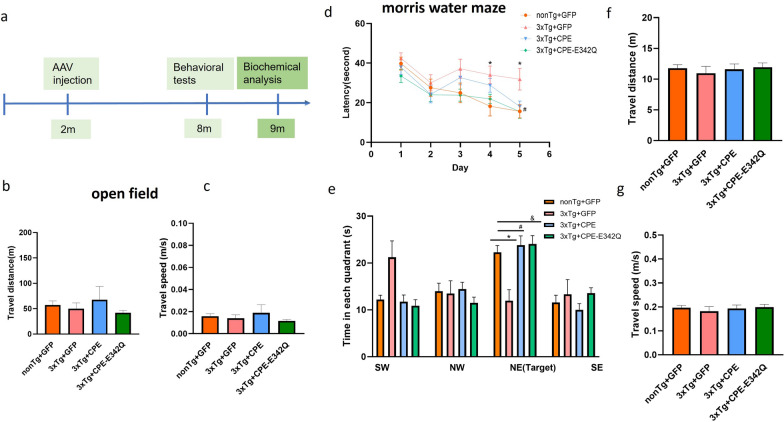
![AAV-NF-α1/CPE and AAV-NF-α1/CPE-E342Q decrease APP and tau phosphorylation and increase Bcl2 in 3 × Tg-AD mice.Schematic graph of the experimental design.,Locomotor activity in the open field test. There were no significant differences across the groups in the travel distance and speed in the open field test.Effects of overexpression of NF-α1/CPE or NF-α1/CPE-E342Q on spatial learning in the Morris water maze test. On day 4, the latency in the 3 × Tg + GFP group was increased compared to the nonTg + GFP ( = 0.0363). One-way ANOVA analysis followed by Tukey's post-hoc multiple comparison test [(3,38) = 3.221, = 0.0332]. On day 5, the latency in the 3 × Tg + GFP group was increased compared to nonTg + GFP ( = 0.0284). NF-α1/CPE-E342Q treatment significantly reduced the latency in 3 × Tg-AD mice compared to 3 × Tg + GFP ( = 0.0224), while NF-α1/CPE approached significance in reducing the latency ( = 0.0682). One-way ANOVA followed by Tukey's post-hoc multiple comparison test [(3,38) = 4.033, = 0.0139].Overexpression of NF-α1/CPE or NF-α1/CPE-E342Q prevented memory deficits of 3 × Tg-AD in the Morris water maze. 3 × Tg + GFP mice spent less time in the target area (NE) compared to nonTg + GFP ( = 0.0232), while both 3 × Tg + NF-α1/CPE ( = 0.0022) and 3 × Tg + NF-α1/CPE-E342Q ( = 0.0015) spent more time in the target quadrant compared to 3 × Tg + GFP. One-way ANOVA followed by Tukey's post-hoc multiple comparison test [(15,152) = 6.566, < 0.0001]. = 10–11, mean ± SEM.There were no significant differences in swimming distance or speed across all groups in the Morris water maze. = 10–11, mean ± SEM a b c d e f, g * * # * # & P F P P P P F P P P P F P n n](https://europepmc.org/articles/PMC12648813/bin/40035_2025_520_Fig1_HTML.jpg "Click to view full size")
AAV-NF-α1/CPE and AAV-NF-α1/CPE-E342Q decrease APP and tau phosphorylation and increase Bcl2 in 3 × Tg-AD mice.Schematic graph of the experimental design.,Locomotor activity in the open field test. There were no significant differences across the groups in the travel distance and speed in the open field test.Effects of overexpression of NF-α1/CPE or NF-α1/CPE-E342Q on spatial learning in the Morris water maze test. On day 4, the latency in the 3 × Tg + GFP group was increased compared to the nonTg + GFP ( = 0.0363). One-way ANOVA analysis followed by Tukey's post-hoc multiple comparison test [(3,38) = 3.221, = 0.0332]. On day 5, the latency in the 3 × Tg + GFP group was increased compared to nonTg + GFP ( = 0.0284). NF-α1/CPE-E342Q treatment significantly reduced the latency in 3 × Tg-AD mice compared to 3 × Tg + GFP ( = 0.0224), while NF-α1/CPE approached significance in reducing the latency ( = 0.0682). One-way ANOVA followed by Tukey's post-hoc multiple comparison test [(3,38) = 4.033, = 0.0139].Overexpression of NF-α1/CPE or NF-α1/CPE-E342Q prevented memory deficits of 3 × Tg-AD in the Morris water maze. 3 × Tg + GFP mice spent less time in the target area (NE) compared to nonTg + GFP ( = 0.0232), while both 3 × Tg + NF-α1/CPE ( = 0.0022) and 3 × Tg + NF-α1/CPE-E342Q ( = 0.0015) spent more time in the target quadrant compared to 3 × Tg + GFP. One-way ANOVA followed by Tukey's post-hoc multiple comparison test [(15,152) = 6.566, < 0.0001]. = 10–11, mean ± SEM.There were no significant differences in swimming distance or speed across all groups in the Morris water maze. = 10–11, mean ± SEM a b c d e f, g * * # * # & P F P P P P F P P P P F P n n
AAV-NF-α1/CPE and AAV-NF-α1/CPE-E342Q treatment rescues hippocampal CA1 neurodegeneration and decreases activated microglia in 3 × Tg-AD mice
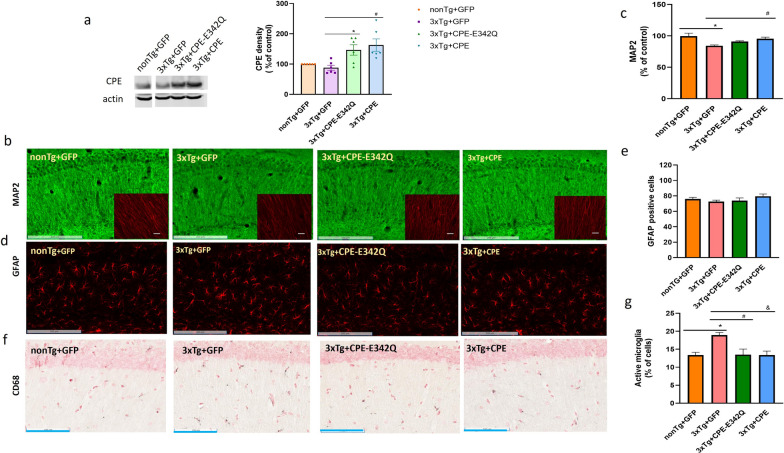
To evaluate whether AAV-NF-α1/CPE or AAV-NF-α1/CPE-E342Q treatment has any effects on neuroinflammation, GFAP and CD68 immunostaining was performed to assess activation of astrocytes and microglia. Astrocyte activation was comparable across all four groups (Fig. 2d, e), while microglial activation was increased in the 3 × Tg + GFP group compared with the non-Tg mice, but was significantly reduced in 3 × Tg + CPE and 3 × Tg + CPE-E342Q mice compared with the 3 × Tg + GFP mice (Fig. 2f, g). This result indicates that NF-α1/CPE and NF-α1/CPE-E342Q might be involved in the regulation of neuroinflammation via modulating microglial, rather than astrocytic activation.
![AAV-NF-α1/CPE and AAV-NF-α1/CPE-E342Q treatment rescues hippocampal CA1 neurodegeneration and decreases activated microglia.CPE protein level was increased in the hippocampus of 3 × Tg-AD that received AAV-NF-α1/CPE ( = 0.0059) or AAV-NF-α1/CPE-E342Q ( = 0.0351) compared with 3 × Tg + GFP. One-way ANOVA analysis followed by Tukey's post-hoc multiple comparison test [(3,20) = 6.643, < 0.01]. = 6, mean ± SEM.Representative immunohistochemistry images of MAP2 (), GFAP () and CD68 () in the hippocampal CA1 region of nonTg + GFP, 3 × Tg + GFP, 3 × Tg + CPE-E342Q and 3 × Tg + CPE mice at the age of 8–9 months. Scale bars, 200 μm forand, 100 μm for, 25 μm for red insets which were color converted from green in. = 6 mice per genotype.Quantification of MAP2 intensity in hippocampal CA1 region at the age of 8–9 months. MAP2 intensity decreased in 3 × Tg + GFP compared with nonTg + GFP ( = 0.0024); 3 × Tg + CPE increased MAP2 intensity significantly compared with 3 × Tg + GFP ( = 0.0284). One-way ANOVA followed by Tukey's post-hoc multiple comparison test [(3,17) = 6.871, = 0.0031]. mean ± SEM. 3–4 sections per mouse, = 5–6 mice per genotype.Quantification of GFAP-positive cells in hippocampal CA1 region at the age of 8–9 months. There were no significant changes across groups. One-way ANOVA followed by Tukey's post-hoc multiple comparison test. = 5–6 mice per genotype, 4 sections per mouse; mean ± SEM.Quantification of CD68-positive cells in hippocampal CA1 at the age of 8–9 months. CD68-positive cells were significantly increased in 3 × Tg + GFP compared with nonTg + GFP ( = 0.0141). Overexpression of NF-α1/CPE-E342Q or NF-α1/CPE in 3 × Tg-AD significantly reduced activated microglia (CPE-E343Q, = 0.0119; CPE: = 0.0142). One-way ANOVA followed by Tukey's post-hoc multiple comparison test [(3,18) = 6.196, = 0.0044]. = 5–6 mice per genotype, 4 sections per mouse; mean ± SEM a b, d, f b d f b d f b c e g # * * # * # & P P F P n n P P F P n n P P P F P n](https://europepmc.org/articles/PMC12648813/bin/40035_2025_520_Fig2_HTML.jpg "Click to view full size")
AAV-NF-α1/CPE and AAV-NF-α1/CPE-E342Q treatment rescues hippocampal CA1 neurodegeneration and decreases activated microglia.CPE protein level was increased in the hippocampus of 3 × Tg-AD that received AAV-NF-α1/CPE ( = 0.0059) or AAV-NF-α1/CPE-E342Q ( = 0.0351) compared with 3 × Tg + GFP. One-way ANOVA analysis followed by Tukey's post-hoc multiple comparison test [(3,20) = 6.643, < 0.01]. = 6, mean ± SEM.Representative immunohistochemistry images of MAP2 (), GFAP () and CD68 () in the hippocampal CA1 region of nonTg + GFP, 3 × Tg + GFP, 3 × Tg + CPE-E342Q and 3 × Tg + CPE mice at the age of 8–9 months. Scale bars, 200 μm forand, 100 μm for, 25 μm for red insets which were color converted from green in. = 6 mice per genotype.Quantification of MAP2 intensity in hippocampal CA1 region at the age of 8–9 months. MAP2 intensity decreased in 3 × Tg + GFP compared with nonTg + GFP ( = 0.0024); 3 × Tg + CPE increased MAP2 intensity significantly compared with 3 × Tg + GFP ( = 0.0284). One-way ANOVA followed by Tukey's post-hoc multiple comparison test [(3,17) = 6.871, = 0.0031]. mean ± SEM. 3–4 sections per mouse, = 5–6 mice per genotype.Quantification of GFAP-positive cells in hippocampal CA1 region at the age of 8–9 months. There were no significant changes across groups. One-way ANOVA followed by Tukey's post-hoc multiple comparison test. = 5–6 mice per genotype, 4 sections per mouse; mean ± SEM.Quantification of CD68-positive cells in hippocampal CA1 at the age of 8–9 months. CD68-positive cells were significantly increased in 3 × Tg + GFP compared with nonTg + GFP ( = 0.0141). Overexpression of NF-α1/CPE-E342Q or NF-α1/CPE in 3 × Tg-AD significantly reduced activated microglia (CPE-E343Q, = 0.0119; CPE: = 0.0142). One-way ANOVA followed by Tukey's post-hoc multiple comparison test [(3,18) = 6.196, = 0.0044]. = 5–6 mice per genotype, 4 sections per mouse; mean ± SEM a b, d, f b d f b d f b c e g # * * # * # & P P F P n n P P F P n n P P P F P n
AAV-NF-α1/CPE and AAV-NF-α1/CPE-E342Q decrease APP and tau phosphorylation and increase the pro-survival protein Bcl2 in 3 × Tg-AD mice
Western blotting also revealed a highly increased level of ptau in 3 × Tg + GFP mice compared with the nonTg + GFP mice. However, AAV-NF-α1/CPE-E342Q and AAV-NF-α1/CPE treatment significantly decreased ptau levels in these mice (Fig. 3f).
The protein level of mitochondrial pro-survival protein Bcl2 is downregulated within tangle-bearing neurons of AD patients [29], while expression of Bax, a mitochondrial pro-apoptotic protein, is upregulated in AT8 (a marker for hyperphosphorylated tau)-positive cells in AD patients [30]. Western blotting revealed that Bcl2 and Bax levels were not significantly different between nonTg + GFP and 3 × Tg + GFP, but treatment with AAV-NF-α1/CPE-E342Q or AAV-NF-α1/CPE significantly increased Bcl2 level (Fig. 3g) and decreased Bax level (Fig. 3h), indicating that NF-α1/CPE enhances the Bcl2-mediated pro-survival cascade.
![AAV-NF-α1/CPE and AAV-NF-α1/CPE-E342Q decrease APP and tau phosphorylation and increase Bcl2 in 3 × Tg-AD mice.Immunohistochemistry for APP expression after hippocampal stereotaxic injection at the age of 8–9 months. Scale bars, 1 mm.hAPP was decreased by treatment with AAV- NF-α1/CPE or AAV-NF-α1/CPE-E342Q ( = 0.0037, = 0.0006). One-way ANOVA followed by Tukey's post-hoc multiple comparison test [(2,15) = 13.16, = 0.0005]. = 6, mean ± SEM.Protein levels of human + mouse APP (hmAPP) were significantly increased in 3 × Tg + GFP compared with nonTg + GFP (* = 0.0008), while treatment with AAV-CPE or AAV-CPE-E342Q decreased hmAPP level in 3 × Tg-AD ( = 0.0186; = 0.0012). One-way ANOVA followed by Tukey's post-hoc multiple comparison test [(3,20) = 9.301, = 0.0005]. = 6, mean ± SEM.Treatment with AAV-CPE or AAV-E342Q did not induce any significant changes in the ratio of soluble Aβ42/40. = 6, mean ± SEM.Treatment with AAV-CPE-E342Q significantly decreased the ratio of insoluble 42/40 in 3 × Tg-AD ( = 0.0285), and AAV-CPE induced a trend of reduction of the ratio ( = 0.0555;). One-way ANOVA followed by Tukey's post-hoc multiple comparison test [(2,15) = 4.980, = 0.0219]. = 6, mean ± SEM.The ptau/tau ratio was significantly increased in 3 × Tg + GFP compared with nonTg + GFP ( = 0.0078), while treatment with AAV-CPE or AAV-CPE-E342Q decreased the ratio in 3 × Tg-AD ( = 0.042; = 0.0184). One-way ANOVA followed by Tukey's post-hoc multiple comparison test [(3,20) = 5.555, = 0.0061]. = 6, mean ± SEM.Treatment with AAV-CPE or AAV-CPE-E342Q increased Bcl2 protein level in 3 × Tg-AD (* = 0.0084; = 0.0021). One-way ANOVA followed by Tukey's post-hoc multiple comparison test [(3,20) = 8.318, = 0.0009]. = 6, mean ± SEM.Treatment with AAV-CPE and AAV-CPE-E342Q decreased Bax protein level in 3 × Tg-AD ( = 0.0449; = 0.0184;). One-way ANOVA followed by Tukey's post-hoc multiple comparison test [(3,20) = 4.274, = 0.0174]. = 6, mean ± SEM a b c d e f g h * # # & * * # & # * # P P F P n P P P F P n n P P F P n P P P F P n P P F P n P P F P n](https://europepmc.org/articles/PMC12648813/bin/40035_2025_520_Fig3_HTML.jpg "Click to view full size")
AAV-NF-α1/CPE and AAV-NF-α1/CPE-E342Q decrease APP and tau phosphorylation and increase Bcl2 in 3 × Tg-AD mice.Immunohistochemistry for APP expression after hippocampal stereotaxic injection at the age of 8–9 months. Scale bars, 1 mm.hAPP was decreased by treatment with AAV- NF-α1/CPE or AAV-NF-α1/CPE-E342Q ( = 0.0037, = 0.0006). One-way ANOVA followed by Tukey's post-hoc multiple comparison test [(2,15) = 13.16, = 0.0005]. = 6, mean ± SEM.Protein levels of human + mouse APP (hmAPP) were significantly increased in 3 × Tg + GFP compared with nonTg + GFP (* = 0.0008), while treatment with AAV-CPE or AAV-CPE-E342Q decreased hmAPP level in 3 × Tg-AD ( = 0.0186; = 0.0012). One-way ANOVA followed by Tukey's post-hoc multiple comparison test [(3,20) = 9.301, = 0.0005]. = 6, mean ± SEM.Treatment with AAV-CPE or AAV-E342Q did not induce any significant changes in the ratio of soluble Aβ42/40. = 6, mean ± SEM.Treatment with AAV-CPE-E342Q significantly decreased the ratio of insoluble 42/40 in 3 × Tg-AD ( = 0.0285), and AAV-CPE induced a trend of reduction of the ratio ( = 0.0555;). One-way ANOVA followed by Tukey's post-hoc multiple comparison test [(2,15) = 4.980, = 0.0219]. = 6, mean ± SEM.The ptau/tau ratio was significantly increased in 3 × Tg + GFP compared with nonTg + GFP ( = 0.0078), while treatment with AAV-CPE or AAV-CPE-E342Q decreased the ratio in 3 × Tg-AD ( = 0.042; = 0.0184). One-way ANOVA followed by Tukey's post-hoc multiple comparison test [(3,20) = 5.555, = 0.0061]. = 6, mean ± SEM.Treatment with AAV-CPE or AAV-CPE-E342Q increased Bcl2 protein level in 3 × Tg-AD (* = 0.0084; = 0.0021). One-way ANOVA followed by Tukey's post-hoc multiple comparison test [(3,20) = 8.318, = 0.0009]. = 6, mean ± SEM.Treatment with AAV-CPE and AAV-CPE-E342Q decreased Bax protein level in 3 × Tg-AD ( = 0.0449; = 0.0184;). One-way ANOVA followed by Tukey's post-hoc multiple comparison test [(3,20) = 4.274, = 0.0174]. = 6, mean ± SEM a b c d e f g h * # # & * * # & # * # P P F P n P P P F P n n P P F P n P P P F P n P P F P n P P F P n
Proteomic analysis revealed DEPs in the hippocampus of AAV-NF-α1/CPE-treated versus AAV-GFP-treated 3 × Tg-AD mice
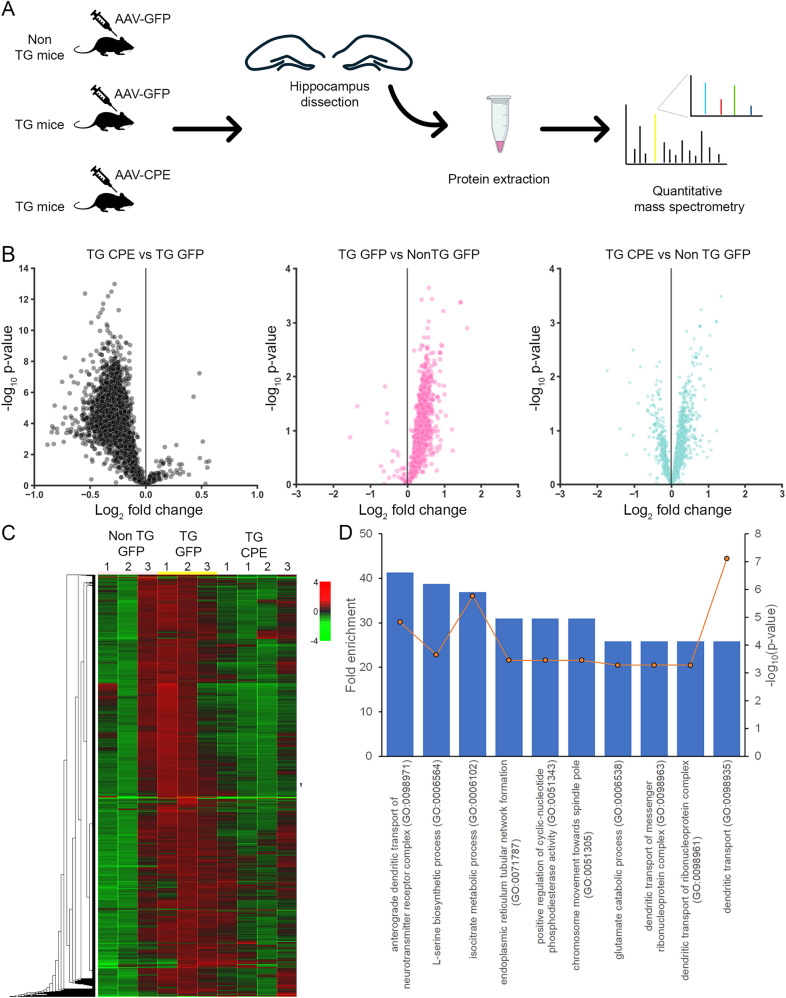
PANTHER Overrepresentation Test was performed to assess whether specific gene sets were represented in the input gene list differently from what is expected by chance. The dataset of most changed proteins were filtered with log2 fold change ratio ≥ 0.33 or ≤ − 0.33 in comparison of 3 × Tg + CPE vs 3 × Tg + GFP mice. PANTHER Overrepresentation Test (with Fisher's Exact test using FDR correction) with the functional category of GO molecular function comparing 3 × Tg + CPE mice vs 3 × Tg + GFP mice showed enrichment in anterograde dendritic transport of neurotransmitter receptor complex, glutamate catabolic process, dendritic transport of messenger ribonucleoprotein complex, dendritic transport of ribonucleoprotein complex, and dendritic transport (Fig. 4d), indicting that AAV-NF-α1/CPE overexpression triggered synaptic and dendritic remodeling.

Differentially expressed proteins in hippocampus of AAV-NF-α1/CPE versus AAV-GFP treated 3 × Tg-AD mice.Schematic of quantitative mass spectrometry. Proteins extracted from hippocampus were used for analysis in triplicates.Volcano plots showing quantitative comparison of hippocampal proteins between 3 × Tg + CPE and 3 × Tg + GFP, 3 × TgGFP and nonTg + GFP mice, and 3 × Tg + CPE and nonTg + GFP mice.Protein profile hierarchical heatmap showing protein expression in the hippocampus from 3 groups and their individual replicates (marked as 1, 2 and 3). The replicate 1 was repeated in TG-CPE group as a technical replicate. The cell color represents log(ratio) to the average abundance across different samples.Top 10 canonical pathways from PANTHER Overrepresentation Test analysis using the dataset of most changed proteins filtered with logfold change ratio ≥ 0.33 or ≤ -0.33 between 3 × Tg + CPE and 3 × Tg + GFP mice. Blue bars show fold enrichment, and orange circle markers show the significance values plotted as − log (-value).-values were calculated using Fisher exact test with FDR correction a b c d 2 2 P P
Hippocampal delivery of AAV-NF-α1/CPE modulates expression of many AD-associated DEPs in 3 × Tg-AD mice
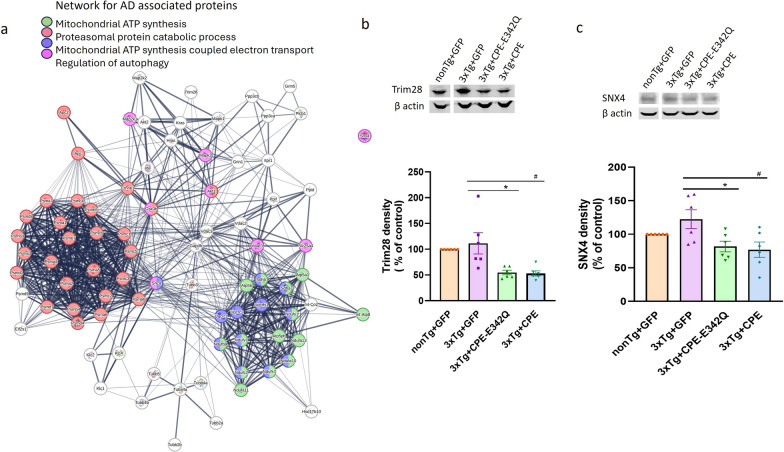
![Hippocampal delivery of AAV-NF-α1/CPE modulates expression of AD-associated proteins in 3 × Tg-AD mice.Functional protein network association map generated by String db for proteins annotated to be involved in AD, based on comparison of 3 × Tg + CPE vs 3 × Tg + GFP.Immunoblotting revealed that treatment with AAV-NF-α1/CPE or AAV-CPE-E342Q decreased Trim28 in 3 × Tg-AD ( = 0.0073; = 0.0057). One-way ANOVA followed by Tukey's post-hoc multiple comparison test [(3,20) = 7.777, = 0.0012]. = 6 mice per genotype, mean ± SEM.Immunoblotting revealed that treatment with AAV-NF-α1/CPE or AAV-CPE-E342Q decreased Snx4 in 3 × Tg-AD ( = 0.0384; = 0.0187). One-way ANOVA followed by Tukey's post-hoc multiple comparison test [(3,20) = 4.399, = 0.0157]. = 6 mice per genotype, mean ± SEM a b c * # * # P P F P n P P F P n](https://europepmc.org/articles/PMC12648813/bin/40035_2025_520_Fig5_HTML.jpg "Click to view full size")
Hippocampal delivery of AAV-NF-α1/CPE modulates expression of AD-associated proteins in 3 × Tg-AD mice.Functional protein network association map generated by String db for proteins annotated to be involved in AD, based on comparison of 3 × Tg + CPE vs 3 × Tg + GFP.Immunoblotting revealed that treatment with AAV-NF-α1/CPE or AAV-CPE-E342Q decreased Trim28 in 3 × Tg-AD ( = 0.0073; = 0.0057). One-way ANOVA followed by Tukey's post-hoc multiple comparison test [(3,20) = 7.777, = 0.0012]. = 6 mice per genotype, mean ± SEM.Immunoblotting revealed that treatment with AAV-NF-α1/CPE or AAV-CPE-E342Q decreased Snx4 in 3 × Tg-AD ( = 0.0384; = 0.0187). One-way ANOVA followed by Tukey's post-hoc multiple comparison test [(3,20) = 4.399, = 0.0157]. = 6 mice per genotype, mean ± SEM a b c * # * # P P F P n P P F P n
Hippocampal AAV-NF-α1/CPE delivery modulates synaptic proteins and rescues impaired synaptogenesis in 3 × Tg-AD mice
To test the hypothesis provided by our proteomic analysis, we investigated two major synaptic proteins Synapsin1 and postsynaptic density protein 95 (PSD95). Synapsin1 is mainly distributed in the vesicles of presynaptic terminals and regulates neurotransmitter release [36 –38]. PSD95 is a critical component of post-synaptic density that interacts with many post-synaptic proteins. Western blotting analysis showed significant decreases of Synapsin1 and PSD95 protein levels in the 3 × Tg + GFP mice compared with the nonTg + GFP mice (Fig. 6b, c). Treatment with AAV-NF-α1/CPE significantly upregulated expression of Synapsin1 (Fig. 6b) and PSD95 (Fig. 6c) in 3 × Tg-AD mice. AAV-NF-α1/CPE-E342Q treatment increased Synapsin1 protein level and induced a trend of increase of PSD95 in 3 × Tg-AD mice comparison with the 3 × Tg + GFP mice (Fig. 6c). Electron microscopy showed post-synaptic thickening in synapses in the hippocampus of nonTg + GFP (Fig. 6d) and 3 × Tg + CPE-E342Q (Fig. 6f) mice, in contrast to the thin post-synaptic structures in the 3 × Tg + GFP mice (Fig. 6e). This finding suggested that defective synaptogenesis in the 3 × Tg-AD mice is reversed with AAV-NF-α1/CPE or AAV- NF-α1/CPE-E342Q treatment.
![Hippocampal AAV-NF-α1/CPE delivery modulates synaptic proteins and rescues impaired synaptogenesis.Functional protein network association map generated by String db for proteins annotated to be involved in synaptic organization, based on comparison of 3 × Tg + NF-α1/CPE vs 3 × Tg + GFP mice.Synapsin1 protein level was significantly decreased in 3 × Tg + GFP compared with nonTg + GFP ( = 0.0001). Treatment with AAV-NF-α1/CPE or AAV-CPE-E342Q effectively increased synpasin1 in 3 × Tg-AD ( = 0.0239; = 0.0055). One-way ANOVA followed by Tukey's post-hoc multiple comparison test [(3,20) = 10.52, = 0.0002]. = 6 mice per genotype, mean ± SEM.Synaptic marker PSD95 was significantly decreased in 3 × Tg + GFP compared with nonTg + GFP ( = 0.001). Treatment with AAV-NF-α1/CPE increased PSD95 in 3 × Tg-AD ( = 0.0454). One-way ANOVA followed by Tukey's post-hoc multiple comparison test [(3,20) = 7.573, = 0.0014]. = 6 mice per genotype, mean ± SEM.Electron microscopic images of nonTg + GFP (), 3 × Tg + GFP () and 3 × Tg + CPE-E342Q (). Arrows indicate synapses. scale bars, 2 μm in upper panels, 1 μm in bottom panels a b c d–f d e f * # & * # P P P F P n P P F P n](https://europepmc.org/articles/PMC12648813/bin/40035_2025_520_Fig6_HTML.jpg "Click to view full size")
Hippocampal AAV-NF-α1/CPE delivery modulates synaptic proteins and rescues impaired synaptogenesis.Functional protein network association map generated by String db for proteins annotated to be involved in synaptic organization, based on comparison of 3 × Tg + NF-α1/CPE vs 3 × Tg + GFP mice.Synapsin1 protein level was significantly decreased in 3 × Tg + GFP compared with nonTg + GFP ( = 0.0001). Treatment with AAV-NF-α1/CPE or AAV-CPE-E342Q effectively increased synpasin1 in 3 × Tg-AD ( = 0.0239; = 0.0055). One-way ANOVA followed by Tukey's post-hoc multiple comparison test [(3,20) = 10.52, = 0.0002]. = 6 mice per genotype, mean ± SEM.Synaptic marker PSD95 was significantly decreased in 3 × Tg + GFP compared with nonTg + GFP ( = 0.001). Treatment with AAV-NF-α1/CPE increased PSD95 in 3 × Tg-AD ( = 0.0454). One-way ANOVA followed by Tukey's post-hoc multiple comparison test [(3,20) = 7.573, = 0.0014]. = 6 mice per genotype, mean ± SEM.Electron microscopic images of nonTg + GFP (), 3 × Tg + GFP () and 3 × Tg + CPE-E342Q (). Arrows indicate synapses. scale bars, 2 μm in upper panels, 1 μm in bottom panels a b c d–f d e f * # & * # P P P F P n P P F P n
AAV-NF-α1/CPE and AAV-NF-α1/CPE-E342Q treatment restore autophagic activity in 3 × Tg-AD mice
To examine the autophagy-related proteins that may be modulated by CPE or CPE-E342Q to rescue impaired autophagy in 3 × Tg-AD mice, immunoblotting and electron microscopy studies were performed. Beclin1 and Map1lc3a/b (LC3 II/I) are established autophagy markers. Beclin1 facilitates the assembly of autophagosomes via interacting with other proteins such as PI3KC3 (class III type phosphoinositide 3-kinase)/Vps34 [41, 42]. LC3II is a modified form of microtubule-associated light chain 3 (LC3 I) protein which is recruited to autophagosome membrane and later degraded by lysosomal hydrolases [43]. Western blots showed that Beclin1 was significantly decreased in 3 × Tg + GFP mice compared with nonTG + GFP mice, while treatment with AAV-NF-α1/CPE or AAV-NF-α1/CPE-E342Q increased the level of Beclin1 compared to the 3 × Tg + GFP group (Fig. 7b). In addition, the LC3II/LC3I ratio was decreased in the 3 × Tg-AD mice compared to the non-Tg mice, and increased with AAV-NF-α1/CPE or AAV-NF-α1/CPE-E342Q treatment (Fig. 7c). The network analysis revealed alterations of the autophagy pathway protein ATG7 downstream of Map1lc3a/b (LC3 II/I). Hence we examined regulation of its expression by NF-α1/CPE. Western blotting revealed that the ATG7 level was decreased in 3 × Tg-AD mice, but increased with AAV-NF-α1/CPE or AAV-NF-α1/CPE-E342Q treatment (Fig. 7d).
Electron microscopy showed that autophagosomes in normal neurites in the hippocampus of nonTg + GFP mice had little accumulation of dense material (Fig. 7e); in contrast, autophagosomes in the 3 × Tg + GFP mice contained highly dense undigested materials in dystrophic neurites (Fig. 7f). In the 3 × Tg + CPE-E342Q mice, autophagosomes in neurites contained less accumulation of materials compared to 3 × Tg + GFP (Fig. 7g). These results indicate that AAV-NF-α1/CPE and AAV-NF-α1/CPE-E342Q treatment rescues impaired autophagy in 3 × Tg-AD mice by up-regulating expression of critical proteins Beclin1, LC3 and ATG7.
![AAV-NF-α1/CPE and AAV-NF-α1/CPE-E342Q treatment restore autophagic activity in 3 × Tg-AD mice.The String db functional protein network association map of autophagy-related proteins. The proteins highlighted in cyan were detected in our experimental dataset comparing 3 × Tg + CPE vs 3 × Tg + GFP. Beclin1 and Map1lc3a/b (LC3 II/I) labeled in magenta are prominent markers of autophagy pathway.Western blotting showing that Beclin1 was significantly decreased in 3 × Tg + GFP compared with nonTg + GFP ( = 0.0005). Treatment with AAV-NF-α1/CPE and CPE-E342Q both increased Beclin1 in 3 × Tg-AD ( = 0.0426; = 0.0049). One-way ANOVA followed by Tukey's post-hoc multiple comparison test [(3,20) = 8.743, = 0.0007]. = 6 mice per genotype, mean ± SEM.Western blotting showing that the LC3II/LC3I ratio was significantly decreased in 3 × Tg + GFP compared with nonTg + GFP ( = 0.0041). Treatment with AAV-NF-α1/CPE and CPE-E342Q both increased the ratio in 3 × Tg-AD ( = 0.0015; = 0.0008). One-way ANOVA followed by Tukey's post-hoc multiple comparison test [(3,20) = 9.579, = 0.0004]. = 6 mice per genotype, mean ± SEM.Western blotting showing that ATG7 was significantly decreased in 3 × Tg + GFP compared with nonTg + GFP (* < 0.0001). Treatment with AAV-NF-α1/CPE and CPE-E342Q both increased ATG7 in 3 × Tg-AD mice ( = 0.0347; = 0.0309). One-way ANOVA followed by Tukey's post-hoc multiple comparison test [(3,20) = 23.71, < 0.0001]. = 6 mice per genotype, mean ± SEM.Electron microscopic images of nonTg + GFP (), 3 × Tg + GFP () and 3 × Tg + E342Q (). Dashed circles: neurites (defined by the structure of synapses) containing autophagosomes. Arrowheads indicate autophagosomes containing dense core materials. Scale bars, 1 μm a b c d e, f , g e f g * # & * # & # & P P P F P n P P P F P n P P P F P n](https://europepmc.org/articles/PMC12648813/bin/40035_2025_520_Fig7_HTML.jpg "Click to view full size")
AAV-NF-α1/CPE and AAV-NF-α1/CPE-E342Q treatment restore autophagic activity in 3 × Tg-AD mice.The String db functional protein network association map of autophagy-related proteins. The proteins highlighted in cyan were detected in our experimental dataset comparing 3 × Tg + CPE vs 3 × Tg + GFP. Beclin1 and Map1lc3a/b (LC3 II/I) labeled in magenta are prominent markers of autophagy pathway.Western blotting showing that Beclin1 was significantly decreased in 3 × Tg + GFP compared with nonTg + GFP ( = 0.0005). Treatment with AAV-NF-α1/CPE and CPE-E342Q both increased Beclin1 in 3 × Tg-AD ( = 0.0426; = 0.0049). One-way ANOVA followed by Tukey's post-hoc multiple comparison test [(3,20) = 8.743, = 0.0007]. = 6 mice per genotype, mean ± SEM.Western blotting showing that the LC3II/LC3I ratio was significantly decreased in 3 × Tg + GFP compared with nonTg + GFP ( = 0.0041). Treatment with AAV-NF-α1/CPE and CPE-E342Q both increased the ratio in 3 × Tg-AD ( = 0.0015; = 0.0008). One-way ANOVA followed by Tukey's post-hoc multiple comparison test [(3,20) = 9.579, = 0.0004]. = 6 mice per genotype, mean ± SEM.Western blotting showing that ATG7 was significantly decreased in 3 × Tg + GFP compared with nonTg + GFP (* < 0.0001). Treatment with AAV-NF-α1/CPE and CPE-E342Q both increased ATG7 in 3 × Tg-AD mice ( = 0.0347; = 0.0309). One-way ANOVA followed by Tukey's post-hoc multiple comparison test [(3,20) = 23.71, < 0.0001]. = 6 mice per genotype, mean ± SEM.Electron microscopic images of nonTg + GFP (), 3 × Tg + GFP () and 3 × Tg + E342Q (). Dashed circles: neurites (defined by the structure of synapses) containing autophagosomes. Arrowheads indicate autophagosomes containing dense core materials. Scale bars, 1 μm a b c d e, f , g e f g * # & * # & # & P P P F P n P P P F P n P P P F P n
Discussion
In the current study, we showed that human CPE, which is 96.6% identical to mouse CPE in amino acid sequence, has no functional difference from mouse CPE [13] in neuroprotection and reversal of AD pathology and cognitive dysfunction in AD mice.
The results of proteomic analysis uncovered novel proteins involved in AD pathogenesis and further illuminated the mechanisms underlying the actions of NF-α1/CPE in rescuing AD pathology and cognitive dysfunction in 3 × Tg-AD mice. These include restoring protein levels of Synapsin1 and PSD95 that are involved in synaptogenesis (Fig. 8). Analysis of DEPs in the autophagy pathway network revealed that NF-α1/CPE restored levels of Beclin1 and Map1lc3a/b (LC3II/I), and up-regulated the expression of its downstream protein ATG7, which were confirmed by Western blotting. ATG7 is a crucial protein in the autophagy pathway, acting as an E1-like enzyme that initiates the process of autophagy and plays a vital role in the formation and extending of autophagosomes that engulf cellular waste and damaged components for recycling [46] (Fig. 8). Furthermore, Trim28 and Snx4, which showed aberrant levels in AD mice, were decreased with NF-α1/CPE treatment. Trim28 plays a critical role in regulating α-Syn and tau levels. Reduction of Trim 28 leads to decreased tau and α-Syn levels in Drosophila [47] and mice [48]. Snx4 regulates Aβ production. Reduction of Snx4 activity leads to decreased steady-state level of BACE1 and subsequent attenuation of Aβ production [49]. Thus, NF-α1/CPE acts in a multifaceted manner to restore cognitive dysfuntion and ameliorate pathology in AD mice.
Numerous proteomic studies using animal models and in AD patients have indicated that AD is a very complex disease, exhibiting dysregulation of multiple regulatory metabolic pathways [50 –52]. An analysis of proteomic studies involving 38 reports in clinical patients with AD revealed that synaptic activity- and vesicle-associated proteins are altered in early stage of AD, and mitochondria function-associated proteins are changed in more advanced stage of AD [53]. Aberrant autophagy has also been reported in AD patients [54]. Indeed, findings from our proteomic study in 3 × Tg mice mirror those from clinical studies. Dysregulation of vast numbers of proteins associated with mitochondrial activity, proteasomal protein catabolic process, dendritic transport and glutamate catabolic process and autophagy were also identified in our AD mice. Given the mitochondrial and autophagic signatures revealed by proteomics analysis, in the future we will continue to investigate the role of NF-α1/CPE in mitochondrial function and ATP production, as well as the significance of TFEB (transcription factor EB) in mitigating autophagy dysfunction.
Although there were no exact common dysregulated proteins identified in our 3 × Tg proteomic study with those from clinical AD proteomic analysis published thus far, there were many dysregulated proteins with common functions. For example, glutamate ionotropic receptor AMPA type subunit 2 (GRIA2) has been found decreased in AD patients [53], and Gria1 was also altered in the 3 × Tg mice with NF-α1/CPE treatment (Fig. S1), suggesting the role of AMPA subunits in the pathogenesis of AD. Changes of HSPB1 (heat shock protein beta 1) in AD brains have been reported [53, 55] and alteration of Hspa1a (Heat Shock Protein Family A (Hsp70) Member 1A) was observed in the 3 × Tg mice with NF-α1/CPE treatment (Fig. S1). These findings indicate the involvement of HSP families in the progression of AD. Hence, our proteomic study uncovered new insights into proteins that are altered in AD pathology and progression, providing an avenue for further translational and clinical studies, such as developing biomarkers for early detection of AD and monitoring treatment efficacy.

Summary of proteins verified to be regulated by NF-α1/CPE in 3 × Tg-AD mice. NF-α1/CPE downregulates characteristic pathological proteins including APP, β amyloid and ptau. Additionally, Trim28 and Snx4 which are involved in the production of pathological proteins, are reduced by NF-α1/CPE treatment. AD-associated neuroinflammation, especially increased activation of microglia, is reduced by NF-α1/CPE treatment as evidenced by reduced number of activated microglia and decreased level of pro-inflammatory protein Card14. Autophagy markers Beclin1, ATG7 and ratio of LC3II/I, are all increased by NF-α1/CPE treatment, indicating higher activity of autophagy. Synaptogenesis markers such as Synapsin1 and PSD95 are increased by NF-α1/CPE, suggesting increased synaptogenesis. NF-α1/CPE also acts as a neuroprotector by upregulating survival proteins. For instance, mitochondria survival protein Bcl2 is enhanced, and pro-apoptotic protein Bax is reduced by NF-α1. Serpina3g, a protein that upregulates survival, is also increased by NF-α1/CPE. Plin4, an inhibitor of mitophagy, is reduced by NF-α1/CPE
Conclusions
AD is a multifactorial disease, yet at present most therapeutic approaches have focused on single targets such as elimination of tau and amyloid accumulation in the brain, with only a small amount of success for long-term reversal of cognitive dysfunction [56 –59]. Moreover, these drugs produce many side effects [60]. Our current study together with previous work has strengthened the evidence that NF-α1/CPE is an excellent candidate therapeutic agent for treating AD and potentially other neurodegenerative diseases. First, we have demonstrated that NF-α1/CPE is different from other therapeutics in its ability to normalize and modulate expression of proteins involved in numerous cell biological processes, metabolic pathways, synaptogenesis and autophagy in neurons and glial cells to regain homeostasis. Second, our proteomic study uncovered new proteins linked to AD and provided insights into the mechanism of actions of NF-α1/CPE in rescuing AD pathology. Finally, we have previously demonstrated that overexpression of NF-α1/CPE via the AAV-gene therapy in normal mice has no apparent side effects on proteins disrupted in AD or cognitive function [13]. While our studies were conducted in male 3 × Tg-AD mice, other studies using both male and female, or female AD mouse models [44] have also shown the ability of NF-α1/CPE to reverse AD pathology and cognitive dysfunction, suggesting no gender distinction in the efficacy of this treatment approach.
Supplementary Information
Additional file 1. Fig. S1 List of all proteins detected by quantitative mass spectrometry. Table S1. List of antibodies for western blot. Table S2. List of antibodies for immunohistochemistryAdditional file 2. Table S3. DEPs in the hippocampus of AAV-NF-α1/CPE-treated versus AAV-GFP-treated 3×Tg-AD mice.Additional file 3. Original uncropped Western blots.