
What this is
- This research investigates how supraphysiological androgen levels (SAL) induce in prostate cancer (PCa) cells.
- It identifies annexin A2 (ANXA2) as a direct () target gene that mediates this process.
- The study also explores the interaction between ANXA2 and heat shock protein 27 (HSP27) in the context of -AKT signaling, suggesting a novel pathway for in PCa.
Essence
- ANXA2 mediates SAL-induced in prostate cancer cells through a novel -AKT signaling pathway, with implications for patient survival.
Key takeaways
- SAL treatment enhances ANXA2 expression in prostate cancer cells, which is linked to improved patient survival. Higher ANXA2 levels correlate with better outcomes in PCa patients.
- ANXA2 is identified as a direct target of the , with its expression regulated by the -AKT interaction. This suggests a mechanism by which androgens can induce senescence.
- The study reveals that ANXA2 interacts with HSP27, forming a signaling pathway that mediates . Inhibition of HSP27 reduces the senescence levels induced by SAL.
Caveats
- The findings are based on in vitro studies and may not fully translate to in vivo conditions. Further research is needed to validate these mechanisms in clinical settings.
- While higher ANXA2 levels are associated with better survival, the study does not establish causation. Additional studies are required to clarify the role of ANXA2 in PCa progression.
Definitions
- cellular senescence: A state of permanent cell cycle arrest that can be induced by various stressors, including DNA damage and oncogenic signaling.
- androgen receptor (AR): A type of nuclear receptor that is activated by binding to androgens, playing a critical role in the development and progression of prostate cancer.
Simplified
Introduction
Prostate cancer (PCa) is diagnosed highest among new incidence cancer in men in US (Siegel et al. 2023). The growth of the normal prostate tissue and progression of PCa relies on the activity of the androgen receptor (AR, NR3C4) (Vickman et al. 2020). Accordingly, the inhibition of the AR activity by androgen deprivation therapy and the use of AR antagonists for maximal blockade of AR is used regularly to hormonally treat PCa patients.
Paradoxically, higher concentrations of androgens at supraphysiological androgen level (SAL) also inhibit PCa tumor growth in cell lines and in mouse xenograft model systems. Interestingly, in both androgen dependent and castration-resistant PCa cell lines as well as in PCa samples from patients treated ex vivo, SAL induces cellular senescence (Roediger et al. 2014; Pungsrinont et al. 2020; Kokal et al. 2020; Mirzakhani et al. 2022). SAL is currently used in clinical trials for treatment of metastatic PCa patients by the so-called bipolar androgen therapy (BAT) (Denmeade 2018; Isaacs et al. 2019; Denmeade et al. 2021; Kumar et al. 2023; Markowski et al. 2024).
Consistently, low doses of androgens (defined as 1 pM R1881, LAL) promote growth whereas SAL (defined as 1 nM R1881) inhibits potently PCa cell proliferation and induces cellular senescence, which is dependent on the presence of AR (Roediger et al. 2014; Niu et al. 2008). Mechanistically, SAL leads to increased p-AKT levels and induction of p15INK4b (Mirzakhani et al. 2022). The AKT inhibitor (AKTi) reduced the level of senescent cells in both castration-sensitive (LNCaP) and castration-resistant (C4-2) PCa cell lines induced by SAL (Mirzakhani et al. 2022). This indicates that SAL induces cell senescence in part through the AKT signaling pathway.
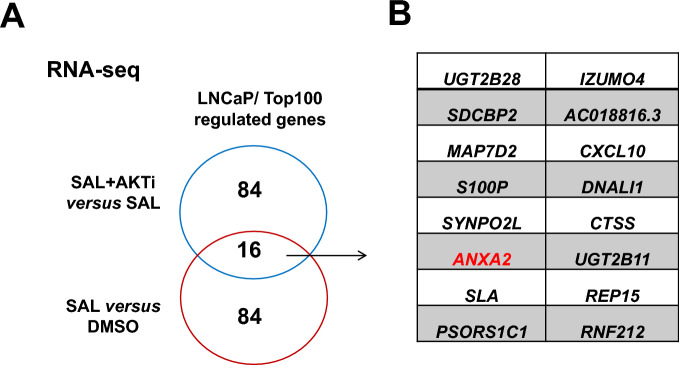
Transcriptome analyses revealed that Annexin A2 (ANXA2) is one factor, which is induced by SAL and repressed by AKTi treatment in both PCa cell lines. ANXA2 has many functions including membrane repair, connecting membrane with the cytoskeleton, endo- and exocytosis (Kayejo et al. 2023). Interestingly, higher ANXA2 levels are associated with increased survival of patients with PCa suggesting that treatment with SAL has tumor suppressive activity. Functionally, the knockdown of ANXA2 suggests that it mediates SAL-induced cellular senescence and regulates p-AKT and HSP27 levels. The data suggest that ANXA2 is a direct AR target gene, which is induced by SAL and mediates the induction of cell senescence by SAL. Further, the data suggest that ANXA2 is part of the AR-AKT and HSP27 signaling to regulate the induction of cellular senescence by SAL, thus linking androgen signaling to ANXA2.
Results
Transcriptome Analyses Reveal an Upregulation ofby SAL in both LNCaP and C4-2 Cell Lines ANXA2
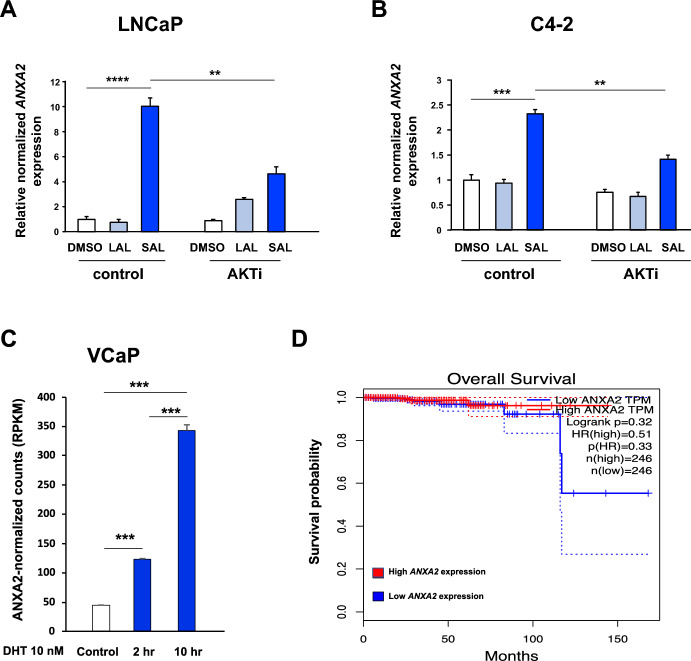
In line with this, public available RNA-seq data set from GSE157104 (Guo et al. 2021) confirms the induction of ANXA2 in another human PCa cell line using VCaP cells treated with DHT (Fig. 2C). Moreover, the data suggest a similar tendency but not statistically significant in mouse xenografts using tumor samples from LuCaP patient-derived xenografts (supplemental Fig. S2; Han et al. 2022). Of note, the GEPIA database indicates, although not significantly, that high ANXA2 mRNA expression is associated with better survival of PCa patients comparing low expression and high expression data plotted against overall survival (Fig. 2D) being in line with previous reports (Ding et al 2010; Grewal et al. 2021) that suggest higher expression level of ANXA2 have tumor suppressive function in PCa.

expression is upregulated by SAL and inhibited by co-treatment with AKTi. Transcriptome analyses using RNA-seq were performed after treatment of cells for 72 h ( = 3).Venn diagram indicates the overlap of the top100 significantly SAL-mediated upregulated genes in LNCaP cells and their downregulation by AKTi co-treatment.The overlap of these genes is indicated with highlighted ANXA2 n ANXA2 A B

expression is induced preferentially by SAL in both LNCaP and C4-2 cell lines. To confirm the androgen-mediated regulation ofexpression, qRT-PCR experiments were performed with LNCaP () and C4-2 cells () treated for 72 h with low androgen level (LAL, 1 pM R1881), supraphysiological androgen level (SAL, 1 nM R1881) and/or AKTi (1 μM). DMSO was used as solvent control. Normalized fold change of mRNA expression is indicated using normalization to the expression of bothandas house-keeping genes. ( = 3, biological replicates).Expression ofin VCaP cells treated with DHT (10 nM) using RNA-seq data derived from GSE157104 indicated as RPKM (reads per kilo base per million mapped reads).The ANXA2 expression data are plotted against overall survival in months. Data were obtained from the publicly available Gene Expression Profiling Interactive Analysis (GEPIA) database with the indicated hazard ratios (HR) and samples size numbers (). Two-tailed unpaired Student's-test was performed for statistical analysis (* ≤ 0.05, ** ≤ 0.01, *** ≤ 0.001, **** ≤ 0.0001) ANXA2 ANXA2 TBP GAPDH n ANXA2 n t p p p p A B C D
SAL Induces the Chromatin Recruitment of AR toGene ANXA2
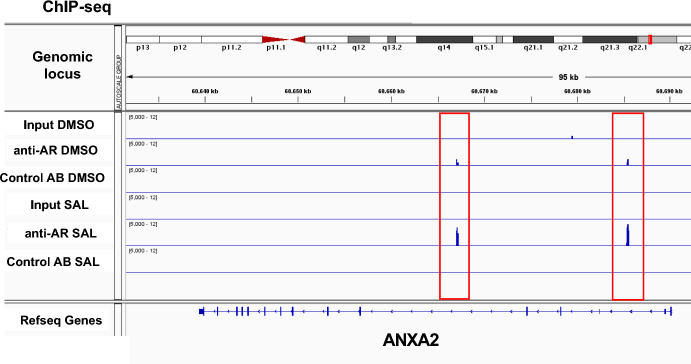
The induction of gene expression of ANXA2 by SAL led to the hypothesis that ANXA2 may be a direct target gene of AR. Chromatin immunoprecipitation experiments with massive parallel sequencing (ChIP-seq) were performed with LNCaP cells with and without SAL treatment.

The AR is recruited in a SAL-dependent manner to thegenomic locus. Chromatin immuno-precipitation with subsequent massive parallel sequencing (ChIP-seq) revealed recruitment of AR to thelocus in LNCaP cells. The enrichment of AR is enhanced by SAL treatment at the introns 1 and 3 of thegenomic locus ANXA2 ANXA2 ANXA2
ANXA2 Mediates in Part Cellular Senescence Induced by SAL, Functionally Linking AR-AKT to ANXA2 Signaling
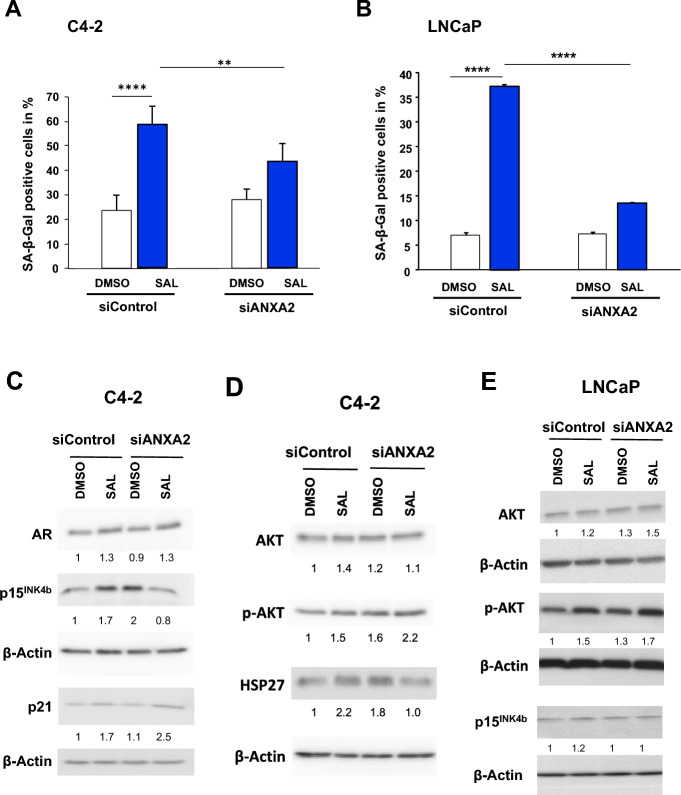
Analyzing the levels of the cell cycle inhibitor p15INK4b, the data suggest that SAL treatment enhances the protein level whereas siANXA2 blunts this effect, which is in line with the induction of cellular senescence (Fig. 5C-E, supplemental Fig. S3). Expectedly, the AR protein level is stabilized by androgens and seems unaffected by ANXA2 knockdown. Notably, while the p21 levels are enhanced moderately by SAL as described earlier (Roediger et al. 2014), the knockdown of ANXA2 further enhances p21 levels by SAL treatment (Fig. 5C).
It was reported previously that the lncRNA SAT1 mediates SAL-induced cellular senescence (Mirzakhani et al. 2022). Interestingly however, the knockdown of ANXA2 did not change the expression of the lncRNA SAT1 and vice versa (supplemental Fig. S4). This suggests that ANXA2 uses a distinct pathway to mediate SAL-induced cellular senescence and indicates the identification of a novel pathway to induce cellular senescence by SAL.
Taken together, the knockdown of Annexin A2 suggests that the androgen-induced ANXA2 promotes SAL-induced cellular senescence indicating a novel AR-ANXA2 signaling pathway in PCa to induce cellular senescence.
Activated AKT signaling is known as a pro-survival pathway. Since AKT mediates in part the induction of cellular senescence by SAL (Roediger et al. 2014; Mirzakhani et al. 2022), we analyzed AKT and p-AKT levels. The knockdown of ANXA2 had no measurable change on AKT levels in both cell lines (Fig. 5D, E). Notably, analyzing p-AKT levels, the knockdown of ANXA2 rather enhances p-AKT level (Fig. 5D, E). This suggests that ANXA2 regulates phosphorylation of AKT and reduces AKT signaling. This suggests that ANXA2 reduces this pro-survival pathway of PCa cells.
It was reported that ANXA2 interacts with the heat shock protein 27 (HSP27) mediating in UVC-resistance in AP1 breast cancer cells (Tong et al. 2008).

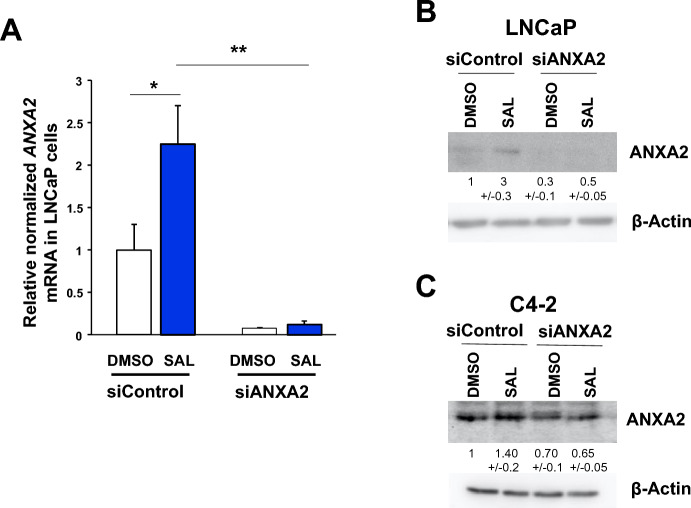
Knockdown of ANXA2 reduces mRNA levels and protein levels upon SAL treatment. LNCaP and C4-2 cells were transiently transfected with siRNA scrambled control or siRNA directed against ANXA2 and treated with DMSO as solvent control or SAL for 72 h. RNA and protein extracts were used for qRT-PCR and Western blot, respectively.Downregulation ofmRNA in cells transfected with siANXA2 ( = 3).Reduction of ANXA2 protein levels in LNCaP cells and () C4-2 cells. Numbers below the immunodetected bands indicate the intensities normalized to β-Actin bands as loading control A B C ANXA2 n

ANXA2 mediates SAL-induced cellular senescence in both LNCaP and C4-2 cell lines. C4-2 and LNCaP cells were transiently transfected with control scrambled siRNA or siANXA2 RNA and treated for 72 h with SAL or DMSO as solvent control. Cells were stained for the senescence-associated β-galactosidase (SA-β-Gal) activity. The percentage of the SA-β-Gal positive cells was calculated in relation to total number of cells per observed field of each transfection and treatment. Three random fields per well were counted and the mean was calculated.C4-2 andLNCaP cells. For each cell line three independent experiments were performed. Student's t-test was performed for statistical analysis (** ≤ 0.01, *** ≤ 0.001, **** ≤ 0.0001).andProtein levels of AKT, p-AKT, p15, p21 and HSP27 of transiently transfected C4-2 cells with siControl or si.Protein levels of AKT, p-AKT and p15of transiently transfected LNCaP cells with siControl or si. The numbers indicate the protein levels normalized to the loading control β-Actin using LabImage 1D software A B C D E p p p ANXA2 ANXA2 INK4b INK4b

The AR is recruited to thegene locus encoding HSP27. Chromatin immuno-precipitation with subsequent massive parallel sequencing (ChIP-seq) revealed recruitment of AR to thelocus in LNCaP cells. The enrichment of AR is enhanced at the promoter regions of thegenomic locus. Input and a control antibody (Control AB) were used as background control HSPB1 HSPB1 HSPB1

Inhibition of HSP27 activity reduces SAL-induced cellular senescence. Similar experimental setup as described in Fig. A using C4-2 cells treated with the HSP27 inhibitor J2 (10 nM) with and without R1881 (1 nM) for 72 h prior the SA-beta galactosidase assay. The percentage of the SA-β-Gal positive cells was calculated in relation to total number of cells per observed field of each transfection and treatment. Three random fields per well were counted and the mean was calculated 5

SAL induces cellular senescence through the novel AR-ANXA2-HSP27-p15pathway. SAL leads to upregulation of both ANXA2 and HSP27 as novel positively regulated AR target genes that mediate cellular senescence by enhancing p15level in PCa cells INK4b INK4b
Discussion and Conclusions
In the bipolar androgen therapy cycling of SAL is used for treatment of metastatic PCa patients. Mechanistically, SAL induces cellular senescence in PCa cells including androgen-sensitive and CRPC cells as well as in human PCa patient-derived samples treated ex vivo with SAL (Roediger et al. 2014; Mirzakhani et al. 2022). The molecular pathway of SAL-induced cellular senescence and cell cycle arrest by AR in PCa is unclear, since treatment with low androgen levels rather promotes growth of PCa cells through the AR. We focused on SAL-induced cellular senescence and identified several factors that are induced by SAL. Besides AKT signaling that mediates in part the SAL-induced cellular senescence (Mirzakhani et al. 2022), also the mitogen-inducible gene 6 (MIG6), as a feedback inhibitor of ERBB-2 that induces mitogenic and transforming activity, was identified recently as a mediator of SAL-induced cellular senescence (Schomann et al. 2022). It seems MIG6 acts as a tumor suppressor in PCa but functions differentially in other cancers. Similarly, ANXA2 has been shown to act functionally in a cancer type and context-dependent manner (Zhang et al., 2012; Grewal et al. 2021; Huang et al. 2022).
In PCa tissue the expression of ANXA2 is significantly lower compared to samples from patients with benign prostate hyperplasia (Yee et al. 2007; Ding et al. 2010). Further, lower ANXA2 expression is negatively associated with tumor stage and Gleason scores 5–7. ANXA2 expression decreased steadily with the progression of PCa (Beyene et al., 2018). Also, PCa recurrence and metastasis are associated with lower ANXA2 expression (Yee et al. 2007), which suggests that ANXA2 is a tumor suppressor in PCa. Accordingly, a higher survival rate of patients with PCa is significantly correlated with higher ANXA2 expression.
Tumor suppressive association of ANXA2 was also reported for esophageal squamous carcinoma, sinonasal adenocarcinoma, and nasopharyngeal carcinoma. However, a battery of other cancers suggest that ANXA2 has oncogenic properties and shows an upregulation of ANXA2 expression including breast, pancreatic, colorectal cancer, renal cell carcinoma, and acute promyelocytic leukemia (Zhang et al., 2012). Targeting ANXA2 was suggested as a therapeutic approach (Li et al. 2021; Grewal et al. 2021; Gounou et al. 2023). Thus, ANXA2 appears to be involved in a wide range of cellular processes, and its functions may vary depending on the cell type and context in which it is expressed. Since ANXA2 has cancer type dependent activities as a tumor suppressor or oncoprotein a drug targeting system would be useful only for an individualized cancer management (Christensen et al., 2018).
In general, ANXA2, also known as Lipocortin II or Calpactin I, is a member of the annexin A family and located in nucleus, cytoplasm and also at the extracellular cell surface (Zhang et al., 2012). ANXA2 is known to regulate membrane trafficking, to bind to RNA and Ca2+ -ions and to interact with many factors including S100A10 forming a heterotetramer which can be translocated upon the activation of the non-receptor tyrosine kinase Src (Bharadwaj et al. 2021; Grewal et al. 2021). Further, it was reported that ANXA2 is part of the cytokinesis of cells for proper mitosis (Benaud et al. 2015).
One of the functions of ANXA2 as an oncoprotein in cancer is to promote invasion and angiogenesis, e.g. by promoting the activation of angiogenic factors such as VEGF (vascular endothelial growth factor). As a tumor suppressor higher ANXA2 levels are associated with better survival of PCa patients. Associated with this, it was reported that in PCa ANXA2 levels are inversely correlated to ERG gene expression, known to be a marker for more aggressive PCa (Griner et al., 2015).
Although in some cancer types ANXA2 is associated with activating AKT, the knockdown of ANXA2 reduces AKT protein level in nasopharyngeal carcinoma (Chen et al. 2015), while our data suggest that in PCa cells the knockdown seems not to influence AKT protein levels.
Mechanistically, SAL induces the recruitment of AR to the ANXA2 gene locus and induces its expression indicating that ANXA2 is a direct and positively controlled AR target gene. Inhibition of AKT blunts SAL-mediated induction of ANXA2 gene expression indicating that the AR-AKT interaction is essential for full ANXA2 induction. Inhibition of AKT reduces also cellular senescence levels mediated by SAL. This led to the hypothesis that ANXA2 mediates in part the induction of cellular senescence mediated by the AR-AKT interaction. In line with this, the inhibition of ANXA2 by knockdown resulted in lower levels of senescent cells when treated with SAL. Thus, the data suggest that ANXA2 as a novel AR target gene induced by SAL mediates SAL-induced cellular senescence in PCa. Of note, this pathway seems to be independent of the previously published AR- lncRNA SAT1 pathway. Therefore, it indicates the identification of a novel signaling pathway used by the AR.
Interestingly, the knockdown of ANXA2 reduced the protein level of HSP27. HSP27 itself is a client protein of ANXA2 (Tong et al. 2008) and interacts also with AR. Interestingly, in ovarian carcinoma cells the knockdown of HSP27 enhances p21 levels in cytosol linking HSP27 to p21 and to ANXA2 (Lu et al. 2016). Of note, SAL induces HSP27 protein levels, which are associated with induction of cellular senescence. This indicates that the AR-AKT pathway is linked to ANXA2-HSP27 signaling. This led to the hypothesis that HSP27 is responsible for ANXA2 activity to mediate cellular senescence by SAL. In fact, this was observed using the HSP27-specific inhibitor J2. Inhibition of HSP27 reduced the level of cellular senescence induced by SAL. This suggests that for induction of cellular senescence by SAL, a novel pathway is identified consisting of the AR-AKT-ANXA2-HSP27 signaling.
Experimental Section
Cell Culture and Treatments
Cell lines, cell culture were described previously (Protopopov et al. 2002; Schomann et al. 2022). Cells were treated for 72 h with 1 pM R1881 (LAL), 1 nM R1881 (SAL), or 0.1% DMSO as shown by Roediger et al. (2014).
RNA-sequencing and transcriptome analysis have been previously described (Mirzakhani et al. 2022). The RNA-seq datasets are available in GEO database. Accession numbers: GSE162711, GSE155528, GSE154755. The GSE179687 was used to analyze ANXA2 expression in mouse xenografts treated with high-T.
ChIP-Seq analysis was performed as described by Schomann et al. (2022). Cells were treated with and without SAL prior chromatin immunoprecipitation (ChIP). DMSO was used as solvent control. Anti-AR antibody from Cell signaling was used for immunoprecipitation after crosslinking and the iDeal ChIP-seq Kit from Diagenode, (Cat.-Nr.: C01010055, Denville, U.S.) was used according to the manufacturer's protocol including multiple quality controls (Schomann et al. 2022). Input and a control antibody (Control AB) were used as background control. The IGV software was used for visualization.
Cell Transfection with siRNA
To generate an ANXA2 knockdown with siRNA, C4-2 and LNCaP cells were transfected using Human ANXA2 siRNA SMARTPool (Dharmacon) with a final concentration of 25 nM. As negative control the ON-TARGETplus non-targeting pool was used. In general, the DharmaFECT™ transfection reagent was used according to the manufacturer's instructions. Briefly, 16 h before transfection 250*105 C4-2 and LNCaP cells were seeded in 6-well cell culture dishes in an antibiotic-free medium. 1 h before transfection, the antibiotic-free medium was refreshed. The siRNAs were diluted in 1 × siRNA buffer and with medium to reach 250 nM final concentration. Diluted siRNAs and siReagent were added to opti-MEM medium separately and kept at room temperature for 5 min. After that, siRNA-opti-MEM was transferred to siReagent-opti-MEM Eppendorf and incubated at room temperature for 20 min. Then 200 µL of the mixture was dropwise added to each respective well. 1 day after transfection, the cells were treated with SAL (1 nM R1881) or 0.1% DMSO as solvent control for 3 days.
Cellular Senescence Assays
The assays were performed with 6-well plates, and the cells were seeded at 25,000 cells per well. The staining and detection were performed as described previously (Dimri et al. 1995; Esmaeili et al. 2016). At least 3 × 200 cells per well and at least 2 wells per treatment were analyzed to calculate the percentage of SA-β-Gal positive cells.
Antibodies and Western Blotting
Primary antibodies used for immunodetection include: ANXA2 (Proteintech, 60,051–1-Ig, dilution: 1:1000), panAKT (Cell Signaling, 4685S, dilution: 1:5000), AR (Biogenex, 256 M, 1:2000), β-Actin (Abcam, ab6276, dilution: 1:10,000), p-AKT (S473) (Cell Signaling, 4058S, dilution: 1:5000), p15INK4b (MBiosource, MBS821044, dilution: 1:2000), p21Cip1 (Cell Signaling, 2946, dilution: 1:2000), and HSP27 (Enzolifescience, SPA 800D, dilution 1:1000). For detection HRP- IgG (Cell Signaling, 7076S, dilution 1:10,000) or anti-rabbit IgG (Cell Signaling, 7074S, dilution: 1:10,000). Quantifications were performed via the LabImage 1D.
Quantitative Real Time PCR (qRT-PCR)
Two-step qRT-PCR was performed as described previously (Esmaeili et al. 2016) with gene specific primers. For normalization the housekeeping genes TBP and GAPDH mRNAs were used.
The correlation data for overall survival between ANXA2 expression and PCa patients were retrieved from Gene Expression Profiling Interactive Analysis (GEPIA) datasets (Tang et al. 2017), which provides hazard ratio and log rank.
For statistical analysis the two-tailed unpaired Student's t-test was used (GraphPad Prism 8.0) A 95% confidence interval (p-value p < 0.05) was considered as statistically significant (*).
| ANXA2 | fwd rev | GCTCGGGATCTCTATGACGC TACTTTCTGGAGGTGGGGCA |
| FKBP5 | fwd rev | GAGGAAACGCCGATGATTGGAGAC CATGCCTTGATGACTTGGCCTTTG |
| GAPDH | fwd rev | AGTCCCTGCCACACTCAG TACTTTATTGATGGTACATGACAAGG |
| CDKN2B()p15INK4b | fwd rev | GAATGCGCGAGGAGAACAAG TCATCATGACCTGGATCGCG |
| TBP | fwd rev | GGCGTGTGAAGATAACCCAAGG CGCTGGAACTCGTCTCACT |
Supplementary Information
Below is the link to the electronic supplementary material. Supplementary file1 (PPTX 17204 KB)