
What this is
- This review examines Parkinson's disease (PD), a complex neurodegenerative disorder affecting over 10 million people globally.
- It explores the multifactorial causes of PD, including genetic, environmental, and lifestyle factors, alongside its diverse symptoms.
- The review emphasizes the need for innovative therapeutic strategies and improved access to care, especially in low- and middle-income countries.
Essence
- Parkinson's disease (PD) is a multifaceted disorder driven by genetic and environmental factors, leading to significant motor and nonmotor symptoms. Current treatments focus on symptom management but require a shift towards precision medicine and innovative therapies.
Key takeaways
- PD affects over 10 million individuals worldwide, with incidence expected to double by 2040 due to aging populations. This highlights an urgent need for enhanced healthcare strategies.
- Comorbidities like depression, diabetes, and cardiovascular issues complicate PD management, impacting treatment efficacy and patient quality of life.
- Emerging therapies, including stem cell treatment, CRISPR-Cas9 gene editing, and AI-assisted diagnostics, show promise but require further validation and equitable access.
Caveats
- The review relies on literature published until 2025, which may not capture the most recent advancements in PD research and treatment.
- Access to care remains a significant barrier, particularly in low- and middle-income countries, where diagnostic and treatment resources are limited.
Definitions
- Ferroptosis: An iron-dependent form of cell death characterized by lipid peroxidation, linked to neurodegeneration in PD.
- Deep brain stimulation (DBS): A surgical treatment involving implanted electrodes that stimulate specific brain regions to alleviate motor symptoms in PD.
Simplified
Introduction
Literature review methodology
This review was conducted by searching PubMed, Scopus, and Google Scholar databases using the keywords "Parkinson's disease," "α-synuclein," "dopaminergic neurons," "LRRK2," "mitochondrial dysfunction," "comorbidities," "levodopa," and "neuroinflammation." Studies published in English between 2000 and 2025 were included. Preference was given to peer-reviewed original research, clinical trials, and systematic reviews. Articles were excluded if they lacked relevance to neurobiological or clinical aspects of Parkinson's disease. A total of 216 sources were shortlisted, of which 120 were cited based on scientific quality and thematic relevance.
Parkinson's disease (PD) is the second most prevalent neurodegenerative disorder globally, surpassed only by Alzheimer's disease (Zaguirre, 2023). Affecting more than 10 million people worldwide, its incidence is expected to double by 2040 due to population aging and improved survival rates (WHO, 2020; Zhong and Zhu, 2022). PD is clinically characterized by a triad of motor symptoms—bradykinesia, rigidity, and resting tremor—alongside a range of debilitating nonmotor symptoms such as depression, anxiety, cognitive decline, and autonomic dysfunction (Panicker et al., 2021; Hindle et al., 2018).
Parkinson's disease (PD) poses an escalating global health challenge, with recent WHO data projecting a near doubling in cases by 2040 (WHO, 2020; Zhong and Zhu, 2022). The global societal burden is equally significant, with total direct and indirect costs estimated to exceed $112 billion USD annually by 2023 (Ola et al., 2022; Chaudhuri et al., 2024). Beyond the clinical manifestations, PD incurs heavy economic costs due to prolonged caregiving, disability, and lost productivity. High-income countries (HICs) typically provide structured care and insurance-based support, while low- and middle-income countries (LMICs) face limited access to neurologists, diagnostic tools, and long-term care facilities (Payami et al., 2023; Masoom et al., 2018). These global disparities necessitate region-specific policy planning, emphasizing both infrastructure and research capacity-building in under-resourced regions (Payami et al., 2023; Masoom et al., 2018).
Originally described in 1817 by James Parkinson as a purely motor disorder (Parkinson, 1817), PD is now recognized as a complex, multisystem disease involving a confluence of molecular, genetic, environmental, and immunological factors (Rode Karan Ganesh et al., 2024; Franco et al., 2021). Mutations in genes such as SNCA, LRRK2, PARK7, PINK1, and VPS35 are associated with familial forms of PD, while pesticide exposure, heavy metals, and industrial chemicals contribute to sporadic cases. Additionally, early nonmotor symptoms—such as anosmia, REM sleep behavior disorder (RBD), and gastrointestinal dysfunction—are increasingly identified as prodromal indicators.
PD poses a substantial economic burden globally. In the United States alone, the annual cost of PD exceeds $52 billion, including direct medical expenses and indirect costs such as lost productivity and caregiver burden (Ola et al., 2022; Chaudhuri et al., 2024). This burden is disproportionately heavier in low- and middle-income countries (LMICs), where underdiagnosis, limited therapeutic access, and healthcare disparities amplify disease impact (Payami et al., 2023; Masoom et al., 2018).
This review synthesizes contemporary insights into PD's pathophysiology, genetic and environmental risk factors, comorbidities, and therapeutic innovations. Particular emphasis is placed on emerging tools such as stem cell therapy, CRISPR-Cas9 editing, AI-assisted diagnostics, and nanocarrier-mediated drug delivery. We also explore the role of global collaboration and policy strategies to address PD's escalating prevalence and unmet clinical needs, especially in resource-limited settings.
Pathophysiology and molecular mechanisms of Parkinson's disease
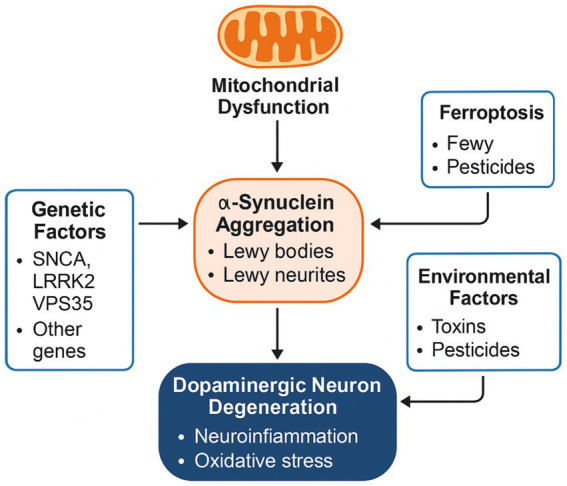
Parkinson's disease (PD) is a multifactorial neurodegenerative disorder characterized by the progressive degeneration of dopaminergic neurons in the substantia nigra pars compacta (SNpc). A combination of protein misfolding, mitochondrial dysfunction, oxidative stress, neuroinflammation, and iron-mediated toxicity converge to disrupt neuronal homeostasis (Behl et al., 2022; Luo et al., 2022). This section outlines the key molecular events driving PD pathology (Figure 1).
This schematic illustrates the key molecular mechanisms contributing to dopaminergic neuron degeneration in Parkinson's disease (PD). Genetic factors, including mutations in SNCA, LRRK2, and VPS35, promote α-synuclein aggregation into Lewy bodies and neurites. Mitochondrial dysfunction further enhances protein misfolding and oxidative stress. Environmental toxins and pesticides exacerbate the pathological process by triggering ferroptosis—a form of iron-dependent cell death—and contributing to synuclein aggregation. These converging pathways culminate in the progressive loss of dopaminergic neurons through neuroinflammation and oxidative stress.

Molecular pathogenesis of Parkinson's disease.
-synuclein aggregation and prion-like propagation α
Recent findings support the hypothesis that α-synuclein pathology originates in the enteric nervous system and ascends to the brain via the vagus nerve. This aligns with the "body-first" PD subtype theory, suggesting that peripheral initiation may precede CNS involvement (Goedert et al., 2017; Wu et al., 2023). Moreover, exosomal transfer and templated seeding of misfolded α-synuclein contribute to its prion-like behavior (Dorsey et al., 2024). Lewy bodies, once thought to be mere markers, are now considered active participants in disease propagation due to their interaction with endolysosomal and mitochondrial pathways (Dorsey et al., 2024; Murphy and McKernan, 2022).
The misfolding and aggregation of α-synuclein into insoluble fibrils is a pathological hallmark of PD. These aggregates accumulate in neuronal cytoplasmic inclusions known as Lewy bodies and Lewy neurites (Goedert et al., 2017; Wu et al., 2023). Recent research supports a prion-like propagation model, where pathogenic α-synuclein spreads trans-neuronally via exosomes and synaptic transmission, initiating a chain reaction of misfolding across interconnected brain regions. This contributes to the progression from prodromal to symptomatic PD stages (Dorsey et al., 2024; Murphy and McKernan, 2022).
α-Synuclein interferes with synaptic vesicle trafficking, mitochondrial dynamics, and axonal transport, ultimately leading to synaptic dysfunction, impaired neurotransmission, and axonopathy. Post-translational modifications such as phosphorylation at Ser129 further enhance its aggregation propensity and neurotoxicity (Goedert et al., 2017; Wu et al., 2023).
In addition to complex I deficiency, dysfunction of mitochondrial quality control pathways—specifically PINK1/Parkin-mediated mitophagy—plays a pivotal role. Under physiological conditions, PINK1 accumulates on depolarized mitochondria and recruits Parkin to facilitate their degradation. Mutations in either gene impair this surveillance, allowing damaged mitochondria to persist and propagate oxidative stress (Franco et al., 2021; Luo et al., 2022). Furthermore, DJ-1, a redox-sensitive protein, is involved in protecting neurons from oxidative damage and modulating mitochondrial integrity, linking environmental and genetic risk (Franco et al., 2021; Luo et al., 2022).
Mitochondrial dysfunction and oxidative stress
Mitochondrial complex I deficiency is consistently observed in PD, leading to impaired ATP synthesis and overproduction of reactive oxygen species (ROS) (Chang and Chen, 2020; Zeng et al., 2024). Accumulated ROS cause oxidative damage to lipids, DNA, and proteins, creating a pro-degenerative cellular environment (Chang and Chen, 2020; Zeng et al., 2024). Genetic mutations in PINK1 and PARKIN, which regulate mitophagy, impair the clearance of damaged mitochondria, exacerbating oxidative stress (Franco et al., 2021; Luo et al., 2022).
Furthermore, LRRK2 mutations—particularly G2019S—are linked to disrupted mitochondrial dynamics, altered kinase activity, and aberrant autophagy (Franco et al., 2021; Luo et al., 2022). VPS35, a component of the retromer complex, contributes to mitochondrial fragmentation and impaired trafficking, particularly affecting dopaminergic neurons (Franco et al., 2021; Luo et al., 2022).
Ferroptosis: iron-mediated cell death
Ferroptosis is an emerging mechanism in PD, characterized by iron-dependent lipid peroxidation. Postmortem analyses reveal excessive iron accumulation in the SNpc, correlating with dopaminergic neuron loss (Wang et al., 2023; Xing et al., 2023). Iron promotes Fenton chemistry, enhancing hydroxyl radical production and driving oxidative injury (Wang et al., 2023; Xing et al., 2023). Key regulators such as glutathione peroxidase 4 (GPX4), ferritin, and transferrin are dysregulated in PD, suggesting therapeutic potential for ferroptosis inhibitors and iron chelators (Wang et al., 2023; Xing et al., 2023).
Studies show that α-synuclein may bind iron directly, promoting its aggregation, while lipid peroxidation products further stabilize toxic oligomers (Wang et al., 2023; Xing et al., 2023).
Neuroinflammation and cytokine activation
Chronic neuroinflammation is another driver of PD progression. Activated microglia and astrocytes release proinflammatory cytokines including tumor necrosis factor-alpha (TNF-α), interleukin-6 (IL-6), and interleukin-1β (IL-1β), creating a hostile neuroimmune milieu (Isik et al., 2023; Eidson et al., 2017; Fu et al., 2023). These cytokines disrupt blood–brain barrier integrity, potentiate oxidative stress, and induce apoptotic signaling pathways (Isik et al., 2023; Eidson et al., 2017; Fu et al., 2023).
In PD brains, persistent glial activation is associated with regions of dopaminergic degeneration, indicating a spatial correlation (Isik et al., 2023; Eidson et al., 2017; Fu et al., 2023). In addition, peripheral inflammation—linked to comorbid conditions like diabetes and HIV—may exacerbate central neuroinflammatory responses (Isik et al., 2023; Eidson et al., 2017; Fu et al., 2023).
Epigenetic regulation also influences proteostasis in PD. Alterations in histone acetylation and DNA methylation affect the transcription of key autophagy genes such as ATG5 and LC3B. MicroRNAs (miRNAs) like miR-34b/c and miR-7 have been implicated in regulating α-synuclein expression and lysosomal biogenesis. These findings suggest that targeting epigenetic modifiers and miRNA networks may offer novel therapeutic opportunities (Isik et al., 2023; Eidson et al., 2017; Fu et al., 2023).
Disrupted proteostasis and autophagy-lysosomal dysfunction
The autophagy-lysosomal pathway (ALP) and ubiquitin-proteasome system (UPS) are critical for degrading misfolded proteins. In PD, mutations in GBA, ATP13A2, and PARK9 impair lysosomal function, leading to α-synuclein accumulation and cellular toxicity (Behl et al., 2022; Luo et al., 2022). Dysregulated mTOR signaling and defective chaperone-mediated autophagy further inhibit proteostasis (Behl et al., 2022; Luo et al., 2022).
In particular, LRRK2 mutations impair endolysosomal trafficking, contributing to α-synuclein clearance failure and promoting neurodegeneration (Behl et al., 2022; Luo et al., 2022).
Epidemiology and global burden of Parkinson's disease
Parkinson's disease (PD) is one of the fastest-growing neurological disorders globally, driven primarily by population aging, environmental exposures, and improved longevity. According to the Global Burden of Disease (GBD) Study 2019, the number of individuals living with PD more than doubled from 2.5 million in 1990 to over 6.1 million in 2016, with projections exceeding 12 million by 2040 (Zhong and Zhu, 2022). Age-standardized prevalence and disability-adjusted life years (DALYs) associated with PD have shown a 156% increase between 1990 and 2019 (Zhong and Zhu, 2022).
Age and sex distribution
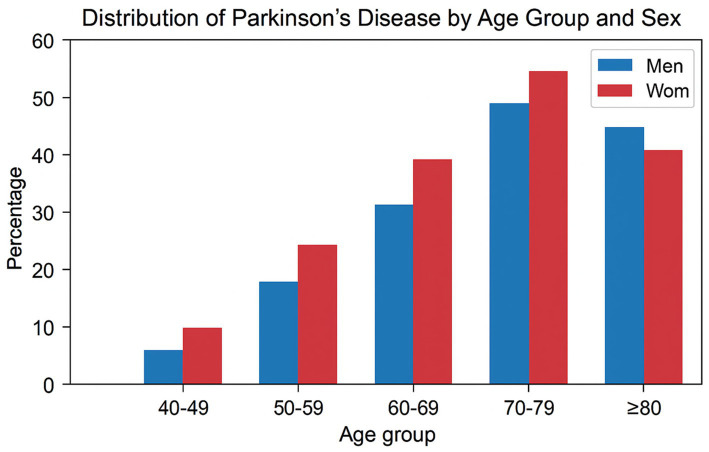
PD predominantly affects individuals over the age of 60, with incidence rising sharply after the age of 70. Epidemiological analyses reveal a male predominance, with men exhibiting approximately 1.5 times higher risk than women (Ben-Shlomo et al., 2024). This disparity is hypothesized to arise from differences in estrogen-mediated neuroprotection, lifestyle factors, and occupational exposure to neurotoxins (Ben-Shlomo et al., 2024) (Figure 2).

Distribution of Parkinson's disease by age group and sex. This bar graph illustrates the percentage distribution of Parkinson's disease across different age groups (40–49, 50–59, 60–69, 70–79, and ≥80 years) for men (blue bars) and women (red bars). The prevalence increases with age in both sexes, peaking in the 70–79 age group. Women show a higher percentage than men in the 40–79 age groups, with the trend reversing slightly in the ≥80 group. Data suggest a sex-specific and age-related trend in Parkinson's disease prevalence.
Geographical variations
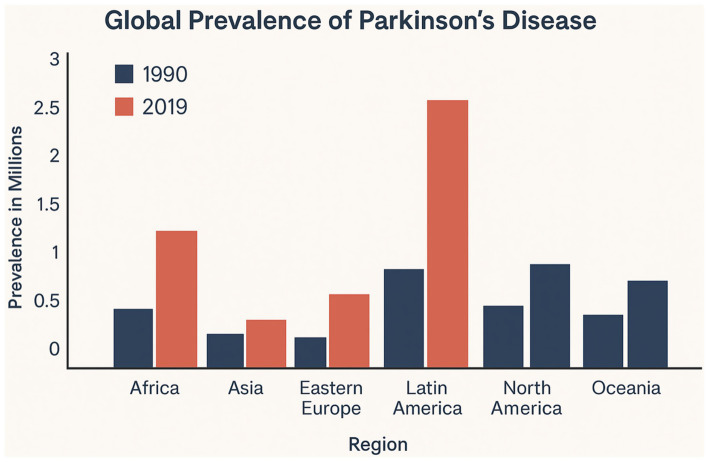
The prevalence and incidence of PD vary across countries and regions, influenced by demographic structure, industrialization, access to healthcare, and awareness levels. High-income countries (HICs) report higher prevalence rates due to better diagnostic tools, registry systems, and longer life expectancy. However, low- and middle-income countries (LMICs) are experiencing the steepest rise in new PD cases, largely due to demographic transition and under-recognition in the past (Masoom et al., 2018; Rahman et al., 2025) (Figure 3).

Global prevalence of Parkinson's disease (1990–2019). This bar chart compares the regional prevalence of Parkinson's disease across six global regions—Africa, Asia, Eastern Europe, Latin America, North America, and Oceania—between 1990 and 2019. All regions show marked increases in PD prevalence, with the most significant rise observed in Latin America and Africa. These trends reflect population aging, improved diagnosis, and environmental exposure patterns in both high-income and low- and middle-income countries.
Socioeconomic and health system impact
PD imposes a significant socioeconomic burden, including direct healthcare costs (e.g., medications, hospitalizations, and surgery) and indirect costs (e.g., lost income, caregiver absenteeism, and reduced productivity). In the United States alone, the economic burden of PD exceeded $52 billion in 2020, with caregivers losing an average of $19,000 in annual income due to reduced work hours or job loss (Chaudhuri et al., 2024).
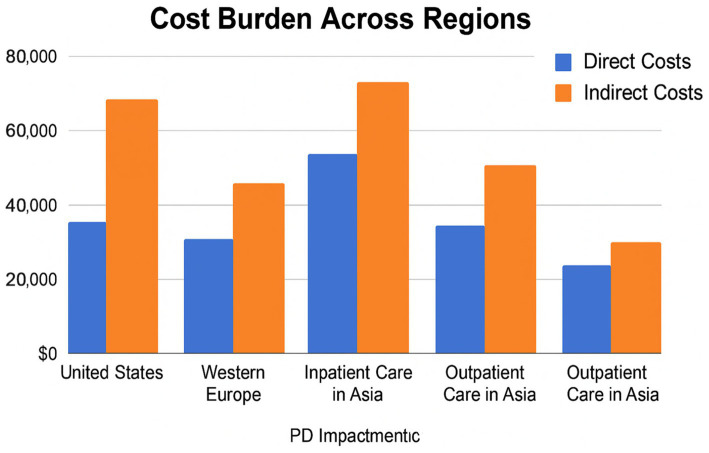
Comparative studies show that while HICs absorb higher per-patient costs through insurance systems and assistive infrastructure, LMICs face a disproportionately higher household-level burden, where out-of-pocket expenses can consume over 50% of monthly income (Ola et al., 2022) (Figures 4, 5).

Cost burden across regions and care sectors in Parkinson's disease. This grouped bar chart compares direct and indirect costs of PD across healthcare systems, including the United States, Western Europe, and inpatient/outpatient care in Asia. Indirect costs—such as lost productivity and caregiver burden—surpass direct medical expenses in most settings. The figure underscores the need for cost-effective, system-wide policy responses to support PD care globally.

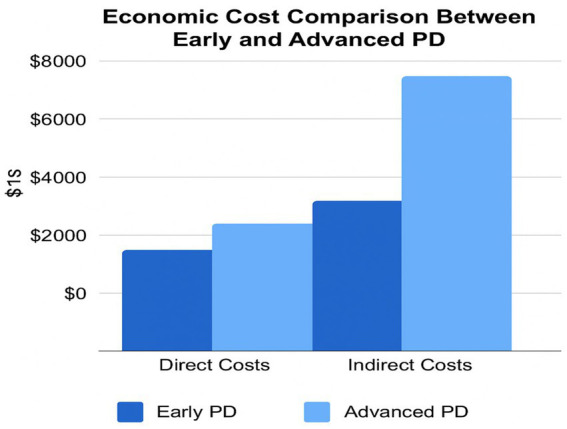
Economic cost breakdown between direct and indirect components by PD stage. This side-by-side bar chart compares the direct and indirect costs of early versus advanced PD. While both cost categories rise with disease progression, indirect costs such as caregiver absenteeism, job loss, and social support account for the greatest burden in advanced stages. This figure supports the need for integrated financial support and early intervention frameworks.
Barriers to diagnosis and registry development
A significant proportion of PD patients in LMICs remain undiagnosed or misdiagnosed, especially in rural and low-resource settings. Contributing factors include: Lack of trained neurologists or movement disorder clinics. Cultural stigma and poor health literacy. Overlapping symptomatology with aging and other comorbid conditions.
Establishing national PD registries, integrating PD into noncommunicable disease (NCD) strategies, and investing in mobile health screening tools are critical steps toward improved surveillance and resource allocation. (Gupta and Dhawan, 2021).
PD complications and comorbidities
Recent epidemiological surveys have refined our understanding of comorbidity patterns in PD. For example, depression and anxiety occur in up to 60% of patients, while dementia develops in nearly 80% of advanced cases (Panicker et al., 2021; Leta et al., 2022; Lee et al., 2022; Elefante et al., 2021). Emerging research also suggests that cardiovascular dysfunction—especially orthostatic hypotension and cardiac denervation—contributes to early mortality (Grosu et al., 2023). HIV and T2DM are increasingly recognized not just as co-existing conditions but as synergistic factors that worsen neurodegeneration (Denaro et al., 2022; Hassan et al., 2020; Hassan et al., 2020; Camargo et al., 2019). These conditions may not only complicate treatment but also precede motor onset, underscoring their diagnostic and prognostic value.
Parkinson's disease (PD) is increasingly recognized as a systemic, multisystem disorder that encompasses a wide array of nonmotor complications and comorbidities. These features often precede motor symptoms and can serve as prodromal indicators, profoundly influencing diagnosis, treatment response, and quality of life. The multifaceted nature of PD comorbidities necessitates a precision medicine approach tailored to the patient's full clinical context (Panicker et al., 2021; Leta et al., 2022).
Neuropsychiatric symptoms: depression, anxiety, and cognitive decline
Over 40–60% of PD patients experience depression and anxiety, which are often underdiagnosed and misattributed to motor disability (Lee et al., 2022; Elefante et al., 2021). These symptoms are linked to degeneration in serotonergic and noradrenergic circuits, particularly in the raphe nuclei and locus coeruleus, and may manifest years before classical motor signs (Lee et al., 2022; Elefante et al., 2021).
Cognitive impairment, ranging from mild cognitive dysfunction to Parkinson's disease dementia (PDD), affects up to 80% of individuals in advanced stages (25). This is attributed to Lewy body pathology in cortical regions, cholinergic depletion, and altered frontostriatal connectivity. Psychiatric symptoms may also be exacerbated by dopamine replacement therapy (DRT), particularly dopamine agonists, which can trigger impulse control disorders, hallucinations, and psychosis (Burchill et al., 2024; Taslim et al., 2024).
Diagnostic challenge: Differentiating neuropsychiatric manifestations from motor-induced cognitive slowness or medication side effects requires multidisciplinary assessment. Use of validated scales (e.g., MoCA, GDS, HADS) in routine care is recommended.
Cardiovascular and autonomic dysfunction
Autonomic dysfunction is a hallmark nonmotor feature of PD and includes: Orthostatic hypotension (in up to 30–40%). Arrhythmias, bradycardia, and QT prolongation. Urinary incontinence, constipation, and sexual dysfunction.
Cardiac sympathetic denervation, detectable via 123I-MIBG scintigraphy, is strongly associated with disease progression (Grosu et al., 2023). These cardiovascular abnormalities increase fall risk, exacerbate fatigue, and limit the use of medications such as anticholinergics and MAO-B inhibitors (Grosu et al., 2023).
Management complications: Cardiovascular symptoms complicate pharmacotherapy by interacting with anti-parkinsonian drugs that modulate autonomic tone, requiring dose balancing and often necessitating cardiology consultation (Sharkey and Modarai, 2018; Al-Kuraishy et al., 2023).
HIV co-infection and antiretroviral therapy
HIV-positive individuals are at increased risk of parkinsonism due to basal ganglia vulnerability to viral neurotoxicity, chronic inflammation, and mitochondrial stress (Denaro et al., 2022; Hassan et al., 2020). HIV-associated neurocognitive disorders (HAND) share overlapping features with PD, including bradykinesia and cognitive dysfunction (Denaro et al., 2022; Hassan et al., 2020).
Moreover, antiretroviral therapy (ART), particularly protease inhibitors and nucleoside reverse transcriptase inhibitors, can:Interfere with dopamine metabolism.Alter pharmacokinetics of Levodopa.Exacerbate oxidative stress and mitochondrial dysfunction (Marin et al., 2021; Ferrazzoli et al., 2016).
Thus, HIV–PD co-management requires careful drug selection and neurology–infectious disease collaboration to avoid worsening symptoms or drug–drug interactions.
Type 2 diabetes mellitus (T2DM)
T2DM is a significant comorbidity in PD, with shared pathogenic features including: Insulin resistance in the CNS. Mitochondrial dysfunction. Chronic low-grade inflammation. Advanced glycation end products (AGEs) that impair dopaminergic signaling.
Epidemiological studies suggest a 30–50% increased risk of PD in patients with T2DM (Hassan et al., 2020; Camargo et al., 2019). T2DM may also accelerate PD progression, worsen cognitive decline, and impair motor response to Levodopa. Conversely, certain GLP-1 receptor agonists, such as exenatide, have shown neuroprotective effects in clinical trials, indicating the potential for cross-therapeutic benefits (Troshneva and Ametov, 2022).
Gut dysbiosis and the microbiota-gut-brain axis
Emerging evidence highlights the role of gut microbiota in PD pathophysiology. PD patients frequently exhibit dysbiosis, characterized by:Reduced short-chain fatty acid–producing bacteria (e.g., Faecalibacterium).Increased pro-inflammatory genera (e.g., Enterobacteriaceae).
Gut inflammation and barrier dysfunction may facilitate α-synuclein misfolding in the enteric nervous system, with retrograde propagation via the vagus nerve (Li et al., 2023; Turco et al., 2023). Animal models support this bottom-up mechanism of disease initiation (Li et al., 2023; Turco et al., 2023).
Probiotics, prebiotics, and synbiotics are under clinical investigation as adjunct therapies to modulate gut-brain interactions and reduce systemic inflammation (Chan et al., 2022; Hashish and Salama, 2023).
Treatment challenges and therapeutic innovations
Despite being the cornerstone of symptomatic management, current Parkinson's disease (PD) treatments are palliative rather than disease-modifying. Levodopa remains the most effective agent for controlling motor symptoms, but its long-term use leads to motor complications, reduced efficacy, and treatment resistance (Kulisevsky, 2022; Naqvi et al., 2020), highlighting the need for combination strategies and novel delivery platforms (Kulisevsky, 2022; Naqvi et al., 2020). This section evaluates major therapeutic modalities, limitations, and emerging innovations.
Levodopa and the rationale for combination therapy
Levodopa, often co-administered with carbidopa to inhibit peripheral metabolism, is the gold standard for PD treatment. However, chronic use is associated with:Motor fluctuations (wearing-off, on–off phenomena).Dyskinesia.Diminished response in advanced stages (Kulisevsky, 2022; Naqvi et al., 2020).
To enhance efficacy and reduce complications, combination therapies employ:MAO-B inhibitors (e.g., rasagiline).Dopamine agonists (e.g., pramipexole).COMT inhibitors (e.g., entacapone) (Suárez Castro et al., 2016; Khan et al., 2023).
Yet these agents often exacerbate neuropsychiatric and cardiovascular side effects, especially in older patients, limiting their use (Suárez Castro et al., 2016; Khan et al., 2023).
Deep brain stimulation (DBS) vs. pharmacological treatment
DBS is indicated in patients with severe motor fluctuations and Levodopa-induced dyskinesia. It involves stereotactic implantation of electrodes into deep brain structures, most commonly:Subthalamic nucleus (STN).Globus pallidus internus (GPi) (Niethammer et al., 2017).
Efficacy comparison:
DBS significantly improves motor function and quality of life, particularly in patients with advanced disease and medication-refractory symptoms (Hacker et al., 2020; Rawls, 2022; Hitti et al., 2019; Rahimpour et al., 2022). Compared to pharmacological treatment, DBS provides sustained symptom control and reduces Levodopa requirements. However, risks include surgical complications, hemorrhage, infection, and neuropsychiatric side effects, necessitating careful patient selection and multidisciplinary evaluation (Cury et al., 2022; Wagle Shukla et al., 2017) (Table 1).
| Parameter | Levodopa | DBS |
|---|---|---|
| Motor symptom control | High | High |
| Nonmotor symptom improvement | Limited | Variable |
| Disease modification | None | None |
| Side effects | Dyskinesia, fluctuations | Surgical risks, cognition |
| Cost and accessibility | Low–moderate | High (surgical + device) |
Overcoming the blood–brain barrier (BBB): nanocarrier-based drug delivery
The BBB severely restricts CNS penetration of most therapeutic agents. Emerging nanocarrier platforms aim to improve drug bioavailability and target specificity (Naqvi et al., 2020; Inamdar et al., 2024):Liposomes: biocompatible vesicles for encapsulating Levodopa and neuroprotective agents.Polymeric nanoparticles: controlled release systems (e.g., PLGA-based).Dendrimers and micelles: facilitate passage via receptor-mediated transcytosis.Exosome-inspired nanocarriers: for endogenous biomimicry and enhanced biocompatibility.
These carriers can be engineered for surface modification with ligands targeting dopaminergic neurons or inflamed brain regions, enabling precision delivery and minimizing off-target toxicity (Naqvi et al., 2020; Inamdar et al., 2024).
Gene therapy: targeting underlying molecular defects
Gene therapy in PD aims to:Restore dopamine synthesis: e.g., via delivery of aromatic L-amino acid decarboxylase (AADC).Enhance neuronal survival: e.g., delivery of GDNF or neurturin genes.Silence or correct mutations: e.g., SNCA and LRRK2 via RNA interference (RNAi) or CRISPR-Cas9 (Niethammer et al., 2017; Sen et al., 2025., Inoue et al., 2023; Sharma et al., 2025).
AAV2-based vectors have been used in clinical trials to deliver therapeutic genes to the striatum or SNpc, showing safety and moderate benefit (Niethammer et al., 2017; Sen et al., 2025). However, challenges remain in target specificity, long-term expression, and immune response (Inoue et al., 2023; Sharma et al., 2025).
Stem cell-based approaches
Stem cell therapies offer the potential to replace lost dopaminergic neurons and restore neural circuitry. Promising cell types include:Induced pluripotent stem cells (iPSCs): Autologous and genetically matched.Embryonic stem cell–derived DA progenitors.Mesenchymal stem cells (MSCs): For immunomodulation and trophic support (Gholamzad et al., 2023; Madrazo et al., 2019).
Preclinical models and early-phase trials have shown motor improvement and graft survival, but issues such as immune rejection, tumorigenicity, and ethical concerns need resolution (Xiao and Tan, 2023; Li et al., 2023; Cha et al., 2023; Barker, 2019).
CRISPR-Cas9 and genomic correction
CRISPR-Cas9 enables precise genome editing and holds transformative potential for monogenic PD, particularly:Correction of LRRK2 G2019S, SNCA triplications, or PINK1 mutations.Creation of isogenic cellular models for drug screening (Inoue et al., 2023; Sharma et al., 2025).
Currently, CRISPR is limited to in vitro and animal studies due to safety and ethical barriers, but advances in delivery vectors and base editing technologies may accelerate clinical translation (Inoue et al., 2023; Sharma et al., 2025).
Artificial intelligence (AI) in diagnosis and monitoring
AI and machine learning (ML) are revolutionizing PD management through:Early diagnosis: analyzing digital biomarkers (e.g., voice, gait, handwriting).Disease progression models: integrating longitudinal clinical and imaging data.Treatment response prediction: personalizing drug regimens based on patient profiles (Burchill et al., 2024; Taslim et al., 2024).
Wearable sensors and smartphones now enable real-time symptom tracking, and ML algorithms can stratify patients for adaptive trial designs and biomarker discovery (Burchill et al., 2024; Taslim et al., 2024) (Figure 6).

Emerging therapeutic modalities in Parkinson's disease. This infographic highlights four cutting-edge therapeutic strategies under investigation for Parkinson's disease (PD). Stem cell therapy aims to replace lost dopaminergic neurons using induced pluripotent stem cells or embryonic-derived progenitors. CRISPR-Cas9 gene editing enables precise correction of PD-associated mutations such asor. Artificial Intelligence (AI) supports early diagnosis, disease monitoring, and personalized treatment planning through machine learning algorithms analyzing clinical, wearable, and omics data. Nanocarriers, including liposomes and polymeric nanoparticles, are engineered to cross the blood–brain barrier for targeted drug delivery and enhanced bioavailability of neuroprotective compounds. LRRK2 SNCA
Future projections and the need for research
Despite significant strides in symptomatic therapy, Parkinson's disease (PD) remains incompletely understood and incurable, with no current treatment that halts or reverses neurodegeneration. A strategic shift is needed from reactive management to preventive and disease-modifying paradigms.
Future research must address three critical gaps:Early diagnosis—through robust biomarkers and AI-enabled screening.Personalized therapeutics—integrating genomics, imaging, and digital phenotyping.Equitable care models—ensuring access to diagnosis, treatment, and trials across all income settings.
These goals will require interdisciplinary collaboration, investment in longitudinal registries, and ethical frameworks for the deployment of novel technologies like gene editing and neural interfaces.
Biomarker discovery and validation
Biomarkers are essential for diagnosing PD in its prodromal phase, tracking progression, and predicting treatment response. Promising classes include:Protein biomarkers: α-synuclein (total and phosphorylated), neurofilament light chain (NfL), DJ-1.Inflammatory markers: TNF-α, IL-6, IL-1β in serum/CSF.Lipid peroxidation products: for ferroptosis monitoring.Imaging biomarkers: dopaminergic transporter (DaT) SPECT, PET tracers for α-synuclein.Microbiome profiles: gut microbial shifts linked to motor and nonmotor symptomatology.
Longitudinal cohort initiatives like the Parkinson's Progression Markers Initiative (PPMI) and BioFIND are accelerating multi-omic biomarker integration. However, most candidates require standardization across labs, ethnic groups, and disease stages before clinical deployment.
Innovation in clinical trial design
Traditional PD trials are constrained by: Slow progression of disease markers. Symptomatic overlap. High inter-patient variability.
Future trials should adopt:Adaptive designs: allow protocol adjustments based on interim data.Basket trials: group patients by molecular subtype (e.g., LRRK2+, SNCA+, idiopathic).Decentralized trials: leverage digital tools and wearables for home-based data capture.Multi-arm, multi-stage (MAMS) protocols: increase efficiency in assessing multiple interventions.
Moreover, digital endpoints (e.g., gait variability, voice modulation, tremor amplitude) using AI analytics offer objective and continuous monitoring over traditional scales like the Unified Parkinson's Disease Rating Scale (UPDRS).
Advancing precision medicine
The heterogeneity of PD underscores the need for personalized therapy. Key enablers include:Genetic profiling: stratifying patients by mutations (LRRK2, GBA, PINK1) to match targeted treatments.AI-driven treatment selection: using machine learning models trained on clinical, genomic, and imaging data to guide drug choice and dosage.Multi-omics integration: transcriptomics, epigenomics, proteomics, and metabolomics to define subtypes and therapeutic windows.
Precision medicine is already guiding trials for LRRK2 inhibitors, GCase modulators, and GLP-1 analogues, representing a shift toward therapies tailored to molecular etiology and patient-specific risk profiles.
Addressing global and socioeconomic gaps
Most PD research and trials are concentrated in high-income countries, neglecting ethnic diversity, LMIC-specific risk factors, and accessibility challenges. Priorities include:Building local research capacity: training neurologists and establishing centers of excellence in LMICs.Developing affordable, scalable tools: e.g., mobile-based screening apps, low-cost wearable diagnostics.Engaging underserved populations in trials: to ensure global applicability of therapies and biomarkers.
Public-private partnerships and South–South collaborations are essential to ensure global equity in PD care and innovation.
Research priorities at a glance
See Table 2.
| Research focus | Recommended action |
|---|---|
| Biomarker development | Validate CSF/plasma α-synuclein, NfL, cytokines across populations |
| AI in PD management | Expand tools for early detection and individualized therapy |
| Ferroptosis pathway | Investigate iron chelators and lipid peroxidation inhibitors |
| Microbiome–brain axis | Develop microbiota-targeted interventions (e.g., synbiotics) |
| Stem cell and gene therapies | Advance iPSC-based trials and AAV-mediated gene editing |
| Clinical trial design | Implement adaptive, decentralized, and biomarker-enriched trials |
Conclusion and policy recommendations
Parkinson's disease (PD) represents a mounting global challenge, characterized by rising prevalence, incomplete understanding of disease mechanisms, and inadequate access to care—especially in resource-limited regions. Although symptomatic therapies like Levodopa and Deep Brain Stimulation (DBS) offer short-term relief, they fail to alter disease progression or address the wide array of nonmotor symptoms and comorbidities.
The evolution of PD management now depends on: Precision diagnostics to detect disease earlier and differentiate subtypes. Molecular-targeted interventions that go beyond dopamine replacement. Health system reforms that integrate PD care into national strategies, particularly in low- and middle-income countries (LMICs).
Global research equity, digital innovation, and collaborative policy action are essential to build a future where PD prevention, care, and cure are accessible to all.
Summary of key insights
Pathogenesis: PD is driven by interlinked mechanisms including α-synuclein aggregation, mitochondrial dysfunction, ferroptosis, and neuroinflammation.Genetic and environmental interplay: mutations in SNCA, LRRK2, PINK1, and VPS35 interact with toxins and metabolic stressors to trigger degeneration.Comorbidities: neuropsychiatric symptoms, HIV, T2DM, cardiovascular dysfunction, and gut dysbiosis significantly modify disease trajectory and complicate treatment.Therapeutic limitations: levodopa loses efficacy over time; DBS is invasive and inaccessible to many; the blood–brain barrier (BBB) remains a major hurdle in CNS drug delivery.Emerging strategies: gene therapy, stem cells, nanocarriers, and AI-driven diagnostics show promise but require further validation, regulatory clarity, and equitable access.Economic and regional disparities: LMICs experience disproportionate diagnostic delays, treatment inaccessibility, and caregiver burden.
Actionable research recommendations
See Table 3.
| Priority Area | Proposed action |
|---|---|
| Biomarker development | Fund longitudinal, multi-omics studies including LMIC populations |
| Clinical trial innovation | Adopt adaptive, digital, and basket trial models |
| AI/ML for personalized care | Deploy AI to stratify patients and predict therapy response |
| Gene and cell-based therapies | Support scalable iPSC and CRISPR-based preclinical and early clinical studies |
| Ferroptosis and neuroinflammation | Investigate iron chelation and anti-cytokine interventions |
| Gut microbiota modulation | Advance trials on synbiotic, probiotic therapies |
Health system and policy recommendations
Expand early screening and AI-based diagnostic tools in primary and rural care settings to detect PD in prodromal stages. Subsidize essential therapies, including Levodopa combinations and deep brain stimulation (DBS), via public–private partnerships. Establish national PD registries and surveillance systems, integrated into broader NCD frameworks. Train a multidisciplinary PD care workforce, including neuropsychiatrists, geriatricians, rehabilitation specialists, and community health workers. Mandate inclusion of LMIC patients in international clinical trials to ensure therapeutic relevance and accessibility across populations. Promote open-access data sharing platforms (e.g., PPMI, ASAP) and South–South scientific collaboration.
Vision forward
The future of PD care must be multidimensional, digitally enabled, and globally inclusive. Investments in biomarker discovery, personalized therapies, and innovative trial frameworks should be matched by equitable health system reforms and coordinated policy alignment. Only through interdisciplinary collaboration, open science, and technology-driven democratization of care can the field transition from symptomatic palliation to genuine disease modification (Table 4).
| Comorbidity | Prevalence in PD (%) | Pathophysiological link | Clinical implication |
|---|---|---|---|
| Depression and anxiety | 40–60% | Serotonergic and noradrenergic dysfunction; neuroinflammation | Reduced quality of life; may precede motor symptoms |
| Cognitive decline | Up to 80% | Lewy pathology in cortex; cholinergic loss | Progresses to dementia; affects treatment planning |
| Cardiovascular dysfunction | 30–50% | Autonomic failure; α-synuclein in cardiac nerves | Orthostatic hypotension; arrhythmias; fall risk |
| Type 2 diabetes mellitus | 30–50% comorbidity | Insulin resistance; mitochondrial stress; inflammation | Accelerates PD progression; impairs Levodopa response |
| HIV co-infection | Higher in endemic regions | Mitochondrial stress; viral toxicity; ART interactions | Overlap with neurocognitive symptoms; drug interactions |