
What this is
- This research presents a novel gene-therapeutic strategy using CRISPR to enhance CAR T cell therapy in solid tumors.
- The approach focuses on remodeling the immunosuppressive tumor microenvironment () through targeted cytokine expression.
- A bioinformatics pipeline, , identifies patient-specific CRISPR knock-in sites for effective integration of pro-inflammatory cytokines.
- Findings demonstrate that this method improves immune cell infiltration and tumor control in neuroblastoma models.
Essence
- Personalized CRISPR knock-in of cytokine genes remodels the tumor microenvironment, enhancing CAR T cell therapy efficacy in solid tumors. The pipeline identifies optimal integration sites, leading to improved immune responses.
Key takeaways
- identifies a median of 130 tumor-specific PAM sites across the transcriptome in neuroblastoma samples. This high specificity is crucial for effective CRISPR knock-in applications.
- CRISPR-mediated CXCL10 knock-in enhances CAR T cell infiltration and tumor control in both in vitro and in vivo models. This indicates a promising strategy for overcoming barriers to immunotherapy.
- The strategy of tumor-intrinsic cytokine expression could be broadly applicable to various solid tumors, suggesting a versatile approach to improve immunotherapy outcomes.
Caveats
- The study's focus on neuroblastoma limits generalizability to other solid tumors. Further validation in diverse cancer types is needed.
- Tumor heterogeneity and sequencing dataset biases may affect the reproducibility of 's findings, highlighting the need for caution in application.
- The current CRISPR efficiency scores require further refinement to enhance target site selection and minimize off-target risks.
Definitions
- TME: Immunosuppressive tumor microenvironment that hinders effective immune responses against tumors.
- CancerPAM: A multi-omics bioinformatics pipeline that identifies patient-specific CRISPR knock-in sites for therapeutic applications.
Simplified
Introduction
The emergence of CRISPR-Cas9 technology has transformed genome engineering by enabling precise gene editing. Guided by single-guide RNAs (gRNAs), the Cas9 nuclease induces site-specific double-strand breaks, allowing targeted gene knockouts and insertions. This versatility has established CRISPR-Cas9 as an indispensable tool in both genetic research and therapy development1,2. Harnessing CRISPR for cancer therapies necessitates highly specific target selection to ensure both safety and efficacy. Automated bioinformatics pipelines integrating multi-omics (genomic, transcriptomic and epigenomic) data have been developed either to advance understanding of cancer biology3,4 or to facilitate optimal CRISPR gRNA design, to maximize therapeutic precision5. However, tools that effectively combine both are still lacking.
Despite advances in precision oncology, solid tumours remain a major global health burden6. Directly targeting tumour cells through cytotoxic gene therapy is hindered by the necessity to deliver the therapy to every cancer cell to prevent relapse, a requirement current delivery vehicles fail to meet7–9. Immunotherapies have emerged as a promising alternative, leveraging the immune system's ability to recognize and eliminate tumours. Oncolytic viruses, neoantigen-based vaccines and chimeric antigen receptor (CAR) T cell therapy have shown considerable potential10–12. CAR T cells, genetically modified to express synthetic receptors that combine tumour antigen recognition with intracellular signalling domains, directly recognize target antigens and mount a cytotoxic response13. However, the immunosuppressive tumour microenvironment (TME) in many solid tumours presents a significant hurdle to CAR T cell therapy. Tumours deploy various immune evasion mechanisms, including secretion of immunosuppressive cytokines and recruitment of regulatory T cells, which collectively hinder CAR T cell infiltration and cytotoxic activity14,15.
Neuroblastoma is a paediatric solid tumour of neuroectodermal origin that has an immunosuppressive TME. Despite aggressive multimodal treatment regimens, high-risk neuroblastoma is associated with poor long-term survival16,17. CAR T cell therapies targeting antigens on neuroblastoma cells, such as L1CAM, or GD2 have been explored18,19. While CAR T cell therapy against GD2 has shown some promise (NCT03373097), other clinical trials, including those targeting L1CAM (NCT02311621), have reported limited efficacy due to antigen escape and poor infiltration and persistence in the hostile TME20–22. This immune exclusion is particularly pronounced in MYCN-amplified tumours (~25% of neuroblastomas), which exhibit transcriptional repression of interferon-stimulated genes, impaired antigen presentation, and reduced infiltration of CD8⁺ T cells and NK cells23–25. Low IFNG signatures and diminished chemokine expression, especially T cell-attracting chemokines (e.g. CXCL10), correlate with poor prognosis and impaired immune responsiveness in neuroblastoma23,24,26. Conversely, tumours with robust T cell-inflamed gene expression signatures that include IFNG and its downstream chemokines are associated with improved overall survival27. Together, these findings underscore the central role of the interferon-chemokine axis in shaping the neuroblastoma TME.

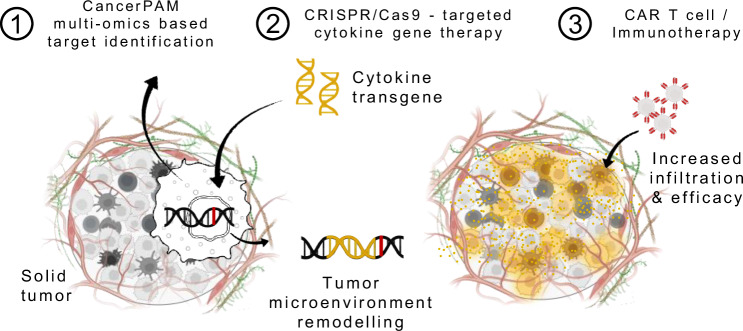
Therapeutic concept. Schematic of an augmentative therapeutic approach combining the CancerPAM multi-omics-based target identification pipeline with CRISPR/Cas9-targeted cytokine gene therapy, followed by CAR T cell or other immunotherapies. CancerPAM enables the identification of promising tumour-specific CRISPR knock-in target sites in solid tumours with an immunosuppressive microenvironment. At these sites, cytokine transgenes are integrated, leading to beneficial tumour biology changes that enhance subsequent CAR T cell or other immunotherapies.Schematic components: Created in BioRender. Kuenkele, A. (2025). Illustration attribution: https://BioRender.com/u71d212
Results
The CancerPAM pipeline identifies and ranks tumour-specific novel PAM sites

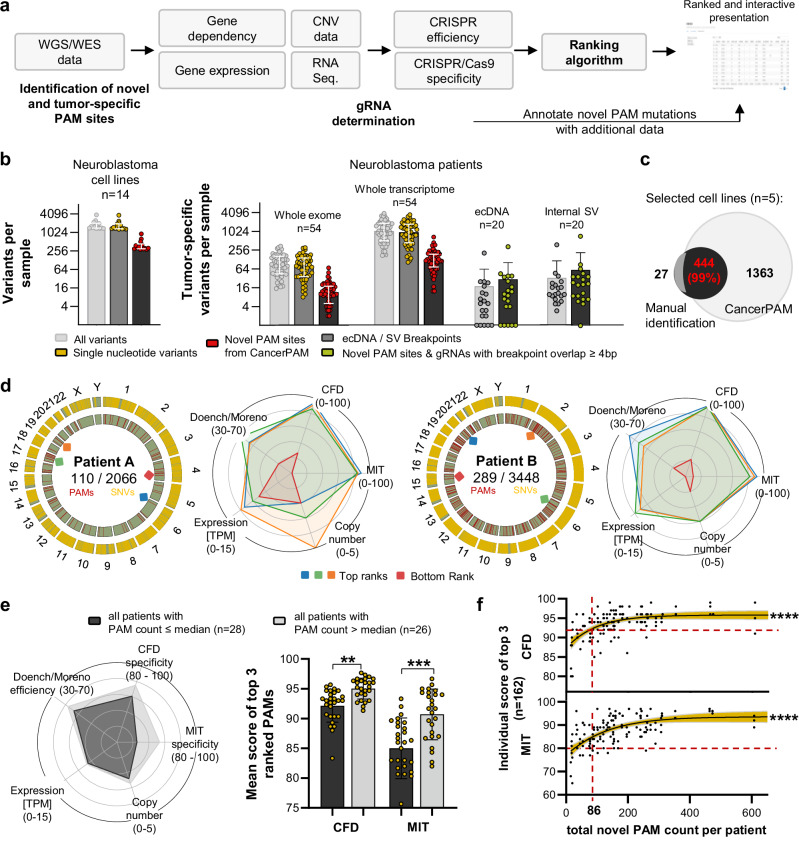
The CancerPAM multi-omics-based automated pipeline identifies and ranks targetable tumour-specific PAM sites in cancer cell lines and patient samples. Overview of CancerPAM integrating whole-genome/whole-exome sequencing (WGS/WES) data with multi-omics annotation to identify and rank novel PAMs.Quantification of variants and tumour-specific PAMs in neuroblastoma cell lines (WES) and patients (WGS including extrachromosomal DNA (ecDNA)). "All variants" refers to single-nucleotide variants (SNVs) and small insertions/deletions (InDels) (<300 bp) from the CancerPAM pipeline. "Genomic structural variants (SVs)" = larger rearrangements (deletions, insertions, tandem duplications, inversions, translocations; SV/ecDNA pipeline).Overlap between novel PAM sites identified via manual screening and those identified using the CancerPAM pipeline.Chromosomal distribution of SNVs and novel tumour-specific PAM sites and visualization of annotated feature characteristics for the top three highest- and lowest-ranked PAM site in two patients (A and B) including expression of the gene containing the PAM in transcripts per million (TPM).Mean annotated feature values of the top three ranked PAM sites, averaged across patients with a high (>median; = 26) or low (≤median; = 28) PAM count. Statistical comparison of these two groups is shown for the mean cutting frequency determination (CFD) and Massachusetts Institute of Technology (MIT) specificity scores.Correlation analysis of individual scores for the top three ranked novel PAM sites across patients ( = 162 individual PAM sites, top three per patient) versus total tumour-specific PAM count per patient. Red dashed lines indicate potential safety and feasibility thresholds. Data presentation:,Mean ± SD. Dots andrepresent individual cell lines or patients. Statistical tests:Kruskal–Wallis with Dunn's post-hoc correction (two-sided, exact = 0.0071, 0.0006);Logistic regression for curve fitting with error bands representing the 95% confidence interval followed by two-sided Spearman correlation analysis (exact < 0.0001, <0.0001).values:<0.01,<0.001,<0.0001;., not significant. Source data are provided as a Source Data file. a b c d e f b e e f n n n n p p p n.s ** *** ****
CRISPR-mediated knock-in of cytokine transgenes at tumour-specific target sites is feasible and efficient

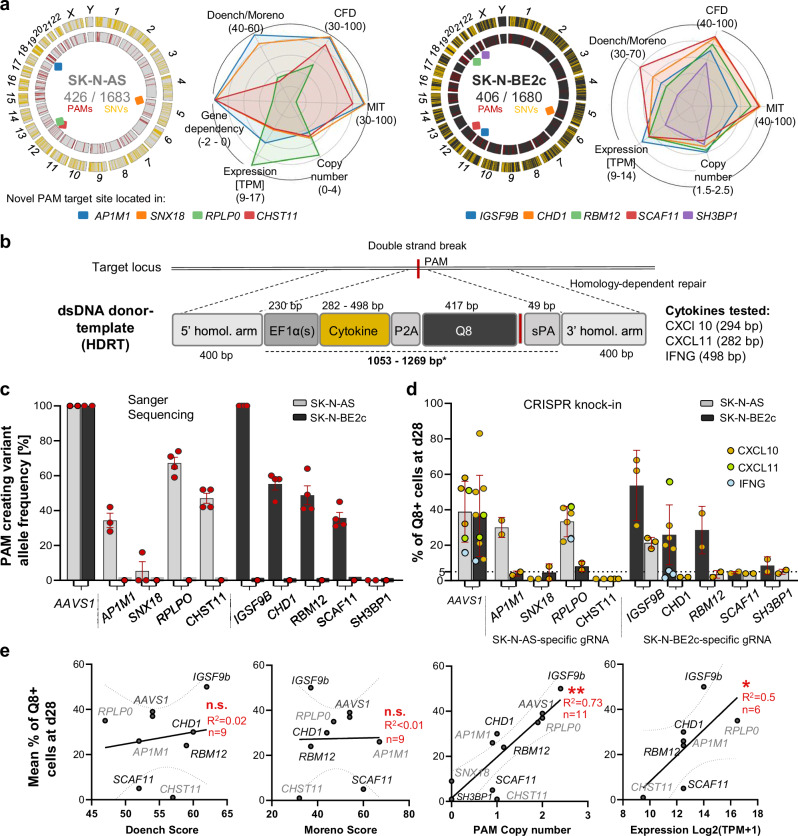
Gene-therapeutic CRISPR knock-in of cytokine transgenes is efficient and specific for top-ranked novel PAM targets. Circos plots showing the chromosomal distribution of single-nucleotide variants (SNVs, yellow) and novel PAM sites (red) in SK-N-BE2c and SK-N-AS neuroblastoma cell lines. PAMs tested in knock-in experiments are marked with coloured squares. Radar plots visualize annotated features for these PAMs, named after their respective genes.Schematic of CRISPR/Cas9-mediated transgene knock-in via homology-directed repair (HDR) following ribonucleoprotein (RNP) electroporation. The linear double-stranded (ds) homology-directed repair donor template (HDRT) consists of 5′ and 3′ homologous arms, 400 base pairs (bp) each, a custom EF1α-derived promoter, the cytokine transgene linked by a P2A self-cleaving peptide to a stainable Q8 reporter (CD34 epitope, CD8 transmembrane domain), followed by a stop codon and synthetic poly(A) (sPA) sequence.PAM-creating mutation allele frequency analysed by Sanger sequencing of selected targets in SK-N-BE2c and SK-N-AS.Knock-in efficiency of three cytokines (CXCL10, CXCL11, IFNG) at different target sites, measured by Q8 antigen expression by flow cytometry at day 28 post-electroporation.Correlation of mean knock-in rate (Q8 antigen expression at day 28) with PAM-annotated features, including CRISPR efficiency scores (Doench and Moreno), PAM copy number, and expression of the gene containing the PAM for selected targets. Each dot andrepresent the mean value for the selected locus-cell line combinations from (). Data presentation:,Mean ± SD. Each dot represents one biological replicate and exactvalues per condition are provided in the Source Data file. Statistical analysis:Linear regression for curve fitting with² values and error bands representing the 95% confidence interval followed by two-sided Spearman correlation analysis (exact = 0.62, 0.82, 0.0022, 0.019).values:<0.05,<0.01;., not significant. Source data are provided as a Source Data file. a b c d e d c d e n n R p p n.s * **

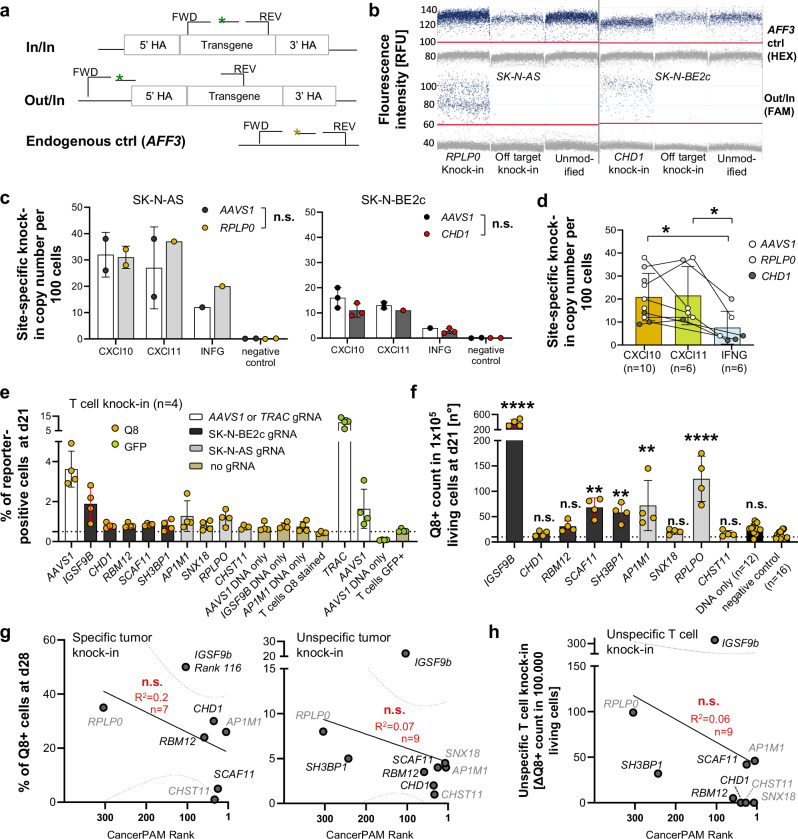
The CancerPAM pipeline accurately identifies novel PAM sites with a low unspecific knock-in risk. Schematic of digital PCR assays for site-specific CRISPR knock-in confirmation. "In/In" refers to a fluorescence probe-based PCR assay with primers binding inside the transgene, while "Out/In" uses a forward primer upstream of the homologous arm. A probe-based assay for thegene served as an endogenous control.Digital PCR raw data showing positive partitions (blue) for knock-in and control samples using the Out/In orcontrol assay. Representative of biological replicates shown in (), with similar results obtained in all replicates.Site-specific knock-in copy number per 100 cells, 7 days after RNP/HDRT electroporation in SK-N-AS and SK-N-BE2c for different transgenes and loci.Cumulative site-specific knock-in copy numbers for CXCL10, CXCL11, and IFNG.Comparison of reporter (Q8/GFP) positive cells 21 days post-CRISPR knock-in in primary T cells from two donors using gRNAs targeting neuroblastoma-specific novel PAM sites or AAVS1 and TRAC controls ( = 4, 2 biological replicates per donor).High-throughput flow cytometry (>300,000 cells analysed per sample) to compare unspecific knock-in rates for Q8-reporter HDRTs at neuroblastoma-specific PAM sites after T cell knock-in ( = 4).Correlation of specific knock-in rates (in novel PAM-harbouring neuroblastoma cells) and unspecific knock-in rates (in cells lacking the novel PAM) with CancerPAM-assigned ranks.Correlation of unspecific CRISPR/Cas9-mediated T cell knock-in rates, as determined in (), with CancerPAM ranks. Data presentation:–Mean ± SD. Each dot represents one biological replicate.refers to the number of biological replicates and exactvalues are provided in the Source Data file.,Dots andrepresent the mean value for the selected locus-cell line combinations from Fig. . Statistical analysis,Two-way ANOVA with Tukey test (two-sided, exact = 0.42, 0.14, 0.01, 0.025);Kruskal–Wallis with Dunn's post hoc test (two-sided, exact = <0.0001, >0.99, 0.38, 0.002, 0.0076, 0.0058, >0.99, 0.0004, >0.99, 0.12);,Linear regression for curve fitting with error bands representing the 95% confidence interval followed by two-sided Spearman correlation analysis (exact = 0.14, 0.21, 0.35).values:<0.05,<0.01,<0.001,<0.0001; n.s., not significant. Source data are provided as a Source Data file. a b d c d e f g h f c f g h : c d f g h AFF3 AFF3 n n n n n p p p p 3d * ** *** ***
Tumour cytokine secretion achieved by CRISPR-mediated knock-in improves CAR T cell infiltration and efficacy in vitro and in vivo

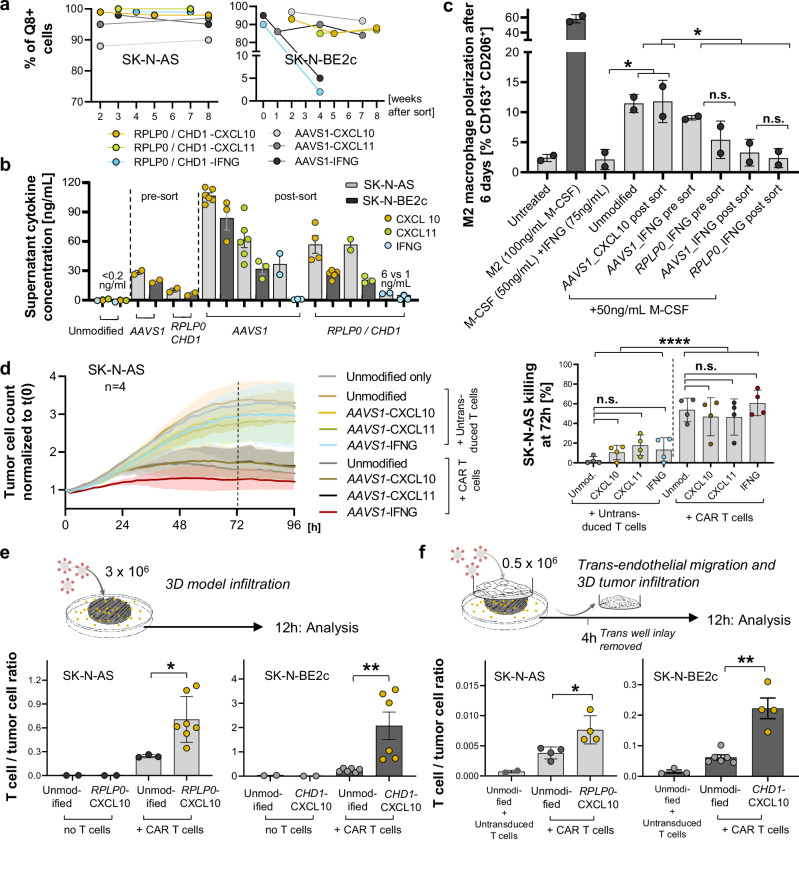
Gene-therapeutic induction of CXCL10 secretion enhances CAR T cell migration and infiltration in vitro. Post-enrichment transgene expression rates measured via Q8 positivity in flow cytometry over 8 weeks for transgenic SK-N-AS and SK-N-BE2c cell lines.Supernatant cytokine concentrations for different cytokine-target locus combinations before (pre-sort) and after enrichment (post-sort) for Q8⁺ cells, determined via ELISA.Flow cytometric analysis of M2 macrophage polarization in response to tumour cell-derived or recombinant IFNG and M-CSF (Macrophage Colony Stimulating Factor).CAR T cell killing dynamics for transgenic and enriched cytokine-expressing SK-N-AS cell lines co-cultivated with either non-transduced T cells or L1CAM-targeting CD4⁺ and CD8⁺ CAR T cells at an effector-to-target ratio of 1:5 ( = 4 individual co-culture experiments, 2 per donor for CAR T cell production). Killing dynamics were tracked over 96 h via Incucyte live imaging. The dotted line marks 72 h, where statistical comparisons were conducted. Killing at 72 h was determined as the ratio of the t(0) normalized tumour cell count of the treated cell line against the untreated unmodified control.Bioprinted 3D neuroblastoma models were used to analyse CAR T cell infiltration into 3D tumours 12 h post-co-culture. 3D tumour CAR T cell infiltration, represented by the T cell-to-tumour cell ratio (flow cytometry), was compared between enriched cytokine-expressing and unmodified SK-N-AS and SK-N-BE2c cells.Transendothelial migration and 3D tumour infiltration assays were performed using a HUVEC monolayer with a Boyden transwell insert on a bioprinted 3D neuroblastoma model. Four hours after adding L1CAM-targeting CAR T cells, the insert was removed, and 3D tumour infiltration was measured via flow cytometry after eight hours, following the same procedure as in (). Data presentation:–Mean ± SD. Each dot represents one biological replicate, and exactvalues are detailed in the Source Data file. Statistical analysis:,Kruskal–Wallis with Dunn's post hoc test (two-sided, exact = 0.021, 0.038, 0.41, 0.13, 0.65, 0.12, 0.4, >0.99, >0.99, >0.99);two-sided Two-way ANOVA for CAR T cell vs. MOCK comparison (exact < 0.0001);,Mann–Whitney test (two-sided, exact = 0.017, 0.0022, 0.029, 0.0095).values:<0.05,<0.01,<0.0001;., not significant. Source data are provided as a Source Data file. Illustration attribution: CAR T cell illustration elements in (,): Created in BioRender. Kuenkele, A. (2025). a b c d e f d b f c d d e f e f n n p p p p n.s * ** **** https://BioRender.com/u71d212

Tumour-intrinsic CXCL10 expression enhances CAR T cell infiltration in xenograft neuroblastoma models. Schematic of the xenograft mouse model using immunodeficient NOG (NOD.Cg-PrkdcIl2rγ/JicTac) mice with subcutaneous transplantation of unmodified SK-N-AS and SK-N-BE2c cells,CXCL10 Q8⁺ enriched knock-in cell lines, or a SK-N-BE2c L1CAM knock-out cell line in the left flank. After tumour engraftment, mice were treated with firefly luciferase-expressing L1CAM-targeting CD3⁺ CAR T cells by tail vein injection, followed by repetitive bioluminescence imaging analysis. Representative images of individual animals analysed as groups in (). Images from all animals are provided in Supplementary Figs. and.Tumoural CAR T cell infiltration over time, represented as the bioluminescence signal in the left flank relative to the tumour size measured on the same day for different treatment groups. Theincludes four animals that were excluded from CAR T cell treatment due to tumour sizes smaller than 50 mm³ (Supplementary Fig. ).Comparison of total tumoural CAR T cell infiltration and expansion, represented by the area under the curve (AUC) of the bioluminescence-to-tumour volume ratio, and comparison of early infiltration based on the bioluminescence-to-tumour volume ratio on day 4 between treatment groups.Individual tumour growth curves for all treatment groups. Data presentation:,Mean ± SD. Dots in () represent mean values and dots in () andrepresent individual animals. Statistical analysis: () Mann-Whitney test (two-sided, exact = 0.39, 0.026, >0.99, 0.038).values:<0.05,<0.01,<0.0001);., not significant. Source data are provided as a Source Data file. Illustration attribution: Elements of tumor cell culture, tumor cell bulk and CAR T cells in (): Created in BioRender. Kuenkele, A. (2025). a b b c d b c b c c a scid tm1Sug * ** **** RPLP0/CHD1 SK-N-AS tumour only group n p p n.s 22 23 24a https://BioRender.com/u71d212

Tumour-intrinsic CXCL10 expression enhances CAR T cell efficacy in humanized CD34⁺ NOG mice. Experimental overview. CD34⁺ cord-blood-derived human haematopoietic stem cells were engrafted into NOG (NOD.Cg-PrkdcIl2rγ/JicTac) mice to establish a human immune system, followed by collection of T cells for CAR T cell production and subsequent subcutaneous transplantation of SK-N-BE2c neuroblastoma cells (±CXCL10). After engraftment, mice received i.v. luciferase-expressing L1CAM-targeting CAR T cells (10 × 10⁶).Baseline tumour sizes before CAR T cell treatment.Flow-cytometric quantification of peripheral human immune-cell subsets before tumour transplantation (pre-randomization). Human leukocytes are shown as percent of living mononuclear cells; other subsets as percent of human CD45⁺ cells; CD4⁺ and CD8⁺ cells as percent of CD3⁺ cells.Serum CXCL10 concentrations before treatment and at the experimental endpoint.Individual tumour growth curves after CAR T cell infusion.Percentage of mice with tumour control (≤2 × baseline volume) at day 14.Kaplan–Meier analysis of event-free survival.represents individual animals at time point 0.Proportion of circulating human leukocytes (hCD45⁺) and CAR T cells (truncated epidermal growth factor receptor tag positive cells (EGFRt⁺)) in peripheral blood over time.Flow-cytometric quantification of tumour-infiltrating human immune cells (hCD45⁺/CD3⁺) and CAR T cells (EGFRt⁺) at endpoint. Data presentation:,,,,Mean ± SD. Dots inrepresent mean values and dots in,,,andrepresent individual animals. Statistical analysis:,,Mann–Whitney test (two-sided, exact = 0.9, 0.026, 0.0044, 0.049, 0.01);,Two-sided two-way ANOVA for group comparison (exact = 0.66, 0.12);One-Way ANOVA with Friedman test for CXCL10 group (day 28 vs day 56, exact = 0.0056);Fisher's exact test (two-sided, exact = 0.04);log-rank (Mantel–Cox) test (two-sided, exact = 0.0009).values:<0.05,<0.01,<0.001;., not significant. Source data are provided as a Source Data file. Illustration attributionElements of Cord blood stem cells, immune cells, spleen, tumor cell culture, tumor cell bulk and CAR T cells in (): Created in BioRender. Kuenkele, A. (2025). a b c d e f g h i b c d h i h b c d i b d i c h h f g : a scid tm1Sug * ** *** n n p p p p p p n.s https://BioRender.com/u71d212
Discussion
We present a gene-therapeutic strategy that remodels the TME through tumour-intrinsic cytokine expression to enhance immune cell infiltration and immunotherapeutic efficacy, enabled by CancerPAM - a bioinformatics pipeline that identifies patient-specific, tumour-selective CRISPR knock-in target sites. CancerPAM leverages multi-omics datasets to systematically select optimal CRISPR targets, prioritizing specificity and safety while facilitating efficient transgene integration. Applied to data from neuroblastoma samples with a low mutational tumour burden relative to adult malignancies40,41, CancerPAM identified a median of 130 tumour-specific PAM sites across the entire transcriptome. Using these data, we successfully implemented CRISPR-mediated insertion of pro-inflammatory cytokine genes (CXCL10, CXCL11, IFNG) to enhance immune cell infiltration and function.
CancerPAM's integrative approach, incorporating genomic, transcriptomic and epigenomic data, provides an automated and systematic method to identify tumour-specific PAM sites and minimize off-target risks. The pipeline substantially accelerates the identification process while maintaining high accuracy compared with manual selection. Its ranking algorithm prioritizes sites based on specificity, predicted efficiency and biological relevance to ensure robust therapeutic target selection. Certain limitations remain. Sequencing dataset biases and tumour heterogeneity may influence reproducibility, and the CRISPR efficiency scores used require further improvement. CancerPAM is currently optimized for 5′-NGG-3′ PAM sequences (related to the Streptococcus pyogenes-derived Cas9 used), limiting compatibility with alternative Cas9 variants. In addition to SNV-derived PAM sites, we also explored structural variant- and ecDNA breakpoints as tumour-specific integration sites outside of the refined CancerPAM pipeline. Although less frequent, breakpoint-derived PAMs and gRNAs further broaden the mutational landscape beyond point mutations. While the feasibility of CRISPR knock-in at ecDNA junctions remains to be determined experimentally, these sites represent intriguing candidates for future studies. However, our analysis revealed that all identified novel targets were highly individualized: only 1.4% of CancerPAM-identified SNV-PAMs and 5.6% of SV/ecDNA candidates were re-detected in a second patient, and at most a few novel PAMs were shared across up to 7% (4/54) of patients (4 PAMs in 3 patients; 2 PAMs in 4 patients). This low recurrence rate suggests that a broadly shared "tumour-specific safe-harbour" is unlikely to exist in neuroblastoma, at least at the level of SNVs, SVs or ecDNA. Instead, these findings reinforce the rationale for individualized strategies such as CancerPAM, which can identify and rank patient-specific integration sites with high accuracy. The growing feasibility of individualized gene therapies, as highlighted by a recently reported in vivo base-editing therapy in a neonate, further supports the translational potential of personalized targeting approaches guided by CancerPAM42. Future pipeline iterations will focus on broadening target recognition (e.g. integrate ecDNA and SV breakpoint analysis), refining ranking criteria and to further integrate functional validation.
CAR T cell recruitment and tumour control in vivo was enhanced through CXCL10 expression by engineered tumour cells. These findings highlight tumour-intrinsic cytokine expression as a promising strategy to reprogram the TME and overcome key barriers to immunotherapy in solid tumours. By enabling localized, sustained secretion of chemokines such as CXCL10 directly from tumour cells, this approach promotes immune cell recruitment and trafficking while avoiding systemic cytokine exposure, potentially minimizing off-target effects and toxicity. Unlike conventional systemic cytokine therapies or exogenous TME modulation, this strategy reprograms the tumour from within, enhancing its susceptibility to immunotherapy. In combination with CAR T cell therapy, we observed improved immune infiltration and tumour control in vitro, in xenografts, and in a humanized NOG (HuNOG) model reconstituted with human CD34⁺ haematopoietic stem cells, where CXCL10 knock-in increased intratumoural leukocyte and CAR T cell infiltration and prolonged tumour control within a reconstituted human immune microenvironment, supporting this synergistic paradigm.
Although our study focuses on neuroblastoma, the underlying principle may be applicable across a range of immune-excluded solid tumours. In vivo testing was limited to CXCL10 as a representative CXCR3 ligand and candidate, since CXCL10 and CXCL11 share the same receptor and mechanism of action, and stable IFNG knock-in could not be achieved in SK-N-BE2c cells. To highlight the broader relevance of the approach, we compiled a list of additional cytokines, their natural expression in cell line and patient samples and their potential to modulate the TME in neuroblastoma and other solid tumours. These include, for example, CCL19/CCL21, which promote tertiary lymphoid structures and enhance dendritic and T cell recruitment43,44; IL-12, IL-15, and IL-18, which drive Th1 polarization and NK/CD8⁺ T cell activation45–47; GM-CSF and Flt3L, which expand and mobilize antigen-presenting cells48,49; type I interferons, which activate dendritic cells and improve antigen cross-priming50; and LIGHT (TNFSF14), which normalizes tumour vasculature and facilitates lymphocyte entry51. Such candidates underscore that our selection of CXCL10, CXCL11, and IFNG represents a rational proof-of-concept rather than the only possible solution (Supplementary Table 8). Future studies will be needed to evaluate multiplexed or context-dependent cytokine combinations, e.g. further augmented with checkpoint blockade, ideally in optimized immunocompetent preclinical models for neuroblastoma or other entities.
Clinical translation of our strategy depends on improving CRISPR knock-in efficiency and tissue-specific in vivo delivery. Optimized non-viral knock-in approaches, such as modified single-stranded DNA templates and DNA nanostructures have been validated to significantly enhance HDR efficiency52. CRISPR delivery strategies like lipid nanoparticles53, evolved viral particles54 or peptide-based delivery of CRISPR components55, show promise for in vivo translation. Particularly, lipid nanoparticle-mediated mRNA delivery has been shown to allow transient CRISPR expression and selective organ-targeting for tissue-specific delivery53,56,57. Adeno-associated viral (AAV) vectors, widely used for stable gene delivery, require further refinement to mitigate immunogenicity and insertional mutagenesis risks58. Combining AAV and nanoparticle-based approaches could enhance safety and efficiency59. Notably, in vivo administration of CAR T cell-encoding mRNA lipid nanoparticles enabled functional CAR T cell production without ex vivo engineering, suggesting a potential adaptation for CRISPR-based TME remodelling to improve immunotherapy in solid tumours60. In this context, another important consideration is whether stable genomic integration is needed at all compared with transient delivery of mRNA encoding for TME remodelling cytokines. While mRNA delivery offers flexibility and avoids permanent genomic modification, current platforms lack tumour specificity, provide only short-lived expression, and can trigger innate immune responses that limit efficacy61–63. By contrast, genomic integration is technically more complex and less efficient, but once achieved - even at low knock-in frequencies - it enables durable, localized cytokine secretion directly from tumour cells. This continuous production may remodel the TME more effectively than transient pulses, and CancerPAM ensures that expression remains tumour-restricted, thereby enhancing safety. We view both strategies as complementary. The optimal approach will depend on future advances in tumour-specific, non-immunogenic delivery technologies64,65.
To summarize, our approach - combining CancerPAM-guided CRISPR editing with tumour-intrinsic cytokine expression - offers a versatile and conceptually framework to enhance immunotherapy across solid tumours. By tailoring immune-stimulatory cues within the tumour itself, this strategy can convert immune-excluded tumours into immune-permissive environments, thereby augmenting existing therapies such as CAR T cells or immune checkpoint inhibitors. While our proof-of-concept focuses on neuroblastoma, the platform is broadly applicable to other malignancies with immunosuppressive TMEs. Continued advances in CRISPR delivery technologies and knock-in efficiency will be essential to realizing clinical translation. Together, our findings establish a foundation for precision-engineered TME modulation, highlighting the synergy between computational target selection and therapeutic genome engineering to unlock new avenues in personalized cancer immunotherapy.
Methods
Data sources and sample information
Human tumour and matched normal tissue samples (n = 54) from patients with neuroblastoma were analysed. The cohort consisted of paediatric and adolescent patients (age range: 1–17 years). Information on participant sex or gender was not available in the anonymised dataset. Sex and gender were not considered as variables in the study design, as there is currently no evidence that these factors influence the occurrence of CRISPR target sites or affect gene-editing efficacy or safety, and were therefore not relevant to the scientific objectives of this analysis. WGS was performed for patient tumour and matched normal tissue, and expression data were generated from RNA-sequencing (RNA-seq). For comparative in vitro analyses, unpublished data from several neuroblastoma cell lines (n = 14) were used. WES and RNA-seq were performed to determine mutational and transcriptional profiles. Extrachromosomal DNA (ecDNA) and structural variants (including deletions, insertions, inversions, tandem duplications and translocations) data were obtained from 20 neuroblastoma primary tumours with matched controls corresponding to the published WGS data of the discovery cohort38. We used the processed SV calls and ecDNA reconstructions provided by Rodríguez-Fos et al. and deposited with that study38; no additional SV calling or ecDNA reconstruction was performed. For downstream PAM analysis, ecDNA coordinates were lifted over to GRCh38 to match the reference genome used in this study66. Additionally, publicly available sequencing data from neuroblastoma cell lines (n = 48) were included from the Cancer Dependency Map Portal (DepMap 23Q4, 22Q2, 20Q4)3,67–71. These datasets comprise mutational profiles generated through high-coverage WES, read-depth analysis and RNA sequencing. Gene dependency scores, gene-expression data, and copy-number variations were also obtained from DepMap. Somatic variants were identified using MuTect2 (version) to call variants between tumour-normal pairs for patients and against the reference genome GRCh38.p14 (release 44) for DepMap and NB cell lines. For comprehensive gene annotation, the reference genome GRCh38.p14 (release 44) was used across all data sets.
CancerPAM - identification and analysis of novel PAMs
CancerPAM (Python) was designed to process the called variants (csv-files) based on their genome builds (e.g. hg38) and identify somatic variants that produce novel NGG PAMs. The 5′ and 3′ genomic sequences surrounding the somatic variants were retrieved through an API and the UCSC Genome Browser. This analysis was conducted to assess whether novel C were adjacent to existing C or novel G to existing G. The output included information on the somatic variant, the potential gRNA sequence, the novel PAM and whether the novel PAM was located on the plus or minus strand of the genome. Novel PAMs were analysed for CRISPR efficiency and specificity using CRISPOR37. Access to the platform was facilitated through an API, which provided the relevant efficiency and specificity values. CancerPAM was designed using Snakemake to automate and streamline the analysis pipeline72.
Analysis of novel PAMs and gRNAs at ecDNA and SV breakpoints
To identify tumour-specific CRISPR-Cas9 target sites in structural variants (SVs) involving extrachromosomal DNA (ecDNA), we developed the bkp-PAM analysis pipeline. This approach builds on previously published neuroblastoma WGS data and breakpoint annotations (Rodriguez-Fos et al.)38 and extends them with systematic PAM and gRNA discovery at ecDNA/SV-associated junctions.
For each ecDNA/SV breakpoint, we extracted 60 bp windows flanking the junction in the GRCh38 reference genome (−30 to +30 relative to the breakpoint, where the breakpoint lies between positions −1 and +1). Both flanking sequences were strand-corrected according to the reported orientation of the rearrangement breakpoints. For tumour-specific-breakpoint-generated novel PAM site detection, we first assessed whether the breakpoint itself generated a novel CRISPR-Cas9 PAM sequence. Bases at positions −1 and +1 were inspected for the presence of "GG" (NGG PAM motif) or "CC" (CCN motif, reverse complement PAM). To distinguish genuine breakpoint-derived PAMs from pre-existing sites, the flanking sequences were aligned to the wild-type reference genome. A PAM was considered novel if the required G or C was absent in the unaltered genomic context but introduced by juxtaposition at the breakpoint. For NGG PAMs, the corresponding gRNA sequence was defined as bases −22 to −3 upstream of the PAM; for CCN PAMs, the gRNA was defined as the reverse complement of bases +3 to +22 downstream of the PAM. In addition to de novo PAM creation, we searched for gRNAs spanning the breakpoint that would bind uniquely due to sequence divergence from the reference. Candidate NGG or CCN motifs were identified within ±30 bp around each breakpoint (NGG starting between +6 and +16; CCN starting between −18 and −8). To ensure breakpoint specificity, we required that candidate gRNAs include at least four nucleotides complementary to both sides of the junction. For each breakpoint, the pipeline generated an annotated table with the number and type of novel CRISPR target sites, their genomic coordinates, PAM motif, associated gRNA sequence, and classification as either (a) novel PAM created at the breakpoint or (b) novel gRNA.
CancerPAM - features and ranking of novel PAMs
In this study, four CRISPOR-derived scores were utilized alongside gene dependency, expression and copy number data. Two scores, MIT and CFD, assess on-target specificity by estimating the guide RNA's genomic uniqueness and considering mismatches with the target DNA. These scores, ranging from 0 to 100, account for the number, position and distribution of mismatches in a sequence-dependent manner, with higher values indicating reduced off-target effects. Notably, the CFD score correlates more strongly with the total off-target cleavage fraction of a guide than the MIT score5,35,73. To predict the on-target efficiency the Doench and Moreno-Mateos scores were chosen. The higher the efficiency score, the more likely cleavage occurs at this position. The Moreno-Mateos score is based on CRISPRscan and predicts gRNA activity by analysing molecular features such as guanine enrichment, adenine depletion, nucleotide truncation and 5′ mismatches, effectively capturing the sequence determinants influencing CRISPR/Cas9 activity in vivo34. The Doench score, developed from a large-scale CRISPR study, evaluates sequence traits linked to high or low guide RNA activity, creating a scoring algorithm based on desirable nucleotide patterns. These scores also range from 0 to 1005. Beside that gene dependency data was used to estimate how essential a gene is for cell survival and the lethality of its knock-out. Highly negative dependency scores indicate critical gene functions, with values below −0.5 signifying depletion in most cell lines and scores below −1 representing strong lethality, corresponding to the median of all essential genes. A value of 0 reflects non-essential genes3. To calculate a single score for each novel PAM, they were first ranked for each feature individually. PAMs lacking data for a given feature were assigned the lowest rank for that feature. In the case of ties in feature values, the corresponding PAMs shared the same rank. Subsequently a final score for each novel PAM site was determined by summing the weighted ranks of all features. The Doench and Moreno scores (which assess cutting efficiency but not knock-in efficiency) were averaged. In contrast, the CFD score was assigned a weighting factor of 2, to increase specificity and hence safety. The final score was calculated as follows: 2* rank CFD + rank MIT + 0.5*(rank Doench + rank Moreno) + rank Dependency + rank expression + rank copy number. Scores were then normalized within each dataset to a range of 0–100, where a score of 100 represents the most promising target and a score of 0 the least promising. Finally, PAMs were ranked from highest to lowest score in the output table. In the case of ties the corresponding PAMs shared the same rank.
Homology-directed repair template design and preparation
Sequences for all homology-directed repair templates (HDRTs) and gRNAs used are provided in Supplementary Table 3. Human cytokine coding sequences were obtained from the NCBI genome viewer (https://www.ncbi.nlm.nih.gov/gdv/↗). Q8 tag and sPA were used as published74,75. DNA fragments were acquired from Twist Bioscience after codon optimisation. We used homology-based seamless cloning NEBuilder HiFi DNA Assembly, NEB) to insert DNA fragments into a high-copy-number pUC-based plasmid vector, containing a ColE1 origin and Ampicillin resistance (AmpR) before transformation of ultracompetent XL10-Gold (Agilent) Escherichia coli cells. Transformed cells were selected on LB agar plates containing ampicillin. Positive clones were identified by colony PCR and their plasmid DNA was isolated using the ZymoPURE Plasmid Miniprep Kit (ZYMO RESEARCH) before Sanger sequencing (LGC Genomics) was conducted for comprehensive analysis. Linear dsDNA HDRTs were produced by PCR amplification using KAPA HiFi DNA Polymerase (Roche) in a 400 μl reaction. Following amplification, the HDRTs were purified using AMPure XP Beads (Beckman Coulter) and their correct size confirmed by gel electrophoresis. For vector expression testing the Effectene transfection reagent (Qiagen) was used in HEK293T cells at a dose of 1 µg DNA per 1 × 10⁶ cells. Custom genetic constructs and oligonucleotides generated in this study are available from the corresponding author upon reasonable request.
CRISPR cutting and knock-in
CRISPR cutting and knock-in experiments were conducted using the Lonza 4D-Nucleofector (Lonza, Basel, Switzerland)76. Ribonucleoprotein (RNP) complexes were assembled from synthesized single-guide RNAs (gRNAs) (Synthego, Supplementary Table 3) and Alt-R™ S.p. Cas9 Nuclease V3 (IDT) with or without HDRTs and polyethylene glycol (PGA). Electroporation was performed using the X-unit of the 4D-Nucleofector with 16 well Nucleocuvette strips applying pulse programs DN110 for SK-N-BE2c and FF104 for SK-N-AS cells. For CRISPR-Cas knock-in experiments, the RNP complex was assembled immediately before nucleofection. Per reaction, a gRNA to Cas9 protein molar ratio of 2:1 was used (80 pmol gRNA (2.5 µg) and 40 pmol Cas9 enzyme (6.67 μg) per 1 × 10⁶ cells) with 50 μg polyethylene glycol (PGA) were mixed with sterile water. The complex was incubated at room temperature for 15 min. HDRT dsDNA (2.0 μg per 1 × 10⁶ tumour cells and 1.0 µg per 1 × 10⁶ T cells) was then added. Tumour cells were trypsinized, counted, washed twice (200 × g, 5 min, room temperature) and resuspended in SF buffer containing Supplement 1 (1:4.5 dilution). T cells were resuspended in supplement containing buffer P3. For each reaction, 20 μL of the cell suspension was added to the corresponding RNP-HDRT mixture and electroporation was carried out using Lonza 4D-Nucleofector 16-well strips. Following nucleofection, cells were recovered in antibiotic-free RPMI medium supplemented with 10% FBS, incubated at 37 °C with 5% CO₂ and transferred to appropriate cell culture plates. For T cell knock-ins Alt-R HDR Enhancer V2 (IDT) at 1 µM final concentration was added. CRISPR knock-in experiments targeting tumour cells did not include an Alt-R HDR Enhancer V2 (IDT). After 24 h, culture conditions were adjusted as necessary, including the removal of HDR Enhancer (IDT) when applicable. For CRISPR editing efficiency assessment, custom PCR assays were designed using the GeneGlobe tool (Qiagen) to amplify the cut sites. Out/Out PCR reactions were performed using the QIAprep & CRISPR Kit (Qiagen) with AllTaq Master Mix. Sanger sequencing was conducted and the resulting chromatograms were analysed using the ICE (Synthego) and EditR (http://baseeditr.com/↗) tools to quantify indel formation.
Digital PCR for copy number variation analysis
To assess the efficiency and stability of genetic modifications in transgenic cell lines, digital PCR (dPCR) was performed using the QIAcuity digital PCR system (QIAGEN). Primers and hydrolysis probes were designed based on thermodynamic and structural parameters optimized for the QIAcuity digital PCR system. GC content (40–60%), primer melting temperature (55–65 °C), and probe Tm (1–3 °C higher than primers) were adjusted to avoid secondary structures and cross-dimerization. Specificity was confirmed by NCBI BLAST. All primer and probe sequences are available in Supplementary Table . Primers were synthesized by Eurofins Genomics and hydrolysis probes by Metabion. Copy number variation (CNV) analysis was conducted using a duplex probe-based approach to quantify the integrated transgenes relative to a reference gene. Genomic DNA was extracted from stable transgenic and wild-type control cell lines. The dPCR reaction mix contained the QIAcuity Probe PCR Master Mix (QIAGEN), gene-specific primers and probes and fragmented template DNA. The total reaction volume was 12 µl for a 96-well nanoplate format and 40 µl for a 24-well format. The final reaction composition included: 1× QIAcuity Probe PCR Master Mix, 800 nM forward and reverse primers for the target transgene, 400 nM for the reference gene (AFF3) primers, 400 nM target-specific hydrolysis probe (FAM-labelled) and 200 nM AFF3 probe (HEX-labelled). To optimize template accessibility, 0.05 U/µl XbaI (New England Biolabs) was added. Samples were pipetted into the QIAcuity Nanoplate (QIAGEN) and sealed with a QIAcuity Nanoplate Seal (QIAGEN). The dPCR thermal cycling protocol was performed on the QIAcuity One digital PCR system (QIAGEN) with the following conditions for In/In transgene-specific assays: Enzyme activation at 95 °C for 2 min, denaturation at 95 °C for 15 s, primer annealing and elongation at 58 °C for 30 s. This cycle was repeated for 40 cycles, followed by an imaging step for fluorescent signal detection. For Out/In site-specific knock-in assays annealing at 5 8 °C for 30 s was followed by an additional elongation step for 1 min at 72 °C and cycle count was increased to 55 cycles followed by a 2-min extension at 72 °C to enhance signal resolution. Following amplification, the QIAcuity software (QIAGEN) analysed partitioned fluorescence signals to determine absolute DNA copy numbers per microliter using Poisson statistics. Each sample was processed as a duplex reaction, normalizing transgene copy number to the AFF3 reference to account for variations in DNA input and to calculate cell counts. The software generated graphical representations of positive and negative partitions, scatterplots and quantitative tables. Negative control wells (no-template controls) were included to validate specificity and fluorescence thresholding was manually reviewed to ensure correct partition classification. Final CNV values were expressed as copies per 100 cells. 4
CAR T cell generation
CAR T cells were generated from PBMCs isolated from the blood of healthy donors using a density gradient centrifugation method18. Blood was diluted 1:1 with phosphate-buffered saline (PBS) and carefully layered over Ficoll-Paque (Sigma-Aldrich) in a centrifuge tube. Following centrifugation at 300 × g for 20 min without brake, the mononuclear cell layer was collected. Red blood cells were lysed using a haemolysis buffer, and the remaining cells were washed with PBS and counted. T cells were isolated from PBMCs the CD3+ Pan-T Cell Isolation Kit (Miltenyi), followed by magnetic-activated cell sorting (MACS) as per the manufacturer's instructions. Isolated T cells were seeded at a concentration of 1 × 10⁶ in a 24-well plate and activated with anti-CD3/CD28 beads at a 1:1 cell-to-bead ratio. Depending on the CAR construct, T cells were transduced with lentiviral vectors (SIN epHIV7) propagated in 293T cells on Day 1 post-activation at a multiplicity of infection of 1. non-transduced T cells served as negative controls. Transduced T cells were cultured in T cell medium (RPMI + 10% FBS + 1% GlutaMAX (Gibco) supplemented with 0.5 ng/ml interleukin-15 (IL-15, Miltenyi)) and 5 ng/ml interleukin-7 (IL-7, Miltenyi), with medium and cytokine replenishment every 2–3 days. Twelve days post-transduction, transduction efficiency was assessed by immunostaining for epidermal growth factor receptor truncated (EGFRt) and analysed by flow cytometry. EGFRt-positive cells were enriched using MACS. Cells were stained with a PE-labelled anti-EGFRt antibody, followed by incubation with magnetic anti-PE beads and subsequently separated magnetically. The enriched T cells were then cryopreserved for future use. Prior to experimental use for in vitro experiments, cryopreserved CAR T cells were thawed and subjected to an expansion protocol. For in vivo experiments, CAR T cells were enriched using MACS, expanded according to the rapid expansion protocol, and cryopreserved until use. This involved co-culturing the CAR T cells with freshly thawed, irradiated (80 Gy) PBMCs and irradiated (35 Gy) EBV-transformed lymphoblastoid feeder cells (TM-LCL), in the presence of OKT3 (Miltenyi) CD3 activating antibody complex, IL-7 and IL-15. The culture medium was refreshed every 2–3 days with the addition of 0.5 ng/ml IL-15 and 5 ng/ml IL-7 for in vitro and NOG xenograft experiments and 10 ng/ml IL-15 and 10 ng/ml IL-7 for humanized NOG (HuNOG) experiments. Experiments were conducted 12–15 days after the initiation of the second stimulation.
3D bioprinted tumour infiltration model
To assess CAR T cell infiltration into 3D neuroblastoma tumours, bioprinted tumour models were generated39. Bioprinting was performed by Cellbricks GmbH (Berlin, Germany) using a standardized hydrogel-based bioink optimized for neuroblastoma culture, allowing the creation of standardized cylindrical tumour constructs embedding SK-N-AS and SK-N-BE2c neuroblastoma cells (±cytokine knock-in) with precise size and volume (Ø 3 mm × 1 mm; 7.07 mm³), enabling controlled cell distribution and tumour architecture. L1CAM-targeting CAR T cells were then co-cultured with the 3D tumours for 12 h and infiltration efficiency was quantified by flow cytometry, using the T cell-to-tumour cell ratio as a readout. To further model physiological barriers to T cell migration, a transendothelial migration and tumour infiltration assay was developed by incorporating a Human Umbilical Vein Endothelial Cells (HUVEC) monolayer within a Boyden transwell insert, positioned atop the bioprinted tumour constructs. This system simulated vascular endothelium, requiring CAR T cells to migrate through an endothelial barrier before reaching the tumour mass. Vybrant™ DiO Cell-Labelling Solution (Thermo Fisher, Cat# V22886) was used to confirm HUVEC layer formation before T cell addition. After 4 h of CAR T cell migration, the insert was removed, and CAR T cell infiltration into the tumour mass was assessed 8 h later by flow cytometry.
Housing and handling of animals
Mice were housed under specific pathogen-free conditions in individually ventilated cages with a 12 h light/dark cycle, at an ambient temperature of 23 ± 1 °C and relative humidity of 45–65%, with ad libitum access to food and water. The animal welfare was checked twice daily. Body weights, tumour volume and general health conditions were recorded throughout the whole study.
Xenograft mouse model, in vivo CAR T cell transplantation and bioluminescence imaging
All animal experiments were conducted in female NOD.Cg-Prkdcscid Il2rγtm1Sug/JicTac mice (CIEA NOG; Taconic Biosciences, Inc.) aged 6–8 weeks at the start of the experiment. A total of 24 mice were used for humanization and 48 mice for non-humanized xenograft CAR T-cell experiments. Only female mice were used to minimize variability in tumour growth kinetics and immune reconstitution related to sex hormones; therefore, sex was not included as an experimental variable in the analyses. For transplantation 5 × 10⁶ tumour cells were mixed with Matrigel (1:1) and transplanted subcutaneously in a final volume of 100 µl in the right flank. After engraftment (palpable tumour), tumour size was measured at least twice a week with a digital caliper. Tumour volume was calculated with the formula V = (L × W²)/2. CAR T cell transplantation was performed at a tumour volume of at least 50 mm³. For in vivo experiments, 10 × 10⁶ CAR T cells were injected into the tail vein (i.v.) in 200 µl PBS by slow injection. For BLI mice were anaesthetised with Isoflurane (Baxter, San Juan, Puerto Rico) and received intraperitoneally 150 mg/kg D-Luciferin (Biosynth, Staad, Switzerland) dissolved in PBS. BLI was performed with the NightOwl II LB983 in vivo imaging system. The IndiGO 2.0.5.0 software was used for initial analysis, colour-coding of the signal intensity and quantification. BLI was performed d1, d4, d7, d11 and d14-26 for SK-N-AS and d1, d4, d7, d11, d17, d24 and d28 for SK-N-BE2c transplanted animals. All mice treated in this study were sacrificed upon reaching a tumour volume of 1.5 cm³, which represents the maximal tumour size permitted by the institutional animal ethics approval (LaGeSo, Reg E0023-23), or earlier if other humane endpoints were met. All animals were euthanized before exceeding this limit. Blood samples were collected after retrobulbar venous plexus puncture in MiniCollect® tubes containing Lithium Heparin for serum samples and processed according to the manufacturer's instruction. Serum samples were stored at −80 °C. For tumour tissue collection, mice were sacrificed. Tumours were removed, their weights determined and subsequently divided into two pieces, one of which was formalin-fixed and paraffin-embedded and one as a snap-frozen sample.
Humanized NOG (HuNOG) mouse model and engraftment
Human umbilical cord blood and buffy coat samples were obtained under informed consent and isolation of human CD34⁺ haematopoietic stem cells (HSCs) and their transplantation into NOG mice were performed at EPO Berlin-Buch. HSCs were isolated from umbilical cord blood or buffy coat samples by Ficoll density gradient separation followed by MACS using CD34 microbeads (Miltenyi Biotec), as previously described77. Purity of CD34⁺ cells was confirmed by flow cytometry. HSCs were cryopreserved in freezing medium (10% DMSO, 90% FBS) and stored in liquid nitrogen until use. Prior to transplantation, samples were thawed in 50% FBS/50% PBS, counted, and resuspended in 200 µl PBS for intravenous injection. Recipient NOG mice were irradiated (1 Gy) 4–24 h before HSC transplantation. A total of 24 mice were engrafted with HSCs derived from five independent donor pools (groups A-E; n = 4–6 per group). One animal per group was sacrificed post-engraftment for spleen harvest and CD3⁺ T-cell isolation to generate CAR T cell products. For each donor pool, peripheral blood from all remaining animals was pooled with the spleen sample to increase total T-cell yield for CAR T cell manufacturing. Autologous CAR T cells were successfully produced for groups A and B, which subsequently received autologous infusions, while the remaining animals received allogeneic CAR T cells from donor groups A or B in a balanced design. CAR T cell production failed for three donor pools due to one instance of bacterial contamination and two cases with insufficient CD3⁺ T-cell yield. Immune reconstitution was confirmed by flow cytometry 140 days post-CD34+ stem cell transplantation prior to tumour xenografting and CAR T cell infusion.
Statistics & reproducibility
Sample sizes were based on prior experience with comparable experiments and reflect standards commonly used in the field. Given the exploratory nature of this study and the limited availability of primary samples and animals, no formal statistical method was used to predetermine sample size. Data were excluded only from animals that met pre-defined exclusion criteria, such as pre-infusion graft-versus-host disease, engraftment failure or ectopic tumour localisation as detailed in the Results section. For in vitro experiments, data were excluded only when technical errors occurred (e.g. electroporation failure, cell viability <70%, or flow cytometry data with <5000 gated events). No other data were excluded from analyses. Animal treatment allocation and analysis were randomized and performed in a blinded manner. In vitro experiments were randomized with respect to treatment allocation and measurement order, but investigators were not blinded during these assays. Biological replicates were defined as independent experiments performed on separate cell preparations, animals, or donor-derived samples. For in vitro experiments, one biological replicate corresponds to an independent electroporation, transfection, or co-culture performed on a separate cell passage or donor. Technical replicates (e.g. replicate wells or repeated measurements) were averaged within each biological replicate and not used for statistical testing. For in vivo experiments, one biological replicate corresponds to a single animal. Exact n values for each condition are provided in the figures, figure legends, or Source Data file. All statistical analyses were performed using GraphPad Prism (version 10.2.0). Data are presented as mean ± standard deviation (SD) unless stated otherwise. For comparisons of more than two groups, Kruskal–Wallis tests with Dunn's post hoc correction were applied. Pairwise comparisons were conducted using Mann-Whitney tests. Two-way analysis of variance (ANOVA) with Tukey's post hoc test was used for multiple comparisons across conditions and time points. Linear regression was applied for curve fitting, while Spearman's rank correlation was used for correlation analyses, as it is more robust for small sample sizes where R² values are expected to be low. Logistic regression was used for growth curve fitting and growth coefficients k were used for proliferation rate comparison (Y = (Ym · Y₀) / [(Ym − Y₀) · exp(−k·x) + Y₀]). For survival analysis in in vivo studies, Kaplan–Meier curves were generated. Bioluminescence to tumour volume ratios and total CAR T cell infiltration over time were analysed using AUC calculations followed by Mann-Whitney tests. For dPCR-based quantifications, two-way ANOVA was applied. All statistical tests were two-sided unless stated otherwise. Multiple comparisons were adjusted as indicated (Dunn's, Tukey's). Statistical significance was defined as p < 0.05 (p values: *<0.05, **<0.01, ***<0.001, ****<0.0001; n.s., not significant). Exact p values of key analyses from in are given in the figure legends, all other p values are available in the source data file. Sample sizes for each experiment are indicated in the respective figures and figure legends, as well as in the source data file.
Additional methods are described in the supplementary methods section. Equipment, consumables, antibodies and software used are listed in Supplementary Tables –. 5 7
Ethics statement
All experiments were performed in accordance with relevant ethical regulations for research involving human participants and animals. Collection and reuse of human tumour and matched normal tissue samples (n = 54) were conducted under written informed consent and approved by the Ethics Committee of Charité - Universitätsmedizin Berlin (protocol EA2/055/17), in accordance with the Declaration of Helsinki and applicable data protection laws. The generation of CAR T cells was conducted under the ethical approval EA2/262/20 from Charité - Universitätsmedizin Berlin. Human umbilical cord blood and buffy coat samples used for generation of CD34⁺ haematopoietic stem cells were obtained under informed consent and processed at EPO Berlin-Buch in compliance with institutional and national regulations. No participant compensation was provided for sample donation. All animal procedures (humanized and non-humanized xenograft NOG models) were approved by the Landesamt für Gesundheit und Soziales (LaGeSo), Berlin, Germany (approval Reg E0023-23) and performed in compliance with German animal-welfare legislation. Mice were housed under standardized conditions with veterinary oversight, and humane endpoints were pre-defined and observed.
Reporting summary
Further information on research design is available in the linked to this article. Nature Portfolio Reporting Summary
Supplementary information
Supplementary Information Reporting Summary Transparent Peer Review file
Source data
Source Data
 CRISPR Gene Editing