
What this is
- This research investigates the role of , a transcription factor in Caenorhabditis elegans, in regulating innate immunity through the p38 MAPK pathway.
- The study identifies as a key regulator that switches from a repressor to an activator of immune response genes upon phosphorylation by .
- Findings suggest that this regulatory mechanism is conserved across species, including mammals, indicating its fundamental role in innate immunity.
Essence
- regulates innate immunity in C. elegans by switching from a repressor to an activator of -regulated genes upon phosphorylation by p38 MAPK.
Key takeaways
- serves as a transcriptional regulator of the -mediated immune response, switching roles based on its phosphorylation state.
- Loss-of-function mutations in restore basal expression of -regulated genes but prevent their induction by pathogens, highlighting 's dual role.
- The findings suggest that the regulation of by represents an ancient mechanism for controlling innate immunity across metazoans.
Caveats
- The study primarily focuses on C. elegans, and while it suggests conservation in mammals, direct evidence in mammalian systems remains to be established.
- The genetic interactions and phenotypes observed may not fully capture the complexity of innate immune responses in more complex organisms.
Definitions
- ATF-7: A transcription factor in C. elegans that regulates immune responses through the PMK-1 p38 MAPK pathway.
- PMK-1: A p38 mitogen-activated protein kinase involved in innate immunity signaling in C. elegans.
Simplified
Introduction
Studies of innate immunity in phylogenetically diverse organisms have revealed the conservation of key signaling pathways mediating pathogen defense [1],[2]. In mammals, the initial encounter between cells of the immune system and pathogenic bacteria triggers the activation of the innate immune response to infection, which is under the control of the transcription factor NF-kB and stress-activated mitogen-activated protein kinases (MAPKs) p38 and JNK [3]. Multiple phosphorylation targets for p38 and JNK MAPKs have been identified in mammalian systems, including members of the cyclic AMP-responsive element binding (CREB)/activating transcription factor (ATF) family such as ATF2 [4], activating protein 1 (AP-1), transcription factors Fos and Jun [5], and multiple kinases including the MAPK-activated protein kinase MK2 [6]. Genetic analysis of MK2 knockout mice is suggestive of a role for p38 MAPK regulation of MK2 in the post-transcriptional regulation of TNF-α production [7]. However, genetic analysis of transcription factor targets of p38 and JNK MAPKs has been limited by lethality of knockouts and possible redundancy [8], and thus the identification and characterization of the physiologically relevant targets of MAPK signaling in innate immunity remains a major challenge [9].
We have focused on the genetic dissection of innate immunity in the nematode Caenorhabditis elegans. Previously, we identified a requirement for a conserved NSY-1-SEK-1-PMK-1 MAPK pathway, orthologous to mammalian ASK1 MAPKKK-MKK3/6 MAPKK-p38 MAPK, in C. elegans innate immunity [10]. Notably, the loss of PMK-1 p38 MAPK activity in C. elegans, unlike the loss of mammalian p38 MAPK, does not affect growth and development of C. elegans on non-pathogenic bacteria. The ASK1-MKK3/6-p38 MAPK pathway has been shown to be required for innate immune signaling downstream of Toll-like Receptor-4 (TLR4) in mice [11], whereas NSY-1-SEK-1-PMK-1 signaling in C. elegans is TLR-independent and functions downstream of a Toll-Interleukin-1 Receptor (TIR) domain protein TIR-1 [12] –[15], an ortholog of mammalian SARM [16] –[18]. The role of SARM in mammalian innate immunity is somewhat unclear [16],[17], with some studies suggestive of a role for SARM in the inhibition of TRIF-dependent TLR signaling [16]. Recent studies of the PMK-1 pathway are suggestive of a role for protein kinase C-dependent signaling upstream of TIR-1 [19],[20].
The TIR-1-NSY-1-SEK-1-PMK-1 pathway acts cell autonomously in the intestine to regulate innate immunity in C. elegans[21], paralleling the role of this pathway in the epidermal response to Drechmeria [15]. The transcriptional profiling of C. elegans mutants deficient in PMK-1 pathway activity has identified a number of PMK-1-dependent candidate effector genes, including C-type lectins and putative antimicrobial peptides, many of which are induced by pathogen infection [22]. Whereas the GATA family transcription factor ELT-2 has been implicated in the regulation of C. elegans innate immunity in response to intestinal infection [23], in addition to its role in the expression of all intestinally expressed genes [24], the specific targets of PMK-1 p38 MAPK in the regulation of the immune effector response have remained uncertain.
In this paper we report the results of a forward genetic screen for mutants deficient in immune signaling through the PMK-1 p38 MAPK pathway. We report the identification of ATF-7, a putative ortholog of the mammalian ATF2 family of basic-region leucine zipper (bZIP) transcription factors, as a key downstream target of the PMK-1 p38 MAPK pathway in C. elegans. Our data establish a pivotal role for ATF-7 as a transcriptional regulator of the PMK-1-mediated innate immune response in C. elegans.
Results
Isolation and characterization of mutant alleles of atf-7
We modified our prior screen for mutants with enhanced susceptibility to pathogens (Esp phenotype) [10] to focus on the identification of genes encoding components of PMK-1 p38 MAPK-dependent innate immunity in C. elegans. We used as our starting strain a wild-type (WT) N2-derived strain carrying the agIs219 transgene, which is comprised of the promoter of a PMK-1-regulated gene, T24B8.5, encoding a ShK-like toxin peptide, fused to green fluorescent protein (GFP) and provides an in vivo sensor of PMK-1 pathway activity [21]. Mutagenized animals with diminished GFP expression were enriched using the COPAS worm sorter, and this enriched population was subsequently transferred to Pseudomonas aeruginosa PA14 for isolation of mutants with diminished PMK-1-dependent reporter expression and an Esp phenotype. From an initial round of high-throughput screening of worms derived from 140 000 mutagenized genomes, we isolated 33 mutants representing five complementation groups using a cutoff for Esp screening that required mutants to be dead prior to the death of any unmutagenized worms treated in parallel (Table 1). Using a combination of complementation testing and sequencing of candidate genes, we determined that four of the complementation groups correspond to genes encoding the established TIR-1-NSY-1-SEK-1-PMK-1 pathway.
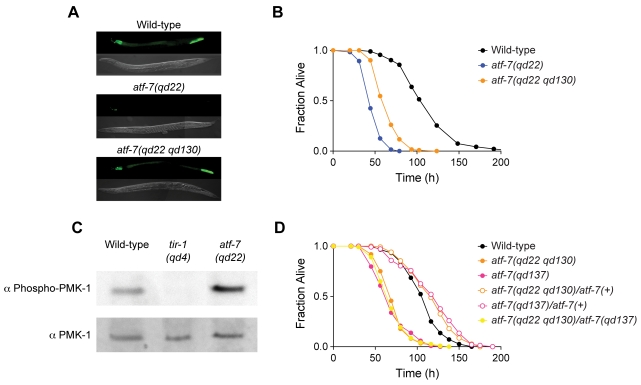
The fifth complementation group was defined by a single allele, qd22. The qd22 mutant exhibited a marked decrease in expression of the agIs219 transgene (Figure 1A) and conferred a strong Esp phenotype (Figure 1B and Figure S10). The lifespan of the qd22 mutant on relatively non-pathogenic Escherichia coli OP50 was comparable to WT (Figure S1 and Figure S16). Using lysates from qd22 mutant worms, we carried out immunoblotting against the activated form of PMK-1. We found that unlike the other mutants isolated in the screen which carry mutations in PMK-1 pathway components functioning upstream of PMK-1 [21], the qd22 mutant did not exhibit diminished levels of PMK-1 activation, and in fact had increased levels of activated PMK-1 compared to WT (Figure 1C). Taken together, these data suggested that the qd22 mutation affected PMK-1-dependent reporter gene expression either at a step downstream of or parallel to PMK-1.
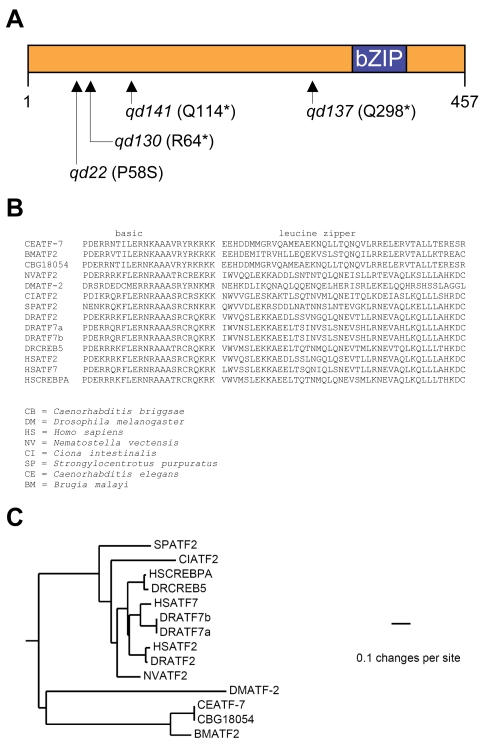
Using single nucleotide polymorphism (SNP)-based mapping [25],[26], we narrowed the region containing the qd22 mutation to a 250 kb region of the left arm of LG III, where we identified a C→T missense mutation causing a P58S change in the open reading frame defined by the gene atf-7, encoding a basic-region leucine zipper (bZIP) domain-containing protein (Figure 2A). Phylogenetic analysis, based on the comparison of the conserved putative DNA binding domain sequence of ATF-7 with other bZIP transcription factors (A.W. Reinke and A.E. Keating, unpublished data), suggests that C. elegans ATF-7 is an ortholog of the mammalian ATF2/ATF7/CREB5 family of bZIP transcription factors [27] (Figure 2B and 2C). Injection of the fosmid 25cA04, that includes the atf-7 locus, resulted in partial rescue of the Esp phenotype (Figure S2).
We were unable to phenocopy the diminished GFP reporter gene expression of the atf-7(qd22) mutant by RNAi of the atf-7 gene in the WT background (Figure S3A), but interestingly, we observed that RNAi of atf-7 in the atf-7(qd22) mutant background resulted in reversion of the diminished GFP reporter gene expression (Figure S3A). RNAi of atf-7 in WT worms resulted in an Esp phenotype (Figure S3B and Figure S11), but notably, RNAi of atf-7 in the atf-7(qd22) mutant conferred increased pathogen resistance and partial suppression of the Esp phenotype of the atf-7(qd22) mutant (Figure S3C and Figure S11). These data suggested that qd22 is a gain-of-function mutant allele of the atf-7 gene, which was further corroborated by analysis of the phenotype of the atf-7(qd22)/atf-7(qd22 qd130) trans-heterozygote (the qd130 loss-of-function allele is described below), which is nearly as susceptible to P. aeruginosa as the atf-7(qd22) mutant (Figure S4 and Figure S12). Interestingly, we observed that the atf-7(qd22) allele is recessive with respect to the Esp phenotype (Figure S4).
Based on the evidence that atf-7(qd22) was a gain-of-function, and possibly neomorphic, mutant allele of atf-7, we anticipated that we would be able to isolate atf-7 loss-of-function alleles from a screen for suppressors of the attenuated GFP expression phenotype of the atf-7(qd22) mutant. We screened 20 000 haploid genomes for mutants with increased GFP reporter expression and isolated an intragenic suppressor of atf-7(qd22), atf-7(qd22 qd130), which carries a nonsense mutation resulting in an early stop codon in the atf-7 gene (Figure 2A). The atf-7(qd22 qd130) mutant allele suppressed the diminished GFP fluorescence phenotype of the atf-7(qd22) mutant (Figure 1A), but only partially suppressed the Esp phenotype, demonstrating that the atf-7 loss-of-function mutant also has an Esp phenotype compared to WT (Figure 1B and Figure S10).
To confirm that the observed Esp phenotype of the atf-7(qd22 qd130) mutant was caused by the nonsense mutation in atf-7, we also analyzed a second putative null allele of atf-7, atf-7(qd137) (Figure 2A), which we isolated from a separate screen (described below). The atf-7(qd137) mutant exhibited the same Esp phenotype as that observed for the atf-7(qd22 qd130) mutant, as well as the trans-heterozygote, atf-7(qd22 qd130)/atf-7(qd137) (Figure 1D and Figure S13). We also carried out rescue experiments using a transgene comprised of the genomic atf-7 locus with GFP fused to the 3′ end between the atf-7 stop codon and the 3′-untranslated region (UTR). We observed that this transgene partially rescued the Esp phenotype of the atf-7(qd22 qd130) mutant (Figure S5). The partial degree of rescue observed for both the atf-7(qd22) and atf-7(qd22 qd130) mutants may reflect the detrimental effects of overexpression of atf-7.
The Esp phenotype of the atf-7(qd22 qd130) mutant was consistent with the results of the RNAi experiments (Figure S2B) and suggests that whereas the atf-7(qd22) gain-of-function allele confers a strong Esp phenotype, loss of atf-7 activity also compromises pathogen resistance relative to WT. We observed that the longevity of atf-7(qd22 qd130) and atf-7(qd137) mutants on E. coli OP50 was comparable to that observed for WT (Figure S6 and Figure S16).

Characterization ofmutants that affect signaling downstream of PMK-1 p38 MAPK. atf-7 (A) Fluorescence microscopy images of GFP expression from thetransgene in wild-type,andone-day-old adults. (B) Pathogenesis assay of L4 larval stage wild-type worms,andmutant animals, onPA14. All strains carry thetransgene. The differences in susceptibility betweenmutant animals and wild-type worms,andmutant animals, andmutant animals and wild-type worms are all significant (<0.0001 for each comparison). Replicate data can be seen in. (C) Immunoblot analysis of worm lysates fromworms. Total PMK-1 was identified using a polyclonal antibody generated againstPMK-1. Activated PMK-1 levels were identified using an antibody specific for the doubly phosphorylated TGY motif of activated PMK-1. (D) Pathogenesis assay of L4 larval stage wild-type worms;andmutants; and, andtrans-heterozygotes, onPA14. All strains carry thetransgene. The differences in susceptibility betweenmutant animals andtrans-heterozygotes, andmutants animals andtrans-heterozygotes are significant (<0.0001 for each comparison). There is no difference in susceptibility betweenmutant animals andtrans-heterozygotes, andmutant animals andtrans-heterozygotes (>0.35 for each comparison). Replicate data can be seen in. agIs219 atf-7(qd22) atf-7(qd22 qd130) atf-7(qd22) atf-7(qd22 qd130) P. aeruginosa agIs219 atf-7(qd22) atf-7(qd22) atf-7(qd22 qd130) atf-7(qd22 qd130) p atf-7(qd22) C. elegans atf-7(qd22 qd130) atf-7(qd137) atf-7(qd22 qd130)/atf-7(+), atf-7(qd137)/atf-7(+) atf-7(qd22 qd130)/atf-7(qd137) P. aeruginosa agIs219 atf-7(qd22 qd130) atf-7(qd22 qd130)/atf-7(+) atf-7(qd137) atf-7(qd137)/atf-7(+) p atf-7(qd22 qd130) atf-7(qd22 qd130)/atf-7(qd137) atf-7(qd137) atf-7(qd22 qd130)/atf-7(qd137) p Figure S10 Figure S13

Mutant alleles of, an ortholog of the mammalian ATF2/ATF7/CREB5 family of bZIP transcription factors. C. elegans atf-7 (A) Identification of mutations in thegene. Changes shown in amino acid residues are in reference to the coding region of gene model. (B) Sequence alignment comparing the DNA binding domains ofATF-7 and human ATF-2. (C) Phylogenetic analysis groupingATF-7 with the mammalian ATF2/ATF7/CREB5 family of bZIP transcription factors. C. elegans atf-7 C07G2.2a C. elegans C. elegans
| Gene | Allele | Mutation |
|---|---|---|
| nsy-1 | qd1 | Not identified |
| nsy-1 | qd3 | Q256* |
| nsy-1 | qd6 | W391* |
| nsy-1 | qd8 | G440E |
| nsy-1 | qd23 | W514* |
| nsy-1 | qd25 | W157* |
| nsy-1 | qd29 | Q426* |
| nsy-1 | qd31 | P867L |
| nsy-1 | qd38 | G793R |
| nsy-1 | qd41 | 451 bp deletion with 2 bp insertion |
| nsy-1 | qd44 | Not identified |
| nsy-1 | qd50 | Splice site |
| nsy-1 | qd52 | Not identified |
| nsy-1 | qd55 | G673E |
| sek-1 | qd12 | R221K |
| sek-1 | qd14 | S103N |
| sek-1 | qd24 | M217I |
| sek-1 | qd26 | E220K |
| sek-1 | qd37 | G199D |
| sek-1 | qd39 | W123* |
| sek-1 | qd60 | G5R |
| sek-1 | qd65 | G212R |
| pmk-1 | qd9 | L296F |
| pmk-1 | qd11 | D161N |
| pmk-1 | qd13 | M209I |
| pmk-1 | qd15 | W353* |
| pmk-1 | qd20 | C173Y |
| pmk-1 | qd47 | W29* |
| pmk-1 | qd49 | Not identified |
| tir-1 | qd2 | A451V |
| tir-1 | qd66 | Q278* |
| tir-1 | qd67 | P460L |
| atf-7 | qd22 | P58S |
loss-of-function alleles suppress the immunodeficiency phenotype of atf-7 pmk-1
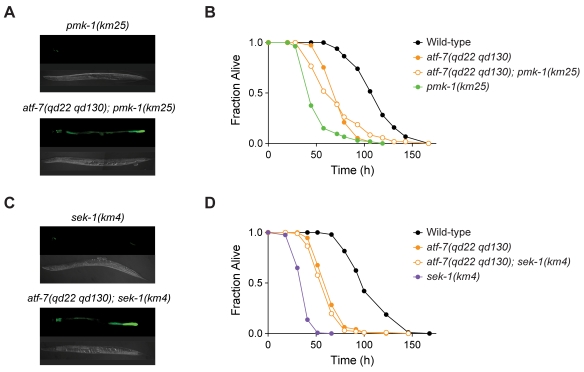
Because atf-7(qd22) appeared to be a gain-of-function allele of atf-7 that exhibited the same phenotypes as observed for mutants carrying loss-of-function mutations in PMK-1 pathway components, we hypothesized that ATF-7 might be negatively regulated by the PMK-1 pathway and function as a repressor of the innate immune response. To test this hypothesis, we carried out epistasis analysis using the atf-7(qd22 qd130) and pmk-1(km25) null alleles. We observed that the atf-7(qd22 qd130) loss-of-function allele suppressed the diminished agIs219 GFP reporter gene expression phenotype of the pmk-1(km25) mutant (Figure 3A). Also, the atf-7(qd22 qd130); pmk-1(km25) double mutant had a reduced pathogen susceptibility compared to pmk-1(km25), comparable to that of the atf-7(qd22 qd130) single mutant (Figure 3B and Figure S14). The partial suppression of the Esp phenotype of the pmk-1(km25) mutant by atf-7(qd22 qd130) was rescued by a transgene carrying wild-type atf-7 fused with GFP (Figure S7). Furthermore, we found that atf-7(qd22 qd130) also suppressed the pathogen susceptibility (Figure 3D and Figure S15) and diminished agIs219 GFP reporter expression (Figure 3C) phenotypes of the sek-1(km4) mutant.
The Esp phenotypes of the atf-7(qd22 qd130); pmk-1(km25) and atf-7(qd22 qd130); sek-1(km4) double mutants are comparable to the Esp phenotype of atf-7(qd22 qd130) single mutant. The lack of effect of the pmk-1(km25) or sek-1(km4) mutations on the Esp phenotype in the atf-7(qd22 qd130) mutant background is particularly noteworthy in view of the strong Esp phenotype conferred by inactivation of the PMK-1 pathway in the WT background.
Based on the genetic interaction between atf-7(qd22 qd130) and pmk-1(km25), we anticipated that a screen aimed at isolating suppressors of the diminished agIs219 GFP reporter expression and pathogen susceptibility phenotypes of the pmk-1(km25) mutant would yield additional loss-of-function alleles of atf-7. Indeed, we isolated two more putative null alleles of atf-7, the aforementioned atf-7(qd137) allele and atf-7(qd141) (Figure 2A), from a genetic screen of 15 000 haploid genomes. The suppression of the pathogen susceptibility phenotypes of PMK-1 pathway loss-of-function mutants by atf-7 null alleles is consistent with a role for ATF-7 downstream of activated PMK-1 in the negative regulation of innate immunity in C. elegans.
![The loss-of-functionmutation suppresses the immunodeficient phenotype caused by deficient signaling in the PMK-1 pathway. atf-7(qd22 qd130) (A) Fluorescence microscopy images of GFP expression from thetransgene inandone-day-old adults. (B) Pathogenesis assay of L4 larval stage wild-type worms;andmutant animals; anddouble mutant animals, onPA14. All strains carry thetransgene. The difference in susceptibility betweenmutant animals anddouble mutant animals is significant (<0.0001). Replicate data can be seen in. (C) Fluorescence microscopy images of GFP expression from thetransgene inandone-day-old adults. (D) Pathogenesis assay of L4 larval stage wild-type worms;andmutant animals; anddouble mutant animals, onPA14. All strains except for KU25 [] carry thetransgene. The difference in susceptibility betweenmutant animals anddouble mutant animals is significant (<0.0001). Replicate data can be seen in. agIs219 pmk-1(km25) atf-7(qd22 qd130); pmk-1(km25) atf-7(qd22 qd130) pmk-1(km25) atf-7(qd22 qd130); pmk-1(km25) P. aeruginosa agIs219 pmk-1(km25) atf-7(qd22 qd130); pmk-1(km25) p agIs219 sek-1(km4) atf-7(qd22 qd130); sek-1(km4) atf-7(qd22 qd130) sek-1(km4) atf-7(qd22 qd130); sek-1(km4) P. aeruginosa sek-1(km4) agIs219 sek-1(km4) atf-7(qd22 qd130); sek-1(km4) p Figure S14 Figure S15](https://europepmc.org/articles/PMC2848548/bin/pgen.1000892.g003.jpg "Click to view full size")
The loss-of-functionmutation suppresses the immunodeficient phenotype caused by deficient signaling in the PMK-1 pathway. atf-7(qd22 qd130) (A) Fluorescence microscopy images of GFP expression from thetransgene inandone-day-old adults. (B) Pathogenesis assay of L4 larval stage wild-type worms;andmutant animals; anddouble mutant animals, onPA14. All strains carry thetransgene. The difference in susceptibility betweenmutant animals anddouble mutant animals is significant (<0.0001). Replicate data can be seen in. (C) Fluorescence microscopy images of GFP expression from thetransgene inandone-day-old adults. (D) Pathogenesis assay of L4 larval stage wild-type worms;andmutant animals; anddouble mutant animals, onPA14. All strains except for KU25 [] carry thetransgene. The difference in susceptibility betweenmutant animals anddouble mutant animals is significant (<0.0001). Replicate data can be seen in. agIs219 pmk-1(km25) atf-7(qd22 qd130); pmk-1(km25) atf-7(qd22 qd130) pmk-1(km25) atf-7(qd22 qd130); pmk-1(km25) P. aeruginosa agIs219 pmk-1(km25) atf-7(qd22 qd130); pmk-1(km25) p agIs219 sek-1(km4) atf-7(qd22 qd130); sek-1(km4) atf-7(qd22 qd130) sek-1(km4) atf-7(qd22 qd130); sek-1(km4) P. aeruginosa sek-1(km4) agIs219 sek-1(km4) atf-7(qd22 qd130); sek-1(km4) p Figure S14 Figure S15
Regulation of PMK-1–regulated genes by ATF-7
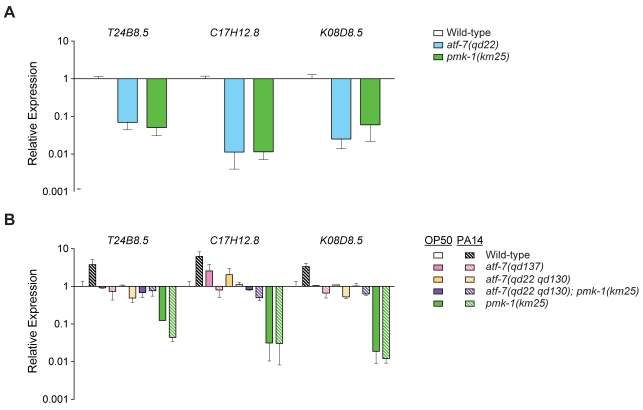
We used quantitative real-time PCR (qRT-PCR) to measure changes in expression of three representative genes previously identified as being regulated by the PMK-1 pathway [22]. We observed that the atf-7(qd22) mutant, consistent with the observed effects on agIs219 GFP reporter expression (Figure 1A), exhibited sharply diminished expression of PMK-1-regulated genes relative to WT on E. coli OP50, comparable to the levels observed in the pmk-1(km25) mutant (Figure 4A). These data confirm that the observed effects of the atf-7(qd22) mutation on agIs219 expression reflect a change in the regulation of PMK-1-regulated genes.
The basal level of expression of PMK-1-regulated genes, as defined by the levels of expression of genes on the relatively non-pathogenic E. coli OP50, was comparable in the atf-7 loss-of-function mutants and WT (Figure 4B). Confirming the observations with the agIs219 transgenic reporter, the atf-7(qd22 qd130) loss-of-function allele suppressed the markedly diminished basal expression of PMK-1-regulated genes in the pmk-1(km25) mutant (Figure 4B). These data are suggestive of a role for ATF-7 in the transcriptional repression of the basal expression of PMK-1-regulated genes, with de-repression of these genes through inhibition of ATF-7 by activated PMK-1. But if ATF-7 functioned solely as a transcriptional repressor of PMK-1-regulated genes, then an increase in basal expression of these genes might be anticipated. However, the basal expression of PMK-1-regulated genes is comparable to the levels observed in WT. This observation, as well as the Esp phenotype of the atf-7 loss-of-function mutants, is suggestive that ATF-7 functions not only as a repressor of the PMK-1-regulated immune response, but as a positive regulator of innate immunity as well, and thus we sought to examine the requirement for ATF-7 in pathogen-induced gene expression.
Upon exposure to pathogen infection, a number of genes are up-regulated in a PMK-1-dependent manner [22]. We observe that genes that require PMK-1 for induction by P. aeruginosa PA14 also require ATF-7 for pathogen-induced expression (Figure 4B). Although the basal expression of PMK-1-regulated genes on E. coli OP50 in the atf-7(qd22 qd130) and atf-7(qd137) mutants is comparable to WT, no induction of expression is observed in the presence of P. aeruginosa (Figure 4B). These data also suggest dual switching roles for ATF-7, both as a PMK-1-regulated repressor of the basal expression of PMK-1-regulated genes as well as a PMK-1-dependent activator of PMK-1-regulated genes upon pathogenic P. aeruginosa infection. This requirement may contribute to the observed Esp phenotype of the atf-7(qd22 qd130) mutant, as optimal regulation of the C. elegans innate immune response may be dependent on PMK-1 regulation of ATF-7.

ATF-7 regulation of PMK-1–regulated genes. qRT–PCR analysis of the expression of PMK-1-regulated genes. (A) L4 larval stage worms of the indicated genotype were propagated onOP50 and RNA was prepared as described in the. Expression is relative to wild-type. Shown is the mean from two independent biological replicates with error bars representing SEM. (B) As in (A), except that worms of the indicated geneotype were exposed toPA14 for 4 h. Expression is relative to wild-type onOP50. E. coli P. aeruginosa E. coli Methods
Phosphorylation of ATF-7 by PMK-1
The genetic and gene expression data above are consistent with a role for PMK-1 in the modulation of the transcriptional regulator ATF-7. Because the PMK-1 pathway acts in the intestine in a cell autonomous manner to regulate the innate immune response [21], we anticipated that ATF-7 would also be expressed in the intestine. We observed that a rescuing translational fusion of ATF-7::GFP under the control of the endogenous promoter and 3′ UTR was strongly expressed in the nuclei of intestinal cells (Figure 5).
We next sought to obtain further evidence for a direct interaction between activation of the PMK-1 pathway and ATF-7. We examined whether PMK-1 could phosphorylate ATF-7 by generating activated PMK-1 by co-expressing epitope-tagged C. elegans atf-7, pmk-1, and sek-1 cDNAs in Cos7 cells and immunoblotting against T7-ATF-7 to detect changes in gel mobility indicative of phosphorylation. Expression of PMK-1 with SEK-1, which results in activated PMK-1, produced a shift in the T7-ATF-7 protein band indicative of a change in the phosphorylation state (Figure 6A, lane 4). This shift in the ATF-7 band is not seen when either pmk-1 or sek-1 cDNAs are not expressed (Figure 6A, lanes 2 and 3), or when ATF-7 is immunoprecipitated and treated with phosphatase (Figure S8). These data are consistent with PMK-1-dependent phosphorylation of ATF-7.
We used a mutated version of PMK-1 that does not have kinase activity to establish that ATF-7 and PMK-1 physically interact. Immunoprecipitation using the T7 antibody, followed by immunoblotting using anti-HA, revealed an HA-PMK-1(kinase-dead)-T7-ATF-7 interaction that was dependent on the activated form of PMK-1, as determined by the requirement for co-transfection of sek-1 cDNA (Figure 6B).
We introduced the qd22 mutation into the T7-ATF-7 expressed in Cos7 cells and found that in contrast to the WT ATF-7, the mutant ATF-7 showed no change in gel mobility in the presence of activated PMK-1 (Figure 6A, lane 5), suggestive that the atf-7(qd22) allele may encode a form of the protein that can bind PMK-1 (Figure 6B, lane 3), but cannot be phosphorylated by PMK-1. The unusual nature of the atf-7(qd22) allele, with respect to the Esp phenotype and effects on PMK-1-regulated gene expression, coupled with the apparent insensitivity of the corresponding mutant ATF-7 protein to PMK-1 activity, further suggests that the phosphorylation of ATF-7 by PMK-1 may function to relieve the transcriptional repressor activity of ATF-7.

ATF-7 is expressed in the nuclei of intestinal cells in. C. elegans Fluorescence and DIC microscopy of a representative L4-staged wild-type worm carrying antransgene under the regulation of the endogenous genomicpromoter and 3′-untranslated region. The red fluorescence from the pharynx is due to aco-transformation marker. The rescuing capability of this translational fusion transgene was confirmed in both themutant () anddouble mutant (). Scale bar, 100 µm. atf-7::GFP atf-7 Pmyo-2::RFP atf-7(qd22 qd130) atf-7(qd22 qd130); pmk-1(km25) Figure S5 Figure S7

Phosphorylation of ATF-7 by PMK-1. (A) Cos7 cells were transfected with T7-ATF-7 or T7-ATF-7 carrying the P58Smutation, along with HA-PMK-1 and FLAG-SEK-1 as indicated. Whole cell extracts were immunoblotted with antibodies that recognize T7 (top), HA (middle), and FLAG (bottom). (B) Cos7 cells were transfected with T7-ATF-7 or T7-ATF-7 carrying the P58Smutation, along with kinase-dead (KD) HA-PMK-1 and FLAG-SEK-1 as indicated. ATF-7 was immunoprecipitated with anti-T7 and immunoblotted with anti-HA (top). Whole cell extract were immunoblotted with antibodies that recognize T7 (middle top), HA (middle bottom), and FLAG (bottom). qd22 qd22
ATF-7 confers immune response specificity to PMK-1 pathway activation
In order to determine whether our observations were specific to infection by P. aeruginosa PA14, we examined the role of ATF-7 in pathogen resistance to two other microbial pathogens that cause lethal infections in C. elegans, Serratia marcescens and Enterococcus faecalis. On S. marcescens Db10, the pmk-1(km25) mutant had a weak Esp phenotype (Figure 7A) compared to the strong Esp phenotype exhibited on P. aeruginosa PA14 (Figure 3B). The atf-7(qd22 qd130) mutant also had a similarly weak phenotype, as did the atf-7(qd22 qd130); pmk-1(km25) double mutant (Figure 7A). These data suggest that the PMK-1 pathway and ATF-7 are required for resistance to S. marcescens, but the comparable Esp phenotypes of single mutants and the atf-7(qd22 qd130); pmk-1(km25) double mutant are consistent with PMK-1 and ATF-7 functioning as positive regulators of pathogen resistance in the same pathway, or with ATF-7 under negative regulation by PMK-1 with ATF-7 functioning as a transcriptional repressor.
Interestingly, on the Gram-positive pathogen E. faecalis MMH594, the atf-7(qd22 qd130) mutant does not have an appreciable Esp phenotype (Figure 7B), suggestive that ATF-7 may not serve as a positive regulator of resistance to E. faecalis. In addition, the atf-7(qd22 qd130) mutation only partially suppresses the Esp phenotype of the pmk-1(km25) mutant (Figure 7B), suggestive that there are both ATF-7-dependent and ATF-7-independent mechanisms downstream of PMK-1 in response to E. faecalis. Distinct sets of genes have been observed to be induced by exposure to different bacteria, and little is known about how the transcriptional responses to Gram-positive bacteria and Gram-negative bacteria differ [28]. Of note, we observed diminished GFP expression from the agIs219 transgene on Gram-positive bacteria relative to expression on E. coli OP50 (D.H.K., unpublished data). Gene expression studies of genes induced in C. elegans infection with Gram-positive bacteria, and the identification of such genes that are regulated by the PMK-1 pathway may further illuminate the differences in the role of ATF-7 observed between E. faecalis and P. aeruginosa.
The PMK-1 pathway regulates the response to arsenite and oxidative stress through regulation of the transcription factor SKN-1 [29],[30]. We observed that the atf-7(qd22 qd130) mutant did not exhibit enhanced sensitivity to arsenite stress, and in addition, did not suppress the arsenite sensitivity of the pmk-1(km25) mutant or the sek-1(km4) mutant (Figure 8). In addition, we observed that skn-1 mutants did not exhibit enhanced susceptibility to P. aeruginosa (Figure S9). Whereas PMK-1 mediates multiple responses to environmental stressors, including oxidative stress and pathogen infection, these data suggest that the transcription factor substrates of PMK-1, ATF-7 and SKN-1, confer specificity to PMK-1-mediated responses.

Requirement for ATF-7 in resistance to other bacterial pathogens. (A) Pathogenesis assay of L4 larval stage wild-type worms;andmutant animals; anddouble mutant animals, onDb10. All strains carry thetransgene. The difference in susceptibility betweenmutant animals and wild-type worms is significant (<0.0001). (B) Pathogenesis assay of L4 larval stage wild-type worms;andmutant animals; anddouble mutant animals, onMMH594. All strains carry thetransgene. The difference in susceptibility betweenmutant animals anddouble mutant animals is significant (<0.0001). There is no difference in susceptibility betweenmutant animals and wild-type worms (>0.9). atf-7(qd22 qd130) pmk-1(km25) atf-7(qd22 qd130); pmk-1(km25) S. marcescens agIs219 atf-7(qd22 qd130) p atf-7(qd22 qd130) pmk-1(km25) atf-7(qd22 qd130); pmk-1(km25) E. faecalis agIs219 pmk-1(km25) atf-7(qd22 qd130); pmk-1(km25) p atf-7(qd22 qd130) p

ATF-7 does not contribute to arsenite resistance in. C. elegans Arsenite stress assay of L4 larval stage wild-type worms;, andmutant animals; andanddouble mutant animals. Shown is the fraction of worms alive after 18 h. Error bars are standard deviation. The differences in survival betweenmutant animals anddouble mutant animals, andmutant animals anddouble mutant animals are significant (<0.05 for each comparison). atf-7(qd22 qd130), pmk-1(km25) sek-1(km4) atf-7(qd22 qd130); pmk-1(km25) atf-7(qd22 qd130); sek-1(km4) atf-7(qd22 qd130) atf-7(qd22 qd130); pmk-1(km25) atf-7(qd22 qd130) atf-7(qd22 qd130); sek-1(km4) p
Discussion
We have described the identification and characterization of ATF-7, a C. elegans ortholog of the mammalian ATF2/ATF7/CREB5 family of bZIP transcription factors, as a transcriptional regulator of PMK-1-mediated innate immunity in C. elegans. We isolated four mutant alleles of C. elegans atf-7 from three different forward genetic screens. First, the gain-of-function qd22 allele was isolated from a large-scale screen for mutants with diminished PMK-1-dependent GFP reporter gene expression and an Esp phenotype. The isolation of qd22 served as a starting point for the characterization of ATF-7, and the analysis of this unusual gain-of-function allele provided insights into the mechanism of ATF-7 regulation by PMK-1. The increased levels of PMK-1 activation in the atf-7(qd22) mutant relative to WT (Figure 1C) may reflect feedback loops that serve to counteract the suppression of the PMK-1-mediated transcriptional response by increasing levels of activated PMK-1. Although atf-7(qd22) acts as a gain-of-function allele, we determined that atf-7(qd22) is recessive with regard to pathogen susceptibility (Figure S4). We suggest that whereas the qd22 mutant ATF-7 protein cannot be phosphorylated by PMK-1 and thus functions as a constitutive repressor (Figure 6A), the resulting protein may undergo changes in structure and folding that compromise the ability of the mutant ATF-7 to compete with WT ATF-7 at corresponding promoter sites in the atf-7(qd22)/atf-7(+) trans-heterozygote.
Based on evidence that atf-7(qd22) was a gain-of-function allele, we isolated the atf-7(qd22 qd130) allele as an intragenic suppressor of atf-7(qd22). A third genetic screen aimed at isolating suppressors of pmk-1(km25) yielded two additional putative null alleles of atf-7, qd137 and qd141. The genetic analysis of loss-of-function alleles of atf-7 allowed us to begin to address the physiological role of ATF-7 in innate immunity. Genetic interaction analysis of atf-7 mutant alleles suggests that PMK-1 negatively regulates ATF-7, which in turn functions as a negative regulator of C. elegans innate immunity to P. aeruginosa and E. faecalis. At the same time, the Esp phenotype of atf-7 loss-of-function mutants and the analysis of P. aeruginosa-induced gene expression were suggestive of a requirement for ATF-7 in the activation of the inducible innate immune response, as ATF-7 was shown to be required for the increased expression of PMK-1-regulated genes in response to P. aeruginosa infection. Interestingly, the lack of an Esp phenotype of atf-7(qd22 qd130) on E. faecalis may be suggestive of the absence of a PMK-1-regulated inducible response to E. faecalis that is regulated by ATF-7.
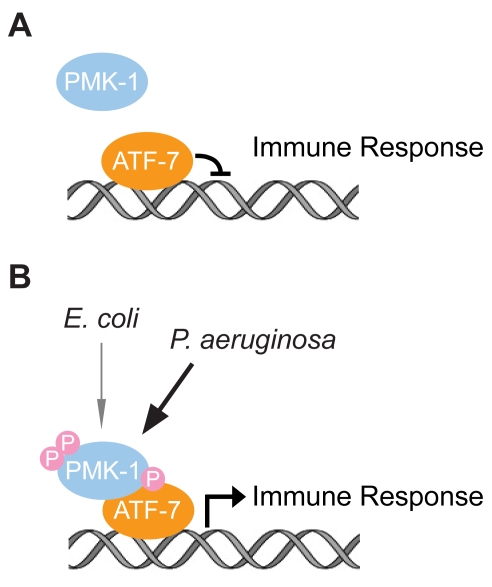
We showed that ATF-7 physically interacts with activated PMK-1 and undergoes PMK-1-dependent phosphorylation in mammalian cells in heterologous expression assays. Based on these data, we propose that activation of the PMK-1 pathway in response to pathogen infection results in PMK-1 phosphorylation of ATF-7, leading to a switch in the activity of ATF-7 from transcriptional repressor to an activator that facilitates P. aeruginosa-induced gene expression (Figure 9). In yeast, phosphorylation of the CREB/ATF transcription factor Sko1p downstream of the ancestral Hog1p MAPK pathway in response to osmotic stress converts Sko1p from a transcriptional repressor to an activator [31]. Our data suggest that this mode of transcriptional regulation by MAPK activation has been conserved in C. elegans innate immunity. Further work may define the detailed mechanisms by which ATF-7 transcriptional control is modulated by PMK-1.
In view of the multiple substrates for p38 MAPK that have been established in mammalian cell systems and the multiple activities of p38 MAPK in mammalian innate immunity, it is perhaps surprising that loss of activity of a single transcription factor, the C. elegans ortholog of mammalian ATF2, is sufficient to suppress the immunocompromised phenotype caused by loss of p38 MAPK activity in C. elegans. Mice homozygous for a deletion of the ATF2 gene die shortly after birth due to the lack of pulmonary surfactant [8], although analysis of cells from mutant mice expressing low levels of ATF2 are suggestive of a role for ATF2 in the modulation of cytokine expression [32]. Interestingly, these studies also indicate a role for mammalian ATF2 in both activating and inhibitory activities on the immune response [32]. Whether ATF2 plays a correspondingly homologous role in mammalian innate immunity downstream of p38 MAPK, paralleling the activity of C. elegans ATF-7, awaits the further molecular genetic analysis of the ATF2/ATF7/CREB5 family in mammalian systems. Our data establish the SARM-p38 MAPK-ATF-7 pathway as a major pathway of C. elegans innate immunity and suggest that the regulation of ATF2/ATF7 family of bZIP transcription factors by p38 MAPK may represent a key feature of innate immunity in ancestral organisms that was retained even as Toll-dependent NF-kB immune signaling was lost [33]. The mechanism of regulation of ATF-7 activity by PMK-1 may also provide insights into conserved mechanisms by which p38 MAPK modulates the activity of ATF2/ATF7 in mammalian innate immunity.

Model for the function of ATF-7 ininnate immunity. C. elegans (A) Repression of PMK-1–regulated immune effector gene expression by ATF-7 in the absence of PMK-1 activation. (B) Activation of basal and pathogen-induced immune effector gene expression by PMK-1 phosphorylation of ATF-7, which switches ATF-7 from a repressor to an activator of transcription.
Materials and Methods
strains C. elegans
C. elegans was maintained and propagated on E. coli OP50 as described [34]. AU78, an N2-derived strain carrying the agIs219 transgene was used as the wild-type strain [21]. CB4856 was used for single nucleotide polymorphism-based mapping [26].
Previously isolated and characterized mutants used: LG II: nsy-1(ag3)[10], nsy-1(ky397)[35]. LG III: tir-1(qd4)[21]. LG IV: pmk-1(km25)[36], skn-1(zu67), skn-1(zu135)[37]. LG X: sek-1(km4)[10],[38].
Mutants described in this study: ZD442 [agIs219 atf-7(qd22) III] was isolated as described below and backcrossed three times to its parental strain, AU78. ZD318 [agIs219 atf-7(qd22 qd130) III] was isolated as described below and outcrossed four times to wild-type strain N2. ZD39 [agIs219 III; pmk-1(km25) IV] was made by crossing the agIs219 transgene from strain AU78 into pmk-1(km25). ZD395 [agIs219 III; sek-1(km4) X] was made by crossing the agIs219 transgene from strain AU78 into sek-1(km4). ZD332 [agIs219 atf-7(qd137) III; pmk-1(km25) IV] and ZD402 [agIs219 atf-7(qd141) III; pmk-1(km25) IV] were isolated as described below. ZD332 was backcrossed three times to ZD39. ZD350 [agIs219 atf-7(qd137) III] was made by removing pmk-1(km25) from agIs219 atf-7(qd137); pmk-1(km25), which had been previously backcrossed twice to ZD39, by outcrossing to N2. ZD326 [agIs219 atf-7(qd22 qd130) III; pmk-1(km25) IV] was made by crossing pmk-1(km25) into agIs219 atf-7(qd22 qd130) and was outcrossed to pmk-1(km25) an additional three times. ZD340 [agIs219 atf-7(qd22 qd130) III; sek-1(km4) X] was made by crossing sek-1(km4) into agIs219 atf-7(qd22 qd130) and was outcrossed to sek-1(km4) an additional three times.
Pathogenesis assays
Pathogenesis assays with P. aeruginosa PA14 [39], S. marcescens Db10 [40] and E. faecalis MMH594 [41],[42] were performed as described previously with the following modifications. Single colonies of P. aeruginosa PA14 and S. marcescens Db10 were used to inoculate 3 ml cultures of Luria-Bertani (LB) broth, which were then incubated overnight at 37°C. Five microliters of the S. marcescens Db10 culture was used to seed standard 35-mm slow-kill assay plates, whereas five microliters of the P. aeruginosa PA14 culture was used to seed 35-mm slow-kill assay plates containing 0.05 mg/ml 5-fluorodeoxyuridine (FUDR), used to prevent eggs from hatching. Seeded plates were incubated at 37°C overnight and then incubated at room temperature overnight. A single colony of E. faecalis MMH594 was used to inoculate a 3 ml culture of brain heart infusion (BHI) broth containing 80 µg/ml of kanamycin, which was then incubated at 37°C for 5 hours. Seven microliters of culture was used to seed 35-mm BHI agar plates containing 80 µg/ml of kanamycin, which were incubated at 25°C overnight. In all pathogenesis assays, the size of the bacterial lawn was small, meaning that the culture was seeded in the middle of the plate and was not spread to the edge. For each assay, approximately 20–40 L4-staged worms were picked over to prepared plates, with 3–5 plates per strain. The sample sizes for each assay are provided in Table S1. All pathogenesis assays were conducted at 25°C. Plates were checked at regular intervals for survival and worms that did not respond to gentle prod from a platinum wire were scored as dead. Worms on S. marcescens plates were transferred to new plates on days 1, 2, and 3 of the assay. All S. marcescens plates in a single assay were seeded on the same day. Worms on P. aeruginosa PA14 plates containing FUDR and E. faecalis MMH594 plates did not require transferring. Statistical analyses of survival curves were performed in Prism 5 (GraphPad) using the log-rank test function, which computes the Mantel-Haenszel method.
Isolation of mutants with diminishedreporter expression and enhanced susceptibility to killing byPA14 agIs219 P. aeruginosa
Mutagenesis using ethyl methane sulfonate (EMS) was carried out following standard methods [43]. The synchronized F2 generation L1 stage larvae were plated onto NGM plates seeded with E. coli OP50 and incubated for 55 hours at 20°C and subsequently sorted with a Union Biometrica COPAS Biosorter. Worms with diminished fluorescence compared to wild-type worms were directly plated onto a plate seeded with P. aeruginosa PA14, and incubated at 25°C. The plates were screened at 24 hours for dead worms. Following the rationale of our previously reported screen for Esp mutants [10], carcasses of dead worms were picked to individual NGM plates seeded with E. coli OP50, allowing the fertilized eggs inside each carcass to hatch so that the mutant strains could be recovered. In three separate screens a total of 140 000 haploid genomes were mutagenized. We note that the yield of the screen is strongly dependent on the time at which the Esp screening takes place, and that the 24 h time point represented a particularly stringent time such that siblings were rarely isolated among the mutant isolates. The early time of screening also accounts for the relatively low yield of mutants from the number of genomes mutagenized and the high specificity of isolated mutations for the PMK-1 pathway.
Single-nucleotide polymorphism (SNP)-based mapping using the C. elegans isolate CB4856 was performed as reported [26] with modifications utilizing SNPs that were analyzed by the DraI restriction enzyme for the rapid rough mapping of mutant isolates [25]. Once chromosomal linkage was determined, complementation testing was performed using previously isolated mutant alleles (tir-1(qd4), nsy-1(ag3) and nsy-1(ky397), sek-1(km4), and pmk-1(km25)). After assignment of the isolated alleles into complementation groups, the open reading frame of the affected gene was sequenced to identify the causative mutation in each allele. Isolates from the screen and the identified mutations are shown in Table 1. Using this approach, a single mutant allele not corresponding to previously identified mutants, qd22, was isolated. Fine mapping of qd22 was carried out using CB4856 SNP-based mapping. The location of qd22 on the left arm of LG III was in the vicinity of the agIs219 integrated transgenic array, and thus a strain carrying qd22 without agIs219 was generated and SNP mapping was carried out using the Esp phenotype of qd22. In order to facilitate interpretation of the pathogen killing assays with recombinants, a strain carrying the qd22 mutation (without the agIs219 transgene) and the CB4856-derived allele of npr-1, 215F, was utilized for crossing with CB4856 because of the enhanced susceptibility conferred by the 215F allele of npr-1 relative to the Bristol N2 background [44],[45] in which qd22 was initially isolated.
Isolation of atf-7(qd22 qd130)
A forward genetic screen to identify suppressors of the atf-7(qd22) diminished agIs219 GFP fluorescence phenotype was carried out similarly as above. Briefly, C. elegans atf-7(qd22) hermaphrodites carrying agIs219 were mutagenized with EMS and synchronized larvae of the F2 generation were plated onto NGM plates seeded with E. coli OP50 and incubated for 55 hours at 20°C. The F2 worms were screened for GFP expression from the agIs219 transgene using a Zeiss Stereo V12 Discovery microscope with a GFP wide-band fluorescence cube. Any F2 worm with increased fluorescence compared to atf-7(qd22) was singled to a NGM plate seeded with E. coli OP50. Isolates with increased fluorescence were then tested for suppression of the atf-7(qd22) Esp phenotype to P. aeruginosa PA14 using the PA14 pathogenesis assay described above. The atf-7 coding region was then sequenced in isolates that had both increased fluorescence and diminished pathogen susceptibility.
Isolation ofand atf-7(qd137) atf-7(qd141)
A genetic screen for suppressors of the pmk-1(km25) mutant was carried out using ZD39 as the starting strain and following a procedure as outlined for the isolation of atf-7(qd22) suppressor mutants.
Generation of transgenic animals
C. elegans genomic fosmids (Geneservice) were isolated using Qiagen Miniprep Kits following the standard protocol. Fosmid 24cA04 was injected into ZD442 at a concentration of 20 ng/µl, along with 25 ng/µl of Pmyo-2::RFP as a co-injection marker and 55 ng/µl of pBlueScript (Stratagene) as carrier DNA. The fluorescently-tagged atf-7 construct was generated by yeast-mediated ligation of genomic fragments generated by PCR using fosmid 25cA04 as template DNA and Phusion high-fidelity DNA polymerase (New England Biolabs). A 22794 bp genomic region, from 7474 to 30267 with respect to fosmid 25cA04, was covered in the fluorescently-tagged atf-7 construct. This construct was injected into ZD326 at a concentration of 20 ng/µl, along with 32 ng/µl of Pmyo-2::RFP as a co-injection marker and 10 ng/µl of pBlueScript (Stratagene) as carrier DNA. Two independent lines carrying this construct were crossed into strain ZD318 using standard genetic techniques.
Yeast-mediated ligation construction of atf-7::GFP
Yeast-mediated ligation of atf-7::GFP was performed as previously described [46]. Briefly, the 22794 bp operonic region containing the atf-7 gene was amplified in fragments ranging in size from ∼1 kb to 4 kb in 8 separate PCR reactions with at least a 50 bp overlap between adjacent fragments. The gene encoding GFP was amplified from the Fire vector pPD95.75 [47]. The 9 PCR products, along with destination vector pRS426 (ATCC) digested with BamH1 and Xho1 restriction enzymes (New England Biolabs), were transformed into yeast strain FY2 following standard procedures. Phenol-chloroform extraction was used to isolate yeast DNA, which was then transformed into DH5-α electrocompetent cells (Invitrogen) and isolated using Qiagen Miniprep Kits following the standard protocol.
Quantitative real-time PCR
Synchronized populations of wild-type and indicated mutant strains were grown to the L4 larval stage. For P. aeruginosa exposure experiments, L4 stage worms were washed onto plates seeded with E. coli OP50 or P. aeruginosa PA14 in parallel, dried, and incubated for four hours at 25°C. Samples were collected, frozen in liquid nitrogen, and stored at −80°C before RNA extraction using TRI reagent (Ambion). cDNA was prepared with the Retroscript kit (Ambion) using oligo dT primers. The reverse transcription reaction was also performed without reverse transcriptase for each sample, and subsequent qRT-PCR on these control reactions showed that no contaminating genomic DNA was present. qRT-PCR was performed with a Mastercycler Realplex (Eppendorf) with SYBR Green detection in triplicate reactions of 20 µl. All primers were previously reported, and relative expression between samples was determined using snb-1 as a reference gene [22]. Fold change was calculated using the Pfaffl method [48]. Standardization between two biological replicates was performed as described [49].
RNAi of atf-7
A 771 bp segment of the atf-7 coding region, corresponding to bases 11532 to 12303 with respect to cosmid C07G2, was amplified by PCR and subcloned into the Fire vector L4440. RNAi by bacterial feeding using E. coli HT115 bacteria expressing either the L4440-derived atf-7 RNAi vector or the empty L4440 vector (control RNAi) was carried out as reported [50]. L4 animals were fed on RNAi bacteria plates, and the F1 generation animals were assayed for susceptibility to P. aeruginosa PA14 or analyzed for GFP expression from the agIs219 transgene.
Immunoblotting oflysates C. elegans
Immunoblotting against C. elegans PMK-1 and activated PMK-1 (Promega) was carried out as described previously [10].
Visualization ofGFP reporter gene expression and fluorescently-tagged agIs219 atf-7
To visualize expression of the agIs219 reporter, L4-staged worms, grown at 20°C, were picked over to normal maintenance plates and placed at 20°C overnight. After approximately 18 h, worms were mounted on 2% agarose pads and immobilized in 10 mM sodium azide. Slides were viewed using an AxioImager Z1 fluorescence microscope (Zeiss) with an A-Plan 10X/0.25 objective (Zeiss) and pictures were taken using an AxioCam HRm camera. To visualize expression of fluorescently-tagged atf-7, L4-staged worms, grown on NGM agar plates seeded with E. coli OP50 at 20°C, were mounted and imaged as described above with a Plan-Apochromat 20X/0.8 objective (Zeiss). Background intestinal autofluorescence was removed by taking a picture with the DAPI filter and subtracting the resulting picture from the image taken with the GFP filter.
Expression in Cos7 cells, immunoprecipitation, and immunoblotting
Cos7 cells were maintained in DMEM supplemented with 10% fetal calf serum, 100 µg/ml penicillin G and 100 µg/ml streptomycin at 37°C and 5% CO2. Cos7 cells (1×10⁶) were plated in 6-cm dishes and transfected with a total of 6 µg DNA containing various expression vectors by using FuGENE6 (Roshe). The ATF-7 expression vector contained the atf-7c isoform. After 48 h, cells were collected and washed once with ice-cold phosphate-buffered saline (PBS) and lysed in 0.6 ml of extraction buffer (20 mM HEPES, pH 7.4, 150 mM NaCl, 1.5 mM MgCl2, 2 mM EGTA, 2 mM dithiothreitol, 1 mM phenylmethylsulfonyl fluoride, 1.7 µg/ml aprotinin and 0.5% Triton X-100). Cellular debris was removed by centrifugation at 10 000×g for 5 min. Small aliquots of each cell lysate were boiled with SDS-sample buffer and were used as whole cell extracts. Remaining cell lysates were divided into 200 µl and each cell lysate was incubated with 0.5 µg of various antibodies and 10 ml protein G-Sepharose (Amersham Biosciences, Piscataway, NJ). The immune complexes were washed five times with wash buffer (20 mM HEPES, pH 7.4, 150 mM NaCl) and then boiled with SDS-sample buffer. Phosphatase treatment was performed on immunoprecipitated samples with Lambda protein phosphatase (New England Biolabs) at 30°C for 10 minutes. Immunoblotting was performed as described previously [51].
Arsenite stress assays
Sensitivity of mutant strains to oxidative stress was determined using sodium arsenite. Briefly, mutant worms were grown on E. coli OP50. L4-staged animals were transferred to standard slow-killing plates supplemented with 5 mM sodium arsenite and 0.05 mg/ml of FUDR, seeded with concentrated E. coli OP50. The sample sizes for the arsenite stress assay are provided in Table S1. Stress assays were performed at 20°C. Animals were considered dead when they no longer responded to a gentle prod with a platinum wire. Statistical analysis of data was performed in Prism 5 (GraphPad) using an unpaired, two-tailed, Student's t-test.
Lifespan assays
Strains used in the lifespan assays were maintained on E. coli OP50 at 20°C. Approximately 40 L4-staged worms (Day 0) were picked over to NGM plates containing 0.05 mg/ml of FUDR, seeded with E. coli OP50. Four to five plates for each strain were used in each experiment and plates that had become contaminated or plates in which the worms had borrowed were excluded upon the appearance of contamination/borrowing. Worms that had protruding/exploding vulvas and worms that crawled off the plate were censored. The sample sizes for each assay are provided in Table S1. Lifespan assays were performed at 20°C. Animals were considered dead when they no longer responded to a gentle prod with a platinum wire.