
What this is
- This research investigates (), a condition with various long-term symptoms following COVID-19.
- It utilizes a large dataset (n = 3,372) to explore predictors of severity, focusing on and acute illness severity.
- The study proposes two novel scores that refine symptom assessment, potentially improving treatment strategies.
Essence
- The study confirms that and acute COVID-19 severity predict severity. It introduces two new scores that focus on specific symptom complexes linked to these predictors.
Key takeaways
- significantly affects severity. Higher resilience correlates with lower scores, indicating less severe symptoms.
- Acute COVID-19 severity also predicts severity. More severe acute symptoms lead to higher scores, highlighting the impact of initial illness on long-term outcomes.
- The new scores (-R and -S) allow for more targeted assessments of , aiding in the identification of different symptom subdomains and potential treatment needs.
Caveats
- The study's reliance on self-reported data may introduce bias, affecting the accuracy of symptom reporting and severity assessment.
- Most data were collected from non-vaccinated individuals infected before the Omicron variant, limiting the findings' applicability to current COVID-19 variants.
- The absence of pre-infection data may lead to overestimation of the role of certain symptoms in , complicating the understanding of their origins.
Definitions
- Post-COVID Syndrome (PCS): A condition characterized by persistent symptoms following COVID-19, including fatigue, cognitive deficits, and other health issues.
- Individual Resilience: The ability of an individual to recover from stress or adversity, measured in this study using the Brief Resilience Scale (BRS).
Simplified
Introduction
The rapid spread of SARS-CoV-2, a coronavirus strain first identified in December 2019 in Wuhan, China, resulted in a global pandemic of the associated coronavirus disease 2019 (COVID-19). COVID-19 manifests itself through a variety of symptoms, most notably respiratory complications (i.e., cough, dyspnoea, and shortness of breath) and fever [1]. If COVID-19-associated health problems persist until 12 weeks or later after the initial infection, patients are diagnosed with Post-COVID Syndrome (PCS) [2].
PCS is a complex and heterogeneous condition predominantly characterized by fatigue, exertional intolerance, and memory or concentration deficits [3, 4]. Worldwide, estimates of the prevalence of PCS vary greatly depending upon the disease definition and diagnostic criteria used. In patients with mostly mild COVID-19, as are usually included in population-based follow-up studies, the prevalence of self-reported PCS was found to be approximately 15%. However, although it is known that former COVID-19 patients consult general practitioners 1.2 times more often than non-infected controls, the true public health impact of PCS is still unclear [5 –7]. This uncertainty is partly due to limited treatment options and varying levels of healthcare utilization for PCS, which so far may have obscured the true rate of convalescence among COVID-19 patients.
The PCS score developed by Bahmer et al. [4] in 2022 allows individuals to be categorized as either not/mildly, moderately, or severely affected by PCS, based upon 12 self-assessed symptom complexes. Higher PCS scores were consistently found to be correlated with lower quality of life (QoL), as measured by the EQ-5D-5 L index [4]. Notably, the severity of acute COVID-19 and the individual resilience of patients were consistently identified as relevant predictors of the score-based PCS severity of study participants in two different cohorts [4]. One possible explanation of this finding could be that the PCS score encompasses symptom complexes that affect patients differently, depending upon their individual resilience or severity of acute illness. The original definition of the PCS score did not account for this possibility.
A more detailed characterization of PCS, particularly the identification of possible subdomains of the PCS phenotype, would not only be of scientific interest but could also improve PCS care by enabling more targeted treatment strategies. Therefore, we analysed a large expansion of the database used for the definition of the PCS score (i) to verify its two main predictors and (ii) to assess in more detail how the latter relate to the symptom complexes constituting the PCS score.
Materials and methods
The COVIDOM study
COVIDOM is a prospective population-based cohort study that aims to investigate the long-term health effects of COVID-19 in Germany. The study was initiated in October 2020 as part of the National Pandemic Cohort Network (NAPKON), funded by the Federal Ministry of Education and Research. In collaboration with local health care authorities in the Kiel, Würzburg and Berlin regions, a total of 3,372 participants (Kiel: 2,413; Würzburg: 523; Berlin: 436) with a positive PCR test for SARS-CoV-2 were recruited and had their data collected between 15th November 2020 and 24th January 2023. First study site visits were scheduled 6 months or later after the initial SARS-CoV-2 infection. In order to account for the local circumstances of their recruitment, the Würzburg and Berlin samples were combined in one sub-cohort (n = 959), and the Kiel samples were divided into sub-cohorts Kiel-I (n = 667) and Kiel-II (n = 1,746). While Kiel-I coincides with its namesake in the study by Bahmer et al. [4], Würzburg/Berlin and Kiel-II represent expansions by 643 and 1,287 participants, respectively, of the original sub-cohorts. Additional information about COVIDOM has been published elsewhere [4, 8].
Ethics committee
COVIDOM has been carried out in accordance with relevant guidelines and regulations. The study was approved by the local ethic committees of the university hospitals of Kiel (No. D 537/20) and Würzburg (No. 236/20_z). According to the professional code of the Berlin Medical Association, approval by the Kiel ethics committee was also valid for the Berlin study site. All participants provided written informed consent prior to their inclusion.
Study protocol
The COVIDOM study protocol included a detailed patient history and a structured interview, followed by in-depth clinical examinations and biomaterial collection [4]. Further information about the data acquisition process can be found in the Supplementary Material of this article. In brief, before and during their study site visit, participants were asked to answer questionnaires comprising validated diagnostic tools, namely PHQ-8 for depression, GAD-7 for anxiety, FACIT-F for fatigue, screening questions according to the Canadian Consensus Criteria for 'myalgic encephalomyelitis/chronic fatigue syndrome' (ME/CFS), BRS for resilience, MoCA for cognitive function, and EQ-5D-5 L for QoL, amongst others. In addition, detailed assessments were made of different organ functions (neurologic, pneumologic, cardiologic, and chemosensoric). Finally, comprehensive laboratory analyses were performed, and biomaterial was collected and stored for future analyses.
Long-term COVID-19 symptom assessment
From the collected data, the presence or absence of 35 common long-term symptoms of COVID-19 was determined for each participant. The results were summarised as the binary indicators of 12 symptom complexes also used originally to define the PCS score [4] (Table 1).
| Symptom complex | Self-reported sub-symptoms |
|---|---|
| Fatigue | Fatigue |
| Coughing, wheezing | Coughing, wheezing |
| Neurological ailments | Confusion, vertigo, headache, motor deficits, sensory deficits, numbness, tremor, deficits of concentration, cognition or speech |
| Joint or muscle pain | Muscle pain, joint pain |
| Ear-Nose-Throat ailments | Hoarseness, sore throat, running nose |
| Gastrointestinal ailments | Stomach pain, diarrhoea, vomiting, nausea |
| Sleep disturbance | Insomnia, unrestful sleep |
| Exercise intolerance | Shortness of breath, reduced exercise capacity |
| Infection signs | Chills, fever, general sickness/flu-like symptoms |
| Chemosensory deficits | Smelling disturbance, impaired sense of taste |
| Chest pain | Chest pain |
| Dermatological ailments | Hair loss, rash, itchiness |
PCS score predictors
Two significant predictors of the PCS score have been identified before among COVIDOM participants, namely (i) their individual level of resilience, as measured by the Brief Resilience Scale (BRS) index, and (ii) the severity of their acute illness, as measured by the number of acute phase symptoms of COVID-19 (out of a possible 24) that they individually rated as severe or life-threatening [4]. To revisit these predictors in the present study, resilience was classified as either low (BRS < 3.0), medium (3.0 ≤ BRS < 4.3), or strong (BRS ≥4.3) [9], and the acute severity of COVID-19 was classified as either none (no severe or life-threatening acute phase symptoms), weak (1–3 symptoms), moderate (4–6 symptoms), or severe (≥ 7 symptoms).
Statistical analysis
Statistical analysis with R 4.1.2 (https://www.R-project.org↗) was performed in different subgroups of COVIDOM participants with complete information on the 12 long-term symptom complexes underlying the PCS score (total n = 2,889). PCS score differences between subgroups of newly recruited participants with complete data (grouping according to resilience: n = 770; acute severity: n = 1,268) were tested for statistical significance using a Kruskal-Wallis test or a paired Wilcoxon test, as appropriate. Pairwise associations between the 12 symptom complexes constituting the PCS score were quantified by Cohen's κ, using R packages DescTools and stats.
Classification and Regression Tree (CART) analysis as implemented in R package rpart was used to identify subsets of the 12 PCS score-constituting symptom complexes that were potentially more specific to individual resilience and acute phase COVID-19 severity as the main predictors of overall PCS severity (for details, see Supplementary Material). The CART analyses included all COVIDOM participants with complete data on both the score and the respective predictor (resilience: n = 2,250; acute severity: n = 2,889).
Based upon the results of the CART analysis, two novel PCS scores were constructed in sub-cohort Kiel-I (n = 667). In so doing, we followed the same procedure as the definition of the original PCS score [4], but included only those symptom complexes that were assigned, by CART, to the respective main predictor (for details, see Supplementary Material).
Finally, potential predictors of the two novel PCS scores were evaluated post-hoc by way of multiple ordinal logistic regression analysis with backward selection (threshold p < 0.05) as described [4]. Candidate predictors were chosen from the 10 acute phase and general characteristics of COVIDOM participants that had been identified before as being significantly associated with the original PCS score [4]. The main objective of this analysis was to verify whether the construction of the two novel PCS scores fulfilled its intended purpose, namely to define sub-phenotypes of PCS that were more specific to one of the main predictors of overall PCS severity, and to identify evidence of etiological overlap between the two sub-phenotypes.
Results
Resilience and acute COVID-19 severity as main predictors of the PCS score
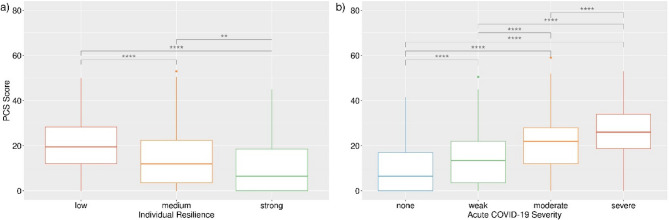
Of all potential predictors tested, only individual resilience and the acute phase severity of COVID-19 were originally found by Bahmer et al. [4] to be consistently associated with the PCS score. This result was confirmed in the present study for COVIDOM participants who have since been recruited. Among new participants with complete data on both the PCS score and the BRS index (n = 770), the former was found to decrease with increasing individual resilience (Fig. 1a) and to differ significantly between all three BRS-defined resilience classes (Kruskal-Wallis test or paired Wilcoxon test, as appropriate: all Benjamini-Hochberg-adjusted p < 0.001). Similarly, among the 1,268 newly recruited participants with complete data on the PCS score and acute COVID-19 severity, more serious illness was associated with a higher PCS score (Fig. 1b) and the PCS score differed significantly between all acute severity-defined groups (Kruskal-Wallis test or paired Wilcoxon test, as appropriate: all Benjamini-Hochberg-adjusted p < 0.001).

Relationship between PCS score and individual resilience () and acute COVID-19 severity () in newly recruited COVIDOM participants with complete data (resilience: = 770; acute severity: = 1,268). Individual resilience was classified as low (BRS < 3.0), medium (3.0 ≤ BRS < 4.3), or strong (BRS ≥ 4.3). Acute COVID-19 severity was classified as none (no severe or life-threatening symptoms), weak (1–3 symptoms), moderate (4–6 symptoms), or severe (≥ 7 symptoms). Both omnibus and all pairwise tests revealed significant score differences between the predictor-defined groups (Kruskal-Wallis test or paired Wilcoxon test, as appropriate; ****: Benjamini-Hochberg-adjusted < 0.001) a b n n p
Association between long-term symptom complexes
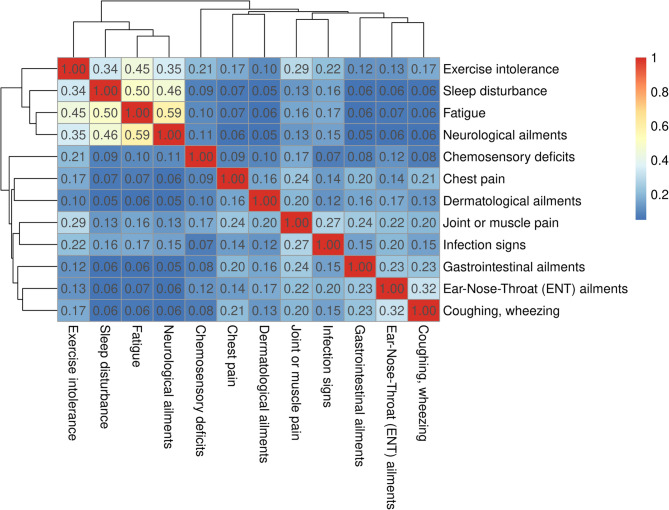
Pairwise associations between the 12 long-term symptom complexes included in the PCS score were quantified by Cohen's κ in all COVIDOM participants with complete data (n = 2,889). This way, a clustering became apparent of four of the symptom complexes, namely exercise intolerance, sleep disturbance, fatigue, and neurological ailments (Fig. 2). The strongest associations of all were observed between fatigue and neurological ailments (κ = 0.59), and between fatigue and sleep disturbance (κ = 0.50).

Pair-wise associations between the 12 long-term symptom complexes underlying the Post-COVID Syndrome (PCS) score. Cohen's κ values were calculated in all COVIDOM participants with complete data ( = 2,889) and subjected to hierarchical clustering by Euclidean distance. The strength of the association between symptom complexes was color-coded as red (0.75 ≥ k), yellow (0.45 ≤ κ < 0.75) or blue (κ < 0.45) n
Classification and regression tree (CART) analysis
Individual resilience
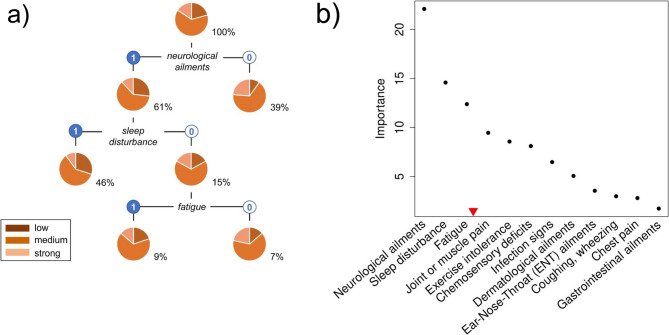
The majority (63.5%) of COVIDOM participants with complete data on both, the PCS score and the BRS index (n = 2,250) had medium resilience, 15.9% described their resilience as strong, and 20.6% as low (Fig. 3a). CART analysis resulted in relevant splits in the final (pruned) tree by the presence or absence of neurological ailments, sleep disturbance, and fatigue, respectively. Applying the elbow rule to the corresponding importance values (for details, see Supplementary Material), the same three symptom complexes were also selected for the subsequent construction of a novel, resilience-specific PCS score (Fig. 3b).

Classification and Regression Tree (CART) analysis of individual resilience, as measured by the Brief Resilience Scale (BRS) index. CART analysis served to determine which PCS symptom complexes were most strongly associated with individual resilience in all COVIDOM participants with complete data ( = 2,250), allowing for a possible statistical interaction between complexes. Nodes were successively split by the presence (1, blue) or absence (0, white) of a particular symptom complex. The percentage of samples included is given alongside each node. The resulting tree was pruned until all leaves comprised at least 5% of the samples. Symptom complexes were selected for novel PCS score definition by applying the elbow rule to their importance values (threshold marked by red triangle) n a b
Acute COVID-19 severity
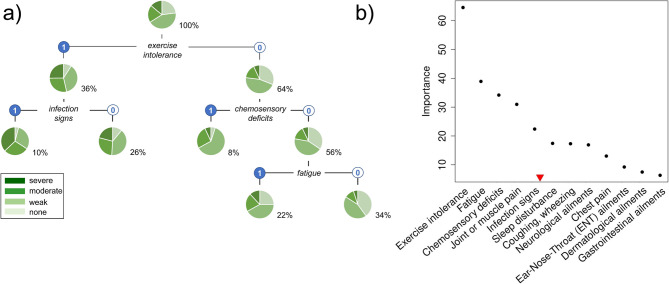
A second CART analysis was performed treating the acute COVID-19 severity of COVIDOM participants (n = 2,889) as the target variable. Overall, 22.9% of these individuals reported no severe or life-threatening symptoms, 42.7% were mildly affected, 20.5% reported moderate severity, and 13.8% suffered severely from the disease. Tree building and pruning led to four splits by the presence or absence of exercise intolerance, infection signs, chemosensory deficits, and fatigue (Fig. 4a). Based upon their importance values, however, the following five PCS symptom complexes were selected for acute severity-specific score construction: exercise intolerance, fatigue, chemosensory deficits, joint or muscle pain, and infection signs (Fig. 4b).

Classification and Regression Tree (CART) analysis of acute COVID-19 severity ( = 2,889; for details, see legend to Fig. ) n 3
Construction of novel predictor-specific PCS scores
Following Bahmer et al. [4], participants in sub-cohort Kiel-I with complete data on the CART-selected symptom complexes (n = 605) were included in the construction of two novel, predictor-specific PCS scores. In brief, the respective symptom complexes were subjected to an iterative combination of k-means clustering and ordinal logistic regression, each time treating the cluster affiliation of a sample as the outcome variable in the regression analysis. Parameter k was increased until the logistic regression models became sufficiently stable [4].
For individual resilience, the construction involved three long-term symptom complexes, namely neurological ailments, fatigue, and sleep disturbance. It stopped at k = 2, and the resulting clusters clearly differed in terms of the proportions of participants presenting individual symptom complexes (Table 2). The mean cluster centre equalled 0.137 for the first cluster (n = 224), and 0.893 for the second cluster (n = 381). All three symptom complexes were assigned roughly the same weight in the resulting resilience-specific PCS-R score (fatigue: 46.0; neurological ailments: 46.0; sleeping disturbance: 45.0). ROC analysis led to a threshold of 46.0 (AUC = 0,971) for the PCS-R score to distinguish between a severe (cluster II) and a less severe or absent PCS phenotype (cluster I). Classification according to this threshold reproduced the cluster affiliation for 592 of the 605 participants (97,9%).
For the acute disease severity-specific PCS-S score, the construction process stopped at k = 6, with mean cluster centres of 0 0.007, 0.240, 0.382, 0.408, 0.635, and 0.767, respectively (Table 3). Joint or muscle pain and chemosensory deficits were assigned the highest weights (7.0 and 6.5, respectively), followed by exercise intolerance (4.5), infection signs (3.9) and fatigue (2.5). ROC analysis yielded thresholds for the PCS-S score of 0.0 (AUC = 0.981), 6.0 (AUC = 0.970), 7.0 (AUC = 0.901), 9.5 (AUC = 0.951) and 13.5 (AUC = 0.973), application of which reproduced the cluster affiliation of 493 of the 605 participants (81.5%).
Similar to Bahmer et al. [4], we related the two novel PCS scores to the self-reported QoL of participants, measured by EQ-5D-5 L [4, 10]. Both scores exhibited a significant inverse correlation with the EQ-5D-5 L index (PCS-R: Spearman correlation coefficient ρ=−0.63; PCS-S: ρ=−0.64; both p < 0.001), indicating that higher PCS-R or PCS-S scores are associated with significantly lower QoL. Notably, however, these correlations were found to be slightly weaker than for the original PCS score (ρ=−0.70; p < 0.001).
The PCS-R and PCS-S scores were also moderately correlated with one another (ρ = 0.71). This notwithstanding, linear regression analysis revealed that the two novel scores, which comprise only seven of the 12 symptom complexes underlying the original PCS score, predict the latter exceptionally well. The resulting model equalled1\documentclass[12pt]{minimal} \usepackage{amsmath} \usepackage{wasysym} \usepackage{amsfonts} \usepackage{amssymb} \usepackage{amsbsy} \usepackage{mathrsfs} \usepackage{upgreek} \setlength{\oddsidemargin}{-69pt} \begin{document}$$\mathrm{PCS}=-0.219+0.124\times\mathrm{PCS}\text-\mathrm R+1.048\times\mathrm{PCS}\text-\mathrm S$$\end{document}
and achieved a coefficient of determination of R2 = 0.93, i.e., 93% of the variation of the original PCS score was explicable by the variation of the two novel scores. For practical purposes, it may be useful to rescale the two novel PCS scores so that their sum roughly equals the original score. To this end, each logistic regression coefficient would have to be multiplied by the corresponding linear regression coefficient and the result rounded again to the nearest half-integer (see Tables 2 and 3).
| Symptom complex | Cluster centre | Logisticregression coefficient | Score weight | ||
|---|---|---|---|---|---|
| I( = 224)n | II( = 381)n | original | rescaled | ||
| Fatigue | 0.094 | 0.906 | 45.751 | 46 | 5.5 |
| Neurological ailments | 0.138 | 0.934 | 45.761 | 46 | 5.5 |
| Sleep disturbance | 0.179 | 0.84 | 45.243 | 45 | 5.5 |
| Mean cluster centre | 0.137 | 0.893 | NA | NA | |
| Symptom complex | Cluster centre | Logisticregression coefficient | Score weight | ||||||
|---|---|---|---|---|---|---|---|---|---|
| I( = 187)n | II( = 119)n | III( = 111)n | IV( = 99)n | V( = 34)n | VI( = 55)n | original | rescaled | ||
| Fatigue | 0 | 1 | 0.91 | 0.596 | 0.971 | 0.982 | 2.421 | 2.5 | 2.5 |
| Exercise intolerance | 0 | 0 | 1 | 0.384 | 1 | 0.945 | 4.454 | 4.5 | 4.5 |
| Joint or muscle pain | 0.005 | 0.059 | 0 | 0.04 | 0 | 1 | 7.228 | 7 | 7.5 |
| Chemosensory deficits | 0 | 0 | 0 | 1 | 0.206 | 0.382 | 6.402 | 6.5 | 6.5 |
| Infection signs | 0.032 | 0.143 | 0 | 0.02 | 1 | 0.527 | 3.747 | 3.5 | 4 |
| Mean cluster centre | 0.007 | 0.24 | 0.382 | 0.408 | 0.635 | 0.767 | NA | NA | |
identification of predictors of novel PCS scores Post-hoc
To assess the robustness of their intended predictor specificity, the two novel PCS scores were subjected to multiple ordinal logistic regression analyses with backward selection (threshold: p < 0.05) in COVIDOM sub-cohorts Würzburg/Berlin (n = 884) and Kiel-II (n = 1,613), treating the corresponding PCS score classes as the respective outcome variables.
In addition to individual resilience itself, only the most severe form of acute COVID-19 was found to be consistently associated with a higher PCS-R score (Supplementary Table 1). While a one-unit increase in BRS index reduces the odds for a high PCS-R score by 37%–57%, seven or more serious or life-threatening symptoms during the acute phase of COVID-19 increased these odds by a factor of 2.7 to 4.5, compared to a lack of symptoms.
The PCS-S score was also associated with acute disease severity (Supplementary Table 2), and the estimated odds ratios of the three higher severity categories (i.e. 1–3, 4–6, ≥ 7 symptoms), relative to the lack of symptoms, ranged from 1.9 to 3.2 in the Würzburg/Berlin sub-cohort, and from 2.9 to 10.5 in the Kiel-II sub-cohort. As the only other consistent predictor in Kiel-II and Würzburg/Berlin, a one-unit increase in body mass index increased the odds for a high PCS-S score by 4% to 7%.
Discussion
Although the global COVID-19 pandemic apparently has lost much of its threat, there is still a continuing need to study the lasting consequences of SARS-CoV-2 infection. Here, we reported that a previously developed Post-COVID Syndrome (PCS) score that uses 12 different symptom complexes to measure individual PCS severity [4], in fact, conjoins two different facets of PCS. The corresponding sub-phenotypes can be captured by two novel, more specific PCS scores that comprise only symptom complexes associated with the two main predictors of the original score, namely individual resilience and acute phase severity of COVID-19. The novel scores, labelled PCS-R and PCS-S, may both complement the original score when tailoring interventional strategies for PCS and improve our understanding of PCS pathogenesis. In fact, the two scores have already been used in other COVIDOM-based studies to serve as more cause-specific measures of PCS severity [11].
The present study also confirmed the capability of individual resilience and acute COVID-19 severity to predict PCS severity, thereby corroborating the idea that PCS can emerge through different etiological pathways. More specifically, the PCS-R score derived from symptom complexes associated with baseline individual resilience was found to classify patients into two severity groups, roughly speaking those with or without a condition that may be termed 'neuro-psychological' PCS. The PCS-S score, on the other hand, which comprises long-term exercise intolerance, fatigue, joint or muscle pain, chemosensory deficits, and signs of infection, was found to define an apparent 'prolonged recovery' sub-phenotype of PCS.
Any means of first-tier phenotypic classification of PCS patients that is easy to implement in practice should prove particularly useful in clinical care. It appears highly likely that the two PCS sub-phenotypes identified in our study require different medical interventions. As a first step towards the differential diagnosis required to this end, it would be helpful to determine the two cause-specific PCS scores from the self-reported symptoms of the patient. Knowledge of these scores can then help the treating physician to make diagnostic and therapeutic decisions that are best suited to the phenotype of the individual patient.
While both, the original and the two novel PCS scores were based upon a broad spectrum of disease sequelae, other studies pursued different strategies when devising PCS scoring systems or algorithms for PCS sub-phenotype identification. For instance, the PASC score developed in the RECOVER study was intended for the differential diagnosis of PCS [12]. Symptoms more specific for PCS, such as the impairment of smell and taste, consequently have greater weight in the PASC score than non-specific symptoms like fatigue. Although the PASC score uses binary indicators of self-reported symptoms similar to our scores, and although higher PASC scores are associated with lower health-related QoL as well, the main purpose of the PASC score was to determine whether or not a patient has PCS at all, and not to measure PCS intensity. Nevertheless, some of the score-defined groupings of patients are similar in both systems. For example, cluster IV of our PCS-S score and cluster I of the PASC score mainly comprise patients with chemosensory deficits, corroborating that these clusters may highlight a distinct phenotype [12]. Joint or muscle pain, on the other hand, is a rather frequent symptom in all PASC clusters but prevails only in cluster VI of our PCS-S score [12]. Notably, however, the PASC score also highlights the limitations of defining PCS by clinical symptoms alone because as many as 3.7% of the non-infected participants of the RECOVER study were PCS-positive, according to the PASC score [12].
In the ORCHESTRA study [13], different PCS phenotypes were also defined by way of clustering, but without prior stratification by potential PCS predictors as was done for constructing the PCS-R and PCS-R scores. The four clusters detected in ORCHESTRA were (i) chronic fatigue-like syndrome, with fatigue, headache, and memory loss; (ii) respiratory syndrome, with cough and dyspnoea; (iii) chronic pain syndrome, with arthralgia and myalgia, and (iv) neurosensory syndrome, with alterations of taste and smell. Except for respiratory syndrome, most of the characteristics of the other clusters recall the symptom complexes included in our two novel PCS scores. In line with other reports [13], female sex was also identified in ORCHESTRA as a predictor of severe PCS [13, 14]. However, even although we observed a trend towards higher PCS score values in women, both for the original and the novel scores, sex was excluded as a relevant covariate from all logistic regression models during score construction when individual resilience was included.
Interestingly, a history of psychiatric diseases, especially depression, strongly predicted chronic manifestation of COVID-19 symptoms in a Swiss study [7]. In the Würzburg/Berlin sub-cohort of COVIDOM, pre-existing neurologic or psychiatric diseases were also found to be a highly significant predictor of the PCS-S score, but the same association failed to reach statistical significance in Kiel-II after adjustment for multiple testing. Together, these results suggest a possible, albeit milder effect of a neuro-psychiatric disease history in the COVIDOM data. The Swiss study also revealed how the presence and severity of PCS interferes with the ability to work and of the 1.6% of PCS patients who were unfit to work at all, the majority were women [7]. The Swiss data together with our own therefore suggest that the resilience-specific PCS subdomain identified in here shares risk factors with depression and other psychiatric diseases, both of which are also more frequent in women.
Many studies exploring risk factors and sub-phenotypes of PCS were based upon electronic health records or hospital records, and often used the International Classification of Disease (ICD) code U09.9 as a criterion for data extraction [15 –17]. This has limited such studies to patients (i) who sought medical help for comparatively severe PCS and (ii) whose treating physicians actually used the ICD code in question. An example of this is provided by a US American study [16] in which an initial database of roughly 14 million patients was narrowed down to just 6,500 participants who fulfilled the inclusion criteria. Similar to our own results, the US study identified a neuropsychiatric and a pain/fatigue cluster in addition to two multi-systemic clusters [16], thereby adding further evidence for the existence of at least two distinct subdomains of PCS. However, whereas pulmonary and cardiovascular clusters were observed in the US study as well, the latter systematically excluded data on chemosensory deficits [16] because these are rarely documented in hospital records.
The strengths of the COVIDOM study include its population-based, multi-centre and prospective setting as well as its structured collection of quality-controlled data. In the future, the detailed clinical phenotyping in COVIDOM will also allow clinical classifications to be related to molecular markers as measured in the collected biomaterials. A limitation of the study is its retrospective acquisition of clinical data from the acute phase of COVID-19, potentially introducing recall bias. Furthermore, the majority of the COVIDOM data came from non-vaccinated individuals who got infected during the pre-Omicron era. In terms of both clinical care and viral etiology, the picture of COVID-19 and its sequelae has likely developed further from that among the COVIDOM participants included in our study. The conclusions drawn in here may therefore not be readily applicable to other variants of SARS-CoV-2, or to vaccinated individuals. In particular, since both the prevalence and the clinical characteristics of the 12 symptom complexes underlying our definition of a PCS score could have changed, the relative weights assigned to individual complexes may also require some adjustment to fit other groups of subjects. Finally, one limitation of COVIDOM may be its lack of pre-infection data. Since fatigue, sleep disturbance, and cognitive impairment are frequent symptoms of psychiatric and neurologic diseases, it cannot be excluded that the preferential recruitment of such patients into COVIDOM may have led to an overestimation of the role of named symptoms in PCS. However, studies with more comprehensive data than those available in COVIDOM are required to clarify this issue further. In any case, current scientific evidence already underscores the high relevance of psychological evaluation in PCS diagnosis even though distinguishing between predominantly somatic and predominantly psychological symptoms still remains challenging in clinical practice. This is partly because long-term chronic illnesses can be emotionally stressful in themselves and may thus contribute to neuropsychological symptoms and the onset of psychiatric diseases.
In conclusion, individuals with low resilience seem to suffer differently from PCS than individuals with severe acute COVID-19. The two novel PCS scores developed in the present study should allow clinicians and researchers to take this difference into account. Since functional limitations are scarce in PCS patients, clinical trials of PCS mostly employ patient-reported outcomes or health-related QoL to evaluate the efficacy of interventions and treatments. The proposed PCS scores can transform this information into clear-defined PCS sub-phenotypes enabling more efficient tailoring of interventions to different aetiologies and clinical needs.
Supplementary Information
Supplementary Material 1.