
What this is
- () is a severe muscle-wasting disorder affecting 1 in 3500 male births.
- Existing animal models, like mice, do not adequately replicate the human condition, limiting research efficacy.
- This study presents a novel rabbit model of created using , which closely mimics the disease's characteristics.
- The rabbit model exhibits key phenotypes such as impaired mobility, elevated serum creatine kinase, and cardiac dysfunction, making it a valuable tool for preclinical studies.
Essence
- A new rabbit model of () was developed using , showing significant similarities to human . This model exhibits impaired physical activity, elevated serum creatine kinase levels, and cardiac issues, providing a better platform for research and potential therapies.
Key takeaways
- The rabbit model demonstrates similar disease progression to human , including muscle necrosis and fibrosis. This aligns with the symptoms observed in patients, making it a relevant model for studying the disease.
- Echocardiography revealed reduced left ventricular ejection fraction and fractional shortening in the rabbits, indicating cardiac involvement similar to that seen in human cases.
- The rabbit model allows for straightforward physical activity assessments using wearable devices, enhancing the feasibility of preclinical trials compared to larger animal models.
Caveats
- The study primarily focuses on the initial characterization of the rabbit model, and long-term outcomes of the disease progression remain to be fully understood.
- While the model shows promise, the translation of findings from rabbits to humans may still face challenges due to biological differences.
Definitions
- Duchenne muscular dystrophy (DMD): An X-linked recessive disorder characterized by progressive muscle degeneration and weakness, typically leading to loss of ambulation by early adolescence.
- CRISPR/Cas9: A genome-editing technology that allows for precise modifications of DNA sequences in living organisms.
Simplified
INTRODUCTION
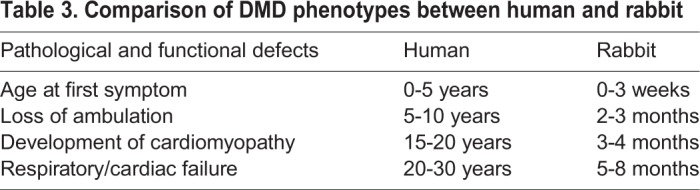
Duchenne muscular dystrophy (DMD) is a fatal X-linked recessive disease characterized by progressive muscle weakening and wasting. DMD patients usually lose the ability to walk between 10 and 12 years of age and die of respiratory and/or cardiac failure by the age of 20-30 years (Spurney, 2011). DMD affects ∼1 in 3500 male births according to newborn screening (Mendell and Lloyd-Puryear, 2013; Mendell et al., 2012).
DMD is caused by mutations in the DMD gene, which encodes dystrophin protein (Bonilla et al., 1988; Hoffman et al., 1987). The DMD gene consists of 79 exons on the X chromosome (Hoffman et al., 1987), and mutations occur in any of these exons with the common hotspots in exons 3-7 and exons 45-55. The mutations include various forms: large deletion (68%), large duplication (11%), point mutations (11%) and small insertion/deletion (7%) (Bladen et al., 2015). These mutations cause frameshift and/or premature stop codon formation in the DMD gene, thus disrupting the expression of dystrophin and leading to the development of DMD (Beggs et al., 1991). Currently, there is no effective therapeutic treatment available for DMD.
At present, several animal models of DMD presenting the dystrophic phenotype are available, including mouse (Bulfield et al., 1984; Chapman et al., 1989; Sicinski et al., 1989), dog (Baltzer et al., 2007; Cooper et al., 1988; Jones et al., 2004; Sharp et al., 1992; Smith et al., 2011) and pig (Klymiuk et al., 2013). Many of the pathogenesis and preclinical studies were initially carried out in Mdx (Dmd) mice, a widely used animal model of DMD. However, the Mdx mice do not recapitulate human DMD patients in many aspects. For example, the phenotype of Mdx mice is much milder compared with that of DMD patients, with almost a normal life span (Chamberlain et al., 2007), although they exhibit muscular dystrophy (Bulfield et al., 1984; Chapman et al., 1989; Sicinski et al., 1989). This could be part of the reason for the poor translation of the findings achieved with these animals. Golden retriever muscular dystrophy (GRMD) dogs (Baltzer et al., 2007; Cooper et al., 1988; Jones et al., 2004; Sharp et al., 1992; Smith et al., 2011), on the other hand, show severe muscular dystrophy pathology, lethal respiratory distress and cardiomyopathy, resembling DMD patients. Dystrophin-deficient pigs were generated by deleting exon 52 in pig fibroblasts followed by nuclear transfer (Klymiuk et al., 2013). These pigs exhibit many features of muscular dystrophy including elevated serum creatine kinase, impaired mobility and progressive dystrophic changes in skeletal muscle (Klymiuk et al., 2013). Interestingly, pathological alterations were not observed in the heart of these pigs; however, some DMD pigs also die shortly after birth (Klymiuk et al., 2013; Yu et al., 2016). Although GRMD dogs and DMD pigs resemble human DMD patients better than Mdx mice do, the cost associated with the usage of these large animals poses a big hurdle for many laboratories.
Therefore, there is a need to develop DMD models in other species, which must recapitulate human DMD patients with reasonable costs for maintenance in ordinary laboratories. Of note, the rabbit shares more similarities with humans in terms of physiology, anatomy and genetics than does the mouse (Wang et al., 2014), and has been extensively used as an appropriate model for cardiovascular and metabolic disease research (Bősze et al., 2003). Lower maintenance cost and shorter gestational duration makes the rabbit a superior model compared with dogs or pigs.
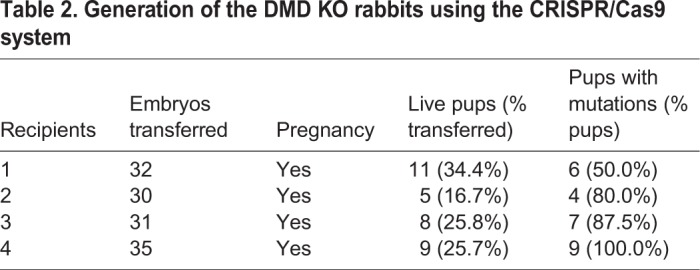
In this study, we established a novel DMD rabbit model by cytoplasm microinjection of Cas9 mRNA and single guide RNA (sgRNA). These clustered regularly interspaced short palindromic repeats (CRISPR)/Cas9 knockout (KO) rabbits showed many features of muscular dystrophy including elevated serum creatine kinase (CK), muscle necrosis and regeneration, impaired mobility, and increased fibrosis in the heart and bladder. This novel DMD rabbit model could be a valuable resource for DMD research and preclinical studies.
RESULTS
Generation ofKO rabbits using CRISPR/Cas9 DMD

(A) The common mutations in exon 51 in human DMD patients. (B) Schematic diagram of two sgRNA target sites located in exon 51 of the rabbitlocus.exons are indicated by purple boxes; target sites of the two sgRNA sequences (sgRNA1 and sgRNA2) are highlighted in red; protospacer-adjacent motif (PAM) sequences are highlighted in green. (C,D) Mutation detection by the T7E1 cleavage assay in pups 1-16 (C) and 17-33 (D). M, the DNA ladder (DL2000). Generation ofKO rabbits using CRISPR/Cas9. DMD DMD DMD

Disruption of dystrophin expression in theKO rabbits DMD

(A-C) Immunofluorescence staining of muscle sections from WT andKO rabbits with mouse monoclonal antibodies against dystrophin (A), glycosylated α-dystroglycan (B) and α-sarcoglycan (C). Nuclei were stained by DAPI. Scale bar: 100 µm. Disruption of dystrophin expression in the skeletal muscle ofKO rabbits. DMD DMD
Muscular dystrophy presentation inKO rabbits DMD
DMD patients show progressive decline in ambulation, which can be evaluated by a 6-min walk test (6MWT) (McDonald et al., 2010). The 6MWT is also the most accepted primary clinical endpoint in ambulatory DMD trials and has also been used to assess dogs with heart disease (Boddy et al., 2004). To examine the physical activity of the rabbits and to design a simple 6MWT-like assay for preclinical trials using these rabbits, we mounted a human-used activity-monitoring device (Millet Sports Bracelet Wearable Device) on the right hind leg of rabbits and counted the walking steps within 1 h. The KO rabbits showed significantly decreased mobility compared with the healthy ones (Fig. 3E). This 1-h wearable device-assisted walking test (1HWDAWT) provides an extremely simple and inexpensive way to evaluate the physical activity of the freely moving rabbits.
Muscle injury is a hallmark of muscular dystrophy, which releases muscle proteins such as CK into the circulation. We observed that serum CK was significantly elevated in the KO rabbits from 8 to 20 weeks of age compared with their age-matched littermate controls (Fig. 3F). In addition, serum aspartate aminotransferase (AST) and alanine aminotransferase (ALT) were elevated in the DMD KO rabbits (data not shown), which could also be caused by muscle breakdown. When the rabbits were placed in front of a step, WT rabbits easily climbed up the step whereas the KO rabbits failed with obvious attempts (Fig. 3G; Movies 1↗ and 2↗).

(A) Photograph of a 12-week-oldKO rabbit and its WT littermate showing significant forelimb paralysis in the KO rabbit. (B,C) Body mass comparison ofKO and WT female (B) and male (C) rabbits from birth to 24 weeks of age (=6). (D) Kaplan–Meier survival curves for theKO and WT rabbits (=22). (E) The walking steps during a 1-h recording period for theKO and WT rabbits (=6). (F) N-acetyl-L-cysteine measurements of serum CK levels (=6). (G) Photographs of aKO rabbit and WT control rabbit performing a stair-climb challenge. *<0.05; **<0.01; ***<0.001. Impaired physical activity inKO rabbits. DMD DMD DMD n DMD n DMD n n DMD P P P

(A,B) Analysis of H&E- and Masson's trichrome-stained sections of gastrocnemius from 5-month-old (A) and 12-month-old (B) WT andKO rabbits.KO rabbits displayed myopathy with excessive fiber size variation (red arrows), fiber fracture (green arrows), fibrosis (black arrows) and central nucleated fibers (blue rectangle). (C,E) Quantification of mean gastrocnemius muscle fiber area in WT andKO rabbits at 5 (C) and 12 (E) months of age. (D,F) Quantification of centrally nucleated fiber (CNF) percentage in WT andKO rabbits at 5 (D) and 12 (F) months of age. (G) Size distribution of WT andKO gastrocnemius muscle at 5 months of age. (H) Quantification of relative fibrotic area in WT andKO rabbits at 5 months of age. Scale bars: 50 µm. ***<0.001;=5. Muscular dystrophy presentation in-KO rabbits. DMD DMD DMD DMD DMD DMD DMD P n
Cardiomyopathy in theKO rabbits DMD

(A) The hearts from aKO rabbit and WT control at 20 weeks of age. (B,C) The left ventricular ejection fraction (EF, B) and fractional shortening (FS, C) were decreased inKO rabbits. (D,E) H&E-stained and Masson's trichrome-stained sections of cardiac muscle from WT andKO rabbits at 5 (D) and 12 (E) months of age showed significant fibrosis (black arrows), mononuclear inflammatory cell infiltration (red arrow) and adipose tissue (blue arrow). Scale bars: 50 µm. **<0.01;=5. Cardiomyopathy in theKO rabbits. DMD DMD DMD DMD P n
DISCUSSION
In this study, we generated a novel rabbit model for DMD via the zygote injection of Cas9 mRNA and a pair of sgRNAs targeting exon 51 of the DMD gene, and demonstrated that the DMD KO rabbits exhibited almost all hallmarks of the disease observed in DMD patients, including muscular dystrophy, cardiomyopathy and high incidence of premature death. To the best of our knowledge, this is the first report of a DMD rabbit model that develops both muscular dystrophy and cardiomyopathy.
Approximately 74% of the live rabbit pups carried mutations at the target sites of the DMD gene and ∼85% of these targeted animals carried biallelic mutations. Many of these mutations are small deletions or insertions, disrupting the reading frame of the DMD gene. Sanger sequencing and T7E1 assay did not detect significant off-target activities at the top predicted off-target sites. These results are consistent with previous reports that cytoplasmic injection of sgRNA-directed CRISPR/Cas9 mRNA can be used as an efficient approach to generate targeted KO animals, including rabbits, with high fidelity (Honda et al., 2015; Yuan et al., 2016).
Previous studies have shown the DMD mutation hotspots are located in the regions of exons 3-7 and exons 45-55 (Badalian and Malygina, 1995; Koenig et al., 1989). We thus chose exon 51 as the target site. Small deletions/insertions (with the number of nucleotides deleted or inserted indivisible by three) in this exon would cause frameshift and thus disrupt the dystrophin expression. Indeed, we observed that the DMD transcript was greatly reduced in the skeletal muscle of DMD KO rabbits.
Different from Mdx mice, the DMD KO rabbits showed clear cardiomyopathy at 4 months of age, as evidenced by reduced left ventricular ejection fraction (EF) and fractional shortening (FS) (Fig. 5B,C). Therefore, the DMD KO rabbit can be used in preclinical studies to evaluate the therapeutic effects of the tested medicine or treatment on muscular dystrophy and cardiomyopathy. The relatively lower maintenance cost and shorter gestational duration compared with dog and pig models make the DMD KO rabbit a particularly attractive model for preclinical studies. We showed that human-used activity-monitoring devices, such as the Millet Sports Bracelet Wearable Device used in this study, can be easily mounted on freely moving rabbits to monitor their physical activities. Moreover, echocardiography recording can be performed to assess their cardiac function.
To the best of our knowledge, this is the first report of a DMD rabbit model with close resemblance to its human counterpart. This new model could facilitate basic research to understand the pathogenesis of DMD, and translational studies to develop novel therapeutic strategies for this devastating disease.
MATERIALS AND METHODS
Animals and ethics statement
The New Zealand rabbits used in this study were maintained at the Laboratory Animal Center of Jilin University. All experiments involving rabbits in this study were performed in accordance with the guide of the Animal Care and Use Committee of Jilin University.
CRISPR/Cas9 sgRNA preparation, embryo microinjection and embryo transfer
The CRISPR/Cas9 sgRNA was designed and assembled as previously described (El Refaey et al., 2017; Xu et al., 2015b; Xu et al., 2016). The annealed sgRNA oligonucleotides were cloned into the BbsI sites of pUC57-T7-sgRNA cloning vector (Addgene ID 51306) as described (Shen et al., 2013). The vector of pUC57-T7-sgRNA was PCR amplified using T7 primers (Forward, 5′-GAAATTAATACGACTCACTATA-3′; Reverse, 5′-AAAAAAAGCACCGACTCGGTGCCAC-3′), and the PCR products were transcribed in vitro with a MAXIscript T7 Kit (Ambion; Applied Biosystems, CA, USA) and purified using a miRNeasy Mini Kit (Qiagen, Hilden, Germany) according to the manufacturer’s instructions.
The 3xFLAG-NLS-SpCas9-NLS vector (Addgene ID 48137) (containing Cas9 from Streptococcus pyogenes), was linearized with NotI and transcribed in vitro using a mMessage mMachine SP6 Kit (Ambion) and RNeasy Mini Kit (Qiagen) according to the manufacturer's instructions.
The microinjection procedure and embryo transfer were performed essentially the same as previously described (Sui et al., 2016). Briefly, female New Zealand White rabbits at the age of 6-8 months were superovulated with 50 IU follicle stimulating hormone (FSH) at intervals of 12 h six times, mated with male rabbits, and injected with 100 IU human chorionic gonadotropin (HCG). The female rabbits were then euthanized and the oviducts were flushed with 5 ml Dulbecco's phosphate-buffered saline (DPBS)-bovine serum albumin (BSA) for zygote collection. Rabbit embryos were collected at the pronuclear stage. A mixture of in vitro-transcribed Cas9 mRNA (200 ng/µl) and sgRNA (50 ng/µl) was microinjected into the cytoplasm of zygotes. The injected embryos were transferred into Earle's balanced salt solution (EBSS) medium and cultured at 38.5°C in 5% CO2 for 20-30 min. Approximately 30-50 injected zygotes were then transferred into the oviducts of recipient rabbits.
Mutation detection in pups by PCR and sequencing
The genomic DNA from DMD KO and WT rabbits was extracted from a small piece of ear tissue using a TIANamp Genomic DNA Kit (Tiangen, Beijing, China) according to the manufacturer's instructions. The sgRNA target sites were amplified by PCR using primers (Forward, 5′-TAGTTTGGCTCAGATTGTAG-3′; Reverse, 5′-AGAATAGACAAAGCAGTGTG-3′). The PCR products were gel purified and cloned into pGM-T vector (Tiangen). A minimum of 14 positive clones were sequenced and analyzed using DNAman.
T7E1 cleavage assay
The T7E1 cleavage assay was performed as described previously (Xu et al., 2015b, 2013). Briefly, the PCR products as described above were purified, denatured and then re-annealed in NEBuffer 2 (NEB) using a thermocycler. Hybridized PCR products were digested with T7 endonuclease 1 (M0302L, NEB) for 30 min at 37°C and subjected to 2% agarose gel electrophoresis.
Off-target analysis
The top off-target sites were predicted using the online CRISPR Design tool developed by the Zhang group at Massachusett's Institute of Technology (http://crispr.mit.edu/↗). The PCR products for these potential off-target sites using the primers listed in Table S1↗ were subjected to T7E1 assay and Sanger sequencing.
RNA extraction, RT-PCR and quantitative RT-PCR
Total RNA was isolated from the gastrocnemius muscle of WT and DMD KO rabbits using TRNzol-A+ reagent (Tiangen), and treated with DNase I (Fermentas Inc., MD, USA). The first-strand cDNA was synthesized using the cDNA first strand synthesis kit (Tiangen). The cDNA was used for regular RT-PCR and quantitative RT-PCR (qRT-PCR) analyses to examine the expression of DMD. The primers were used for regular RT-PCR (Forward, 5′-GTCAACTATCTACTGCAAGAGC-3′; Reverse, 5′-CTGTACTTCATCCCACTGATTC-3′) and qRT-PCR (Forward, 5′-CCGAACTAGAAATGCCATCTT-3′; Reverse, 5′-CACAATCACTTGCTGCGATTT-3′). qRT-PCR was performed using a BioEasy SYBR Green I Real Time PCR Kit (Bioer Technology, Hangzhou, China), and the 2−ΔΔCT formula was used to analyze gene expression, Gapdh was used as a reference gene. All experiments were repeated three times for each gene. Data were expressed as the mean±s.e.m.
Body weight and survival curve
The body weight of age- and sex-matched WT and DMD KO rabbits were measured biweekly. All data were expressed as the mean±s.e.m., and a minimum of three individual animals of each genotype were used in all experiments.
Serum biochemistry analysis
The blood samples were collected into heparinized tubes from the ear vein, and sera were prepared by precipitation and centrifugation. Serum CK, ALT and AST levels were measured using a CK test kit (N-acetyl-L-cysteine method), ALT test kit (continuous monitoring method) and AST test kit (continuous monitoring method), respectively (Ningbo Ruiyuan Biotechnology Co., China).
Activity measurement
A Millet Sports Bracelet Wearable Device was used to record movement steps within a 1-h period for DMD KO and WT rabbits. The rabbits wearing the device on their right hind leg were placed in an ∼30 m2 room to allow free movement.
Echocardiography
Echocardiography recording was performed as described previously (Han et al., 2007; Xu et al., 2015a). Briefly, two-dimensional and M-mode transthoracic echocardiography were performed as previously described on WT and DMD KO rabbits (n≥3 per group) by an SIUI all digital color doppler ultrasound diagnostic system (Apogee 300, ShanTou, China). Rabbits were studied in right lateral recumbency from parasternal long and short axis views. The rabbits were held in the right position by restraining their limbs with people. A linear array probe and center frequency of 10.0 MHz were used. Cardiac dimensions [the interventricular septal thickness at end-diastole (IVSd), left ventricular end diastolic diameter (LVDd) and left ventricular systolic diameter (LVDs)] were determined and the percentage of FS and left ventricular EF calculated.
Histology analysis
Various tissues, including gastrocnemius, tibialis anterior, quadriceps, diaphragm and heart, were collected from DMD KO and WT rabbits (euthanized at 5 and 12 months of age). The tissues were fixed in 4% paraformaldehyde at 4°C, dehydrated in increasing concentrations of ethanol (70% for 6 h, 80% for 1 h, 96% for 1 h and 100% for 3 h), cleared in xylene and embedded in paraffin for histological examination. The 5-μm sections were cut for H&E (Han et al., 2007; Xu et al., 2015a) and Masson's trichrome staining as previously described. The stained sections were imaged with a Nikon TS100 microscope.
Immunofluorescence staining
Paraffin-embedded skeletal muscle tissues were deparaffinized and antigen retrieval was performed using a pressure cooker. After blocking with 10% goat serum in PBS for 1 h at room temperature, the tissue sections were incubated with primary antibodies diluted in PBS with 1% BSA at 4°C overnight. Primary antibodies against dystrophin (MANDYS1 clone 3B7, 1:20, Developmental Studies Hybridoma Bank), α-dystroglycan (sc-53987, 1:50, Santa Cruz Biotechnology), α-sarcoglycan (NCL-L-a-SARC, 1:100, Leica Biosystems) and caveolin 3 (610420, 1:500, BD Biosciences) were used. The slides were then extensively washed with PBS and incubated with secondary antibodies (Alexa Fluor 594-conjugated goat anti-mouse IgG, 1:500, Invitrogen) for 1 h at room temperature. Finally, the glass slides were mounted using VECTASHIELD Mounting Medium with 4′,6-diamidino-2-phenylindole (DAPI) (Vector Laboratories). Then the slides were imaged with a Nikon Ti-E inverted fluorescence microscope equipped with an Andor Zyla sCMOS camera and a Nikon Super Fluor 20×/0.75 NA objective lens. Images were recorded using the NISElements Advanced Research software package (Nikon) and processed using Photoshop CS5 (Adobe).
Morphometric analysis of myofibers
The H&E-stained cross-sections of gastrocnemius, tibial anterior and quadriceps muscles from the DMD KO and WT rabbits at 5 months of age were analyzed for fiber size, central nucleation and fibrosis. A minimum of three different regions were counted per section. The fiber size, percentage of central nucleated fibers and fibrotic area were calculated using ImageProPlus 6.0 software (Media Cybernetics, Silver Spring, MD, USA).
Statistics
Data are expressed as mean±s.e.m. Statistical differences were determined by unpaired Student's t-test for two group comparisons, and one-way ANOVA with Bonferroni's post-tests for multiple group comparisons, using Prism 7.0 (GraphPad). P≤0.05 was considered significant.