
What this is
- This research investigates the role of the nhr-23 gene in C. elegans, which is essential for both developmental and circadian rhythms.
- The study reveals that nhr-23 functions as a core component of the circadian clock in adults, while also regulating the molting cycle during development.
- Findings suggest that ancestral circadian clock genes have evolved to operate across different biological timescales.
Essence
- The nhr-23 gene is critical for both the 8-h developmental clock and the circadian clock in adult C. elegans, indicating a shared evolutionary origin for these biological rhythms.
Key takeaways
- nhr-23 is essential for generating circadian transcriptional rhythms in adult C. elegans, demonstrating its role as a core circadian clock gene.
- The study identifies that genes regulated by nhr-23 exhibit distinct rhythmic patterns during development and adulthood, suggesting functional flexibility in clock gene networks.
- Ancestral circadian clock genes, such as nhr-23, may have evolved to regulate multiple biological rhythms, challenging the view of a strict separation between developmental and circadian clocks.
Caveats
- Limited overlap between rhythmic genes in C. elegans and those in mammals suggests caution in generalizing results across species.
Simplified
Introduction
Many organisms across phyla have internal clock systems which generate biological rhythms. These clocks operate on various timescales: e.g., the segmental clock induces a rhythmic somite segmentation every several hours1,2, and the circatidal clock generates the ~12.4-h period rhythm3.
One of the best-characterized biological clocks is the circadian clock. In mammals, the circadian rhythm is generated by a transcriptional network of genes known as clock genes, including transcriptional factors such as Bmal1, Clock, Dbp, and Ror4. Specifically, CLOCK and BMAL1 bind to a specific cis-element, E-box, to activate transcription of a series of genes including Per1-3 genes, and the translated PER proteins inhibit the E-box-mediated transcription. Thus, these genes form a core negative feedback loop that generates the circadian oscillation4. Moreover, the core loop is interlocked with regulatory loops via D-box and RORE elements. D-box and RORE are activated by transcriptional factors DBP and ROR, respectively5. These three cis-elements generate specific phases of circadian transcription: E-box generates a morning expression, D-box generates a daytime expression, and RORE generates an evening expression5–7. Therefore, combinational regulation by these cis-elements generates the daily expression patterns of individual genes.
Interestingly, in the nematode C. elegans, the circadian clock gene homologs are considered to constitute the "developmental clock". In C. elegans, molting occurs every 8–16 h depending on the temperature, and thousands of genes oscillate in synchrony with this molting cycle8,9. C. elegans homologs of the circadian clock genes are essential for this developmental rhythm with an 8-h period at 25 °C8–11. For instance, lin-42, the sole Per homolog, plays a critical role in determining the timing of molting during development. lin-42 gene exhibits a clear developmental rhythm at the mRNA level10, and lin-42 mutants exhibit an arhythmic molting cycle9,12. Furthermore, the C. elegans Ror homolog, nhr-23, controls rhythmic transcriptions of molting-related genes13–16 and is hence indispensable for developmental progression15,17. Thus, in C. elegans, it has been believed that the ancestral circadian clock had evolved into the developmental clock8.
While the clock gene homologs are used to generate the developmental rhythm with an 8-h period, circadian rhythms have also been observed in adult C. elegans18–22. Although much weaker than those in mammals, circadian transcriptional rhythms emerge after entrainment by temperature cycles in adult C. elegans18. However, in spite of the existence of such a transcriptome-wide circadian dataset published years ago, no study has identified canonical genes for circadian mRNA rhythm till now. Since the circadian transcriptome should reflect large information about the direct output from the core circadian clock, we assumed that the deeper analysis of the dataset leads to the identification of strong candidates for the core clock components.
In this study, we performed a reanalysis of the adult circadian transcriptome18 and larval developmental transcriptome23. We discovered that the expression of Ror/nhr-23-targeted genes exhibited adult circadian rhythms in a specific phase, while they exhibited developmental rhythms during larval development. We then showed that Ror/nhr-23 is essential for the adult circadian rhythms, as well as for the larval developmental rhythms13,17,24. These results suggest that bilaterian ancestral circadian clock genes might have evolved to count multiple periods in C. elegans.
Results
The targets of clock gene homolog Ror/nhr-23 exhibited circadian transcriptional oscillations in adult C. elegans
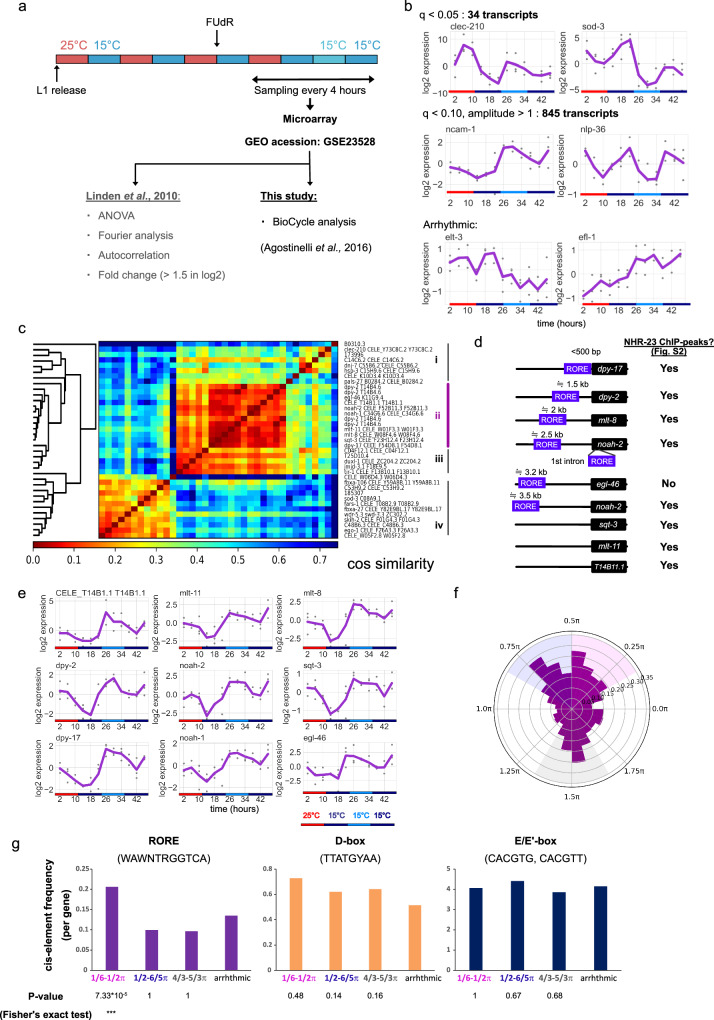
First, we focused on 34 transcripts with which met the criteria of q < 0.05 (Fig. 1b). Twelve of them were identified as rhythmic in the previous study18. To elucidate the temporal patterns of these genes, we performed hierarchical clustering after amplitude normalization. As a result, we observed 4 large clusters (Fig. 1c, "i–iv"). Remarkably, cluster ii consisted of genes with highly similar temporal patterns (Fig.1c, magenta). Indeed, the cluster ii genes exhibited a similar temporal expression pattern, i.e., oscillation in a specific phase (Fig. 1e). Hereafter, we call these genes "cluster ii genes". Since these cluster ii genes were likely to be regulated by the same transcription factor, we investigated the detail of these genes and found that some of them (dpy-2, noah-1, mlt-8, mlt-10,mlt-11) were reported to be regulated by nhr-2313–16,24, the homolog of the clock gene Ror. To examine whether other cluster ii genes are also downstream of ROR/NHR-23, we explored the genome sequence and a previous comprehensive ChIP-seq dataset27. The dataset showed that most of the cluster ii genes indeed had NHR-23 ChIP peaks nearby their coding regions (Fig. 1d and Supplementary Fig. S3, 8 out of 9). Moreover, the ROR-regulated cis-elements, ROREs (WAWNTRGGTCA), were found in six of their regulatory regions (Fig. 1d). In addition, we investigated the homology of nhr-23/Ror among multiple species (Supplementary Fig. S4a, flies, zebrafish, mammals). Overall, the full amino acid sequences showed 30–40% similarity (36% when compared to Mus musculus). Specifically, the DNA-binding region (zinc finger) of homologs are highly conserved across species (78%, compared to Mus musculus). Therefore, Ror/nhr-23 and ROREs are suggested to play canonical roles in generating the C. elegans circadian rhythm.
As mentioned earlier, mammalian ROREs generate a specific phase of circadian transcription7. To test if C. elegans ROREs are also enriched around the genes with the circadian rhythm in a specific phase, we first examined a phase distribution of the circadian expression. We extended the analysis to a broader set of genes (845 transcripts) with some false positives (q < 0.10, 1< amplitude). See Methods for the definition of amplitudes, where amplitude 1 in log2-tranformed dataset approximately corresponds to 2-fold change. This allowed us to describe the overall characteristics of the circadian genes, rather than focusing on an individual gene. There were 3 apparent peaks in the phase distribution (Fig. 1f): 1/6–1/2 π (magenta), 1/2–5/6 π (navy), and 4/3–5/3 π (gray). We then examined the enrichment of cis-elements in the regulatory region of genes with each of the peaks (4 kb upstream and introns). The frequency of ROREs around the genes in the "magenta" phase (1/6–1/2 π), the phase the cluster ii genes exhibited, was two times higher than those in other peaks and arrhythmic genes. However, we did not find any evidence for the enrichment of other circadian-related cis-elements, D-box and E/E'-box, in any of the peaks (Fig. 1g). In addition, we explored the rhythmicity of C. elegans gene homologs in mice based on RhythmicDB28 (Supplementary Fig. S4b). As a result, we found that 35% of the rhythmic genes in C. elegans also exhibit circadian rhythms in mice. This percentage is slightly higher compared to the overall proportion of rhythmic genes among all mouse genes that have C. elegans homologs (28%, P = 0.067 in Fisher's test). However, given the limited overlap, we could not draw a definitive conclusion from this analysis.
These results suggest that genes with RORE are activated by ROR/NHR-23 at the specific time of the day in C. elegans as reported in mammals, while other, perhaps unknown, cis-elements might be responsible for the generation of other circadian phases.
![and RORE cis-elements generate a specific phase of circadian transcription. Ror/nhr-23 Reanalysis of the dataset from the previous study. Briefly, worms were entrained by four 12-h warm (25 °C, red) and 12-h cold (15 °C, blue) temperature cycles (WC) and subsequently kept under the constant condition (CC) at 15 °C. Animals were sampled every 4 h over WC and CC. = 3 biologically independent replicates at each time point. The dataset was reanalyzed using BioCycle in this study.The result of BioCycle analysis. The number of periodic transcripts (arrays) in each criteria and representative gene expression were described.Hierarchical clustering of < 0.05 genes in BioCycle analysis. Magenta indicates specifically inter-correlated genes ("cluster ii). Colors indicate cosine distance between expression patterns.The existence of RORE cis-elements and ChIP peaks in the clustered gene.The expression pattern of the cluster ii genes.Phase distribution of circadian rhythmic genes ( < 0.10 with 1< amplitude). Three peaks (magenta, blue, gray) were observed in the distribution.Enrichment of cis-elements in gene regulatory region of the circadian rhythmic genes.values were calculated by Fisher's exact test followed by Holm's correction. *** < 0.001. a b c d e f g [18] n q q P P](https://europepmc.org/articles/PMC10902330/bin/42003_2024_5894_Fig1_HTML.jpg "Click to view full size")
and RORE cis-elements generate a specific phase of circadian transcription. Ror/nhr-23 Reanalysis of the dataset from the previous study. Briefly, worms were entrained by four 12-h warm (25 °C, red) and 12-h cold (15 °C, blue) temperature cycles (WC) and subsequently kept under the constant condition (CC) at 15 °C. Animals were sampled every 4 h over WC and CC. = 3 biologically independent replicates at each time point. The dataset was reanalyzed using BioCycle in this study.The result of BioCycle analysis. The number of periodic transcripts (arrays) in each criteria and representative gene expression were described.Hierarchical clustering of < 0.05 genes in BioCycle analysis. Magenta indicates specifically inter-correlated genes ("cluster ii). Colors indicate cosine distance between expression patterns.The existence of RORE cis-elements and ChIP peaks in the clustered gene.The expression pattern of the cluster ii genes.Phase distribution of circadian rhythmic genes ( < 0.10 with 1< amplitude). Three peaks (magenta, blue, gray) were observed in the distribution.Enrichment of cis-elements in gene regulatory region of the circadian rhythmic genes.values were calculated by Fisher's exact test followed by Holm's correction. *** < 0.001. a b c d e f g [18] n q q P P
generates developmental rhythm with 8-h period during larval stage Ror/nhr-23
While our results suggest a putative contribution of Ror/nhr-23 to C. elegans circadian clock, Ror/nhr-23 has been considered to be a core developmental clock gene of the molting cycle, which oscillates with a shorter period (~8 h)13,15,24. In C. elegans, the homolog of the other mammalian RORE-binding clock gene, Rev-erb/nhr-85, does not show developmental rhythm, and loss of nhr-85 marginally impairs development in C. elegans29. Therefore, Ror/nhr-23 has a major contribution to RORE-dependent developmental rhythm in C. elegans.
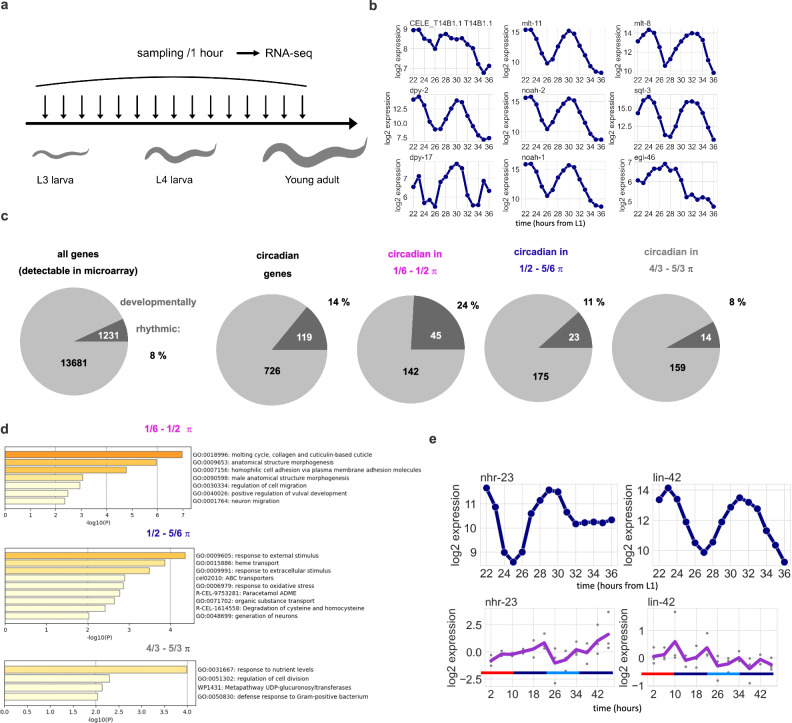
In addition, consistent with the previous reports10,18, mRNA of the canonical developmental clock gene, Per/lin-42, showed a developmental rhythm but not a circadian rhythm (Fig. 2e), suggesting that the developmental clock is somewhat different from the circadian clock. nhr-23 also shows arrhythmic expression in adulthood (Fig. 2e), but this is probably due to its high germline expression for spermatogenesis after sexual maturation31.
Taken together, though the outcome of the circadian clock does not completely overlap with that of the developmental clock, the functional rhythm of Ror/nhr-23 plays a significant role in generating gene expression rhythms in both contexts.
![RORE-targeted circadian genes oscillate with 8 h period during larval development. Summary of the dataset for developmental transcription. Animals from 22 to 36 h after the L1 stage (L3 to young adults) were sampled every 1 h. = 1 for each time point.Expression of RORE-targeted genes ("clustered gene" in Fig. ) during larval development.The proportion of developmentally rhythmic genes in circadian rhythmic genes ( < 0.10 with 1< amplitude).The result of Metascape analysisin genes oscillating in circadian rhythm with a specific phase.Expression ofandduring larval development and adulthood. a b c d e n q Per/lin-42 Ror/nhr-23 1 [30]](https://europepmc.org/articles/PMC10902330/bin/42003_2024_5894_Fig2_HTML.jpg "Click to view full size")
RORE-targeted circadian genes oscillate with 8 h period during larval development. Summary of the dataset for developmental transcription. Animals from 22 to 36 h after the L1 stage (L3 to young adults) were sampled every 1 h. = 1 for each time point.Expression of RORE-targeted genes ("clustered gene" in Fig. ) during larval development.The proportion of developmentally rhythmic genes in circadian rhythmic genes ( < 0.10 with 1< amplitude).The result of Metascape analysisin genes oscillating in circadian rhythm with a specific phase.Expression ofandduring larval development and adulthood. a b c d e n q Per/lin-42 Ror/nhr-23 1 [30]
Ror/nhr-23 is a critical regulator not for only the larval molting rhythm but also for the adult circadian rhythm
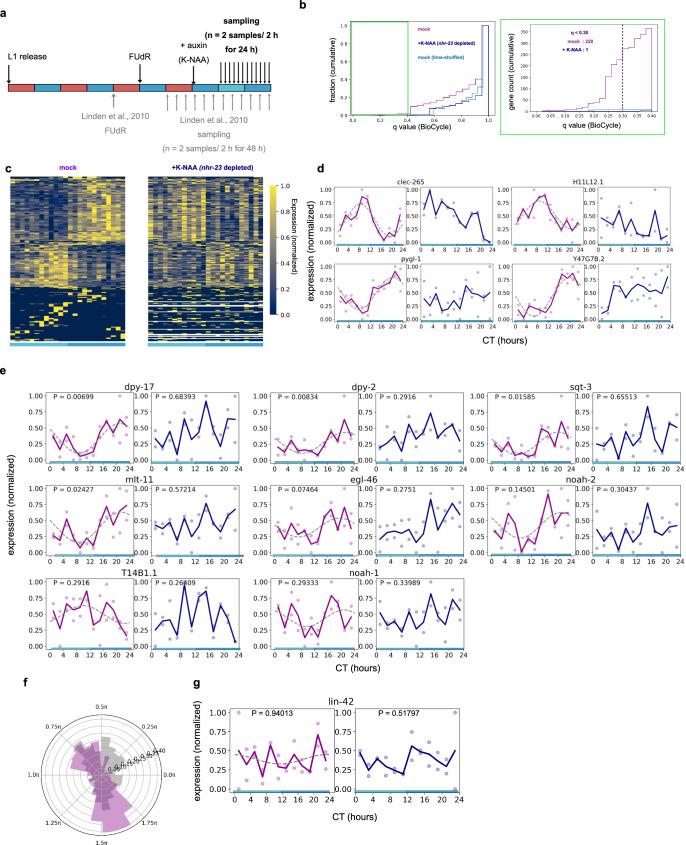
In the resulting dataset (Supplemental Data 3), we could detect only a small number of circadian rhythmic genes in the mock condition, compared with the previous study18: only 228 genes met the criteria of q < 0.30 by BioCycle analysis in the mock condition (Fig. 3b). However, the number of rhythmic genes based on q values was still substantially larger than that in the time-shuffled dataset (Fig. 3b, d). Therefore, rhythmic components are considered to be indeed embedded in our dataset. The phase distribution of rhythmic (q < 0.30) genes are largely consistent with the previous study, though the RORE-enriched phase (1/2–1/6 π) was not obvious in q < 0.30 (Fig. 3f). Some of the RORE-targeted genes were detected as circadian rhythmic at least at uncorrected P value P < 0.05, but not all of them (Fig. 3e). These differences from the previous study might be due to the limited sampling time (24 h in this study vs. 48 h in the previous study) or the difference in the strains (degron knock-in strains vs. N2).
However, even with the low detection power, the effect of nhr-23 knockdown was evident: treatment with the auxin analog K-NAA34 decreased the circadian periodicity of gene expression to the level of that in the time-shuffled dataset (Fig. 3b). Only one gene was detected as periodic in the nhr-23 knockdown dataset even in q < 0.30, and most q < 0.30 genes in the mock dataset lost overt rhythm by auxin treatment (Fig. 3c, d and Supplementary Fig. S5). The abolishment of circadian rhythms is not limited to a specific phase (Fig. 3c, e), suggesting that nhr-23 is involved in a canonical circadian oscillator in adult C. elegans, rather than merely generating a specific phase of circadian transcription. Overall, our findings indicate that nhr-23/Ror is one of the core circadian clock genes in C. elegans.

is essential for circadian transcription in. Ror/nhr-23 C. elegans Summary of the experiments for RNA-seq. The entrainment schedule was based on the previous study. The test group was treated with auxin (K-NAA) to deplete NHR-23 12 h before sampling was started. Animals were sampled every 2 h for a day in the constant condition at 15 °C. = 2 biologically independent replicates.Cumulative histogram of the q value calculated by BioCycle in circadian transcription for all genesvalue in < 0.40 gene count. Apparently, more genes are rhythmic in the mock dataset, compared to the auxin-treated dataset. For reference, the number of < 0.30 genes were indicated in the graph area.Expression pattern of rhythmic genes ( < 0.30 in mock condition). The gene expressions were normalized so that maximum = 1 and min = 0. Auxin treatment eliminates overt rhythms. rep. stands for biological replicates.Representative plots of raw TPM values of circadian rhythmic genes.indicates uncorrectedvalues in BioCycle analysis. Colors indicate the experimental group (magenta: mock, +K-NAA: navy).Expression of the RORE-targeted genes (cluster ii genes in Fig. ) in the datasets. Colors indicate the experimental group as ().Phase distribution of < 0.30 genes in the mock condition (magenta). The gray histogram shows the phase distribution of Fig. .Arrhythmic expression pattern ofin our RNA-seq dataset. a b c d e d f g n q q q q P P q Per/lin-42 1 1f
Discussion
In this study, we discovered that Ror/nhr-23 is not only an essential clock gene for developmental rhythm (with 8 h period in 25 °C) as previously reported16,17,24, but also a core circadian clock gene of adult C. elegans. Genes with RORE exhibited circadian transcription in a specific phase, and depletion of Ror/nhr-23 in adulthood abolished the circadian rhythm itself. So far, no study has identified a canonical circadian clock gene in C. elegans, or the common component of the developmental and circadian clocks. The Ror/nhr-23 is involved in the core transcriptional network of the developmental clock during larval stages, and may come to be involved in that of the circadian clock after the completion of larval development.
Even in the light of our data, however, the clockwork of C. elegans has still been enigmatic. Moreover, we have no idea of how the transition between these two clockworks occurs. To our knowledge, even in the developmental clock, no study has clearly demonstrated how the clock gene homologs interact to generate the 8-h oscillation. One interesting observation is that Per/lin-42 mRNA does not show a circadian rhythm18 (Figs. 2e and 3g). Given this, Ror/nhr-23 might be involved in the Per/lin-42-based oscillatory system during larval development. After the completion of larval development, the contribution of lin-42 is somehow decreased, and another oscillatory system might emerge.
Circadian rhythms exist across diverse species, while the core clock components differ between distant species. For example, FRQ and WC in Neurospora35 and TOC1 and CCA in plants36 form transcriptional feedback loops. However, some molecular components, such as CK137, calcium38, and redox oscillations39, are conserved even in organisms with different clock genes, suggesting the possibility that these elements may exist prior to the transcriptional feedback loops. Intriguingly, the redox oscillation was reported in C. elegans40. Considering these findings, while the homologous oscillators of the mammalian circadian clock have evolved to the developmental clock in C. elegans, it is possible that these conserved components drive functional oscillation of nhr-23 after the developmental clock, resulting in a circadian functional rhythm of nhr-23.
To date, the "ancestral clock" of the circadian clock was thought to have evolved to generate the 8-h developmental rhythm in C. elegans. However, our results indicate that the core component of C. elegans developmental clock still possesses an ability to generate circadian rhythms. That is, the ancestral clock genes evolved to flexibly generate the biological rhythms with multiple timescales according to the context, i.e., molting during larval development and daily cycles in adulthood. While decades of research have revealed how robustly the circadian clocks are tuned to 24-h, few studies have focused on how flexible the clock gene network could be. Our findings provide deeper insights into the evolution of the biological clock system.
Methods
strains and culture C. elegans
Animals were maintained on nematode growth media (NGM)41. Wild-type animals correspond to the Bristol strain N2. For NHR-23 knockdown experiments, we used JDW259: wrdSi55[eft-3p:TIR1:F2A:mTagBFP2:tbb-2 3′UTR, I:-5.32]; nhr-23(kry61(nhr-23::AID*::TEV::3xFLAG)).
Analysis of transcriptome dataset
The dataset was acquired from GEO (circadian transcriptome18: GSE23528, developmental transcriptome23: GSE52910). For the circadian transcriptome analysis. we used the temperature cycle and constant temperature (WC-CC) dataset. For developmental transcriptome analysis, we used "N2 untreated" dataset.
We used BioCycle R script25 for periodicity tests and estimation of phases and amplitudes: For circadian transcriptome, a range of the period was set to 20–28 h. For developmental transcriptome, the range was set to 8–10 h. We used BH method to calculate q values. In the dataset, we found a substantial number of arrays with identical values, which we suspect to be artifacts. However, these arrays were not included in our analysis. In BioCycle analysis, the amplitude is defined as variance of the signal to the variance of a cosine signal. We used JTK_CYCLE using R script for comparison in Supplementary Fig. S1.
For cis-element analysis, we acquired genomic positions and introns and upstream regions of genes from WormBase (www.wormbase.org↗) using Python web service API. Then, the sequence was extracted from WBcel235 genome assembly. All introns and 4 kb upstream from the first exons were searched for enrichment of cis-elements. The number of cis-elements in each regulatory region is described in Supplemental Data 3.
All statistical analyses were performed with Python3 scripts.
The result of reanalysis by BioCycle is described in Supplemental Data and. 1 2
RNA extraction and sequencing
In total, 1000–2000 L1-synchronized animals were cultivated on 10-cm dishes under temperature cycles (25 °C : 12 h, 15 °C : 12 h) as described in Fig. 3a. After 48 h (L4 stage), animals were transferred to other 10-cm plates with 10 µM FUdR to eliminate offsprings. Then, after 36 h (84 h post L1 release), animals were transferred to plates with 400 mM K-NAA.
From 97 to 119 h post L1 release, animals were sampled every 2 h: Animals were collected from plates and washed at least 3 times using cold wash buffer. Animals were then frozen in liquid nitrogen. All manipulations were done in at most <15 min.
RNA was extracted from the samples with TRIzol (Invitrogen) and RNAeasy mini kit (Qiagen). All RNA samples showed RIN > 9. Strand-specific RNA-Seq libraries were prepared by BGI (China) and sequenced on the DNB-Seq platform (150 bp pair end, 12,000,000 reads). Quantification of gene expressions was performed by Salmon42 with C. elegans mRNA sequences (WS284 version). The dataset after BioCycle analysis is described in Supplemental Data 3.
Statistics and reproducibility
We treated animals derived from individual culture plates as biologically independent replicates. We used 36, 16, 24 samples in Figs. 1–3 (3 replicates from 12 time points, 1 replicate from 16 time points, 2 replicates from 12 time), respectively. Statistical tests for periodicity are based on BioCycle. We used BH-corrected P value (q value) to control False Discovery Rate (FDR) in multiple comparison. For cis-element enrichment analysis, Fisher's test was performed to the binarized value (each gene regulatory region has/does not have cis-element), then corrected by Holm's correction.
Reporting summary
Further information on research design is available in the linked to this article. Nature Portfolio Reporting Summary
Supplementary information
Supplementary Information Description of Additional Supplementary Files Supplemental Data 1 Supplemental Data 2 Supplemental Data 3 Supplemental Data 4 Supplemental Data 5 Reporting Summary