
What this is
- This research investigates the impact of SARS-CoV-2 Spike protein on blood clotting processes.
- It focuses on how different Spike peptides affect fibrin formation and .
- The findings suggest that specific Spike fibrils can lead to persistent microclots, potentially contributing to long COVID symptoms.
Essence
- SARS-CoV-2 Spike protein impair fibrin formation and , with Spike685 fibrils significantly enhancing clot resistance to breakdown. This may explain persistent microclot formation in long COVID.
Key takeaways
- Spike601 delay thrombin-mediated fibrin formation but do not affect . This indicates that not all Spike fibrils impair clot breakdown.
- Spike685 enhance fibrin clot formation and significantly resist plasmin-mediated . This suggests a mechanism for the formation of persistent microclots in long COVID.
- Five of the seven tested Spike did not substantially interfere with the fibrinogen-fibrin- process, indicating variability in their effects.
Caveats
- The study uses in vitro methods, which may not fully replicate the complexity of blood coagulation in vivo. This limits the generalizability of the findings.
- Only specific sequences of the Spike protein were tested, which may not represent the full range of variants present in actual infections or vaccinations.
Definitions
- Fibrinolysis: The process of breaking down fibrin in blood clots, crucial for preventing thrombosis.
- Amyloid fibrils: Misfolded proteins that aggregate into fibrils, often associated with various diseases, including long COVID.
Simplified
Introduction
During the Coronavirus disease 2019 (COVID-19) pandemic caused by the Severe acute respiratory syndrome coronavirus 2 (SARS-CoV-2), it was reported that many patients, recent studies say up to 25%, exhibited physical symptoms several months after clearing the virus infection.These symptoms have been observed to manifest or persist as a wide range of nonspecific clinical symptoms involving the entire body, affecting multiple organs and systems.Furthermore, patients commonly exhibit chronic fatigue and cognitive dysfunction, commonly known as "brain fog," along with a majority showing postexertional symptom exacerbation (PESE). This has led to the classification of a disease termed "long COVID," "post-COVID conditions," or "postacute sequelae of COVID-19 (PASC)." − 1 2 3 4 − 5 6 7
One discovery that could explain these multisystem effects of long COVID and the collection of varied symptoms are the formation of microclots in the blood of patients., These microscopic blood clots (or thrombi) have been shown to consist of misfolded, amyloid forms of the clotting protein fibrin as well as an entrapment of several other proteins. Because of their size and composition, microclots have been suggested to block microcapillaries, limit O2 transfer to tissues, induce oxidative stress, and promote release of inflammatory cytokines. Another aspect of microclots is the resistance to proteolytic breakdown, known as fibrinolysis. Therefore, capillary blockages by microclots that remain in the body over time have been argued to contribute and play a role in the pathophysiology of long COVID.
The association of misfolded, amyloidogenic proteins to altered blood coagulation and fibrinolysis has been recognized in other amyloid diseases, such as cerebral amyloid angiopathy (CAA) of amyloid β (Aβ).The mechanism of which has recently been proposed to be mediated by Aβ1–42 protofibrils forming complexes with fibrinogen.An association of microclots in general to cardiovascular disease (CVD) has also been made.Changes in fibrin clot structures could be linked to different CVD risk factors, such as prothrombic disease phenotypes and hypertension. Up to 500 different clot-bound proteins were also determined to be included in CVD-related plasma fibrin clots. Additionally, denser fibrin clot networks and hypofibrinolysis pose an increased risk of CVD. , 9 10 , 11 12 13 13
More specifically, it has been proposed that the Spike protein of SARS-CoV-2 virus cause the clotting pathology of long COVID. The Spike protein can both activate clotting factorsand have amyloidogenic properties.By interacting with the fibrinogen protein, inducing inflammation, and affecting coagulation and fibrinolytic processes, the SARS-CoV-2 Spike protein could give rise to an "amyloid-mediated impaired fibrinolysis". 14 15 , 14 16
Soluble fibrinogen is a hemostatic 340 kDa glycoprotein circulating in plasma at ∼2–5 mg/mL. Fibrinogen is enzymatically converted to fibrin upon vascular injury.Fibrin clot structure is strongly influenced by the conditions during fibrin formation. A fibrin network can also be conformationally converted by imposed strain and partially converted from α-helical to β-sheet secondary structure, which resulted in increased binding of the amyloid dye ThT and conversely a lower affinity for tissue plasminogen activator (tPA).In turn, binding of tPA to fibrin is a prerequisite for the downstream tPA activation of plasminogen to plasmin, which is the active component in the lysis of fibrin. 17 18
Fibrinolysis is the regulated degradation of insoluble fibrin networks, crucial for prevention of thrombosis.The process is mediated by plasmin, a protease derived from its inactive zymogen, plasminogen. Plasminogen binds to lysine residues on fibrin fibers, where it is cleaved and activated by tPA. Activated plasmin then cleaves fibrin transversely, releasing D-dimers and other fibrin degradation products (FDPs).The rate of fibrinolysis is determined by factors, such as the fibrin fiber diameter, clot density, and pore size of the formed fibrin clot. A dense fibrin structure consisting of thinner fibers has been observed to lead to lysis resistance, as diffusion of tPA and plasminogen in the fibrin network becomes stalled. , 19 20 , 19 21
Fibrin amyloid microclots (fibrinaloids), 1–200 μm in size, have been suggested to be a main contributor to long COVID pathology. The makeup of these fibrinaloids from ex vivo samples have been described to be primarily composed of fibrin with amyloid characteristics but also other proteins such as α-2-antiplasmin, SARS-CoV-2 virion particles, and inflammatory molecules., Several recent reports illustrate that the SARS-CoV-2 Spike protein influences coagulopathy. In vitro studies of blood plasma, using fluorescence microscopy to observe formed aggregates with amyloid dyes thioflavin T and Amytracker revealed amyloid components in Spike induced microclots in vitro. The amyloid formation of these fibrinaloids in vivo has been argued to stem from interactions between fibrinogen and other proteins, such as the SARS-CoV-2 Spike protein or the acute phase protein serum amyloid A (SAA). Because of the β-sheet amyloid structures of fibrinaloids, and incorporation of proteolysis inhibitors α-2-antiplasminand plasminogen activator inhibitor 1, a resistance to normal fibrinolysis of fibrin clots is formed. This fibrinolytic resistance and aggregation of fibrin then leads to the formation of persistent microclots that suggestively cause long COVID symptoms. A consequence of fibrinaloids could be a blockage of microcapillaries, which induces tissue ischemia and hypoxia. As fibrinaloids also incorporate inflammatory molecules and other proteins, it is suggested that these microclots could also contribute to the observed thrombotic endotheliosis in long COVID. Fibrinogen is known to bind to the trimeric SARS-CoV-2 Spike protein by interactions of β and γ fibrinogen chains with SARS-CoV-2 Spike segments: 37–103, 229–251 305–319, 341–355, 1049–1063, and 1089–1107 (linear peptides). The fibrinogen-spike interactions generated proinflammatory blood clots that drive systemic thromboinflammation. In addition, these proinflammatory fibrin clots are resistant to degradation and may possess a potential thromboembolic threat.
SARS-CoV-2 is an enveloped positive-sense single-strand RNA virus with the virion particle composed of 4 structural proteins., These proteins are the Spike, envelope, membrane, and nucleocapsid proteins. Each monomer of the large homotrimeric Spike protein consists of two subunits (S1 and S2), where S1 contains a domain with the receptor binding motif that enables viral entry. This domain of the SARS-CoV-2 Spike protein exhibits the highest mutational rate. The Spike protein has been characterized as being an amyloidogenic protein. Upon in vitro cleavage of the full-length Spike protein by neutrophil elastase and subsequent incubation, networks of branched amyloid fibrils were produced. We previously identified 7 amyloidogenic peptide sequences within the Spike protein. Amyloid fibrils composed of a mixture of these seven peptides impaired the fibrinolysis process in vitro.
The interest from the scientific community for the hypothesis that formation of persistent amyloid-like small thrombi or microclots is mechanistically associated with the amyloidogenisis of SARS-CoV-2 Spike proteinrendered us to investigate this link in detail. By employing a reductionistic approach, we specifically asked if amyloid fibrils from different Spike sequences influenced the fibrinogen–fibrin–fibrinolysis pathway using pure biochemical systems. 27
Materials and Methods
Spike Amyloid Formation
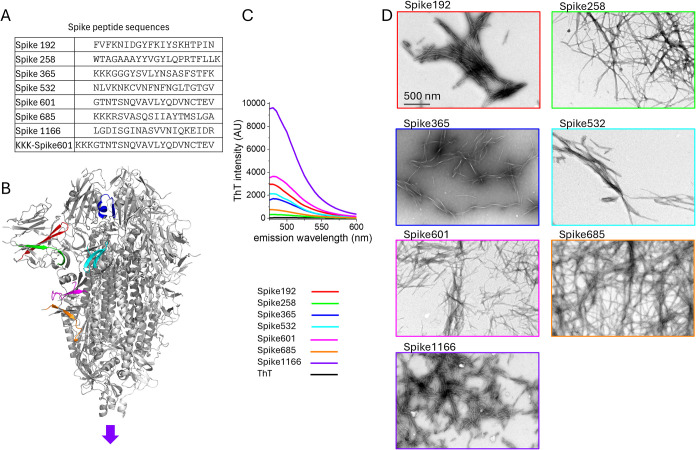
Amyloids of peptides derived from SARS-CoV-2 Spike protein (Wuhan strain) were generated as previously described. In short, amyloidogenic amino acid stretches were detected using the online available WALTZ algorithm. The peptides were custom synthesized by Genscript, NL, and delivered as a lyophilized powder. The powder was resuspended in 100% hexafluoro-isopropanol (HFIP) to a final concentration of 10 mg/mL. 1 mg/mL samples in PBS with 10% residual HFIP and 0.5 mg/mL samples with 5% HFIP were subjected to 37 °C and shaking in glass vials for 24 h to generate amyloid fibrils. Spike peptide sequences can be found in Figure.
![Amyloidogenic sequences in SARS-CoV-2 Spike and the corresponding
peptides (A, B) that were selected by WALTZ prediction.Their amyloid properties were tested by ThT
intensity measurements (C) and TEM analysis (D). Fibrils were formed
at 0.5 mg/mL of Spike peptide within 24 h. Additional verification
methods for amyloid are found in. The structure model in (B) displays the location of the amyloidogenic
segments within one protomer of the prefusion state of the Spike protein
trimer determined by Cryo-EM (PBD:). [28] [31] SFigure 1 6VXX](https://europepmc.org/articles/PMC12713721/bin/bi5c00550_0001.jpg "Click to view full size")
Amyloidogenic sequences in SARS-CoV-2 Spike and the corresponding peptides (A, B) that were selected by WALTZ prediction.Their amyloid properties were tested by ThT intensity measurements (C) and TEM analysis (D). Fibrils were formed at 0.5 mg/mL of Spike peptide within 24 h. Additional verification methods for amyloid are found in. The structure model in (B) displays the location of the amyloidogenic segments within one protomer of the prefusion state of the Spike protein trimer determined by Cryo-EM (PBD:). [28] [31] SFigure 1 6VXX
ThT Spectra
Fibrils formed in glass vials were used for fibrinogen experiments. To ensure fibril content, 10 μL aliquots, in triplicate, were added to 90 μL of ThT in PBS to reach a final concentration of 0.1 mg/mL Spike peptide and 2 μM ThT in a 96-well black, untreated half-area plates with flat transparent bottom (Corning costar 3880). Wells with ThT buffer supplemented with 10 μL of fibrillation buffer (PBS + HFIP) was used as reference. ThT intensity was measured bottom up using a Tecan Infinite M1000 Pro plate reader, excitation wavelength 440 nm, and emission scan every 5 nm between 470 and 600 nm.
Congo Red Microscopy
Aliquots from the unstained fibrillation reactions were prepared for the evaluation of Congo red birefringence as follows: 10 μL of 0.5 mg/mL Spike-peptide fibrils was added to 90 μL of Congo red staining solution (10 μM Congo red in 25 mM Tris–HCl, pH 7.5) resulting in a molar ratio of Spike peptide:dye, 2.5:1. Stained fibrils were left to self-sediment overnight at 20 °C and were briefly centrifuged at 2000 rpm in a benchtop centrifuge. Three microliters from the bottom of the pelleted samples were transferred to superfrost gold glass slides (Thermo Fisher, Walldorf, Germany) and were allowed to dry. The dried droplets were covered with a fluorescence mounting medium (Dako, Glosrup, Denmark). Congo red-stained samples were analyzed by using a Nikon bright-field microscope equipped with polarizers for both incoming light and in front of the detector.
ThT Kinetics
ThT measurement of amyloid formation over time (ThT kinetics) was performed as previously describedbut at a peptide concentration of 0.5 mg/mL. In short, HFIP solubilized peptide was added to ice cold phosphate buffered saline (PBS) pH 7.4, supplemented with ThT to reach a final concentration of 0.5 mg/mL peptide, 2 μM ThT and 5% HFIP. Reference samples without peptide were run in parallel. The samples were distributed in 96-well black, untreated half-area plates with a flat transparent bottom (Corning costar 3880) placed on ice. The sealed plate was placed at 37 °C in a Tecan Infinite M1000 Pro plate reader with linear shaking between measurements with an amplitude of 2 mm and a frequency of 654 rpm. ThT intensity was monitored by bottom read mode with excitation at 440 nm and emission at 500 nm every 5 min for 24 h. 15
TEM of Spike Amyloid Fibrils
TEM grids from each of the Spike amyloid fibril samples were prepared from the fibrillation reactions as follows: 5 μL of samples were placed on 400 mesh carbon-coated copper grids (Carbon-B, Ted Pella Inc.) and incubated for 2 min. Excessive salt was rinsed by one wash with 5 μL Milli-Q water. The grids were negatively stained with 2% uranyl acetate for 30 s before being blotted dry and air-dried overnight. Transmission electron microscopy (TEM) imaging was performed using a Jeol JEM1400 Flash TEM microscope operating at 80 kV.
Turbidity Monitoring of Fibrin Formation and Fibrinolysis
A turbidity based fibrin formation–fibrinolysis experiment was performed inspired by Terasawa, Okumura and colleagues. 29
Frozen fibrinogen stock solution (−20 °C) of 25 mg/mL in dH2O (human, Merck, 341578) was thawed at 37 °C in a heating block. A Mastermix of 0.625 mg/mL fibrinogen and clot buffer (20 mM 2-[4-(2-hydroxyethyl)piperazin-1-yl]ethane-1-sulfonic acid (HEPES) pH 7.4, 0.12 M NaCl, 1 mM CaCl2) was prepared and kept at 37 °C. Thrombin working-solution (WS) 1 U/ml in clot buffer was prepared using a refrigerated thrombin stock solution of 500 U/ml (bovine, Merck, 605157-1KU) and kept cold. A lysis mixture of 1 μM plasminogen and 2.4 nM tPA in clot buffer was prepared using a stock solution of 50 μM plasminogen (human, Roche, 10874477001) and 1,2 nM tPA (Human, Merck, T0831-100 μg) and was kept on ice during fibrin clot formation.
Each turbidity experiment was performed in six replicates. Because of the short deadtime of the experimental setup, each plate run contained two Spike-seeded experiments (e.g., Spike192 and Spike258 amyloid fibrils). To adjust for batch variations, a baseline control consisting of unseeded samples, meaning all components except the Spike peptide amyloid, was included on each plate and used as a reference for experiments on that plate.
Thrombin-induced fibrin clot formation was performed in a Corning Costar 3881 plate (nonbinding, half-area well with total maximum well volume of 190 μL). First, 60 μL of Mastermix (0.625 mg/mL fibrinogen) was applied to each assigned well in a prewarmed microplate (37 °C). 1.5 μL portion of Spike amyloid fibrils (1 mg/mL) was added and mixed in the corresponding wells of the two Spike variants. The plate was then inserted into a Fluostar Galaxy microplate reader (BMG Labtech) and the experimental run was started, first measuring baseline turbidity at 355 nm. After 4 cycles of 45 s (3 min), the measurement was paused, and the plate was taken out.
To each well containing Mastermix, 15 μL of thrombin WS (1 U/ml) was applied and mixed in with a pipet, discarding the pipet tip for every well. The final clot concentrations of fibrinogen and thrombin were 0.5 mg/mL and 0.2 U/ml, respectively. After the addition of thrombin WS, the plate was reinserted to the plate reader, and turbidity measurement at 355 nm resumed for 60 min at 37 °C. After the formation of fibrin clots, 75 μL of lysis mixture consisting of 1 μM plasminogen and 2.4 nM tPA was applied in each well by carefully dispensing the lysis solution against the top of plate walls. The final concentrations of plasminogen and tPA were 0.5 μM and 1.2 nM, respectively, and the final Spike amyloid fibril concentrations were 10 μg/mL. Turbidity at 355 nm was then measured at 37 °C for 2.5 h (150 min) in a final well volume of 150 μL.
Dose-Dependent Fibrin Formation and Fibrinolysis
A dose-dependent experiment was performed for the most interesting Spike amyloid fibrils: Spike601 and Spike685. Here, increasing concentrations of Spike amyloid fibrils were added to reach final concentrations of 1.4, 2.8, 5.6, 10, and 20 μg/mL of Spike amyloid fibril per experiment. Each fibril concentration was run in 4 replicates, also including the 4 replicates of unseeded control.
First, 60 μL of Mastermix (0.625 mg/mL fibrinogen), thrombin WS (1 U/ml thrombin), and lysis mix (1 μM plasminogen, 2.4 nM tPA) were prepared as previously described for the turbidity assay using the Fluostar Galaxy microplate reader (BMG Labtech). 0.1 mg/mL Spike fibril solution was prepared by mixing 10 μL of 1 mg/mL Spike amyloid fibrils to 90 μL of PBS, and vortexed. Starting with the lowest concentration of 1.4 μg/mL, 2.1 μL of 0.1 mg/mL Spike fibrils was added and mixed to each corresponding well. Similarly, for Spike fibril concentrations 2.8 and 5.6 μg/mL, 4.2 and 8.4 μL of 0.1 mg/mL Spike amyloid fibril solution were applied to assigned wells. Finally, for Spike amyloid fibril concentrations 10 and 20 μg/mL, 1.5 and 3 μL of 1 mg/mL Spike amyloid fibril solution was mixed into the corresponding wells. After measuring baseline turbidity, fibrin clotting was initiated as previously described by adding 15 μL of thrombin WS to each well. The final concentrations of fibrinogen and thrombin were 0.5 mg/mL and 0.2 U/ml, respectively. Turbidity measurement of clot formation was then run for 60 min. After the completion of fibrin clot formation, fibrinolysis was started by applying 75 μL of lysis mix to all wells, and the decrease in turbidity was observed for 150 min. The final concentrations of lysis mix were 0.5 μM plasminogen and 2.4 nm tPA.
Fibrin Clot Formation for Fluorescence Microscopy
A precipitation assay was performed to elucidate the propensity for coprecipitation of fibrinogen and fibrin with Spike601 and 685, respectively. Spike365 that had a limited influence on the fibrin formation and lysis process, while still carrying the triple-lysine tag enabling NHS coupling of the Cy5 fluorophore, was included as a negative control. Cy5 labeling of preformed Spike amyloid fibrils of Spike365, KKK-Spike601, and Spike685 (made as described above) was performed by first dissolving 1.5 mg of Cyanine5 NHS ester (Cy5) (Lumiprobe, Westminster, MD, USA) in 100 μL of DMSO. This stock was further diluted 10-fold and 10 μL was added to 500 μL of Spike fibrils 0.5 mg/mL dissolved in PBS buffer pH 7.5 with 5% HFIP. This resulted in a final concentration of 45 μM Cy5 and 227 μM Spike peptide. Staining was allowed to proceed for 1 h, whereafter the reaction was quenched with 10 μL of 0.1 M Tris–HCl pH 8. The samples were diluted with 1000 μL of PBS and were concentrated and diluted in two additional rounds of buffer change to PBS buffer in Amicon Ultra Centrifugal Filters, 10 kDa MWCO (Millipore). Cy5-labeled KKK-Spike amyloid fibrils were stable for about 1 week at room temperature.
Fluorescein-labeled fibrinogen was generated by dissolving Fluorescein-5-Isothiocyanate (FITC) (F1906, Invitrogen) in DMSO and mixing with 1 mL of 0.625 mg/mL fibrinogen in clot buffer (20 mM 2-[4-(2-hydroxyethyl)piperazin-1-yl]ethane-1-sulfonic acid (HEPES) pH 7.4, 0.12 M NaCl, 1 mM CaCl2) kept at 37 °C. This resulted in a final concentration of 1 μM FITC and 1.8 μM fibrinogen for the labeling reaction. Labeling was allowed to proceed for 1 h. One part FITC-labeled fibrinogen was mixed with 10-fold excess unlabeled fibrinogen for use in the fibrin and fibrinolysis experiments as described in that section in the presence of Cy5-labeled Spike amyloid fibrils.
For the fluorescence microscopy experiments, 60 μL per well of freshly FITC-labeled fibrinogen diluted with unlabeled fibrinogen (total 0.625 mg/mL) was mixed with 3 μL of the three different Cy5-labeled Spike amyloid fibrils and were subjected to thrombin cleavage and lysis by plasminogen/tPA in a plate reader at 37 °C as described in fibrinogen–fibrin–fibrinolysis experiments. Samples that were not thrombinated were kept in parallel in the plate reader to establish the affinity between fibrinogen and Spike amyloid fibrils. Samples before the addition of thrombin and after thrombin cleavage and plasmin lysis were collected and sedimented by centrifugation for 10 min, 20,000g at 10 °C. The pelleted material was subjected to hyperspectral imaging with an epifluorescence microscope (Leica 6000B equipped with a spectral cube, ASI, Migdal Ha Emek, Israel) and with fluorescence confocal microscopy (Zeiss 780 LSM-system). For hyperspectral analysis, samples collected at different steps of the fibrin formation–fibrinolysis process were collected and placed on microscope slides. Three images were collected from different parts of each slide, and 27 regions of interest (ROIs) were analyzed for each sample. Images for qualitative depiction of the in vitro formed fibrin clots were collected using confocal microscopy.
Results
We first revisited our protocol for the formation of amyloid fibrils from synthetic peptides of the SARS-CoV-2 Spike protein (original Wuhan sequence) (Figure). At a peptide concentration of 0.5 and 1 mg/mL, all seven peptides formed amyloid fibrils as deduced by ThT fluorescence intensity and negative-stain transmission electron microscopy (TEM) (Figure) as well as Thioflavin T (ThT) kinetics assay and Congo red binding and birefringence (Figure S1↗).
Fibrin Formation and Fibrinolysis
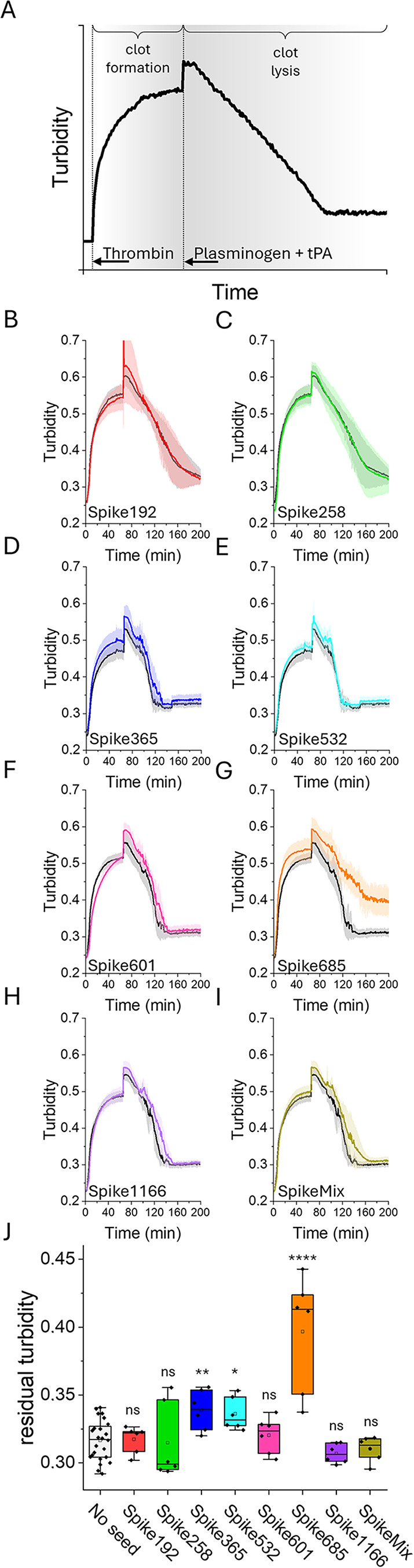
A procedure for thrombin-induced fibrin clot formation and plasminogen/tPA fibrinolysis was established. Addition of thrombin to fibrinogen in a well of a 96-well plate instantly induced fibrin formation, leading to the formation of light scattering fibrin fibers (FigureA). At 60 min, the content of the well had formed a polymerized gel or clot. The formed clot was thereafter covered with a solution of plasminogen and catalytic amounts of tissue plasmin activator (tPA), generating plasmin and the clot was slowly dissolved. The breakdown of the fibrin clot was monitored as a loss of light scattering until the baseline was reached (FigureA).
Based on the experimental limitation of the fast initial rate of clot formation (first 5–10 min), the assay was performed using replicates of two Spike peptide amyloids where 10 μg/mL of Spike amyloid fibrils was added to each well, containing 625 μg/mL fibrinogen. One control sample, containing no addition of amyloid was run side by side in each plate (Figure B–E). Clot formation was monitored for 60 min. We found that Spike601 amyloid fibrils were the only Spike amyloid with a tendency to delay fibrin clot formation. Addition of Spike685 amyloid and to some extent Spike365 fibrils resulted in higher turbidity at the plateau (FigureD,G). Spike192, Spike258, and Spike1166 demonstrated no effect on the fibrinogenesis and lysis processes and can hence serve as negative controls for general amyloids in the experiment. Clot lysis was then initiated by the addition of plasminogen and tPA. Spike685 amyloid fibril addition resulted in extensive residual turbidity at the experimental end point (FigureG). Spike mix amyloids formed when coaggregating the seven Spike peptides (at 1/7 concentration of each peptide), also rendered a slight delay of fibrin clot lysis (FigureE) concomitant with our previous results, but no residual turbidity at end point 200 min was detected. A quantitative comparison of lysis efficacy between all Spike-seeded reactions relative to a pool of all control experiments showed that the presence of Spike685 amyloid fibrils during fibrin formation significantly impaired lysis of the formed clot (FigureJ). This was also observed to some extent for Spike365 and Spike532 amyloid fibrils (FigureJ), but not for Spike192 amyloid fibrils at this concentration of seed.
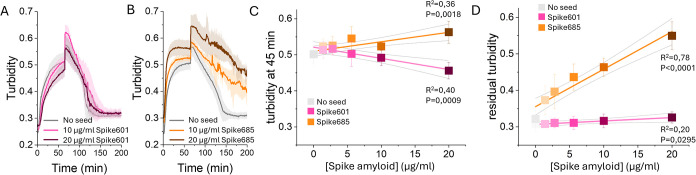
The diverging behavior of Spike601 and Spike685 amyloid fibrils on the fibrinogen–fibrin–fibrinolysis process urged us to perform concentration-dependent experiments with these seeds. A titration of Spike601 and Spike685 amyloid fibrils in the turbidity assay was hence performed. Delayed fibrin formation in the presence of Spike601 amyloid fibrils and, orthogonally, an increase in turbidity upon the addition of Spike685 amyloid fibrils was detected (FigureA–C). For the fibrinolysis reaction, addition of Spike685 amyloid fibrils resulted in a highly significant concentration dependence on residual turbidity, showing that fibrinolysis became increasingly incomplete as the concentration of the Spike685 amyloid fibrils was increased (Figure B,D). For Spike601 amyloid fibrils, on the other hand, only a miniscule increase in residual turbidity was observed with a higher concentration of amyloid (FigureA,D) showing that this is a specific effect for Spike685 amyloid fibrils.
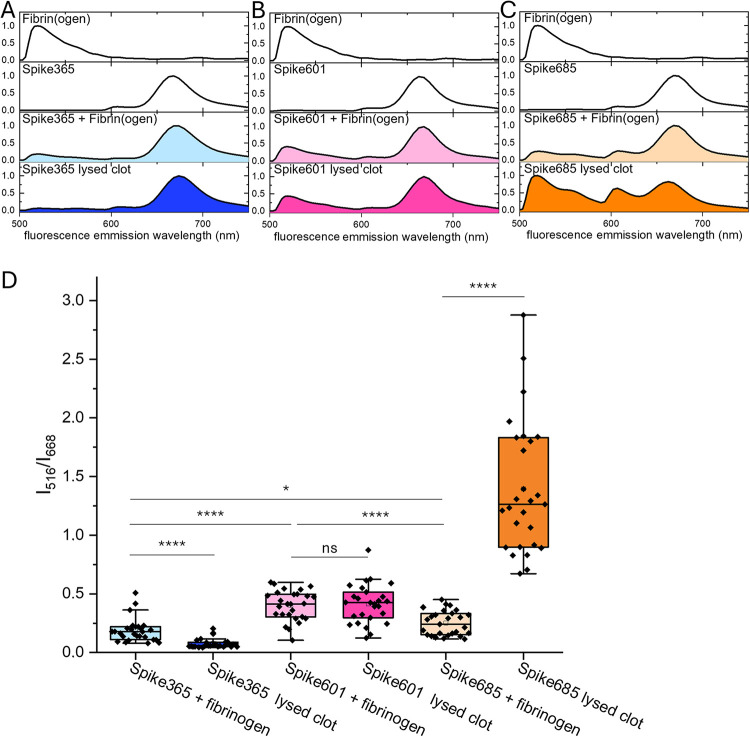
Spike365 and Spike685 amyloid fibrils were initially produced with a triple-lysine (KKK) solubility tag (FigureA). This feature was exploited by using the tag as an amine rich tag for covalent NHS coupling of the fluorescent marker Cy5 on preformed fibrils. Subsequently, we also made Spike601 peptide with a KKK-tag and labeled fibrils with Cy5. In combination with fluorescein-labeled fibrinogen, we could quantify the coprecipitation of these three Spike amyloid fibrils and fibrinogen before thrombin cleavage and the residual fibrin in the presence of the respective Spike amyloid fibrils after plasmin lysis of thrombin-induced clots by spectroscopy using hyperspectral microscopy. Spike365 amyloid was included as a negative control since it had a limited effect on the fibrin formation and lysis process (FigureD,J) while having the KKK-tag enabling its use in the fluorescence based assay. The Spike365 fibrils did not pull down fibrinogen or hamper fibrinolysis (FigureA). Fibrinogen coprecipitated with Spike601 amyloid fibrils to a significantly higher degree than it did with either of Spike365 and Spike685 amyloid fibrils and the colocalization of fluorescence intensities were retained also after lysis (FigureB,D). Coprecipitation of fibrinogen with Spike685 amyloid fibrils was similar to that of Spike365 amyloid fibrils (FigureA,C,D). Most strikingly, the presence of Spike685 amyloid fibrils during fibrin clot formation resulted in a fibrinolysis product where residual fibrin and Spike amyloid colocalized at the resolution of this technique, which was 5 μm × 5 μm (Figure C,D).
Qualitative analysis of the experiments where fibrinogen was coprecipitated with Spike601 and Spike685 amyloid fibrils, respectively, using confocal microscopy, demonstrates that fibrinogen coprecipitates with Spike601 amyloid fibrils (FigureA) but was barely visible when coprecipitated with Spike685 amyloid fibrils (FigureB). The material on these slides was homogeneous and evenly spread. On the other hand, when reactions were subjected to thrombin to induce fibrin clots and centrifuged, Spike685 amyloid fibrils were encapsulated within fibrin droplets that were larger but fewer than for Spike601 and unevenly distributed over the slide while Spike601 amyloid fibrils were distributed more evenly within a fibrin mesh (FigureC–D).
TEM analysis was performed to further investigate fibrinogen binding and fibrinolysis products in the presence of Spike601 and Spike685 amyloid fibrils. Fibrinogen and Spike amyloids were coincubated and sedimented by centrifugation. TEM analysis revealed that Spike601 amyloid fibrils in the presence of fibrinogen had a thin coating (FigureBi) and also spheres of a size in accordance with the size of fibrinogen nodules (5–7 nm) (FigureBii) attached to the fibrils. Co-incubation of fibrinogen and Spike685 amyloid fibrils on the other hand did not result in such a coating. Spheres on Spike685 amyloid fibrils were scarcely found and on the contrary the apparent repulsion of the putative fibrinogen spheres from the perimeters of Spike685 amyloid fibrils was conspicuous (FigureBiii,iv). Furthermore, in vitro formed and lysed clots were subjected to precipitation by centrifugation. In the absence of Spike amyloid fibrils, again, spheres corresponding to the size of fibrin(ogen) nodules were visible (FigureCi,Di). If clots were formed in the presence of Spike601, thin layers of amorphous material were deposited on the TEM grid (FigureDii), and in it, slender amorphous aggregates were occasionally found (FigureCii,iii,Dii). When clots were formed in the presence of Spike685 amyloid fibrils, the pelleted material contained a large amount of dense granular structures with fibrous cores, sizing between ∼50 and ∼500 nm (FigureCiv,v) and were evenly distributed over the TEM grid (FigureDiii). Spike amyloid fibrils were also found side by side with the granular structures (Figure S2↗).

(A) Turbidity curve of thrombin-induced fibrin polymerization. Clot formation was performed at a concentration of 0.5 mg/mL fibrinogen and 0.2 U/mL thrombin, a final volume of 75 μL. When the reaction reached its plateau, fibrinolysis was induced by addition of 75 μL 1.0 μM plasminogen and 2.4 nM tPA. Reactions were performed at 37 °C, and turbidity was measured as OD at 355 nm. (B–I) Clot formation and lysis were monitored in the absence and presence of Spike amyloid fibrils (final concentration 10 μg/mL) with one unseeded and two seeded experiments in each plate. Each experiment was run in 6 replicates. The graphs show the average of each spike amyloid fibril seeded experiment in color with its corresponding control, from the same plate, in gray. The shaded area depicts standard deviation. (J) Residual turbidity at 200 min for all control experiments (no seed) (= 24) and each spike-seeded sample (= 6). Two-sampletest was performed using no seed as reference: ns = non-significant; *> 0.05; **> 0.005; ****> 0.0001. n n t p p p

(A, B) Concentration-dependent impact of Spike601 and Spike685 amyloid fibrils respectively present during fibrin formation, exemplified by samples run with 0, 10, and 20 μg/mL Spike amyloid addition. (C) Quantitative analysis of clot formation time at 45 min. (D) Quantitative analysis of clot lysis measured as residual turbidity at 200 min. Average of four replicates with standard deviation. Colored lines in (C, D) represent the linear regression fits to test trend significance (values < 0.05) with associated. The gray lines show 95% confidence intervals for the fit. p R 2

Fluorescence hyperspectral microscopy was performed for spectroscopic analysis of coprecipitation of fibrin(ogen) and Spike amyloid fibrils. Fibrinogen was covalently labeled with fluorescein and Spike amyloids were covalently labeled with Cy5. (A–C) The fluorescence spectrum from a 25 μmregion of interest (ROI) with a median spectral signature for each sample type. The top two panels depict the fluorescence spectra for each individual component. Fibrinogen and Spike amyloid fibrils were mixed, incubated for 200 min and were pelleted by centrifugation at 20,000(panel 3). A separate mix of Fibrinogen and Spike amyloid fibrils were subjected to thrombin cleavage and plasmin degradation and pelleted as above (panel 4). (D) quantitative analysis of 27 ROIs collected from 3 different objects on the microscope slide. The ratio between fluorescence intensity at 516 and 668 nm describes the degree of coprecipitation of fluorescein-labeled fibrin(ogen) and Cy5-labeled Spike amyloid fibrils, respectively. Box indicates the 25%–75% interval, whisker indicates the mean ± 1.5 SD, central line indicates the median, and central open box indicates the mean. Two-sampletest was performed: ns= not significant; *> 0.05; ****> 0.0001. 2 g t p p

Representative confocal microscopy images for qualitative analysis of colocalization of fluorescein-labeled fibrin(ogen) and Cy5-labeled Spike amyloids. Top panels (A, B) illustrate samples where fibrinogen has been coincubated with Spike amyloid prior to plasmin degradation. Lower panels (C, D) are the images selected to illustrate the degree of colocalization between Spike amyloid fibrils and thrombin-induced fibrin and representative differences in size of the resulting fibrin–amyloid clusters.

Representative negative-stain TEM images showing (A) Spike601 and Spike685 amyloid fibrils (B) Spike amyloid fibrils incubated with fibrinogen. Colored lines indicate the average diameter of the nodule parts of a fibrinogen molecule, arrows indicate suggested fibrinogen associated with amyloid fibril, encircled are the areas depleted of suggested fibrinogen. (C, D) Fibrin clots after lysis by plasminogen, in the absence or presence of Spike amyloid fibrils. Spike amyloid fibrils visible side by side with fibrin clots are exemplified in. SFigure 2
Discussion
COVID-19 is to a large extent a disease of the vasculature system and is associated with coagulation abnormalities in a large proportion of patients.Insufficient fibrinolysis has been acknowledged as a prominent factor behind this phenomenonand neutrophils have been pinpointed as a driving force of pathogenesis.Events of thromboembolism have also been recorded as an adverse event of COVID vaccination from several of the major vaccines on the market with the common factor being the expression of SARS-CoV-2 Spike protein.Development regarding diagnostic markers of long COVID is also an area where research is focused.A large number of potential biomarker candidates have been identified, but as of now, no specific tests for molecular diagnosis of long COVID exists.Furthermore, there are difficulties in distinguishing these potential biomarkers from other conditions. Microclots, suggested as a probable cause of neurological symptoms, have also been seen as a potential therapeutic target in long COVID.Fibrin degradation products such as D-dimer have been elevated in 25% of recovered COVID patients up to 4 months post infection. 33 34 35 5 38 40 , 36 37 , 5 39
In this work, we focused on our previous findings of amylogenesis of fragmented Spike protein and its influence on fibrinolysis.To this end, we specifically studied if certain amyloid fibrils from different Spike sequences affected the fibrinogen–fibrin–fibrinolysis pathway. 15
The common components of SARS-CoV-2 infection and most regimens of COVID vaccination are the expression of Spike protein and the recruitment of neutrophils to the site of infection or injection. Brogna and colleagues used mass spectrometry utilizing the vaccine specific Proline mutation as benchmark and could establish expression of vaccine-mediated Spike protein in 50% of tested samples and for up to 187 days post vaccination. mRNA is detectable in blood up to 28 days after vaccination and in the axillary lymph nodes and in myocardium up to 30 days in patients who died from heart failure in close temporal proximity to receiving mRNA vaccination against COVID. A recent study used in situ hybridization to detect persistent vaccine-mediated as well as SARS-CoV-2 virus-induced Spike protein expressions in the intima of cerebral arteries in over 40% of vaccinated patients who suffered hemorrhagic strokes. Expression of Spike protein could persist up to 17 months after the latest vaccination, as shown by immunohistochemistry. According to the same study, Spike protein positive histology was also found in unvaccinated cases and even without previous medical records of SARS-CoV-2 infection, indicative of mild or asymptomatic infection. The concert of these studies is that Spike protein can be persistently expressed in several cell types and organs, including cerebral arteries, for an extended period after SARS-CoV-2 infection and mRNA vaccination generating Spike protein.
Amyloids in a more general context are known to interact with and impair the coagulation and fibrinolysis cascades.SARS-CoV-2 Spike protein comprises several amyloidogenic sequences, and we have demonstrated that SARS-CoV-2 Spike protein, when cleaved by neutrophil elastase forms amyloid, and this is dictated by at least 7 amyloidogenic segments within the large Spike protein.In addition, the Pretorius and Kell groups have demonstrated that addition of Spike protein to platelet poor plasma renders formation of microclots with amyloidogenic properties such as ThT positivity and fibrillar structure. 45 15 , 22 46
Efforts have been made to estimate the concentration of the soluble Spike protein in plasma after SARS-CoV-2 infection or COVID vaccination. Such studies with antibody-based techniques target the receptor binding domain (RBD) of the Spike protein as a proxy for the full-length protein and arrive at an approximation in the order of 10–100 pg/mL as average concentration in human plasma (see refs. , for examples). The RBD of SARS-CoV-2 (residues ∼320–540) represents a rather soluble portion of the protein and as such will have a fast turnaround time if the protein is degraded. Using other soluble sequences of the SARS-CoV-2 protein in a mass spectrometry approach, Seco-Gonzalez and colleagues arrived at Spike concentrations ranging 1–10 μg/mL, up to 14 μg/mL in the pelleted blood fraction in one individual, i.e., many magnitudes higher than antibody-based techniques. Large differences in the determination of absolute protein concentrations in blood are common between different techniques (e.g., refs. and ). To the best of our knowledge, there are no quantitative studies looking at insoluble portions of the Spike protein, such as the ones proposed in our study, in plasma. Additionally, our study uses a fibrinogen level approximately 1 order of magnitude lower than the average concentration in human plasma to keep the time and turbidity window for observing turbidity changes in vitro manageable.
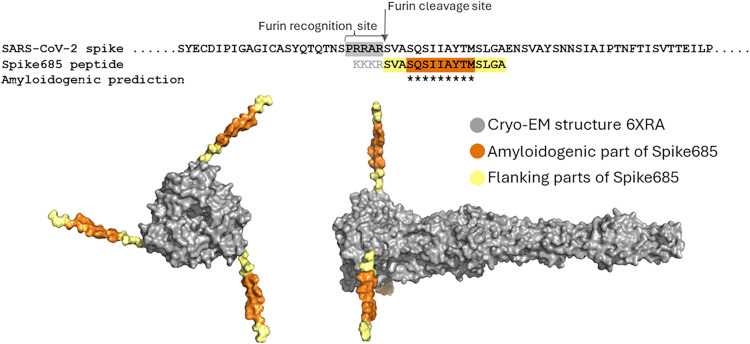
Blood is a very complex fluid tissue, and the blood coagulation and fibrinolysis cascades contain a myriad of components that interact to keep this tissue regulated. With this background, using pure in vitro systems, we scrutinized herein a rather complex molecular mechanism of how Spike-derived amyloid fibrils could influence microclot formation. An in vitro experiment employing pure components from a complex system within a time frame of hours cannot perfectly reflect the in vivo situation with all its unknowns. In pilot optimization studies, we arrived at concentrations of Spike amyloid fibrils, fibrinogen, thrombin, and plasmin (tPA and plasminogen) that give a good experimental resolution to test our hypothesis. Despite the limitations of the experimental setup with synthetic fibrils, our data do suggest that some, but not all, Spike-derived amyloid fibrils impacted fibrin folding and assembly and thereby cause impaired plasmin-mediated fibrinolysis. All the Spike amyloids were generated under the same conditions and were assayed with the same buffer background regarding both PBS and residual HFIP (approximately 0.1% final concentration). Under the conditions used here (lower concentrations than in previous work), five out of seven Spike amyloid fibrils did not substantially affect fibrinogen–fibrin–fibrinolysis, and consequently, neither did the buffer or other background conditions, whereas two affected the process in different ways. This finding strongly suggests specificity rather than a generic amyloid impact on the fibrinogen–fibrin system. It is also worth noting that our amyloid fibril sequences studied here differ from those shown previously within folded trimeric spike, and linear peptides thereof, to bind with fibrinogen. A closer analysis of the turbidity curves in the presence of Spike601 and Spike685 amyloid fibrils revealed that Spike601 amyloid fibrils delayed the formation of a fibrin clot but did not impair the fibrinolysis. Spike685 amyloid fibrils (and to some extent Spike365 amyloid fibrils), on the other hand, enhanced the rate of fibrin clot formation and prevented the full removal of the formed fibrin clot by plasmin degradation. A titration of these amyloids revealed a decrease in fibrin formation rate as Spike601 amyloid fibrils concentration increases, while a significant decrease in fibrinolysis was evident with addition of more Spike685 amyloid fibrils. Spike601 amyloid fibrils attracted fibrinogen, potentially blocking thrombin accessibility. Spike685 amyloid fibrils, on the other hand, had lower affinity for fibrinogen but stabilized fibrin formation and facilitated fibrin misfolding. Hence, fibrin formed in the presence of coaggregating Spike685 amyloid fibrils resulted in hampered plasmin-mediated fibrinolysis. It is notable that the amyloidogenic sequence encoding Spike685 is located directly after the furin cleavage site (at position 686) between the S1 and S2 regions of the prefusion state of the Spike protein. The first amino acids (residues 686–702) of S2 are not resolved in the Cryo-EM structure of the postfusion state of the Spike protein. This indicates that this part of the protein, which is analogous to the Spike685 peptide, is highly flexible rather than being aligned to the body of the globular protein and, hence, appears to be accessible to the surrounding environment. While this cleavage is not fully sufficient to dissociate S1 and S2, this occurs after processing at S2́ (position 816), it proposes a vulnerable dynamic nicked Spike protein state (Figure). The 2P (K986P and V987P) mutations have been inserted into the vaccines to stabilize the prefusion conformation. However, it has been hypothesized that the same furin processing with shedding of S1 may occur after vaccination with the original Pfizer–BioNTech and Moderna mRNA constructs that contained the furin cleavage site. Such a vulnerable aggregation protein state, as illustrated in Figure, if presented on the cell surface would facilitate intermolecular interactions with neighboring cleaved Spike proteins and Spike protein fragments from neutrophil elastase cleavage, facilitating misfolding, aggregation, and recruitment of extracellular fibrin(ogen) proximal to cells expressing the Spike protein. This process may be an initiation seed for a persistent amyloidogenic microclot thrombus. While hypothetical, such a localized seeding process where fibrils can accumulate on a cell surface may represent the high spike fibril concentrations used in our biochemical experiments. The high affinity between fibrinogen and SARS-CoV-2 Spike is also a possible contributing mechanism for high local concentration of Spike in vivo. It is important to note that many mutations have occurred in the viral SARS-CoV-2 Spike protein since the original Wuhan strain, which we studied herein, several of which are in and around the furin cleavage site and in other positions mainly in the RBD. This may have implications for the risk of microclot formation from SARS-CoV-2 infection. So far, the main attributed cases of long COVID have been reported from the initial strains of the virus and possibly from some original vaccine constructs. Emerging innovative screening technologies enabling high throughput studies of putative patients with microclots was recently proposed such as nailfold capillaroscopy, which would be imperative for making clinical trials of therapeutic interventions.
![Hypothetical model of a vulnerable aggregation
prone state of SARS-CoV-2
Spike protein. Sequence of the S1/S2 boundary with the highlighted
furin cleavage site, compared with the Spike685 peptide (top). Cryo-EM
structure of the postfusion state of S2 (PDB:),in top view and side view. The protein segment for Spike685
is not resolved in the cryo-EM structure, indicating high flexibility.
The residues were added as an extended strand using PyMOL and is highlighted
in yellow and orange. 6XRA [52]](https://europepmc.org/articles/PMC12713721/bin/bi5c00550_0007.jpg "Click to view full size")
Hypothetical model of a vulnerable aggregation prone state of SARS-CoV-2 Spike protein. Sequence of the S1/S2 boundary with the highlighted furin cleavage site, compared with the Spike685 peptide (top). Cryo-EM structure of the postfusion state of S2 (PDB:),in top view and side view. The protein segment for Spike685 is not resolved in the cryo-EM structure, indicating high flexibility. The residues were added as an extended strand using PyMOL and is highlighted in yellow and orange. 6XRA [52]
Conclusions
In conclusion, our findings demonstrate how the amyloidogenic properties of SARS-CoV-2 Spike protein can have bearing on several of manifestations found in the complex multitude of symptoms of severe and long COVID, as well as adverse side effects of Spike protein expression vaccination strategies. This study should foster further exploration of Spike protein targets such as the Spike685 sequence containing Spike protein aggregates when mining for biomarkers of long COVID. The knowledge should also be considered for the future development of vaccines to avoid exposure to amyloidogenic segments which may negatively influence human health.
 Long Covid