
What this is
- This research investigates the relationship between sex hormones and the risk of () in women.
- Using , the study examines genetic predispositions to serum levels of sex hormones.
- Findings suggest that elevated sex hormone-binding globulin (SHBG) levels may increase risk, while higher bioavailable testosterone (BioT) levels may decrease it.
Essence
- Genetic predisposition to higher SHBG levels is associated with increased risk among women, while higher BioT levels suggest a decreased risk. The study indicates a complex interplay of sex hormones in risk.
Key takeaways
- An 18% increased risk is associated with each 1-SD increase in genetically determined SHBG levels among women, indicating a potential causal role of SHBG in risk.
- A suggestive 27% decrease in risk is linked to each 1-SD increase in BioT, although this association diminished when accounting for SHBG effects.
- No significant associations were found between age at menarche, age at menopause, or estradiol levels and risk, suggesting limited influence of these factors.
Caveats
- The study faced limitations due to the unavailability of all relevant exposure SNPs in the outcome GWAS, potentially affecting statistical power.
- The genetic correlation between SHBG and BioT complicated the estimation of their direct effects on risk, leading to lower power in multivariable analyses.
- Only a single SNP was used for estradiol, which may limit the robustness of findings related to its effects on risk.
Definitions
- Mendelian randomization: A method using genetic variants as instrumental variables to assess causal relationships between exposures and outcomes.
- Aneurysmal subarachnoid hemorrhage (aSAH): A type of stroke caused by bleeding into the space surrounding the brain, often due to the rupture of an aneurysm.
Simplified
Methods
Data Availability
We used summary data from published studies for our analyses, publicly available via the original studies (data sources in the Supplemental Material↗). All studies obtained relevant ethical approval and participant consent.
Exposure Data
We retrieved publicly available sex-specific genome-wide association study (GWAS) summary-level data of SNPs associated with the exposures (Table).9–11 We selected SNPs associated with the exposure at the genome-wide significance level (P<5×10⁻⁸). Independence of SNPs was assessed using stringent criteria (r2, 0.001; clumping window, 10 000 kb). If an instrumental SNP for the exposure was not available in the outcome data set, we replaced it with a suitable proxy SNP (r2>0.8 in the European 1000 Genomes Project reference panel using LDlink [https://ldlink.nci.nih.gov/↗]) or removed it in the absence of such a proxy. We harmonized the SNP alleles across studies and removed palindromic SNPs with ambiguous allele frequencies (0.42–0.58). Data of all instrumental variables used are shown in Table S1 through S6↗. For estradiol, we used a single SNP (rs727479) which has been reported in the literature and was found to be associated with serum estradiol levels in both men and postmenopausal women, although with different effect sizes (Table S7↗).12,13 The SNP is located in the CYP19A1 gene, which encodes aromatase, the enzyme responsible for converting testosterone to estradiol.
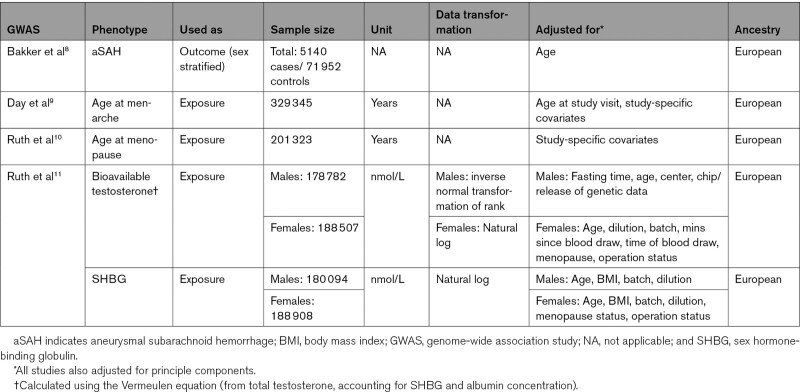
Outcome Data
We obtained sex-specific summary-level outcome data from a GWAS on aSAH, comprising 23 cohorts with a total of 5140 cases and 71 934 controls.8 All individuals were of European ancestry. As the calculated potential UK Biobank sample overlap between exposure and outcome GWASs was <4% at maximum, we considered the risk of bias due to sample overlap minimal.14
Statistical Analysis
We performed primary MR analysis among women using a random-effects inverse-variance weighted meta-analysis, if at least 2 SNPs for the exposure were available.15 This comprises a meta-analysis of SNP-specific Wald estimates (ie, SNP-outcome β divided by the SNP-exposure β). This method assumes that all variants are valid instruments.16 Consequently, we performed several statistical sensitivity analyses. We first tested for heterogeneity between variant-specific estimates using Cochran Q statistic in the inverse-variance weighted model. We then explored horizontal pleiotropy via the MR-Egger and MR-Pleiotropy Residual Sum and Outlier methods.17,18 A significant nonzero Egger intercept is suggestive of unbalanced, directional horizontal pleiotropy. It can thereby identify and correct for bias due to directional pleiotropic effects, assuming that the size of the pleiotropic effects is independent of the SNP-exposure effects (InSIDE-assumption). The MR-Egger estimate is however sensitive to outliers and influential data points, which may lead to low statistical power in estimating a causal effect. MR-Pleiotropy Residual Sum and Outlier calculates the effect estimate after identifying and excluding outlier SNPs (ie, potential pleiotropic variants) if present. We additionally performed a weighted median-based MR analysis, which assumes that at least half of the included variants are valid instrumental variables. We repeated the analyses after MR-Steiger filtering which removes SNPs suggestive of a reversed causal direction (ie, those explaining more variance in the outcome than in exposure), a violation of the exclusion restriction assumption.19 In addition, we conducted sensitivity MR analyses for all exposures using the male-specific exposure and outcome summary data. In this respect, AAM and age at natural menopause functioned as negative control outcomes. For estradiol with only one SNP available, we calculated the Wald estimate, as other MR methods require at least 2 SNPs.
A strong genetic correlation (rg=−0.74) was reported between SHBG and BioT among women.11 In additional analyses, the authors were able to identify 2 clusters: (1) a cluster of SNPs mainly affecting SHBG levels, with secondary directionally opposing effects on testosterone and (2) a cluster of SNPs affecting testosterone levels, independent of SHBG. To account for this genetic correlation and to explore the independent effects of each exposure, we used 2 different methods. First, we performed cluster-specific MR analyses. Second, we performed multivariable MR analyses. Here, the SNPs associated with BioT and SHBG are combined, and the direct causal effect on the risk of aSAH is estimated for each exposure while accounting for the other exposure.20 Also, since the SHBG SNPs were all identified after adjusting for body mass index in the exposure GWAS, we performed sensitivity analysis using the same SNPs with their body mass index unadjusted effects on SHBG.
We calculated all effect estimates as odds ratios (OR) with 95% CIs. For AAM and age at natural menopause, we calculated ORs for aSAH per 1-year increment. For all other exposures, we calculated ORs per 1-SD increase in exposure levels. We estimated 1-SD unit using the estimate_trait_sd() function in the TwoSampleMR package, which estimates the trait SD via obtaining the beta estimates from z-scores and finding the ratio with original β values. We set the P value for statistical significance at P<0.01, after correcting for multiple exposures using the Bonferroni method (α=0.05/5 exposures). We considered results with P values between 0.05 and 0.01 suggestive. We performed all MR analyses using the TwoSampleMR (version 0.5.6), Mendelian randomization (version 0.5.1), and MRPRESSO (version 1.0) packages for R.18,21,22
Results
The primary univariable MR analysis showed an 18% increased aSAH risk among women per 1-SD increase in genetically determined SHBG levels (OR, 1.18 [95% CI, 1.05–1.34]; P=0.007) as shown in the Figure. We also found suggestive evidence of a 27% decrease in aSAH risk among women per 1-SD increase in genetically determined BioT (OR, 0.73 [95% CI, 0.55–0.95]; P=0.02). However, when only using SNPs from the cluster of BioT-associated SNPs independent of SHBG, the latter association disappeared (17 SNPs; OR, 1.24 [95% CI, 0.81–1.91]; P=0.313), as shown in Table S8↗. The MR-estimate after cluster filtering using SNPs with primary SHBG effects and secondary (opposite) effects on testosterone remained significant (126 SNPs; OR, 1.21 [95% CI, 1.05–1.40]; P=0.008). Multivariable MR analyses, however, did not support a direct causal effect of either SHBG (OR, 1.17 [95% CI, 0.94–1.46]; P=0.169) or BioT (OR, 1.02 [95% CI, 0.61–1.69]; P=0.952) on aSAH risk among women (Table S9↗). However, the multivariable OR estimate for SHBG was almost identical to the univariable estimate, suggesting low power in the multivariable MR analysis. No associations were observed between genetically determined AAM, age at menopause or estradiol levels, and risk of aSAH (Figure and Table S10↗). MR estimates were similar between body mass index adjusted and unadjusted SHBG, suggesting no body mass index-related collider bias (Table S10↗).
Cochran Q statistic showed no evidence for heterogeneity. The MR-Pleiotropy Residual Sum and Outlier global test and MR-Egger intercepts showed no indication for directional pleiotropic effects. No associations were identified among men (Table S11↗). MR analyses based on the weighted median method yielded results in the same direction as in the inverse-variance weighted-method, but with lower precision. MR-Steiger filtering was performed for the exposures AAM, age at menopause, SHBG, and BioT to remove SNPs suggestive of reverse causation. Subsequent MR analyses excluding these variants showed comparable results to the main analyses (Table S12↗).
, Inverse-variance weighted estimates for the association between a genetically determined unit increase in exposure on the risk of aneurysmal subarachnoid hemorrhage (aSAH).and, Scatter plots of individual single-nucleotide polymorphism (SNP) effects and estimates from different Mendelian randomization (MR) methods for the effect of () sex hormone-binding globulin (SHBG) on aSAH and () bioavailable testosterone on aSAH.het is thevalue belonging to the Q statistic for heterogeneity.Egger is thevalue belonging to the Egger intercept. IVW indicates inverse-variance weighted; and OR, odds ratio. Effect estimates among women. A B C B C P P P P
Discussion
We showed that genetic predisposition to elevated levels of SHBG, with secondary lower levels of BioT, is associated with an increased risk of aSAH among women. Additionally, we found that genetically determined increased AAM or age at menopause is unlikely to have a substantial effect on aSAH risk. Moreover, associations were only found among women, suggesting a smaller role, if any, of sex hormone levels on aSAH risk among men.
Although SHBG has not been investigated before in the context of aSAH, observational studies implicate a role for SHBG in various vascular diseases. For example, serum SHBG levels are inversely associated with the risk of ischemic stroke in postmenopausal women, even after adjusting for potential mediators such as estradiol, testosterone, and diabetes.23 Similarly, higher serum SHBG levels have been associated with optimal cardiovascular health among postmenopausal women.24 A previous MR study has also demonstrated a potential causal association between increasing SHBG levels and decreasing risk of coronary heart disease.25 However, the mechanism of how SHBG directly affects vascular diseases is currently poorly understood.26 Despite the usually protective associations between elevated SHBG and vascular diseases, the direction of effect was the opposite in our study. However, almost all SNPs used for the univariate analyses on SHBG had secondary (opposite) effects on BioT levels. Consequently, the cluster analyses including only SNPs affecting SHBG levels, with secondary (opposite) effects on BioT yielded a similar point estimate.
The effect of SHBG on aSAH risk may be mediated via testosterone. In the literature, it is hypothesized that testosterone deficiency may contribute to vascular aging in both men and women via oxidative stress and inflammation, a process known to affect the risk of aSAH.5,27 However, this is currently unclear, partly due to the high complexity of both protective and detrimental effects of androgens on the cerebral vasculature, which may differ based on sex, dose, and age, among many other factors.28 For example, androgens appear to have proinflammatory effects under basal conditions, but potentially protective anti-inflammatory effects under pathological conditions, such as hypoxia, endotoxin-induced inflammation, or ischemia.28 The vascular protective effects of estradiol, and the potential role of estradiol deficiency in increasing the risk of aSAH among postmenopausal women, have been established in far greater detail. Experimental studies have provided evidence of, for example, endothelial dysfunction and inflammation resulting from estrogen deficiency.6 Clinical studies, mainly retrospective case-control studies, have focused on many estrogen-related factors, such as age at menopause, use of hormone replacement therapy or oral contraceptives, pregnancy, and hysterectomies.3,4 However, these studies are limited by small case numbers, high risk of confounding, and have, in some instances, provided contradicting evidence. Based on our analyses, the AAM or age at menopause is unlikely to have a major effect on aSAH risk. This may reflect a limited effect of estradiol on aSAH risk since menopause, for example, mainly influences estrogens, as opposed to androgens which decline with age shortly after puberty.27 However, although our explorative analysis with 1 SNP for estradiol levels resulted in an inconclusive finding, the substantial (fundamental) evidence behind estradiol and aSAH highlights the importance of further investigation. Overall, our understanding of the mechanisms behind the different sex hormones on the progression of intracranial aneurysms toward rupture remains insufficient and needs further exploration.
Strengths and Limitations
To our knowledge, this is the first MR study on the associations of sex hormones with risk of aSAH. MR studies have benefits over traditional observational studies, for example, by reducing the risk of residual confounding. As such, we were able to provide novel insights that may contribute to a better understanding of the sex difference in aSAH incidence. Also, we used recently published large-scale GWAS-data and performed multiple sensitivity analyses to assess the robustness of our findings.
Our study also has its limitations. First, data were not available for all relevant exposure SNPs in the outcome GWAS, even after searching for potential proxies. A substantial number of exposure SNPs could, therefore, not be used for our MR analyses. Despite affecting the statistical power to detect small effects, we could still include a fair number of SNPs and perform adequate MR analyses. Second, the genetic correlation between SHBG and BioT restricted our ability to estimate their direct effects on aSAH risk. We performed multivariable analyses and cluster analyses to take this into account, despite both having lower power compared to the univariate models. This especially affected the cluster analyses with BioT SNPs independent of SHBG, for which just 17 SNPs could be used. Third, we only used a single SNP related to serum estradiol levels. GWASs of estradiol levels have been complicated by the fluctuations of serum estradiol levels among premenopausal women but also because of difficulties in measuring low serum levels.11 However, we think the use of this single SNP is valid for explorative analyses. Particularly because it is located in a biologically relevant gene (CYP19A1) encoding aromatase, the key enzyme for the aromatization of testosterone to form estradiol. Moreover, the SNP has not been associated with testosterone levels, making it suitable to estimate the independent effect of estradiol.13 Also, the SNP has been validated against known or suspected estradiol-related traits, such as bone mineral density and insulin sensitivity, as well as estrogen receptor positive breast cancer and endometrial cancer.13,29 Finally, MR estimates lifetime effects rather than acute effects. Lifelong exposure typically has a greater effect on an outcome compared with short-term exposure. This is due to the cumulative effects of most exposures on the associated outcome over time.30 Effects of acute hormonal changes, for example, via supplementation, might therefore not be captured.
Conclusions
This MR study provides evidence that a genetically determined increase in serum SHBG levels, with secondary lower BioT levels, is associated with an increased risk of aSAH among women. Our knowledge about this topic is still insufficient, especially about the potential role of androgens. This highlights the need for further (mechanistic) studies on the role of sex hormones on aSAH risk and their potential as an interventional target to lower aSAH incidence.
Article Information
Sources of Funding
None.
Disclosures
Dr Uyttenboogaart received funding from the Dutch Heart Foundation and Health Holland/TKI Public Private partnership program for other research projects not related to the contents of this article. M.K. Bakker has received funding from The Netherlands Cardiovascular Research Initiative: an initiative with support of the Dutch Heart Foundation, CVON2015-08 ERASE. Dr Ruigrok has received funding from the European Research Council (ERC) under the European Union’s Horizon 2020 research and innovation program (grant agreement no. 852173). The other authors report no conflicts.
Supplemental Material
Data Sources
Tables S1–S12
ISGC Intracranial Aneurysm Working Group Contributors
STROBE-MR Checklist
Supplementary Material
Contributor Information
Rob Molenberg, Email: robmolenberg@me.com.
Chris H.L. Thio, Email: c.h.l.thio@umcg.nl.
Marlien W. Aalbers, Email: mwaalbers@gmail.com.
Maarten Uyttenboogaart, Email: m.uyttenboogaart@umcg.nl.
Susanna C. Larsson, Email: Susanna.Larsson@ki.se.
Mark K. Bakker, Email: m.k.bakker-25@umcutrecht.nl.
Ynte M. Ruigrok, Email: ij.m.ruigrok@umcutrecht.nl.
Harold Snieder, Email: h.snieder@umcg.nl.
References
Associated Data
Supplementary Materials
Data Availability Statement
We used summary data from published studies for our analyses, publicly available via the original studies (data sources in the Supplemental Material↗). All studies obtained relevant ethical approval and participant consent.