
What this is
- This longitudinal study investigates how work organization affects insomnia among night shift workers in a hospital.
- Data from 6765 records of 2615 participants were analyzed from January 2014 to December 2018.
- Insomnia was defined as a score of ≥15 on the ().
- The study explores the relationship between work-related factors and insomnia occurrence and resolution.
Essence
- Work organization significantly impacts insomnia patterns among night shift workers, with factors like shift experience and work-time control influencing insomnia risk and resolution.
Key takeaways
- Less than 5 years of shift work experience correlates with a 1.71× higher risk of insomnia occurrence. This indicates that newer night shift workers are more vulnerable to sleep disturbances.
- Nap opportunities and work-time control are associated with a 1.65× and 1.56× higher risk of insomnia occurrence, respectively. Better work organization could mitigate these risks.
- Participants with 5–14 years of shift work experience show higher odds of insomnia resolution compared to those with less than 5 years. This suggests that longer experience may help in coping with insomnia.
Caveats
- The study's findings may not be generalizable due to the predominance of female participants from a single hospital. Occupational effects on sleep disturbances were not assessed.
- Insomnia was assessed through subjective questionnaires, which may not accurately reflect actual sleep duration and quality.
- The healthy worker effect may have led to an underestimation of insomnia prevalence, as those with sleep issues might have left the night shift earlier.
Definitions
- Insomnia Severity Index (ISI): A questionnaire assessing the severity of insomnia, with scores of 15 or higher indicating clinical insomnia.
- Shift work disorder (SWD): A sleep disorder characterized by insomnia and/or excessive sleepiness due to irregular work hours.
Simplified
Introduction
Shift work has become a common type of work schedule in many countries. It is reported that 18 percent of employees in EU work outside normal daytime hours1. Healthcare workers are known to commonly work in shifts; they make up the largest proportion of shift workers in many regions. It has been reported that approximately 40% of healthcare workers are shift workers2,3.
However, shift work can lead to several health problems including cardiovascular, gastrointestinal, and metabolic disorders. Furthermore, the relationships between shift work and cancer, mental disorders, and reproduction problems have been reported4. Several mechanisms, such as circadian disruption, disturbed sleep, behavioral change, psychosocial stress, and physiological change have been suggested as plausible reasons behind these relationships4,5. Among these possible mechanisms, occurrence of sleep disorders is one of the most important ones, since it is both an adverse health outcome of circadian disruption and an underlying cause of other health problems.
According to the International Classification of Sleep Disorders, 3rd edition, sleep disorder induced by shift work is called shift work disorder (SWD) and is characterized by complaints of insomnia and/or excessive sleepiness6. The risk of SWD varies according to many individual and work-related factors. A previous systematic review that included 85 studies concluded that individual factors, such as older age, morning-type personality, circadian flexibility, being married or having children, increased caffeine intake, higher neuroticism scores, and lower hardiness scores were related to a higher risk of SWD, whereas physical activity was a protective factor7. Another review that included 24 studies suggested that work demands, job strain, bullying, and effort-reward imbalance are related to more sleep disturbances, whereas social support at work, control, and organizational justice are related to fewer sleep disturbances8.
Notably, identifying the harmful work-related factor of shift work is as important as identifying the vulnerable populations. Several studies have reported the associations between quick return (11 or less hours of rest between shifts) and sleep disorders9–11. However, long-term impacts of other shift work-specific work organization on sleep problems have not been well established7,12. Furthermore, the number of longitudinal studies on the occurrence or resolution of insomnia is limited.
In the present study, we explored the impact of work organization on the trajectories of insomnia patterns among night shift workers. Using longitudinal health examination data, we categorized participants according to the insomnia patterns derived from the analysis of their Insomnia Severity Index (ISI) scores, and investigated the impacts of work organization, including both shift work-specific and other work-related factors that are known to cause sleep problems13–15, on the occurrence and the resolution of insomnia.
Results
In the analysis of the occurrence of insomnia, shift work experience, consecutive night shifts, nap opportunity, and work-time control were significant risk factors. The risk was higher for those who had shift work experience of less than 5 years (OR 1.71, 95% CI 1.20–2.43). Further, nap opportunity and work-time control were associated with a 1.65-fold (95% CI 1.20–2.28) and 1.56-fold (95% CI 1.27–1.91) higher risk for the occurrence of insomnia, respectively. Meanwhile, the influential factor for resolution of insomnia was shift work experience. Instead of those who had no shift work experience, the participants who reported less than 5 years of experience were used as a reference group in the analysis for the resolution of insomnia. Participants who had shift work experience of 5–9 years (OR 1.64, 95% CI 1.16–2.32) and 10–14 years (OR 2.14, 95% CI 1.25–3.68) had higher odds of resolution than those with shift work experience of less than 5 years. Notably, there was no relationship between weekly working hours and resolution and occurrence of insomnia, even though the risk of occurrence of insomnia among the participants was significant.

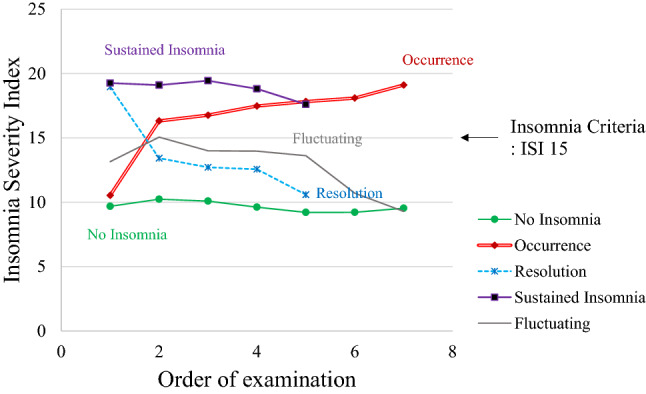
Insomnia patterns recorded during the study period.Insomnia Severity Index. ISI

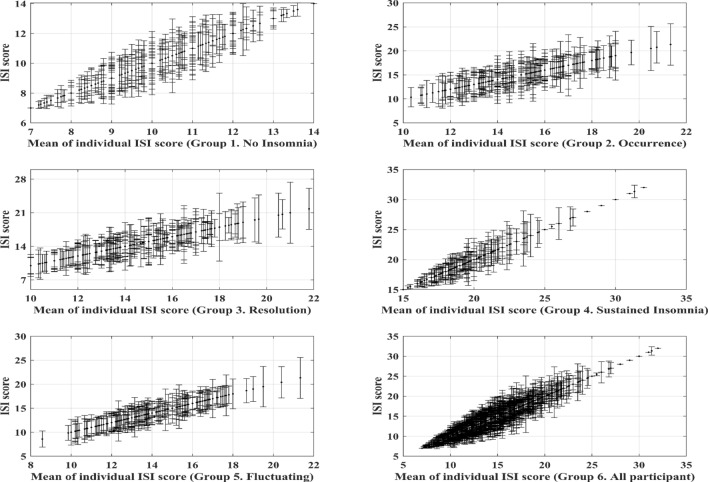
Variability of Insomnia Severity Index scores in each group. The-axis indicates individual means, and the vertical lines indicate individual standard deviation of Insomnia Severity Index scores.Insomnia Severity Index. x ISI
| Male (n = 606) | Female (n = 2009) | Total (n = 2615) | ||||
|---|---|---|---|---|---|---|
| N | (%) | N | (%) | N | (%) | |
| Age, mean (range) | 30.6 | (23.0, 59.0) | 27.1 | (21.0, 59.0) | 27.9 | (21.0, 59.0) |
| BMI, mean (range) | 24.4 | (16.5, 37.4) | 21.4 | (14.2, 37.4) | 22.1 | (14.2, 37.4) |
| Smoke | ||||||
| Yes | 136 | (22.4) | 2 | (0.10) | 138 | (5.28) |
| No | 470 | (77.6) | 2007 | (99.9) | 2477 | (94.7) |
| Drink | ||||||
| < 1/week | 180 | (29.7) | 1008 | (50.2) | 1188 | (45.4) |
| 1–2/week | 374 | (61.7) | 911 | (45.4) | 1285 | (49.1) |
| 3–7/week | 52 | (8.58) | 90 | (4.48) | 142 | (5.43) |
| ISI score | ||||||
| 0–7 | 461 | (76.1) | 1292 | (64.3) | 1753 | (67.0) |
| 8–14 | 124 | (20.5) | 563 | (28.0) | 687 | (26.3) |
| 15–21 | 18 | (2.97) | 135 | (6.72) | 153 | (5.85) |
| 22–28 | 3 | (0.50) | 19 | (0.95) | 22 | (0.84) |
| Shift work experience | ||||||
| Never | 45 | (7.43) | 230 | (11.5) | 275 | (10.5) |
| < 5 years | 474 | (78.2) | 1261 | (62.8) | 1735 | (66.4) |
| 5–9 years | 33 | (5.45) | 289 | (14.4) | 322 | (12.3) |
| 10–14 years | 12 | (1.98) | 136 | (6.77) | 148 | (5.66) |
| 15–19 years | 16 | (2.64) | 82 | (4.08) | 98 | (3.75) |
| ≥ 20 years | 26 | (4.29) | 11 | (0.55) | 37 | (1.41) |
| Quick return | ||||||
| Yes | 240 | (39.6) | 572 | (28.5) | 812 | (31.1) |
| No | 366 | (60.4) | 1437 | (71.5) | 1803 | (69.0) |
| Consecutive night shift | ||||||
| 1 day | 275 | (45.4) | 443 | (22.1) | 718 | (27.5) |
| 2 days | 99 | (16.3) | 226 | (11.3) | 325 | (12.4) |
| 3 days | 136 | (22.4) | 1079 | (53.7) | 1215 | (46.5) |
| 4 days | 16 | (2.64) | 44 | (2.19) | 60 | (2.29) |
| ≥ 5 days | 80 | (13.2) | 217 | (10.8) | 297 | (11.4) |
| Nap opportunity | ||||||
| Yes | 286 | (47.2) | 249 | (12.4) | 535 | (20.5) |
| No | 320 | (52.8) | 1760 | (87.6) | 2080 | (79.5) |
| Work-time control | ||||||
| Yes | 389 | (64.2) | 794 | (39.5) | 1183 | (45.2) |
| No | 217 | (35.8) | 1215 | (60.5) | 1432 | (54.8) |
| Weekly working hours | ||||||
| < 40 h | 45 | (7.43) | 160 | (7.96) | 205 | (7.84) |
| 40 h | 122 | (20.1) | 630 | (31.4) | 752 | (28.8) |
| 41–51 h | 144 | (23.8) | 803 | (40.0) | 947 | (36.2) |
| 52–59 h | 61 | (10.1) | 224 | (11.2) | 285 | (10.9) |
| ≥ 60 h | 234 | (38.6) | 192 | (9.56) | 426 | (16.3) |
| N | First ISI–Last ISI | valuep | ||||
|---|---|---|---|---|---|---|
| Mean difference | Confidence interval | Within | Between | |||
| All | 1747 | − 0.28 | − 0.56 | 0 | 0.0473 | – |
| Shift work experience | ||||||
| Never | 4 | − 2.00 | − 6.68 | 2.68 | < 0.0001 | < 0.0001 |
| < 5 years | 1029 | − 1.91 | − 2.24 | − 1.58 | ||
| 5–9 years | 343 | 2.02 | 1.4 | 2.63 | ||
| 10–14 years | 193 | 2.45 | 1.61 | 3.29 | ||
| 15–19 years | 98 | 2.33 | 1.02 | 3.63 | ||
| ≥ 20 years | 80 | 1.1 | 0.11 | 2.09 | ||
| Quick return | ||||||
| Yes | 522 | − 0.64 | − 1.13 | − 0.15 | 0.0964 | 0.3003 |
| No | 1225 | − 0.13 | − 0.46 | 0.21 | ||
| Consecutive night shift | ||||||
| 1 day | 259 | 0.58 | 0.01 | 1.15 | 0.0512 | < 0.0001 |
| 2 days | 202 | 0.1 | − 0.69 | 0.9 | ||
| 3 days | 1027 | − 0.57 | − 0.95 | − 0.19 | ||
| 4 days | 36 | − 0.53 | − 2.56 | 1.5 | ||
| ≥ 5 days | 223 | -0.28 | -1.05 | 0.49 | ||
| Nap opportunity | ||||||
| Yes | 312 | − 0.01 | − 0.53 | 0.51 | 0.3716 | < 0.0001 |
| No | 1435 | − 0.34 | − 0.66 | − 0.02 | ||
| Work-time control | ||||||
| Yes | 486 | 0.15 | − 0.31 | 0.6 | 0.0611 | < 0.0001 |
| No | 1261 | − 0.45 | − 0.79 | − 0.10 | ||
| Weekly working hour | ||||||
| < 40 h | 58 | 0.28 | − 1.28 | 1.83 | 0.039 | 0.0001 |
| 40 h | 345 | 0.41 | − 0.22 | 1.04 | ||
| 41–51 h | 765 | − 0.30 | − 0.73 | 0.13 | ||
| 52–59 h | 243 | − 1.35 | − 2.16 | − 0.54 | ||
| ≥ 60 h | 336 | − 0.27 | − 0.81 | 0.27 | ||
| Source | All participants | Insomnia occurrence | Insomnia resolution | ||||||
|---|---|---|---|---|---|---|---|---|---|
| OR estimates | Confidence interval | valuep | OR estimates | Confidence interval | valuep | OR estimates | Confidence interval | valuep | |
| Shift work experience | |||||||||
| Never | 1 | Reference | < 0.0001 | 1 | Reference | 0.0435 | - * | ||
| < 5 years | 3.51 | (2.28–5.40) | 1.71 | (1.20–2.43) | 1 | Reference | 0.0066 | ||
| 5–9 years | 3.69 | (2.34–5.84) | 1.46 | (0.86–2.49) | 1.64 | (1.16–2.32) | |||
| 10–14 years | 3.14 | (1.90–5.18) | 1.93 | (0.96–3.89) | 2.14 | (1.25–3.68) | |||
| 15–19 years | 2.76 | (1.53–4.97) | 1.41 | (0.62–3.19) | 1.32 | (0.59–2.98) | |||
| ≥ 20 years | 2.59 | (1.32–5.06) | 1.05 | (0.34–3.20) | 0.72 | (0.22–2.36) | |||
| Quick return | |||||||||
| No | 1 | Reference | 0.039 | 1 | Reference | 0.7678 | 1.07 | (0.84–1.36) | 0.5784 |
| Yes | 1.13 | (1.01–1.28) | 1.03 | (0.84–1.26) | 1 | Reference | |||
| Consecutive night shift | |||||||||
| 1 day | 1 | Reference | < 0.0001 | 1 | Reference | 0.05 | 0.64 | (0.39–1.05) | 0.3563 |
| 2 days | 1.8 | (1.45–2.24) | 1.12 | (0.81–1.55) | 0.84 | (0.53–1.34) | |||
| 3 days | 2.11 | (1.74–2.55) | 1.46 | (1.11–1.91) | 0.91 | (0.63–1.31) | |||
| 4 days | 1.88 | (1.32–2.67) | 1.36 | (0.80–2.32) | 1.32 | (0.62–2.77) | |||
| ≥ 5 days | 2.08 | (1.68–2.59) | 1.43 | (1.01–2.03) | 1 | Reference | |||
| Nap opportunity | |||||||||
| Yes | 1 | Reference | 0.0362 | 1 | Reference | 0.0021 | 1.08 | (0.68–1.74) | 0.7372 |
| No | 1.24 | (1.01–1.52) | 1.65 | (1.20–2.28) | 1 | Reference | |||
| Work-time control | |||||||||
| Yes | 1 | Reference | < 0.0001 | 1 | Reference | < .0001 | 1.14 | (0.85–1.52) | 0.3949 |
| No | 1.7 | (1.49–1.94) | 1.56 | (1.27–1.91) | 1 | Reference | |||
| Weekly working hour | |||||||||
| < 40 h | 1 | Reference | < 0.0001 | 1 | Reference | 0.9426 | 1.05 | (0.46–2.39) | 0.0166 |
| 40 h | 1.17 | (0.90–1.52) | 0.98 | (0.69–1.40) | 0.7 | (0.43–1.14) | |||
| 41–51 h | 1.88 | (1.45–2.43) | 0.98 | (0.68–1.40) | 0.53 | (0.34–0.81) | |||
| 52–59 h | 1.96 | (1.48–2.61) | 1.1 | (0.73–1.65) | 0.64 | (0.41–1.02) | |||
| ≥ 60 h | 1.89 | (1.42–2.54) | 0.98 | (0.63–1.51) | 1 | Reference | |||
Discussion
In this study, we investigated the association between work organization and the trajectories of insomnia patterns among night shift workers in a hospital. We noted that all work-related factors were significantly related to the risk of insomnia. The results suggest that night shift work induces sleep problems16; however, specific work-related factors can further deteriorate sleep health among night shift workers.
Generally, people who work long hours and have quick returns do not have enough time for rest, domestic work, or leisure; therefore, they perceive that their time is limited. It causes them to be preoccupied with sleep, try to sleep intentionally, and increase their sleep effort. According to the attention-intention-effort pathway, those reactions are important components in the development of insomnia17. A previous study showed a positive relationship between sleep effort and subjective insomnia18, and other studies reported results consistent with this finding as well11,19. However, in the present study, quick return was not significantly associated with the occurrence and resolution of insomnia, although the association with insomnia was significant in all participants. Regarding weekly working hours, the risk of insomnia generally increased as weekly working hours increased; however, it was not a significant factor for the occurrence or resolution of insomnia.
Additionally, disruption of circadian rhythm and melatonin regulation may have played a role in the observed relationship. The suppression of the amplitude of melatonin with increasing numbers of consecutive night shifts suggests that workers with more consecutive night shifts have more severe sleep problems20. In addition, nap opportunities may have affected the melatonin levels of the study participants. Although its impact on melatonin level was not conclusive in previous studies21,22, on-shift napping may reduce the duration of total light exposure at night23,24. As supportive evidence, no nap opportunity was one of the major risk factors for the occurrence of insomnia among those who did not have insomnia at baseline in the present study (OR for occurrence: 1.65, 95% CI 1.20–2.28).
Low work-time control is likely to cause poor recovery and work-family conflict, which are related to the occurrence of insomnia. Previous studies also indicated that low work-time control, long working hours, and unfavorable psychosocial work organizations are related to an increased risk for insomnia or future development of sleep disturbances8,13–15. In the present study, work-time control showed a significant association with the occurrence of insomnia among those who did not have insomnia at baseline (OR for occurrence 1.56, 95% CI 1.27–1.91), whereas the odds of resolution were not significant among those who had insomnia at baseline (Table 3).
Shift work experience was also related to an increased risk of insomnia in the present study. Our results consistently showed that insomnia was alleviated with increasing shift work experience. The OR of insomnia increased with increasing shift work experience up to 9 years of experience, and then decreased. Furthermore, less than 5 years of experience was associated with a 1.71-fold higher risk of occurrence of insomnia among those who reported no insomnia previously. Regarding those who had insomnia, 5–14 years of shift work experience was significantly associated with resolution of insomnia compared to less than 5 years of shift work experience (Table 3). These results demonstrated that 0–5 years of shift work experience is the major influential factor for occurrence and deterioration of insomnia.
We considered the healthy worker effect as an explanation for these findings25. Based on the last examination records of the participants, the prevalence of insomnia among the participants who dropped out during the follow-up period was slightly higher (41.1%) than that among the participants who completed the examination until 2018 (39.5%). Therefore, although the difference was small, there is a possibility that workers with sleep problems quit night shift work early in their career. A previous study reported findings similar to ours26.
As shown in Fig. 2, the variations of ISI scores in the sustained insomnia group were comparatively small. Therefore, we further analyzed the effects of work organization on the deterioration of ISI in the sustained insomnia group (see the Supplement Table). Interestingly, any work-related factors were not shown significance to the deterioration of ISI in the sustained insomnia group, whereas those relationships were significant for all participants. These results indicate that those who had insomnia consistently would have other reasons that contributed to their insomnia more than the individual- and work-related factors included in this study. In fact, there are a lot of factors that affect sleep disturbances, such as living patterns, psychosocial stress, health status, personal medications, and individual susceptibility. Thus, it is necessary to identify and compare the major contributing factors from various sources.
This study has several limitations. Firstly, the individual occupation records were not available, so the occupation effect for sleep disturbances could not be considered. Secondly, the study participants were mainly women and were from a single hospital. Therefore, we could not conclude whether the results of this study are generalizable to workers in other fields or male-dominant industry. Thirdly, insomnia was assessed based on the responses in a subjective questionnaire; details of actual sleep duration were not obtained. Therefore, although the ISI is a well-known validated instrument for screening insomnia, accurate diagnosis could not be achieved27. Fourthly, we could not assess other health conditions commonly comorbid with insomnia, such as psychiatric disorders, obstructive sleep apnea, and restless leg syndrome28. Also, effect of work-related stress were not assessed. Furthermore, some work-related factors were investigated according to "yes" or "no" responses. Therefore, investigating the dose–response relationship between quick return, nap, and insomnia was not possible. Lastly, the healthy worker effect may have impacted our results. Notably, the healthy worker effect may also have resulted in an underestimation of the effects of shift work. However, we used a longitudinal study design, and followed-up with the participants for up to 4 years. Therefore, recall bias or reverse causation was minimized in the present study. Additionally, the large number of participants is another strength of this study.
In conclusion, shift work is unavoidable for hospital workers in the modern society. However, the risk of insomnia among night shift workers varies according to work organization. Although sleep problems are inevitable for many night shift workers, the results of this study suggest that a well-designed work schedule and better work organization can help reduce the occurrence of insomnia among them. Work schedules that incorporate sufficient rest time, nap opportunities, and work-time control are required to prevent undesirable health outcomes related to insomnia. Furthermore, consecutive night shifts and long working hours should be limited. Future studies are required to examine other factors, including work organization, socio-demographic factors, and health status that contribute to insomnia.
Methods
Study participants
Under the Occupational Safety and Health Act of Korea, night workers are obligated to undergo an annual health examination. Night work is defined as follows: an 8-h duty including the hours from midnight to 05:00 h for an average of four times or more per month in the past 6 months, or 60 or more hours of work between 22:00 h to 06:00 h in the past 6 months29. For this study, we used the health examination data of night shift workers who were working in a university hospital from 2014 to 2018. A total of 7997 records of 3118 night shift workers were collected and analyzed. Cases with insufficient/no response records (878) and irregular night shift experiences due to department changes (354) were excluded. Finally, 6765 records of 2615 night shift workers were included in the present study. Informed consent was obtained from all participants, and the Institutional Review Board of Ajou University Hospital reviewed the protocol and approved this study (AJIRB-MED-MDB-18-154). This study was conducted in accordance with the STROBE guidelines.
Insomnia, work-related factors, and other covariates
The health examination data analyzed in this study included demographic factors, anthropometric measures such as height and weight, and questionnaires on work organization, medical history, and insomnia. Among the investigated factors, sex, age, BMI, smoking history, and history of alcohol consumption were included in the analyses. Age and BMI were used as continuous variables, smoking history was divided into two groups according to the current smoking status (yes, no), and history of alcohol consumption was divided into three groups (< 1 time/week, 1–2 times/week, and 3–7 times/week). In addition, six components of work organization were included as follows: shift work experience (< 5, 5–9, 10–14, 15–19, ≥ 20 years, and never), quick return (yes, no), consecutive night shift (1, 2, 3, 4, and ≥ 5 days), nap opportunity (yes, no), work-time control (yes, no), and weekly working hours (< 40, 40, 41–51, 52–59, and ≥ 60 h).
Insomnia was assessed using the ISI, which consists of seven questions on difficulty in falling asleep, difficulty in staying asleep, problems waking up too early, sleep satisfaction, anxiety regarding insomnia, and interference with daily functioning experienced in the past 2 weeks. Each item is rated 0 (none), 1 (mild), 2 (moderate), 3 (severe), or 4 (very severe). The total score indicates severity of insomnia as follows: 1–7, no clinical significance; 8–14, subthreshold insomnia; 15–21, clinical insomnia (moderate); and 22–28, clinical insomnia (severe). In this study, we defined insomnia as having an ISI score of 15 or higher, according to the ISI author recommendations30.
Participant grouping
The general characteristics and distributions of individual ISI scores were evaluated. Subsequently, we categorized the participants according to the insomnia patterns derived from the ISI scores. The no insomnia group included participants whose ISI scores were below 15 during the follow-up period (n = 1229). The insomnia occurrence group included participants whose ISI scores were below 15 at baseline, but insomnia occurred during the study period and persisted until the end of the follow-up period (n = 362). The insomnia resolution group included those who had insomnia at baseline, but the insomnia resolved at the end of the study (n = 301). The sustained insomnia group included participants whose ISI scores were 15 or more consistently from baseline to the end of the follow-up period (n = 472). The fluctuating insomnia group included those whose insomnia patterns did not match the definitions of the other four groups (n = 251).
Statistical analysis
The repeated measure analysis of variance was used to analyze the effects of work organization while considering intra- and inter-individual effects. The GEE method was used to estimate the long-term effects of work organization on insomnia. The covariance structure specified compound symmetry, and the model included the six components of work organization: shift work, quick return, consecutive night shift, nap opportunity, work-time control, and weekly working hours, as well as age, sex, BMI, smoking status, and alcohol consumption status as covariates. The first analysis was conducted for all the participants. To evaluate the impact of work organization on the occurrence of insomnia, the second analysis was conducted for the no insomnia and insomnia occurrence groups. The third analysis was conducted for the sustained insomnia and insomnia resolution groups to investigate the effects of work organization on the resolution of insomnia. Due to lack of power, 25 records of participants that reported no shift work experience were not included in the third model. Lastly, a linear mixed model was used to discover the impact of work organization on the deterioration of ISI scores in the sustained insomnia group. This model included age, sex, BMI, smoking status, and alcohol consumption status as covariates, and compound symmetry was specified as the covariance structure. All statistical analyses were performed using SAS version 9.4 (SAS Institute, Cary, NC, US) and the trend of variability was figuring out using MATLAB R2020a, MathWorks, MA, US).
Supplementary Information
Supplementary Information.