
What this is
- This research presents a platform for gene regulation in Haemophilus influenzae, enhancing functional genomics in bacteria.
- The platform enables genome-wide fitness analyses, revealing growth medium-dependent fitness costs for various genes.
- An extensive online resource, HaemoBrowse, is introduced for visualizing genome annotations and spacers.
Essence
- The study develops a system that allows for precise gene regulation in H. influenzae, uncovering essential genes and their medium-dependent fitness costs.
Key takeaways
- The platform covers 99.27% of the H. influenzae genome, facilitating the study of essential genes across different growth conditions.
- Fitness analysis revealed that 531 genes were essential in both sBHI and CDM media, with 80.3% of these genes shared between the two conditions.
- The platform demonstrated that gene silencing effects could be reversed by supplementing the growth medium with specific nutrients, such as L-serine.
Caveats
- The study's findings are based on laboratory conditions, which may not fully replicate in vivo environments.
- The system's effectiveness may vary based on the genetic context of the targeted genes.
Definitions
- CRISPRi: A technology that uses CRISPR to inhibit gene expression without altering the DNA sequence.
- sgRNA: Single-guide RNA, a component of the CRISPR system that directs the Cas9 protein to the target DNA.
Simplified
Introduction
The human-specific Gram-negative bacterial species Haemophilus influenzae is a normal part of the upper airway microbiome but can cause invasive infections such as pneumonia, otitis media, and meningitis typically in infants and young children. Infant mortality due to invasive infections was drastically reduced by introduction of the conjugated vaccine that targets strains with the serotype b polysaccharide capsule [1]. However, nontypeable H. influenzae strains continue to cause high morbidity due to their role in common infections and chronic diseases, and are major contributors to persistent infection and exacerbations of chronic obstructive pulmonary disease (COPD) and cystic fibrosis (CF) [2 –4].
Functional genomics is a powerful approach to identify new vaccine candidates and antibiotic targets for important human pathogens. Genome-wide studies to assess the fitness contribution or essentiality of each genetic feature across diverse conditions or genetic backgrounds in bacteria have predominantly been performed using transposon-mediated approaches combined with next-generation sequencing (e.g., Tn-seq and TraDIS) [5]. Indeed, Tn-seq has identified putative essential genes for H. influenzae adaptation to changes in environmental CO2 levels, for survival in the presence of neutrophils, serum and complement, and for in vivo survival in a murine model of airway infection [6 –9]. However, transposon mutagenesis methods are less appropriate for gene essentiality studies as insertion mutants of essential genes are per definition counter-selected. In contrast, inducible Clustered Regularly Interspaced Short Palindromic Repeats interference (CRISPRi) technology, developed from natural CRISPR systems found in bacteria and archaea as part of their adaptive immunity against phages, overcomes this limitation as it enables the transient repression of target genes and allows to monitor phenotypes associated to dispensable and essential genes [10 –12]. CRISPRi is based on the co-expression of a single-guide RNA (sgRNA) and a catalytically inactive (dead) Streptococcus pyogenes Cas9 (dCas9) protein, which binds DNA but lacks endonuclease activity. The sgRNA consists of a 20 nucleotide-long variable spacer sequence that is complementary to a target DNA stretch, a Cas9 handle crucial for interaction with dCas9, and a transcriptional terminator. The sgRNA targets the dCas9 protein to a site on the genome with a sequence complementary to its spacer sequence next to a protospacer adjacent motif (PAM) site composed of 3 nucleotides, typically NGG. When bound to the non-template strand of the target gene, the dCas9•sgRNA complex serves as a roadblock for RNA polymerase, hampering transcription initiation or elongation of the targeted gene [10 –15]. sgRNAs can be designed to target any sequence of interest provided that the target is next to a PAM site. As such, almost all genes of a given genome can be studied with an appropriate design of sgRNAs if dCas9 and/or the sgRNA is under the control of an inducible promoter to prevent constitutive gene repression. This makes CRISPRi particularly valuable for functional studies including essential gene assessment [16 –19].
Two approaches can be employed for genome-wide CRISPRi screenings. An arrayed library method involves handling each mutant with a single sgRNA individually, enabling direct observation of diverse phenotypes [15,17,20]. This method is laborious and time consuming considering each sgRNA mutant strain needs individual processing. In contrast, a pooled library approach, where multiple knockdown strains are grown together, is more convenient but it limits phenotype measurements besides gene fitness. Deep sequencing reveals changes in sgRNA abundances of the pooled library upon selective pressures, reflecting the differential fitness provoked by conditional target repression. Hence, the combination of pooled CRISPRi libraries with NGS (CRISPRi-seq) offers a robust method to study gene fitness in bacteria (via relative quantification and comparison of sgRNA abundance) at a genome-wide scale in particular growth conditions [16,18 –27].
Here, we implemented a CRISPRi system suitable for individual genes or pooled libraries knockdown in H. influenzae. We first validated operability and titratability of the newly implemented anhydrotetracycline (aTc)-inducible CRISPRi system. Furthermore, we constructed a genome-wide CRISPRi library with high coverage in the genome of RdKW20 strain, designed to cover 99.27% of all total genetic features. As a proof of concept, the generated H. influenzae genome-wide CRISPRi library was screened in two laboratory growth media to quantify gene fitness through CRISPRi-seq. We uncovered growth medium-dependent fitness cost, and confirmed several hits with individual knockdown/knockout mutants. In addition, we introduce HaemoBrowse (https://HaemoBrowse.VeeningLab.com↗), through which the genome annotations and sgRNA design on H. influenzae genomes can be readily inspected. The H. influenzae CRISPRi platform presented here provides a valuable tool for both gene functional analyses and essentiality in a notorious human pathobiont.
Results
An inducible CRISPRi system in H. influenzae
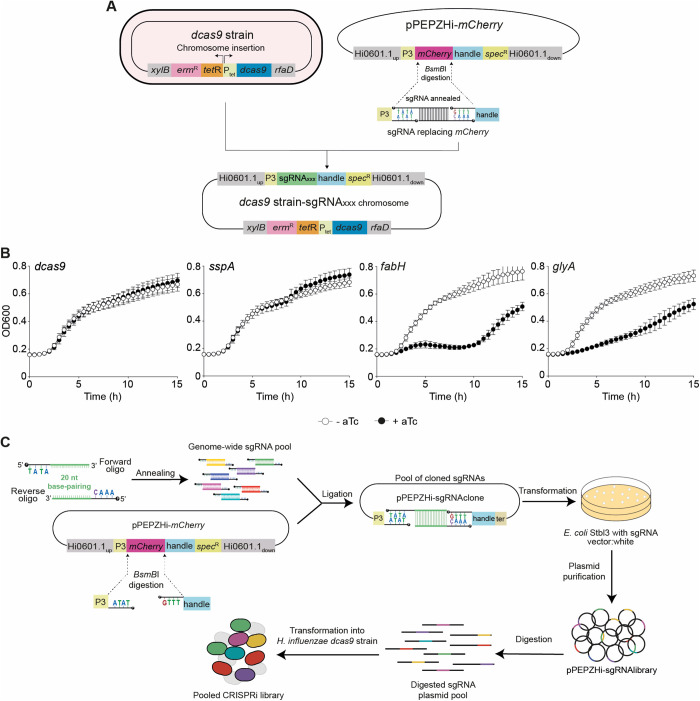
In previous work, we successfully established CRISPRi for the Gram-positive human pathogen Streptococcus pneumoniae by placing the dcas9 gene under tight control of LacI and TetR-regulated promoters, while expressing the sgRNA from the synthetic constitutive P3 promoter [17,19]. To adapt this operational streptococcal CRISPRi system for H. influenzae, we integrated two cassettes into the chromosome of the widely used laboratory strain H. influenzae RdKW20, by taking advantage of its high frequency to naturally acquire exogenous linear DNA. The first cassette was engineered as a linear fragment through Golden Gate cloning encoding dcas9 under the control of the anhydrotetracycline (aTc)-responsive promoter (hereafter Ptet) [28], an erm erythromycin resistance gene, and the tetR transcriptional repressor. The product was integrated into the non-essential xylB-rfaD locus of the RdKW20 chromosome [29], generating the RdKW20-dcas9 strain (hereafter, dcas9 strain) (Fig 1A). This dcas9 cassette was designed to have no- or minimal impact on the neighbour genes. First, the xylB gene is upstream of- and in the same orientation than the dcas9 cassette. Second, the dcas9 cassette is bordered by transcriptional terminators to minimize transcriptional readthrought. Third, neither deletion nor duplication were generated due to the dcas9 cassette chromosomal integration. Integration of the cassette at this locus did not hamper the fitness of the engineered strain compared to its isogenic parental wild-type (Fig A inS1 Text, panel A). In parallel, we constructed the pPEPZHi-mCherry vector, which will be used to constitutively express sgRNAs from the P3 promoter [14]. pPEPZHi-mCherry encodes the mCherry gene to allow for visual red-white screening of sgRNA cloning in E. coli, the dCas9-required handle sequence, and a spec spectinomycin resistance gene for selection in both Escherichia coli and H. influenzae. Illumina read 1 and read 2 sequences flank the sgRNA sequence to allow for a one-step PCR amplification of the sgRNAs and downstream deep sequencing of a library pool. Finally, we introduced flanking homology regions for the neutral Hi0601.1 locus [30], to subsequently generate sgRNA-containing linear cassettes for chromosomal integration in the dcas9 strain (double homologous recombination) by natural transformation (Fig 1A).
To assess the efficacy of our CRISPRi system in H. influenzae, we separately integrated three sgRNAs targeting either essential or non-essential (control) genes [31 –33] in the chromosome of the dcas9 background strain. As shown in Fig 1B, strains carrying a sgRNA targeting fabH (encoding a β-ketoacyl-acyl carrier protein synthase III) or glyA (encoding a serine hydroxymethyltransferase) were severely hampered to grow upon addition of 50 ng/mL aTc, in line with their predicted essential functions in the cell. In contrast, the strain with a sgRNA targeting the dispensable gene sspA (encoding stringent starvation protein A) grew similarly whether dCas9 was induced or not. As a control, we verified that expression of dCas9 had no effect on growth in a sgRNA-devoid strain (Fig 1B, left panel).
For more subtle control over gene expression, and to determine the dynamic range of the CRISPRi system in H. influenzae, we tested the growth profiles for a range of aTc concentrations. We observed a narrow window of gene expression control between 0.25 and 1 ng/mL aTc indicating that the here-used Ptet promoter offers some levels of titratability in dCas9 expression (Fig A inS1 Text, panel B). For the rest of the work presented here, we used a saturating aTc concentration of 50 ng/mL.
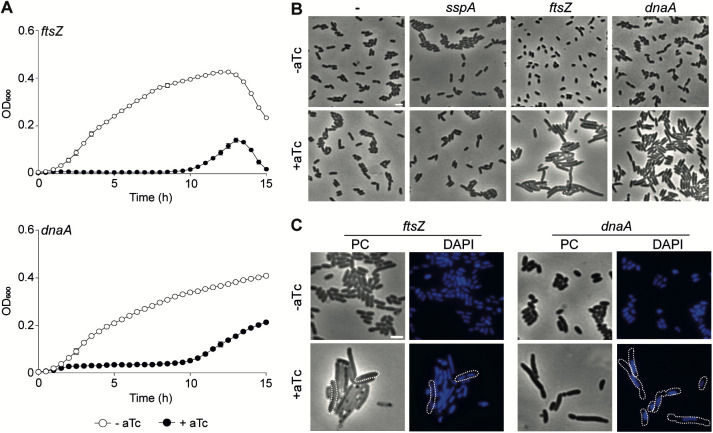
The results presented demonstrated that the developed CRISPRi system for H. influenzae is both functional and inducible. To further verify the accuracy of the system, we selected ftsZ and dnaA as knockdown targets. Since these targets are directly involved in cell division and DNA replication initiation, respectively, we can evaluate the knockdown phenotype by observing bacterial cell and nucleoid morphology. We engineered sgRNAftsZ and sgRNAdnaA strains as previously described. As expected, cell growth was inhibited for both depletion strains upon dCas9 induction (Fig 2A). This macroscopic behavior correlates with an elongation phenotype of most bacterial cells that does not occur when using a sgRNA targeting a neutral gene (sspA) (Fig 2B). As highlighted by DAPI staining, activation of the CRISPRi system revealed two different phenotypes for ftsZ and dnaA respective gene knockdowns. Indeed, ftsZ knockdown produced filamentous cells with multiple compartmentalized nucleoids or nucleoids that spread throughout the cytoplasm, while cells depleted for dnaA harbored a unique compact nucleoid with DNA-free area and produced anucleate minicells (Fig 2C). These observations are in direct line with the functions performed by FtsZ and DnaA, demonstrating that the here-described CRISPRi system for H. influenzae is specific.

Engineering of a CRISPRi knockdown platform for H. influenzae. (A) Generation of astrain with an aTc-inducibleby double homologous recombination at the/locus. Backbone vector pPEPZHi-for sgRNA cloning includes a Specmarker, a P3 promoter controlling sgRNA expression, and angene encoding a red fluorescent protein flanked byI restriction sites.I vector digestion generates two ends compatible for annealed sgRNA cloning bygene replacement. The sgRNA cassette is amplified from pPEPZHi-sgRNAto perform chromosomal integration at the HI0601.1of thebackground. (B) Functional validation of theCRISPRi genetic platform. Thestrain (-) and derivatives expressing,orsgRNAs were grown in sBHI, in the absence (white circles)/presence (black circles) of aTc for CRISPRi-based gene silencing. Growth was monitored by measuring ODevery 30 min for 15 h; standard deviation to the mean is shown for each timepoint. (C) Workflow to generate a CRISPRi-based genome-wide library in. Oligo pairs containing 20 bp complementary stretchs and 4 nt overhangs compatible with theI-digested pPEPZHi-vector were annealed, phosphorylated and ligated in pool to theI-digested pPEPZHi-. The pool of purified sgRNA-containing plasmids (pPEPZHi-sgRNAlibrary) serves as the reservoir for CRISPRi library construction in. The sgRNA library plasmid pool was linearized and transformed into the competentbackground, generating the pooled CRISPRi library. Bothand sgRNA cassettes are integrated in two separate locations into the recipient host chromosome,and HI0601.1 loci, respectively. H. influenzae dcas9 xylB rfaD mCherry mCherry BsmB BsmB mCherry locus dcas9 H. influenzae dcas9 sspA fabH glyA H. influenzae BsmB mCherry BsmB mCherry H. influenzae dcas9 dcas9 xylD/rfaD R XXX 600

Efficiency and specificity of theCRISPRi system. H. influenzae (A) Thederivative strains expressingorsgRNAs were grown in sBHI, in the absence (white circles)/presence (black circles) of aTc, in 96-well plates; ODwas measured every 30 min for 15 h. Standard deviation to the mean is shown for each timepoint. (B) Phase contrast (PC) microscopy showing bacterial cell morphology for thestrains (-) and derivatives expressing,orsgRNAs. Bacteria were grown in sBHI in the absence/presence of aTc. (C) Detailed bacterial cell and nucleoid morphology alterations showing the effect of dCas9 induction inderivative strains expressingorsgRNAs. The nucleoid was stained with DAPI and several cells are outlined to emphasize nucleoid structures and organization in the cytoplasm. Scale bars are equal to 2 µm. dcas9 ftsZ dnaA dcas9 sspA ftsZ dnaA dcas9 ftsZ dnaA 600
Development of a genome-wideCRISPRi library H. influenzae
To widen the scope of this new tool in H. influenzae, we developed a pooled library for strain RdKW20. Through previously described and validated computational algorithms [19], we designed an optimized library including 1,773 sgRNAs targeting all predicted genetic features annotated in the RdKW20 genome. This library covers 99.27% of all total features of the RdKW20 genome (13 features are not targeted by the library due to the lack of PAM sites in their coding sequences). Of note, some designed sgRNAs may target more than one genetic feature (coding sequences, ribosomal RNAs, transfer RNAs or small RNAs) if that feature is present in multiple copies, or if repetitive regions are present (S1 Dataset).
To construct the CRISPRi sgRNA library, we used a synthetic pool of 3,546 ssDNA oligonucleotides for RdKW20 encoding two partially complementary oligonucleotides for each sgRNA (1,773 sgRNAs). From this synthetic ssDNA pool, a pooled plasmid library was constructed through cloning into BsmBI-digested pPEPZHi-mCherry and transformation into E. coli Stbl3 (Fig 1C). In total, the cloning yielded ~1010 CFU/mL, ~ 4.48 × 10⁶ times the theoretical coverage of the library, of which ~0.1% was positive for mCherry, indicating a highly efficient digestion and cloning reaction. Subsequent Illumina sequencing of the plasmid library showed a normal distribution of the relative sgRNA prevalence, with only few sgRNAs absent [16] in the pool (Fig B inS1 Text, panel A, and S2 Dataset). The created plasmid library was subsequently used for digestion (see Methods section) and natural transformation of the sgRNA-containing linear cassette pool into the Ptet-dcas9 background strain, resulting in ~1x10⁶ total CFU transformants, and retention of 1,742 sgRNA in a normally distributed library (98.3% of all 1,773 synthesized sgRNAs; 1,701 genes (HI_XXX) targeted by sgRNAs out of 1,779) (Fig 1C and Fig B inS1 Text, panel B, and S2 Dataset).
In summary, we were able to generate a CRISPRi library in H. influenzae that includes evenly distributed sgRNAs targeting 98.3% of all annotated features.
Genome-widefitness evaluation by CRISPRi-seq H. influenzae
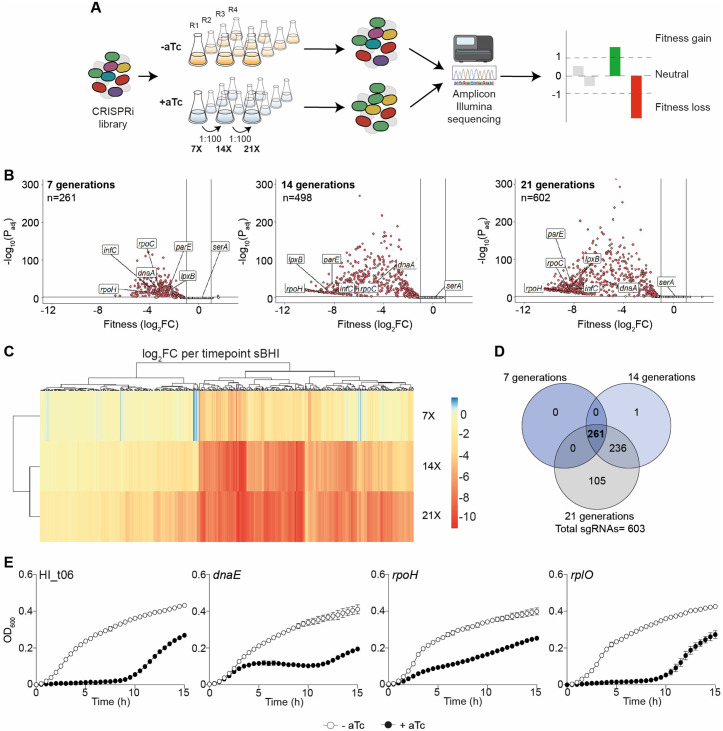
Next, we used the CRISPRi library to investigate the RdKW20 strain 'essentialome', by quantifying the fitness of each sgRNA target when grown in sBHI medium. For a better resolution of CRISPRi-seq across all sgRNAs, three time points (7, 14 and 21 generations) were sampled in quadruplicate (Fig 3A). Induction of dCas9 was achieved by adding aTc at 50 ng/mL.
Through deep sequencing, quantification and comparison of sgRNA abundance in induced versus uninduced samples, we confirmed the tight control over dcas9 expression by Ptet, as all uninduced samples had a similar sgRNA composition, whether they were grown for 7, 14, or 21 generations (Fig C inS1 Text, panels A and B). Considering induced samples, the majority (91%) of variance between samples was due to dcas9 induction in a time-dependent manner. Fitness score comparison between the three conditions showed that the number of essential genes gradually increased according to the number of generations (Fig 3B-D, and S3 Dataset). Indeed, within the induced samples, we observed that 261 sgRNAs have significantly reduced abundance after 7 generations, 498 after 14 generations and 602 after 21 generations (Fig 3B and 3D, and S3 Dataset). Consistently, sgRNAs with significant lower abundances at earlier timepoints remain so at later timepoints (Fig 3D). Moreover, volcano plots and heatmaps highlight the trend for individual fitness scores to be lower and lower over generations (Fig 3B and 3C, and Fig C inS1 Text, panel B). In direct line with individual sgRNA data (Figs 1B and 2), sgRNAs targeting glyA, dnaA, fabH or ftsZ showed drastic reduced abundances (S3 Dataset).
To validate this CRISPRi-seq fitness screen performed in sBHI growth medium, we independently analyzed a panel of genes whose sgRNAs showed significantly reduced abundance after 7 generations. Fourteen separate sgRNAs targeting the HI_t06, dnaE, rpoH, rplO, infC, rpsL, ispE, metK, rpoC, lpxB, parE, rsxA, rpsT and mepA genes were individually cloned in the pPEPZHi-mCherry vector and integrated in the Ptet-dcas9 background, as described above. In the presence of inducer, twelve out of the fourteen tested sgRNAs strains exhibited growth defects (Fig 3E and Fig D inS1 Text).
These results strongly validate the robustness and reliability of this novel H. influenzae CRISPRi platform in bacterial genome-wide assays, and unveil gene requirements in a laboratory-based complex medium.

CRISPRi-seq gene fitness analysis ofduring growth in sBHI medium. H. influenzae (A) TheCRISPRi library was grown in sBHI without (orange) or with (blue) aTc 50 ng/mL. Four biological replicates were performed for each condition. After 7, 14 and 21 generations of exponential growth, bacterial cultures were pelleted, genomic DNA was purified, sgRNA-containing amplicons were generated and Illumina sequenced, and data were analysed for differential fitness score abundance. (B) Volcano plots show sgRNA target fitness scores uponinduction for 7, 14 and 21 generations of exponential growth in sBHI. Red dots represent sgRNAs targeting essential genes, with significant differential fitness effects (logFC<−1 and P < 0.05; vertical and horizontal black lines). Several essential ([DNA replication initiation],[translation initiation factor],[lipid A synthase],[DNA topoisomerase],[RNA polymerase] and[sigma factor]) and dispensable ([serine metabolism]) genes in sBHI have been plotted. (C) The heatmap combined with hierarchical clustering displays all significantly enriched/depleted sgRNAs over the three timepoints. A negative (red) score indicates a fitness loss in inducing conditions, while a positive (blue) score indicates a fitness gain. (D) Venn diagram showing the overlap of sgRNAs with reduced abundance after aTc induction over the three timepoints. (E) CRISPRi-based analysis ofspecific gene fitness.derivative strains expressing HI_t06,orsgRNAs were grown in sBHI, in the absence (white circles)/presence (black circles) of aTc. Strains were grown in 96-well plates, and ODwas measured every 30 min for 15 h. Standard deviation to the mean is shown for each timepoint. dcas9 dcas9 dnaA infC lpxB parE rpoC rpoH serA H. influenzae dcas9 , dnaE rpoH rplO 2 adj 600
CRISPRi-seq reveals growth medium-dependent essentiality H . influenzae
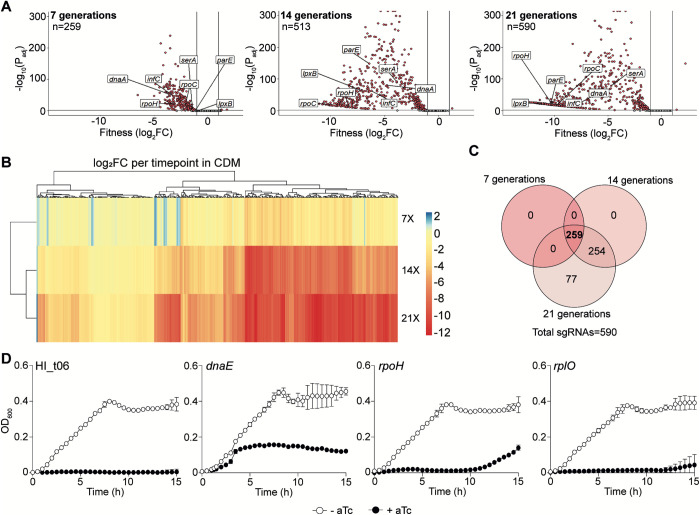
We next assessed H. influenzae gene essentiality in a different growth condition through cultivation in a chemically defined (CDM) medium [34,35], and subsequent comparative analysis to the sBHI data. The CRISPRi library was grown in CDM in the absence/presence of aTc, and deep-sequenced for gene fitness quantification. Akin to sBHI, variability was primarily attributed to dcas9 expression with longer induction times increasing differences in sgRNA content (Fig C in S1 Text, panels A and B), as the number of genes with significant fitness defects were 259 sgRNAs with reduced abundance after 7; 513 after 14; and 590 after 21 generations (Fig 4A-C, and S3 Dataset). As reported hereabove for the sBHI screen, we validated the functionality of this high-throughput CRISPRi screen in CDM with 12 (out of 14) individual sgRNA strains (Fig 4D and Fig E in S1 Text).
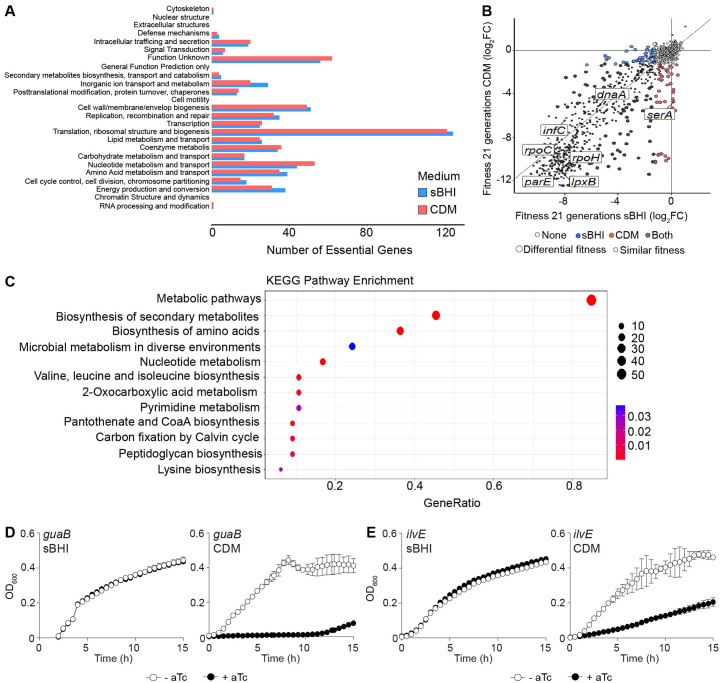
A significant number of essential genes were common to both sBHI and CDM media (531 genes). As expected, analysis of Clusters of Orthologous Genes (COG) for all essential genes (80.3% shared essential genes between the two media) showed minor differences. Translation, ribosomal structure and biogenesis was the most affected category. Small differences between the two media were observed for inorganic ion transport, nucleotide and amino acid metabolism and transport, as well as energy production (Fig 5A).
Next, we performed a differential fitness analysis between samples grown in sBHI versus CDM. Comparative fitness analysis showed that 7, 35 and 60 genes were significantly more essential in sBHI at 7, 14, and 21 generations, respectively, whilst 22, 75 and 94 genes were significantly more essential in CDM (Fig 5B, and S4 and S5 Datasets). Through a KEGG pathway enrichment analysis on the genes differentially essential after 21 generations, we observed that more essential genes in CDM mostly belong to amino acid and nucleotide biosynthesis pathways (36% and 17%, respectively) and metabolic pathways in a more general manner (85%) (Fig 5C). In contrast, sBHI-specific essential genes primarily encode transporters (35%) (Fig F inS1 Text). Aiming to confirm this medium-dependent essentiality, we selected 2 genes, guaB and ilvE, whose sgRNAs showed reduced abundance in CDM but stayed equal in sBHI. The guaB gene encodes an inosine-5´-monophosphate dehydrogenase that catalyzes the conversion of inosine 5'-phosphate to xanthosine 5'-phosphate, the first committed and rate-limiting step in the de novo synthesis of guanine nucleotides. The ilvE gene encodes for a branched chain amino acid aminotransferase acting on leucine, isoleucine and valine. Both sgRNAs were individually cloned in the Ptet-dcas9 background and bacterial growth was assayed in CDM and sBHI (in the absence/presence of aTc). Strikingly, dCas9 induction showed a CDM-specific growth defect, while growth in sBHI was unaffected regardless of dCas9 induction (Fig 5D and 5E).
These results validate the use of this CRISPRi platform in bacterial genome-wide assays to reveal growth condition-dependent gene requirements.

CRISPRi-seq gene fitness analysis ofduring growth in CDM medium. H. influenzae (A) Volcano plots show sgRNA target fitness scores uponinduction for 7, 14 and 21 generations of exponential growth in CDM. Red dots represent sgRNAs targeting essential genes, with significant differential fitness effects (logFC<−1 and P < 0.05; vertical and horizontal black lines). Several essential genes ([DNA replication initiation],[translation initiation factor],[lipid A synthase],[DNA topoisomerase],[RNA polymerase],[sigma factor] and[serine metabolism]) in CDM have been plotted. (B) The heatmap combined with hierarchical clustering displays all significantly enriched/depleted sgRNAs over the three timepoints. A negative (red) score indicates at fitness loss in inducing conditions, while a positive (blue) score indicates a fitness gain. (C) Venn diagram showing the overlap of sgRNAs with reduced abundance after induction over the three timepoints. (D)derivative strains expressing HI_t06,orsgRNAs were grown in CDM, in the absence (white circles)/presence (black circles) of aTc. Strains were grown in 96-well plates, ODwas measured every 30 min for 15 h. Standard deviation to the mean is shown for each timepoint. dcas9 dnaA infC lpxB parE rpoC rpoH serA dcas9 , dnaE rpoH rplO 2 adj 600

CRISPRi-seq reveals medium-specific growth determinants for H. influenzae. (A) Distribution of COG categories in all significantly essential genes in sBHI (blue) and CDM (red). (B) Interaction plot comparing fitness scores uponinduction for 21 generations in sBHICDM. Blue and red dots represent sgRNAs with logFC<−1 and P < 0.05 in sBHI and CDM, respectively. Black dots represent sgRNAs with logFC<−1 and P < 0.05 in both conditions, and white dots color dispensable genes. Dot size refers to genes considered as differentially essential in one medium (94 genes more essential in CDM; 60 genes more essential in sBHI). Several genes ([DNA replication initiation],[translation initiation factor],[lipid A synthase],[DNA topoisomerase],[RNA polymerase],[sigma factor] and[serine metabolism]) essential in at least one medium are labeled. (C) KEGG pathway enrichment analysis in CDM (sBHI). The gene ratio refers to the number of enriched genes in CDM for a specific pathway reported to the total amount of differentially essential genes. Dot size reflects the number of differentially essential genes. Color shades scale the significance (P). (D & E)derivative strains expressing sgRNA(D) or sgRNA(E) were grown in sBHI and CDM, in the absence (white circles)/presence (black circles) of aTc. Strains were grown in 96-well plates, ODwas measured every 30 min for 15 h, standard deviation to the mean is shown for each timepoint. dcas9 versus dnaA infC lpxB parE rpoC rpoH serA versus dcas9 2 adj 2 adj adj guaB ilvE 600
CRISPRi-programmed fitness defects are rescuable in H. influenzae
Our differential fitness analysis between sBHI or CDM grown samples shed light on medium specificities and genetic targets (Figs G and H inS1 Text) [31,36]. Among others, genes encoding enzymes required for threonine and serine biosynthesis are differentially essential in CDM compared to sBHI (Fig 6 and Fig I inS1 Text). As a last validation of this H. influenzae CRISPRi system, we tested whether the observed CRISPRi-promoted fitness burden could be rescued by other genetic tools. We selected the CDM-specific serA gene, which encodes a D-3-phosphoglycerate dehydrogenase involved in the L-serine biosynthesis pathway. Therefore, repression of the serA gene should cause L-serine auxotrophy. Coherently, in the presence of aTc, bacterial growth of the sgRNAserA strain exhibited a severe defect in CDM, but not in sBHI (Fig 6A). In line with this data, a ΔserA deletion mutant showed auxotrophy when grown in CDM (Fig 6B). L-serine concentration is about 285 mM in sBHI (Javier Asensio-López, personal communication), while only 0.29 mM in CDM [35]. We reasoned that increasing L-serine concentration in CDM might abolish the sgRNAserA and ΔserA fitness defects. As expected, supplementation of CDM with L-serine 10 mM abolished the growth arrest phenotype caused by underexpression of serA (Fig 6B and 6C). For completion, similar observations were made for the dcas9-sgRNAserA and ΔserA strains when using a minimal chemically defined medium totally deprived of L-serine (mCDM) (Fig J inS1 Text). These results fully support the operativity of our study design and CRISPRi platform to identify H. influenzae genes undergoing medium-dependent fitness cost.

sgRNA gene silencing reversibility in H. influenzae. (A) Thederivative strain expressing sgRNAwas grown in CDM (left panel) and sBHI (right panel), in the absence (white circles)/presence (black circles) of aTc. (B) RdKW20 WT (triangles) and ∆(circles) strains were grown in CDM in the absence (white) or presence (black) of L-serine 10 mM (left panel), and in sBHI (right panel). (C)strain and its derivative expressing sgRNAwere grown in CDM supplemented with L-serine 10 mM, in the absence (white circles)/presence (black circles) of aTc. Strains were grown in 96-well plates, ODwas measured every 30 min for 15 h, standard deviation to the mean is shown for each timepoint. dcas9 serA dcas9 serA serA 600
HaemoBrowse: a visual and intuitivegenome browser H. influenzae
Finally, we developed HaemoBrowse, a genome browser for H. influenzae (Fig 7). Based on JBrowse 2, HaemoBrowse offers a user-friendly and highly intuitive visual platform to browse the genome of the strain RdKW20 for its encoded features. Moreover, HaemoBrowse shows the position and sequence of the designed sgRNAs. Additional flexibility is offered by allowing for the search of locus tags (including HI_XXXX, locus tags for RdKW20) and gene names. We also included the genomes of three other commonly used H. influenzae strains, NTHi375, R2866 and 86–028NP. To allow for further exploration of gene function, direct links to the UniProt [37], PaperBLAST [38], AlphaFold [39], FoldSeek [40], and STRING databases [41] are available for each encoded feature. Finally, the conservation and the essentiality of the encoded features in the different conditions and at different timepoints, as determined through the CRISPRi-system introduced in RdKW20 here, are documented. HaemoBrowse is freely available at https://HaemoBrowse.VeeningLab.com↗.

HaemoBrowse, available at. https://HaemoBrowse.VeeningLab.com (A) A screenshot of theas shown in HaemoBrowse. In the left panel, tracks can be turned on/off. In the right panel, the genome can be browsed by dragging the mouse to the left or right, zooming in and out, or searched on gene name and/ortags. (B) For each coding sequence, a context menu provides additional information and links to external resources, such as Uniprot [], PaperBLAST [], AlphaFold [], FoldSeek [], and STRING []. The context menu also displays the essentiality per experimental condition. (C) PaperBLAST provides additional information through literature search []. (D) Structure predictions can be consulted through AlphaFold []. (E) STRING database shows interactions of the protein of interest []. fabH locus locus [37] [38] [39] [40] [41] [38] [39] [41]
Discussion
Identification of bacterial genetic targets for drug development requires powerful screening strategies and extended information on gene function and bacterial physiology to lead such pharmacological search. Here, we made a step forward towards this goal for H. influenzae by designing a robust genome-wide screen. We engineered a scalable CRISPRi platform and developed a CRISPRi library covering 99.27% of all annotated features in the genome of the H. influenzae RdKW20 strain. We demonstrate the functionality of our CRISPRi system at a macroscopic and microscopic scale in the RdKW20 strain, and employed CRISPRi-seq to quantify bacterial gene fitness in vitro on a genome-wide level. Moreover, given that this CRISPRi system is responsive to any type of tetracycline-like molecule including doxycycline, challenging vertebrate/murine models with an induced/uninduced pool of our CRISPRi library is likely to identify genes involved in virulence, invasion or colonization at multiple steps of infection, as demonstrated for S. pneumoniae [19].
Our high-throughput knockdown approach is validated by a previous transposon-based knockout essentialome study in sBHI [42]. Even more, 83.7% (262 out of 313) of the essential genes identified via Tn-seq across three independent studies (in vitro and in vivo, i.e., in a mouse intranasal infection model) [9,32,42] were also identified at 21 generations in sBHI. Besides, 340 genes were found to be only essential when using our CRISPRi-seq approach, and 47 genes were found to be only essential in Tn-seq-based previous analyses (S6 Dataset).
Importantly, the inducibility of our system allowed us to refine the study of essential genes. For instance, 47 genes that are significantly essential in both CDM and sBHI are considered as more essential in CDM, providing an exhaustive view of the genetic requirements for bacterial growth in this specific medium. This kind of differential analysis on crucial genes is obviously precluded with Tn libraries where clones bearing a Tn insertion in an essential gene are counter-selected and eradicated from the pool of Tn mutants. Also, sampling at multiple time points provided a dynamic view of H. influenzae genes important for fitness. In a logical way, a prolonged inducer treatment aggravates fitness losses, resulting in larger fold changes. This may also help to identify genes with marginal fitness effects over generations. In addition, this temporal analysis gives information about the kinetics of depletion that, besides the efficiency of sgRNA repression, reflects the necessity, abundancy and stability of the encoded protein.
Of note, a decrease in the abundance of an sgRNA does not automatically indicate that the gene is essential as such, but rather statistically less abundant than in the uninduced control under a given condition. Therefore, CRISPRi data interpretation strongly requires considering the robustness of the significance. In addition, CRISPRi is by nature polar thus multiple genes in polycistronic operons can be affected by a single sgRNA. It is thus always advised to consider the genetic context of the CRISPRi knockdown, something that is now facilitated by the generation of HaemoBrowse (Fig 7). Moreover, the pooled growth approach described here is robust and convenient, but unable to differentiate between competitive and environmental influences on sgRNA selection, as sgRNA selection in the sample may be influenced when cells with different sgRNA content grow together. Thus, as it is shown in Figs 3 and 4, and in Figs D and E inS1 Text, it is required to perform confirmation experiments. Notably, our confirmation assays strongly validate the robustness and reliability of the CRISPRi-seq platform presented in this study. It should also be noted that we observed an outgrowth around 8–10 h for some individual knockdown mutants. This phenomenon was previously reported [43,44] and may be merely explained by a degradation of aTc or a mutation in the tetR gene or the Ptet. We cannot rule out partial repressions for which proteins might accumulate in the cytoplasm over time reaching a level that promotes a net growth. However, given that our CRISPRi screens were performed over maximum 21 generations (~10 h), this regrowth effect should have a minor impact on the data analysis output.
Importantly, our differential essentialome analysis showcased medium-dependent essential gene specificities. Depletion of many genes involved in purine (guaB) and amino acid (e.g. ilvE and serA) metabolism showed a marked impact on growth in CDM when compared to sBHI. The nutrient scarcity in CDM is supposed to be the main reason for such requirements. Notably, the system may also have the potential to titrate metabolite concentration requirements, as sgRNAserA abundance drops in a medium containing about 10 times less molecules of L-serine (CDM). Likewise, knockdown defect restoration is feasible, as seen upon addition of exogenous extra L-serine in CDM assays. In contrast, more puzzling results were found for genes with stronger impact on growth in sBHI compared to CDM. Knocking down genes encoding ABC transporter systems for metal (Zn, zevB; Mo, modA; or Ni, HI1624) or carbon sources (ribose, rbsB; dipeptides, dpp genes; methionine, metQ; polyamines, potBC) in a complex and rich medium such as sBHI is toxic. This might be due to a defect in nutrient import, or in pumping out nutrients from cytoplasm that could provoke an accumulation of toxic intermediates. These observations together reinforce the versatility of our CRISPRi platform, and open a whole range of clinically relevant in vitro or in vivo conditions to be investigated in future studies. Indeed, our CRISPRi platform is likely to be exploitable to a large set of clinically relevant H. influenzae strains or lineages to elicit a core set of essential genes. In this scope, our sgRNA library has already been designed to be compatible with three additional H. influenzae strains, NTHi375, 86–028NP and R2866 (see Material & Methods section). Moreover, this proof of concept study paves the way to multi-species experiments (genes beneficial/detrimental in bacterial co-cultures) and to host-pathogen interaction works where gene knockdown fitness will be evaluated in colonization, carriage, virulence or infectious conditions. In summary, the genetic (inducible promoter, neutral insertion platform, depletion system, genome-wide fitness library) and in silico (HaemoBrowse) resources generated here provide powerful tools to deeply investigate the molecular genetics of H. influenzae, facilitating the understanding of this pathogen physiology and the identification of therapeutic targets.
Materials and methods
Bacterial strains, growth conditions and chemicals
Strains used in this study are listed in Table A inS1 Text. H. influenzae strains were grown on solid medium at 37ºC with 5% CO2 using either PolyVitex agar (PVX, bioMérieux, 43101), or Haemophilus Test Medium agar (HTM, Oxoid, CM0898) supplemented with 10 μg/mL hemin and 10 μg/mL nicotinamide adenine dinucleotide (NAD) (sHTM). H. influenzae liquid cultures were grown at 37ºC with 5% CO2 in either brain heart infusion medium (BHI, Oxoid, CM1135), chemically defined medium (CDM) or minimal chemically defined medium (mCDM, see Table B inS1 Text), in all cases supplemented with 10 μg/mL hemin and 10 μg/mL NAD (referred to sBHI, CDM or mCDM). Stock solutions of anhydrotetracycline 500 µg/mL (aTc, Merck, 37919–100MG-R) were prepared in ethanol 96%. L-Serine (Merck, S4500) 0.47 M stock solution was prepared in distilled water. For H. influenzae, erythromycin 11 μg/mL (Erm11), spectinomycin 50 μg/mL (Spec50), or L-serine 10 mM were used when necessary. E. coli was grown on Luria Bertani (LB) or LB agar at 37ºC, supplemented with Spec50 when appropriate.
Construction of ahost strain with an aTc-inducible dCas9 H. influenzae
Plasmids and primers used in this work are shown in Tables C and D inS1 Text, respectively. The aTc-inducible system to control dcas9 expression was based on a previously developed doxycycline-inducible CRISPRi system in S. pneumoniae [19]. Four fragments (1–4) were amplified separately for assembly using Golden Gate cloning. Fragment 1, containing the H. influenzae xylB region for homologous recombination, was amplified from RdKW20 genomic DNA with F_xylB/2469 and R_AarI_xylB-ery/2470 primers; fragment 2, containing an Erm (ermC) selection marker, was amplified from pUC19-Hi061.1-Erm with F_AarI_ery/2471 and R_AarI_ery/2472 primers; fragment 3, containing the tetR-Ptet-dcas9 cassette, was amplified from S. pneumoniae VL3468 strain genomic DNA [19] with F_AarI_tetR/2473 and R_AarI_dCas9/2474 primers; and fragment 4, containing the H. influenzae rfaD region for homologous recombination, was amplified from RdKW20 genomic DNA with F_AarI_rfaD/2475 and R_rfaD/2476 primers. The four DNA fragments were separately purified using NucleoSpin Gel and PCR Clean-up Kit (Macherey-Nagel, 22740609.250), and assembled by Golden Gate cloning to build the Ptet-dcas9 cassette. The assembly reaction, performed with AarI (New England Biolabs, ER1581) and T4 DNA ligase (New England Biolabs, M0202S), involved 30 cycles of 1.5 min/cycle at 37ºC, followed by 3 min at 16ºC. Enzymes were inactivated at 80ºC for 10 min. The 8,424 bp ligation product was amplified by PCR with primers F_xylB/2469 and R_rfaD/2476, purified using NucleoSpin Gel and PCR Clean-up Kit, and chromosomally integrated into the RdKW20 genome by double homologous recombination between the xylB and rfaD genes using the M-IV method [45]. Chromosomal integration was selected on sHTM-agar with Erm11, to generate the RdKW20 derivative strain RdKW20-dcas9, used as a host recipient strain for individual sgRNA and for sgRNA library cloning (named as dcas9 strain).
Generation of a vector platform for sgRNA cloning
Five fragments were assembled to generate the backbone vector pPEPZHi-mCherry, a derivative of pPEPZ-sgRNAclone [16,19]. Fragment 1, containing the pUC18 replication origin, was amplified from pPEPZ-sgRNAclone vector with F_AarI-oUC18/2483 and R_AarI-oUC18/2484 primers; fragment 2, containing the H. influenzae Hi0601.1 upstream region for homologous recombination, was amplified from RdKW20 genomic DNA with F_AarI-Hi0601up/2477 and R_AarI-Hi0601up/2478 primers; fragment 3 containing Illumina read 1 sequence, P3 promoter, mCherry-encoding gene flanked by BsmBI restriction sites, dCas9 handle binding, terminator region of sgRNA, Illumina read 2 sequence, 8 bp Illumina index sequence and P7 adaptor sequence, was amplified from pPEPZ-sgRNAclone with primers F_AarI-P3-sgRNA/2488 and R_AarI-sgRNA/2480; fragment 4, containing the 5' end of a SpecR gene (nucleotides from 1 to 1,333) was amplified from pUC19-Hi061.1-Spec [46] with F_AarI-specHi/2485 and R_AarI_specmut/2517 primers; fragment 5 containing the rest of the same SpecR marker (nucleotides from 1,334–1,948) and the H. influenzae Hi0601.1 locus downstream region for homologous recombination, was amplified from pUC19-Hi061.1-Spec with F_AarI_specmut/2518 and R_AarI_Hi0601dn/2482 primers. The five fragments were purified separately using NucleoSpin Gel and PCR Clean-up Kit, and used in a Golden Gate assembly reaction with AarI and T4 ligase, for 30 cycles of 1.5 min at 37ºC followed by 3 min at 16ºC. Enzymes were inactivated at 80ºC for 10 min. The Golden Gate product, i.e., backbone vector, was directly used to transform chemically competent E. coli Stbl3. Growth of red SpecR colonies after plating indicated successful transformation of E. coli Stbl3 with pPEPZHi-mCherry.
Construction of individual sgRNA plasmids
Targeting sequences were ordered from Stab Vida (https://www.stabvida.com/es↗) as two partially complementary 24 nt primers (Table D inS1 Text). Annealing of each oligo pair generated a dsDNA fragment with 20 nt sgRNA base-pairing spacer sequence and 4 nt overhang at each end. The annealing reaction was performed separately for each sgRNA in 10xTEN buffer (10 mM Tris, 1 mM EDTA, 100 mM NaCl, pH 8) in a thermocycler, for 5 min at 95ºC, followed by slow cooldown at RT (0.1ºC/s). The two 4 nt overhangs were designed to be compatible with the two adhesive ends of the BsmBI-digested pPEPZHi-mCherry. The pPEPZHi-mCherry vector was BsmBI-digested (Fisher Scientific, ER0451) and purified by gel extraction to ensure removal of the 739 bp mCherry gene. Each annealing product was individually ligated into BsmBI-digested pPEPZHi-mCherry with T4 ligase to generate pPEPZHi-sgRNAgeneXclone plasmids. Ligation products were transformed into chemically competent E. coli Top10 cells. Transformants were selected on LB agar with Spec50. After red/white screening and PCR confirmation, one colony from each pPEPZHi-sgRNAclone was selected for culturing and plasmid purification using PureYield Plasmid Miniprep System (Promega, A1222). Purified plasmids were used to amplify each sgRNA cassette by PCR with F_AarI-Hi0601up/2477 and R_AarI_Hi0601dn/2482 primers. PCR products were transformed into the dcas9 strain, generating RdKW20-dcas9 P3-sgRNAgeneX. Three individual colonies per construct were stored and used for later analyses.
Growth assay ofCRISPRi system with individual sgRNAs H. influenzae
H. influenzae dcas9 P3-sgRNAgeneX clones were grown on PVX agar for 12 h at 37ºC with 5% CO2. Two to five colonies were inoculated in 10 mL sBHI or CDM and grown for 12 h with shaking (90 r.p.m). Cultures were then diluted to OD600 = 0.05, incubated in sterile 50 mL flasks with 10 mL sBHI or CDM and shaking (180 r.p.m), up to OD600 = 0.3. Cultures were diluted for a second time to OD600 = 0.03, each in duplicate, incubated in sterile 50 mL flasks with 10 mL sBHI or CDM, in the presence or absence of aTc 50 ng/mL for 2 h at 180 r.p.m, up to OD600 = 0.3. Afterwards, cultures were diluted to OD600 = 0.01 in sBHI or CDM, and 198 µL-aliquots were transferred to individual wells in 96-well plates, in the respective presence or absence of aTc 50 ng/mL. Plates were incubated at 37ºC for 15 h in an Agilent Biotek Synergy H1 Microplate Reader H1M Unit3 – AV; OD600 was recorded every 30 min. For the Ptet responsiveness experiment, cells were grown for 12 h at 37°C in 10 mL sBHI with shaking (120 r.p.m). Next, cultures were diluted in fresh sBHI to OD600 = 0.01 and transferred to a 96-wells plate with a range of aTc concentrations. In all cases, each growth curve was corrected to its respective blank value. All 96-well experiments were performed in duplicate on at least three independent occasions (n ≥ 3).
sgRNA library design
Prokka [47] was used to annotate the H. influenzae genomes of strains RdKW20, NTHi375, 86–028NP and R2866, and the non-redundant sgRNA library was automatically designed via a R-pipeline (https://github.com/veeninglab/CRISPRi-seq↗) to target every genetic feature as previously described [16,48]. The list of 7,260 sgRNAs designed for the 4 aforementioned strains was narrowed down to generate a non-redundant library of 3,351 sgRNAs (1,773 sgRNAs specific to strain RdKW20) and avoid exact duplicates that will bias the library distribution. Detailed information about the list of all sgRNA sequences and target genes is available in S7 Dataset.
Construction of a genome-wide sgRNA plasmid pool
An oligo pair was designed for each of 3,351 sgRNAs, and 6,702 oligonucleotides were manufactured by IDT (S7 Dataset), corresponding to two partially anti-complementary 24 nt oligos per annotated ORF at a final concentration of 1 pmol/oligo (oPools). The annealing process of the oligo pairs in pool resulted in the formation of a double stranded DNA fragment with 20 nt sgRNA base-pairing spacer sequence with a 4 nt 5´ overhang, as described above. Next, the annealing product was 5´ phosphorylated with T4 polynucleotide kinase (New England BioLabs, M0201S) for 40 min at 37ºC, and inactivated by incubating at 65ºC for 20 min. The two 4 nt overhangs were designed to align with the two adhesive ends of the BsmBI-digested pPEPZHi-mCherry. To guarantee mCherry elimination, a digestion was performed with the RrsII restriction enzyme, which has a cutting site within the mCherry gene. The RrsII digestion product was used as a template for PCR with primers OVL6185 and OVL6186, and purified using NucleoSpin Gel and PCR Clean-up Kit. The purified PCR product was digested with BsmBI and ligated to the phosphorylated pool-annealing product in a one step process performed in a thermocycler, for 1.5 min at 37ºC, 66 cycles of 3 min at 16ºC and 5 min at 37ºC, followed by 10 min at 80ºC, to generate a pPEPZHi-sgRNAlibrary plasmid pool. The pPEPZHi-sgRNAlibrary plasmid pool was transformed into electrocompetent E. coli Stbl3 cells. SpecR transformants were pooled, collected and stored at -80ºC in LB-glycerol 20%. Collected transformant pools were used for plasmid pool mini-prep purification.
Construction of CRISPRi library in H. influenzae
The purified pPEPZHi-sgRNAlibrary plasmid pool was used to generate a genome-wide CRISPRi library in the dcas9 strain. The purified sgRNA plasmid pool was separately digested with (i) HaeII (New England BioLabs, R0107S) and RsrII (New England BioLabs, R0501S); (ii) MmeI (New England BioLabs, R0637S) and RsrII, for 1 h at 37ºC, and restriction enzymes were further inactivated for 20 min at 80ºC or 65ºC, respectively. This generates a pool of linear DNA fragments, mixed together in equal proportion (~60 µL of the digestion product), and used for transformation of naturally competent dcas9 bacterial cells using the M-IV method. After the incubation period, the entire volume was plated on HTM-agar with Spec50 (300 µL/plate on 150 mm petri dishes), and plates were incubated at 37ºC overnight with 5% CO2. Pooled transformants were collected with 5 mL sBHI and stored at -80ºC in sBHI-glycerol 20%.
CRISPRi-seq essentiality screen
The dcas9 CRISPRi library was grown in 25 mL fresh sBHI or CDM medium using 500 µL aliquots of the previously frozen CRISPRi library. Cultures were grown at 37ºC with shaking (180 r.p.m) to OD600 = 0.3, and stored (2.5 mL culture + 750 µL 80% glycerol) at -80ºC, named working stocks. Library growth for CRISPRi-seq assay was performed using the working stocks. When appropriate, 50 ng/mL aTc was added for induction. All conditions were performed in quadruplicate. For the 7 generations experiments, 250 µL of working stock were inoculated in 24.75 mL medium in the absence (control group) or presence (experimental group) of aTc 50 ng/mL. Cultures were incubated at 37ºC with shaking (180 r.p.m) to OD600 = 0.3. Ten mL/culture were next centrifuged (4,000 g, 10 min, 4ºC), and pellets were kept at -80ºC for subsequent genomic DNA extraction. For 14 generations experiments, the previous cultures were 1:100 diluted (250 µL culture in 24,75 mL medium), and incubated at 37ºC, 180 r.p.m. When OD600 reached 0.3, 10 mL/culture were harvested by centrifugation (4,000 g, 10 min, 4ºC), and pellets were kept as above. For 21 generations assays, cultures from the 14 generations assay were 1:100 diluted as before, incubated at 37ºC and 180 r.p.m to reach OD600 = 0.3, 10 mL/culture were centrifuged (4,000 g, 10 min, 4ºC), and pellets were kept at -80ºC.
Library preparation and Illumina sequencing
Samples were used for genomic DNA extraction and purification with DNeasy Blood & Tissue kit (Qiagen, 69506), resuspended in 200 µL DNase-free water/sample, and quantified with a Nanodrop spectrophotometer. Genomic DNA samples served as a template for a one step PCR reaction with primers including barcode index (N5 and N7 Illumina series). PCR products were purified from gel extraction, quantified (Qubit dsDNA HS Assay Kit; life Technologies, Q32851) and assembled in equimolarity for library pooling deep sequencing. Purified amplicons were sequenced on an Aviti systems (Element Biosciences) using single ends 150 bp reads protocols and read primer 1. Sequencing data are available as a BioProject, ID: PRJNA1274682.
CRISPRi-seq differential enrichment analysis
Sequencing results were demultiplexed and processed through 2FAST2Q (available at https://github.com/veeninglab/2FAST2Q↗) to elicit sgRNA counts per sample. Differential enrichment analysis using the R package DESeq2 was performed for evaluation of fitness cost of each sgRNA, as previously described. EggNOG mapper v2 (http://eggnog-mapper.embl.de/↗) [49] was used to allocate COG categories (one letter code) to each genetic feature of the prokka annotated genome of RdKW20. Enrichment pathway analyses were performed with the R packages ClusterProfiler and enrichlot. Metabolic maps were generated with the R package pathview.
Generation of Δmutant strain serA
To inactivate the serA gene in the RdKW20 strain, a 1,240 bp DNA fragment corresponding to the serA coding sequence was PCR amplified (Phusion DNA Polymerase) using RdKW20 genomic DNA as template with primers f1_serA_new/2333 and r1_serA_new/2334. This amplicon was cloned into pJET1.2/blunt, generating pJET1.2-serA/P1259, which was then linearized by inverse PCR using primers serA_F2_NEW/2376 and serA_R2_NEW/2377 to disrupt the serA gene sequence, followed by ligation to a blunt-ended SpecR gene obtained from pRSM2832 by EcoRV digestion, to generate pJET1.2-serA::spec (P1260). The serA::spec disruption cassette (2,410 bp) was PCR amplified with primers f1_serA_new/2333 and r1_serA_new/2334, and used for RdKW20 natural transformation using the M-IV method [45]. The ΔserA::spec (P1261) strain was selected on sHTM agar with Spec50 and confirmed by PCR.
Microscopy imaging and image processing
Cells were grown for 12 h in 50 mL-falcon tubes with 10 mL sBHI at 37°C with shaking (120 r.p.m). They were next diluted in fresh sBHI to OD600 = 0.05 and incubated at 37ºC with shaking (120 r.p.m) for 3 h, in the presence or absence of aTc. When stated, cells were stained with DAPI (Sigma Aldrich, D9542). Briefly, 500 µL of cells were incubated at 37ºC with DAPI 100 µg/mL for 15 min, and next centrifuged (5,000 r.p.m. for 5 min) and washed with 1 mL sBHI. Cells were imaged by adding 1 µL of cell suspension onto 1% (w/v) PBS-agarose gel pads. Microscopy was conducted using a Leica DMi8 microscope with a sCMOS DFC9000 GTC (Leica) camera and a ×100/1.40 oil-immersion objective (0.09 working distance). Phase-contrast images were acquired using transmission light with a 100 ms exposure. Snapshot fluorescence images were acquired with a 100 ms exposure, a 405 nm excitation laser module and a DAPI 390 filter (Ex: 395/25 nm, BS: LP 425 Leica 11533333, Em: 460/50 nm). All microscope images were acquired with LasX v.3.4.2.18368 (Leica), and processed with FIJI v2.14.0 to adjust contrast and brightness [50].
HaemoBrowse
The HaemoBrowse genome browser for H. influenzae was created using JBrowse 2 [51], through methods described before [52]. In short, the genomes of 86–028NP, NTHi375, R2866, RdKW20 (Refseq accession numbers GCF_000012185.1, GCF_000767075.1, GCF_000165525.1, and GCF_000027305.1, respectively) were acquired from the NCBI, and annotated de novo using Prokka [46]. The protein sequences were used to generate links to UniProt [37], PaperBLAST [38], AlphaFold [39], FoldSeek [40] and STRING [41] for each protein coding sequence, by matching through BLAST [53]. Translated protein sequences from strain RdKW20 were also used to match the Prokka annotations to the reference locus tags for RdKW20 (HI_XXXX). Prokka annotation information was used for links to external databases on enzyme classifiers (Enzyme Commission (EC) numbers, and Clusters of Orthologous Groups (COGs)). The designed sgRNAs targeting each genome are available from each genome's sgRNA track. Conservation was determined using panaroo [54] from the Prokka-produced gff-files, through standard settings and "clean-mode" set to "strict". Genome alignment was determined using MashMap3 (v3.1.3) [55]. The NucContent plugin for JBrowse2 is used to provide a track to calculate and visualize GC content (available from https://github.com/jjrozewicki/jbrowse2-plugin-nuccontent↗).