
What this is
- Genomic surveillance of SARS-CoV-2 in Paraná, Brazil, from March 2020 to April 2021 analyzed 333 genomes.
- The study identified the dominance of the Gamma variant and emergence of the .
- A new mutation, E661D, was found in nearly 10% of the Gamma genomes during the study period.
Essence
- The study reveals the dominance of the Gamma variant in Paraná, Brazil, alongside the emergence of the and the identification of the E661D mutation in the spike protein.
Key takeaways
- The Gamma variant constituted 87.2% of sequenced genomes in April 2021, indicating its high prevalence in Paraná.
- The was also present, with unique mutations that may affect viral behavior, emphasizing the need for ongoing genomic surveillance.
- The E661D mutation was identified in approximately 10% of Gamma genomes, suggesting potential implications for immune evasion and viral fitness.
Caveats
- The study did not find a significant association between Gamma variant prevalence and clinical severity or age group, indicating the need for further research.
- Limited follow-up on clinical outcomes of the patients in the cohort may affect the understanding of the variant's impact on disease severity.
Definitions
- VOC Gamma: A variant of concern (P.1 lineage) first identified in Brazil, associated with increased transmissibility.
- Gamma-like-II lineage: A lineage related to the Gamma variant, exhibiting some unique mutations and moderate frequencies in certain regions.
Simplified
Introduction
Coronavirus disease 2019 (COVID-19) is caused by severe acute respiratory syndrome coronavirus 2 (SARS CoV-2). Currently, Brazil ranks third in absolute numbers of cases, second in absolute numbers of deaths and ninth in number of deaths per million inhabitants (https://covid19.who.int/↗). To date, Paraná has almost 1 million laboratory confirmed COVID-19 cases and more than 195.9 deaths per 100,000 habitants [1]. On the other hand, immunization efforts have progressed slowly: only 10% of Paraná citizens have been fully vaccinated thus far [2]. The state of Paraná is strategically located in southern Brazil due to its borders with other Brazilian states (São Paulo, Santa Catarina and Mato Grosso do Sul) and with Argentina and Paraguay. This scenario of uncontrolled coronavirus spread may favor the emergence of potentially more contagious variants. Genomic surveillance efforts have been allowed to monitor the emergence and spread of new SARS CoV-2 variants worldwide. Two lineages, the B.1.1.28 and B.1.1.33 variants, were dominant during the first wave of COVID-19 in Brazil [3, 4]. However, the number of people infected with the VOC Gamma (P.1), a ramification of the B.1.1.28 lineage first detected in Manaus (northern Brazil) that harbors the E484K and N501Y mutations in the spike (S) protein [5], has grown rapidly since December 2020 and was thought to be responsible for the deadly second wave of COVID 19 throughout Brazil [6 –8]. Compared to the first wave, more cases and deaths were registered in a shorter period of time during the second wave. According to official Brazilian Ministry of Health data, from the beginning of the pandemic until the end of November 2020, 282,645 cases of infection were registered in Paraná, which resulted in 6,160 deaths [9]. Between December 2020 and April 2021, an additional 663,528 cases and 16,160 deaths were recorded [10]. Although many factors may have contributed to this scenario, the introduction and spreading of new SARS-CoV-2 variants in the state of Paraná and the relationship between case severity and the prevalence of the VOC Gamma have not yet been investigated.
In this study, we carried out an analysis of 333 SARS-CoV-2 genomes of strains circulating in Paraná from February 2020 to April 2021. Our results demonstrate a cocirculation of the dominant VOC Gamma and the recently described Gamma-like-II (P.1-like-II) lineage [11]. Notably, a new S:E661D mutation present in approximately 10% of the VOC Gamma genomes from March and April 2021 was identified. Mutations in the S protein are of particular interest because they may favor viral immune evasion and/or alter the efficacy of viral-cell interactions. Finally, we address the relationship between the prevalence of the Gamma variant, the severity of the cases and the age group strata.
Materials and methods
Selection and recovery of samples
An equal allocation of samples were obtained in each clinical severity, host city/macroregion and age group strata. Thus, mild and severe cases were represented by 48 samples each, and a same number of samples were taken from each host city/microregion. Also, for each geographic region, an equal allocation of samples was used for each age strata (5 samples each). In the eastern macroregion, the municipality of Curitiba was considered separately from that of Paranaguá: the capital (Curitiba) contributed 20 samples (10 per laboratory and 5 per age group), and Paranaguá contributed 16 samples (8 per laboratory and 4 per age group). To assess whether there is an association between the frequency of the Gamma variant and the age group or the severity of COVID-19, we used a Fisher's exact test at the 5% significance level. Additionally, we estimated the odds ratio (OR) and the corresponding 95% confidence interval (95% CI) considering age less than 60 years and mild case severity as the reference categories (OR=1.00).

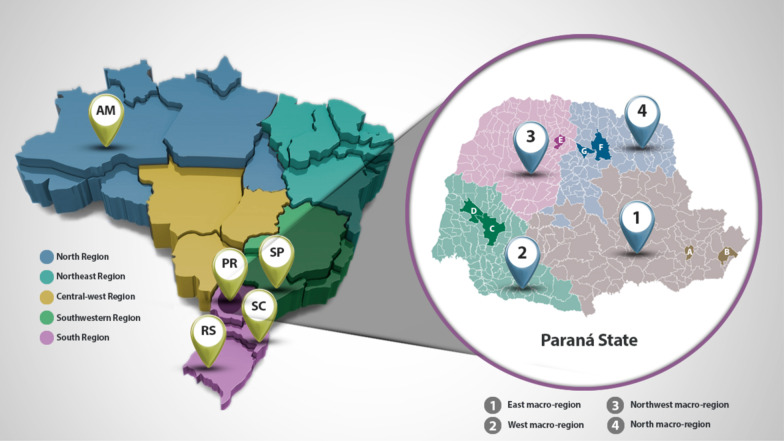
Sampling of SARS-CoV-2-positive patients was performed according to Paraná's Secretary of Health official macroregional division. The map of Brazil is shown on the left. The color code represents the 5 regions of the country. The states of Amazonas (AM), São Paulo (SP), Paraná (PR), Santa Catarina (SC) and Rio Grande do Sul (RS) are indicated. The map of Paraná is shown on the right, and each macroregion was represented by at least one host city, as follows: (1) the east macroregion was represented byCuritiba andParanaguá; (2) the west macroregion was represented byCascavel andToledo; (3) the northwest macroregion was represented byMaringá; and (4) the north macroregion was represented byLondrina andApucarana cities a b c d e f g
SARS-CoV-2 RNA purification and sequencing
Nasopharyngeal and pharyngeal swabs from infected patients (Ct < 25) were suspended in viral transport medium and maintained at -80 °C. Viral RNA was purified from these samples using the QIAamp ViralRNA Purification Kit (Qiagen). The purified RNA was converted to cDNA, and the viral genome was amplified by PCR using the Artic protocol [12]. The genome was sequenced on the Illumina MiSeq platform in the 2x300 bp paired-end configuration. Variants were identified after read mapping in the reference genome for SARS-CoV-2 (RefSeq accession number NC 045512), and the analysis was performed on the Pangolin and Nextclade platforms. This study was approved by the Hospital do Trabalhador/SES/PR Ethics Committee: CAAE 31650020.5.0000.5225.
SARS-CoV-2 genome assembly and variant calling
The bioinformatics analyzes were carried out at the Fiocruz Bioinformatic Platform Highz server (Fiocruz Rio—RPT04). The reads were trimmed with Trimmo matic v0.39 [13] and assembled using the tools SPAdes v3.14.1 [14] and MEGAHIT v1.2.9 [15]. The scaffolds were built with RagTag v1.1.1 [16], ABACAS v1.3.1 [17] using the SARS-CoV-2 isolate Wuhan-Hu-1 as a template (NC 045512 RefSeq). Using this approach, we generated consensus sequences with a mean of 95% coverage (QUAST v5.0.2) [18]. To assign the viral lineages, we used the nomenclature proposed by Ram baut et al [19], using the Pangolin standalone (pangolin v2.4.2 and pangoLEARN 2021-04-28). In parallel, we also assigned the viral lineages using the Nextclade web application (https://clades.nextstrain.org↗).
Phylogenetic analysis
Phylogenetic analyses were performed using the 333 genomes generated as part of the Fiocruz COVID-19 Genomic Surveillance Network but also included other SARS-CoV-2 genomes from the state of Paraná and other states in Brazil that were deposited in the GI SAID (Additional file 8: Appendix S1). We retrieved all high-quality (< 5% of N) complete (> 29 kb) SARS-CoV-2 genomes of lineages B.1.1.28, B.1.1.33, Gamma and P.2 sampled in the state of Paraná, the B.1.1.28 lineage sam pled in the state of Amazonas, and the Gamma vari ant sampled in the states of Amazonas, Santa Catarina, Rio Grande do Sul and from other regions of Brazil that were available on the GISAID [20] as of May 14, 2021. The set of sequences was divided into two datasets: (1) Paraná sequences (n = 396) and (2) Paraná + Out Paraná sequences (n = 354). The two groups of sequences were aligned using MAFFT v7.475 [21]. The datasets were subjected to a maximum likelihood (ML) and a phylogenetic analysis using IQ TREE v2.1.2 [22] under the GTR + G4 + F nucleotide substitution model, and branch support was assessed by the approximate likelihood-ratio test based on the Shimodaira–Hasegawa-like procedure (SH-aLRT) with 1,000 replicates. Trees were visualized on the web application Interactive Tree Of Life (iTOL v5) [23]. To highlight the mutations and categorize them by the frequency, genomic location and effect on protein sequences, we performed single nucleotide polymorphisms (SNPs) analysis with Snippy tools and Coronapp. The SNPs were assessed in each sample using the Wuhan-Hu-1 genome sequence as the reference. The results of the two tools were considered positive when the SNPs observed were predicted in the two tools.
Time-scaled phylogenetic analysis
The time-scale phylogenetic tree was built using the Bayesian Markov Chain Monte Carlo (MCMC) approach implemented in BEAST 1.10.4 with the BEAGLE v3.1.0 library to optimize the computational time. The Bayesian tree was reconstructed using the HKY substitution model and the gamma distribution to account for rate heterogeneity across sites. The tree prior with parameter was set up using the co alescent Bayesian skyline model to create a molec ular clock using the lognormal relaxed-clock model with an exponential substitution rate (8 × 10⁻⁴ sub stitutions/site/year). Two MCMC chains were run for 200 million generations and then were combined to ensure stationarity and good mixing. Convergence (effective sample size > 200) in parameter estimates was assessed using TRACER v1.7.2. The maximum clade credibility (MCC) tree was summarized with TreeAnnotator v1.10.4 ML, and MCC trees were vi sualized using FigTree v1.4.4 [24, 25]. In parallel, we built phylogenetic trees on a time scale with the same SARS-CoV-2 samples using the TreeTime tool with default parameters [26]. The time-scaled phyloge netic tree was performed using 2 sets of the SARS-CoV-2 sequence. In the group 1, the dataset was constructed with up to 3 random sequences from each state in Brazil in each of the months of 2021 (Period 2021-01-01 to 2021-05-14; GISAID). Furthermore, the sequences were identified as the B.1.1.28 lineage from the Amazonas state (n = 15) and the Gamma-like-II lineage genome from different Brazilian states: Paraná (n = 20), Santa Catarina (n = 30), São Paulo (n = 14), Rio de Janeiro (n = 5), Rio Grande do Sul (n = 5), Minas Gerais (n = 3), Espírito Santo (n = 1) and Alagoas (n = 1). In group 2, the dataset was constructed with up to 5 random sequences from the state of Paraná in each month of 2021 (Period 2020- 03-01 to 2021-09-23; GISAID). In addition, the sequences were identified as the Gamma lineage from the Amazonas state (n = 1), the B.1.1.28 lineage genome Paraná (n = 16), Gamma lineage genome Paraná (n = 18) and Gamma-like-II lineage genome Paraná (n = 48—P.1.2 = 18, P.1.3 = 4, P.1.4 = 2, P.1.7 = 20, P.1.9 = 4).
Results
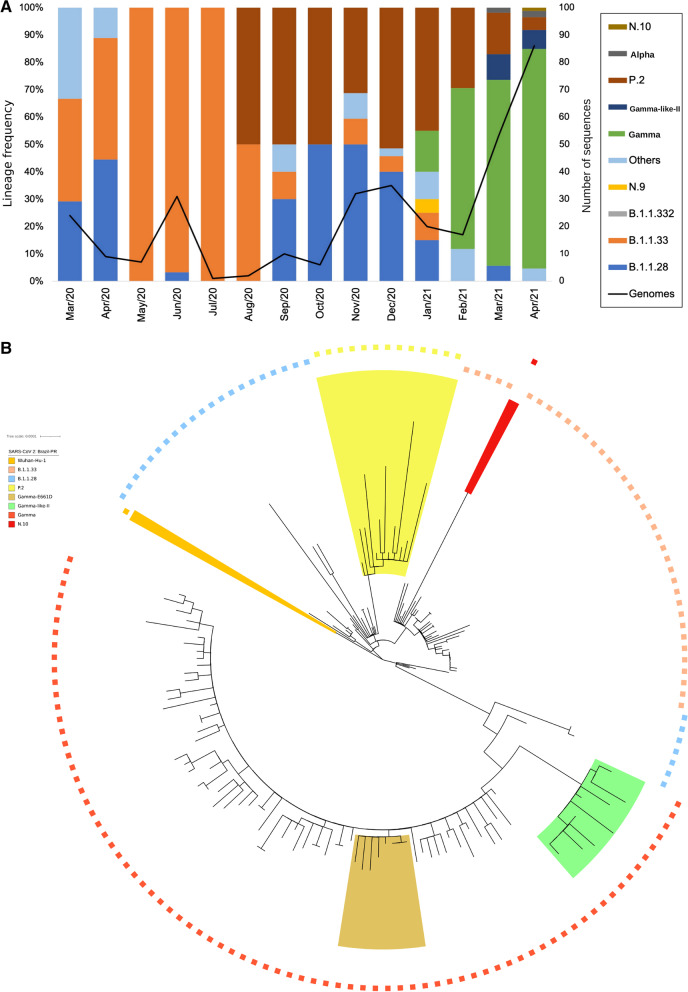
To refine our knowledge about the prevalence of the VOC Gamma in the state of Paraná and its relationship with age strata (patients < 60 or ≥ 60 years old) and clinical severity (mild or severe COVID-19 cases), we selected a cohort of 96 patients who tested positive for COVID-19 (Ct < 25) in April 2021 to sequence the genome of the virus that infected them. Of the 86 genomes successfully sequenced, the variant Gamma was the most frequent (n = 75; 87.2%), followed by the P.2 variant (n = 4; 4.7%) (Additional file 1: Figure S1). The VOC Gamma was predominant in all macroregions, ranging from 58.8% in the western region to 100% in Curitiba (eastern region), and in both age groups (Additional file 1: Figure S1), although a higher diversity of variants was observed in the < 60-year-old stratum (Additional file 3: Figure S3). Regarding the sampling strata established, we did not observe any association between the frequency of the Gamma variant and age group (p value 0.33) or the case severity (p value 0.75) (Additional files 3, 4: Figures S3 and S4) in this cohort.

SARS-CoV-2 variants in Paraná state identified by genome sequencing.Frequency and temporal distribution of the SARS-CoV-2 variant from February 2020 to April 2021. Information on the number of sequenced genomes and identification of variants from February 2020 to February 2021 were retrieved from the website genomahcov.fiocruz.br. The"Genomes" line indicates the number of representative sequences that were used to estimate the variant frequency at each time point.Phylogenetic analysis of SARS-CoV-2 genomes identified in the state of Paraná. High-quality genomic sequences (n < 5%) were aligned using Mafft software in the default configuration. The phylogenetic tree was built using the maximum likelihood method in IQTree software and visualized in IToL. The scale of the phylogenetic branches is given as substitutions per nucleotide site. Each symbol represents a SARS-CoV-2 lineage, as shown in the legend. The lineage N.10 is highlighted in red; the lineage P.2 is highlighted in light yellow; the Gamma-like-II genomes are highlighted in light green; Gamma sequences harboring S:E661D are highlighted in shadow golden and Wuhan-Hu-1 is highlighted in orange a b

Phylogenetic tree of the VOC Gamma strain isolated in the State of Paraná from 2020-03-05 to 2021-04-28. High-quality genomic sequences (n < 5%) were aligned using Mafft software in the default configuration. The phylogenetic tree was built using the maximum likelihood method in IQTree software and visualized in IToL. Phylogenetic tree highlighting the Gamma variant containing the sequences of Amazonas, Santa Catarina and Rio Grande do Sul and closely related sequences, including those of the subclad Gamma-like-II. The aLRT support values are indicated in key branches, and the scale of the phylogenetic branches is given as substitutions per nucleotide site. Each symbol represents a SARS-CoV-2 lineage, as shown in the legend. The lineage N.10 is highlighted in red; the Gamma-like-II genomes are highlighted in light green; Gamma sequences harboring S:E661D are highlighted in shadow golden and Wuhan-Hu-1 is highlighted in orange

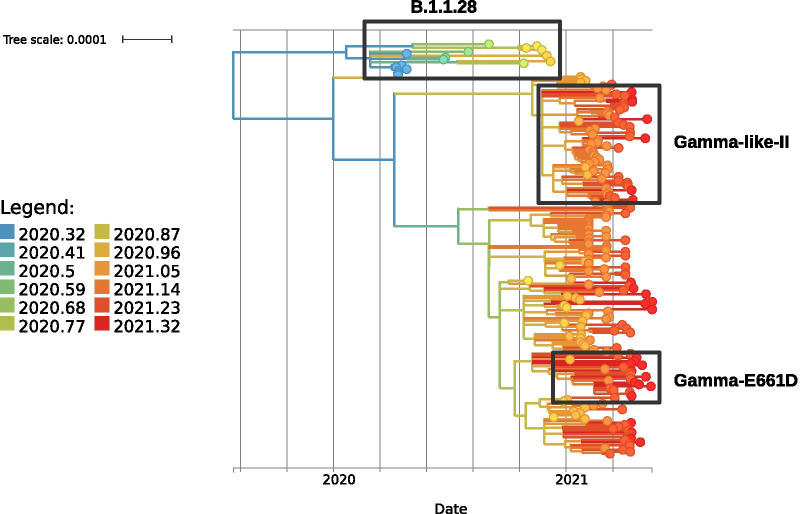
Time-scaled phylogenetic trees of SARS-CoV-2. The picture shows a time-stamped phylogeny of the Gamma lineage in the State of Paraná in comparison with sets of Gamma sequences from the States of Amazonas, Santa Catarina and Rio Grande do Sul. In the figure, the length of the branches corresponds to years and the number of mutations, and these are colored according to the legend of colors. In addition, the SARS CoV-2 reference sequence, the Gamma-like-II sequence and the Gamma sequence group with the spike protein mutation S:E661D are highlighted

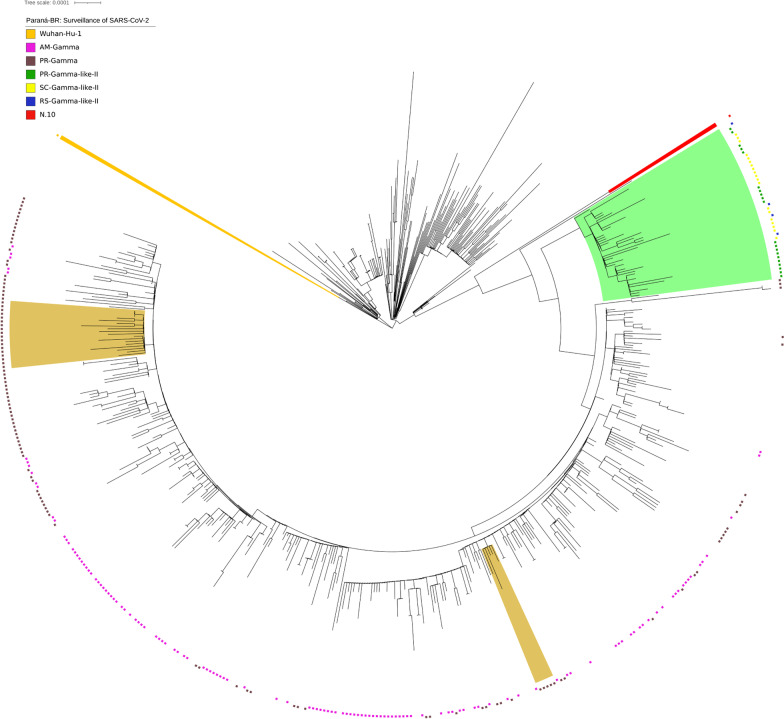
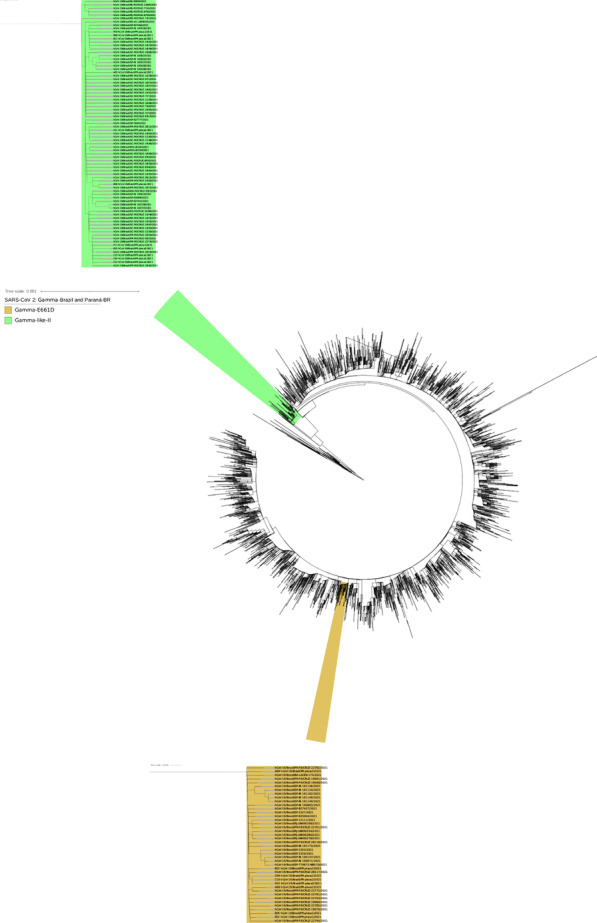
Phylogenetic tree of the Brazilian VOC Gamma. VOC Gamma genomic sequences from all Brazilian states, produced by the Fiocruz genomic network or retrieved from GISAID, were aligned using MAFFT and used to construct a phylogenetic tree. Highlighted in the boxes are the genomes of the Gamma-like-II lineage (green) and the Gamma -E661D mutation (golden). The states from which the sequences originated were represented as PR-Paraná; SC-Santa Catarina; RS-Rio Grande do Sul; SP-São Paulo; RJ-Rio de Janeiro; MG-Minas Gerais; ES-Esp´ırito Santo; AL-Alagoas; BA-Bahia
| Protein | Gamma-PR | Gamma-SC | Gamma-AM | Gamma-RS | |||||||
|---|---|---|---|---|---|---|---|---|---|---|---|
| C09 | D01 | A09 | A08 | E09 | C10 | E02 | E03 | ||||
| N | P80R | P80R | P80R | P80R | P80R | P80R | P80R | P80R | P80R | P80R | P80R |
| R203K | R203K | R203K | R203K | R203K | R203K | R203K | R203K | R203K | R203K | R203K | |
| G204R | G204R | G204R | G204R | G204R | G204R | G204R | G204R | G204R | G204R | G204R | |
| ORF1a | S1188L | S1188L | S1188L | S1188L | S1188L | S1188L | S1188L | S1188L | S1188L | S1188L | S1188L |
| K1795Q | K1795Q | K1795Q | K1795Q | K1795Q | K1795Q | K1795Q | K1795Q | K1795Q | K1795Q | K1795Q | |
| ORF1b | P314L | P314L | P314L | P314L | P314L | P314L | P314L | P314L | P314L | P314L | P314L |
| E1264D | E1264D | E1264D | E1264D | E1264D | E1264D | E1264D | E1264D | E1264D | E1264D | E1264D | |
| ORF3a | S253P | S253P | S253P | S253P | S253P | S253P | S253P | S253P | S253P | S253P | S253P |
| ORF8 | E92K | E92K | E92K | E92K | E92K | E92K | E92K | E92K | E92K | E92K | E92K |
| ORF9b | Q77E | Q77E | Q77E | Q77E | Q77E | Q77E | Q77E | Q77E | Q77E | Q77E | Q77E |
| Spike | L18F | L18F | L18F | L18F | L18F | L18F | L18F | L18F | L18F | L18F | L18F |
| T20N | T20N | T20N | T20N | T20N | T20N | T20N | T20N | T20N | T20N | T20N | |
| P26S | P26S | P26S | P26S | P26S | P26S | P26S | P26S | P26S | P26S | P26S | |
| D138Y | D138Y | D138Y | D138Y | D138Y | D138Y | D138Y | D138Y | D138Y | D138Y | D138Y | |
| R190S | R190S | R190S | R190S | R190S | R190S | R190S | R190S | R190S | R190S | R190S | |
| K417T | K417T | K417T | K417T | K417T | K417T | K417T | K417T | K417T | K417T | K417T | |
| E484K | E484K | E484K | E484K | E484K | E484K | E484K | E484K | E484K | – | E484K | |
| N501Y | N501Y | N501Y | N501Y | N501Y | N501Y | N501Y | N501Y | N501Y | – | N501Y | |
| D614G | D614G | D614G | D614G | D614G | D614G | D614G | D614G | D614G | D614G | D614G | |
| H655Y | H655Y | H655Y | H655Y | H655Y | H655Y | H655Y | H655Y | H655Y | H655Y | H655Y | |
| E661D | E661D | E661D | E661D | E661D | E661D | E661D | E661D | – | – | – | |
| T1027I | T1027I | T1027I | T1027I | T1027I | T1027I | T1027I | T1027I | T1027I | T1027I | T1027I | |
| V1176F | V1176F | V1176F | V1176F | V1176F | V1176F | V1176F | V1176F | V1176F | V1176F | V1176F | |
Discussion
In this work, we performed an analysis of the evolution of the SARS-CoV-2 pandemic in the state of Paraná, southern Brazil. Our study was based on 333 genomes identified between March 2020 and April 2021 by the Genomic Surveillance Network from Fiocruz and other sequences available in the GISAID database (Additional file 8: Appendix S1). As in other Brazilian states, the year 2020 was marked by the predominance of the variants B.1.1.28 and B.1.1.33 and, from August 2020 onwards, by the VOI P.2 [3, 4]. From January 2021 and in subsequent months, the VOC Gamma emerged in the state and spread fast, reaching 87.2% of all genomes in April 2021. No other variant introduced in Brazil has thus far reached such high prevalence values in the state of Paraná. This may be related to the low social isolation rates observed in Paraná, as well in Brazil, during the COVID-19 pandemic [29 –31]. Our analysis reveals that the Gamma variant, first identified in January 2021 in Japanese travelers returning from a trip to the Amazon [5], was already circulating in the state of Paraná by that time.
Additionally, in January 2021, genomes of the VOC Alpha, which are dominant in the United Kingdom [32], were identified in the state of Paraná. Despite the presence of two VOCs in the state of Paraná, it is noticeable that variant Alpha did not replace the most frequent variant or even spread in the state and remained at low frequencies. The dominance of the Gamma variant, even in the presence of another VOC, may be related to the fact that Gamma variant infections are associated with higher viral loads in the upper respiratory tract when compared to non Gamma variant patients [8].
A study conducted in the United Kingdom that evaluated the relationship between the Alpha variant and case severity estimated that the risk of death associated with Alpha is 61% higher than that associated with pre-existing non-VOC lineages [33]. In this study, the presence of the Alpha variant was confirmed by PCR based on S gene amplification failure instead of the complete genome. In our study, we analyzed whether the incidence of the Gamma variant would be related to different age groups or clinical condition strata based on a specific cohort composed of 86 samples from April 2021 that were completely sequenced. Our results did not reveal an association between the Gamma variant prevalence, age range and severity. The Gamma variant was dispersed in all groups with similar severity indices; however, we emphasize that in our April cohort, the Gamma-like-II lineage was identified only in patients under the age of 60 years.
We evaluated the severity of the gamma variant by analyzing samples from a cohort of 86 patients. These samples were classified based on the laboratory of origin. From the LACEN lab oratory, samples were obtained from patients who needed to be admitted to a hospital. From the LAC, outpatient samples were obtained and represent mild cases. According to this specific study, the gamma variant is not associated with severity (p value 0.75). Therefore, we infer, based on the available data, that the Gamma variant may not be related to a higher severity of COVID-19, although further studies should be carried out to carefully explore this issue. A limitation of our study includes the possibility of follow-up the clinical outcome of the patients in the cohort.
Our phylogenetic analysis performed with the Gamma variant genomes identified in the state of Paraná and in the other states of Brazil showed that the recently described lineage Gamma-like-II [11] was also present at moderate frequencies in the state of Paraná (Figs. 3 and 5). The Gamma-like-II lineage presents 15 of the 22 mutations of the Gamma variant, including the three main mutations in the RBD domain of the S protein: K417T, E484K and N501Y. On the other hand, they present some unique substitutions: ORF1ab:C8905T, C16954T and A20931G; NSP4:D2980H, intergenic region E/M A26492T and N:P383L. The analysis of the mutations in the first 11 Gamma-like-II genomes from Paraná identified 3 of the 4 unique substitutions of the Gamma-like-II lineage (C8905T, C16954T, A26492T) in addition to the N:P383L and ORF1a:D2980H mutations. However, we also identified some unique substitutions, which were not yet described, for the Gamma variant and Gamma-like-II lineage, and these substitutions in cluded ORF1a:P1213 L and ORF1b:K23240N, which appeared in 45% of the genomes (Additional file 7: Table S2). Our results, in agreement with the initial study [8, 11], show that the VOC Gamma and the Gamma-like-II lineages diverged from a common ancestor that contained some, but not all, of the defining mutations found in the Gamma variant. Among the main mutations common between the two groups, we highlight those that occur in the S protein: S:E484K, S:N501Y and S:D614G. This hypothesis also justifies the absence of other mutations in the S protein, such as S:T20N, in the Gamma-like-II lineage. Our phylogenetic analysis over time showed that the Gamma-like-II lineage emerged between 2 and 4 months later than the Gamma variant. Interestingly, unlike the VOC Gamma, the Gamma-like-II lineage genomes were not dispersed throughout the state of Paraná but were clustered in western Paraná (represented by the host cities, Toledo and Cascavel). Particularly in this region, we found the lowest VOC Gamma frequency of the state, while the Gamma-like-II lineage genomes accounted for almost 30% of the samples sequenced in the cohort study in April 2021. Conversely, the phylogenetic analysis supports a local transmission of the Gamma-like-II lineage in Paraná. To date, Santa Catarina is the Brazilian state where the largest number of the Gamma-like-II lineage genomes has been identified: 30 in total, which corresponds to 71% of the genomes of that state that were previously classified as the Gamma variant by WHO/PANGO (Fig. 5). Of this, 20 Gamma-like-II representatives were identified in the city of Chapecó, which is also located in the western region, approximately 360 km from Toledo and Cascavel. For instance, in February 2021, Chapecó was responsible for the largest outbreak of COVID-19 in the state of Santa Catarina [34]. According to our tree-scaled analysis (Fig. 4), the emergence of the Gamma-like-II lineages in the state of Paraná is estimated to occur at the same time as the appearance of the Gamma-like-II lineages in Santa Catarina. On the other hand, the Gamma-like-II lineages from the other states (São Paulo, Minas Gerais, Alagoas, Espírito Santo) appeared after the variants observed in Paraná and Santa Catarina. These data, together with genomic surveillance information, reinforce the hypothesis that the Gamma-like-II lineage may have arisen in the western area of the state of Santa Catarina. It is possible that the Gamma-like-II lineage may have emerged during the outbreak in the city of Chapecó and initially spread to the western region of Paraná, which could explain the localized expansion of the Gamma-like-II lineage. This result suggests that, unlike the Alpha variant that failed to establish a prevalence in the state and despite having emerged after the VOC Gamma, the constellation of mutations of the Gamma-like-II lineage allowed it to increase in frequency and then cocirculate with the Gamma variant in some specific geographic regions. During the phylogenetic analysis, we noticed that a group formed by 8 genomes from the state of Paraná stood out. Analysis of this group of genomes, classified as belonging to the Gamma variant, revealed the presence of an additional mutation in the S protein (S:E661D). A genomic surveillance study carried out in the United Kingdom identified the S:E661D mutation in viral genomes; however, they were at an extremely low frequency, because 6 genomes out of 142,859 were identified [35]. In our study, the E661D mutation appeared at a much higher frequency and occurred in the Gamma variant, which already has a high number of mutations. We also looked for the presence of this mutation in other Gamma variant genomes from Brazil deposited in the GISAID. We verified the existence of 46 Brazilian Gamma variant genomes with the S:E661D mutation, 20 of which were identified in April 2021. However, our attention was drawn to the high frequency of this mutation in genomes in the state of Paraná, which occurred in 11.35% of the Gamma variant genomes. In comparison, the second state with the highest frequency of the S:E661D mutation was Minas Gerais, with 2.94%. Notably, the S:E661D mutation was not detected throughout the state of Paraná but was observed specifically in northern Paraná, as well as in the capital Curitiba, which accounted for nearly 25% of the Gamma variant genomes. Conversely, the phylogenetic analysis revealed clusterization of the Gamma genomes harboring S:E661D mutation as a function of the state from which the samples were collected, indicating that this mutation had not occurred randomly, but this mutation happened systematically in some geographical regions (Fig. 5).
Cheng and coworkers [36] used structure-based computational models to demonstrate that the SARS-CoV-2 S protein exhibits a high affinity motif for binding to T cell receptors [36]. This predicted motif extends from the amino acid residues E661 to R685 of the S protein. Despite the amino acid change, the E661D mutation maintained the acidic character of the motif, suggesting that this feature may be important for the function of the protein. Additionally, the comparison of the predicted superantigenic region of the SARS-CoV-2 S protein with the same region within bacterial superantigenic proteins showed that there is conservation of aspartic acid residues in bacterial proteins. Although there is no evidence regarding this additional mutation on any aspect of the biology of the virus, it is noteworthy that mutations in the S protein are frequently associated with altered viral fitness and/or immune evasion. For example, the D614G substitution enhanced viral stability and infectivity [37], and the E484 mutation in the receptor-binding domain (RBD) conferred a partial resistance of SARS-CoV-2 to neutralizing antibodies [38]. Our results reinforce the importance of genomic vigilance to track possible novel VOIs that may arise from the current scenario of low vaccination rates and uncontrolled dissemination of SARS-CoV-2 in Brazil, as previously documented [39]. In addition, there are currently 11 Gamma sublines that are accumulating new mutations near the furin cleavage site, among them the E661D described in this work [40].
The classification of genomes into variants performed by Nexclade and Pangolin revealed the presence of an N.10 variant genome in the state of Paraná (N.10-PR). Variant N.10, identified in samples from the Brazilian state of Maranhão, is considered a VOI due to the set of mutations it carries, mainly in the S protein (26). However, unlike the N.10 variant originally described (N.10-MA), the N.10-PR variant has the S:W152C mutation in addition to the other mutations previously described. The S:W152C mutation was initially described in the VOI B.1.429 (CAL.20C), which was identified in the state of California, United States (Additional file 6: Table S1). The importance of the S:W152C mutation is the fact that the NTD is a target for neutralizing antibodies [41]. The VOI B.1.429, which also has a very important S:L452R mutation [38], was identified in California, and to date, there are no reports that it has arrived in Brazil [42, 43]. The other mutations identified in the B.1.429 variant, with the exception of S:D614G, do not match the N.10-PR variant. These results suggest that the N.10-PR S:W152C mutation occurred independently in this variant and has no relation with the VOI B.1.429. The B.1.429 variant has been extensively studied for its infective capacity and binding to neutralizing antibodies. The infective capacities of mutations occurring in the B.1.429 variant were investigated using pseudoviruses carrying the D614G mutation together with the L452R or W152C mutations infected in 293 T cells expressing the ACE2 receptor as well as the cofactor TMPRSS2 [44]. Although the results show an increase in infectivity close to 20-fold for the D614G/L452R protein, the increase in infectivity for D614G/W152C was fourfold when compared to the S protein containing only the D614G mutation [44]. A neutralizing antibody activity study using convalescent serum from patients or serum from vaccinated individuals showed a 3–sixfold reduction against the B.1.429 variant, and furthermore, the neutralizing activity of mAbs targeting NTD was completely blocked due to the combined mutations S:S13I and S:W152C in that domain [43]. Additional information from the GISAID (GISAID—2021–06-01) showed that the S:W152C mutation emerged 41,272 times (2.38% of all samples with spike sequences) in 39 countries. The first strain with this change, collected in July 2020, was hCoV-19/Mexico/ROO-InDRE 243/2020. The most recent occurred in strain hCoV-19/USA/KS KHEL-1975/2021, collected in May 2021, but none of them were identified in Brazil according to the GISAID data. The concern with this N.10-PR variant is the emergence of the S:W152C mutation, and several studies have already showed its relevance to the biology of SARS-CoV-2 due to its S protein that has already accumulated important mutations such as S:V445A, S:E484k and S:D614G. At this point, the N.10-PR variant has as many mutations in the S protein as the VOCs Alpha and B.1.645, which are seven in total.
Conclusion
A genomic survey from March 2020 onwards in the state of Paraná state, which is based on 333 SARS CoV-2 genomes, allowed us to map the entire dynamics of detection frequency of variants in the state of Paraná since the beginning of the pandemic. This work represents the most complete SARS-CoV-2 genomic surveillance study carried out in the state of Paraná. A phylogenetic analysis revealed that a group of genomes branched into a monophyletic clade, identified as the Gamma-like-II lineage, which probably emerged between February and March 2021. The Gamma-like-II lineage was proportionally more frequently detected in the state of Santa Catarina, which borders the state of Paraná. Interestingly, unlike other lineages, the prevalence of the Gamma-like-II variant in Paraná was not negatively affected by the advancement of the Gamma variant during the period analyzed. We also detected the occurrence of an additional mutation S:(E661D) in the Gamma variant genomes. Finally, having the laboratory of origin of the samples as a parameter, we did not detect a relationship between the Gamma variant, age group and case severity.
Supplementary Information
Additional file 1: Figure S1. SARS-CoV-2 variants identified in Paraná state in April 2021.Additional file 2: Figure S2. Distribution of SARS-CoV-2 variants identified in April 2021, according to macroregions of Paraná state.Additional file 3: Figure S3. SARS-CoV-2 variants identified in Paraná state in April 2021 by age group.Additional file 4: Figure S4. SARS-CoV-2 variants identified at Paraná state in April 2021 by clinical severity at the moment of sample collection (LAC: mild cases; LACEN: severe cases).Additional file 5: Figure S5. The picture shows a time-stamped phylogeny of the B.1.1.28 lineage, Gamma and Gamma like-II lineages in the State of Paraná. In the figure, the length of the branches corresponds to years and the number of mutations, and these are colored according to the legend of colors. In addition, the Gamma genome from the state of Amazonas, the Gamma genomes from Paraná and the group of Gamma-like-II sequences are highlighted. List S1: Number and source of SARS-CoV-2 genomes used in this study.Additional file 6: Table S1. Nonsynonymous mutations described for VOIs N.10-PR, N.10-MA and B.1.429.Additional file 7: Table S2. Nonsynonymous mutations described for Gamma-like-II.Additional file 8: Appendix S1. GISAID acknowledgment file.