
What this is
- Spinal cord ischemia-reperfusion injury (SCIRI) can lead to severe neurological deficits.
- , a form of regulated cell death, is implicated in SCIRI's pathophysiology.
- Heme oxygenase 1 (HMOX1) promotes through excessive via its interaction with BNIP3.
- Targeting HMOX1 may offer therapeutic potential for SCIRI.
Essence
- is a key mechanism in spinal cord ischemia-reperfusion injury, with HMOX1 acting as a central regulator that promotes this process through excessive . The interaction between HMOX1 and BNIP3 is crucial, suggesting HMOX1 as a potential therapeutic target.
Key takeaways
- contributes significantly to SCIRI pathogenesis. HMOX1's upregulation after injury activates excessive , leading to neuronal death.
- HMOX1 knockdown in rats improved neurological recovery by reducing and excessive , indicating its detrimental role in SCIRI.
- BNIP3 is identified as an interacting partner of HMOX1, enhancing and , which underscores the importance of this interaction in neuronal injury.
Caveats
- The study lacks clinical specimen data due to the unavailability of human spinal cord tissues, limiting translational insights.
- The in vitro OGD/R model may not fully replicate the complex microenvironment of SCIRI, potentially affecting the generalizability of findings.
Definitions
- Ferroptosis: A regulated form of cell death characterized by iron-dependent accumulation of reactive oxygen species and lipid peroxidation.
- Mitophagy: A selective autophagy process that removes damaged mitochondria to maintain cellular health.
Simplified
Introduction
Spinal cord ischemia-reperfusion injury (SCIRI) is a condition that can cause severe sensory and motor dysfunction [1]. SCIRI frequently occurs as a complication of thoracic and abdominal aortic surgeries and may also be associated with spinal trauma and intradural tumors [2]. SCIRI may cause permanent spinal cord dysfunction, including paraplegia or mortality, without timely intervention [3]. Therefore, identifying modifiable risk factors for spinal cord repair is essential.
Ferroptosis is a non-apoptotic cell death modality characterized by toxic reactive oxygen species (ROS) accumulation and lipid peroxidation [4 –6]. Emerging evidence implicates ferroptosis in numerous diseases, particularly as a therapeutic target in cancer and ischemic organ injury [7 –9]. Inhibition of ferroptosis in animal models of traumatic spinal cord injury (SCI) enhanced functional recovery [10 –12]. However, the role of ferroptosis in SCIRI remains poorly understood.
Mitochondria are critical organelles that maintain cellular homeostasis [13]. Their vulnerability to damage can lead to dysfunction and disruption of cellular homeostasis, requiring prompt repair or elimination [14]. Mitophagy, a selective form of autophagy, provides quality control by eliminating dysfunctional mitochondria [15, 16]. Growing evidence indicates that moderate mitophagy can sequester iron to mitigate ferroptosis, while excessive mitophagy may provide additional iron to exacerbate it [17, 18]. BNIP3 is a hypoxia-induced mitophagy protein that may drive excessive mitophagy and cell death, whereas NIX mainly regulates basal mitophagy [19, 20]. For instance, the lncRNA SNHG14 has been shown to induce excessive mitophagy in HT22 cells via the microRNA-182-5p/BNIP3 axis [21].
Hemoglobin oxygenase 1 (HMOX1) is an inducible enzyme that oxidizes hemoglobin within cells to release biliverdin, carbon monoxide and free ferrous iron (Fe²⁺) [22]. HMOX1 may exert protective effects on cells by converting the pro-oxidant hemoglobin into the antioxidant biliverdin. Alternatively, it may release large amounts of Fe²⁺ directly into the mitochondrial iron pool, thereby catalyzing ROS production, driving lipid peroxidation and inducing ferroptosis. Therefore, HMOX1 acts as a double-edged sword, providing protection or enhancing cellular vulnerability [23 –25]. Elevated HMOX1 expression has been linked to neuronal damage and neurodegeneration in Alzheimer's and Parkinson's disease [26]. Therefore, the exact protective or damaging role of HMOX1 in SCIRI needs to be further clarified, as this could lead to potential therapeutic strategies for treating SCIRI.
In this study, we found that ferroptosis is closely associated with SCIRI and that HMOX1 plays a key role in regulating ferroptosis. SCIRI-induced HMOX1 upregulation activates excessive mitophagy through interaction with BNIP3, ultimately triggering iron-dependent ferroptosis. Collectively, this study demonstrates that HMOX1 is a critical contributor to SCIRI pathogenesis and may represent a potential therapeutic target.
Results
Ferroptosis in the SCIRI rat model with increased HMOX1 expression levels

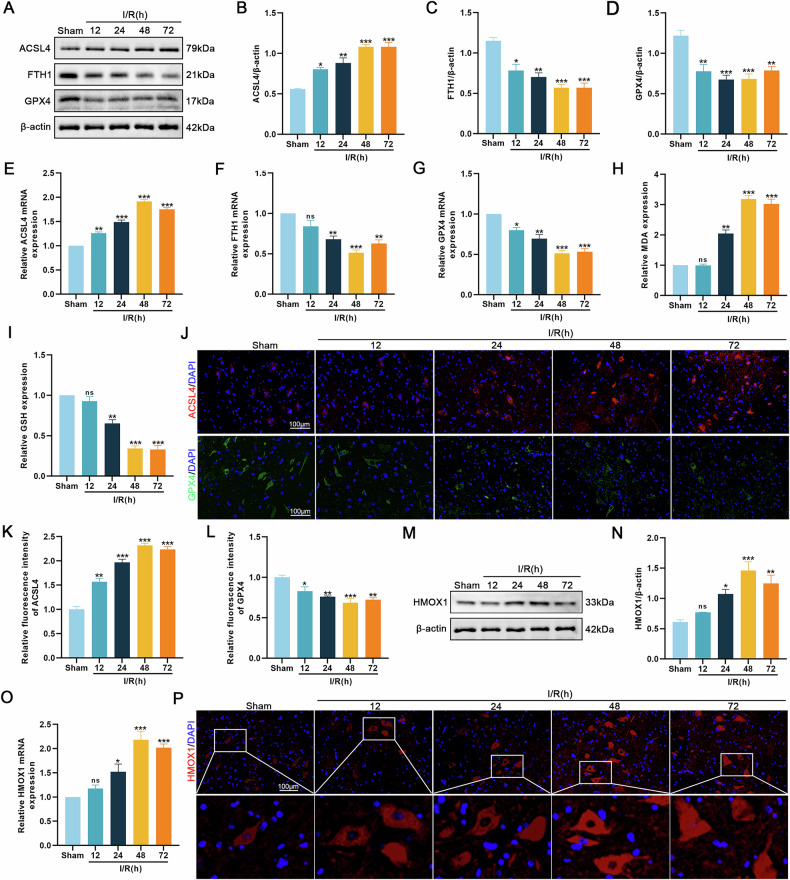
Ferroptosis occurs after SCIRI and HMOX1 expression level is increased. Rat spinal cords were subjected to I/R injury (I: 45 min; R: 12, 24, 48, or 72 h) or sham surgery.Western blotting analysis of ferroptosis-related proteins (ACSL4, FTH1, GPX4) in rat spinal cord tissues ( = 3).qRT-PCR analysis of mRNA expression of ferroptosis-related proteins ( = 3).,Determination of relative levels of MDA and GSH ( = 6).Immunofluorescence staining was used to detect the levels of ACSL4 and GPX4 ( = 6).,Detection of HMOX1 protein and mRNA levels after SCIRI using western blotting and qRT-PCR ( = 3).Immunofluorescence assay to detect HMOX1 expression after SCIRI ( = 6). Compared with the sham group, * < 0.05, ** < 0.01, *** < 0.001. A–D E–G H I J–L M O P n n n n n n P P P
Ferroptosis was observed in the OGD/R model, concomitant with increased HMOX1 expression levels
We further examined the changes in HMOX1 expression following OGD/R treatment. Both the western blotting and qRT-PCR results demonstrated that HMOX1 protein and mRNA levels increased significantly, peaking at 6 h of deprivation followed by 24 h of reoxygenation (Fig. 2N–P). The immunofluorescence results were consistent with these findings (Fig. 2Q). These data indicate that OGD/R injury triggers ferroptosis in PC12 cells, accompanied by upregulation of HMOX1.

OGD/R treatment induced ferroptosis and increased HMOX1 expression in PC12 cells. PC12 cells were treated with OGD/R (OGD: 2, 4, 6, or 8 h; R: 24 h) or control.Western blotting analysis of ferroptosis-related proteins ( = 3).qRT-PCR analysis of mRNA expression of ferroptosis-related proteins ( = 3).CCK-8 assay of cell viability at various OGD/R time points ( = 6).FerroOrange and C11 BODIPY fluorescent probes measured Fe²⁺ and lipid peroxidation levels ( = 6).,The relative values of MDA and GSH concentrations were determined ( = 6).Western blotting and qRT-PCR analysis of HMOX1 protein and mRNA expression ( = 3).Immunofluorescence analysis of HMOX1 expression ( = 6). Compared with the control group, * < 0.05, ** < 0.01, *** < 0.001. A–D E–G H I–K L M N–P Q n n n n n n n P P P
HMOX1 upregulation promotes ferroptosis

HMOX1 promotes ferroptosis in vitro. PC12 cells were transfected with LV-shHMOX1 or LV-HMOX1.,Western blotting and qRT-PCR analysis of the most effective knockdown sequences ( = 3).,Western blotting and qRT-PCR analysis of HMOX1 expression post-LV-HMOX1 transfection ( = 3).Western blotting analysis of ferroptosis-related protein expression in OGD/R (OGD: 6 h; R: 24 h) and Erastin (2 μM, 24 h) treated cells ( = 3).,Quantification of MDA and GSH levels in OGD/R and Erastin treated cells ( = 6).FerroOrange and C11-BODIPY staining were used to detect the levels of intracellular Fe²⁺ and lipid peroxidation ( = 6). * < 0.05, ** < 0.01, *** < 0.001. A B C D E–H I J K–P n n n n n P P P
HMOX1 interacts with BNIP3

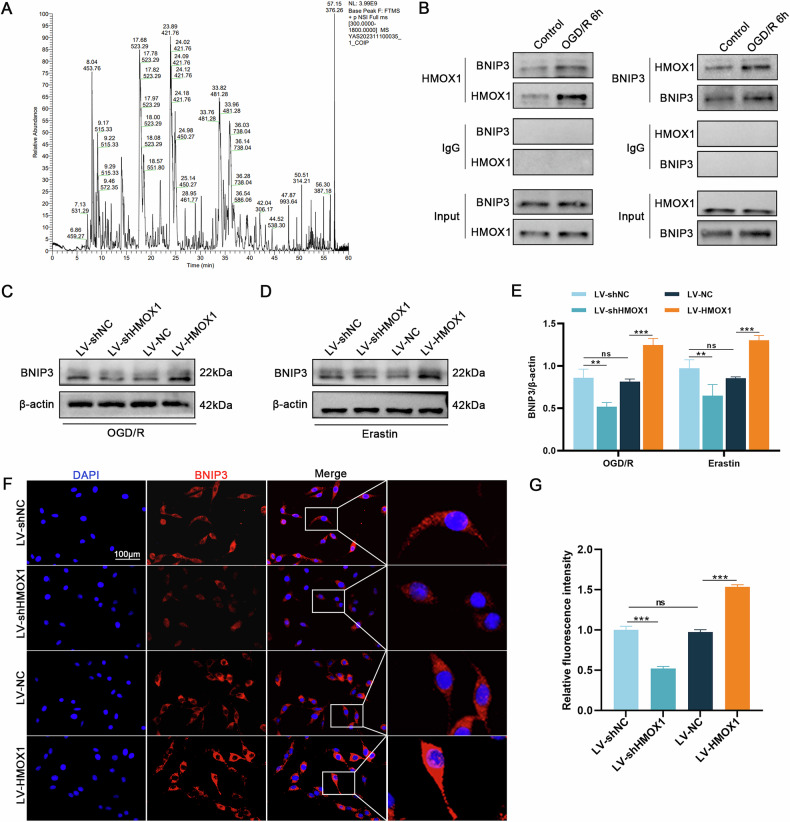
HMOX1 and BNIP3 interactions. IP/MS analysis identified HMOX1-interacting proteins. BNIP3 was identified as an HMOX1-interacting protein.Co-IP assessed endogenous protein interactions in PC12 cell lysates under physiological conditions or post-OGD/R (OGD: 6 h; R: 24 h). Immunoprecipitation with anti-HMOX1 or anti-IgG antibodies, followed by immunoblotting with anti-BNIP3, was performed. Conversely, immunoprecipitation with anti-BNIP3 or anti-IgG, followed by immunoblotting with anti-HMOX1, confirmed endogenous interactions ( = 3).Western blotting analysis of BNIP3 expression in OGD/R (OGD: 6 h; R: 24 h) and Erastin (2 μM, 24 h) treated cells ( = 3).,Immunofluorescence analysis of BNIP3 expression post-HMOX1 knockdown and overexpression ( = 6). * < 0.05, ** < 0.01, *** < 0.001. A B C–E F G n n n P P P
HMOX1-induced ferroptosis is associated with mitophagy activation
Next, we assessed mitophagy flux. P62 immunofluorescence and TOMM20/LC3 co-staining results aligned with the immunoblotting data (Fig. 5G–J). MMP measurements showed a substantial decrease following HMOX1 overexpression, whereas HMOX1 knockdown restored MMP (Fig. 5K, L). Finally, transmission electron microscopy confirmed that HMOX1 knockdown reduced autophagosome formation, while HMOX1 overexpression increased it (Fig. 5M, N). These findings support the hypothesis that HMOX1 and BNIP3 interact to trigger the activation of excessive mitophagy.

HMOX1 is associated with excessive activation of mitophagy. Western blotting analysis of mitophagy-related proteins (P62, COXIV, TOMM20, LC3) in OGD/R-treated cells (OGD: 6 h; R: 24 h) post-LV-shHMOX1 and LV-HMOX1 transfection ( = 3).Western blotting analysis of mitophagy-related protein expression post-HMOX1 knockdown or overexpression with rapamycin or mdivi-1 intervention ( = 3).Immunofluorescence staining validated P62 expression and TOMM20/LC3 co-localization ( = 6).,JC-1 staining analysis of changes in MMP across groups ( = 6).,Transmission electron microscopy analysis of autophagosome numbers across groups ( = 6). * < 0.05, ** < 0.01, *** < 0.001. A, B C–F G–J K L M N n n n n n P P P
BNIP3 overexpression reverses ferroptosis following HMOX1 knockdown
Next, we investigated the changes in ferroptosis. Western blotting revealed that the OGD/R + LV-shHMOX1+LV-BNIP3 group exhibited upregulated ACSL4 expression and downregulated FTH1 and GPX4 expression, which was counteracted by mdivi-1 treatment (Fig. 6H, I). Similarly, LV-shHMOX1+LV-BNIP3 treatment elevated MDA levels and reduced GSH levels, both of which were normalized by mdivi-1 administration (Fig. 6J). Mito-FerroGreen is a fluorescent probe designed specifically to detect Fe2+ in mitochondria. FerroOrange, Mito-FerroGreen, and C11 BODIPY staining were consistent with the above findings. Specifically, the overexpression of BNIP3 following HMOX1 knockdown increased mitochondrial Fe2+ levels and induced lipid peroxidation. This effect could be reversed by mdivi-1 (Fig. 6K–P). These findings demonstrate that BNIP3-mediated mitophagy contributes significantly to HMOX1-induced ferroptosis in neuronal cells.

HMOX1 interacts with BNIP3 to regulate ferroptosis through the process of mitophagy. PC12 cells were transfected with LV-BNIP3, which was based on LV-shHMOX1, and then treated with either the iron chelator DFO or the mitophagy inhibitor mdivi-1.,The expression of ACSL4, FTH1, BNIP3, and LC3 was analysed using western blotting after DFO intervention ( = 3).Detailed information on the experimental group in this part of the experiment.Western blotting analysis of mitophagy-related proteins ( = 3).,JC-1 staining assessed MMP changes ( = 6).,Western blotting analysis of ferroptosis-related proteins ( = 3).Quantification of MDA and GSH levels in OGD/R-treated PC12 cells ( = 6).FerroOrange, Mito-FerroGreen, and C11 BODIPY probes were used to assess intracellular and mitochondrial Fe²⁺ levels and lipid peroxidation levels ( = 6). * < 0.05, ** < 0.01, *** < 0.001. A B C D, E F G H I J K–P n n n n n n P P P
HMOX1 knockdown promotes neurological recovery in rats after SCIRI

HMOX1 knockdown promotes neurological function recovery after SCIRI. Immunofluorescence staining of HMOX1 expression in spinal cord tissues post-SCIRI (I: 45 min; R: 48 h) ( = 6).,Western blot analysis of HMOX1 expression across groups ( = 3).Results of BMS scores of rats after SCIRI ( = 6).Neurophysiological evaluation via SEP and MEP (arrow indicates evoked potential onset) ( = 6).Quantitative analysis of SEP and MEP latency and amplitude ( = 6).Representative HE staining of spinal cord tissues across groups post-SCIRI ( = 6).Representative LFB staining of spinal cord tissues across groups post-SCIRI ( = 6).Representative immunofluorescence staining of NeuN in spinal cord tissues across groups post-SCIRI ( = 6). * < 0.05, ** < 0.01, *** < 0.001. A B C D E F–I J K L n n n n n n n n P P P
HMOX1 knockdown inhibits ferroptosis and excessive mitophagy in SCIRI rats

HMOX1 knockdown inhibits ferroptosis and excessive mitophagy in SCIRI rats. ,Z-VAD-FMK intervention was administered to rats with HMOX1 knockdown, and the expression of ACSL4, GPX4, and cleaved caspase 3 was analyzed by western blotting ( = 3).,Western blotting analysis of ferroptosis-related protein expression ( = 3).Immunofluorescence staining validated ACSL4 and GPX4 expression ( = 6).Western blotting analysis of mitophagy-related protein expression ( = 3).Immunofluorescence staining assessed BNIP3 expression and TOMM20/LC3 co-localization ( = 6). * < 0.05, ** < 0.01, *** < 0.001. A B C D E–H I–L M–P n n n n n P P P
Discussion
In this study, we establish that ferroptosis contributes to the pathogenesis of SCIRI and, for the first time, demonstrate that HMOX1 knockdown suppresses ferroptosis and excessive mitophagy, thereby promoting neurological recovery in rats. HMOX1 was found to interact with BNIP3, modulating the mitophagy pathway, promoting excessive mitophagy activation, and leading to ferroptosis. Thus, HMOX1 has been proposed as a potential therapeutic target for SCIRI.
HMOX1 primarily exerts protective effects on cells [32]. However, emerging evidence suggests that excessive HMOX1 expression may be detrimental [24, 25, 33]. The overexpression of HMOX1 increases the levels of unstable intracellular Fe²⁺, thereby promoting ferroptosis [34, 35]. Bioinformatics analysis revealed elevated HMOX1 expression and ferroptosis in SCIRI. We confirmed the expression of ferroptosis-related proteins and HMOX1 in vivo, as well as the occurrence of ferroptosis and markedly elevated HMOX1 expression following SCIRI. Immunofluorescence revealed predominant HMOX1 expression in neuronal cells, indicating its role in neuronal damage. To further elucidate the role of HMOX1 in ferroptosis during SCIRI, we employed HMOX1 knockdown in vivo, effectively inhibited ferroptosis and promoted neurological function recovery in rats following SCIRI. These findings suggest that HMOX1 promotes ferroptosis and impairs spinal cord function recovery in SCIRI rats.
To elucidate the mechanism of HMOX1-induced ferroptosis, we identified BNIP3 as a novel interacting protein using IP/MS and Co-IP techniques. Immunoblotting and immunofluorescence analyses demonstrated that HMOX1 modulates BNIP3 expression, with HMOX1 knockdown reducing BNIP3 levels and HMOX1 overexpression producing the opposite effect, indicating a positive correlation between HMOX1 and BNIP3. As a critical mitophagy receptor, BNIP3 may selectively induce excessive mitophagy, resulting in cell death [20]. Thus, the interaction between HMOX1 and BNIP3 may constitute a pivotal mitophagy regulatory mechanism.
Mitophagy is a critical mechanism that regulates mitochondrial function and cellular homeostasis [15]. Recent studies have established a strong correlation between ferroptosis and mitophagy [18, 36]. Mitophagy sequesters iron within mitochondrial autophagosomes, under mild stress or early iron overload conditions, thereby attenuating ferroptosis. However, excessive activation of mitophagy may provide additional iron, thereby aggravating ferroptosis [17]. We revealed that mitophagy was enhanced following HMOX1 upregulation, with the opposite effect observed upon HMOX1 downregulation, while mdivi-1 and rapamycin reversed these effects. Thus, we propose a novel mechanism by which HMOX1 induces ferroptosis. To further investigate whether mitophagy triggered during HMOX1-induced ferroptosis is associated with BNIP3, BNIP3 was overexpressed in the context of HMOX1 knockdown. The results revealed that HMOX1-deficient neurons exhibited enhanced mitophagy and ferroptosis following BNIP3 overexpression, while mdivi-1 reversed these effects. This finding further supports the hypothesis that HMOX1 induces ferroptosis by excessively activating mitophagy.
Although these findings indicate that HMOX1 interacts with BNIP3 to induce mitochondrial dysfunction and ferroptosis in PC12 cells through excessive mitophagy activation, HMOX1 knockdown improved sensorimotor function recovery and suppressed ferroptosis and excessive mitophagy in SCIRI rats in vivo. However, several limitations and challenges should be noted. First, clinical specimen was hindered by the unavailability of human spinal cord tissue samples. Second, the in vitro OGD/R model could not fully reproduce the SCIRI-associated complex microenvironmental changes. Further research is needed to clarify the precise mechanisms underlying the HMOX1-BNIP3 interaction and its regulation of excessive mitophagy activation.
In conclusion, we established that HMOX1 plays a critical role in neuronal pathology following SCIRI. Ferroptosis represents a key injury mechanism in SCIRI and a promising therapeutic target. The interaction between HMOX1 and BNIP3 constitutes a pivotal molecular event that promotes cellular ferroptosis and induces excessive mitophagy. A deeper understanding of HMOX1-related molecular mechanisms and signaling pathways may facilitate the development of novel diagnostic and therapeutic strategies for the regulation of neuronal survival and death following SCIRI. This underscores the potential of targeting HMOX1 as a viable therapeutic strategy for SCIRI, offering novel insights for its treatment.
Materials and methods
SCIRI model
Adult female Sprague-Dawley rats (200-250 g) were provided by the Experimental Animal Center of Lanzhou University. The study was approved and overseen by the Ethics Committee of Lanzhou University (approval number: D2024-289). All surgical procedures were performed under sterile conditions. Anesthesia was induced by intraperitoneal pentobarbital injection (40 mg/kg). First, the left femoral vein and right femoral artery were isolated and cannulated for fluid return, blood withdrawal, and blood pressure monitoring. Next, a 1.0 cm segment of the spinal cord centered at T10 was exposed through layered dissection. Hemorrhage was induced by withdrawing 30% of the total blood volume (duration: 10 min, rate: 0.5 ml/min). The blood volume withdrawn (ml) was calculated as the body mass (g)×7.4%×30%. Blood was collected and stored in a heparinized sterile syringe at 4°C. Resuscitation was initiated after 45 min of hemorrhage. Somatosensory evoked potential (SEP) and motor evoked potential (MEP) were monitored throughout the experimental procedure. Manual bladder expression was performed every 8 h postoperatively until reflex bladder emptying returned.
In the sham group, the wound was closed directly following inguinal vascular isolation and removal of the T10 spinous process and lamina to expose the dura mater. In the SCIRI + LV-shNC, SCIRI + LN-shHMOX1, and SCIRI + LN-shHMOX1+Z-VAD-FMK groups, the respective lentiviral vectors and Z-VAD-FMK (10 μM; Selleckchem) were administered intrathecally after SCIRI. Spinal cord tissues were harvested 48 h after surgery for subsequent experiments.
Functional behavior analysis
Rats were maintained on a 12-h light-dark cycle with ad libitum access to food and water. All rats were acclimated in the testing chamber or apparatus for 1 h before behavioral testing. Neurological function was scored using the Basso Mouse Scale (BMS) at predetermined time points, beginning on day 1 after injury.
Tissue preparation, hematoxylin-eosin, and luxol fast blue staining
Forty-eight hours after surgery, rats were anesthetized with 4% pentobarbital sodium and underwent systemic perfusion with phosphate-buffered saline (PBS) and 4% paraformaldehyde. The isolated spinal cord tissues were fixed in 4% paraformaldehyde for 24 h, followed by ethanol gradient dehydration and paraffin embedding. Sections (5 μm) were prepared for hematoxylin-eosin (HE) and luxol fast blue (LFB) staining (Solarbio).
PC12 cell culture
PC12 cells (Shanghai Institute of Biochemistry and Cell Biology, Shanghai, China) were routinely cultured in high-glucose Dulbecco's modified Eagle's medium (DMEM; Meilun Biotech) supplemented with 10% fetal bovine serum in an incubator at 37°C with 5% CO₂. Cells were cultured for 24 h with or without the ferroptosis inducer Erastin (2 μM; PeproTech), the mitophagy inducer rapamycin (80 nM; Selleckchem), the mitophagy inhibitor mdivi-1 (40 μM; Selleckchem), and the iron chelating agent deferoxamine (DFO; 10 μM; Selleckchem) for 24 h. Cells were collected when confluence reached 70%–80%.
Lentivirus transfection
When the PC12 cell density reached approximately 30% in culture flasks, lentivirus (GeneChem) was transfected at a multiplicity of infection of 100. The medium was replaced 48 h after transfection. HMOX1 and BNIP3 expression levels were quantified using qRT-PCR and western blotting.
OGD/R model
An OGD/R model was created to simulate in vitro SCIRI using established protocols [37]. PC12 culture medium was replaced with glucose-free DMEM, and the cells were subjected to OGD in a tri-gas incubator (94% N2, 5% CO2, 1% O2; 37°C) for 2, 4, 6, or 8 h. Subsequently, the medium was replaced with high-glucose DMEM, and the cells were transferred to a regular incubator (5% CO2; 37°C) for 24 h of reoxygenation. The control group cells were cultured in high-glucose in a regular incubator for the same duration.
Cell viability, malondialdehyde, and glutathione assays
Cell viability and the levels of malondialdehyde (MDA) and glutathione (GSH) in tissues or cell lysates were evaluated using a Cell Counting Kit-8 (CCK-8) assay (Dojindo), MDA assay kit (Beyotime), and GSH assay kit (Beyotime). The absorbance was measured using a BioTek microplate reader (Agilent Technologies).
JC-1 staining
Changes in mitochondrial membrane potential (MMP) changes were assessed using the JC-1 MMP Assay Kit (Beyotime). Cells were incubated with JC-1 staining solution at 37°C for 20 min in a cell culture incubator, rinsed twice with JC-1 staining buffer, and imaged using a fluorescence microscope (Olympus).
FerroOrange, Mito-FerroGreen, and C11 BODIPY staining
Intracellular and mitochondrial Fe²⁺ and lipid peroxidation levels in live cells were detected using FerroOrange (Dojindo), Mito-FerroGreen (Dojindo), and C11 BODIPY (Thermo Fisher Scientific) fluorescence probes. Cells were seeded on coverslips, treated, and stained according to the manufacturer's instructions. Subsequently, cells were imaged using a fluorescence microscope (Olympus).
qRT-PCR
Total RNA was extracted using TRIzol (Takara) and reverse-transcribed using the PrimeScript RT Master Mix Kit (Takara). HMOX1, ACSL4, FTH1, and GPX4 expression levels were quantified using the SYBR PrimeScript RT-PCR Kit (Takara), and target mRNA expression levels were normalized to GAPDH. Relative expression levels were calculated using the 2−ΔΔCT method. The primers used for qRT-PCR are listed in Table S1.
Western blot analysis
Total proteins were extracted from PC12 cells and rat spinal cord tissues using RIPA lysis buffer (Beyotime). Protein concentrations were measured using a BCA Protein Assay Kit (Beyotime) and analyzed by SDS-PAGE. Antibodies used in this study were HMOX1 (1:2000, Abcam), ACSL4, FTH1, GPX4, LC3, COXIV, TOMM20, and cleaved-caspase 3 (all 1:1000, Abmart), BNIP3 (1:1000, Cell Signaling Technology), P62 (1:5000, Abmart), Flag-Tag (1:2000, Cell Signaling Technology), and β-actin (1:1000, Beyotime).
Immunofluorescence
Paraffin sections were dewaxed, hydrated, and antigen retrieved. Cells were fixed in 4% paraformaldehyde for 30 min and permeabilized with 0.2% Triton X-100 for 15 min. The subsequent staining procedures were identical for both tissue and cell samples. After blocking with 10% goat serum at 37°C for 1 h, the samples were incubated with primary antibodies at 4°C overnight. After washing, the samples were incubated with fluorescent secondary antibodies at 37°C for 1 h. Nuclei were stained with DAPI, and imaged using a fluorescence microscope (Olympus).
Immunoprecipitation and co-immunoprecipitation
PC12 cells were washed twice with PBS, harvested, and lysed with IP binding buffer and protease inhibitor (Beyotime). An aliquot was reserved for western blotting, while the remaining lysate was incubated with specific antibodies and protein A/G beads using a BeaverBeads Protein A/G Immunoprecipitation (IP) Kit (Beaver Bioscience), gently mixed to ensure homogeneous bead-antibody complexes, and incubated overnight at 4 °C on a rotator. Magnetic beads were separated using a magnetic stand. Thereafter, beads were boiled in sodium dodecyl sulfate loading buffer and analyzed by western blotting.
IP coupled with mass spectrometry (IP/MS)
Total protein was extracted from PC12 cells, and IP was performed as described using specific antibodies and protein A/G-agarose beads, followed by MS (Thermo Fisher) analysis of the isolated immunoprecipitates.
Statistical analysis
Statistical analysis was conducted using GraphPad Prism (version 9.0), with all experiments performed in at least triplicate. The results are presented as the mean ± standard deviation. Student's t-test was employed for two-group comparisons, while one-way analysis of variance was used for multi-group analyses. P < 0.05 was considered statistically significant.
Supplementary information
Supplementary Information Legends Figure S1 Table S1 Original Western Blots