
What this is
- The Roots to Thrive (RTT-) protocol provides a structured approach for delivering group-based psychedelic therapy.
- Developed in 2018 in British Columbia, Canada, RTT- integrates Western clinical frameworks with Indigenous knowledge systems.
- The protocol includes a 12-week program featuring three ketamine sessions within a , emphasizing resilience and cultural responsiveness.
Essence
- RTT- combines with a resilience-informed, culturally responsive framework to enhance mental health treatment. The model emphasizes the role of community and relational safety in facilitating therapeutic change.
Key takeaways
- RTT- has supported over 750 participants through more than 2,000 ketamine sessions and 700 groups. This extensive implementation underscores its scalability and adaptability in real-world settings.
- The model positions ketamine as an adjunctive catalyst rather than the primary driver of change, focusing on group dynamics and relational processes to foster therapeutic outcomes.
- Early evaluations indicate that 92% of participants with impaired life-work functionality reported improvement by program completion, suggesting the model's effectiveness in addressing mental health challenges.
Caveats
- The RTT- protocol has not been evaluated through randomized controlled trials, limiting the robustness of its findings. Variability in facilitator implementation may also affect outcomes.
- Cultural adaptations must be made thoughtfully to ensure community safety and congruence when implementing the protocol in diverse settings.
Definitions
- Community of Practice (CoP): A collaborative group where participants share knowledge and support each other in a structured therapeutic environment.
- ketamine-assisted therapy (KaT): A therapeutic approach that uses ketamine to enhance psychological treatment, often within a supportive group context.
Simplified
Introduction
The Roots to Thrive ketamine-assisted therapy (RTT-KaT) protocol offers a real-world model for delivering group-based psychedelic therapy within a resilience-informed framework. Developed in 2018 in British Columbia, Canada, through a collaboration between a university and a regional health authority, the program was initially launched as a quality improvement initiative to address treatment-resistant mental health conditions and caregiver burnout. The structured Community of Practice (CoP) served as the primary intervention, with psychedelic therapy provided as an adjunct. While not the only psychedelic explored (psilocybin and MDMA are also provided via special approvals), ketamine has been the primary medicine used—largely due to its accessibility (it can be prescribed without special permissions from Health Canada) and its compatibility with group-based therapeutic processes. Early findings demonstrated significant improvements in symptoms of generalized anxiety, PTSD, depression, and overall functioning (1 –3). In 2021, the program transitioned into a non-profit clinical service operating within an ongoing quality improvement framework. To date, it has supported over 750 participants through more than 700 CoP sessions and 2,000 ketamine treatments.
The RTT-KaT model embeds three ketamine sessions within a structured 12-week CoP framework, delivered by a multidisciplinary team that includes healthcare providers, therapists, facilitators, and, where appropriate, Indigenous Elders. Grounded in trauma-informed, culturally responsive, and somatic-based practices (4), the program is guided by a resilience-focused curriculum designed to foster congruence and a sense of coherence, while leveraging the benefits of co-regulation and supporting the development of secure attachment. Within this context, ketamine serves as an adjunctive catalyst—facilitating openness, deepened insight, and engagement—rather than acting as the primary driver of therapeutic change.
The RTT-KaT protocol is grounded in several foundational theories, including Carl Rogers' principles of congruence and unconditional positive regard (5, 6), and Antonovsky's concept of sense of coherence (7). Its therapeutic foundation is further supported by a growing body of literature affirming the safety and efficacy of ketamine in psychiatric care (8 –13), including its role in enhancing neuroplasticity and psychological flexibility (14 –16). The model is further distinguished by its ceremonial framing, integration of Indigenous teachings, and the involvement of Elders and traditional knowledge keepers—components that foster a culturally grounded and relationally attuned approach to care (17). Emphasis is placed on therapeutic set and setting, including the program's structured and predictable rhythm, its ceremonial context, and the intentional use of music as an active therapeutic agent (18).
Although not developed as a formal research intervention, RTT-KaT has been refined through an iterative quality improvement process, informed by ongoing participant feedback, facilitator reflection, and real-world application. This methods article presents, for the first time, the complete RTT-KaT protocol, detailing its clinical, operational, and ceremonial components.are also included to support safe, ethical, and culturally responsive implementation. Together, these tools offer a replicable foundation for clinical teams and community organizations seeking to deliver resilience-centered, group-based psychedelic-assisted therapy. 1
This model reflects a transformative arc that moves from knowing to being to doing - each phase supporting therapeutic integration. Knowing involves cognitive understanding of one's patterns, values, or traumas; being marks the internalization of insights through felt awareness and presence; and doing signifies the alignment of behavior with insight - the translation of embodied insight into congruent action. This progression fosters sense of coherence, agency, and sustainable change - core goals of the therapeutic journey.
Personnel, materials, and equipment
The RTT-KaT protocol requires a multidisciplinary team, trauma-informed physical environment, and a set of structured participant-facing and clinical materials. This section outlines the essential components for safe and consistent delivery of the program.
Personnel and team composition
Physical setting
Participant-facing materials
The following materials are provided to support clarity, safety, and participant empowerment throughout the RTT-KaT program:
Facilitator and clinical tools
The following resources support safe, consistent, and ethically grounded delivery of RTT-KaT:
Methods
Program overview
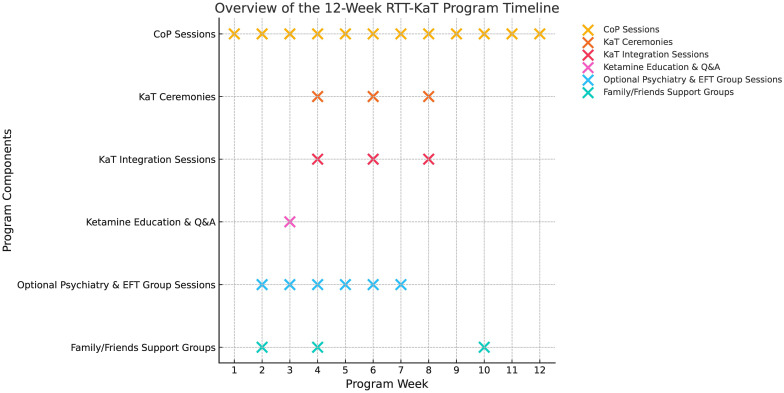
Figure 1 provides a visual overview of the 12-week program, illustrating the timing of CoP sessions, ketamine ceremonies, preparatory and integration activities, and support offerings for both participants and their families.
Guided by a resilience-informed curriculum, each aspect of the program supports participants to develop the awareness and agency to move from knowing, to being, to doing - supporting intentional change that can be sustained in their day to day life. Weekly content follows a consistent structure (see weekly guide template in), emphasizing shared intentions, meaning making, emotional regulation, relational safety, and personal alignment—each contributing to the development of resilience through enhanced congruence and sense of coherence. 5
Additional support offerings include a mandatory ketamine education and Q&A session, optional weekly psychiatry groups and Emotional Freedom Technique (EFT) sessions. Family and friends support groups are offered at three key points to support the wider integration container. The program concludes with final CoP integration and discharge.
Rather than adhering to a manualized psychotherapy model, RTT-KaT draws from trauma-informed, somatic, and relational principles. Its primary therapeutic mechanism is rooted in the CoP environment, where shared intentions and relational agreements enable authenticity, co-regulation, and secure interpersonal connections. Each cohort includes 20–40 participants, subdivided into small groups of 6–9, and is supported by a multidisciplinary team of medical professionals, therapists, somatic practitioners, and cultural knowledge keepers.
All ketamine sessions are medically supervised by licensed prescribers and delivered in accordance with provincial and federal clinical governance standards. Weekly large- and small-group sessions integrate somatic practices, guided inquiry, and culturally responsive agreements to support psychological safety. Participants are expected to attend all 12 weekly sessions, with an option to join additional support sessions, and must complete all preparatory components before receiving their first ketamine treatment.

Overview of the 12-week RTT-KaT program timeline. The program consists of weekly CoP sessions, three structured KaT ceremonies and integrated preparation and integration components.
Participant screening and intake
Information sessions are offered for participants, friends, and family members before applying to the program, providing an overview and answering questions. To be eligible, they require a referral by licensed healthcare providers and undergo a multi-step screening process to assess readiness and suitability. The process includes:
Weekly CoP format
Each weekly RTT session includes both a Large Group and a Small Group segment. Weekly curriculum themes are outlined in Table 1, and a detailed session guide is provided in Supplementary File 5.
Large group segment (30–40 minutes):
Small group segment (70–90 minutes): These facilitated sessions, led by dyadic or triadic teams, focus on compassionate witnessing, embodied presence, and emergent sharing. Small groups maintain consistent membership throughout the program to support the development of relational trust and psychological safety.
Additional Sessions:
| Week | Curriculum Topic |
|---|---|
| 1 | Foundations |
| 2 | Supporting the Body to Hold Compassionate Space for 'What Is' |
| 3 | Mindful & Heartful Listening |
| 4 | Inner Healing Intelligence & RAIN |
| 5 | Liminal Spaces and the Window of Tolerance |
| 6 | Emotional Conditioning and Pathways of Expression |
| 7 | Letting Go and Awakening to Purpose |
| 8 | Relationships and Attachment Tendencies |
| 9 | My Journey to Self-Compassion |
| 10 | Acknowledging Our Interconnectedness – Co-Creating Community |
| 11 | Generativity – Your Way Forward |
| 12 | Locating Your North Star |
Ketamine sessions
Participants receive three ketamine sessions spaced across the 12-week program, typically beginning between weeks 4 and 6. These sessions are held in a ceremonial group setting and follow a consistent, trauma-informed structure designed to foster emotional safety, predictability, and inner-directed presence.
Preparation
Preparation for ketamine sessions includes the following components:
Session day
On the day of the ketamine session, participants are welcomed into a quiet, low-stimulus room arranged in a circle, with dim lighting, soft furnishings, and blankets to support comfort and containment. Facilitators are already present in the space, modeling an inward focus and available to help participants settle. The ceremonial tone of the room invites a shift from outward social engagement ("up and out") to inward exploration ("in and down"). A structured session record () is used to guide and document key safety steps. This includes: 7
The medicine ceremony is guided by a highly structured and scripted protocol, designed to ensure continuity, minimize ambiguity, and foster psychological and relational trust. Participants are encouraged to prepare their space with intention and to remain inwardly focused throughout the experience. To preserve the contemplative and ceremonial atmosphere, verbal communication is kept to a minimum. Touch preferences are reviewed during Week 3 medical check-ins and are formally confirmed on the day of the session using two methods: a dedicated touch consent form () and a clearly visible whiteboard in the medicine room that lists individual preferences for all team members to reference in real time. 7
In alignment with teachings from local Elders, ketamine is introduced into the room with ceremonial intention, emphasizing the participant's relationship with the medicine as an ally in healing. This approach highlights the role of intention-setting and respect for ketamine as a therapeutic agent and ally. Ketamine is administered either via sublingual lozenges (100–300 mg) or intramuscular injection (0.5–1.5 mg/kg), based on clinical assessment and participant preference. For participants who are uncertain about starting with a higher dose, an initial lower dose is provided with the option of a top-up—ranging from 5–20 mg, administered 10–20 minutes into the session. This flexible dosing strategy supports individualized care while maintaining therapeutic efficacy. A curated music playlist (18) accompanies the session to act as an emotional anchor, guide somatic and psychological processing, and serve as a co-therapist throughout the journey.
Following the session, participants remain in the space until they feel steady and ready to transition home. Once ready, they are accompanied to their designated driver. A no-driving policy is enforced for 24 hours. Session documentation () includes observations, clinical notes, and safety measures. 7
Integration and post-program support
Integration is woven into both small group sessions (where they remain with familiar CoP members) and dedicated integration meetings (mixing CoP members) following each ketamine session. Participants are encouraged to explore the contrast between "being" and "doing," and to cultivate insights from their experiences within the CoP.
Post-session integration is structured through small-group CoPs and individualized support where needed. Participants are encouraged to engage in self-reflection, journaling, and ongoing community of practice. Where available, referrals to local suppliers and longitudinal follow-up assessments are used to ensure continuity of care.
All processes described in this Methods section are detailed further in the, including intake documentation, medical protocols, safety procedures, and group facilitation tools. These resources are provided to support adaptation and replication of the RTT-KaT protocol in diverse therapeutic environments. 1
Following the final CoP session, participants are invited to join alumni programming, which includes ongoing access to CoP groups and optional KaT refresher sessions, as clinically indicated. At discharge, participants complete the same set of standardized mental health assessments administered at intake. These results are summarized in a consultation note that is shared with the referring healthcare provider to support continuity of care.
(Anticipated) Results
Although this article does not present new outcome data, the RTT-KaT protocol has been implemented with more than 750 participants across 14 cohorts between 2020 and 2024. Published program evaluations from the initial cohorts (1 –3) demonstrated meaningful improvements in symptoms of depression, anxiety, and PTSD. For example, 92% of participants who reported impaired life-work functionality at baseline indicated improvement by program completion, and most participants screening positive for PTSD no longer met diagnostic thresholds at 12 weeks. These early results—derived from a real-world, community-delivered setting—provided the foundation for ongoing protocol refinement through continuous quality improvement.
A subsequent safety and tolerability analysis involving 128 participants and over 400 ketamine sessions found both sublingual (100–300 mg) and intramuscular (0.5–1.5 mg/kg) routes to be well tolerated, with only transient and manageable side effects (3). No serious adverse events have been reported across any of the RTT-KaT cohorts to date, contributing to the protocol's strong safety profile and feasibility for wider clinical application.
Notably, approximately 10% of RTT-KaT participants have self-identified as Indigenous. In response, a targeted quality improvement initiative was undertaken to better understand Indigenous participant experiences and adapt the model accordingly (17). Feedback emphasized the need for relational authenticity, the presence of Indigenous team members, and the integration of traditional healing values and ceremonial elements. These findings directly informed the development of the culturally responsive framework presented in this protocol.
Together, these published findings support RTT-KaT as a safe, well-tolerated, and scalable group-based approach to psychedelic-assisted therapy. The model's adaptability across clinical, academic, and community contexts—particularly when guided by local cultural knowledge—positions it as a promising option for expanding access to integrative mental health care.
Discussion
Real-world foundations and evolving implementation
While the RTT-KaT protocol has not been evaluated through randomized controlled trials, it is grounded in real-world data, published outcomes, and an iterative quality improvement process. Embedding protocol dissemination within methods articles—such as this one—helps bridge innovation and evaluation, offering transparency for replication and adaptation while contributing to the ethical evolution of group-based psychedelic care.
This article presents a structured clinical model for delivering KaT within a Community of Practice (CoP) framework. While the protocol originated in a specific cultural and geographic context (Vancouver Island, Canada), it has since been adapted and delivered in a range of clinical, academic, and community-based environments. These implementations underscore the model's flexibility, though further research is needed to evaluate its feasibility and effectiveness across broader and more diverse populations.
Integration of Indigenous and Western paradigms
A central strength of RTT-KaT is its integration of Western therapeutic principles with Indigenous relational values. Developed in partnership with Indigenous Elders and knowledge keepers, the model incorporates ceremonial elements, collective witnessing, and teachings rooted in interconnection, reciprocity, and relational accountability. These components reflect a worldview often underrepresented in psychedelic-assisted therapy literature and offer an inclusive alternative to individually focused models of care.
Throughout its development, RTT-KaT has prioritized cultural humility and careful differentiation between cultural appreciation and appropriation. Teachings are shared with permission, grounded in longstanding relationships, and embedded within appropriate ceremonial and community contexts. Co-developing protocols with Indigenous collaborators and maintaining feedback loops ensures the integrity of sacred knowledge is respected and that cross-cultural integration is approached with consent, transparency, and relational accountability.
Community-based framework for resilience development
Rather than employing a manualized therapy approach (e.g., CBT or ACT), RTT-KaT centers healing within a Community of Practice, where shared intentions and relational safety agreements create the conditions for authenticity, vulnerability, somatic awareness, and secure attachment—each unfolding at the pace of trust. Therapeutic change emerges through co-regulation, compassionate witnessing, and connection to personal and collective meaning. Weekly group sessions foster psychological resilience by cultivating congruence, a sense of coherence, and trauma-informed self-leadership.
Ketamine as an amplifier and therapeutic catalyst
A defining feature of the RTT-KaT model is its ceremonial framing of ketamine as an adjunctive catalyst—one that amplifies rather than drives the healing process. Rather than serving as the central mechanism of change, ketamine supports and enhances the inner work that unfolds within the broader therapeutic container. The three intramuscular sessions are embedded within a structured 12-week curriculum that incorporates multiple forms of "medicine," including relational safety, somatic regulation, emotional processing, values alignment, and community connection. Ritual, music, and embodied practices are woven throughout to foster psychological safety, deepen insight, and support transformative experiences.
Implementation tools and iterative development
To support implementation, seven Supplementary Files accompany this article, offering practical templates and tools used in clinical delivery. While other published protocols have helped establish clinical standards for psychedelic-assisted therapy (19), the RTT-KaT model is distinguished by its resilience-informed curriculum and Indigenous wisdom-informed framework, delivered within a structured CoP model.
The RTT-KaT program continues to evolve through an ongoing quality improvement process. Templates and practices are updated regularly in response to participant feedback, multidisciplinary team reflections, and shifting regulatory standards. This flexible, iterative approach enables contextual adaptation and fosters ethical responsiveness across diverse populations.
Limitations and future directions
Although earlier publications reported outcomes from more than 400 participants (1 –3), additional cohorts have since participated in the program, further informing protocol refinements. While the current paper focuses on sharing the clinical protocol, limitations include the absence of randomized control comparisons, potential variability in facilitator implementation, and the intensive resources required for training and delivery. Additionally, while culturally informed, adaptations must be made thoughtfully when applying the protocol in other settings to preserve cultural congruence and community safety.
The program has been adapted to psilocybin and MDMA therapy and may be further adapted to other psychedelic medicines and clinical populations, as well as the integration of this work across broader systems of care. A longitudinal follow-up study is currently underway to evaluate long-term outcomes across psychological, relational, and spiritual domains, contributing to an evolving understanding of the therapeutic potential of group-based KaT. By contributing a real-world, culturally responsive, and resilience-informed model, this protocol aims to expand the clinical landscape for group-based KaT and provide a scalable alternative for integrative mental health care.
 Psychedelic Science