
What this is
- Four were identified from paper sheet products in Japan.
- These compounds include 1cP-AL-LAD, 1cP-MIPLA, 1V-LSD, and LSZ.
- The study utilized various mass spectrometry techniques and NMR spectroscopy for identification.
Essence
- New were detected in sheet products, indicating ongoing changes in the landscape of designer drugs. This study marks the first identification of with multiple structural modifications in Japan.
Key takeaways
- 1cP-AL-LAD and 1cP-MIPLA were identified as modified at multiple positions. This finding raises concerns about the emergence of new psychoactive substances in the market.
- The study emphasizes the importance of continuous monitoring for newly distributed to address potential health risks associated with these substances.
Caveats
- The metabolic pathways and biological activities of the identified remain unreported, which limits understanding of their effects.
- The study was conducted on products obtained within a specific timeframe, which may not represent the entire market.
Definitions
- LSD analogs: Compounds structurally similar to lysergic acid diethylamide (LSD) that may have psychoactive effects.
Simplified
Introduction
The regulation of a drug of abuse leads to the emergence of other compounds with partially altered structures. Consequently, new and unregulated synthetic cannabinoids, cathinones and fentanyl derivatives are continuously emerging. This so-called 'cat-and-mouse' game is still ongoing.
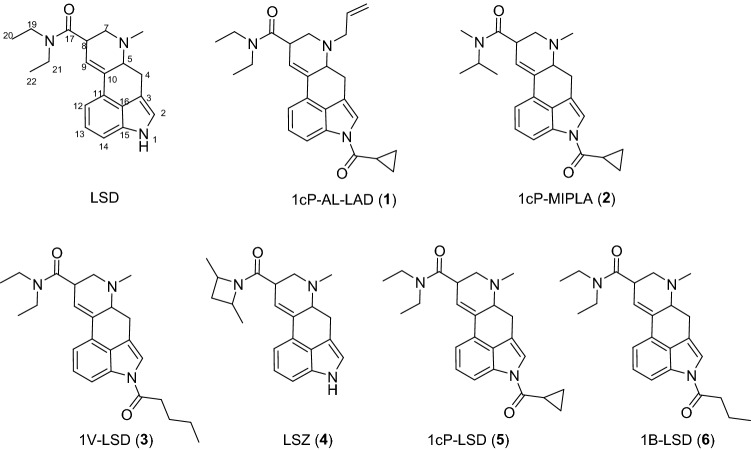
In this paper, we describe the analyses and identification of four LSD analogs in from paper sheet products obtained between 2021 and 2022 in Japan.

Chemical structures of LSD, 1cP-AL-LAD, 1cP-MIPLA, 1V-LSD, LSZ, 1cP-LSD and 1B-LSD
Materials and methods
Chemicals
HPLC-grade acetonitrile and methanol were purchased from Kanto Chemical Co., Inc. (Tokyo, Japan). Methanol-d4 (99.8 at. % D) was purchased from Isotec, Inc. (Miamisburg, OH, USA). LSD was purchased from Cerilliant Corporation (Round Rock, TX, USA). (2'S,4'S)-Lysergic acid 2,4-dimethylazetidide (LSZ) was purchased from Chiron (Trondheim, Norway). Bond Elut C18, 500 mg, 3 mL (Agilent, Santa Clara, CA, USA) was used for purification.
Samples
The four products (A to D) analyzed in this study were obtained in Japan between August 2021 and March 2022. Each sheet was a square with an overall size of 4.5 × 4.5 cm and perforated in a grid pattern with approximately 9 mm on each side. The structural formula of the LSD analog suggested to be contained was printed on one side of the sheet, and the name of the compound was printed on the reverse side.
Sample preparation
Eight mg of each sheet cut into 2 mm squares was extracted with 1 mL of methanol in 15 min under sonication. Methanol was removed from the extract under a nitrogen stream and redissolved in 1 mL of acetonitrile for analysis by gas chromatography–mass spectrometry (GC–MS), liquid chromatography–photodiode array–mass spectrometry (LC–PDA–MS) and liquid chromatography with hybrid quadrupole time-of-flight mass spectrometry (LC–Q-TOF-MS). For nuclear magnetic resonance (NMR) spectroscopy, each piece of a cut sheet was sonicated in 1.0 mL of methanol at room temperature for 5 min. The extraction procedure was repeated three times. The extracts were combined and the solvent was removed using an evaporator. Each residue was purified with Bond Elut C18 eluted with water–methanol, dissolved in 0.3 mL of methanol-d4, and then subjected to NMR spectroscopy.
LC–PDA–MS conditions
The LC–PDA–MS analysis was performed on an ACQUITY UPLC system with a mass detector and a photodiode array (PDA) detector (Waters, Milford, MA, USA). Chromatographic separation was performed using an ACQUITY HSS T3 (2.1 mm i.d. × 100 mm, 1.8 μm particle size, Waters) UPLC column protected by Van Guard HSS T3 (2.1 mm i.d. × 5 mm, 1.7 μm particle size, Waters) at 40 °C. For the LC–MS analysis, we employed a binary mobile phase of solvent A (0.1% formic acid in water) and solvent B (0.1% formic acid in acetonitrile). The samples were analyzed by the following elution program: 5–20% B (0–20 min) and then up to 80% B (20–30 min, 10-min hold) at a flow rate of 0.3 mL/min. The injection volume was 1 μL and the wavelength of the PDA detector for screening was set from 210 to 450 nm. The MS conditions for the LC–ESI-MS were as follows: positive and negative ionization, nitrogen desolvation gas (flow rate 650 L/h at 350 °C), capillary and cone voltages of 2500 V and 30 V, respectively, and mass spectral range m/z 120–650 [9, 10].
GC–MS conditions
The GC–MS was performed on an Agilent 6890 N GC system with a 5975 mass-selective detector (Agilent Technologies, Santa Clara, CA, USA) using a capillary column (DB-1HT capillary, 15 m × 0.25 mm i.d., 0.10-μm film thickness; Agilent Technologies) with helium-gas carrier flowing at 1.0 mL/min. The conditions were as follows: electron energy, 70 eV; injector temperature, 200˚C; injection mode, splitless mode for 1.0 min; transfer line temperature, 280˚C; scan range, m/z 40–550. The oven temperature was held at 120˚C for 1 min, and then increased at 15˚C/min to 280˚C, where it was held for 5 min [9, 10].
HR-MS analysis conditions
The HR-MS analysis was carried out on a TripleTOF® 6600 LC/MS/MS system (AB SCIEX, Framingham, MA, USA) and a Nexera X2 system (Shimadzu, Kyoto, Japan). Chromatographic separation was performed in an ACQUITY HSS T3 (2.1 mm i.d. × 100 mm, 1.8 μm particle size, Waters) UPLC column protected by Van Guard HSS T3 (2.1 mm i.d. × 5 mm, 1.7 μm particle size, Waters) at 40 °C. The mobile phase was a binary phase of solvent A (0.1% formic acid in water) and solvent B (0.1% formic acid in acetonitrile) with a gradient program of A/B 95/5–5/95 (10 min, 2 min hold). The flow rate was 0.3 mL/min, and the elution was monitored at 210–450 nm. The mass spectrometer was operated in ESI mode with an ion-spray voltage of 5500 V (positive mode), a source temperature of 550 °C, an ion-source gas of nitrogen, a pressure of 50 psi for ion-source gases 1 and 2, a curtain gas pressure of 25 psi, and a declustering potential of 80 V. The samples were analyzed in TOF-MS scan mode (m/z 100–650) [9, 10].
NMR spectrometry and parameters
The 1H-NMR and 13C-NMR spectra were measured using a JEOL JMN-ECA800 or ECZ800 spectrometer (JEOL, Tokyo, Japan). The chemical shifts were presented with reference to the residual deuterated methanol (CD3OD, δH 3.33 ppm and δC 49.0 ppm) in the NMR. Compound identification was performed using 1H-NMR, 13C-NMR, heteronuclear multiple quantum coherence (HMQC), heteronuclear multiple bond correlation (HMBC), H–H correlation spectroscopy (H–H COSY) and nuclear Overhauser effect spectroscopy (NOESY).
Results
Analysis of sheet product A

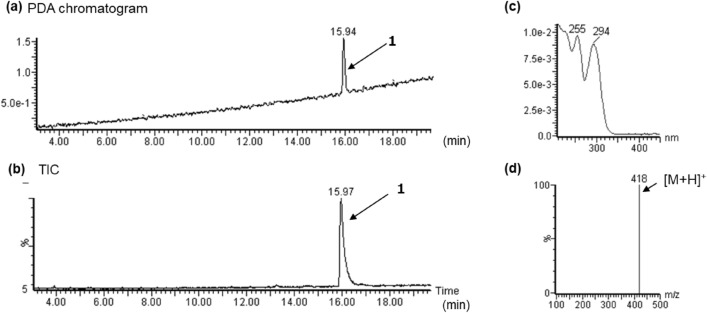
LC–PDA–MS analysis of sheet A; PDA chromatogram, TIC, and UV and ESI mass spectra of peak 1, a b c d

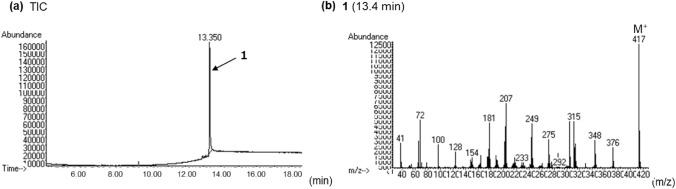
GC–MS analysis of sheet A; TIC, EI mass spectrum of peak 1 a b

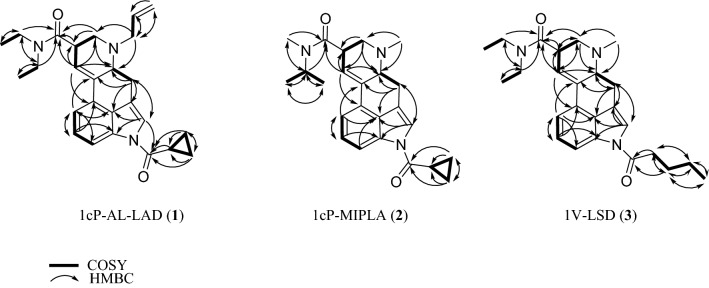
COSY and HMBC correlations of LSD analogs
| No | LSDa) | 1cP-AL-LAD | 1cP-MIPLA | 1V-LSD | 1cP-LSDb) | 1B-LSDb) |
|---|---|---|---|---|---|---|
| 2 | 120 | 120.7 | 120.7 | 120.7 | 120.7 | 121.6 |
| 3 | 110.2 | 118.3 | 118.1 | 118 | 118 | 118 |
| 4 | 27.9 | 27.4 | 27.5 | 27.4 | 27.5 | 27.5 |
| 5 | 64.8 | 60.9 | 63.9 | 63.8 | 63.8 | 63.8 |
| 7 | 57 | 52.7 | 56.1 | 56.7 | 56.7 | 56.7 |
| 8 | 40.6 | 40.7 | 41.2 | 40.6 | 40.6 | 40.6 |
| 9 | 119.5 | 122.2 | 121.6 | 121.6 | 121.6 | 121.6 |
| 10 | 137.7 | 136.6 | 135.9 | 136 | 136.1 | 136 |
| 11 | 128.3 | 129.5 | 129.1 | 129.1 | 129 | 129.1 |
| 12 | 112.7 | 118.2 | 118.1 | 118.2 | 118 | 118.2 |
| 13 | 123.7 | 127.1 | 127.2 | 127.2 | 127.2 | 127.2 |
| 14 | 111 | 116.6 | 116.6 | 116.6 | 116.6 | 116.6 |
| 15 | 135.7 | 135.2 | 135.3 | 135.2 | 135.3 | 135.2 |
| 16 | 127.4 | 129.5 | 129.4 | 129.3 | 129.4 | 129.3 |
| 17 | 173.9 | 173.9 | 173.8 | 173.6 | 173.6 | 173.7 |
| 19 | 41.9 | 41.9 | – | 42 | 42 | 42 |
| 20 | 13.3 | 13.3 | – | 13.3 | 13.3 | 13.3 |
| 21 | 43.8 | 43.8 | – | 43.8 | 43.8 | 43.8 |
| 22 | 15.1 | 15.1 | – | 15.1 | 15.1 | 15.1 |
| 1-N-CH(CH)CO22 | – | 174.4 | 174.4 | – | 174.4 | – |
| 1-N-CO(CH)CH22 | – | 14.4 | 14.4 | – | 14.4 | – |
| 1-N-COCH()CH22 | – | 10.1 | 10.1 | – | 10.1 | – |
| 1-N-COCH()CH22 | – | 10.1 | 10.1 | – | 10.1 | – |
| 6-N-CH3 | 44 | – | 43.8 | 43.8 | 43.8 | 43.8 |
| 6-N-CH = CHCH22 | – | 58 | – | – | – | – |
| 6-N-CH = CH22CH | – | 134.7 | – | – | – | – |
| 6-N-CHCH = 22CH | – | 119.9 | – | – | – | – |
| 18-N-CH3 | – | – | 29.1 | – | – | – |
| 18-N–(CH)CH32 | – | – | 46.2 | – | – | – |
| 18-N–CH(CH)32 | – | – | 19.5 | – | – | – |
| – | – | 19.5 | – | – | – | |
| 1-N-CHCHCHCHCO2223 | – | – | – | 173.6 | – | – |
| 1-N-COCHCHCHCH2223 | – | – | – | 36.2 | – | – |
| 1-N-COCHCHCH2223CH | – | – | – | 28 | – | – |
| 1-N-COCHCHCH2223CH | – | – | – | 23.4 | – | – |
| 1-N-COCHCHCH2223CH | – | – | – | 14.2 | – | – |
| 1-N-CHCHCHCO223 | – | – | – | – | – | 170.3 |
| 1-N-COCHCHCH223 | – | – | – | – | – | 38.3 |
| 1-N-COCHCH223CH | – | – | – | – | – | 19.2 |
| 1-N-COCHCH223CH | – | – | – | – | – | 14 |
| No | LSDa) | 1cP-AL-LAD | 1cP-MIPLA | 1V-LSD | 1cP-LSDb) | 1B-LSDb) |
|---|---|---|---|---|---|---|
| 2 | 6.95, 1H, d, = 1.4 HzJ | 7.70, 1H, d, = 2.1 HzJ | 7.70, 1H, s-like | 7.49, 1H, d, = 7.8 HzJ | 7.71, 1H, d, = 2.1 HzJ | 7.47, 1H, s |
| 4 | 2.65, 1H, m | 2.60, 1H, ddd, = 2.1, 11.7, 15.1 HzJ | 2.59, 1H, m, overlapped | 2.57, 1H, ddd, = 1.8, 11.9, 14.2 HzJ | 2.60, 1H, m, overlapped | 2.56, 1H, m |
| 3.57, 1H, ddd, = 6.5, 14.5, 19.3 HzJ | 3.63, 1H, dd, = 4.8, 15.1 HzJ | 3.61, 1H, m | 3.59, 1H, dd, = 5.5, 15.1 HzJ | 3.62, 1H, dd, = 5.5, 15.2 HzJ | 3.59, 1H, dd, = 5.5, 15.1 HzJ | |
| 5 | 3.20, 1H, m | 3.45, 1H, m | 3.19, 1H, m | 3.19, 1H, m | 3.18, 1H, m | 3.17, 1H, m |
| 7 | 2.76, 1H, t-like, = 11.1 HzJ | 2.67, 1H, t-like, = 11.0 HzJ | 2.68, 1H, t-like, = 11.0 HzJ | 2.73, 1H, t-like, = 11.0 HzJ | 2.73, 1H, t, = 11.0 HzJ | 2.72, 1H, t, = 11.0 HzJ |
| 3.07, 1H, dd, = 4.8, 11.0 HzJ | 3.21, 1H, m | 3.13, 1H, dd-like, = 4.6, 11.0 HzJ | 3.10, 1H, dd-like, = 4.6, 11.4 HzJ | 3.10, 1H, dd-like, = 4.1, 11.4 HzJ | 3.09, 1H, dd-like, = 4.1, 11.4 HzJ | |
| 8 | 3.95, 1H, m | 3.89, 1H, m | 3.90, 1H, m | 3.96, 1H, m | 3.97, 1H, m | 3.96, 1H, m |
| 9 | 6.30, 1H, s-like | 6.39, 1H, s-like | 6.42, 1H, s-like | 6.38, 1H, s-like | 6.37, 1H, s-like | 6.38, 1H, s-like |
| 12 | 7.11, 1H, d, = 6.9 HzJ | 7.39, 1H, d, = 7.6 HzJ | 7.41, 1H, t-like, = 7.8 HzJ | 7.41, 1H, d, = 7.8 HzJ | 7.40, 1H, d, = 7.6 HzJ | 7.40, 1H, d, = 7.3 HzJ |
| 13 | 7.07, 1H, t-like, = 7.6 HzJ | 7.29, 1H, t-like, = 7.6 HzJ | 7.29, 1H, t-like, = 7.8 HzJ | 7.30, 1H, t-like, = 7.8 HzJ | 7.29, 1H, t-like, = 7.6 HzJ | 7.30, 1H, t-like, = 7.8 HzJ |
| 14 | 7.18, 1H, d, = 8.3 HzJ | 8.03, 1H, d, = 8.3 HzJ | 8.03, 1H, d, = 8.3 HzJ | 8.05, 1H, brs | 8.03, 1H, d, = 8.3 HzJ | 8.05, 1H, br |
| 19 | 3.44, 2H, m | 3.41, 1H, m, overlapped | – | 3.41, 1H, m | 3.41, 1H, m | 3.40, 1H, m |
| 3.44, 1H, m, overlapped | – | 3.47, 1H, m | 3.47, 1H, m | 3.47, 1H, m | ||
| 20 | 1.17, 3H, t, = 7.3 HzJ | 1.16, 3H, t, = 7.3 HzJ | – | 1.17, 3H, t, = 7.3 HzJ | 1.17, 3H, t, = 7.3 HzJ | 1.17, 3H, t, = 7.3 HzJ |
| 21 | 3.55, 2H, m, overlapped | 3.53, 2H, m, overlapped | – | 3.55, 2H, m, overlapped | 3.55, 2H, m, overlapped | 3.55, 2H, m |
| 22 | 1.29, 3H, t, = 7.3 HzJ | 1.28, 3H, t, = 7.3 HzJ | – | 1.29, 3H, t, = 7.3 HzJ | 1.30, 3H, t, = 6.9 HzJ | 1.29, 3H, t, = 7.3 HzJ |
| 1-N-CO(CH)CH22 | – | 2.50, 1H, m | 2.50, 1H, m | – | 2.51, 1H, m | – |
| 1-N-COCH()CH22 | – | 1.10, 2H, m | 1.10, 2H, m | – | 1.11, 2H, m | – |
| 1-N-COCH()CH22 | – | 1.19, 2H, m | 1.19, 2H, m | – | 1.19, 2H, m | – |
| 6-N-CH3 | 2.60, 3H, s | – | 2.61, 3H, s | 2.61, 3H, s | 2.61, 3H, s | 2.60, 3H, s |
| 6-N-CH = CHCH22 | – | 3.23, 1H, dd, = 9.0, 14.5 HzJ | – | – | – | – |
| – | 3.76, 1H, dd, = 4.8, 14.4 HzJ | – | – | – | – | |
| 6-N-CH = CH22CH | – | 6.01, 1H, m | – | – | – | – |
| 6-N-CHCH = 22CH | – | 5.28, 1H, d, = 10.0 HzJ | – | – | – | – |
| – | 5.35, 1H, d, = 16.5 HzJ | – | – | – | ||
| 18-N-CH3 | – | – | 3.05, 3H, s | – | – | – |
| 18-N–(CH)CH32 | – | – | 4.82, 1H, m | – | – | – |
| 18-N–CH(CH)32 | – | – | 1.15, 3H, d, = 6.9 HzJ | – | – | – |
| – | – | 1.19, 3H, d, = 6.9 HzJ | – | – | – | |
| 1-N-COCHCHCHCH2223 | – | – | – | 2.97, 2H, t, = 7.3 HzJ | – | – |
| 1-N-COCHCHCH2223CH | – | – | – | 1.78, 2H, dddd, = 7.3, 7.8, 7.8, 7.8 HzJ | – | – |
| 1-N-COCHCHCH2223CH | – | – | – | 1.48, 2H, dddd, = 7.3, 7.3, 7.8, 15.1 HzJ | – | – |
| 1-N-COCHCHCH2223CH | – | – | – | 0.99, 3H, t, = 7.3 HzJ | – | – |
| 1-N-COCHCHCH223 | – | 2.95, 2H, t, = 7.3 HzJ | ||||
| 1-N-COCHCH223CH | – | – | – | – | – | 1.83, 2H, ddd, = 7.3, 14.6, 14.6 HzJ |
| 1-N-COCHCH223CH | – | – | – | – | – | 1.07, 3H, t, = 7.3 HzJ |
Analysis of sheet product B
In the 1H-NMR and 13C-NMR spectra, there are minor signals at positions 7–9 and at the N-methyl-N-isopropyl moiety. As the ratios of these minor signals were changed in different solvents and the same phenomenon was observed for MIPLA, it was presumed that these minor signals were derived from the rotational isomer of the N18 amide moiety of 1cP-MIPLA.
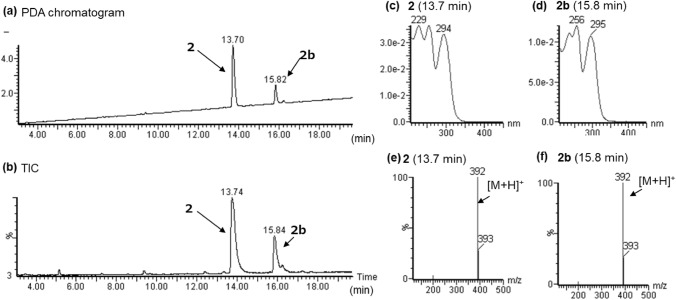
In the LC–PDA–MS analysis, a peak of 2b with the same m/z 392 [M + H]+ as 1cP-MIPLA was detected at 15.8 min (Fig. 5b), in addition to the peak of 1cP-MIPLA. The UV spectrum of 2b was not similar to that of 1cP-MIPLA. In addition, the signals presumed to be derived from minor compounds other than 1cP-MIPLA were also observed in the 1H-NMR and 13C-NMR spectra. It has been reported that the epimerization of LSD at position 8 occurs to produce iso-LSD [13, 14]. As epimerization at position 8 also occurs during the synthesis of LSD analogs [15], this minor compound was presumed to be iso-1cP-MIPLA.


Analysis of sheet product C
In the LC–PDA–MS analysis, a peak of 3b with the same m/z 392 [M + H]+ as 1V-LSD was detected at 20.7 min (Fig. 7b) in addition to the peak of 1V-LSD. The UV spectrum of 3b was not similar to that of 1V-LSD. Moreover, the signals presumed to be derived from minor compound other than 1V-LSD were also observed in the 1H-NMR and 13C-NMR spectra. This minor compound was estimated to be iso-1V-LSD, C8-epimerized 1V-LSD.


Analysis of sheet product D
In the LC–PDA–MS analysis of sheet D, a peak of compound 4 was detected at 6.8 min with a protonated molecular ion ([M + H]+) at m/z 336 (Fig. S1). In the GC–MS analysis, a peak at 11.4 min showed a molecular ion ([M]+) at m/z 335 (Fig. S2a and S2b). After comparing the data from LC–PDA–MS and GC–MS analyses with those of the authentic compound, this compound was identified as LSZ (4) [5, 16], a compound in which the diethyl moiety at position N18 of LSD has been converted to 2,4-dimethylazetidin.
Discussion
Based on the structure of LSD, the detected compound, 1cP-AL-LAD, was speculated to be converted at the positions at N1 and N6, and 1cP-MIPLA be converted at the positions at N1 and N18. This is the first report in which LSD analogs that have been converted at multiple positions have been detected in sheet products in Japan.
It has been reported that N1-acylated LSD analogs in methanol solutions are partially deacylated during GC–MS analysis [9, 10, 15]. In this study, we observed the partial deacylation of 1V-LSD, but not of 1cP-AL-LAD and 1cP-MIPLA under the same conditions. The reason that 1cP-AL-LAD and 1cP-MIPLA were not deacylated could also be conceived, because they were also modified with N6 or N18. However, Simon et al. reported that 1P-AL-LAD, converted at the N1 and N6 positions, was partially deacylated to AL-LAD during GC–MS analysis [15]. Therefore, 1cP-AL-LAD and 1cP-MIPLA may also be partially deacylated depending on the GC–MS analysis conditions. Halberstadt et al. [11] reported that high concentrations of LSD were detected in the plasma of rats after the subcutaneous administration of ALD-52 and 1P-LSD. 1V-LSD might be deacylated in vivo and may function as a prodrug of LSD. The products containing these prodrug-type compounds might cause health damage, similar to LSD.
It has been reported that under alkaline conditions, approximately 10% of LSD is epimerized to iso-LSD after prolonged heat exposure [13, 14]. In addition, the C8-epimerization of 1P-AL-LAD during GC–MS analysis was reported by Simon et al. [15]. In this study, the presence of iso-1cP-MIPLA and iso-1V-LSD was suggested, and C8-epimerization of other LSD analogs may also occur. The metabolic pathway and biological activities of 1cP-AL-LAD and 1cP-MIPLA have not been reported.
Conclusions
This is the first report showing that LSD analogs that were converted at multiple positions have been detected in sheet products in Japan. In this report, we analyzed LSD analogs in four sheet products. As a results, we identified three compounds as 1cP-AL-LAD, 1cP-MIPLA, and 1V-LSD by NMR analyses, one compound as LSZ by comparison of the data with the authentic compound. The possibility of deacylation in vivo and the conversion into AL-LAD or MIPLA should be further investigated. In addition, there are concerns about the future distribution of sheet drug products containing new LSD analogs. Therefore, the continuous monitoring of newly detected compounds in sheet products is important.
Supplementary Information
Below is the link to the electronic supplementary material. Supplementary file1 (DOCX 238 KB)