
What this is
- The article discusses the potential benefits of secondary compounds in magic mushrooms alongside psilocybin.
- Filament Health is exploring the entourage effect, which suggests that these compounds may enhance the therapeutic effects of psilocybin.
- However, skepticism exists regarding the actual contributions of these compounds to the psychoactive experience.
Essence
- Filament Health is investigating whether secondary compounds in magic mushrooms enhance the effects of psilocybin. While the entourage effect is hypothesized to improve therapeutic outcomes, skepticism remains regarding the significance of these compounds.
Key takeaways
- Filament Health uses a proprietary extraction process to create psilocybin products that retain 27 different alkaloids. This approach aims to ensure consistency and stability in dosing for clinical applications.
- Animal studies suggest that mushroom extracts may lead to a greater production of synaptic proteins compared to synthetic psilocybin. This finding implies that other compounds in mushrooms could enhance neuroplasticity.
- Despite these findings, many researchers caution against overinterpreting the results, emphasizing the need for further studies to validate the contributions of secondary compounds to the effects of psilocybin.
Caveats
- The evidence supporting the entourage effect in magic mushrooms is limited and remains largely unsubstantiated. Many researchers call for more rigorous studies to confirm these claims.
- Concerns exist about the statistical significance of findings related to synaptic protein production, suggesting that results should be interpreted with caution.
Simplified
A sum of its parts
Researchers first coined the term entourage effect in 1998 to hypothesize the possible contribution of secondary, pharmacologically inactive compounds in cannabis, upon the discovery of monoacylglycerols that inhibited the metabolism of a cannabinoid. Today the term is being increasingly used in reference to psilocybin products, which, unlike products in the cannabis industry, are dominated by synthetics.
The inclination toward synthetic psilocybin is understandable. Growing Psilocybe cubensis, the most cultivated psychedelic mushroom, is not an easy task. Besides all the regulatory hurdles, these mushrooms are highly sensitive to their environmental conditions and susceptible to contamination.
Even in carefully controlled conditions, each individual mushroom develops variations in its psilocybin content and chemical composition. And on top of all those barriers, magic mushrooms contain a mass fraction of only a few percent psilocybin.
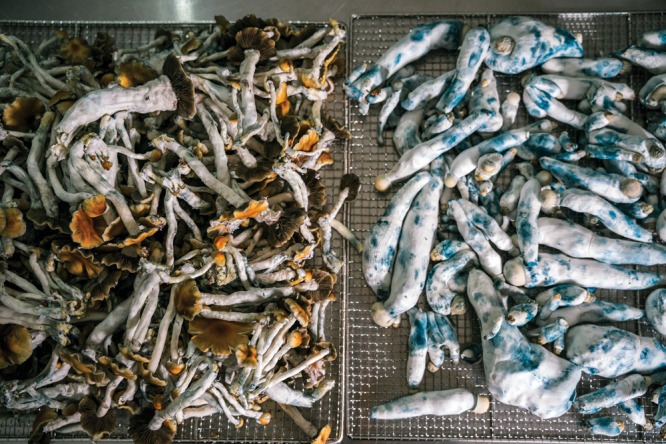
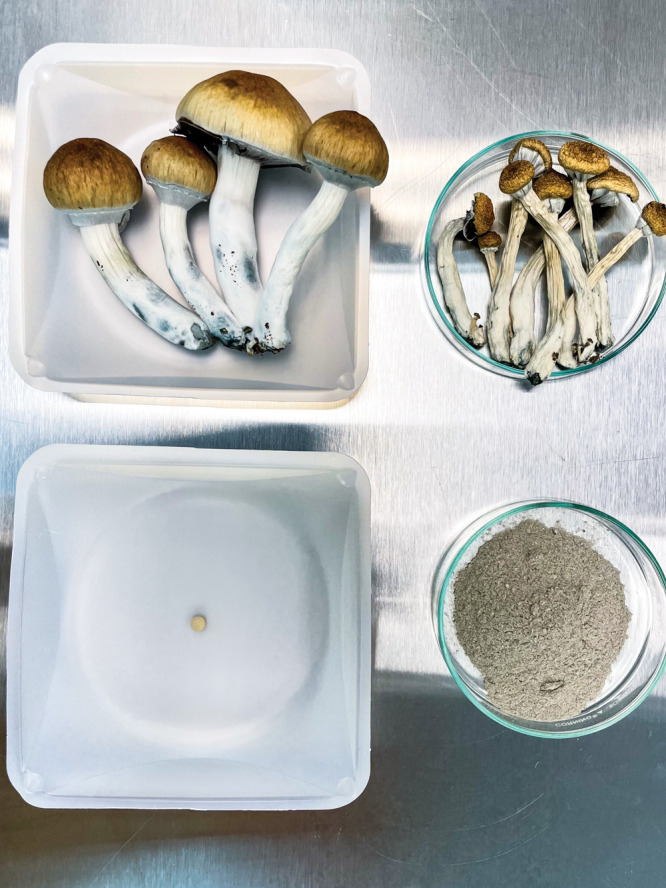
These challenges have not discouraged Filament Health. To ensure consistency in dosing, the company goes beyond growing its product. After harvest, its mushrooms are dried in a commercial dehydrator before being crushed into a powder. In a proprietary seven-step extraction process, all the nonactive compounds, like sugars and chitin, are removed. What remains is a concoction of psilocybin and secondary alkaloids that mimics the profile of the original mushroom.
The process allows Filament Health to ensure an easily testable, consistent, and stable product that can be more readily administered in clinical tests. Moss and his co-workers at Filament Health believe this month-long process is worth the effort because they are strong believers in the entourage effect.
"It's easy to reduce everything down, and, I mean, as a chemist, I understand," Moss says. But he thinks the synthetic approach of simply isolating psilocybin is missing a lot of things.
Notably, it misses the dozens of compounds that have been identified in magic mushrooms. Filament Health's PEX010, the psilocybin drug candidate created from its extraction process, retains 27 different alkaloids.
Whether those compounds are medically important remains to be seen. The ones currently commanding the most attention are the ones that, like psilocybin, are tryptamines: baeocystin, norbaeocystin, and aeruginascin. The compounds are structurally similar to psilocybin, varying by the number of methyl groups pinned onto the molecules.
Some research has found that the metabolite of baeocystin, norpsilocin↗, creates just as strong a response↗ to a key receptor in the brain as psilocin. But other evidence suggests that norpsilocin is too polar to even cross the blood–brain barrier to reach the right neuroreceptor. Concentrations of these tryptamines in magic mushrooms are also significantly lower than the concentration of psilocybin.
Sherwood, who has studied magic mushrooms' tryptamines, is skeptical. "The most compelling evidence suggests that compounds like baeocystin and norpsilocin don't significantly contribute to the psychoactive effects of these mushrooms."
Beyond tryptamines, researchers have also identified↗ trace amounts of nine terpenes and a half-dozen different β-carbolines, like harmane and harmine. β-Carbolines are thought to play an important role in ayahuasca, a plant-based psychedelic, and some think they could be important in modulating the duration of a magic mushroom trip. But the concentrations of β-carbolines in a typical dose of P. cubensis are thousands of times lower than in ayahuasca, leaving some scientists to caution skepticism.
"There's definitely a chance that certain compounds. . . could change the action of these mushrooms," says chemist Claudius Lenz of the Helmholtz Centre for Environmental Research–UFZ, who first identified norpsilocin in magic mushrooms. "But I'm more cautious with this entourage effect than many of my colleagues."
Some of these secondary compounds found in Psilocybe mushrooms, like terpenes, have been extensively studied in cannabis. But despite decades of research, the evidence for the entourage effect in cannabis and cannabidiol, more commonly known as CBD, remains scant. A 2020 metastudy concluded that claims of the entourage effect↗ in cannabis are largely unsubstantiated and at times contradictory.
Despite the rocky evidence, a lack of regulation in cannabis has left space for such claims to be widely used in marketing, such as in "whole plant" and "full spectrum" products, which tout therapeutic claims of the entourage effect. Some researchers are concerned that similar claims could abound in the magic mushroom industry even as the science is unsettled.

Filament Health creates naturally derived psilocybin drugs (bottom left) over a month-long process that includes growing, drying the mushrooms, and crushing and extracting the psilocybin along with other compounds. Credit: Filament Health. Psilocybe cubensis
The entourage effect under the microscope
The state of research into the entourage effect in cannabis, which spans decades, dwarfs the emerging work being done on the same effect in psilocybin. But that lack of conclusive evidence has not dampened the enthusiasm of many psilocybin researchers. With the increased scrutiny and security on the mushrooms, a more rigorous, ground-up scientific approach is being taken for psilocybin, some say.
"People are so busy making money out of cannabis that they don't bother to do research with cannabis very much," says psychiatrist and psychopharmacologist Bernard Lerer of Hadassah BrainLabs, a center for psychedelics research affiliated with Hebrew University. "But there is much, much more fundamental research on psychedelics than there's ever been on cannabis."
Anecdotal reports have suggested that magic mushrooms can have a stronger intensity and different visual effects than synthetic psilocybin. Those reports intrigued Lerer, who set out to conduct some of the first animal tests of the entourage effect in magic mushrooms.
In a 2024 study supported by Parow Entheobiosciences, a biotech company that Lerer advises that is developing psychedelic therapeutics, researchers gave one group of mice synthetic psilocybin↗ and others a mushroom extract. By recording the mice's head twitches, they determined that the drugs induced similarly intense and long-lasting trips. But they found some differences in how the mice's bodies responded.
When an animal is given a drug, different metabolites accumulate as a result of the drug's interaction with the body. Predictably, the results showed that the extract, which included a number of compounds in addition to psilocybin, created a larger metabolic response. But more surprising, Lerer says, was the extract's effect on proteins involved in making new connections between brain cells.
"What we found was that there is a greater production of synaptic proteins following administration of mushroom extract containing psilocybin than there is giving psilocybin alone," Lerer says. The researchers used Western blot analysis to measure synaptic protein production. "It would appear that mushroom extract increases synaptic plasticity more than psilocybin alone."
It is well-known that psilocybin promotes neuroplasticityin fact, this is why some researchers believe psilocybin's effects can have long-lasting results. But the findings, Lerer says, suggest other compounds are at work.
Some researchers, Sherwood included, remain skeptical. Bryan Roth, an MD and PhD who studies the pharmacology of psychoactive substances at the University of North Carolina at Chapel Hill and was not involved in the study, believes the results need to be verified using complementary, independent methods to measure the proteins.
"The differential effect noted on two synaptic proteins is exceedingly modest," Roth says, adding that for some protein measurements, no difference was seen. "On the whole, I'm always a bit skeptical of findings from Western blot analysis where very small differences are measured."
Lerer himself notes that the difference in synaptic protein production seen between the synthetic and extracted forms of psilocybin was not statistically significant. Still, Lerer suspects tryptamines could be responsible for the increase in synaptic proteins; but at this stage, it is just a hunch.
Further differences between mushroom extract and synthetic psilocybin were seen in a second study on mice. Lerer and his colleagues found the mushroom extract produced a stronger effect on reducing behaviors associated with anxiety↗ than did the synthetic psilocybin. But they found mushroom extract and synthetic psilocybin had the same effect on reducing excessive self-grooming, a trait representing OCD. While the study has seen some criticism for its methods and analysis↗, the findings, if proven, could help demonstrate the potential for targeted strategies using magic mushrooms to treat OCD and anxiety.
Praachi Tiwari, a psychedelics researcher at the Center for Psychedelic and Consciousness Research at Johns Hopkins University School of Medicine, says the studies are interesting and should be followed up on but cautions against directly interpreting the results for clinical use.
"There's a lot that needs to be done before we can be sure," Tiwari says.
"We need more comprehensive studies, both preclinical and clinical, in which one tries to tease out the different entourage molecules and find out which of them are making a significant contribution," Lerer says. "I think that's the biggest challenge of all."
The value in natural
Outside the lab, other researchers are assessing the potential extent of the entourage effect with anecdotal studies. But with few participants and only unblinded assessments, many of these findings are demonstrating a preference for natural products rather than proof of the entourage effect. Nonetheless, this preference is a relevant data point that supports Filament Health's approach to psychedelics.
"I think, in general, people's preferences over the last 20 years has been that natural is better," Moss says. "We always joke that most people prefer drinking coffee or tea than just taking a caffeine [pill]. And we view this as similar in a way."
More rigorous anecdotal studies are underway, such as one ongoing survey↗ by Miraculix and the Psychedelic Substances Research Group at the Charité–University Medicine Berlin. These studies, first with user surveys and ultimately with blinded tests, aim to tease out anecdotal differences in trips by accounting for different strains, varying concentrations of active ingredients, prior experiences with psilocybin, gender, and more.
Even if magic mushrooms' secondary compounds are ultimately not found to have any medical benefits, a natural product could still have value. When psilocybin is administered medically, the patient's environment and mindset are important in the outcome of the psychedelic trip.
"Having the participant know that this drug you're taking came from a natural source and was actually grown and things like that might, at least for some people, offer some reassurance in the sometimes challenging experience," Moss says.

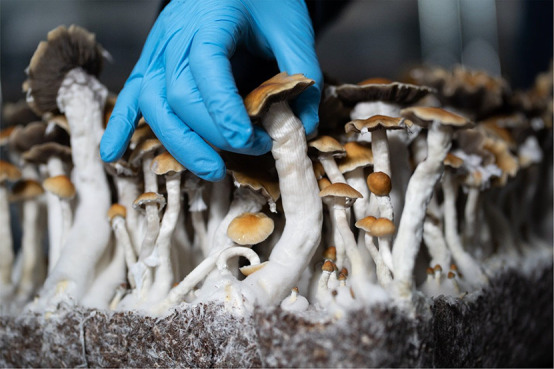
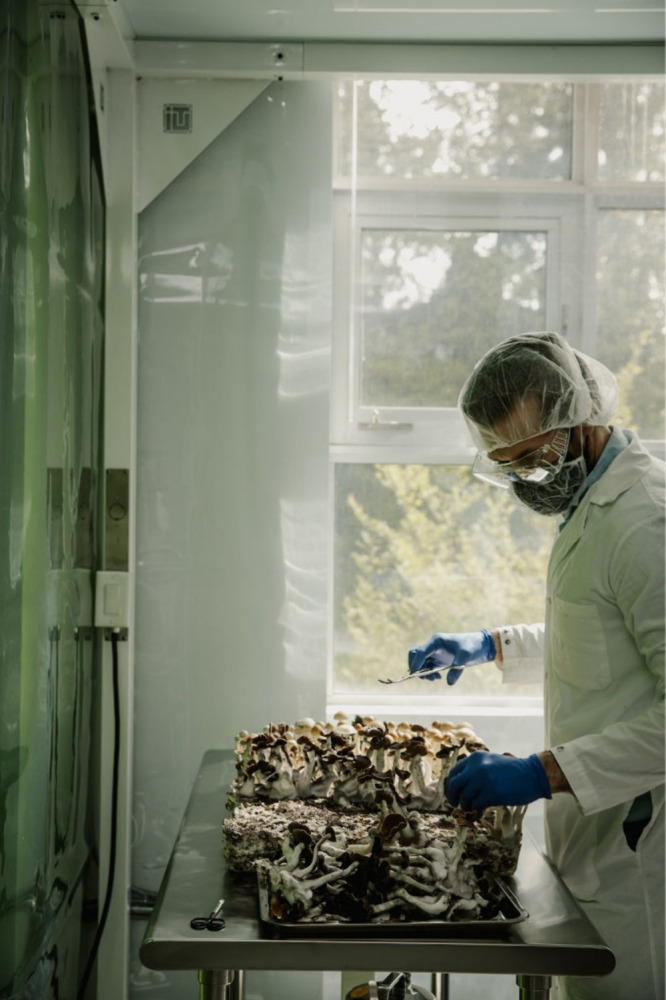
An employee of Filament Health harvests mature magic mushrooms. Credit: Filament Health.
Mara Johnson-Groh is a freelance contributor toChemical & Engineering News↗, an independent news publication of the American Chemical Society.
 Psychedelic Science