
What this is
- via CRISPR-Cas9 offers a method to correct mutations without causing double-strand breaks.
- This research focuses on using SpCas9-NG, a modified Cas9 with broader flexibility, to address a specific mutation causing hemophilia B.
- Induced pluripotent stem cells (iPSCs) were generated from a hemophilia B patient and successfully edited to restore function.
- The findings suggest potential for personalized treatment of genetic diseases through advanced genome-editing techniques.
Essence
- SpCas9-NG effectively repairs a hemophilia B mutation in patient-derived iPSCs, restoring coagulation factor production. This approach utilizes broad flexibility, allowing for targeted editing of previously inaccessible mutations.
Key takeaways
- SpCas9-NG demonstrates broad flexibility, enabling successful of a hemophilia B mutation. This flexibility allows targeting of mutations that wild-type SpCas9 cannot access.
- Gene-corrected iPSCs differentiate into hepatocyte-like cells and express F9 mRNA after transplantation into mice, indicating potential for functional restoration of coagulation factor.
- with SpCas9-NG achieves over twofold greater efficiency in correcting the hemophilia B mutation compared to wild-type SpCas9, expanding the range of treatable genetic mutations.
Caveats
- efficiency for the mutation was lower than in previous studies, possibly due to the complexity of the mutation site. Further optimization of editing tools is necessary.
- Unexpected C to T conversions near the target site indicate potential off-target effects, requiring careful evaluation before clinical application.
- The study assessed a mutation from only one patient, necessitating further validation across diverse genetic backgrounds to confirm efficacy.
Definitions
- Base editing: A genome-editing technology that converts specific DNA bases into others without causing double-strand breaks.
- PAM (Protospacer Adjacent Motif): A short DNA sequence required for Cas9 to bind and edit target DNA, influencing the range of editable mutations.
Simplified
Introduction
Hemophilia is a congenital hemorrhagic disease caused by a genetic mutation in coagulation factor VIII (FVIII) or factor IX (FIX)1. Gene therapy holds an exciting prospect for patients and their families due to its potential to treat hemophilia via a single treatment. Recent clinical trials have established the efficacy of gene therapy for hemophilia using adeno-associated virus (AAV) vectors, which are considered to be a safe approach to gene therapy because the viral genome is maintained episomally.2 Although AAV vectors enable long-term transgene expression in quiescent cells, cell division dilutes the AAV genome, resulting in the loss of therapeutic effect3. Hence, current hemophilia gene therapy with AAV vectors is only adapted to adult patients because their hepatocytes are mostly quiescent. Permanent repair of the gene responsible for hemophilia is a valuable goal for medical science.
We developed a gene-editing approach for hemophilia B using the CRISPR-Cas9 system to overcome the problems faced by current gene therapy techniques4. We inserted cDNA for exons 2–8 into intron 1 of F9. The therapeutic effects of genome editing persist permanently, even if the vector only exists transiently within liver cells. A phase I/II trial of the genome-editing treatment using AAV vectors harboring a zinc finger nuclease to insert cDNA of FIX into the ALB locus had been conducted5. These approaches to in vivo genome editing insert the cDNA at the site of a double-strand break (DSB) in a target locus. The disease-specific mutation cannot be effectively treated due to the lower frequencies of homology-directed repair (HDR)6,7. We previously attempted to specifically treat a disease-specific mutation by HDR; however, the frequency of HDR was <1%4. Creating DSBs by a DNA-cutting enzyme could generate large deletions and shuffle genes, which may result in adverse effects8–11. Therefore, an alternative approach to correct disease-specific mutations without DSBs would be advantageous.
Base editing is a novel genome-editing technology that can convert a specific DNA base into another at a targeted genome. Base editors are chimeric proteins that comprise a DNA-targeting module and a catalytic domain capable of deaminating a cytidine or adenine base (C to T or A to G)12–14. Cas9 nickase (that does not cause a DSB) could be used as a targeting module to bind specific DNA and deliver base editors to the mutation site12–14. Although several studies have reported the treatment of disease-specific mutations using base editing14–20, PAM sequence requirement by Cas9 (NGG for SpCas9 or NNGRRT for SaCas9) hinders its application in various mutations. Thus, a more flexible module is required to bind the target DNA to apply the base-editing approach to various mutations. We recently developed engineered Cas9 (SpCas9-NG), which recognizes NGN (a single guanine) as the PAM sequence21. SpCas9-NG-mediated base editors are predicted to be applicable to a variety of mutations in human genetic diseases.
Here, we investigate whether base editing with SpCas9-NG can efficiently repair a point mutation of a patient with severe hemophilia B. We generate induced pluripotent stem cells (iPSCs) from a patient with severe hemophilia B (c.947T>C; I316T). The base editing with SpCas9-NG, but not wild-type SpCas9, successfully converts C to T at the mutation. The hepatocyte-like differentiated cells derived from gene-corrected iPSCs can express F9 mRNA after the transplantation into immunodeficient mice. The base-editing approach using SpCas9-NG corrects the mutation in both HEK293 cells and knock-in mice with the mutation, thus restoring the production of the functional coagulation factor.
Methods
Generation of human iPSCs and cell culture
Peripheral blood samples from a healthy donor and a patient with severe hemophilia B were collected after obtaining written informed consent, and experiments were approved by the ethical committee of Jichi Medical University (approved number: 18-18). iPSCs were generated as previously described with minor modifications22. Peripheral blood-derived mononuclear cells were cultured in StemFitAK02N (Ajinomoto Healthy Supply Co., Inc. Tokyo, Japan) without Supplement C, containing 50 ng/mL of human interleukin (IL)–6 (BioLegend, San Diego, CA, USA), 100 ng/mL of human stem cell factor (BioLegend), 10 ng/mL of human thrombopoietin (BioLegend), and 100 ng/mL human Fms-related tyrosine kinase ligand (BioLegend) for 3 days. Mononuclear cells were then transduced with Sendai virus vectors expressing reprogramming genes (CytoTune-iPS 2.0, ID Pharma Co., Tokyo, Japan). Four days after transduction, cells were harvested and seeded on plates coated with Corning Matrigel hESC-Qualified Matrix (Corning Inc., Corning, NY, USA) and cultured in StemFitAK02N. The medium was changed every other day until colonies appeared. Colonies were mechanically dissociated and seeded onto Matrigel-coated dishes. Established iPSCs were maintained in StemFitAK02N on plates coated with Matrigel or iMatrix-511 (Matrixome Inc., Osaka, Japan).
HEK293 cells were maintained in DMEM (Merck SA., Darmstadt, Germany) containing 10% fetal bovine serum (FBS; ThermoFisher Scientific, Waltham, MA, USA), GlutaMAXTM Supplement (ThermoFisher Scientific), and penicillin–streptomycin solution (FUJIFILM Wako Pure Chemical, Osaka, Japan).
Plasmid construction and transduction
cDNAs for SpCas9, SpCas9-NG, and SpCas9 (D10A) or SpCas9 (D10A) conjugated with the cytidine base editor PmCDA1 from sea lamprey (TAID) were provided by Prof. Nishimasu and Prof. Nureki (The University of Tokyo)21. Cytidine base editor APOBEC1 (BE4)-GAM23 plasmid (#100806) was obtained from Addgene (Watertown, MA, USA). Plasmids were constructed using routine molecular cloning methods and confirmed by DNA sequencing.
Transduction to iPSCs was performed using P3 Primary Cell 4D-Nucleofector X Kit S (Lonza, Basel, Switzerland) as per the manufacturer's instructions. Briefly, 4 × 10⁵ cells were suspended in a Nucleofector solution mix with 7 µg of plasmids. Cell suspension mixtures were then transferred into cuvettes, and the nucleofector process was initiated using a 4D-Nucleofector core unit (Lonza, Basel, Switzerland). After electroporation, cells were seeded on iMatrix-511-coated wells and cultured in StemFitAK02N with 10 µM Y-27632 (FUJIFILM Wako).
To establish HEK293 cells stably expressing a human F9 cDNA, the linearized plasmid (pBApo-Neo-EF1α, Takara Bio, Shiga, Japan) expressing F9 cDNA (R338L, R338L+I316T patient mutation) was transfected into the cells with Lipofectamine 3000 Reagent (ThermoFisher Scientific), according to the manufacturer's instructions. G418 (400 µg/mL) (Nacalai Tesque Inc., Kyoto, Japan) was added to the culture medium to obtain stably expressed clones.
Surveyor endonuclease assay
Genomic DNA was extracted using the DNeasy Blood & Tissue kit (QIAGEN, Venlo, Netherlands). PCR fragments were amplified using ExTaq DNA polymerase (Takara Bio), then denatured and re-annealed using a thermal cycler. Genomic mutations were detected using the Surveyor Mutation Detection Kit (Integrated DNA Technologies, Skokie, IL). DNA fragments were analyzed by agarose gel electrophoresis. The oligonucleotide primer sequences used to detect mutations are described in Supplementary Table . 1
Next-generation sequencing
Genomic DNA fragments were amplified using Prime Star MAX polymerase (Takara Bio) and purified using AMPure XP beads (Beckman Coulter, Brea, CA). A library was prepared to add adapters and a barcode sequence to the amplicon target. PCR amplicons were subjected to 250 or 300 pair-end read sequencing using Illumina MiSeq (100,000 reads) at Research Institute for Microbial Diseases at Osaka University (Osaka, Japan) or Hokkaido System Science (Hokkaido, Japan). The primer sequences are described in Supplementary Table . 1
Immunohistochemical staining
The immunohistochemical staining of iPSCs was performed to confirm the undifferentiated state24. Human iPSCs cultured in 12-well plates were fixed with 4% paraformaldehyde in phosphate-buffered saline (PBS) at 4 °C for 30 min and permeabilized with PBS containing 0.1% Triton X-100. Sections were blocked with 5% skim milk in PBS containing 0.1% Tween-20 (PBS-T) for 30 min at 4 °C. Cells were stained with anti-NANOG mouse monoclonal antibody (10 µg/mL, clone 23D2-3C6; BioLegend) and anti-OCT4 mouse monoclonal antibody (2.5 µg/mL, clone 3A2A20; BioLegend) at 4 °C overnight. Antibody binding was detected using anti-mouse IgG conjugated with Alexa Fluor 594 (2 µg/mL, ThermoFisher Scientific). Sections were mounted in VECTASHIELD Mounting Medium with DAPI (Vector Laboratories, Burlingame, CA, USA). Immunofluorescence staining was observed by using an all-in-one microscope (BIOREVO BZ-9000, KEYENCE, Tokyo, Japan).
For the immunohistochemistry of HEK293 cells, the cells were fixed with 4% paraformaldehyde for 20 min at room temperature and were washed with PBS containing 0.1% Tween-20. The cells were permeabilized with PBS containing 0.3% Triton X-100 and 2% goat serum for 1 h, and they were subsequently incubated with goat anti-human FIX polyclonal antibody conjugated with biotin (10 µg/mL, GAFIX-AP, Affinity Biologicals, Ancaster, ON, Canada) and rabbit anti-Giantin polyclonal antibody (1 µg/mL, Poly19087; BioLegend) overnight at 4 °C. Next, the binding antibodies were visualized using streptavidin conjugated with Alexa Fluor 594 and anti-rabbit antibody conjugated with Alexa Fluor 488 (10 µg/mL, ThermoFisher Scientific) for 1 h at room temperature. Slides were mounted with VECTASHIELD mounting medium with DAPI. Immunofluorescence staining was observed and photographed using a confocal microscope (Leica TCS SP8; Leica Microsystems, Wetzlar, Germany).
Flow cytometry analysis
Cells were suspended in PBS containing 0.5% bovine serum albumin and 2 mM EDTA and incubated with R-Phycoerythirin-conjugated anti-human SSEA-4 monoclonal antibody (2 µg/106 cells, clone MC-813-70; BioLegend), and Alexa Fluor 488-conjugated anti-human Tra-1-60-R monoclonal antibody (2 µg/106 cells, clone TRA-1-60-R; BioLegend). Cells were resuspended using the BD Cell Viability kit (2 µg/106 cells, BD Bioscience, Franklin Lakes, NJ). The surface expression of target proteins in living cells was analyzed on an LSRFortessa X-20 (BD Bioscience). FCS files were obtained using Diva software and re-analyzed using FlowJo software (BD Bioscience).
Mice
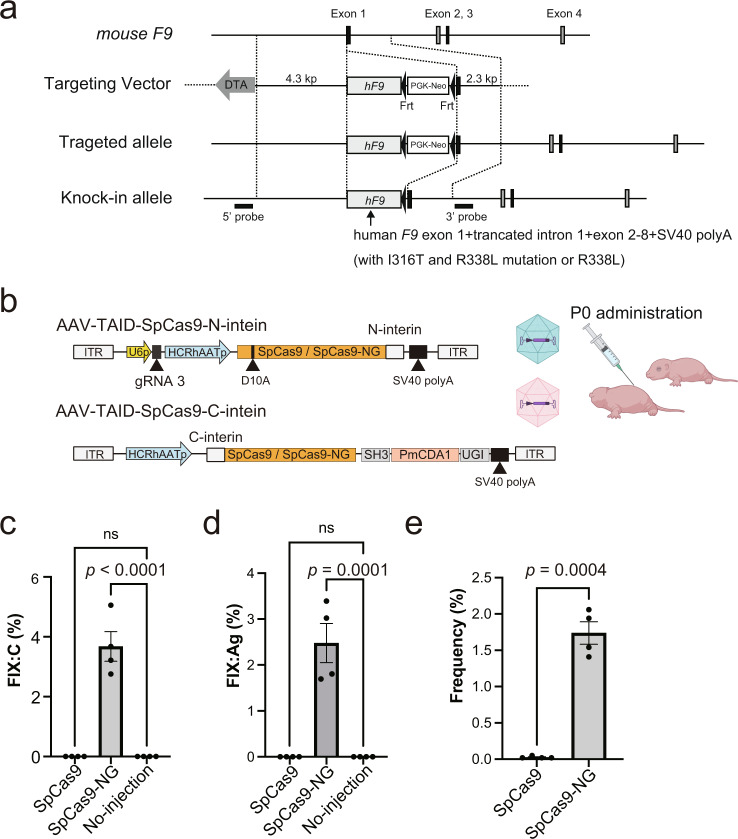
NOG (NOD.Cg-Prkdcscid II2rgtm1Sug/Jic) and TK-NOG [NOD.Cg-Prkdcscid Il2rgtm1SugTg (Alb-UL23)7-2/ShiJic] mice were purchased from In-Vivo Science Inc. (Tokyo, Japan). Knock-in (KI) mice expressing human F9 cDNA without or with the hemophilia B mutation (I316T) [C57BL/6-F9tm1.1(hF9_R338L) and C57BL/6-F9tm1.2(hF9_R338L_I316T)]were developed by UNITECH (Chiba, Japan). Briefly, a linearized targeting vector containing a human F9 minigene (exon 1, truncated intron 1, and exon 2–8) (R338L mutation or R338L+I316T mutations), SV40 polyA sequence, and PGK-Neo cassette with 5′ arm (4.3 kb) and 3′ arm (2.3 kb) was transduced into mouse embryonic stem cells (ESGRO Complete™ Adapted C57/BL6 mouse embryonic stem cell line, Merck, Darmstadt, Germany) by electroporation. The embryonic stem cells were then injected into mouse blastocysts after confirming gene targeting by Southern blotting. Chimeric mice were bred with C57BL/6 mice to produce F1 mice and then bred with CAG-FLPe transgenic mice to delete the PGK-Neo cassette. All animals were housed in groups of a maximum of five mice in individually ventilated cages under specific pathogen-free animal facilities. Dark/light cycles were 12 h/12 h with a temperature of 23 °C and humidity of 50%. All experiments were performed in compliance with the Institutional Animal Care and Concern Committee at Jichi Medical University, and animal care was carried out in accordance with the committee's guidelines.
Teratoma formation and histological analysis
iPSCs (1 × 10⁶ cells) were injected into the testis of immunodeficient NOG male mice (6-week-old). At 12–17 weeks post-injection, mice were anesthetized with isoflurane and perfused with PBS. Tumor tissues were then fixed with 10% formalin. Paraffin-embedded tissue sections were dewaxed using xylene and rehydrated using ethanol and water. Sections were processed for hematoxylin and eosin staining and then visualized using an all-in-one microscope (BIOREVO BZ-9000, KEYENCE).
Differentiation of iPSCs into hepatic cell lineages
Hepatic cell lineage differentiation was performed in vitro as previously described with minor modification25,26. iPSCs were dissociated into single cells using TrypLE-Select (ThermoFisher Scientific) and plated onto Matrigel Growth Factor Reduced Basement Membrane Matrix (Corning). Cells were maintained in StemFitAK02N for a few days until 80% confluent. Endoderm differentiation was initiated using RPMI1640 medium supplemented with 50 ng/mL of human WNT3A (R&D systems, Minneapolis, MN), 100 ng/mL of human Activin A (BioLegend), and B-27 Supplement (ThermoFisher Scientific) for 4 days. Induction of hepatocyte differentiation was performed by culturing the endoderm cells in RPMI1640 supplemented with 20 ng/mL of fibroblast growth factor 4 (BioLegend), 20 ng/mL of bone morphogenetic protein 4 (BioLegend), and B-27 Supplement for 5 days, followed by culture in RPMI1640 supplemented with 20 ng/mL of human hepatocyte growth factor and B-27 Supplement in hypoxic conditions using Hypoxia Chamber (STEMCELL Technologies Inc., Vancouver, BC, Canada). Cells were further cultured for 11 days in Hepatocyte Culture Media (Hepatocyte Culture Media Bullet kit, Lonza, Basel, Switzerland) supplemented with 20 ng/mL of human Oncostatin M (FUJIFILM Wako Pure Chemical).
Subrenal capsule implantation of iPSC-derived hepatic cells into TK-NOG mice
Engraftment of differentiated iPSCs was performed using TK-NOG mice26. Eight-week-old TK-NOG male mice were injected intraperitoneally with 6 mg/kg ganciclovir at 8 and 6 days prior to transplantation. Differentiated iPSC-derived cells (2 × 10⁶) were suspended in ice-cold Hepatocyte Culture Media (Lonza) and Matrigel Growth Factor Reduced Basement Membrane Matrix and then transplanted in the subrenal capsule of TK-NOG mice anesthetized with isoflurane. Mouse kidneys were harvested 12 weeks after transplantation, and mRNA expression of F9 was analyzed. For the detection of the FIX antigen in engrafted tissue via immunohistochemistry, tissue samples were fixed with 4% paraformaldehyde, incubated with PBS containing sucrose, and then frozen in Tissue-Tek O.C.T. Compound (Sakura Fintek Japan, Tokyo, Japan). The sections were incubated with 2% goat serum and 0.3% Triton X-100 and further treated with Ready Probes Streptavidin/Biotin Blocking Solution (Invitrogen, USA). The sections were then incubated with goat-human FIX polyclonal antibody conjugated with biotin (10 µg/mL, GAFIX-AP, Affinity Biologicals) overnight at 4 °C. The antibody binding was detected with streptavidin conjugated with Alexa Fluor 594 (10 µg/mL, ThermoFisher Scientific). Slides were mounted with VECTASHIELD mounting medium with DAPI. Immunofluorescence staining was observed with a Leica SP8 confocal microscope (Leica Microsystems).
Quantitative reverse transcription polymerase chain reaction
Total RNA was isolated using the RNeasy Mini Kit (QIAGEN). Human liver RNA was purchased from Takara Bio. cDNA was synthesized using the PrimeScript RT-PCR Kit (Takara Bio). Quantitative polymerase chain reaction (PCR) was performed using THUNDERBIRD Probe qPCR Mix (Toyobo, Osaka, Japan) or THUNDERBIRD SYBR qPCR Mix (TOYOBO) on QuantStudio 12K Flex (ThermoFisher Scientific). Reactions were analyzed in duplicate and expression levels were normalized to GAPDH mRNA levels. Predesigned primer and probe sets were used for the experiments (TaqMan Gene Expression Assays, ThermoFisher Scientific, AFP: Hs00173490, ALB: Hs00910225, CYP3A4: Hs00604506, HNF4A: Hs00230853, F9: Hs01592597, GAPDH: Hs02758991). The predesigned primers for SYBR qPCR were purchased from Takara Bio (F9: HA166488 GAPDH: HA067812).
Measurement of FIX activity and FIX antigen
The medium of confluent cells was changed into a fresh medium containing 5 μg/mL of menatetrenone (Eisai, Tokyo, Japan), and the culture was continued for the following 48 h. Blood sample was drawn from the jugular vein of anesthetized mice with a 29G micro-syringe (TERUMO Corp., Tokyo, Japan) containing 1/10 (volume/volume) sodium citrate. FIX activity (FIX:C) was measured with a one-stage clotting-time assay using an automated coagulation analyzer (Sysmex CA-1600 analyzer; Sysmex, Kobe, Japan). The FIX antigen (FIX:Ag) was measured as follows: microtiter plates were incubated with PBS containing anti-human FIX antibody (CL20039AP; CEDARLANE, Ontario, Canada) (1 μg/mL) overnight at 4 °C. After blocking with 5% casein in PBS for 1 h at room temperature, samples were incubated in PBS containing 1% casein and 0.1% Triton X-100 for 1 h at 37 °C. After washing with PBS containing 0.1% Triton X-100, the bound FIX antigen was detected with the anti-human FIX antibody conjugated with horseradish peroxidase (Affinity Biologicals) using ABTS microwell peroxidase substrate (Seracare, Milford, MA, USA).
AAV vector construction and vector administration
The SpCas9 cannot be packaged in one AAV vector; thus, we employed an intein-mediated split-Cas9 system27. The SpCas9-base editor was expressed by two AAV vectors. To express the target gene specifically in hepatocytes, we created a plasmid that contains a chimeric promoter (HCRhAAT; an enhancer element of the hepatic control region of the Apo E/C1 gene and the human anti-trypsin promoter), cDNAs, and the SV40 polyadenylation signal. The AAV genes were packaged by triple plasmid transfection of AAVpro293T cells (Takara Bio) to generate the AAV vector4. We used the AAV8 serotype, as it efficiently expresses the target gene in the mouse liver in vivo. The AAV vector was quantified by qPCR measuring the SV40 polyadenylation signal. The primer pairs and probe were as follows:
5'-AGCAATAGCATCACAAATTTCACAA-3' (sense)
5'-CCAGACATGATAAGATACATTGATGAGTT-3' (anti-sense)
5'-AGCATTTTTTTCACTGCATTCTAGTTGTGGTTTGTC-3' (FAM probe)
For the in vivo base-editing experiments, we administered two AAV vectors expressing the N- and C terminal of SpCas9-base editor intraperitoneally (10 µL) in neonatal mice (1 × 10¹¹ viral genomes).
GUIDE-Seq
GUIDE-Seq was carried out as previously described, with minor modifications28. HEK293 cells were transfected with a plasmid expressing SpCas9 or SpCas9-NG and gRNA3 for 7 days together with dsODN. Genomic DNA was isolated, and then the libraries were prepared from 400 ng of genomic DNA using the NEBNext Ultra II FS DNA Library Prep Kit for Illumina (New England Biolabs, Ipswich, MA, USA) according to the manufacturer's instructions. Next, they were subjected to 150 pair-end read sequencing using the Illumina NovaSeq platform (50,000,000 reads) at the Genome Information Research Center at Osaka University. Data analysis was performed using the GUIDE-Seq analysis pipeline following standard procedures29. The primer sequences are described in Supplementary Table 1, and the in silico predicted off-target sites are listed in Supplementary Data 1.
Statistics and reproducibility
Statistical analyses were performed using Prism 9 software (Graph Pad Software, San Diego, CA, USA). All data are presented as mean ± standard error of the mean (SEM). Each data was obtained from biologically independent experiments (Supplementary Data 2). The sample number of the experiment was indicated in each figure legend. When indicated, statistical significance was determined using a two-tailed Student's t-test or one-way ANOVA with post hoc Tukey's multiple comparison test. All P-values <0.05 were considered statistically significant.
Reporting summary
Further information on research design is available in the linked to this article. Nature Portfolio Reporting Summary
Results
SpCas9-NG showed broad PAM flexibility in iPSCs
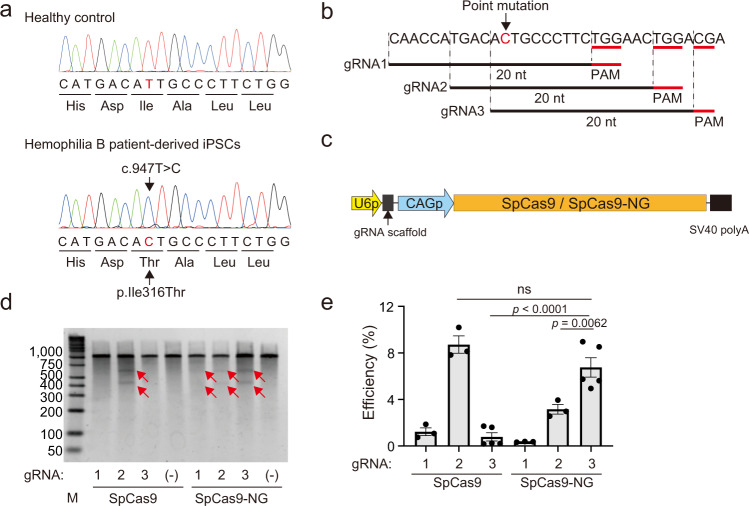
We found three possible PAM sites at the 3′ end of the mutation and designed three guide RNAs (gRNAs) to repair the mutation by a base-editing approach (Fig. 1b). We then inserted each gRNA downstream of the U6 promoter in the plasmid harboring wild-type SpCas9 or SpCas9-NG driven by CAG promoter (Fig. 1c). Using Surveyor endonuclease assay, we assessed a DSB near the mutation site induced by the expression of each gRNA and Cas9 after transduction of patient-derived iPSCs with each plasmid. SpCas9 induced DSBs with gRNA2 (TGG PAM) but not with gRNA1 (TGG PAM) or gRNA3 (CGA PAM). (Fig. 1d and Supplementary Fig. 1). In contrast, SpCas9-NG induced DSBs with all three gRNAs, albeit a low efficiency with gRNA1(Fig. 1d and Supplementary Fig. 1). We quantified the frequency of DSBs induced by Cas9 with gRNA2 and gRNA3 by next-generation sequencing. SpCas9 induced DSBs at the TGG PAM site with gRNA2 more efficiently than SpCas9-NG (SpCas9, 8.72 ± 1.29%; SpCas9-NG, 3.16 ± 0.71%) (Fig. 1e). Notably, SpCas9-NG, but not SpCas9, induced DSBs at the CGA PAM site with gRNA3 efficiently (SpCas9, 0.21 ± 0.04%; SpCas9-NG, 6.55 ± 2.13%) (Fig. 1e). These results confirmed the broad PAM flexibility of SpCas9-NG in iPSCs, as observed in HEK293 cells. To evaluate off-target events in the whole genome, we performed GUIDE-Seq in HEK293 cells transducing the plasmid expressing SpCas9 or SpCas9-NG and gRNA3. The peak score was significantly higher for SpCas9-NG at one guide RNA mismatch, which corresponds to the patient's point mutation (Supplementary Fig. 2a,b and Supplementary Data 1). We could not detect any difference between the other scores and influenced genes of SpCas9 and those of SpCas9-NG (Supplementary Fig. 2a, b and Supplementary Data 1).

PAM flexibility of SpCas9-NG in a hemophilia B patient-derived iPSC. DNA sequencing of(part of exon 8) in control or severe hemophilia B patient-derived iPSCs. The patient-derived iPSCs contain the missense mutation (c.947T>C), leading to an amino-acid substitution (p.Ile316Thr). The replaced nucleotide is highlighted in red.Schematic presentation of 20-nt guide RNA near the missense mutation. PAM sequences for each guide RNA are indicated in red.Schematic presentation of the plasmid constructs. U6p, U6 promoter; CAGp, CAG promoter.,Patient-derived iPSCs were transduced using a plasmid expressing SpCas9 or SpCas9-NG and each gRNA.Detection of induced DSBs using Surveyor endonuclease assay, following 2% agarose gel electrophoresis. Red arrows indicate the fragments caused by the Surveyor endonuclease digestion. M, DNA ladder marker.Examination of the frequency of DSBs using next-generation sequencing. Values represent mean ± SEM ( = 3). Statistical significance was determined using one-way ANOVA with post hoc Tukey's multiple comparison test. ns, not significant. a b c d e d e F9 n
Genetic correction of the mutation in patient-derived iPSCs by base editing
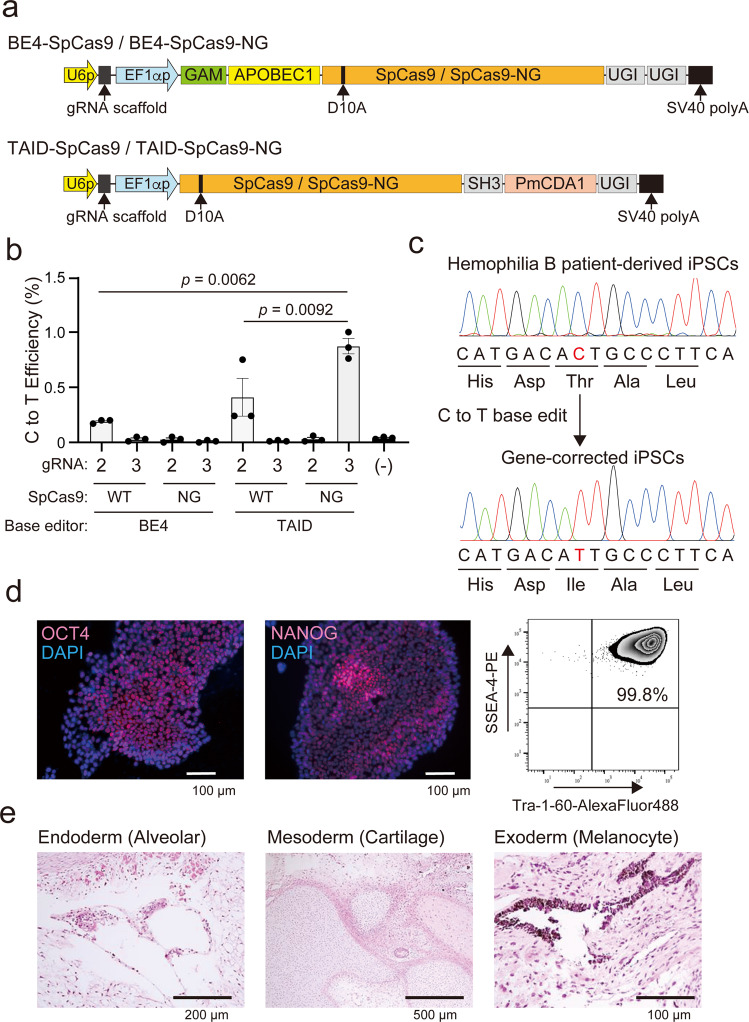
We next cloned iPSC colonies after the transduction of the patient-derived iPSCs with plasmids harboring SpCas9-NG-TAID with gRNA3. We detected 84 colonies and selected one that had the gene correction at the mutation (Fig. 2c). The isolated gene-corrected iPSCs could be maintained in an undifferentiated status since the cells expressed pluripotency markers (NANOG, OCT4, SSEA-4, and Tra-1-60) (Fig. 2d). Furthermore, the gene-corrected iPSCs developed teratomas, representing differentiation into three germ layers, in NOG mice (Fig. 2e).

Genetic correction of hemophilia B patient-derived iPSCs by base-editing technology. Schematic presentation of the plasmid constructs for the cytidine base editor, SpCas9 conjugated BE4 (BE4-SpCas9), SpCas9-NG conjugated BE4 (BE4-SpCas9-NG), SpCas9 conjugated TAID (TAID-SpCas9), or SpCas9-NG conjugated TAID (TAID-SpCas9-NG). U6p, U6 promoter; EF1αp, EF1α promoter; GAM, bacteriophage Mu Gam protein; UGI, a uracil DNA glycosylase inhibitor.The frequencies of C to T conversion at the mutation of the severe hemophilia B patient-derived iPSCs after transduction with BE4-SpCas9, BE4-SpCas9-NG, TAID-SpCas9, or TAID-SpCas9-NG plasmid harboring gRNA2 or gRNA3. The frequency of C to T conversion was examined using next-generation sequencing. Values represent mean ± SEM ( = 3). Statistical significance was determined using one-way ANOVA with post hoc Tukey's multiple comparison test.DNA sequencing of(part of exon 8) in the severe hemophilia B patient-derived iPSCs or the gene-corrected iPSCs by the base editor. The replaced nucleotide is highlighted in red.The expression of pluripotent markers in the patient-derived gene-corrected iPSCs. The expression of OCT4 and NANOG was examined by immunohistochemical staining. Sections were observed using an all-in-one microscope (BIOREVO BZ-9000). Red, OCT4 and NANOG; blue, DAPI. SSEA-4 and Tra-1-60 expression was determined by flow cytometry.Sections from a gene-corrected iPSC-derived tumor in immune-deficient mice were stained with hematoxylin-eosin staining and then observed. Differentiation into three germ layers (endoderm, mesoderm, and exoderm) was confirmed. a b c d e n F9
Differentiation of patient-derived gene-corrected iPSCs into hepatic cells

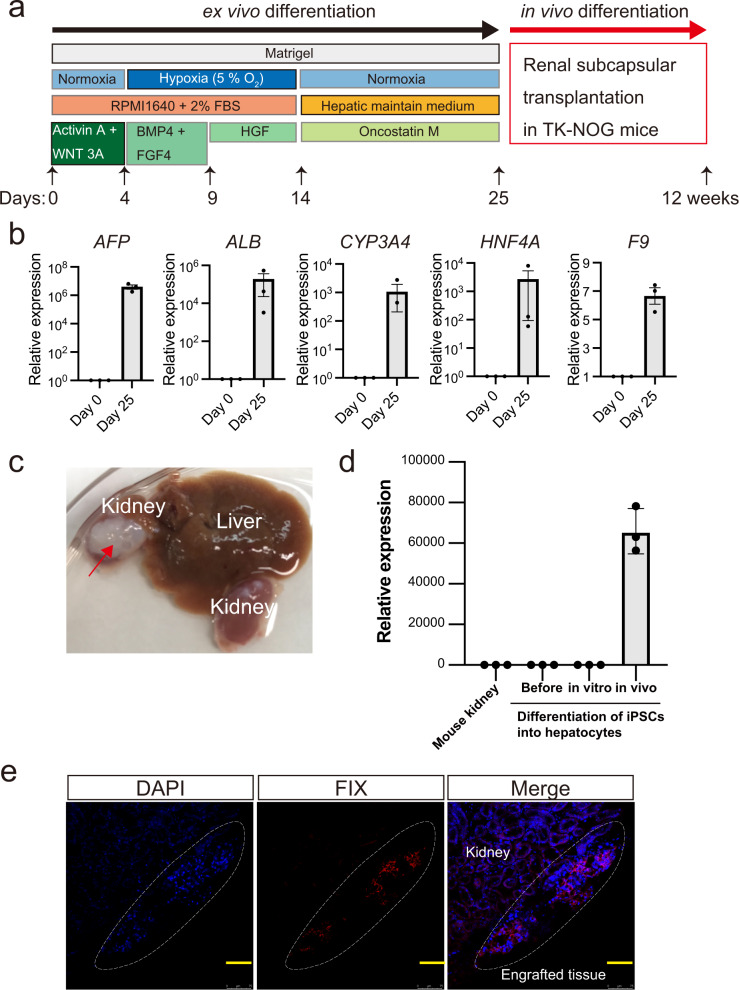
Differentiation of gene-corrected hemophilia B patient-derived iPSCs into hepatic lineage cells. Schematic presentation of the procedure for hepatic lineage differentiation of iPSCs. iPSCs were differentiated in vitro for 25 days and then transplanted into the renal subcapsule of immune-deficient mice.Relative mRNA expression of hepatocyte-specific proteins (,,,, and) in the gene-corrected iPSCs before (day 0) and after hepatic lineage differentiation in vitro (day 25). Values represent mean ± SEM ( = 3).Engraftment of the differentiated iPSCs in mouse kidney at 12 weeks after renal subcapsule transplantation in immune-deficient mice (red arrow).Relative mRNA expression ofin mouse kidney, gene-corrected undifferentiated iPSCs (before), hepatic lineage-differentiated gene-corrected iPSCs in vitro (in vitro), and engrafted tissues derived from hepatic lineage-differentiated gene-corrected iPSCs (in vivo). The same samples in () were analyzed for relative expressions of(Before, Day 0 in (); in vitro, Day 25 in ()). Values represent mean ± SEM ( = 3).FIX expression in the gene-corrected iPSC-derived tissue was assessed by immunohistochemical staining. The staining was observed using a confocal microscope (Leica TCS SP8). Blue, DAPI; Red, FIX. Scale bars (75 μm) are shown in yellow. a b c d b b b e AFP ALB CYP3A4 HNF4A F9 n F9 F9 n
Increase in FIX activity after gene correction by base-editing technology

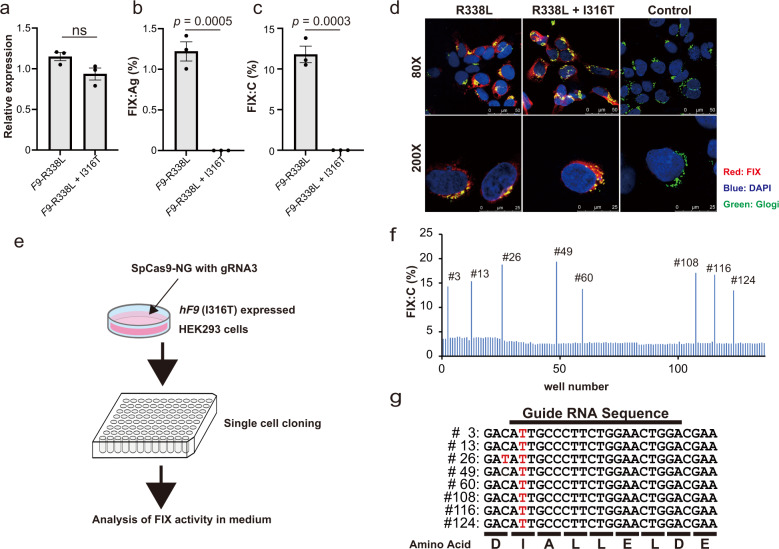
Restoration of FIX production by base-editing technology in HEK293 cells expressing the patient's mutation. The HEK293 cells stably expressing humancDNA (R338L mutation) and the patient'scDNA (R338L+I316T mutations) were established by plasmid transfection.–RelativemRNA expression (), FIX antigen (FIX:Ag) (), and FIX activity (FIX:C) () in the supernatant were assessed. Values represent mean ± SEM ( = 3). ns, not significant. Statistical significance was determined using a two-tailed Student's-test.Intracellular FIX protein expression in the HEK293 cells stably expressing humancDNA (R338L mutation) and the patient'scDNA (R338L+I316T mutations) was assessed by immunohistochemical staining. Immunofluorescence staining was observed and photographed using a confocal microscope (Leica TCS SP8). Red, FIX; green, Golgi; blue, DAPI. The scales are indicated in the figures.Schematic presentation of the isolation of cell clones after base editing. We transfected the plasmids (TAID-SpCas9-NG with gRNA3) into HEK293 cells expressing the patient'scDNA (R338L+I316T mutations). We cloned single-cell-derived colonies and evaluated the FIX:C in the medium.Increase in FIX:C in the medium observed after transfection in eight out of 137 clones.cDNA sequencing near the mutation in the clones showing increased expression of FIX:C in the medium. The red letters indicate the bases that were different from the DNA sequences obtained from the original cells. F9 F9 F9 n t F9 F9 F9 F9 a c a b c d e f g

Restoration of FIX production in knock-in mice expressing the patient'scDNA by base-editing technology. F9 Schematic presentation of the knock-in allele.Schematic presentation of AAV vectors for intein-mediated split-Cas9 system expressing TAID-SpCas9 or TAID-SpCas9-NG. We injected two AAV vectors for the expression of TAID-SpCas9 or TAID-SpCas9-NG, as well as gRNA3, into the newborn pups expressing the patient'scDNA. U6p, U6 promoter; HCRhAATp, a chimeric promoter containing an enhancer element of the hepatic control region of thegene and the human anti-trypsin promoter; UGI, a uracil DNA glycosylase inhibitor.,The increase in plasma FIX antigen (FIX:Ag) () and FIX activity (FIX:C) () at 6 weeks after the vector injection. The data were shown as the percentage of heterozygous knock-in mice expressing humancDNA without the I316T mutation. Values represent mean ± SEM ( = 4). ns, not significant. Statistical significance was determined using one-way ANOVA with post hoc Tukey's multiple comparison test.The frequencies of C to T conversion at the mutation of the livers in the treated mice were assessed with next-generation sequencing. Values represent mean ± SEM ( = 4). Statistical significance was determined using a two-tailed Student's-test. The illustration of () was created with BioRender.com. a b c d c d e b F9 Apo E/C1 F9 n n t
Discussion
The CRISPR-Cas9 genome-editing technologies are expected to be useful for the treatment of genetic diseases. However, attention has recently been directed to non-cutting genome editing, such as base editing13,14, due to the genomic toxicity derived from DSBs8–11. A large percentage of genetic diseases are associated with point mutations34,35, and around 60% of the disease-causing point mutations could be repaired by C-to-T or A-to-G base editing36. Point mutations are the most common type of mutation in hemophilia, and hemophilia B has a particularly high percentage of point mutations, even in severe cases37, making it a good target disease for base editing. We searched the mutations of hemophilia B in the database of the European Association for Haemophilia and Allied Disorders (EAHAD). We extracted 4657 mutations (excluding 56 polymorphisms) and found that 67.2% of them may be treated by base editing (point mutation: A>G, C>T, G>A, and C>T) (Supplementary Table 2). However, the application of base editing to treat disease mutation remains limited as Cas9 requires PAM sequences for target DNA recognition, and base editors can efficiently edit limited few bases in target sites36. The present study revealed that a point mutation in human hemophilia B could be repaired by base editing with SpCas9-NG, an engineered Cas9 with broad PAM flexibility.
The efficiency of base editing with SpCas9-NG to repair the mutation was more than twofold greater than that of wild-type SpCas9. SpCas9-NG can bind to the target DNA site by recognizing only one G nucleotide and could therefore cover four times as many mutation sites. The PAM flexibility of SpCas9-NG in base editing has been previously reported in plants and rabbits38,39. Our data demonstrated that SpCas9-NG is effective in repairing human disease mutations for treatment. xCas9, another engineered Cas9 with broad PAM flexibility, also showed effective repair of human disease mutations by base editing40. However, the efficiency of base editing by xCas9 was much lower than that of SpCas9-NG21. Another variant of Cas9, SpRY, which requires only a single base as the PAM sequence (NRN and NYN), was recently developed41. These SpCas9 variants with high PAM flexibility exhibit lower editing efficiency compared with wild-type SpCas9 at target sites with NGG PAM sequences7. Indeed, we observed that SpCas9-NG induced DSBs at the gRNA-targeting NGG PAM site much less efficiently as compared with wild-type SpCas9. We replaced the Arg1335 of SpCas9, which recognizes the third "G" base, with Ala in SpCas9-NG to remove the base-specific interaction with this base21. The introduction of the mutation may expand the flexibility, although it may decrease the recognition against "NGG". Thus, it is crucial to select wild-type or engineered Cas9 with broad PAM flexibility according to the individual PAM sequence.
TAID showed a higher base-editing efficiency compared with BE4 for the causative mutation (c.947T>C) in a hemophilia B patient. The effective target range of base editing differs between TAID and BE4, and TAID and BE4 effectively induced C to T conversion 2–4 and 4–8 bp downstream of the 5′ end of the gRNA sequence, respectively13,14. When SpCas9-NG binds to the gRNA3-targeting DNA site, the causative mutation exists at the efficient base-editing range of TAID. Although wild-type SpCas9 efficiently induced DSBs at the gRNA2-targeting site and the causative mutation exists in the base-editing range of BE4 in the case of gRNA2, we failed to observe efficient editing by BE4. These data are consistent with previous reports showing that the base-editing efficiency of TAID near the 5′ end of gRNA sequence is higher than that of BE4, and the editing efficiency of BE4 differs between iPSCs and HEK293T cells23,42. As we could not precisely expect a successful outcome from the application of base-editing technology, comparing several combinations of base editors and Cas proteins was necessary to find an effective way to repair particular mutations. Recently, cytidine base editors with improved editing area and efficiency and new base editors, which can change C-to-A or C-to-G in mammalian cells, have been reported43–46. It may become possible to develop personalized genome-editing therapies by combining an engineered Cas9 with broad PAM flexibility and a variety of base-editing tools.
The present study has several limitations. First, the base-editing efficiency for the mutation of iPSC in this study was lower than that in previous reports21. One explanation for the low efficiency could be that the mutation site is difficult to repair by base editing. We predicted the efficiency of the base-editing approach using a Web software based on BE4max (http://deepcrispr.info/DeepBaseEditor/↗)42 and found that the repair efficiency of the mutation was 12%. Since the base-editing efficiency of BE4 was lower than that of BE4max43, the mutation repair was expected to be less than 7%. It has also been reported that the base-editing efficiency in iPSCs did not match the predicted efficiency in HEK293 cells42. The application of improved base-editing tools would efficiently repair the mutation43,44. Second, there may have been a bystander effect of the base editor, in which the base-editing tool creates unwanted C to T alterations when more than one C is present in the editing window. We observed several unexpected C to T conversions near the target site (Supplementary Fig. 5a, b). Efforts to minimize bystander and off-target activities are required for future clinical application. Recent studies reported other genome-editing technologies that do not induce DSBs, such as prime editing, efficient homology-directed gene repair, and genome insertion by piggyback47–50. It will be interesting to compare the treatment effects of base editing with these other approaches. Additionally, we solely assessed the mutation derived from only one patient. Therefore, further investigations are required to validate the efficacy of base editing using SpCas9-NG. Finally, we were able to detect the expression of F9 mRNA and FIX protein in the gene-corrected iPSC-derived cells but did not detect an increase in plasma FIX antigens. We suppose one possible reason why plasma FIX antigen could not be detected was an insufficient number of transplanted cells derived from the iPSCs in mice and incomplete differentiation. A highly efficient method for differentiating iPSCs into mature hepatocytes for therapeutic application remains to be established51. The advancement of novel technologies, including three-dimensional culture and organoid formation52,53, may also lead to iPSC-based cell therapy for inherited liver diseases. We found that utilizing the AAV vector-mediated base-editing approach using SpCas9-NG increased plasma FIX in vivo but failed to completely normalize plasma FIX. Thus, we need to further optimize the efficiencies of the in vivo base-editing treatment. Alternatively, efficient genome editing in the liver hepatocyte could be achieved by lipid nanoparticle (LNP)-based intravenous delivery of Cas9 mRNA in a human clinical trial54. The delivery of CRISPR base editors using LNP could reportedly modify disease-related genes in cynomolgus monkeys in vivo55. The LNP-based approach combined with SpCas9-NG would facilitate in vivo base-editing therapy targeting various point mutations of inherited disorders.
In conclusion, we showed that PAM-flexible SpCas9-NG-mediated base editing effectively repairs point mutations in hemophilia B patient-derived iPSCs, as well as HEK29 cells and knock-in mice carrying the patient's mutation. The broad PAM flexibility of SpCas9-NG allows base editing at target sites that cannot be edited by wild-type SpCas9. Hence, base-editing technology based on SpCas9-NG can be used to treat point mutations in hereditary diseases. Further development of the genome-editing tool with high editing efficiency and specificity, as well as efficient delivery methods, may lead to personalized treatment by base editing for human genetic diseases.
Supplementary information
Supplementary Materials Description of Additional Supplementary Files Supplementary Data 1 Supplementary Data 2 Peer Review File Reporting Summary