
What this is
- This study followed 1,234 individuals with long COVID for 6 months post-SARS-CoV-2 infection to assess recovery.
- At 6 months, 724 (58.7%) had persistent symptoms while 510 (41.3%) had fully recovered.
- Factors such as pre-existing health conditions and specific symptoms at 3 months were linked to long COVID persistence.
Essence
- Over half of individuals with long COVID continued to experience symptoms 6 months after infection, with certain health factors influencing recovery. The study identified distinct clinical trajectories for recovery and persistence.
Key takeaways
- 58.7% of participants had symptoms at 6 months post-infection. This indicates a significant proportion of individuals continue to experience health issues long after initial infection.
- Individuals reporting fatigue, shortness of breath, or cough at 3 months were more likely to have persistent symptoms. These symptoms were identified as independent predictors of long COVID persistence.
- A third of those with sought medical care for their symptoms, indicating ongoing healthcare needs and the impact of long COVID on daily life.
Caveats
- The study relied on self-reported symptoms, which may not capture the full clinical picture. This could affect the accuracy of the findings.
- Only 60% of participants completed the follow-up survey, raising concerns about potential bias in the results due to non-respondents.
- The study did not assess symptom severity, which could provide additional insight into the clinical predictors of .
Definitions
- Persistent long COVID: Presence of one or more COVID-19 illness-related symptoms 6 months post-infection.
- Recovered long COVID: Individuals who had long COVID at 3 months post-infection but reported no symptoms at 6 months.
Simplified
Introduction
Long COVID has been characterized as the continuation or development of new symptoms 3 months after the initial SARS-CoV-2 infection, with no other explanation [1]. Approximately 10–30% of persons infected with SARS-CoV-2 develop long COVID. The wide range in estimates of the prevalence of long COVID can be attributed to a number of factors, including a lack of standardized biomarkers and differences in study design, recruitment strategies, symptom assessment tools employed, and health care environments [2, 3]. Although the exact numbers of those living with the condition are uncertain, at least 65 million people are estimated to be experiencing long COVID globally [4, 5].
Long COVID symptoms may be reported months or even years after infection [6 –8]. The persistence of long COVID symptoms also leads to ongoing demands on healthcare services and can have substantial negative impacts on the ability to work, resulting in significant economic consequences for individuals and society [9 –12].
Because a specific diagnostic test is lacking, there is a reliance on self-reported symptoms to diagnose long COVID [13 –15]. The diverse symptomatology associated with this condition, however, makes developing a precise case definition difficult [16, 17]. Even more challenging has been identification of key factors which can explain the varying clinical course of COVID over time [18 –20]. Early investigations revealed that symptoms associated with long COVID could increase, decrease, or plateau during the first year following SARS-CoV-2 infection [6, 21]. Several clinical trajectories for individuals with long COVID have recently been identified including cohorts with rapidly decreasing versus highly persistent symptomatology, with the latter group likely responsible for the significant ongoing burden of long COVID from a healthcare and economic perspective [19, 22].
The main aim of this study was to investigate factors associated with persistence of symptoms among individuals who had long COVID 3 months after a first SARS-CoV-2 infection with the Omicron variant in Western Australia (WA).
Methods
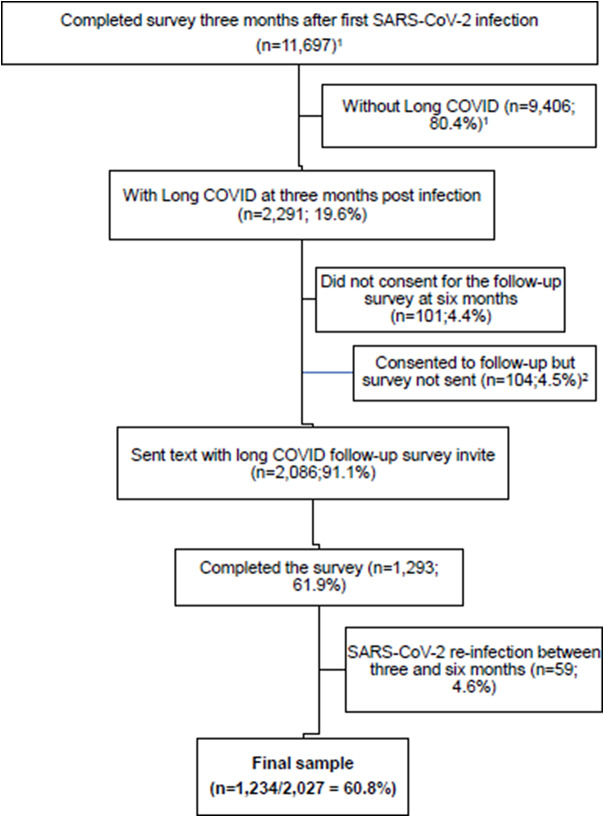
This longitudinal study prospectively followed persons who had long COVID 3 months after SARS-CoV-2 infection out to 6 months. Persons 18 years of age or over with laboratory-confirmed infection between 16 July and 03 August 2022, and long COVID diagnosed in a previous study, were eligible for inclusion [12].
In the earlier study, long COVID was defined as 'the continuation or development of new symptoms 3 months after the initial SARS-CoV-2 infection with no other explanation'. In this follow-up study, 'persistent long COVID' is defined as the presence of one or more COVID-19 illness-related symptom/s or health issue/s 6 months post-SARS-CoV-2 infection among persons who had long COVID 3 months post-infection; 'recovered long COVID' is defined as persons who had long COVID at 3 months post-infection who no longer report related symptoms 6 months post-infection. 'Fully vaccinated' was defined as receipt of 3 or more doses of a COVID-19 vaccine at least 7 days before SARS-CoV-2 infection, and 'not fully vaccinated' was two or fewer doses [12].
In January 2023, the WA Department of Health sent a follow-up survey via text message to persons with long COVID at 3 months who had consented to further follow-up. The responses from the 6-month survey were linked to those from the 3-month survey and information recorded during an interview conducted at the time of their initial SARS-CoV-2 infection, which included demographics, COVID-19 vaccination status prior to infection, and pre-existing health conditions.
Like the 3-month survey, the 6-month survey solicited information on the presence of 22 specific symptoms (henceforth called 'solicited symptoms'), as well as healthcare utilization and impacts on work or study. Non-respondents were reminded of the opportunity to participate in the research via a text message. Persons who reported having a SARS-CoV-2 re-infection diagnosed by polymerase chain reaction or rapid antigen tests between the 3- and 6-month surveys were excluded.
Analysis
We compared baseline demographic and health characteristics in people who completed and people who did not complete (did not consent/consented but did not complete) the survey using chi-squared tests.
Among those who completed the 6-month survey, we calculated the number and proportion with persistent long COVID. We described long COVID symptoms reported at 3 months post-infection separately for those with and without persistent long COVID, including the mean number of symptoms and proportions with each of the solicited symptoms.
We used Poisson regression with robust error variance to estimate relative risks (RR), with 95% confidence intervals (CI) of potential predictors of persistent long COVID. To examine the association of symptoms reported at 3 months with persistent long COVID at 6 months, we assessed each symptom individually while treating sex, 10-year age group, region (metropolitan vs. rural), vaccination status, and any significant or long-standing health issues at the time of the acute SARS-CoV-2 infection as potential confounders, using inverse probability weighting (IPW). These potential confounders were selected for inclusion based on our previous work, which found they were associated with long COVID 3 months post-SARS-CoV-2 infection [12]. To quantify the risk of persistent long COVID associated with increased overall symptomatology, we used a multivariable model, simultaneously adjusting for potential confounders and the number of solicited long COVID symptoms reported by participants at 3 months.
To examine health trajectories among those with persistent long COVID, we assessed the change in the number and type of symptoms individuals reported at 3 and 6 months post-infection as well as reductions in work or study and health care visits in the month prior to the survey. Statistical analysis was conducted in Stata 15 [23].
Results
Survey response

Flowchart of participants for the long COVID follow-up study, Western Australia, 12-30 January 2023.A total of 11,697 participants completed the three-month survey during the initial study. Of those, 2,291 met the case definition for long COVID three months post-infection.Survey not sent due to an administrative error. Notes: 1 2
| Variable | Did not consent for 6-month survey ( = 101)n | Consented but did not complete the 6-month survey( = 793)n | Completed 6-month survey (final study sample)( = 1,234)n | |||
|---|---|---|---|---|---|---|
| Number | % (95% CI) | Number | % (95% CI) | Number 1 | % (95% CI) | |
| Sex | ||||||
| Female | 67 | 67.0 (57.1–75.6) | 520 | 65.8 (64.7–68.8) | 828 | 67.4 (64.7–70.0) |
| Male | 33 | 33.0 (24.4–43) | 270 | 34.2 (31.2–35.3) | 401 | 42.6 (30.1–35.3) |
| Age group | ||||||
| 18–29 | 23 | 22.8 (15.5–32.1) | 115 | 14.5 (12.1–17.1) | 74 | 6.0 (4.7–7.5) |
| 30–39 | 22 | 21.8 (14.7–31.1) | 153 | 19.3 (16.6–22.2) | 140 | 11.4 (9.6–13.2) |
| 40–49 | 15 | 14.9 (9.1–23.4) | 163 | 20.6 (17.8–23.5) | 214 | 17.3 (15.3–19.6) |
| 50–59 | 22 | 21.8 (14.7–31.1) | 195 | 24.6 (21.6–27.7) | 351 | 28.4 (25.9–31.1) |
| 60–69 | 16 | 15.8 (9.9–24.5) | 114 | 14.4 (12–17) | 303 | 24.6 (22.2–27.1) |
| 70 or above | 3 | 3.0 (0.9–9.0) | 53 | 6.7 (5–8.7) | 152 | 12.3 (10.5–14.3) |
| Region | ||||||
| Metropolitan | 81 | 80.2 (71.1–87.0) | 648 | 81.7 (78.8–84.3) | 999 | 81.0 (78.7–83.1) |
| Regional/remote | 20 | 19.8 (13.1–28.9) | 145 | 18.3 (15.7–21.2) | 235 | 19.0 (16.9–21.3) |
| Number of doses before SARS-CoV–2 infection | ||||||
| 0–2 doses | 10 | 9.9 (5.4–17.6) | 57 | 7.2 (5.5–9.2) | 63 | 5.1 (3.9–6.5) |
| 3 doses | 84 | 83.2 (74.4–89.4) | 640 | 80.7 (77.8–83.4) | 867 | 70.3 (67.6–72.8) |
| 4 or more doses | 7 | 6.9 (3.3–14.0) | 96 | 12.1 (9.9–14.6) | 304 | 24.6 (22.3–27.1) |
| Self-rated health at 3 months | ||||||
| Excellent | 2 | 2.0 (0.5–7.7) | 12 | 1.5 (0.8–2.6) | 14 | 1.1 (0.6–1.9) |
| Good | 39 | 38.6 (29.5–48.6) | 321 | 40.5 (37.0–44.0) | 455 | 36.9 (34.2–39.6) |
| Fair | 47 | 46.5 (36.9–56.4) | 388 | 48.9 (45.4–52.5) | 624 | 50.6 (47.7–53.4) |
| Poor | 12 | 11.9 (6.8–19.9) | 62 | 7.8 (6–9.9) | 123 | 10.0 (8.4–11.8) |
| Not sure | 1 | 1.0 (0.1–6.9) | 10 | 1.3 (0.6–2.3) | 18 | 1.5 (0.9–2.3) |
| Number of Long COVID symptoms 3 months post-infection | ||||||
| <6 | 59 | 58.4 (48.4–67.8) | 400 | 50.4 (47.0–53.9) | 580 | 47.0 (44.2–49.8) |
| > = 6) | 42 | 41.6 (32.2–51.6) | 393 | 49.6 (46.1–53.0) | 654 | 53.0 (50.2–55.8) |
| Any significant or long-standing health issues with SARS-CoV–2 infection | ||||||
| No | 73 | 72.3 (62.6–80.2) | 572 | 72.1 (68.9–75.2) | 821 | 66.5 (63.8–69.2) |
| Yes | 28 | 27.7 9 (19.8–37.4) | 221 | 27.9 (24.8–31.1) | 413 | 33.5 (30.8–36.2) |
Risk of persistent long COVID
Recovery or persistence of long COVID 6 months post-infection
Of the 1,234 study participants, 724 (58.7%) reported the presence of one or more COVID-19 illness-related symptom/s or health issues 6 months post-SARS-CoV-2 infection and hence were classified as persistent long COVID; 510 respondents (41.3%) reported no longer having COVID-19 illness-related symptoms or health issues 6 months post-SARS-CoV-2 and were classified as recovered long COVID.
Comparing long COVID symptoms reported at 3 months between those who recovered and those with persistent long COVID
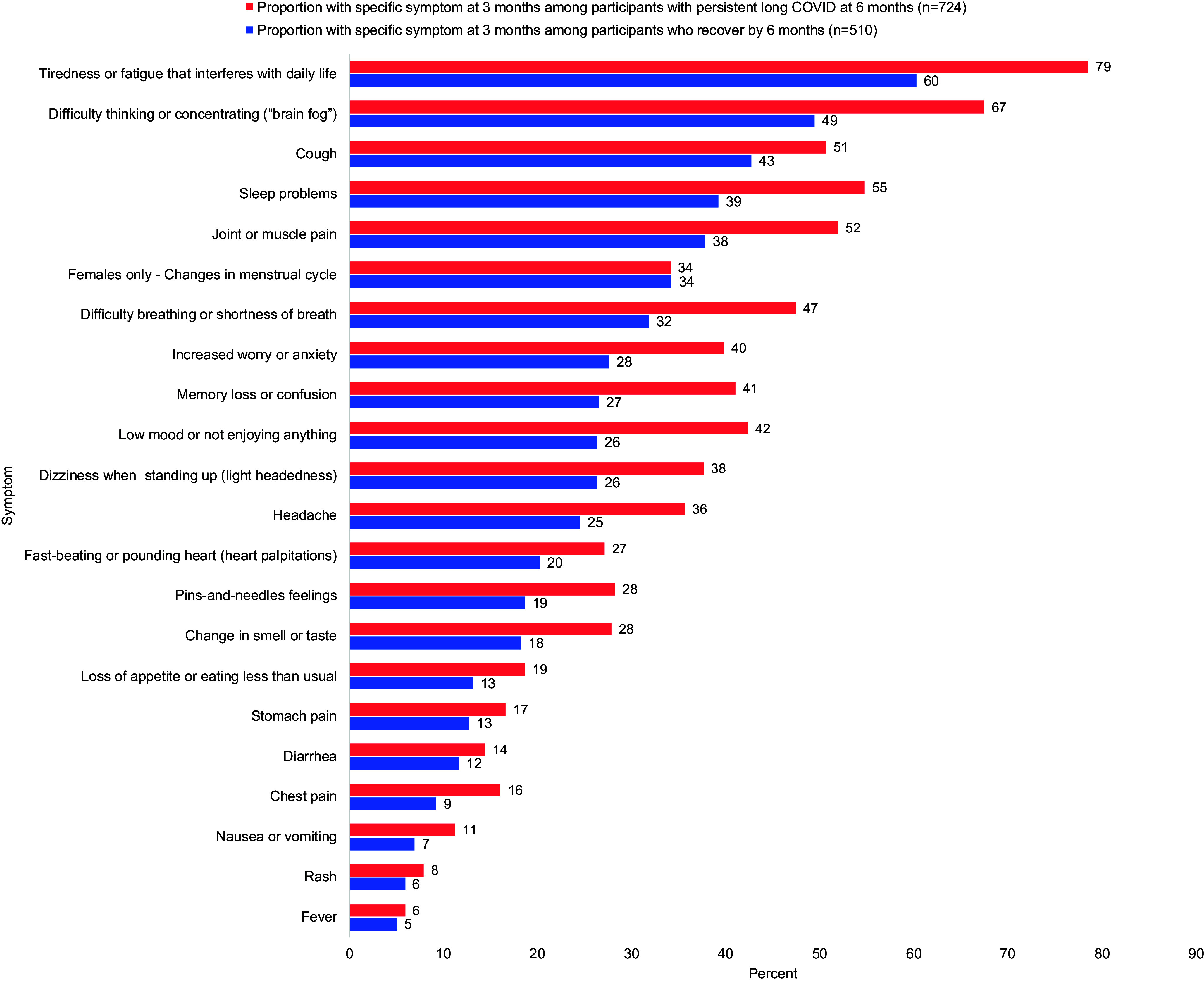
Participants with persistent long COVID reported a mean number of 7.2 (95% CI, 6.9–7.6; range 1–20) solicited symptoms 3 months post-infection compared to a mean of 5.3 (95% CI, 4.9–5.6; range 1–19) among those who recovered.

Proportion of respondents reporting each solicited symptom at three months, by recovered vs persistent long COVID.
Predictors of persistent long COVID
| Variable | Number (%) reporting symptom at 3 months | Unadjusted RR(95% CI) | Adjusted RR(95% CI) 2 | p-value |
|---|---|---|---|---|
| Tiredness or fatigue that interferes with daily life | 875 (70.9%) | 1.49 (1.31–1.70) | 1.49 (1.31–1.70) | <0.001 |
| Difficulty thinking or concentrating ('brain fog') | 740 (60.0%) | 1.38 (1.24–1.53) | 1.37 (1.23–1.53) | <0.001 |
| Sleep problems | 596 (48.3%) | 1.29 (1.18–1.42) | 1.28 (1.16–1.41) | <0.001 |
| Cough | 584 (47.3%) | 1.14 (1.04–1.25) | 1.13 (1.03–1.24) | 0.013 |
| Joint or muscle pain | 569 (46.1%) | 1.26 (1.15–1.39) | 1.23 (1.11–1.35) | <0.001 |
| Difficulty breathing or shortness of breath | 505 (40.9%) | 1.30 (1.19–1.42) | 1.35 (1.21–1.51) | <0.001 |
| Low mood or not enjoying anything | 440 (35.7%) | 1.32 (1.21–1.45) | 1.32 (1.20–1.44) | <0.001 |
| Memory loss or confusion | 432 (35.0%) | 1.29 (1.18–1.41) | 1.26 (1.15–1.39) | <0.001 |
| Increased worry or anxiety | 429 (34.8%) | 1.24 (1.13–1.36) | 1.23 (1.12–1.35) | <0.001 |
| Change in menses 2 | 99 (34.1%) | 1.00 (0.82–1.22) | 1.03 (0.85–1.26) | 0.74 |
| Dizziness when rising to stand up (light headedness) | 406 (32.9%) | 1.23 (1.12–1.35) | 1.20 (1.09–1.32) | <0.001 |
| Headache | 383 (31.0%) | 1.23 (1.12–1.35) | 1.21 (1.10–1.34) | <0.001 |
| Fast-beating or pounding heart (heart palpitations) | 299 (24.2%) | 1.16 (1.05–1.28) | 1.15 (1.04–1.28) | 0.009 |
| Pins-and-needles feelings | 299 (24.2%) | 1.23 (1.11–1.35) | 1.20 (1.09–1.33) | <0.001 |
| Change in smell or taste | 294 (23.8%) | 1.23 (1.12–1.35) | 1.20 (1.09–1.33) | <0.001 |
| Loss of appetite | 202 (16.4%) | 1.17 (1.05–1.31) | 1.16 (1.03–1.30) | 0.015 |
| Stomach pain | 185 (15.0%) | 1.13 (1.00–1.27) | 1.08 (0.95–1.24) | 0.236 |
| Diarrhoea | 163 (13.2%) | 1.10 (0.97–1.25) | 1.11 (0.97–1.26) | 0.133 |
| Chest pain | 163 (13.2%) | 1.25 (1.12–1.4) | 1.26 (1.13–1.40) | <0.001 |
| Nausea or vomiting | 116 (9.4%) | 1.21 (1.07–1.38) | 1.21 (1.06–1.39) | 0.006 |
| Rash | 87 (7.1%) | 1.13 (0.96–1.32) | 1.16 (0.98–1.37) | 0.076 |
| Fever | 73 (5.9%) | 1.00 (0.82–1.22) | 0.98 (0.79–1.22) | 0.877 |
| Variable | Number (%) | Unadjusted RR (95% CI) | Adjusted RR(95% CI) 3 | p-value |
|---|---|---|---|---|
| Sex 3 | ||||
| Female | 495/828 (59.8%) | 1.07 (0.97–1.9) | 1.03 (0.93–1.14) | 0.542 |
| Male (reference) | 224/401 (55.9%) | – | – | |
| Age group | ||||
| 18–29 (reference) | 40/74 (54.1%) | – | – | |
| 30–39 | 76/140 (54.3%) | 1.00 (0.77–1.30) | 1.03 (0.80–1.33) | 0.324 |
| 40–49 | 131/214 (61.2%) | 1.13 (0.89–1.43) | 1.18 (0.93–1.48) | |
| 50–59 | 210/351 (59.8%) | 1.11 (0.88–1.39) | 1.10 (0.88–1.38) | |
| 60–69 | 170/303 (56.1%) | 1.04 (0.82–1.31) | 1.06 (0.84–1.33) | |
| 70 or above | 97/152 (63.8%) | 1.18 (0.93–1.50) | 1.20 (0.94–1.53) | |
| Region | ||||
| Metropolitan (reference) | 578/999 (57.9%) | – | – | |
| Regional/remote | 146/235 (62.1%) | 1.07 (0.96–1.20) | 1.05 (0.94–1.18) | 0.395 |
| Number of doses before SARS-CoV–2 infection | ||||
| Not fully vaccinated (0–2 doses) | 42/63 (66.7%) | 1.15 (0.94–1.41) | 1.09 (0.92–1.30) | 0.318 |
| Fully vaccinated (3+ doses reference) | 682/1171 (58.2%) | – | – | |
| Number (SD) of long COVID symptoms at 3 months | ||||
| <6 (reference) | 275/580 (47.4%) | – | – | |
| 6 or more | 449/654 (68.7%) | 1.45 (1.31–1.60) | 1.42 (1.29–1.58) | <0.001 |
| Any significant or long-standing health issues at the time of SARS-CoV–2 infection | ||||
| No (reference) | 449/821 (54.7%) | – | – | |
| Yes | 275/313 (87.9%) | 1.22 (1.11–1.34) | 1.18 (1.07–1.29) | 0.001 |
| Total | 724/1234 (58.7%) | – | – | |
Changes in symptoms, and health service use and return to work/study at 6 months, among individuals with persistent long COVID
Change in symptoms between 3 and 6 months
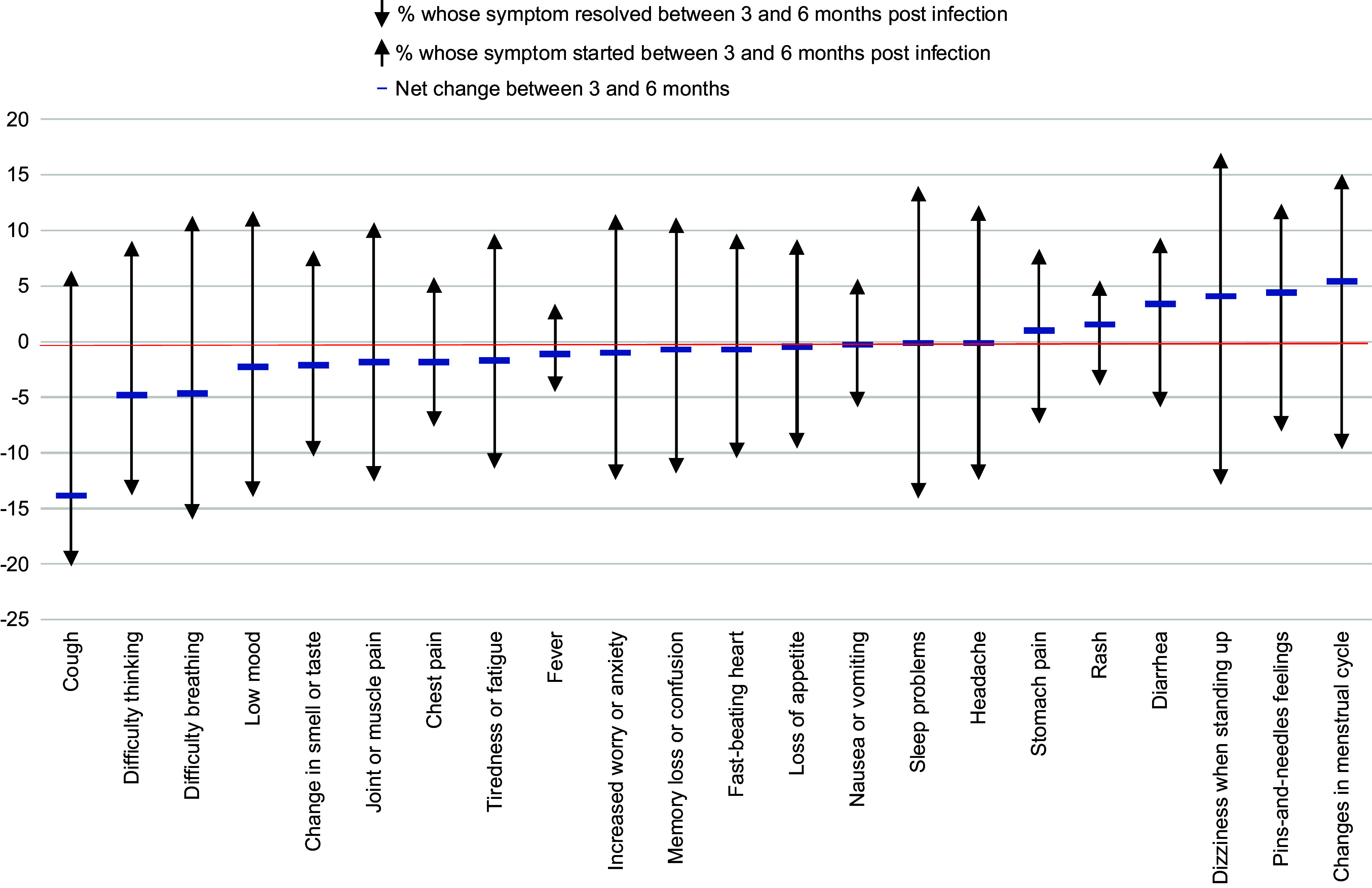
Among those with persistent long COVID, the number of solicited symptoms reported remained stable over time. The mean number of symptoms reported at 3 and 6 months post-SARS-CoV-2 infections was 7.2 (standard deviation [SD] = 4.0) and 7.1 (SD = 4.1), respectively, and the median was 7.0 (interquartile range [IQR] = 4–10) at both timepoints.

.Proportion of individuals with persistent long COVID reporting resolution or new onset of a solicited symptom at three and six months after SARS-CoV-2 infection
Health service use
A third (33.6%; 243/724) of those with persistent long COVID reported accessing health services in the month prior to the 6-month survey due to ongoing symptoms of long COVID. This figure was only marginally lower than the percentage (38.7%) accessing health services in the month prior to the 3-month survey [12]. The vast majority of the healthcare encounters for those with persistent long COVID were outpatient consults with a General Practitioner (97.1%; 236/243); emergency department visits (10.3%; 25/243) and hospital admissions were uncommon (5.8%; 14/243).
Return to work or study
Among the 559 persons with persistent long COVID who reported working/studying prior to their SARS-CoV-2 infection, 179 (32.0%) had ceased or reduced their hours of work or study due to long COVID at 6 months of follow-up. This figure was higher than the proportion (17.8%) who reported reducing or discontinuing work or study in the 3-month survey [12]. Of those with persistent long COVID who reported discontinuing or reducing their work or study hours, 68 (38.0%) had already done so at 3 months of follow-up, but 92 (51.4%) reported fully returning to work or study within 3 months of their initial SARS-CoV-2 illness and then subsequently stopping or reducing their hours at 6 months of follow-up.
Discussion
This follow-up study of persons who had long COVID 3 months post-SARS-CoV-2 infection found that four out of 10 persons reported full recovery from long COVID between 3 and 6 months. Reporting one or more long-standing health issues at the time of the initial SARS-CoV-2 infection and six or more symptoms at 3 months were independent predictors of having persistent long COVID. Examining specific symptoms showed the risk of persistent long COVID was higher for those who reported fatigue, shortness of breath, or cough 3 months post-infection, though for each of these, the attributable increase in risk was modest (i.e., 10–27%).
Importantly, we identified a substantial overlap in terms of the number of solicited symptoms reported at the 3-month time point between the cohort that recovered (mean = 5.3; range 1–19) and those who did not (mean = 7.2; range 1–20). In addition, we observed that the types and frequencies of symptoms reported at 3 months among those with persistent long COVID paralleled, albeit at a higher rate, the symptoms reported among those had who recovered.
Prior to analysing our data, we had anticipated that almost all persons would have some resolution of their symptoms over time and that developing new symptoms more than 3 months after infection would be infrequent. Instead, we found substantial variability in the specific symptoms individuals reported at 3- and 6-month follow-up. Though not anticipated, this observation is not unique to our study population, as considerable heterogeneity in an individual's long COVID symptomatology over extended follow-up has been reported in other settings [20]. Another unexpected finding was that there was essentially no reduction in the mean number of symptoms reported by those with persistent long COVID across the 3- and 6-month time points, with the median number of solicited symptoms reported remaining at 7.0. This suggests that self-reported clinical improvement was very limited over this time frame.
Precise mechanisms to explain why some persons recover completely from long COVID and others have little improvement in their symptomology over time remain elusive [24]. Our data suggest that the existence of medical issues before SARS-CoV-2 infection may play a role. In addition, fatigue that interferes with daily life reported at 3 months was the symptom most strongly associated with persistent long COVID, followed by dyspnoea. Both symptoms are characteristic of myalgic encephalomyelitis/chronic fatigue syndrome (ME/CFS), as are 'brain fog', sleep disruption, and myalgia/arthralgia, which were reported by a majority of persons with persistent long COVID in our study. There is growing evidence that SARS-CoV-2 infection can trigger ME/CFS. Moldofsky et al. report that persistent symptoms experienced by long COVID patients are similar to those described for ME/CFS and a recent meta-analysis found that approximately half of long COVID patients satisfy a diagnosis of ME/CFS [25, 26]. Emerging work suggests that persistence of SARS-CoV-2 infection and development of chronic autonomic dysfunction may be important in explaining ongoing symptomatology associated with long COVID [27 –29]. In addition, there is substantial evidence suggesting a role for psychological mechanisms in development of long COVID, but these constructs have been inadequately explored and warrant further investigation [30, 31].
Our study contributes to efforts to better understand the evolution of long COVID illnesses over time. In France, Servier and colleagues identified '3 trajectories' for individuals with long COVID, that is, highly persistent, rapidly decreasing, and slowly decreasing symptoms [19]. However, their study included participants with suspected COVID-19 disease who lacked laboratory evidence of infection, did not report on vaccination status, and spanned a period when three different SARS-CoV-2 variants circulated. Our study extends observations on long COVID illness trajectories to a cohort of highly vaccinated individuals with lab-confirmed infection caused by a single SARS-CoV-2 variant (Omicron), and we observed two distinct trajectories, which ultimately led to full or minimal recovery at 6 months follow-up.
Our findings also underscore the ongoing burden of long COVID on the healthcare system, with a third of those with persistent long COVID seeking medical attention for their symptoms in the month prior to the 6-month survey. Most participants who sought care attended General Practice, highlighting the critical role of primary care in managing long COVID and thus the need to ensure adequate, ongoing resource allocation to primary care settings [12]. In addition, there is emerging evidence to suggest that investment in speciality 'long COVID clinics' may be warranted, as early treatment at such clinics has been associated with fewer downstream inpatient stays and reduced mortality [32]. For individuals experiencing long COVID, one of the goals of treatment should be to increase the proportion on a trajectory of rapidly decreasing symptoms. Innovative models of care that can be delivered in primary care settings and focus on patient-led self-care should be prioritized. Given the substantial overlap of symptom clusters between persistent long COVID and ME/CFS, existing ME/CFS care guidelines might be adapted to facilitate standardized diagnosis and management of persistent long COVID [33 –35]. The substantive proportion of persons with persistent long COVID in our study who reported symptoms consistent with anxiety and depression suggests that incorporating access to robust mental health services may also be helpful in optimizing recovery [36].
Finally, we found that about a third of those with persistent long COVID were not fully back at work or study 6 months after their initial SARS-CoV-2 infection, including a substantial number of people who had previously fully returned to these activities by 3 months. These data are consistent with other investigations reporting that the impact of the disease on patients' lives began increasing 6 months after their initial illness and corroborate other studies in documenting the significant economic impact of long COVID for both employees and employers [9, 37 –39]. Workers with long COVID face a number of challenges in returning to work, including impairment of cognitive function, decreased physical endurance, mental health issues, and societal stigma [40, 41]. Ultimately, employers can better retain workers experiencing long COVID by creating supportive policies, which, depending on individual circumstances, may include phased return to work and an option for working from home, alterations to hours, duties, and workload, equipment modifications, and time off for healthcare appointments. Occupational health guidelines supporting sustainable return to work for persons with long COVID are available [42 –44].
In contrast to some other investigations, our analysis did not identify an association between COVID vaccinations and a reduced risk of persistent long COVID. It must be noted, however, that our study population was not well suited to examine this issue because only 5% of the participants had received fewer than three doses prior to their initial SARS-CoV-2 infection. Given the small size of the unvaccinated comparator group in our study, this result should be interpreted with caution.
This study has several limitations. First, long COVID symptomatology was based on self-reported information, as opposed to clinical observations verified in medical records. This approach is not uncommon for large-scale studies where clinical assessments may not be feasible for all participants and is supported by the fact that, when studied, objective clinical signs of impairment among individuals with persistent long COVID correlate well with self-reported symptoms [45]. Second, despite a reasonably high response rate (60%), there remains a substantial proportion of individuals who did not participate, and it is unknown if the non-respondents had different experiences or outcomes which might affect the results. This concern is mitigated, however, by the fact that respondents were similar to non-respondents in terms of key long COVID symptoms reported at 3 months and the proportion reporting any significant or long-standing health issues prior to SARS-CoV-2 infection, as shown in Table 1. Third, our questionnaire did not capture subjective or objective measures of symptom severity, and this information may be important for assessing clinical predictors of persistent long COVID. Last, our survey did not include questions on some factors associated with long COVID in other settings such socio-economic status, body mass index, ABO blood groups, and smoking [46, 47].
There are, however, several strengths to this research. First, Western Australia's pandemic experience enabled assessment of long COVID following a single laboratory-proven SARS-CoV-2 infection with the Omicron variant, thus eliminating the potential impact of repeat infections, simultaneous circulation of different variants, and ambiguous timeframes [48]. Second, vaccination status for participants was obtained from a mandatory, population-based national immunization register. Third, we assessed longitudinal data on individuals gathered across three different time points, that is, a detailed case investigation that occurred at the time of their initial SARS-CoV-2 infection and follow-up surveys conducted at 3 and 6 months. This approach reduces the potential for bias and provides an opportunity to examine changes in the symptom profile of long COVID in the same individual over time.
In conclusion, longitudinal follow-up among a cohort of individuals with long COVID 3 months post-infection found the risk of persistent long COVID at 6 months was greater for those with pre-existing health issues at the time of infection and ongoing fatigue and respiratory symptoms at 3 months. Importantly, we observed that many highly symptomatic persons fully recovered by 6 months and that there was substantial overlap in long COVID symptomatology at 3 months among those who recovered and those who did not. Of note, the cohort with persistent long COVID reported almost no improvement in overall symptomatology between the 3- and 6-month timepoints. These data suggest that there may be distinct clinical trajectories for long COVID between 3- and 6-month follow-up, that is, full versus minimal recovery, which could have implications for support and management of affected individuals.
 Long Covid