
What this is
- This research investigates disability progression in relapsing-remitting multiple sclerosis (RRMS) patients who experience progression independent of relapse activity ().
- It focuses on identifying factors that predict whether events persist or regress, which can inform treatment strategies and definitions of disease progression.
- The study utilizes data from the MSBase registry, analyzing 4713 patients over a median follow-up of 8.7 years.
Essence
- Persistent significantly increases the risk of severe disability and secondary progressive MS () compared to non-persistent . Younger age, lower baseline disability, and high-efficacy disease-modifying therapies (DMT) are associated with regression.
Key takeaways
- 32% of RRMS patients experienced improvement in disability following a event, with a median time to improvement of 2.6 years. This indicates that some patients can recover from , although the recovery is slow.
- Patients with non-persistent had an 81% lower risk of reaching 6 compared to those with persistent . This suggests that the ability to recover from is crucial for long-term disability outcomes.
- Factors associated with non-persistent include younger age, lower baseline , and the use of high-efficacy DMTs. These factors may indicate an inflammatory component in some events, highlighting the importance of early and aggressive treatment.
Caveats
- The study lacks MRI data for about 65% of participants, which limits the ability to analyze brain changes associated with . This absence may affect the understanding of the underlying mechanisms of .
- Defining persistent vs. non-persistent based on future assessments may lead to misclassification, as some patients might achieve non-persistence beyond the recorded follow-up period.
Definitions
- PIRA: Progression independent of relapse activity; a condition where disability worsens without accompanying relapses.
- EDSS: Expanded Disability Status Scale; a method for quantifying disability in multiple sclerosis.
- SPMS: Secondary progressive multiple sclerosis; a stage of MS characterized by gradual worsening of disability.
Simplified
Introduction
Approximately 85% of individuals with multiple sclerosis (MS) have an initial relapsing-remitting (RRMS) disease course. Relapse-associated neurological disability can leave residual long-term or permanent disability known as relapse-associated worsening (RAW).1 However, disability progression can also occur in the absence of relapses, termed progression independent of relapse activity (PIRA).2-6 Some PIRA events are an early marker of the transformation from RRMS into secondary progressive MS (SPMS), which is characterized by gradual and continuous disability progression.7 People with MS who experience PIRA are known to have accelerated brain volume reduction, primarily attributable to grey matter loss in the cerebral cortex4; and greater risk of reaching Extended Disability Status Scale (EDSS) 6.0, a rate that is 8-fold higher than patients without PIRA.5 Interestingly, previous studies also found that using high-efficacy disease-modifying therapies (DMTs) is associated with a lower risk of PIRA, suggesting that ongoing inflammation is responsible for at least some PIRA events, not just RAW events.2,8,9 Two systematic reviews examining the existing evidence of PIRA have proposed clinically applicable standard definitions of PIRA to direct ongoing research in this area.10,11
There has been little study to-date on post-PIRA disability trajectories; specifically, whether patients can improve post-PIRA, and what factors are associated with a higher probability of PIRA regression. It is also unknown whether the long-term risk of SPMS or ongoing disability progression is different after PIRA for patients who experience PIRA regression/non-persistence versus those who do not.
We performed a retrospective longitudinal cohort study using the MSBase registry dataset12 to determine the rate of improvement post-PIRA events, assess factors associated with persistent versus non-persistent PIRA, and the long-term outcomes in both groups of patients. Outcomes of interest included time to non-persistent PIRA, confirmed disability progression to EDSS 6, and SPMS.
Materials and methods
Patient data spanning from April 1995 to January 2024 was extracted from the MSBase registry, an international observational cohort study of MS.12 Ethical approval for the MSBase registry was granted by the Alfred Health Human Research and Ethics Committee and the local ethics committees in participating centres. All enrolled patients provided written or verbal consent according to local regulations. Our study followed the Strengthening the Reporting of Observational Studies in Epidemiology (STROBE) reporting guideline.
Study design and participants
Combining the recommendations of the two systematic reviews,10,11 we defined PIRA as a 6-month confirmed disability progression with no relapse for the entire period covering the reference EDSS score (the most recent pre-worsening EDSS), the EDSS score with progression (worsening), and a confirmation EDSS at least 6 months after the EDSS worsening. A 30-day relapse-free period prior to the reference EDSS score was also required to reduce the risk of recent disease activity influencing the reference EDSS score, ensuring it accurately reflects the patient's disability status. A confirmed progression event was defined as an increase in EDSS of ≥1.5, ≥ 1.0 or ≥0.5 from a baseline EDSS of 0, 1.0–5.5 or ≥6.0, respectively. To confirm progression, the increased EDSS had to be sustained for ≥6 months. We defined early PIRA as PIRA occurring within 5 years from the first symptoms of MS,6 and early DMT as the first use of DMT within 3 years of MS onset.11
Patient data were recorded during routine clinic visits at participating centres via the locally installed iMed or MDS MSBase data entry systems. Patients were included if they were diagnosed as RRMS according to the McDonald criteria,13 had at least one PIRA event, and had an EDSS of no more than four at baseline. The baseline was set at the time of the first PIRA occurrence. Participants were also required to have at least three visits with documented EDSS during the follow-up to allow for the ascertainment of disability accumulation and identification of the occurrence of PIRA, and at least three more EDSS visits after the PIRA event to assess disability improvement and/or PIRA persistence. Patients were excluded from the study if they had been diagnosed with PPMS and SPMS before the occurrence of PIRA. In MSBase, a relapse is defined as a new or recurrent neurological symptom lasting for 24 h or more without fever or infection.14
Study outcomes and definitions
The primary study outcome was time to 6-month confirmed non-persistent PIRA, defined as an improvement in EDSS of ≥1.0 or ≥0.5 from the PIRA occurrence of 2.0–5.5 or ≥6.0, respectively, again with a confirmation period of ≥6 months. Absence of relapses was also required between the 30 days before EDSS improvement and the confirmation period. Conversely, persistent PIRA was defined as an ongoing sustained or worsening EDSS disability score that did not improve to the end of follow-up after the PIRA occurrence.
The secondary outcomes were time to 6-month confirmed EDSS 6.0 and time to SPMS. We defined SPMS according to the criteria of Lorscheider et al.,15 as a disability progression in EDSS by 1.0 step if the reference EDSS score (the most recent EDSS assessment before SPMS conversion) was ≤5.5, or 0.5 step if the reference EDSS score was ≥6.0 before the SPMS conversion, leading to an EDSS of at least 4.0, and was confirmed with a ≥3-month period, with a pyramidal functional score of ≥2. We did not allow a relapse between the reference EDSS assessment and SPMS conversion. In the unlikely event that the interval between the reference EDSS and the SPMS conversion was less than 30 days, no relapse was allowed within the 30 days preceding the SPMS conversion to ensure the progression was not relapse-related. This secondary outcome of time to SPMS could only be analyzed in patients with complete Kurtzke Functional Systems Scores (KFS, a scoring system for assessing neurological impairment in MS that includes visual function, brainstem function, pyramidal function, cerebellar function, sensory function, bowel/bladder function and mental function).
Statistical analysis
Continuous variables with a normal distribution were expressed as mean (standard deviation), otherwise as median (interquartile), and categorical variables were expressed as frequency (percentage). Risk factors associated with non-persistent PIRA were first assessed in univariate analyses using Cox proportional-hazards models. Age per 10 years, sex, early PIRA, high-efficacy DMT use within 3 months before baseline, the number of DMTs used before baseline, relapses in one and two years before baseline, baseline EDSS, disease duration, early DMT, and the proportion of DMT use period were examined as potential risk factors in univariate models. All variables with P < 0.20 in univariate analyses or those of known clinical relevance were included in multivariable analyses. Treatment exposures were adjusted as a time-varying variable in all Cox proportional-hazards models. Due to the violation of the proportional-hazards assumption for time-varying treatment exposures in the multivariable model, we split the entire follow-up period into 3 time intervals, and then used the stratified Cox proportional-hazards model taking into account the interaction of the stratified time intervals with treatment exposures.16,17 The proportional-hazards assumption was checked by the Schoenfeld global test.18 The variance inflation factor was calculated to test for multicollinearity. After variable selection, a final model was constructed using a backward-stepwise method including only significant variables.
We used propensity score matching to minimize indication bias due to the baseline differences between persistent and non-persistent PIRA patients. A logistic regression model was used to estimate individual propensity scores. Exposure to non-persistent PIRA was the dependent variable, and the risk factors obtained in the previous step and the clinically important variables were the independent variables, including age, disease duration, sex, baseline EDSS, high-efficacy DMT use at baseline, number of DMTs used before baseline, and relapses in two years before baseline. We matched patients based on the corresponding propensity scores using nearest-neighbour matching without replacement with a variable matching ratio of 1:1. We assessed the covariate balance using an absolute standardized difference (ASD), with an ASD > 0.1 indicating an imbalance.19 Hazard ratios (HRs) of reaching EDSS 6.0 and SPMS were estimated using a Cox proportional-hazards model with robust standard errors based on matched data. Kaplan–Meier cumulative hazard curves were used to show the cumulative risk for each outcome between persistent and non-persistent PIRA groups. We also performed a subgroup analysis by early PIRA and early DMT as well as variables used for computing propensity scores for the analyses of two secondary outcomes.
All statistical tests were two-sided with significance defined as P < 0.05. All analyses were performed in R, version 4.2.2 (R Foundation for Statistical Computing). Data were analysed from 2 January 2024 to 23 March 2024.
Sensitivity analysis
The missing rate of KFS scores was high (46% of patients were completely or partially missing KFS scores) in the primary analysis. However, previous studies showed that some KFS scores such as bowel/bladder, sensory and pyramidal function, were associated with the occurrence of PIRA.6,11 We, therefore, tested the association of all seven functional scores with the persistent PIRA in a sensitivity analysis. We defined a baseline binary variable to indicate whether the PIRA events were driven by an increase in the corresponding functional scores, and repeated the same process as in primary analyses to test for risk factors. We also repeated the time to SPMS analyses using clinician-defined SPMS rather than the Lorscheider criteria to examine the consistency of the results.
Results
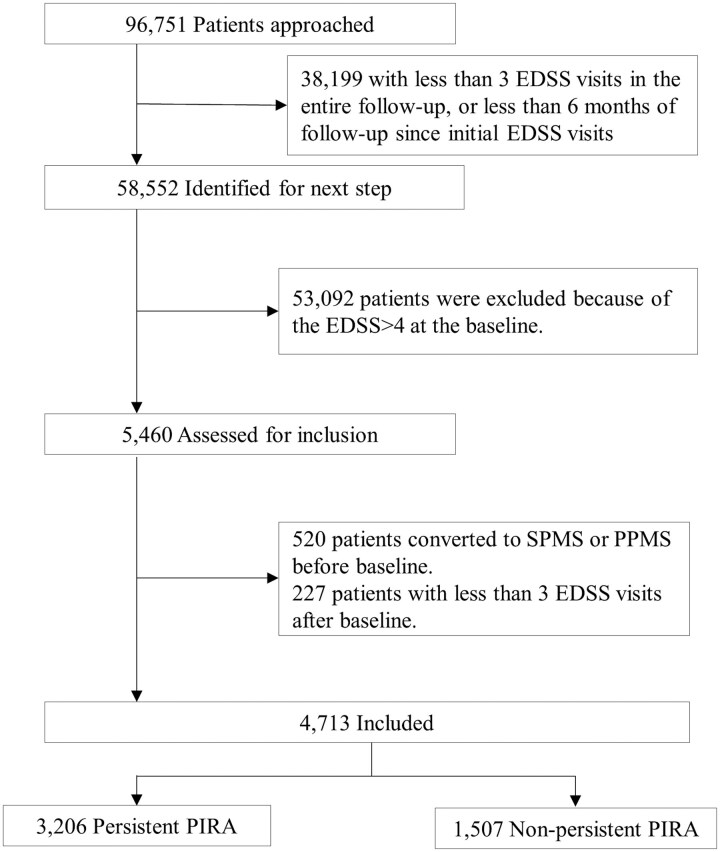
After applying the inclusion criteria, 4713 of 96 751 RRMS patients from 29 countries and 88 centres (outcomes recorded between April 1995 and January 2024) were included in the analysis (Fig. 1, Table 1), with a median follow-up time of 8.7 [(IQR), 6.7–12.0] years. Of these, 3206/4713 (68%) of patients showed no improvement in disability until the end of follow-up after PIRA, and 1507/4713 (32%) of patients improved after PIRA with a median improvement time of 2.6 (IQR, 1.7–4.3) years (Supplementary Fig. 1). Patients with non-persistent PIRA were younger than those with persistent PIRA [mean: 40.99 years (SD 10.03) versus 44.02 years (SD 10.02)], and were 5% more likely to be exposed to high-efficacy DMTs during the PIRA event than patients with persistent PIRA. Patients with persistent PIRA had a worse disability, a longer disease duration, delayed use of initial DMT, and a higher proportion of PIRA occurring within 5 years after symptom onset than patients with non-persistent PIRA.

EDSS, Expanded Disability Status Scale; PIRA, Progression Independent of Relapse Activity; MS, Multiple Sclerosis; SPMS, Secondary Progressive MS; PPMS, Primary Progressive MS. Flow chart of the patients inclusion/exclusion.
| Univariatea | Multivariablea | ||||||
|---|---|---|---|---|---|---|---|
| Risk factors | Total (= 4713)n | Persistent PIRA (= 3206)n | Non-persistent PIRA (= 1507)n | HR (95% CI) | -valueP | HR (95% CI) | -valueP |
| Age, per 10 years | 4.31 ± 1.01 | 4.4 ± 1.00 | 4.10 ± 1.00 | 0.81 (0.76–0.85) | <0.0001 | 0.84 (0.80–0.89) | <0.0001 |
| Sex | 0.90 (0.80–1.01) | 0.0628 | |||||
| Male | 1282 (27) | 894 (28) | 388 (26) | ||||
| Female | 3431 (73) | 2312 (72) | 1119 (74) | ||||
| High-efficacy DMT use during PIRAb | 843 (18) | 525 (16) | 318 (21) | 1.20 (1.06–1.36) | 0.0034 | 1.22 (1.08–1.38) | 0.0015 |
| The number of DMTs used before the baselinec | 0.0 (0.0–1.0) | 0.0 (0.0–1.0) | 0.0 (0.0–1.0) | 1.02 (0.97–1.08) | 0.406 | ||
| The number of relapses in 1 year before baseline | 0.0 (0.0–0.0) | 0.0 (0.0–0.0) | 0.0 (0.0–0.0) | 1.02 (0.91–1.14) | 0.7609 | ||
| The number of relapses in 2 years before baseline | 0.0 (0.0–1.0) | 0.0 (0.0–1.0) | 0.0 (0.0–1.0) | 1.01 (0.95–1.07) | 0.7314 | ||
| Disability (baseline EDSS) | 2.5 (2.0–3.5) | 3.0 (2.0–3.5) | 2.0 (2.0–3.0) | 0.71 (0.67–0.76) | <0.0001 | 0.73 (0.69–0.78) | <0.0001 |
| Disease duration, years | 9.4 (5.1–15.2) | 10.0 (5.4–15.8) | 8.3 (4.4–13.8) | 0.98 (0.97–0.99) | <0.0001 | ||
| The proportion of DMT use period | 0.4 (0.1–0.7) | 0.4 (0.0–0.7) | 0.4 (0.1–0.8) | 1.08 (0.92–1.27) | 0.3241 | ||
| Early DMT | 1888 (40) | 1193 (37) | 695 (46) | 1.21 (1.09–1.34) | 0.0003 | ||
| Early PIRA | 1151 (24) | 724 (23) | 427 (28) | 1.23 (1.10–1.37) | 0.0003 | ||
Risk factors for persistent and non-persistent PIRA
To determine risk factors for non-persistent PIRA, we constructed a multivariable model as described above. The final multivariable model revealed that age [per 10 years; HR (95% CI), 0.84 (0.80–0.89); P < 0.0001], high-efficacy DMTs use within 3 months before baseline [1.22 (1.08–1.38); P = 0.0015], and baseline EDSS [0.73 (0.69–0.78); P < 0.0001] were associated with non-persistent PIRA events. The detailed results are reported in Table 1. Interactions between all variables were tested and were found to be non-significant.
Risk of reaching EDSS 6 and SPMS
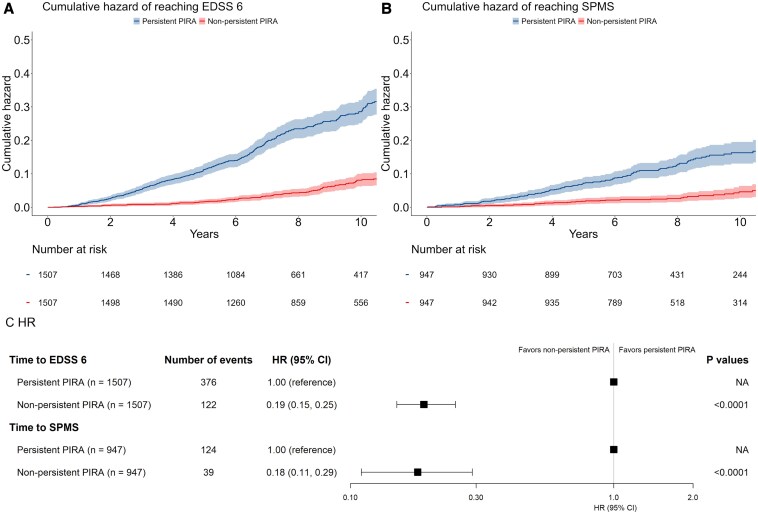
Patients included in the primary analyses were divided into two groups—either persistent or non-persistent PIRA, and then were matched according to their propensity scores. In total, 3014 patients (1507 in each group) were included in the time to 6-month confirmed EDSS 6.0 analysis. Patients with non-persistent PIRA had a significantly 81% lower risk of reaching EDSS 6.0 [HR 0.19; 95% CI, (0.15–0.25); P < 0.0001] compared with patients in the persistent PIRA group (Fig. 2).
We rematched only the patients with reported Kurtzke functional pyramidal scores to estimate the differences in risk of reaching SPMS between persistent and non-persistent PIRA groups, as pyramidal scores are required as part of the Lorscheider definition of SPMS. We excluded the patients who had already met the Lorscheider criteria with an EDSS = 4 and pyramidal functional score ≥2 at baseline. Among the patients with a complete pyramidal functional score, 313/2687 (12%) reached SPMS with a median follow-up of 8.0 years. One thousand eight hundred and ninety-four patients (947 in each group) were matched for time to SPMS analysis. Patients with non-persistent PIRA had a significantly lower risk of reaching SPMS compared to patients with persistent PIRA, with an HR of 0.18 [95% CI, (0.11–0.29); P < 0.0001]. The Kaplan–Meier cumulative hazard curves and the results for both time to EDSS 6 and SPMS are presented in Fig. 2, and the balanced characteristics of patients are reported in Table 2.
Results in the defined subgroups were generally consistent with the results in the main analysis. Non-persistent PIRA significantly interacted with high-efficacy DMT use at baseline and early DMT use on the risk of reaching EDSS 6 (P < 0.05 for interaction), and the associations were greater for patients treated with high-efficacy DMTs at baseline and those treated earlier (Supplementary Table 1). No significant interactions were detected between the subgroups and non-persistent PIRA for the risk of reaching SPMS (Supplementary Table 2).

Kaplan–Meier failure function was applied to the present cumulative hazard of the:time to EDSS 6 in patients with non-persistent PIRA and patients with persistent PIRA, andtime to SPMS, respectively. forhazard ratios for two secondary outcomes. Statistical significance was assessed using the Wald test, with a-value < 0.05 considered significant. CI, confidence interval; HR, hazard ratio; SPMS, secondary progressive multiple sclerosis; EDSS, expanded disability status scale; PIRA, progression independent of relapse activity. The cumulative hazard of the secondary outcomes. A B C P
| Matched patients for EDSS 6 | |||||
|---|---|---|---|---|---|
| Total | Persistent PIRA | Non-persistent PIRA | ASDa | ||
| Before matching | After matching | ||||
| n | 3014 | 1507 | 1507 | ||
| Age, years | 41.06 ± 9.71 | 41.13 ± 9.38 | 40.99 ± 10.03 | .030 | 0.01 |
| Sex | 0.05 | 0.02 | |||
| Male | 765 (25) | 377 (25) | 388 (26) | ||
| Female | 2249 (75) | 1130 (75) | 1119 (74) | ||
| High-efficacy DMT use during PIRA | 640 (21) | 322 (21) | 318 (21) | .012 | 0.01 |
| The number of DMTs used before the baseline | 0.0 (0.0–1.0) | 0.0 (0.0–1.0) | 0.0 (0.0–1.0) | 0.03 | 0.02 |
| The number of relapses in 2 years before baseline | 0.0 (0.0–1.0) | 0.0 (0.0–1.0) | 0.0 (0.0–1.0) | 0.06 | 0.01 |
| Disability (baseline EDSS) | 2.0 (2.0–3.0) | 2.0 (2.0–3.0) | 2.0 (2.0–3.0) | .040 | 0.01 |
| Disease duration, years | 8.3 (4.5–13.7) | 8.4 (4.6–13.4) | 8.3 (4.4–13.8) | .021 | 0.01 |
Sensitivity analyses
The primary analyses for risk factors were repeated with all potential risk factors and the seven functional scores in patients with a complete KFS score. Age per 10 years, high-efficacy DMT use within 3 months before baseline, baseline EDSS, disease duration, early PIRA, early DMT, the proportion of DMT use period, visual function, brainstem function, pyramidal function and sensory function satisfied the criteria in the univariate analyses and were included in the multivariable analysis (Supplementary Table 3). Overall, age [per 10 years; HR (95% CI), 0.82 (0.76–0.90); P < 0.0001], baseline EDSS [0.73 (0.67–0.80); P < 0.0001], visual function [0.82 (0.71–0.95); P = 0.0066], brainstem function [0.75 (0.63–0.89); P < 0.0001] and, marginally, pyramidal function [0.82 (0.68–1.00); P = 0.0447] were all associated with a lower probability of PIRA regression. Moreover, high-efficacy DMTs use within 3 months before baseline [1.20 (1.02–1.42); P = 0.0253] was significantly associated with non-persistent PIRA.
As an additional sensitivity analysis, we used clinician-defined SPMS as the outcome. 266/2687 (10%) of patients were diagnosed with SPMS by their treating clinicians. Compared with persistent PIRA, patients with non-persistent PIRA had a significantly lower risk of reaching clinician-defined SPMS, with an HR of 0.19 (95% CI, 0.04–0.84; P = 0.0292).
Discussion
In this retrospective cohort study, we showed that 32% of RRMS patients experienced 6-month confirmed EDSS improvement after a PIRA event, i.e. a regression of PIRA. This improvement was very slow, with a median time to improvement of 2.6 years. Younger age, high-efficacy DMT use within 3 months before PIRA event and lower baseline EDSS were factors associated with non-persistent PIRA. While PIRA is not necessarily synonymous with early secondary progressive MS, it appears to represent a heterogeneous event. Given the lack of strong biomarkers for secondary progression,20 the evolving definitions of secondary progressive MS, and the possibility of an underlying progressive process despite some improvement in PIRA events, further research is needed to fully understand its relationship to SPMS. In cases of non-persistent PIRA, we found more than an 80% lower risk of reaching severe disability and SPMS compared to persistent PIRA.
Many prior studies showed that age was a major risk factor for PIRA.2,5,21 Our findings confirmed and extended previous research by showing that increasing age also increased the likelihood of persistent PIRA. Specifically, each additional 10 years of age was associated with a 16% decrease in the likelihood of experiencing non-persistent PIRA. Previously, PIRA was identified as a major contributor to disability accumulation in people of all ages.22 Our findings extended this observation that persistent PIRA was associated with a much greater risk of long-term disability progression. Furthermore, prior research also demonstrated that a more severe baseline disability was associated with a higher risk of PIRA.2,22,23 Our findings again extended this observation, as higher baseline disability was also a crucial factor associated with greater odds of long-term PIRA persistence.
Previous evidence indicated that higher pyramidal functional scores were associated with greater risk of sustained disability progression,7,24,25 which was also shown to be a factor driving persistent PIRA in our study. We also found that PIRA events driven by increased vision and brainstem functional scores were more likely to persist. Brainstem progression potentially reflects progressive dysarthria, bulbar dysfunction and disorders of conjugate gaze and visual worsening independent of acute optic neuritis reflect a progressive optic neuropathy. A previous systematic review on the prognostic impact of brainstem dysfunction did not consistently identify brainstem dysfunction as a risk factor for SPMS.26 However, to our knowledge, no prior study had assessed the prognostic significance of sustained worsening of brainstem symptoms. PIRA events driven by worsening visual functional scores are previously believed to be very rare, with relevant literature restricted to case reports.27,28 One report described a case of visual PIRA concomitant with other progression features. In our study, visual worsening was detected as the only driver of PIRA in 180/2100 (9%) PIRA events in patients with complete KFS scores. We also found that visual KFS-led PIRA events had a higher rate of long-term persistence. It is therefore likely that subtle progressive visual dysfunction in the absence of acute optic neuritis relapses is more common than previously reported. It is possible that investigators have not paid much attention to slowly worsening vision in middle-aged individuals with MS, as there are, of course, many non-MS-associated causes. Visual and other PIRA events could possibly be driven by slowly expanding lesions (SELs), but dedicated imaging correlation studies are required.29
Several divergent perspectives exist regarding the efficacy of DMT in mitigating the risk of PIRA. Whilst some studies failed to demonstrate a favourable impact of DMT use on PIRA,21,30 many more showed that the use of DMT can significantly delay the time to reach milestone EDSS values and reduce the risk of experiencing PIRA.2,7-9,22,31 Our findings showed, for the first time, that patients who used high-efficacy DMT during PIRA were 22% more likely to experience non-persistent PIRA, i.e. to improve their disability again. We speculate that some PIRA events could have an underlying inflammatory aetiology, so that exposure to high-efficacy therapy during PIRA events increased the probability of ultimate improvement perhaps by limiting the extent of inflammatory injury. Other PIRA events probably reflected an underlying slow neurodegeneration that no current therapy can target, and therefore a greater likelihood of long-term persistence. In the future, a close correlation between clinical and imaging trajectories could clarify if specific imaging correlates of PIRA and post-PIRA improvement exist, for instance slowly expanding lesion dynamics.
Previous findings suggested that patients with PIRA had a higher risk of reaching EDSS 6 than those without,5,31 and that PIRA events early in the disease course were also tied to a higher risk of SPMS.6 Our results are consistent with these prior observations, but also extended them—PIRA with long-term persistence carried a much higher association with subsequent disability worsening than the one-third of PIRA that ultimately reverted (the reversion rate is consistent with previous findings in RRMS7).
Several limitations should be taken into account. Previous results showed that patients with PIRA presented with accelerated brain atrophy, particularly in the cerebral cortex, and a greater loss of brain volume was found in patients with PIRA compared to clinically stable patients.4,23 It would, therefore, be worth examining the risk factors and differences in persistent and non-persistent PIRA groups using MRI data, as already discussed above. However, we could not include MRI information in our analysis due to the absence of MRI data in around 65% of study participants. Determining when MS changes from relapsing to progressive phenotype is not easy—it is a gradual process on a continuum. Still, we need a clear definition for research purposes, even if it is simplified.32 The Lorscheider criteria can objectively and repeatably determine when secondary progression first appears clinically, making it suitable for registry data studies.15 We also considered clinician-defined SPMS, which might be more variably applied but reflects real-world practice. It is reassuring that both approaches yielded similar results in our study. In addition, while our study design aimed to minimise bias by using the first PIRA event as a shared baseline, we acknowledge potential limitations in defining persistent/non-persistent PIRA groups based on future EDSS assessments. This may lead to interference between the group classification and the outcome measurement,33 because patients could achieve non-persistence beyond the known/recorded follow-up period and might therefore be incorrectly classified as persistent PIRA. However, any long-term study has to accommodate variable follow-up time, and we still detected sufficient numbers of non-persistent PIRA events to characterise this outcome in detail.
Conclusion
This study examined the concept of non-persistent PIRA, defined as an eventual improvement in EDSS after a PIRA event. We showed that this occurred in one-third of all observed PIRA events in people with MS enrolled in the MSBase cohort study. Interestingly, the improvement took place over a long period, with a median of more than 2 years. Non-persistent PIRA is more frequent in younger patients and at lower EDSS scores, and more likely in patients using high-efficacy DMT during PIRA events. All of these risk factors suggest an inflammatory aetiology in some PIRA events. Patients with long-term persistent PIRA are at a substantially higher risk of reaching EDSS 6 and SPMS than those with non-persistent PIRA.
 Psychedelic Science