
What this is
- This research explores how the pigment dispersing factor (PDF) influences in Drosophila.
- It introduces a novel technique using membrane-tethered spider toxins to manipulate ion channel activity in clock neurons.
- Findings suggest that PDF-secreting neurons can phase-advance both PDF secretion and locomotor activity rhythms.
Essence
- Membrane-tethered δ-ACTX-Hv1a expression in PDF-secreting clock neurons induces a phase advance of PDF accumulation and morning locomotor activity. This supports the hypothesis that PDF regulates by modulating the timing of neuronal activity.
Key takeaways
- Membrane-tethered δ-ACTX-Hv1a expression leads to an approximately 4-h phase advance in PDF accumulation in clock neuron terminals. This alteration in PDF timing correlates with changes in locomotor activity, indicating a direct link between PDF signaling and circadian behavior.
- The study validates the tethered-toxin technology for manipulating ion channel activity in vivo. This method allows for precise control over neuronal excitability, providing insights into the mechanisms that govern .
- Expression of membrane-tethered δ-ACTX-Hv1a disrupts free-running locomotor rhythms, leading to arrhythmic or complex rhythmicity in many flies. This highlights the critical role of PDF-secreting neurons in maintaining synchronized .
Caveats
- The study primarily focuses on Drosophila, which may limit the generalizability of findings to other organisms. Further research is needed to explore the applicability of these results across different species.
- Behavioral outcomes were assessed under specific laboratory conditions, which may not fully replicate natural environments. This raises questions about the ecological relevance of the observed effects.
Definitions
- circadian rhythms: Biological processes that follow a roughly 24-hour cycle, responding primarily to light and darkness in the environment.
- neuropeptide: Small protein-like molecules used by neurons to communicate with each other, influencing various physiological functions.
Simplified
Introduction
Drosophila clock neurons are self-sustaining cellular oscillators that rely on negative transcriptional feedback and cellular signaling pathways to keep circadian time. PERIOD (PER) and TIMELESS (TIM) clock proteins constitute the core of a negative transcriptional feedback loop, in which these clock proteins inhibit transcription of the genes that encode them (for review, see [1,2]). The transcription factors Vrille (VRI), par domain protein 1 (PDP1), along with PER and TIM, form two transcriptional feedback loops interconnected through CLOCK/CYCLE-mediated transcriptional activation [3–8]. These feedback loops interact to produce daily rhythms of clock gene mRNA and clock protein accumulation, which are required for rhythmic physiology and behavior (for review, see [2,9–11]). Recent studies have also implicated depolarization-dependent ionic conductances and intracellular Ca2+ signals in cellular oscillation in the fly [12,13].
Proper regulation of organismal rhythms of physiology and behavior requires coordination of the cellular oscillations of the individual clock neurons within the circadian control network [14–21]. A key role has been suggested for pigment dispersing factor (PDF) secretion by the lateral ventral subset of clock neurons in this coordination, as pdf1-null mutant flies, ventral lateral neuron (LNV)-ablated flies, or LNV-electrically silenced flies all exhibit disrupted free-running locomotor rhythms [12,16,17]. It has been proposed that cyclic release of PDF from the dorsomedial terminals of small PDF neurons (sLNV) provides an important circadian signal to PDF-sensitive downstream targets [18,20–22]. In the absence of PDF, pdf1-null flies exhibit dispersed and desynchronized phase relationships of independent cellular oscillators [21]. Hyperexcitation of LNVs via expression of a slowly inactivating bacterial Na+ channel disrupts cyclic release of PDF, and results in desynchrony among subsets of clock neurons and complex behavioral rhythms [18]. These findings suggest that the PDF-secreting LNVs synchronize independent clock oscillators via clock-regulated PDF secretion. The PDF receptor (PDFR) G protein-coupled receptor appears to be functionally active in many clock neurons, and PDFR mutant flies exhibit disrupted free-running locomotor rhythms similar to pdf1-null mutant flies [23–26]. These studies further confirm the key role of PDF neuropeptide in circadian control of locomotor activity, indicating the importance of intercellular communication in the circadian network between PDF-secreting LNVs and clock neurons that express PDFR (for review, see [11]).
Furthermore, the specific hypothesis has been proposed that PDF-secreting clock neurons entrain both the phase of organismal rhythms and cellular oscillations of other clock neurons [17,27–29]. PDF injected into the cockroach brain resets the phase rather than the period of free-running behavioral rhythms [29], suggesting that PDF mediates a nonphotic entraining signal to the circadian clock. In the absence of PDF in pdf1-null mutant flies, phase of LNV and non-LNV clock neurons disperses, and these flies exhibit no morning anticipatory peak of locomotor activity and a phase-advanced evening anticipatory peak [17,21]. This suggests that non-LNV clock neurons free-run when not receiving entraining PDF signal from LNVs and that PDF-dependent intercellular communication in the circadian control network is required to maintain the proper phase relationship between morning and evening activity peaks. Morning and evening anticipatory peaks are thought to be controlled by “morning” cells (M cells), the PDF-secreting LNVs, and “evening” cells (E cells), the dorsal LNDs/DN1s, respectively [30,31]. In constant darkness (DD), M cells dominate the clock network and entrain the phase of E cells and organismal rhythms by sending the E cells a daily resetting signal [27]. In constant light, genetically modified E cells can drive organismal locomotor rhythms [28,32,33], in some situations independently of PDF signals [32,33]. The daily resetting signal that M cells send to E cells has been hypothesized to be PDF itself [27].
In order to test the hypothesis that phase of PDF secretion rhythms entrains phase of E cells and locomotor rhythms, we have devised a novel technique for altering the phase relationship between circadian transcriptional feedback oscillation and rhythmic PDF secretion by LNVs using an ion channel–specific spider toxin to modify voltage-gated para Na+ channel inactivation in vivo. This technique relies on the previously reported “tethered-toxin” technology for cell-autonomous modulation of ionic conductances via heterologous expression of subtype-specific peptide ion channel toxins as chimeric fusion proteins tethered to the plasma membrane with a glycosylphosphatidylinositol (GPI) anchor [34]. Membrane-tethered toxins act only on ion channels present in the membrane of the cell that is expressing the toxin, and not on identical ion channels present on neighboring cells that do not express the toxin. In this study, we demonstrate for the first time, to our knowledge, the utility of the tethered-toxin technology in a transgenic animal, validating four different tethered spider toxin ion channel modifiers for use in Drosophila. Focusing on one of these toxins, GPI-tethered Australian funnel-web spider toxin δ-ACTX-Hv1a, which inhibits Drosophila para voltage-gated Na+ channel inactivation when coexpressed in Xenopus oocytes, we (1) validate the tethered-toxin technology for cell-autonomous modulation of ion channel biophysical properties in vivo in transgenic Drosophila, (2) demonstrate that the kinetics of para Na+ channel inactivation is a key parameter for determining the phase relationship between circadian transcriptional feedback oscillation and PDF secretion, and (3) provide experimental support for the hypothesis that PDF-secreting clock neurons entrain organismal and cellular rhythms via the temporal patterning of secreted PDF signals.
Results
Screen for Membrane-Tethered Ion Channel Toxins Active inCircadian Clock Neurons Drosophila
It has recently been demonstrated that peptide ion channel toxins from venomous predators can be heterologously expressed as fusion proteins covalently tethered to GPI anchors inserted in the extracellular leaflet of the plasma membrane [34]. Membrane-tethered toxins are expressed as chimeric fusion protein comprising (from N to C termini) a secretory signal sequence, peptide toxin sequence, glycine-asparagine repeat hydrophilic linker, and GPI targeting sequence. Membrane-tethered toxins are targeted to the secretory pathway, where the signal sequence is cleaved, and the GPI targeting sequence is substituted by covalent bond to GPI, thus retaining the toxin on the surface of the cell in which it is expressed. The modulatory effects of these tethered toxins are limited to ion channels on the surface of the cells in which the toxin is expressed, and do not influence channels on neighboring cells not expressing membrane-tethered toxin [34].
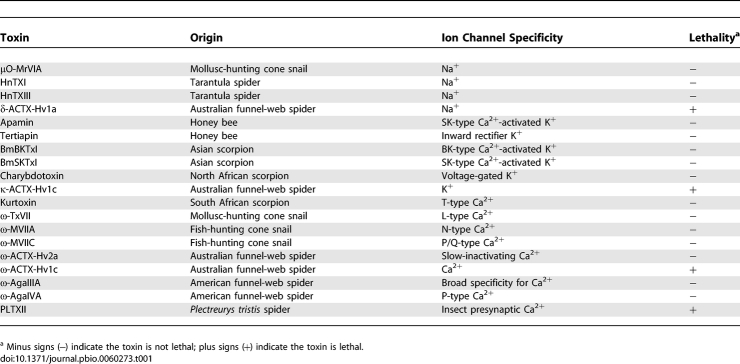
We selected 19 different peptide ion channel toxins from the venoms of cone snails, scorpions, bees, and spiders (Table 1) for testing in vivo in membrane-tethered form in the nervous system of transgenic Drosophila melanogaster. Of the 19 membrane-tethered toxins tested, four of them cause complete embryonic/larval lethality when expressed pan-neuronally using an elav-GAL4 driver (Figure 1), indicating activity against functionally essential fly ion channel subtypes. Three of these four membrane-tethered toxins are derived from the venom of the Australian funnel web spider Hadronyche versuta. δ-ACTX-Hv1a inhibits inactivation of Na+ channels in isolated cockroach giant axon and dorsal unpaired median neurons and rat dorsal root ganglion neurons, and induces spontaneous repetitive action potential (AP) firing accompanied by plateau potentials [35]. κ-ACTX-Hv1c has highly conserved structural features common to multiple K+ channel blockers and has been shown to target Drosophila K+ channels [36,37]. ω-ACTX-Hv1c is a blocker of mid/low- and high-voltage–activated insect Ca2+ channels [38,39]. PLTXII, a toxin from Plectreurys tristis spider venom, inhibits neurotransmission at the Drosophila neuromuscular synapse and targets the presynaptic Ca2+ channel encoded by the cacophony gene [40,41]. As shown in Figure 1, pan-neuronal expression of any of these four toxins induces embryonic/early-larval lethality when expressed from any one of multiple independent chromosomal insertions. In contrast, μO-MrVIA, a blocker of vertebrate voltage-gated Na+ channels from the venom of a fish-eating cone snail [42], has no effect when expressed pan-neuronally (Figure 1). Lack of effect of μO-MrVIA when expressed pan-neuronally indicates absence of activity against fly Na+ channels, at least in its tethered form. We thus utilize tethered μO-MrVIA as a negative control for all experiments. The fact that the only four toxins showing signs of bioactivity when expressed in membrane-tethered form in the Drosophila nervous system are derived from spiders, and not from ocean-dwelling cone snails, makes sense in light of the natural prey species of spiders and cone snails.
To determine whether these four tethered spider toxins are active against ion channels important for circadian pacemaker neuron function, we expressed membrane-tethered toxins solely in the LNV subset of approximately 20 clock neurons that secrete PDF and are considered key pacemakers of the clock circuit [12,16,17]. Three of the four potent membrane-tethered toxins substantially disrupt free-running circadian rhythms of locomotor activity when expressed in PDF neurons using a pdf-GAL4 driver (Figure 2, Table S1). δ-ACTX-Hv1a or κ-ACTX-Hv1c expression in PDF neurons induces arrhythmicity or complex rhythmicity in individual toxin-expressing flies. Complex rhythmicity occurs when an individual fly exhibits multiple rhythms of locomotor activity free-running simultaneously with different periods (Figure 2). In contrast, expression of tethered vertebrate Na+ channel blocker μO-MrVIA in PDF neurons has no behavioral effect on locomotor rhythms in comparison either with the background strain used for transgenesis (unpublished data) or with pdf-GAL4 driver flies (Figure 2, Table S1). Membrane-tethered PLTXII Ca2+ channel blocker has no effect on circadian behavior when expressed in PDF neurons (Figure 2). Membrane-tethered ω-ACTX-Hv1c expression in PDF neurons using the pdf-GAL4 driver, which is active in both PDF-expressing clock neurons as well as in neurosecretory cells in the thoracic ganglion starting in early larval development [8,17], causes death by approximately 1 wk posteclosion, suggesting the possibility of toxin-induced developmental defects. To eliminate such possible developmental effects of toxin expression, we exploited temperature-dependent temporal control of GAL4-driven transgene expression using a temperature-sensitive mutant form of GAL80 transcriptional repressor (GAL80ts), which binds to GAL4 and inhibits downstream transcription that would otherwise be activated by GAL4 [43,44]. At 18 °C, GAL80ts dominates GAL4′s activator function and is active at repressing transcription, but at 30 °C, it is inactive. Thus, GAL4-mediated transgene expression can be temporally activated by shifting flies that also express GAL80ts from 18 °C to 30 °C. Flies expressing membrane-tethered ω-ACTX-Hv1c with both pdf-GAL4 and tub-GAL80ts were allowed to develop to adulthood at 18 °C, and then were shifted to 30 °C to induce membrane-tethered ω-ACTX-Hv1c expression. These flies have a normal lifespan, but exhibit circadian rhythm defects of arrhythmicity or complex rhythmicity, as shown in Figure 2 and Table S1. These results indicate the presence of functionally important ion channels sensitive to κ-ACTX-Hv1c, ω-ACTX-Hv1c, and δ-ACTX-Hv1a in PDF-secreting LNV clock neurons.
Pan-Neuronal Expression of Membrane-Tethered Spider Toxins Induces Lethality in Transgenic Drosophila Flies homozygous for an-transgene were mated to flies heterozygous for the indicatedtransgenes and a phenotypically marked balancer chromosome, such that one half of the progeny receive both-andtransgenes, while the other half of the progeny receive-and the balancer chromosome. Lethality was assessed as percent relative mortality, which is 100% if there are no viable adult flies with both transgenes, and 0% if there are the same number of viable adult flies with both transgenes as with-and the balancer. Negative mortality reflects a fitness disadvantage of progeny carrying a balancer chromosome relative to progeny carrying a chromosome with atransgene insertion. The code numbers refer to independent chromosomal insertions of the indicatedtransgenes. Code numbers 7.4a and 7.6a indicate two independent insertions of a membrane-tethered μO-MrVIAtransgene, which encodes a vertebrate Nachannel blocker with no activity againstion channels. Pan-neuronal expression of membrane-tethered μO-MrVIA has no effect on viability of flies. However, pan-neuronal expression of either one of the four indicated spider toxins induces complete embryonic/larval lethality for all independentchromosomal insertions tested.> 50 animals for each cross. elav GAL4 UAS-toxin elav GAL4 UAS-toxin elav GAL4 elav GAL4 UAS-toxin UAS-toxin UAS Drosophila UAS-toxin n +
Behavioral Arrhythmicity or Complex Rhythmicity Induced by Membrane-Tethered Toxin Expression (A) Double-plotted locomotor actograms of representative individual male progeny of the indicated genotypes are shown, spanning 14 d in DD after release from diurnal 12-h:12-h LD entraining conditions. The bar above each actogram indicates subjective day (gray) and subjective night (black).orcontrol flies expressing μO-MrVIA in PDF neurons (LNs) exhibit a single statistically significant free-running rhythm of locomotor activity.indicates the presence of atransgene.is a temperature-sensitive mutant form of the GAL80 transcriptional repressor. At the permissive temperature of 18 °C, GAL80is active at repressing GAL4-mediated transcription, but at the restrictive temperature of 30 °C, it is inactive. Therefore, GAL4-mediated toxin expression can be temporally activated by shifting adultorflies from 18 °C to 30 °C. In contrast,flies orflies expressing toxin in the LNs frequently exhibit behavioral arrhythmicity or complex rhythmicity of locomotor activity. PLTXII expression in the LNs has no behavioral effect on locomotor activity.flies expressing ω-ACXT-Hv1c driven byandwere allowed to develop to adult stage at 18 °C and tested for behavior at 30 °C, and exhibit behavioral arrhythmicity or complex rhythmicity in comparison to controlflies. The asterisk (*) in the bottom row of actograms indicates 2 d during which the locomotor monitoring system was inoperative. pdf>μO-MrVIA pdf,tub>μO-MrVIA tub tub-GAL80 ts tub-GAL80 ts pdf,tub>μO-MrVIA pdf,tub>ω-ACXT-Hv1c pdf>δ-ACTX-Hv1a pdf>κ-ACTX-Hv1c pdf,tub>ω-ACXT-Hv1c pdf-GAL4 tub-GAL80 ts pdf,tub>μO-MrVIA V V V ts (B) A summary of the percentages of flies exhibiting arrhythmic (red), complex rhythmic (yellow), or single rhythmic (blue) locomotor activity assayed over the first 14 d in DD. The difference in proportion of behavioral phenotypes between controlflies and experimentalorflies expressing toxin from different insertions are statistically significant by χtest; for each of the χvalues,< 0.0001.flies were not statistically distinguishable from control., number of flies tested. pdf>μO-MrVIA pdf>δ-ACTX-Hv1a pdf>κ-ACTX-Hv1a p pdf>PLTXII n 2 2 (C) A summary of the percentages offlies exhibiting behavioral phenotypes at 30 °C. The difference in proportion of behavioral phenotypes between controlflies and experimentalfrom different insertions are statistically significant by χtest; for each of the χvalues,< 0.0001., number of flies tested. pdf,tub>ω-ACXT-Hv1c pdf,tub>μO-MrVIA pdf,tub>ω-ACTX-Hv1c p n 2 2
Membrane-Tethered δ-ACTX-Hv1a Dose-Dependently Inhibits Inactivation ofNaChannel When Coexpressed inOocytes Drosophila para Xenopus +
δ-ACTX-Hv1a has been shown to inhibit inactivation of insect and mammalian voltage-gated Na+ currents [35]. The predominant Drosophila voltage-gated Na+ channel is encoded by the para gene [45,46]. Functional expression of para in Xenopus oocytes is enhanced by coexpression of the tipE accessory subunit [47,48]. We coexpressed membrane-tethered δ-ACTX-Hv1a with para/tipE to examine the effect of the tethered toxin on para voltage-gated Na+ currents. Uninjected oocytes showed no voltage-gated inward currents (unpublished data). The inward Na+ current recorded from oocytes injected with para/tipE complementary RNA (cRNA) exhibits voltage-dependent activation, with rapid and complete inactivation occurring within several milliseconds (Figure 3A). Coexpression of tethered δ-ACTX-Hv1a dose-dependently inhibits the inactivation of para Na+ current. We used the ratio of steady-state current to peak current during 40 ms of depolarization to −30 mV to compare the extent of inhibition by membrane-tethered δ-ACTX-Hv1a of para Na+ current inactivation. Coinjection of para/tipE and either H2O or tethered PLTXII Ca2+ channel toxin cRNAs (1:1) induces inward Na+ current with the current ratio of 0.023 ± 0.015 (n = 4) or 0.029 ± 0.004 (n = 16), respectively (mean ± standard error of the mean [SEM]). A low concentration of 1:1,000 tethered δ-ACTX-Hv1a cRNA significantly decreased the inactivation of Na+ current to a current ratio of 0.169 ± 0.018 (n = 21, p < 0.001). A high concentration of toxin (1:10) completely abolishes inactivation of Na+ current resulting in a current ratio of 1.005 ± 0.003 (n = 8, p < 0.001; Figure 3). In contrast, tethered δ-ACTX-Hv1a has no effect on kinetics and amplitude of Drosophila Shaker K+ current, which also exhibits fast activation and inactivation (Figure 3C), indicating retained specificity of membrane-tethered δ-ACTX-Hv1a for inhibiting inactivation of voltage-gated Na+ channels.
Membrane-Tethered δ-ACTX-Hv1a Abolishes Inactivation ofVoltage-Gated NaChannel Drosophila para + oocytes were injected with same ratio of para/tipE cRNA by weight (1.66/1.32 ng/nl), and inward Nacurrents were recorded in response to step depolarizations from holding potential of −90 mV to a series of test potentials from −70 mV to 40 mV in 10 mV increments. Xenopus + (A) Representative recordings from oocytes injected with cRNA encoding para/tipE and membrane-tethered PLTXII Cachannel toxin or membrane-tethered δ-ACTX-Hv1a Nachannel toxin. Para/tipE conducts inward Nacurrent exhibiting fast activation and inactivation. Membrane-tethered δ-ACTX-Hv1a totally abolishes inactivation of the current when injected at 1:10, and partially abolishes inactivation at 1:400 dilution. Large transient capacitative currents at the beginning and end of the voltage steps were cropped. Current ratio refers to the ratio of steady state current to peak current for the depolarizing step to −30 mV. 2+ + + (B) The curve shows the relationship between membrane-tethered toxin cRNA dilution ratio and current ratio (/). Membrane-tethered δ-ACTX -Hv1a inhibits the inactivation ofNachannel in a dose-dependent manner. I I P para ss + (C) Representative recordings from oocytes injected with cRNA encodingKchannel and membrane-tethered δ-ACTX-Hv1a or HO. Shaker conducts outward Kcurrent exhibiting fast activation and inactivation. Membrane-tethered δ-ACTX-Hv1a has no effect on Shaker inactivation. Drosophila Shaker + + 2
Functional Expression of Membrane-Tethered δ-ACTX-Hv1a in PDF-Secreting LNPacemaker Neurons Dramatically Alters Spontaneous Electrical Activity V
To confirm membrane targeting of membrane-tethered δ-ACTX-Hv1a in vivo, we examined the expression of Myc-tagged δ-ACTX-Hv1a in PDF-secreting clock neurons. The ten-amino acid Myc epitope tag is located in the middle of the glycine-asparagine repeat hydrophilic linker domain. Brains of flies with two, four, or six copies of UAS-δ-ACTX-Hv1a and pdf-GAL4 were double immunostained with anti-Myc and anti-PDF fluorescence, with parental 4×UAS-δ-ACTX-Hv1a flies as negative control for anti-Myc staining. As shown in Figure 4, control UAS-δ-ACTX-Hv1a flies show no anti-Myc immunofluorescence in the LNV cell bodies or terminals. Anti-PDF labels the cell bodies of PDF neurons (LNVs) and their processes, including dorsomedial terminals of sLNVs (Figure 4A) and projection of large LNVs (lLNVs) to the contralateral optic lobe through posterior optic tract (unpublished data). Flies expressing δ-ACTX-Hv1a in LNVs exhibit red anti-Myc immunofluorescence colocalized with anti-PDF green fluorescence in the cell bodies of LNVs. δ-ACTX-Hv1a expression dose-dependently increases anti-Myc immunofluorescence detected in the cell bodies of both lLNVs and sLNVs, as well as sLNV dorsomedial terminals (Figure 4). Red anti-Myc immunofluorescence is barely detectable in cell bodies of lLNV in pdf>2×UAS-δ-ACTX-Hv1a flies, and not at all in the sLNVs. Introduction of four or six copies of UAS-δ-ACTX-Hv1a transgene significantly increases anti-Myc immunofluorescence detected in the cell bodies of both lLNVs and sLNVs (p < 0.001, Figure 4). Anti-Myc immunofluorescence in sLNV dorsomedial terminals is not seen in brain hemispheres of pdf>2×UAS-δ-ACTX-Hv1a or pdf>4×UAS-δ-ACTX-Hv1a 4 flies. In pdf>6×UAS-δ-ACTX-Hv1a flies, 11 out of 16 hemispheres (68.8%) exhibit detectable anti-Myc immunofluorescence in the sLNV dorsomedial terminals (Figure 4B). Projection of lLNVs to the opposite optic lobes through the posterior optic tract is also visualized with anti-Myc immunofluorescence in these brains (unpublished data). These results establish that membrane-tethered δ-ACTX-Hv1a is expressed in LNV clock neurons and is transported throughout their neuronal arbors. Membrane-tethered ω-ACTX-Hv1c, a Ca2+ channel blocker, expression in LNVs is shown in Figure S1. High-resolution confocal images of the dorsomedial terminals of sLNVs expressing membrane-tethered ω-ACTX-Hv1c demonstrate green anti-Myc fluorescence signal surrounding “puncta” of red anti-PDF signal. This is consistent with targeting of ω-ACTX-Hv1c to the plasma membrane of the terminals that encloses regions of concentration of PDF-containing dense-core vesicles. These results indicate that membrane-tethered spider toxins are expressed by LNV clock neurons and targeted to the plasma membrane where they can interact with their target ion channels.
In order to confirm functional expression of membrane-tethered δ-ACTX-Hv1a, we performed whole-cell electrophysiological recordings on lLNV clock neurons expressing δ-ACTX-Hv1a. Previous studies indicate that lLNV RMP and AP firing rate is regulated by the circadian clock to encode time of day [49,50]. In 12-h:12-h light:dark (LD) conditions, lLNV RMP varies within the range of −40 mV to −70 mV. For any given cell steady state, lLNV RMP remains relatively stable, albeit frequently with approximately 5−10-mV membrane potential oscillation. In the representative example shown in Figure 5A, this WT lLNV RMP is relatively stable at −40 mV. Membrane-tethered δ-ACTX-Hv1a–expressing lLNV RMP exhibits dramatically different membrane-activity from WT lLNVs. A representative example is shown in Figure 5B. Membrane-tethered δ-ACTX-Hv1a–expressing lLNV membrane potential oscillates in a very wide range from approximately −140 to approximately 0 mV. Membrane-tethered δ-ACTX-Hv1a–expressing lLNV RMP becomes gradually depolarized, and spontaneous AP firing rate increases as the membrane potential level increases. When the RMP reaches approximately −40 mV, a burst of 5−30 APs lasting approximately 0.2–0.5 s occurs. After the burst, the membrane potential remains at a depolarized plateau (−15−0 mV) for 2−7 s. Following the plateau, membrane potential repolarizes rapidly down to approximately −140 mV within 2 s. Following this huge hyperpolarization, membrane potential gradually depolarizes to eventually initiate another cycle of this unique behavior. We have recorded from 53 membrane-tethered δ-ACTX-Hv1a–expressing lLNVs, and 36 of them exhibit this basic cyclic temporal pattern of membrane potential. However, the exact frequency of these cycles, the duration of AP bursts and depolarized plateau, and the number of APs during the AP burst, exhibit substantial variation from cell to cell, even when expressing the same number of copies of δ-ACTX-Hv1a transgene. lLNVs expressing different numbers of δ-ACTX-Hv1a transgene do not show consistent differences in their membrane potential dynamics. Since membrane-tethered δ-ACTX-Hv1a inhibits inactivation of para voltage-gated Na+ channels (Figure 3), the AP burst and prolonged depolarized plateau in membrane-tethered δ-ACTX-Hv1a–expressing lLNVs most likely involve sustained opening of para channels, substantial Na+ influx, and increased intracellular [Na+]. We thus tested the hypothesis that the massive postplateau hyperpolarization well below the reversal potential for K+ is induced by electrogenic Na+/K+-ATPase pump currents expelling all that intracellular Na+, by blocking those currents with ouabain [51]. In the representative example shown in Figure 5C, the application of 0.1 mM ouabain for 1 min substantially reduces the massive postplateau hyperpolarizations in membrane-tethered δ-ACTX-Hv1a–expressing lLNVs, and this effect is at least partially reversible. These results suggest that Na+/K+-ATPase underlies the postplateau hyperpolarization.
Immunofluorescence Detection of Membrane-Tethered δ-ACTX-Hv1a in PDF-Secreting LNClock Neurons V Adult brains offlies possessing the indicated number oftransgenes and thetransgene, or flies only possessing the indicated number oftransgenes, were processed for immunofluorescence with anti-Myc and anti-PDF antibodies to visualize both Myc epitope-tagged membrane-tethered δ-ACTX-Hv1a and PDF neuropeptide. pdf>δ-ACTX-Hv1a UAS pdf-GAL4 UAS-δ-ACTX-Hv1a (A)(6×UAS) flies exhibit red anti-Myc immunofluorescence in the cell bodies of small LNs (sLNs) and large LNs (lLNs), sLNdorsomedial terminals, and lLNprojections to the opposite optic lobe (not shown in this figure). Anti-Myc immunofluorescence colocalizes with green anti-PDF in the cell bodies of PDF neurons. Red anti-Myc immunofluorescence exhibits punctate staining throughout the sLNterminals. pdf>δ-ACTX-Hv1a V V V V V V V (B) Bar graph demonstrates the dose-dependent expression of δ-ACTX-Hv1a in the lLNs and sLNs (< 0.001; ANOVA Tukey-Kramer multiple comparisons). The intensity level (mean ± SEM) of anti-Myc labeling in the lLNs and sLNs is normalized to the intensity level in flies with six copies ofexpressed withdriver. Bar graph for sLNterminals represents percentage of brain hemispheres exhibiting anti-Myc staining in the sLNterminals. V V V V V V p UAS-δ-ACTX-Hv1a pdf-GAL4
Membrane Activity of Large PDF Neurons (lLNs) Is Dramatically Altered by Membrane-Tethered δ-ACTX-Hv1a Expression V (A) Representative whole-cell recording of WT lLNis shown. The upper panel is a typical 5-min recording, and the lower panel depicts a magnified view of the outlined 10-s segment of the 5-min trace. The resting membrane potential of the WT lLNis relatively stable (∼−40mV), and two different sizes of spontaneous action potentials are observed, as previously reported []. V V [49] (B) Representative 5-min whole-cell recording of lLNexpressing membrane-tethered δ-ACTX-Hv1a from two copies oftransgene anddriver is shown in the upper panel. The lower panel depicts a magnified view of the outlined 20-s segment of the 5-min trace. Immediately following an action potential burst, the membrane potential remains at a −15mV depolarized plateau for approximately 8 s before a rapid massive hyperpolarization that is slowly recovered from. V UAS- δ-ACTX-Hv1a pdf-GAL4 (C) Continuous 15-min recording of another lLNexpressing membrane-tethered δ-ACTX-Hv1a from two copies of. 0.1 mM ouabain was applied for 1 min as indicated by the horizontal bar. Ouabain dramatically reduces the magnitude of postplateau hyperpolarization, suggesting its origin in Na/K-ATPase pump current. The continued increase in ouabain effect following washout is likely due to slow tissue diffusion of the hydrophobic drug. V UAS- δ-ACTX-Hv1a + +
LNExpression of Membrane-Tethered δ-ACTX-Hv1a Disrupts Free-Running Rhythms of Locomotor Activity V
To determine whether these physiological modifications of LNVs induced by expression of membrane-tethered δ-ACTX-Hv1a affect the function of the circadian control network, we examined free-running locomotor activity patterns of flies expressing either membrane-tethered δ-ACTX-Hv1a or μO-MrVIA specifically in the PDF-expressing LNVs using pdf-GAL4 driver. Control pdf>μO-MrVIA flies expressing membrane-tethered μO-MrVIA exhibit rhythmic free-running circadian behavior of locomotor activity with a single statistically significant period of approximately 24.4 h (Figure 6A), of 298 μO-MrVIA–expressing flies tested, 93% of them exhibited a single statistically significant periodogram peak (Figure 6, Table S1). In contrast, substantial numbers of experimental flies expressing membrane-tethered δ-ACTX-Hv1a in the LNVs exhibit arrhythmicity or complex rhythmicity (i.e., multiple superimposed free-running circadian rhythms of locomotor activity with different periods: one of approximately 25 h and one of approximately 22 h). Free-running behavioral effects induced by membrane-tethered δ-ACTX-Hv1a expression in the LNVs either with single independent chromosomal insertion, or with multiple chromosomal insertions are relatively similar. The remaining rhythmic δ-ACTX-Hv1a–expressing flies exhibit single-period free-running circadian rhythms with period corresponding to either the long or short period of complex rhythmicity, suggesting a similar effect on the circadian control network in these flies, albeit with a different behavioral manifestation (unpublished data). Arrhythmicity or complex rhythmicity is only rarely observed in control pdf>μO-MrVIA flies, which almost always exhibit single free-running rhythms (Figure 6, Table S1). The differences in proportion of behavioral phenotypes between membrane-tethered δ-ACTX-Hv1a–expressing flies and control (either membrane-tethered μO-MrVIA–expressing flies or parental UAS flies) were all statistically significant (χ2; p < 0.001).
To exclude a role for developmental effects of membrane-tethered δ-ACTX-Hv1a expression in inducing these behavioral phenotypes, we exploited the GAL80ts system for temporal control of GAL4-driven transgene expression. Flies possessing UAS-δ-ACTX-Hv1a, pdf-GAL4, and tub-GAL80ts transgenes were allowed to develop at 18 °C from egg to adult in the absence of δ-ACTX-Hv1a expression, and then shifted to 30 °C to induce membrane-tethered δ-ACTX-Hv1a expression. Experimental pdf,tub>δ-ACTX-Hv1a flies exhibit arrhythmicity or complex rhythmicity at 30 °C similar to pdf>δ-ACTX-Hv1a flies (Figure S2), indicating that the behavioral phenotype caused by membrane-tethered δ-ACTX-Hv1a expression in the LNVs is not due to developmental effects. The percentage of arrhythmic or complex rhythmic flies expressing δ-ACTX-Hv1a from two or four copies of UAS-δ-ACTX-Hv1a transgene is significantly greater than control pdf>μO-MrVIA or UAS-toxin flies (χ2; p < 0.0001). The exact manifestation of complex rhythmicity in pdf,tub>δ-ACTX-Hv1a flies is somewhat different than in pdf>δ-ACTX-Hv1a flies. The latter tend to simultaneously manifest strong short- and long-period rhythms immediately after transfer from 12-h:12-h LD into DD, while the former tend to initially manifest mainly a long-period rhythm and then, after about a week in DD, transition to predominately just a short-period rhythm, as seen in published studies of complex rhythmic flies [20]. The most likely interpretation of this particular form of complex rhythmicity at the cellular level is—as in the case in which strong short- and long-period rhythms manifest themselves simultaneously—that there are independently free-running subsets of clock neurons running with short and long periods, with the difference that their respective ability to gate locomotor activity waxes and wanes reciprocally over time in DD. These results indicate that the physiological changes induced by LNV expression of membrane-tethered δ-ACTX-Hv1a interfere with the ability of the circadian control network to drive coherent free-running behavioral rhythms in constant darkness.
PDF-Secreting LNClock Neuron Expression of Membrane-Tethered δ-ACTX-Hv1a Disrupts Free-Running Behavioral Rhythms V Flies expressing membrane-tethered μO-MrVIA or δ-ACTX-Hv1a from indicated numbers of copies oftransgenes usingdriver, as well as indicated nonexpressing parentalandflies, were entrained in 12-h:12-h LD conditions before release into DD. Double-plotted normalized actograms depict averaged locomotor activity for indicated genotypes of flies from a representative experiment. Bar graph shows proportions of flies with the indicated behavioral phenotypes as assessed by Lomb-Scargle periodogram analysis of all pooled experiments. Control flies expressing membrane-tethered μO-MrVIA or parental transgenic lines not expressing any membrane-tethered peptide exhibit rhythmic locomotor activity with a single free-running rhythm. In contrast, most flies expressing membrane-tethered δ-ACTX-Hv1a exhibit arrhythmicity or complex rhythmicity. The averaged actograms reveal this complex rhythmicity as multiple superimposed free-running rhythms of different periods. UAS pdf-GAL4 UAS pdf-GAL4 (A) The averaged actograms of all flies (including rhythmic and arrhythmic flies) of the indicated genotypes from a representative experiment are shown.flies exhibit locomotor rhythm with a single period of approximately 24.4 h. In contrast,flies exhibit complex rhythmicity with simultaneously superimposed rhythms with periods of approximately 25 h and approximately 22 h. pdf>μO-MrVIA pdf>δ-ACTX-Hv1a (B) A summary of the percentages of flies exhibiting arrhythmic (red), complex rhythmic (yellow) and single rhythmic (blue) locomotor activity assayed over the first 14 d in DD. The difference in proportion of behavioral phenotypes between each of the control flies, eitherorstrain ordriver, and experimentalflies are each statistically significant by χtest; for each of the χvalues,< 0.0001., number of flies tested. pdf>μO-MrVIA UAS-toxin pdf-GAL4 pdf>δ-ACTX-Hv1a p n 2 2
Membrane-Tethered δ-ACTX-Hv1a Expression in LNClock Neurons Phase Advances Both PDF Cycling in Dorsomedial sLNNerve Terminals and Morning Anticipatory Locomotor Activity V V
PDF-secreting LNVs are important not only for driving free-running locomotor rhythms in DD, but also for generating the “morning” peak of locomotor activity that anticipates lights-on in 12-h:12-h LD conditions [12,16,17,30,31]. To determine whether LNV expression of membrane-tethered δ-ACTX-Hv1a interferes with the LNV-dependent morning activity peak, we performed a refined analysis of the average relative activity in LD of flies expressing membrane-tethered μO-MrVIA or δ-ACTX-Hv1a using pdf-GAL4 driver. As shown in Figure 7A, control μO-MrVIA–expressing flies exhibit robust morning and evening circadian anticipatory peaks of locomotor activity. Membrane-tethered δ-ACTX-Hv1a–expressing pdf>δ-ACTX-Hv1a flies also exhibit robust morning and evening circadian anticipatory peaks of locomotor activity, albeit with phase-advanced morning activity (Figure 7A) compared to control pdf>μO-MrVIA flies. We quantified phase advance of morning activity peaks by computing an anticipation phase score for each fly, defined as the ratio of total relative activity in the 3-h period before lights-on to that after. Increase in anticipation phase scores reflects greater anticipatory activity before lights-on compared to after, thus quantifying phase advances in anticipation. As seen in Figure 7B, membrane-tethered δ-ACTX-Hv1a expression induces dose-dependent increase in morning anticipation phase score (p < 0.001), indicating dose-dependent phase advance of morning anticipation caused by inhibition of para Na+ channel inactivation in LNV morning cells. The dose-dependent phase advance is also apparent in the shape of envelope of relative activity occurring before lights-on, being concave for pdf>μO-MrVIA flies and then becoming progressively more convex with increasing dose of membrane-tethered δ-ACTX-Hv1a. These effects are observed in multiple independent replicate experiments (unpublished data).
PDF has been hypothesized to be a daily phase signal transmitted from LNVs to other clock neurons (and potentially non-clock targets) that entrains both clock neuron cellular oscillation and locomotor rhythms [27]. To determine whether advanced phase of morning activity in flies expressing membrane-tethered δ-ACTX-Hv1a is due to altered phase of PDF secretion rhythms, we compared the daily rhythm of accumulation of PDF in the sLNV dorsomedial terminals (thought to reflect daily rhythm of secretion; [18,22]) of flies expressing either δ-ACTX-Hv1a or μO-MrVIA in the LNVs in LD. There is a recent study demonstrating absence of detectable PDF cycling in the sLNV terminals of a particular transgenic strain of flies that nonetheless still exhibit normal circadian locomotor activity [52]. However, this result is still consistent with a key role for cyclic secretion in circadian rhythms, and with cyclic PDF accumulation as a readout of cyclic secretion, as steady-state accumulation will only reflect secretion rhythms when synthesis rate and secretion rate are similar in magnitude; under conditions in which synthesis rate outpaces secretion rate, a rhythm of secretion may not result in a detectable rhythm of steady-state accumulation. Furthermore, there is functional, albeit indirect, evidence in the literature that rhythmic-activity–dependent PDF secretion is important for circadian rhythmicity [18,20,49,50].Therefore, it is reasonable to conclude that rhythmic steady-state accumulation of PDF reflects rhythmic PDF secretion.
In LD conditions, control flies expressing membrane-tethered μO-MrVIA in the LNVs exhibit significantly greater anti-PDF immunofluorescence in the sLNV dorsomedial terminals at zeitgeber time (ZT)2 and ZT6, in comparison to the night at ZT14 and ZT18 (p < 0.001; Figure 7C). In contrast, PDF accumulation in the sLNV dorsomedial terminals of experimental flies expressing membrane-tethered δ-ACTX-Hv1a in the LNVs cycles with advanced phase, peaking late night, rather than early in the morning, with peak anti-PDF immunofluorescence at around ZT22 (p < 0.001). This approximately 4-h phase advance of PDF cycling induced by LNV expression of membrane-tethered δ-ACTX-Hv1a, in combination with the induced phase advance of morning anticipation, provides experimental support for the hypothesis that the phase of rhythmic PDF secretion determines the phase of morning anticipation. Figure S4 shows an independent replicate of this experiment, confirming δ-ACTX-Hv1a–induced phase advance of PDF accumulation.
We also examined the effect of membrane-tethered δ-ACTX-Hv1a on accumulation of PDF in the sLNV dorsomedial terminals in constant darkness. Anti-PDF immunoreactivity in the dorsomedial terminals was assayed on the 2nd, 4th, or 6th d after release from LD entraining conditions into DD. As shown in Figure 8, LNV expression of membrane-tethered δ-ACTX-Hv1a induces phase advance of PDF accumulation in DD consistent with the effect in LD. On the 2nd d in DD (DD-D2), anti-PDF immunofluorescence in the sLNVs dorsomedial terminals of control membrane-tethered μO-MrVIA–expressing flies peaks at CT2 to CT6 (p < 0.001). In contrast, experimental flies expressing membrane-tethered δ-ACTX-Hv1a exhibit phase-advanced peak PDF accumulation at circadian time (CT)22 to CT2 (p < 0.001). On DD-D4, control pdf>μO-MrVIA flies exhibit peak PDF accumulation at CT6–CT10 (p < 0.001). Experimental pdf>δ-ACTX-Hv1a flies exhibit phase advance of PDF cycling with peak at CT22 (p < 0.001). On DD-D6, control pdf>μO-MrVIA flies exhibit peak PDF accumulation at CT10 (p < 0.001), while experimental pdf>δ-ACTX-Hv1a flies exhibit peak PDF accumulation around CT22 (p < 0.001). The gradual accumulation of a phase delay relative to the 24-h d of PDF oscillation in control pdf>μO-MrVIA flies over 6 d in DD is consistent with their free-running behavioral period of greater than 24 h (Figures 2 and 6). The phase advance of PDF accumulation in sLNV terminals of membrane-tethered δ-ACTX-Hv1a–expressing flies in LD and DD relative to μO-MrVIA–expressing control and the correlated phase advance of morning anticipatory locomotor activity support the hypothesis that phase of LNV PDF secretion rhythms determines phase of morning anticipation.
Membrane-Tethered δ-ACTX-Hv1a Expression in PDF-Secreting LNs Induces Phase Advance of Both Morning Anticipatory Locomotor Activity and PDF Accumulation in the Dorsomedial Terminals of sLNs V V Flies withand either(4×UAS) ortransgenes were entrained for at least 4 d in 12-h:12-h LD conditions and then brains were processed for anti-PDF immunofluorescence. Green anti-PDF signal indicates cytoplasmic PDF accumulation in sLNdorsomedial terminals. pdf-GAL4 UAS- δ-ACTX-Hv1a UAS-μO-MrVIA V (A) Average activity histograms indicate relative levels of locomotor activity versus time for flies of the indicated genotypes over 5 d in LD. Each bar represents 30-min cumulative activity, with white and black bars indicating the day and night phases. Flies expressing membrane-tethered δ-ACTX-Hv1a exhibit phase advanced lights-on anticipation as revealed by the change in shape of the envelope of relative activity in the 3 h prior to lights-on from concave to convex with increasing membrane-tethered δ-ACTX-Hv1a expression. (B) Bar graph shows computed phase scores (mean ± SEM) for lights-on anticipation, defined as relative cumulative activity in the 3 h just before lights-on divided by the 3 h just after lights-on. Indicated genotypes represent flies expressing either membrane-tethered μO-MrVIA or δ-ACTX-Hv1a with one, two, four or six copies of UAS. Membrane-tethered δ-ACTX-Hv1a expression dose-dependently phase advances morning anticipation of lights-on. The difference between controland each of thegenotypes is statistically significant by ANOVA with Tukey-Kramer multiple comparison (< 0.001). pdf>μO-MrVIA pdf> δ-ACTX-Hv1a p (C) Bar graphs show normalized integrated anti-PDF staining intensity (mean ± SEM). Representative immunofluorescence images of sLNdorsomedial terminals from flies of the indicated genotypes at the indicated time points are shown. Control flies expressing membrane-tethered μO-MrVIA exhibit peak PDF accumulation at ZT2–ZT6 and trough at ZT14–ZT18 (< 0.001). In contrast, membrane-tethered δ-ACTX-Hv1a–expressing flies exhibit peak PDF accumulation at ZT22 and trough at ZT10–ZT14 (< 0.001), representing an approximately 4-h phase advance of the rhythm of PDF accumulation. The differences among different genotypes at different circadian times were compared with ANOVA and Tukey-Kramer multiple comparisons.> 22 brain hemispheres for each experimental group. V p p n
Membrane-Tethered δ-ACTX-Hv1a Expression in LNNeurons Induces Phase Advance of PDF Oscillation in sLNDorsomedial Terminals in Constant Darkness (DD) V V Flies withand either(4×UAS) ortransgene were entrained for at least 4 d in LD and then transferred to DD. On the 2nd, 4th, or 6th d of DD, fly brains were processed for anti-PDF immunofluorescence in the sLNdorsomedial terminals. On DD-D2, controlflies exhibit rhythmic anti-PDF immunofluorescence in the sLNdorsomedial terminals with peak accumulation at CT2 to CT6 (< 0.001). In contrast, experimentalflies exhibit a peak at CT22 to CT2 and trough at CT14 (< 0.001). On DD-D4, controlflies exhibit a peak at CT6-CT10 (< 0.001). In contrast, experimentalflies exhibit a peak at CT22 and trough at CT6–CT10 (< 0.001). On DD-D6, PDF oscillation peaks at CT10 and trough at CT18–CT22 (< 0.001) in controlflies. In contrast, experimentalflies exhibit a broad peak spanning CT18, CT22, and CT2 (< 0.001). Differences among different genotypes at different circadian times were compared using ANOVA with Tukey-Kramer multiple comparisons.> 22 brain hemispheres for each experimental group, and error bars indicate SEM. pdf-GAL4 UAS- δ-ACTX-Hv1a UAS-μO-MrVIA pdf>μO-MrVIA p pdf>δ-ACTX-Hv1a p pdf>μO-MrVIA p pdf>δ-ACTX-Hv1a p p pdf>μO-MrVIA pdf>δ-ACTX-Hv1a p n V V
Membrane-Tethered δ-ACTX-Hv1a Expression in LNNeurons Induces a Phase Shift between Par Domain Protein 1 (PDP1) and PDF Oscillations in sLNs V V
The results described above show that membrane-tethered δ-ACTX-Hv1a expression in PDF-secreting LNVs induces a phase-advance of both sLNV PDF secretion rhythms and morning anticipatory locomotor behavior in LD, and disrupts free-running locomotor rhythms in DD. In order to determine the relationship between these phenotypes and cellular transcriptional feedback oscillation, par domain protein 1 (PDP1) clock protein levels were assayed in the sLNV, dorsal lateral neuron (LND), dorsal neuron (DN)1, and DN2 neurons of flies expressing membrane-tethered δ-ACTX-Hv1a in the LNVs. PDP1 is an oscillating transcription factor that has been implicated in a second interlocking circadian transcriptional feedback loop [8]. Regardless of the validity of the assertion that PDP1 does not participate in the cellular time-keeping mechanism and is solely a clock output factor [53], PDP1 is a high-fidelity phase marker for circadian transcriptional feedback oscillation and has been used as such by multiple laboratories [18,32,54,55]. Flies expressing membrane-tethered μO-MrVIA or δ-ACTX-Hv1a are entrained in LD conditions and then released into DD. Brains are fixed at different circadian times, followed by anti-PDP1 immunofluorescence. Anti-PDP1 immunofluorescence is detected in nuclei of clock neurons, and fluorescence levels are quantified by counting the number of stained nuclei in the various anatomical cell groups. To confirm the reliability of this counting method for assaying cellular transcriptional oscillation, we compared it to the established background-subtracted pixel intensity method [13,18,54]. As shown in Figure S3, these two methods reveal the identical temporal patterns of PDP1 oscillation on DD-D4 in DN1 neurons of flies expressing either membrane-tethered μO-MrVIA or δ-ACTX-Hv1a in LNVs. This establishes the reliability of counting PDP1-stained nuclei as a much less labor-intensive method for assessing transcriptional feedback oscillation at the cellular level.
Consistent with previous studies [8,13,18,54], control pdf>μO-MrVIA flies expressing membrane-tethered μO-MrVIA in the LNVs exhibit PDP1 oscillation in sLNVs with peak levels late at night or subjective night and trough levels during day or subjective day (Figure 9). In LD or on DD-D2, sLNVs exhibit peak of PDP1 accumulation at CT18–CT22 with approximately four stained sLNVs detected (p < 0.001). PDP1 accumulation in sLNVs of control pdf>μO-MrVIA flies peaks at CT18–CT22–CT2 on DD-D4 and at CT22–CT2 on DD-D6 (p < 0.001). This gradually increasing slight phase delay of PDP1 accumulation in control flies free-running in DD is consistent with the free-running phase delays of PDF oscillation in the sLNV dorsomedial terminals and moderately long period of free-running locomotor rhythms (Figures 2, 6, and 8, Table S1). PDP1 accumulation in the nuclei of sLNVs of experimental pdf>δ-ACTX-Hv1a flies expressing membrane-tethered δ-ACTX-Hv1a in the LNVs exhibits the same temporal pattern in LD as that of control flies. Thus, membrane-tethered δ-ACTX-Hv1a expression in the LNVs has no effect on PDP1 oscillation in sLNVs in LD, while inducing phase advance of PDF oscillation in their dorsomedial terminals. This phase shift between sLNV PDP1 and PDF oscillations in LD induced by LNV expression of membrane-tethered δ-ACTX-Hv1a was also observed in the independent replicate experiment depicted in Figure S4. The phase advance of morning anticipatory locomotor activity induced by LNV expression of membrane-tethered δ-ACTX-Hv1a thus is determined by the phase of PDF rhythms and not of PDP1. In DD conditions, experimental membrane-tethered δ-ACTX-Hv1a–expressing flies exhibit similar temporal pattern of PDP1 accumulation in the nuclei of sLNVs as control pdf>μO-MrVIA flies on DD-D2 or DD-D4, with a peak at CT18–CT22 (p < 0.001, Figure 9). On DD-D6, PDP1 accumulation in the sLNVs of pdf>δ-ACTX-Hv1a flies peaks at CT18 (p < 0.001), slightly advanced compared with control pdf>μO-MrVIA flies. These results provide experimental support for the hypothesis that the phase of sLNV PDF secretion determines the phase of morning anticipatory locomotor activity, and that PDF transmits phase information from sLNVs to downstream PDF-sensitive targets.
Membrane-Tethered δ-ACTX-Hv1a Expression in LNNeurons Induces No Phase Advance of PDP1 Oscillation in the sLNs in LD V V Red anti-PDP1 immunofluorescence (A) reveals PDP1 accumulation in sLNnuclei. Bar graphs (B) show the number of neurons labeled with anti-PDP1 immunofluorescence (mean ± SEM). Representative images of sLNs from flies of the indicated genotypes at the indicated time points are shown. N.S. indicates complete absence of sLNanti-PDP1 staining above background for that time point and genotype. In LD or on DD-D2, sLNs of controlflies exhibit peak PDP1 staining at ZT/CT18–ZT/CT22 (< 0.001). Peak of PDP1 accumulation in sLNs expressing μO-MrVIA is slightly delayed to CT18–CT22 and CT2 by DD-D4 and CT22 to CT2 by DD-D6 (< 0.001). PDP1 accumulation in the sLNs offlies exhibits temporal pattern similar to that of controlflies in LD and on DD-D2 and DD-D4, with peak at ZT/CT18–ZT/CT22 and trough at ZT/CT6–ZT/CT10 (< 0.001). On DD-D6, peak PDP1 accumulation in the sLNs offlies is slightly advanced to CT18 compared with CT22–CT2 of controlflies (< 0.001). Differences among different genotypes at different circadian times were compared using ANOVA with Tukey-Kramer multiple comparisons.> 22 brain hemispheres for each experimental group. V V V V V V V pdf>μO-MrVIA p p pdf>δ-ACTX-Hv1a pdf>μO-MrVIA p pdf>δ-ACTX-Hv1a pdf>μO-MrVIA p n
Membrane-Tethered δ-ACTX-Hv1a Expression in LNNeurons Induces Short-Period PDP1 Oscillation in Non-LNNeurons V V
We used anti-PDP1 immunofluorescence to assess the effects of phase-advanced PDF cycling in δ-ACTX-Hv1a–expressing PDF-secreting LNVs on cellular oscillation of non-LNV clock neurons that express functional PDF receptor [26]. Control pdf>μO-MrVIA flies exhibit a similar temporal pattern of PDP1 accumulation in the LND cell group in both LD and DD conditions, with peak levels late at night or subjective night, and trough levels during day or subjective day (Figure 10; p < 0.001). This constant phase of PDP1 accumulation over 6 d in DD indicates that LND cellular oscillation free-runs with approximately 24-h period in control flies. Experimental pdf>δ-ACTX-Hv1a flies exhibit a similar temporal pattern of LND PDP1 oscillation to control pdf>μO-MrVIA flies in LD and on DD-D2. However, by DD-D4, PDP1 oscillation in LNDs of experimental pdf>δ-ACTX-Hv1a flies has begun to phase shift relative to control, with blunting of peak accumulation late in subjective night (p < 0.001). By DD-D6, the peak of LND PDP1 accumulation in flies expressing membrane-tethered δ-ACTX-Hv1a in LNVs has phase advanced to CT10. This phase advance indicates that membrane-tethered δ-ACTX-Hv1a expression in the LNVs induces an increase in the pace of LND cellular oscillation. The approximately 12-h phase advance that accumulates after 6 d in DD is consistent with the approximately 22-h free-running period of the short-period component of the complex locomotor rhythms exhibited by many pdf>δ-ACTX-Hv1a flies.
In control pdf>μO-MrVIA flies, DN1s exhibit a peak of PDP1 accumulation in LD around ZT18 (Figure 11). In DD conditions, peak of PDP1 accumulation in DN1s of control flies broadens, but does not exhibit any phase shift. Experimental pdf>δ-ACTX-Hv1a flies expressing membrane-tethered δ-ACTX-Hv1a in LNVs exhibit a similar pattern of PDP1 oscillation as control pdf>μO-MrVIA flies in LD, with peak around ZT18 (p < 0.001). In DD, however, PDP1 oscillation of DN1s in pdf>δ-ACTX-Hv1a flies gradually phase advances with accumulation of an approximately 12-h delay after 6 d in DD, consistent with the approximately 22-h free-running locomotor rhythm component of complex rhythmic pdf>δ-ACTX-Hv1a flies.
The DN2s of control pdf>μO-MrVIA flies exhibit peak PDP1 accumulation at ZT18–ZT22 in LD (Figure 12). The DN2s of control flies exhibit a peak of PDP1 accumulation at CT14 on DD-D2, CT10 on DD-D4, and CT6 on DD-D6. This gradual phase advance of DN2 PDP1 oscillation out of synchrony with the other cell groups after release into DD (Figures 9–12) is consistent with published observations of DN2 cellular oscillation assayed with anti-PER, anti-TIM, or anti-PDP1 immunostaining [18,54,56] and reflects inherent accelerated cellular oscillation in DN2s in DD. Experimental pdf>δ-ACTX-Hv1a flies also exhibit gradual phase advance of PDP1 oscillation after release into DD, peaking around CT0 on DD-D6, but this advance is greater than in control flies, which peak around CT6. Acceleration of non-LNV clock neurons in free-running DD conditions has also been observed in flies in which LNV membrane excitability is altered by ectopic ion channel subunit expression [18,54]. Taken together, all these results indicate that altered membrane activity of LNVs induced by expression of membrane-tethered δ-ACTX-Hv1a (1) phase advances sLNV PDF secretion rhythms and morning anticipatory locomotor activity in LD without phase advance of sLNV PDP1 oscillation and (2) accelerates free-running PDP1 oscillation of LND, DN1, and DN2 PDF receptor-expressing clock neurons in DD.
Membrane-Tethered δ-ACTX-Hv1a Expression in LNNeurons Induces Short Period of PDP1 Oscillation in LNs in DD V D Red anti-PDP1 immunofluorescence (A) reveals PDP1 accumulation in LNnuclei. Bar graphs (B) show the number of neurons labeled with anti-PDP1 immunofluorescence (mean ± SEM). Controlflies exhibit a similar temporal pattern of PDP1 accumulation in the LNs as in the sLNs, with peak centered around CT22 (< 0.001). Experimentalflies exhibit similar temporal pattern of PDP1 oscillation to controlflies on DD-D2 with peak at CT22 and trough at CT10. On DD-D4, LNs offlies exhibit damped peak of PDP1 oscillation at CT22 and trough at CT2-CT6 (< 0.001). However, by DD-D6, a phase advance of PDP1 accumulation in the nuclei of LNs induced by δ-ACTX-Hv1a expression manifests, with a peak at CT10 and trough at CT22-CT2 (< 0.001). δ-ACTX-Hv1a expression in LNs does not affect PDP1 oscillation in LNneurons in LD. Differences among different genotypes at different circadian times were compared using ANOVA with Tukey-Kramer multiple comparisons.> 22 brain hemispheres for each experimental group, and error bars indicate SEM. D D V D D V D pdf>μO-MrVIA p pdf>δ-ACTX-Hv1a pdf>μO-MrVIA pdf>δ-ACTX-Hv1a p p n
Membrane-Tethered δ-ACTX-Hv1a Expression in LNNeurons Induces Short Period of PDP1 Oscillation in DN1s in DD V Red anti-PDP1 immunofluorescence (A) reveals PDP1 accumulation in DN1 nuclei. Bar graphs (B) show the number of neurons labeled with anti-PDP1 immunofluorescence (mean ± SEM). DN1s of controlflies exhibit a peak of PDP1 accumulation at ZT18–ZT22 and trough at ZT6 (< 0.001), in phase with sLNs in LD conditions. In DD conditions, PDP1 oscillation in DN1s peaks at around CT18 on DD-D2 and DD-D4, and trough at CT6–CT10 on DD-D2 and CT2 on DD-D4 (< 0.001). On DD-D6, PDP1 oscillation in DN1s of control flies peaks at CT22–CT2 and trough at CT14 (< 0.001). In contrast, on DD-D2, experimentalflies exhibit PDP1 accumulation in the DN1s with peak at CT14–CT18 and trough at CT2–CT6, approximately 4 h earlier than in control flies. PDP1 accumulation in DN1s offlies continuously shifts peak from CT10–CT14 by DD-D4 (< 0.001) to CT6–CT10 by DD-D6 (< 0.001). δ-ACTX-Hv1a expression in LNs does not affect PDP1 oscillation in DN1 neurons in LD. Differences among different genotypes at different circadian times were compared using ANOVA with Tukey-Kramer multiple comparisons.>22 brain hemispheres for each experimental group, and error bars indicate SEM. pdf>μO-MrVIA p p p pdf>δ-ACTX-Hv1a pdf>δ-ACTX-Hv1a p p n V V
Membrane-Tethered δ-ACTX-Hv1a Expression in LNNeurons Induces Short Period of PDP1 Oscillation in DN2s in DD V Red anti-PDP1 immunofluorescence (A) reveals PDP1 accumulation in DN2 nuclei. Bar graphs (B) show the percentage of brain hemispheres with an identified pair of anatomically distinguishable PDP1-positive DN2s. The DN2s of controlflies drift out of phase with the 24-h day and the other cell groups, exhibiting peak PDP1 accumulation at CT14 on DD-D2, CT10 on DD-D4, and CT6 on DD-D6. The DN2s of experimentalflies exhibit a similar temporal pattern of PDP1 accumulation to control flies in LD. In DD conditions, PDP1 accumulation in DN2s offlies phase advance more rapidly than control flies, with peak at CT10–CT14 on DD-D2, CT6 on DD-D4, and CT22 on DD-D6 (< 0.01, χ).>22 brain hemispheres for each experimental group and error bars indicate SEM. pdf>μO-MrVIA pdf>δ-ACTX-Hv1a pdf>δ-ACTX-Hv1a p n 2
Discussion
In order to begin to dissect the contribution of particular ionic conductances to the cellular physiological function of the circadian control network, we have employed an adaptation of the tethered-toxin methodology in which peptide ion channel toxins are expressed as chimeric fusion proteins with an N-terminal secretory signal sequence and a C-terminal GPI anchor targeting signal [34]. Membrane-tethered toxins derived from blockers of vertebrate ion channels have been demonstrated to cell-autonomously block their target ion channels with expected pharmacological specificity, when transiently expressed in Xenopus oocytes or zebrafish muscle fibers [34]. Here, we extend this system to the use of spider toxins active against insect ion channels in transgenic Drosophila melanogaster, developing and validating four membrane-tethered spider toxins with activity against particular voltage-gated Na+, K+, and Ca2+ channels. Each of these four toxins causes embryonic/larval lethality when expressed pan-neuronally (Figure 1), and three of them induce behavioral phenotypes when expressed in PDF-secreting LNV pacemaker neurons (Figure 2, Table S1). One of these four toxins, δ-ACTX-Hv1a, is a known inhibitor of inactivation of voltage-gated Na+ channels [35].
In order to elucidate mechanisms of intercellular communication in the circadian control network, we employ this novel membrane-tethered spider toxin δ-ACTX-Hv1a as a tool for cell-autonomously inhibiting para Na+ channel inactivation in vivo in PDF-secreting LNV pacemaker neurons of transgenic Drosophila melanogaster. When coexpressed in Xenopus oocytes with para voltage-gated Na+ channel, membrane-tethered δ-ACTX-Hv1a dose-dependently inhibits rapid inactivation, with complete abolition at the highest dose (Figure 3). When expressed in PDF-secreting LNV pacemaker neurons, membrane-tethered δ-ACTX-Hv1a induces a dramatic change in LNV membrane excitability (Figure 5). Wild-type (WT) lLNV neurons generally exhibit tonic or brief burst action potential firing patterns on a relatively stable baseline resting membrane potential (Figure 5; [49,50]). In contrast, lLNV clock neurons expressing membrane-tethered δ-ACTX-Hv1a exhibit a repetitive pattern of prolonged burst firing followed by a sustained plateau potential, which is in turn followed by a massive hyperpolarization that is slowly recovered from (Figure 5). The massive hyperpolarization is likely mediated by ouabain-sensitive Na+/K+-ATPase pump current (Figure 5). The physiological effect of membrane-tethered δ-ACTX-Hv1a is explicable as the consequence of induction of a noninactivating toxin-bound subpopulation of para Na+ channels.
We have performed these electrophysiological experiments on lLNVs, despite the fact that it is the sLNVs that are thought to underlie the morning anticipatory peak of locomotor activity and dominate free-running rhythmicity in DD (for review, see [11]. This is for technical reasons relating to the very small size of the sLNVs and the difficulty of obtaining whole-cell electrophysiological recordings from them. It is, nonetheless, reasonable to consider the effects of membrane-tethered δ-ACTX-Hv1a on lLNVs as a proxy for their effects on sLNVs, given that the sLNVs are certain to possess para Na+ channels (the only known Na+ channel encoded in the Drosophila genome[57,58]) and the Na+/K+-ATPase.
The alteration of LNV membrane activity induced by expression of membrane-tethered δ-ACTX-Hv1a has profound effects on circadian rhythms at the cellular and organismal level. In LD conditions, LNV expression of membrane-tethered δ-ACTX-Hv1a induces phase advance of both sLNV terminal PDF cycling and the morning anticipatory peak of locomotor activity (Figure 7, Figure S4), but does not alter phase of sLNV transcriptional feedback oscillation (Figure 9, Figure S4). In DD, LNV expression of membrane-tethered δ-ACTX-Hv1a induces arrhythmic and complex behavioral rhythms (Figures 2 and 6), phase advance of sLNV PDF rhythms (Figures 7 and 8), and acceleration of cellular oscillation in non-LNV clock cells (Figures 10–12). It is interesting that the same manipulation induces a phase advance of morning activity in LD, while inducing complex and arrhythmic phenotypes in DD. The likely reason for this is that in LD, phase of transcriptional oscillation is dominated by cell-autonomous CRYPTOCHROME-dependent entrainment to the LD cycle [59–61]—thus synchronizing transcriptional rhythms in all clock neurons—whereas in DD, this strong synchronous entraining cue is absent.
These results lead to two important novel conclusions about the relationship between transcriptional feedback oscillation, membrane activity, rhythmic PDF secretion, and behavioral rhythms. First, our results support the conclusion that transcriptional feedback oscillation sets phase of rhythmic PDF secretion via modulation of membrane activity, as manipulation of LNV membrane activity by inhibition of Na+ channel inactivation alters the phase relationship between sLNV transcriptional oscillation and sLNV PDF rhythms. The specific mechanism by which inhibition of para inactivation alters the phase relationship between transcriptional and peptide output rhythms is an important issue for future studies, as it is likely to shed light on the mechanisms by which transcriptional oscillation influences membrane activity [49]. Interestingly, LNV expression of membrane-tethered δ-ACTX-Hv1a also induces an increase in the amplitude of sLNV PDF rhythms (Figures 7 and 8); the reason for an increase in amplitude likely relates to this mechanism of transcription-activity coupling.
Second, our results provide experimental support for the hypothesis that sLNV M cells communicate phase information to non-LNV clock cells, and set the phase of behavioral rhythms, using rhythmic PDF secretion as the phase signal. Previous studies have shown that injected PDF can alter phase of cockroach locomotor rhythms [29] and that Drosophila PDF-secreting LNVs reset the phase daily both of some non-LNV clock neurons and of locomotor rhythms [27]. Here, we show that phase of sLNV PDF cycling determines phase of morning anticipation and non-LNV clock neuron cellular oscillation, thus establishing rhythmic PDF secretion by sLNVs as an entraining phase signal in the circadian control network.
The behavioral and cellular effects of δ-ACTX-Hv1a in DD raise the interesting question as to the precise cellular basis for the complex behavioral rhythms also induced by other manipulations of PDF signaling in the circadian control circuit [18,20,62]. Although it does not appear that any of the cell groups we have assayed via anti-PDP1 immunostaining exhibit detectable long-period cellular rhythms that would be consistent with the approximately 25-h long-period component of the complex behavioral rhythms (Table S1), it is possible that some subtypes of LNDs and/or DN1s are differentially affected by PDF signals, so as to induce short-period or long-period oscillations in few, or even single, neurons that are undetectable in the context of the anatomical group as a whole. As a corollary, it is possible that PDF has period-lengthening effects on some clock neurons and period shortening effects on others. Differences in the cellular consequences of manipulations that result in similar behavioral complex rhythms may thus be explained by the possibility that there are multiple free-running configurations of the circadian control circuit that result in similar behavioral complex rhythms—such that in different configurations, it is different particular subgroups of clock neurons that control long or short period locomotor rhythms.
These studies have a number of implications for further inquiry. The specific mechanism by which inhibition of para inactivation alters the phase relationship between transcriptional and peptide output rhythms is an important issue for future studies. In relation to the role of PDF as a phase signal from sLNV M cells to non-LNV clock neurons and, possibly, other downstream targets, future studies are required to determine the identity of the particular PDF receptor-expressing cells that transduce the phase of sLNV PDF secretion into phase of morning anticipation. In relation to the tethered-toxin technology, our studies now establish the feasibility of this approach to cellular dissection of ion channel function in genetically targeted cellular subsets in the nervous system of a transgenic animal. The four membrane-tethered spider toxins we have developed and validated can now be applied to analysis of ion channel function in other circuits in the Drosophila nervous system. Future studies are also required to determine the cellular and biophysical basis of interference with circadian function by LNV expression of membrane-tethered ω-ACTX-Hv1c and κ-ACTX-Hv1c.
Materials and Methods
Fly strains.
pdf-GAL4 and pdf-gal4;UAS-DsRedII fly lines are as described previously [17,54,63]. pdf-GAL4 was recombined with tubGAL80ts (from Bloomington Drosophila Stock Center) on the second chromosome. UAS-toxin fly strains are generated via standard P element transgenesis techniques [64]. Membrane-tethered toxin transgenes were chemically synthesized with optimal Drosophila codon usage and an optimal Drosophila Kozak translation initiation sequence [AAA]. Encoded chimeric membrane-tethered toxin sequence is based on the long-linker version of Ibañez-Tallon et al. [34], except Myc epitope tag is substituted for FLAG. pdf-GAL4 or pdf-GAL4,tubGAL80ts virgins were crossed to UAS males to generate male progeny for behavioral analysis or immunostaining. pdf-GAL4;UAS-DsRedII virgins were crossed with UAS males to generate progeny for electrophysiological recordings. Multiple independent chromosomal insertions of the UAS-toxin transgene were recombined using classical genetic methods to generate second and third chromosomes bearing two independent insertions each for dose-dependent experiments.
Circadian behavioral analysis.
Locomotor activity of individual adult male flies (1–4 d posteclosion) was measured at 25 °C using the TriKinetics infrared beam-crossing system. The flies were first monitored for 5∼6 d in 12-h:12-h LD conditions, and free-running locomotor activity was then monitored in constant darkness (DD) for two further weeks. Total infrared beam crosses in 10-min bins were recorded and circadian rhythms were analyzed in 20-min blocks by Lomb-Scargle periodogram using Actimetrics Clocklab software [65]. Significant circadian rhythmicity was defined as presence of a peak in periodogram power that exceeds the p = 0.05 significance line, and the percentages of arrhythmic flies were compared using chi-square analyses. Rhythm strength is defined by the height of the relevant periodogram peak, expressed in arbitrary units. Average numbers of activity events per half-hour bin per fly were also calculated, and histograms for relative activities were generated for LD behavior of the flies among 5 d. In addition, the morning anticipation phase score in LD was computed as relative activity in 3-h period before versus after lights-on transition for individual flies, and these peak phases among different genotypes were statistically analyzed by the ANOVA with Tukey-Kramer multiple comparisons.
Two-electrode voltage clamp recording ofoocytes. Xenopus
δ-ACTX-Hv1a and PLTXII were subcloned into pCS2+ plasmid for Xenopus oocyte expression. The gene constructs for cloning Drosophila voltage-gated Na+ channel α subunit (para) and its auxiliary β subunit (tipE), pGH19-13-5 para [47,48] and pGH tipE, are from M. Williamson (Rothamsted Research, Harpenden, United Kingdom). pBSc-ShH37 for Drosophila voltage-gated K+ channel, Shaker, is from L. Salkoff (Washington University, St. Louis, Missouri). Xenopus laevis oocytes were prepared, injected, and recorded using standard methods in ND96 solution [66]. Oocytes were injected with less than 50 nl in vitro transcribed cRNAs encoding para/tipE and either δ-ACTX-Hv1a or PLTXII. The full-strength (1:1) of para, tipE, δ-ACTX-Hv1a, and PLTXII cRNAs are 1.66 ng/nl, 1.32 ng/nl, 2.24 ng/nl, and 1.95 ng/nl, respectively. δ-ACTX-Hv1a cRNA was diluted into the various dilutions (1:10, 1:100, 1:1,000, et al.). Then para, tipE, and either δ-ACTX-Hv1a or PLTXII cRNAs were mixed at 1:1:1 ratio of volume and injected into the oocytes. Two days after para/tipE cRNA injection, inward Na+ current evoked by 40-ms or 100-ms depolarizing steps from −70 mV to 40 mV with 10-mV increments at the holding potential of −90 mV was recorded using two-electrode voltage clamp. The full strength of 2.89 ng/nl Shaker cRNA was diluted 10-fold and mixed with equal volume of H2O or 1:1 δ-ACTX-Hv1a cRNA. Three days after Shaker cRNA injection, outward K+ current evoked by 400-ms depolarizing steps from the holding potential of −90 mV was recorded.
Clock neuron electrophysiology.
Whole-cell recordings on lLNV of fly brain explants are performed as described [49,54]. Briefly, the brains of flies 3–7 d posteclosion are dissected in external recording solution, which consists of (in mM): 101 NaCl, 3 KCl, 1 CaCl2, 4 MgCl2, 1.25 NaH2PO4, 5 glucose, 20.7 NaHCO3 (pH 7.2) with osmolarity of 250 mmol/kg. The brain is placed ventral side up and secured in a recording chamber with a mammalian brain-slice “harp” holder and is continuously perfused with external solution bubbled with 95% O2/5% CO2 at room temperature. LNvs are visualized by DsRed fluorescence, and the immediate area surrounding the lLNVs is enzymatically digested with focal application of protease XIV (2 mg/ml, Sigma). Whole-cell recordings are performed using borosilicate standard-wall capillary glass pipettes (Sutter Instrument Company), and data are acquired with Axopatch 200B amplifier, Digidata 1200 A/D hardware, and pClamp 8.0 software (Axon Instruments). Recording pipettes are filled with internal solution consisting of (in millimolar): 102 potassium gluconate, 17 NaCl, 0.085 CaCl2, 4 Mg-ATP, 0.5 Na-GTP, 0.94 EGTA, and 8.5 HEPES (pH 7.2) and osmolarity of 235 mmol/kg. Gigaohm seals are achieved before recording in cell-attached configuration in voltage-clamp mode, followed by break-in to whole-cell configuration. Then current-clamp is employed to monitor RMP and AP firing rate.
Brain immunocytochemistry.
Adult fly brains were dissected and processed for anti-PDP1 (1:2,000, rabbit) and anti-PDF (1:50, mouse) immunocytochemistry as described previously [18,54]. PDP1 and PDF were visualized using a Cy3-conjugated anti-rabbit secondary antibody (1:200) and a Cy2-conjugated anti-mouse secondary antibody (1:200). Because the DN2 subgroup of clock neurons is frequently indistinguishable anatomically from the nearby DN1 clock neurons, DN2 staining was scored for each brain hemisphere only as the presence or absence of a distinct pair of neurons ventral to the DN1s, and analyzed by comparing the percentage of brain hemispheres exhibiting such a distinct pair. Anti-PDP1 and anti-PDF immunofluorescent images were collected using a charge-coupled device (CCD) camera mounted on a Zeiss Axiophot epifluorescent photomicroscope and used for analysis. In our previous studies, the average background pixel value for each image was subtracted from the threshold-selected pixels of that image to yield the final threshold-selected background-subtracted images. The integrated pixel values of the threshold-selected background-subtracted images were normalized within each cell group and genotype in LD cycle or DD to the time point with the greatest average integrated pixel value. In this study, a simpler and much less labor-intensive method was used to analyze the PDP1 staining pattern, wherein recognizable nuclei exhibiting anti-PDP1 antibody are counted. We have validated that this counting method reveals identical temporal pattern of PDP1 nucleus accumulation as the previous staining-intensity method (Figure S3). The statistical analysis of anti-PDP1 staining was performed using ANOVA with Tukey-Kramer multiple comparisons.
For dose-dependent expression of toxin δ-ACTX-Hv1a in the LNVs and LNV terminals, adult fly brains were processed with anti-Myc (1:200, mouse) and followed by Cy3-conjugated anti-mouse secondary antibody (1:200). For colocalization of PDF and δ-ACTX-Hv1a expression in the LNVs and LNV terminals, adult fly brains were processed with anti-Myc and anti-PDF (1:2,000, rabbit) accompanied with Cy3-conjugated anti-mouse (1:200) and Cy2-conjugated anti-rabbit (1:200) secondary antibodies. For expression of other toxins, the primary antibodies are the same, and the secondary antibodies are Cy2 (1:200) and Texas-red (1:300)-conjugated antibodies, respectively. Anti-myc (clone 9E10) is from Upstate Cell Signaling Solutions. Cy2-, Cy3-, and Texas-red–conjugated secondary antibodies are from Jackson ImmunoResearch Laboratories.
Supporting Information
Acknowledgments
The authors thank Nathaniel Heintz for providing the GPI-tether construct, Justin Blau for providing anti-PDP1 antiserum, Kasim Ali for technical assistance, L. Williamson for para and tipE clones, L. Salkoff for the Shaker clone, and the Bloomington Drosophila Stock Center for stocks.