
What this is
- This research investigates the incidence and prevalence of (ME/CFS) following SARS-CoV-2 infection.
- Participants were adults enrolled in the RECOVER-Adult study, assessed at least 6 months post-infection.
- The study aims to quantify how frequently ME/CFS develops in those infected with COVID-19 compared to uninfected individuals.
Essence
- Post-COVID-19 ME/CFS occurs at a higher rate among infected individuals, with an incidence rate of 2.66 per 100 person-years compared to 0.93 per 100 person-years in uninfected individuals.
Key takeaways
- The incidence rate of ME/CFS in participants infected with SARS-CoV-2 is 2.66 per 100 person-years. This is significantly higher than the rate of 0.93 per 100 person-years in matched uninfected participants.
- 4.5% of infected participants met the criteria for ME/CFS, compared to only 0.6% in uninfected participants. This indicates a notable increase in ME/CFS prevalence following COVID-19 infection.
- was reported by 24.0% of infected participants, highlighting it as a common symptom of post-COVID-19 ME/CFS.
Caveats
- Self-reported symptoms were used to diagnose ME/CFS, which may introduce bias in the findings. Symptoms can vary in severity and frequency.
- Participants with pre-existing ME/CFS were excluded, but some may have had undiagnosed symptoms prior to infection, potentially skewing results.
- The study primarily enrolled participants during the Omicron variant wave, which may limit the generalizability of findings to earlier, more severe COVID-19 variants.
Definitions
- Myalgic Encephalomyelitis/Chronic Fatigue Syndrome (ME/CFS): A complex disorder characterized by extreme fatigue that doesn't improve with rest and may worsen with physical or mental activity.
- Post-Exertional Malaise (PEM): Worsening of symptoms following physical or cognitive exertion, often a key symptom of ME/CFS.
Simplified
INTRODUCTION
Myalgic encephalomyelitis/chronic fatigue syndrome (ME/CFS) can be triggered following acute infection. A landmark prospective study followed patients from the time of acute infection with Epstein-Barr virus, Coxiella burnetii, or Ross River virus and found that 11% met ME/CFS criteria at 6 months post-infection.1
Researching COVID to Enhance Recovery (RECOVER) is a national initiative funded by the National Institutes of Health to conduct research on post-COVD-19 conditions, including postacute sequelae of SARS-CoV-2 infection (PASC), also known as long COVID.2 One component of RECOVER, the longitudinal observational adult cohort (RECOVER-Adult), reported that 85% of participants with PASC had fatigue.3 Other symptoms that PASC patients experience include post-exertional malaise (PEM), brain fog, dizziness, and unrefreshing sleep. These are consistent with the core symptoms that are diagnostic for ME/CFS that include new onset of fatigue that has persisted for at least 6 months and is accompanied by a reduction in pre-illness activities, post-exertional malaise (PEM), and unrefreshing sleep plus either cognitive impairment or orthostatic intolerance (OI).4
We applied the ME/CFS clinical diagnostic criteria to (1) determine the incidence rate of post-COVID-19 ME/CFS among prospectively followed participants enrolled within 30 days of SARS-CoV-2 infection, and (2) compare the occurrence of new onset ME/CFS in participants with and without SARS-CoV-2 infection who were enrolled in the RECOVER-Adult study. We hypothesized that there would be an increased rate of ME/CFS in RECOVER-Adult participants infected with SARS-CoV-2 compared to matched uninfected participants.
METHODS
The study was approved by the institutional review board at NYU Grossman School of Medicine, serving as a single institutional review board. All participants provided written informed consent. The study is registered at NCT05172024.
Study Design
RECOVER-Adult includes participants with and without SARS-CoV-2 infection.2 Participants with SARS-CoV-2 infection met World Health Organization suspected, probable, or confirmed criteria for infection and were enrolled in RECOVER from 83 sites in 33 states plus Puerto Rico and Washington, DC.5 Uninfected individuals did not meet any WHO criteria for infection and had a documented negative SARS-CoV-2 nucleic acid and nucleocapsid antibody test result at the time of enrollment.
Participants
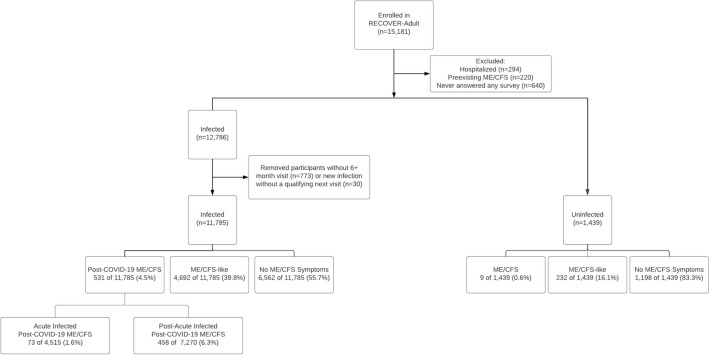
The RECOVER-Adult study included 15,181 people enrolled as (1) acute infected, enrolled within 30 days of infection; (2) post-acute infected, enrolled greater than 30 days after infection; or (3) uninfected. As SAR-CoV-2 infections continued to occur in study participants, participants who were initially enrolled as uninfected and then became infected during the study were reclassified as acute infected for post-infection visits (n=954) and were not included in the uninfected analyses. We excluded participants people who were hospitalized for COVID-19 (n=294), those who did not respond to the symptom questionnaires (n=640), any infected participant that did not undergo a study visit ≥6-month after incident SARS-CoV-2 infection (n=773), and those with pre-existing ME/CFS (n=198 infected, n=22 uninfected). The remaining 11,785 infected participants were assigned to three groups using the first qualifying visit at least 6 months from index infection: (1) post-COVID-19 ME/CFS participants, (2) ME/CFS-like participants, and (3) participants who did not report any ME/CFS symptoms.
The 1439 uninfected participants were classified to parallel the infected participant groups.
Exposure
The exposure was SARS-CoV-2 infection.
Data Source
Outcome measures were drawn from self-reported symptoms and comorbid medical conditions, as reported by participants at 3-month interval study visits.2 All data were ascertained from the September 2024 data lock.
Outcome
The primary outcome was new ME/CFS determined using the Institute of Medicine (IOM) ME/CFS clinical diagnostic criteria that require fatigue accompanied by physical impairment, PEM, unrefreshing sleep and either cognitive impairment or OI.4 The first symptom survey response at least 6 months, or later from first infection was used to group infected participants as post-COVID-19 ME/CFS and ME/CFS-like; for uninfected participants, we included symptoms from any survey response.
Questionnaires to Assess ME/CFS Symptoms
Patient-Reported Outcomes Measurement Information System (PROMIS) Global Health 10 was used to assess (1) severity of fatigue over the past 7 days and (2) physical impairment by inability to carry out daily physical activities. PROMIS Sleep Disturbance question "My sleep was refreshing" was used to assess the severity of unrefreshing sleep over the past 7 days; responses of "Not at all" or "A little bit" were considered moderate to severe unrefreshing sleep. Cognitive impairment was determined by having a self-reported Neuro-QoL cognition T-score of ≤40 (1 SD below national mean) or a raw Neuro-QoL score of <24.3,6 PEM and OI were assessed with a question asking if the participant had "post-exertional malaise (symptoms worse after even minor physical or mental effort)" (PEM) and "Feeling faint, dizzy, 'goofy'; difficulty thinking soon after standing up from a sitting or lying position" (OI), respectively. Responses that indicated the presence of PEM or OI included "Yes, I have it NOW," or "Yes, and I STILL HAVE IT." Frequency and severity measures were not available for these symptoms; thus, all positive symptoms were considered qualifying.
ME/CFS was defined as reporting moderate to very severe fatigue over the past 7 days plus moderate to complete interference with ability to carry out every day physical activities, AND presence of PEM, AND not at all or a little bit of refreshing sleep over the past 7 days PLUS the presence of OI and/or a Neuro-QoL cognitive T-score of <40 or raw score of <24. Those having at least one ME/CFS symptom but not meeting all the above criteria were considered ME/CFS-like.
The RECOVER case definition for PASC identified four clusters composed of 44 symptoms among those with PASC.3 Cluster 1 was characterized primarily by loss/change in smell or taste, and those participants had lowest symptom burden and quality of life impairment. Nearly all participants in cluster 2 had PEM (99%); half had dizziness and gastrointestinal symptoms; none had brain fog. Cluster 3 was defined by the presence of brain fog (100%) in addition to PEM (99%) and other symptoms. Cluster 4 participants had high levels of all symptoms, including PEM, dizziness, gastrointestinal symptoms, and brain fog, and overall had the worst quality of life. We determined which cluster post-COVID-19 ME/CFS and ME/CFS-like participants were assigned to in the study visit used for analysis.
Statistical Analysis
RECOVER-Adult data collected between October 2021 and September 2024, and stored on the RECOVER analytic platform, Seven Bridges, were used in this analysis. Analytic groups were created using the ME/CFS criteria. Chi-square tests were used to assess differences in demographics between analytic groups and the two-sample t-test to test whether age at enrollment differed among the infected and uninfected groups. Fisher's exact test was used to determine differences in comorbid conditions between infected and uninfected participants. All analyses were conducted by restricting infected participants to those enrolled within 30 days of the first infection and then repeated the analyses with all participants regardless of time from SARS-CoV2 infection.
| Infected groups (number (%)) | valueP | ||||
|---|---|---|---|---|---|
| Post-COVID-19 ME/CFS | ME/CFS-like | Never met criteria | Post-COVID-19 ME/CFS vs never | ME/CFS-like vs never | |
| Enrollment age | <0.001 | 0.076 | |||
| Median (IQR) | 48 (18) | 45 (24) | 43 (26) | ||
| N | 531 | 4692 | 6562 | ||
| Age category at enrollment (, %)n | <0.001 | <0.001 | |||
| 18–45 | 223 (42.0) | 2367 (50.5) | 3512 (53.5) | ||
| 46–65 | 275 (51.8) | 1757 (37.5) | 2080 (31.7) | ||
| >65 | 33 (6.1) | 566 (12.1) | 968 (14.8) | ||
| Missing (<18) | 0 (0) | 2 (0.04) | 2 (0.03) | ||
| Sex at birth | <0.001 | <0.001 | |||
| Female | 422 (79.5) | 3552 (75.7) | 4626 (70.5) | ||
| Intersex | 0 (0) | 1 (0.02) | 3 (0.05) | ||
| Male | 107 (20.2) | 1114 (23.8) | 1913 (29.2) | ||
| Missing | 2 (0.4) | 25 (0.5) | 20 (0.3) | ||
| Race | <0.001 | <0.001 | |||
| Asian, non-Hispanic | 15 (2.8) | 211 (4.5) | 464 (7.1) | ||
| Black, non-Hispanic | 45 (8.5) | 630 (13.4) | 941 (14.3) | ||
| Hispanic | 77 (14.5) | 673 (14.3) | 871 (13.3) | ||
| Multiracial/ethnic | 49 (9.2) | 402 (8.6) | 457 (7.0) | ||
| White, non-Hispanic | 328 (61.8) | 2646 (56.4) | 3661 (55.8) | ||
| Other | 15 (28) | 106 (2.3) | 144 (2.2) | ||
| Missing | 2 (0.4) | 24 (0.5) | 24 (0.4) | ||
| Vaccine at enrollment | <0.001 | 0.068 | |||
| Yes | 459 (86.4) | 4203 (89.6) | 5945 (90.6) | ||
| No | 58 (10.9) | 356 (7.6) | 440 (6.7) | ||
| Don't know | 0 (0) | 2 (0.04) | 4 (0.1) | ||
| Missing | 11 (2.1) | 107 (2.3) | 150 (2.3) | ||
| Prefer not to answer | 3 (0.6) | 24 (0.5) | 23 (0.4) | ||
| Education | <0.001 | <0.001 | |||
| Bachelors/advanced degree | 291 (54.8) | 2832 (60.4) | 4602 (70.1) | ||
| High school/some college | 217 (40.9) | 1659 (35.4) | 1716 (26.2) | ||
| Not complete high school | 15 (2.8) | 151 (3.2) | 186 (2.8) | ||
| Missing | 3 (0.6) | 30 (0.6) | 35 (0.5) | ||
| Prefer not to answer | 5 (1.0) | 20 (0.4) | 23 (0.4) | ||
| Rural | <0.001 | <0.001 | |||
| No | 493 (92.8) | 4421 (94.2) | 6324 (96.4) | ||
| Yes | 38 (7.2) | 271 (5.8) | 238 (3.6) | ||
| Medically underserved area | 0.616 | <0.001 | |||
| No | 407 (76.7) | 3384 (72.1) | 4966 (75.7) | ||
| Yes | 124 (23.4) | 1308 (27.9) | 1596 (24.3) | ||
| Uninfected groups (number (%)) | valueP | ||||
|---|---|---|---|---|---|
| ME/CFS | ME/CFS-like | Never met criteria | ME/CFS vs never | ME/CFS-like vs never | |
| Enrollment age | 0.758 | 0.653 | |||
| Median (IQR) | 44 (21) | 51 (27) | 49 (27) | ||
| N | 9 | 232 | 1198 | ||
| Age category at enrollment (, %)n | 0.826 | 0.882 | |||
| 18–45 | 5 (55.6) | 104 (44.8) | 554 (46.2) | ||
| 46–65 | 3 (33.3) | 89 (38.4) | 439 (36.6) | ||
| >65 | 1 (11.1) | 39 (16.8) | 205 (17.1) | ||
| Missing (<18) | 0 (0) | 0 (0) | 0 (0) | ||
| Sex at birth | <0.001 | 0.258 | |||
| Female | 4 (44.4) | 145 (62.5) | 815 (68.0) | ||
| Male | 4 (44.4) | 86 (37.1) | 378 (31.6) | ||
| Missing | 1 (1.1) | 1 (0.4) | 5 (0.4) | ||
| Race | 0.589 | 0.911 | |||
| Asian, non-Hispanic | 0 (0) | 15 (6.5) | 75 (6.3) | ||
| Black, non-Hispanic | 1 (11.1) | 46 (19.8) | 238 (19.8) | ||
| Hispanic | 0 (0) | 24 (10.3) | 109 (9.1) | ||
| Multiracial/ethnic | 0 (0) | 21 (19.1) | 88 (7.4) | ||
| White, non-Hispanic | 7 (77.8) | 121(52.2) | 657 (54.8) | ||
| Other | 0 (0) | 4 (1.7) | 26 (2.2) | ||
| Missing | 1 (1.1) | 1 (0.4) | 5 (0.4) | ||
| Vaccine at enrollment | 0.55 | 0.654 | |||
| Yes | 7 (77.8) | 208 (89.7) | 1,098 (91.7) | ||
| No | 0 (0) | 9 (3.9) | 56 (4.7) | ||
| Don't know | 0 (0) | 1 (0.4) | 0 (0) | ||
| Missing | 2 (22.2) | 13 (5.6) | 43 (3.6) | ||
| Prefer not to answer | 0 (0) | 1 (0.4) | 1 (0.1) | ||
| Education | 0.726 | <0.001 | |||
| Bachelors/advanced degree | 4 (44.4) | 123 (53.0) | 772 (64.4) | ||
| High school/some college | 3 (33.3) | 88 (37.9) | 372 (31.2) | ||
| Not complete high school | 0 (0) | 19 (8.2) | 47 (3.9) | ||
| Missing | 2 (22.2) | 1 (0.4) | 6 (0.5) | ||
| Prefer not to answer | 0 (0) | 1 (0.4) | 1 (0.1) | ||
| Rural | 0.515 | 0.203 | |||
| No | 9 (100.0) | 217 (93.5) | 1144 (95.5) | ||
| Yes | 0 (0) | 15 (6.5) | 54 (4.5) | ||
| Medically underserved area | 0.068 | 0.138 | |||
| No | 9 (100.0) | 158 (68.1) | 873 (732.9) | ||
| Yes | 0 (0) | 74 (31.9) | 325 (27.1) | ||
| Post-COVID-19 ME/CFS(=531)n | ME/CFS-like (=4692)n | Never Met Criteria (=6562)n | valueP | Infected(=11,785)n | Uninfected(=1439)n | valueP | |
|---|---|---|---|---|---|---|---|
| Anxiety, depression or PTSD | 68 (12.8%) | 891 (19%) | 908 (13.8%) | <.0001 | 1867 (15.8%) | 531 (36.9%) | <.0001 |
| Cardiovascular disease | 43 (8.1%) | 492 (10.5%) | 774 (11.8%) | 0.0063 | 1309 (11.1%) | 389 (27%) | <.0001 |
| Obesity | 52 (9.8%) | 659 (14%) | 831 (12.7%) | 0.0064 | 1542 (13.1%) | 351 (24.4%) | <.0001 |
| Asthma | 49 (9.2%) | 429 (9.1%) | 544 (8.3%) | 0.2428 | 1022 (8.7%) | 237 (16.5%) | <.0001 |
| Other mental health disorder | 21 (4%) | 215 (4.6%) | 175 (2.7%) | <.0001 | 411 (3.5%) | 233 (16.2%) | <.0001 |
| Rheumatologic, autoimmune or connective tissue disease | 32 (6%) | 262 (5.6%) | 309 (4.7%) | 0.0697 | 603 (5.1%) | 161 (11.2%) | <.0001 |
| Diabetes and specific type | 17 (3.2%) | 210 (4.5%) | 306 (4.7%) | 0.2932 | 533 (4.5%) | 140 (9.7%) | <.0001 |
| Immunocompromised condition | 23 (4.3%) | 139 (3%) | 185 (2.8%) | 0.1434 | 347 (2.9%) | 143 (9.9%) | <.0001 |
| Chronic pain syndrome or fibromyalgia | 37 (7%) | 169 (3.6%) | 76 (1.2%) | <.0001 | 282 (2.4%) | 102 (7.1%) | <.0001 |
| Neuromuscular disease | 16 (3.0%) | 125 (2.7%) | 79 (1.2%) | <.0001 | 220 (1.9%) | 85 (5.9%) | <.0001 |
| Other chronic lung disease | 10 (1.9%) | 58 (1.2%) | 61 (0.9%) | 0.0592 | 129 (1.1%) | 67 (4.7%) | <.0001 |
| Active cancer | 5 (0.9%) | 61 (1.3%) | 116 (1.8%) | 0.0823 | 182 (1.5%) | 61 (4.2%) | <.0001 |
| Schizophrenia or bipolar disorder | 9 (1.7%) | 75 (1.6%) | 61 (0.9%) | 0.0032 | 145 (1.2%) | 82 (5.7%) | <.0001 |
| Chronic obstructive pulmonary disease | 14 (2.6%) | 77 (1.6%) | 56 (0.9%) | <.0001 | 147 (1.3%) | 62 (4.3%) | <.0001 |
| Kidney disease | 4 (0.8%) | 84 (1.8%) | 92 (1.4%) | 0.0875 | 180 (1.5%) | 53 (3.7%) | <.0001 |
| Polycystic ovary disease | 5 (0.9%) | 99 (2.1%) | 126 (1.9%) | 0.1675 | 230 (2%) | 54 (3.8%) | <.0001 |
| Chronic liver disease | 6 (1.1%) | 38 (0.8%) | 51 (0.8%) | 0.6118 | 95 (0.8%) | 38 (2.6%) | <.0001 |
| Stroke or bleed | 9 (1.7%) | 40 (0.9%) | 55 (0.8%) | 0.1337 | 104 (0.9%) | 38 (2.6%) | <.0001 |
| Dementia or cognitive impairment | 9 (1.7%) | 62 (1.3%) | 35 (0.5%) | <.0001 | 106 (0.9%) | 32 (2.2%) | <.0001 |
| Movement disorder | 6 (1.1%) | 38 (0.8%) | 25 (0.4%) | 0.0021 | 69 (0.6%) | 29 (2.0%) | <.0001 |
| POTS, dysautonomia or autonomic dysfunction | 9 (1.7%) | 45 (1.0%) | 21 (0.3%) | <.0001 | 75 (0.6%) | 25 (1.7%) | <.0001 |
| Seizure disorder | 5 (0.9%) | 38 (0.8%) | 34 (0.5%) | 0.0908 | 77 (0.7%) | 16 (1.1%) | 0.0635 |
| Use of oxygen at home | 9 (1.7%) | 22 (0.5%) | 23 (0.4%) | 0.0011 | 54 (0.5%) | 22 (1.5%) | <.0001 |
| Sickle cell anemia | 2 (0.4%) | 9 (0.2%) | 7 (0.1%) | 0.1411 | 18 (0.2%) | 16 (1.1%) | <.0001 |
| CNS infection, inflammatory or demyelinating disease | 3 (0.6%) | 23 (0.5%) | 18 (0.3%) | 0.0974 | 44 (0.4%) | 10 (0.7%) | 0.0787 |
RESULTS
The 4515 acute infected participants provided the opportunity to estimate the incidence of new post-COVID-19 ME/CFS cases. The incidence rate of ME/CFS among acute infected participants was 2.66 (95% CI 2.63–2.70) per 100 person-years, which was significantly greater than the incidence rate in the propensity score-matched uninfected participants (0.93 per 100 person-years, 95% CI 0.91–0.95) (p<.0001). This is an attributable risk of 1.74 per 100 person-years with a significantly different incidence rate ratio test between SARS-CoV-2 infected and uninfected participants (p <.0001).8 Furthermore, the hazard ratio for developing ME/CFS in acute infected participants compared to uninfected participants was 4.93 (95% CI 3.62–6.71) (p<.005).
Compared to those never meeting ME/CFS criteria in the infected cohort, those with post-COVID-19 ME/CFS were more likely to be White, female, between 46 to 65 years of age, and live in a rural area, and less likely to have been vaccinated at enrollment and to have completed college (Table 1). Since there were only nine participants that met ME/CFS criteria in the uninfected cohort, the sample size was too small to compare to the other uninfected groups (Table 2).
Post-COVID-19 ME/CFS participants were more likely to report chronic pain syndrome or fibromyalgia, neuromuscular disease, chronic obstructive pulmonary disease, dementia or cognitive impairment, postural orthostatic tachycardia syndrome (POTS), dysautonomia or autonomic dysfunction, movement disorder, other mental health disorder, and use of oxygen at home compared to uninfected participants (Table 3). The remaining medical and psychiatric conditions occurred at similar or lower rates compared to those who did not meet ME/CFS criteria.

The ME/CFS clinical diagnostic criteria was applied to both infected and uninfected participants in the RECOVER Adult study group

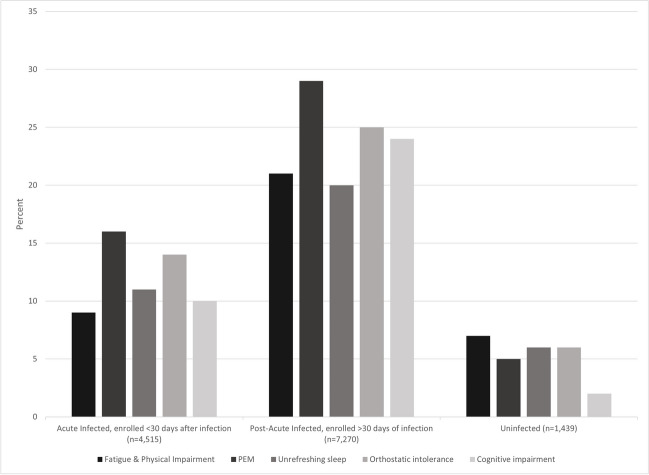
Percent of infected and uninfected participants with ME/CFS symptoms

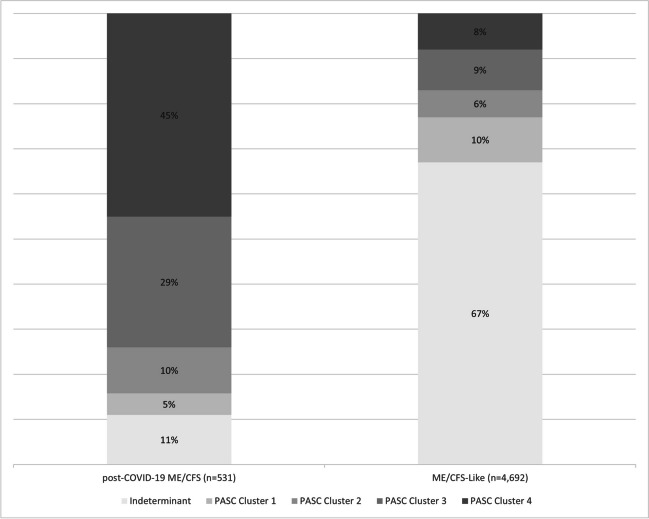
PASC cluster assignments at the first qualifying visit for post-COVID-19 ME/CFS and ME/CFS-like participants
DISCUSSION
Because ME/CFS can be a consequence of acute infection with viral and non-viral agents,1,9,10 we hypothesized it would be a sequela of SARS-CoV-2 infection. The prospective design of the RECOVER-Adult study provided the opportunity to estimate the incidence and prevalence of ME/CFS after infection with SARS-CoV-2. Of the 4515 participants that enrolled in RECOVER Adult within 30 days of their acute SARS-CoV-2 infection and were followed more than 6 months, 2.66 per 100 person-years vs. 0.93 per 100 person-years in matched uninfected participants met the IOM clinical diagnostic criteria for ME/CFS for an attributable risk of ME/CFS after SARS-CoV-2 exposure of approximately 1.74 per 100 person-years. A pre-COVID pandemic study conducted by the CDC estimated the incidence rate of ME/CFS at 0.18 per 100 person-years.11 This low incidence rate may reflect the focus on fatigue as the main outcome rather than the full constellation of ME/CFS symptoms. An electronic health record study found the incidence of post-COVID-19 chronic fatigue was 1.8 per 100 person-years.12 This is between the rate of ME/CFS we found in the acutely infected and uninfected cohorts and is likely an underestimate because the study relied on ICD coding and, prior to a 2023 update to ICD-10, there was not a specific code for ME/CFS.13 Our results provide evidence that the rate and risk of developing ME/CFS following SARS-CoV-2 infection is significantly increased and is supported by other studies that have implicated infectious agents such as Epstein Barr Virus and Ross River Virus and non-viral diseases such as Q fever and giardiasis in the etiology of ME/CFS.1,9,10
The 4.5% post-COVID-19 ME/CFS prevalence rate we found in the RECOVER-Adult study is similar to the 3–4% ME/CFS prevalence rate in people with acute infection-like illness suggestive of SARS-CoV-2 infection reported by the Innovative Support for Patients with SARS-CoV-2 Infections Registry (INSPIRE).14 However, these post-pandemic prevalence rates are in contrast to pre-pandemic ME/CFS prevalence estimates, which ranged from 0.2 to 1.0% of people in the U.S. and is in line with what we found in uninfected participants.15–17 The 2021–2022 wave of the National Health Interview Survey conducted during the pandemic found that 1.3% of adults reported being diagnosed with ME/CFS by a doctor, suggesting that post-COVID ME/CFS might already be increasing national prevalence rates.18 Our finding that 4.5% of infected RECOVER-Adult participants met criteria for ME/CFS based on IOM diagnostic criteria is higher than any pre-pandemic prevalence estimate. While this prevalence is confounded by individuals who enrolled up to 18 months after infection and may be differentially less likely to have fully recovered from COVID, when combined with our incidence estimates from those enrolled within 30 days of SARS-CoV2 infection these data provide further evidence of the post-infectious nature of ME/CFS and confirm that it is one of the diagnosable sequelae that occurs after SARS-CoV-2 infection.19
Detection and diagnosis of a true positive ME/CFS case is complicated as symptoms vary in frequency and severity over the course and duration of illness.20–22 Furthermore, the symptom(s) must be recognized as part of the ME/CFS manifestation. For example, PEM is the worsening of symptoms following physical or cognitive exertion and is an unusual phenomenon, particularly to people who are unfamiliar with the onset, experience, and triggers of exertional intolerance.23 PEM is the cardinal feature of ME/CFS. It is the exacerbation of ME/CFS signs and symptoms that can be triggered by daily activities such as showering, driving, reading, cleaning, cooking, or conversing.23,24 In this study, PEM was the most common symptom among acute and post-acute infected participants in RECOVER-Adult. PEM has also been identified as one of the most common and debilitating symptoms of long COVID in several studies.3,25–27
Cognitive impairment and OI symptoms fluctuate and are exacerbated by being in upright postures.28–30 They were the next most common symptoms in RECOVER-Adult study infected participants. While the mechanisms driving these symptoms are not known, there are pathophysiological findings in ME/CFS that help explain these symptoms. Structural, metabolic, and inflammatory abnormalities have been found in the brain of ME/CFS patients.31–33 Peripheral neurovascular dysregulation and reduced cerebral blood flow is characteristic of ME/CFS.34,35 There is immune dysfunction in both the innate and adaptive immune system in ME/CFS.36,37 Before the COVID-19 pandemic, ME/CFS was characterized as a multisystemic metabolic-inflammatory disorder showing altered bioenergetics associated with disease severity, physical exertion, and illness duration.38–53
Four PASC subgroups have been identified using cluster analysis in the RECOVER study.3 Cluster 1 symptoms include loss or change in smell and taste; cluster 2 includes PEM and fatigue; cluster 3 includes brain fog, PEM, and fatigue; and cluster 4 includes fatigue, PEM, dizziness, brain fog, gastrointestinal, and palpitations.3 Cluster 4 is the most symptomatic PASC subgroup with the highest frequency of ME/CFS defining symptoms. This study found that 90% of post-COVID-19 ME/CFS participants met PASC criteria and aligned with the cluster 4 PASC subgroup.3 This may indicate that post-COVID-19 ME/CFS represents a severely ill subset of PASC. A careful examination of the pathophysiology in both these groups and, as appropriate, modification, and updating of the ME/CFS diagnostic criteria should be considered.
There are limitations to this study that may have contributed to an overestimation of the number post-COVID-19 ME/CFS participants in RECOVER-Adult. We excluded people with a formal diagnosis of ME/CFS prior to infection but may have missed participants who both had pre-existing qualifying symptoms and were not previously diagnosed, mischaracterizing them as new. There may be recall bias where participants were uncertain whether they had symptoms before or only after infection. We included participants with pre-existing medical and psychiatric conditions that might cause ME/CFS-like symptoms, causing a misattribution of ME/CFS. Severity of PEM and OI were not assessed which might have allowed more participants to qualify. There may be a selection bias since with PASC may be more likely to enroll in RECOVER. These issues are mitigated by the enrollment of participants within 30 days of infection.
Conversely, there are also factors that might have contributed to an underestimation of participants with post-COVID-19 ME/CFS. Hospitalized RECOVER participants were excluded and therefore were not included in the prevalence and incidence estimate of post-COVID-19 ME/CFS. The waxing/waning nature of symptoms might have caused us to miss cases. The 2015 IOM ME/CFS diagnostic criteria mostly reflect severely ill ME/CFS of many years duration and may not be ideal for identifying short duration ME/CFS. Participants might not be familiar with the concept of PEM and may not have reported it. The most severely affected individuals may have been unable to enroll in RECOVER or to have been differentially lost to follow-up because of study burden. Participants were mostly enrolled in the Omicron era, limiting our ability to assess ME/CFS frequency after earlier, more severe variants. Most participants were vaccinated, so incidence and severity may be lower and less than in an unvaccinated population.
ME/CFS is a diagnosable sequela of SARS-CoV-2 infection. RECOVER provides the opportunity to identify objective biomarkers and to study the biology, mechanisms, and natural history of post-COVID-19 ME/CFS.
Supplementary Information
Below is the link to the electronic supplementary material. Supplementary file1 (DOCX 15 KB) Supplementary file2 (DOCX 16 KB) Supplementary file3 (DOCX 15 KB) Supplementary file 4 (xlsx 60.3 KB)