
Introduction
Psychedelics, derived from the Greek words "mind" and "manifesting," are hallucinogenic drugs that profoundly alter consciousness. The "classic" psychedelics are serotonergic substances that include lysergic acid diethylamide (LSD), psilocybin (the primary psychoactive ingredient in magic mushrooms), and N,N-dimethyltryptamine (DMT, the main psychoactive chemical in ayahuasca). Recently, the term "psychedelic" has been applied to other mind-expanding yet non-serotonergic drugs, including ketamine and 3,4-methylenedioxymethampetamine (MDMA, also known as ecstasy). For the sake of this paper, we will only consider the classic psychedelics.
Psychedelics have been utilised by early cultures for millennia within diverse sociocultural contexts, as well as spiritual and healing rituals [1 –3]. Recently, researchers have come to recognise that psychedelics may be effective tools in the treatment of psychiatric disorders such as depression [4, 5] and addiction [6]. It is worth noting that, in the contemporary era of psychedelic research, psychedelics are typically only administered as adjuncts to therapy (hence the phrase "psychedelic-assisted therapy"), which may confound the therapeutic effects of the drugs themselves [7].
The effects of psychedelic substances have been examined at several levels. Pharmacological research has measured their interaction with various receptors in the brain (e.g. [8, 9]), while other research domains have explored the subjective experience, or phenomenology, of a psychedelic 'trip'. Neuroimaging research has examined changes in brain activity and functional connectivity under the influence of psychedelics, yet there are still relatively few studies and a plethora of different analysis techniques. Here, we report the findings of three systematic meta-analyses focused on synthesising the evidence about three classical psychedelics: DMT, LSD, and psilocybin. The main aim is to analyse the literature across three levels of description: (1) phenomenology—to discuss key differences in the states of consciousness elicited by psychedelics; (2) functional neuroimaging—to compare the changes in brain activity, functional connectivity, and entropy that are induced by psychedelics; and (3) pharmacology—to discuss the binding affinities and functional activity of psychedelics with respect to various serotonergic and dopaminergic receptors.
Phenomenology
Psychedelics produce altered states of consciousness that are characterised by visual hallucinations; ego death, or a breakdown in one's sense of self; and spiritual or "mystical" experiences [10, 11]. The Altered States of Consciousness (ASC) scale is one popular questionnaire that captures several of these subjective effects. It measures these states along five different dimensions: oceanic boundlessness (e.g. a sense of interconnectedness), anxious ego dissolution, visionary restructuralisation (e.g. visual hallucinations), auditory alterations, and reduction of vigilance. Subsequent factor analyses led to the extraction of 11 lower-order dimensions from the 5D-ASC, resulting in the development of the 11D-ASC: experience of unity, spiritual experience, blissful state, insightfulness, disembodiment, impaired control and cognition, anxiety, elementary imagery, complex imagery, audio-visual synaesthesia, and changed meaning of percepts [12]. Because the ASC is the most common subjective questionnaire in the literature on the neuroimaging of psychedelics, we performed a meta-analysis on both the 5D- and 11D-ASC scores of DMT, LSD, and psilocybin.
However, the ASC is just one of many scales for rating the subjective effects of psychedelics. The multiplicity of scales makes it difficult to comprehensively evaluate the literature on the phenomenology of psychedelics. To date, only two studies have used a single set of scales to compare the subjective effects of LSD and psilocybin in the same group of participants [13, 14]. More recent research has attempted to draw direct comparisons by qualitatively examining larger datasets, such as the Erowid database of trip reports [15 –19]. The key findings from these comparative studies are discussed in Section S3.
Neuroimaging
The first functional magnetic resonance imaging (fMRI) study of psychedelics, published in 2012 [20], was an exploratory analysis of psilocybin-induced changes in cerebral blood flow and BOLD activity in healthy human participants. Since then, dozens of fMRI studies have been performed on human participants under the influence of ayahausca, LSD, psilocybin and DMT, including several studies on depressed patients [21 –26].
The fMRI studies assess three different metrics of brain activity: BOLD activation, connectivity, and entropy. Studies on BOLD activation analyse changes in the trajectory of BOLD timeseries with a rapidly-acting psychedelic, such as intravenously-administered psilocybin. Connectivity studies can examine undirected, instantaneous correlations between different regions (a type of functional connectivity) or model the experimental factors that modulate directed connections between regions, using dynamic causal modelling (a tool for measuring effective connectivity). The entropy of spontaneous brain activity is best assessed with MEG and EEG, but efforts to compute entropy on the spontaneous BOLD signal, as well as the entropy rate (Lempel-Ziv complexity) and indices of criticality, have also been attempted (see Section S1.2 for a full list of citations). While studies on BOLD activation and functional connectivity are common for most subject areas within cognitive neuroscience, entropy is a rather unique feature of the psychedelic neuroimaging literature. The studies on entropy were motivated by Robin Carhart-Harris' influential Entropic Brain Hypothesis (EBH) [27, 28], which states that psychedelics alter consciousness by elevating the entropy of spontaneous brain activity across time.
We performed a quantitative meta-analysis of the pairwise functional connectivity data using a novel algorithm. We initially attempted to conduct a quantitative meta-analysis of the BOLD activation data with the GingerALE method, which examines common clusters of BOLD activity across studies. However, we found that the data was too heterogeneous for the results to be valid. From the outset, we decided to provide a qualitative discussion of the studies on entropy, due to the wide range of methods in that section of the literature.
We chose to perform a meta-analysis exclusively on the fMRI data and not on any of the other modalities used to measure brain activity, such as PET, SPECT, MEG, and EEG. There were too few primary PET (4), SPECT (4), or MEG (2) datasets to merit a meta-analysis; by comparison, 30 fMRI studies have collected original data. While there are many more primary EEG datasets (25) from the post-1960s era (and even more from the 1950s to 1960s era) than PET, SPECT, or MEG, most of the EEG studies do not spatially localise the brain activity recorded at EEG electrodes. Without the raw data, which may be difficult to access when some of the studies are nearly 20 years old, we cannot source-localise the EEG activity ourselves. On the other hand, most fMRI studies report the spatial coordinates of the brain regions that become more or less active or connected on psychedelics. In general, EEG has higher temporal resolution than fMRI [29], so a future meta-analysis that focuses on the temporal, rather than spatial, characteristics of brain activity on psychedelics could consider the EEG rather than fMRI data.
Pharmacology
All classic psychedelics activate serotonin receptors. In particular, their interaction with the serotonin-2A (5-HT2A) receptor is their primary mechanism of action [30, 31]. Multiple studies have demonstrated that blocking the 5-HT2A receptor with antagonists such as ketanserin eliminates their subjective effects [32 –34]. 5-HT2A expression is profuse in human cortex, with one study finding highest expression in the posterior cingulate cortex and V1 [35]. In both humans and monkeys, 86-100% of glutamatergic cells in layers II–V of cortex express mRNA encoding 5-HT2A receptors [36]. 5-HT2A has also been identified in many subcortical regions [2], though human PET imaging implies lower expression than in the cortex [35].
Although the consciousness-altering effects of psychedelics do primarily arise from their action at the 5-HT2A receptor, different psychedelics display different binding profiles. For instance, unlike DMT and psilocybin, LSD has moderate affinity for dopamine receptors [37]. Differences in binding affinities could partially account for the distinctive phenomenology of each psychedelic. There is also some evidence that the 5-HT1A and 5-HT2C receptors may mediate the effects of psychedelics [38, 39].
However, binding affinity paints an incomplete picture of the pharmacology of psychedelics. Another key aspect is their functional activity at receptors. Serotonin and dopamine receptors tend to be G protein-coupled receptors (GPCRs) [40, 41], which perform essential roles in neurophysiological processes like smell, taste, light perception, and more [42]. GPCRs regulate these processes through G protein signalling pathways, which are initiated when agonists bind to GPCRs and activate G proteins [43]. Different families of G proteins are selective for particular signalling pathways [44]. In a phenomenon known as biased agonism, agonists can induce certain conformations in GPCRs, which then selectively activate certain pathways and not others [45]. 5-HT2 receptors couple preferentially to a family of G proteins known as Gαq/11, which activates the enzyme phospholipase C (PLC). This enzyme then catalyses the synthesis of the secondary messenger inositol triphosphate (IP3, a species of inositol phosphate [IP]), which subsequently leads to the release or "mobilisation" of calcium from the endoplasmic reticulum [31]. Psychedelics are also known to recruit β-arrestin proteins [46 –49]. These proteins block the interaction between G proteins and the GPCR and remove the GPCR from the cell membrane, while also coupling GPCRs to signalling proteins without activating G proteins; thus, β-arrestin promotes alternative signalling pathways [50]. Functional GPCR assays on psychedelics have tended to focus on the three aspects of GPCR signalling described above: (1) IP formation, (2) calcium mobilisation, and (3) β-arrestin (specifically β-arrestin2) recruitment.
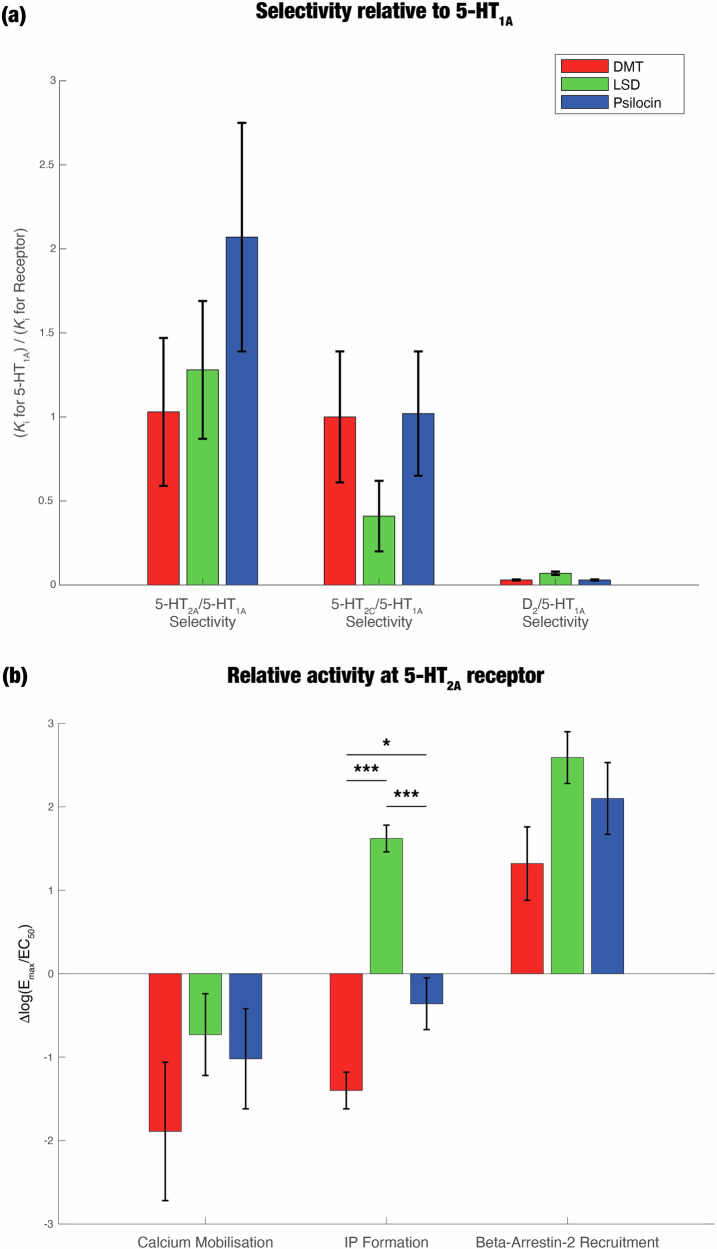
We performed a meta-analysis of the selective affinity of DMT, LSD, and psilocin for the 5-HT2A, 5-HT2C, and D2 receptors, relative to the 5-HT1A receptor. Additionally, we conducted a meta-analysis of their functional activity at the 5-HT2A receptor, as measured by the three aforementioned assays.
Results
We present the results of our meta-analysis of the phenomenology, neuroimaging, and pharmacology of three classical psychedelics: DMT, LSD, and psilocybin. At each level, we measured the alignment between the corresponding results and the Yeo networks, which facilitated comparisons between the three hierarchical levels.
Phenomenology
We performed a meta-analysis on the 5D- and 11D-ASC scores of DMT, LSD, and psilocybin. Our literature search identified n = 44 phenomenology studies that met the inclusion criteria, including 5 studies on DMT (5D-ASC: n = 3; 11D-ASC: n = 3), 14 studies on LSD (5D-ASC: n = 9; 11D-ASC: n = 12), and 25 studies on psilocybin (5D-ASC: n = 12; 11D-ASC: n = 17). The eleven dimensions of the 11D-ASC are subscales of three dimensions in the 5D-ASC: oceanic boundlessness (OB), anxious ego dissolution (AED), and visionary restructuralisation (VR). Nevertheless, the 11D-ASC questionnaire contains fewer items than the 5D-ASC questionnaire, so 5D-ASC data cannot be directly compared to 11D-ASC data. Hence, we ran separate meta-analyses for the 5D-ASC and 11D-ASC data. In order to account for the measurement of multiple subjective dimensions, sometimes with more than one dose or drug, in individual studies, we performed a multilevel random-effects meta-analysis.
DMT was administered intravenously (IV) in the phenomenological studies, whereas LSD and psilocybin were administered orally (we excluded phenomenological studies that used IV LSD and psilocybin). IV administration yields different pharmacokinetics, which are known to influence the subjective experience of the drug [51, 52]. Therefore, while we conducted meta-analyses of all three drugs, we only examined significant between-drug differences for ASC ratings of LSD and psilocybin. Additionally, we only compared similar doses of LSD and psilocybin. We assumed 20 mg psilocybin is equivalent to 0.01 mg LSD [14], and we defined low, medium, and high doses based on the literature [53 –55].
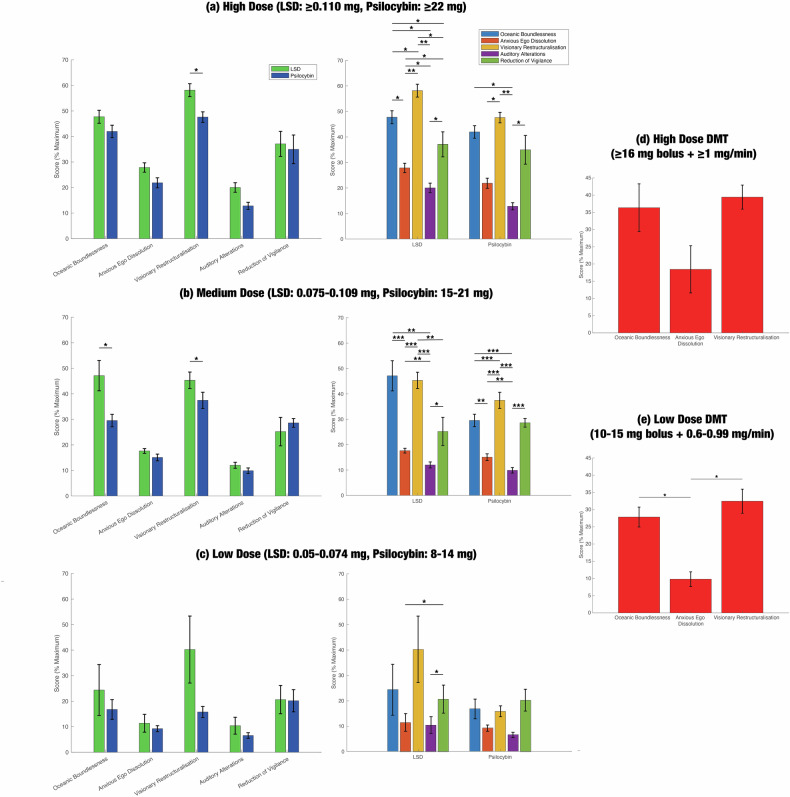
Within-drug differences between the five subjective dimensions were quite similar. A clear separation can be seen between two groups of subjective categories: (1) OB, VR, RV, and (2) AA and AED. At medium doses, VR and OB scores were significantly higher than both AED and AA scores for both LSD and psilocybin. For DMT, there were no significant differences between dimensions at high doses (≥16 mg bolus injection, followed by continuous infusion of 1 mg/min), but for low doses (10–15 mg bolus + 0.6–0.99 mg/min continuous infusion), AED ranked significantly lower than both OB and VR. (Note that only one study measured AA and RV scores for DMT [52], so we did not perform a meta-analysis on these dimensions for DMT.)
The results of the 11D-ASC meta-analysis were not very consistent with those of the 5D-ASC meta-analysis (Fig.; Table). Note that we could not include DMT in the 11D-ASC meta-analysis because two of the three studies on DMT did not report standard errors, which are necessary for pooling the subjective data. At high doses, there were no significant differences between LSD and psilocybin in any of the dimensions, and standard errors were very large for psilocybin in some dimensions, particularly in some OB and VR subscales. At medium doses, where standard errors tended to be lower, we observed that two of the OB subscales (experience of unity and insightfulness), one of the AED subscales (impaired control and cognition), and three of the VR subscales (complex imagery, audio-visual synaesthesia, and changed meaning of percepts) ranked significantly higher for LSD than psilocybin. In line with the 5D-ASC results, we did not find any significant differences between LSD and psilocybin at low doses. However, unlike the 5D-ASC analysis, the 11D-ASC analysis showed that psilocybin rated higher than LSD in most of the dimensions; that being said, standard errors were very high for both LSD and psilocybin, so our estimates are not reliable. For medium doses, within-drug comparisons for the 11D-ASC analysis generally aligned with those of the 5D-ASC analysis. S3 S2
We did not find any significant relationship between the pooled 5D-ASC scores and three methodological covariates that were defined a priori: prior psychedelic use, the time that the questionnaire was administered relative to the drug, and the presence or absence of a task in the experiment. Additionally, there was significant residual heterogeneity in the pooled 5D- and 11D-ASC scores (p < 0.0001 in both cases). Unfortunately, we were unable to obtain reliable estimates of heterogeneity specifically attributable to within-study and between-study differences. For three of the 5D-ASC scales, we found evidence of significant publication bias with Egger's regression test, which determines whether small studies report disproportionately high effect sizes (OB: p = 0.0187, AED: p < 0.0001, VR: p = 0.6279, AA: p < 0.0001, RV: p = 0.6532). The results of our risk-of-bias assessments for individual studies are shown in Table S3. Due to the moderate-to-serious risk of bias, significant residual heterogeneity, high probability of publication bias, and indirectness (some studies measured subjective effects while participants were performing a specific task, as opposed to during resting-state), our certainty in the body of phenomenological evidence is low.
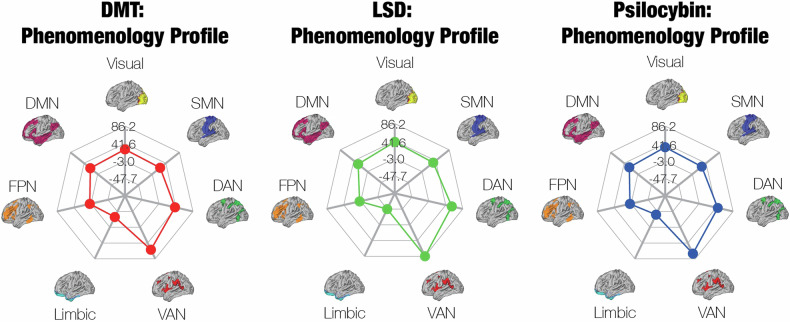
In order to directly compare the phenomenology of psychedelics to their neuroimaging and pharmacological profiles (Sectionand Section), we sought to determine the "phenomenology profiles" of DMT, LSD, and psilocybin based on the neural correlates of their subjective effects. We performed a separate literature search of studies that measured correlations between ASC ratings and fMRI activity. We determined the Yeo network that contained each brain region that exhibited a significant correlation. The phenomenology profiles were defined by a weighted combination of the mean correlations between each ASC scale and each Yeo network, in which the weights were the pooled ASC ratings of high doses of each psychedelic for the corresponding scale. 2.2 2.3
Finally, we also aimed to relate the phenomenology of different psychedelics by qualitatively synthesising the findings of papers that directly compared the subjective experiences of DMT/ayahuasca, LSD, and psilocybin. Sectioncontains a comprehensive summary of their major aims, analysis approaches and findings. S3
![Meta-analysis of the 5-Dimensional Altered States of Consciousness (5D-ASC) data reveals few significant differences between psychedelics, but many more significant differences within psychedelics. The 5D-ASC is one of the most common scales for assessing the subjective effects of psychedelics. It measures altered states of consciousness along five different dimensions: oceanic boundlessness (OB; a feeling of interconnectedness), anxious ego dissolution (AED), visionary restructuralisation (VR; the quality and intensity of visual hallucinations), auditory alterations (AA), and reduction of vigilance (RV). Our literature search identified 23 studies that reported 5D-ASC data. We performed a multilevel random-effects meta-analysis in order to account for the lack of statistical independence between measurements of different dimensions within the same group of participants. Within-study and between-study heterogeneity were estimated with the restricted maximum likelihood procedure. Using a Correlated and Hierarchical Effects model to account for within-study correlations in sampling error, we analysed the effect of dose and drug (DMT, LSD, or psilocybin) on pooled 5D-ASC scores. DMT was administered intravenously in phenomenological studies, whereas LSD and psilocybin were administered orally. Thus, DMT has different pharmacokinetics from LSD and psilocybin, which impacts the subjective experience, so we only compared significant between-drug differences for LSD and psilocybin. We only compared the two drugs for similar doses, assuming that 0.1 mg LSD = 20 mg psilocybin (Ley et al. []). (–, left column) Between-drug comparisons of pooled 5D-ASC scores for LSD and psilocybin. LSD almost always ranked higher than psilocybin, but differences only reached significance in the VR dimension for high and medium doses and in the OB dimension for medium dose. (–, right column) Within-drug comparisons for LSD and psilocybin. VR and OB received significantly higher scores than AED and AA, for both LSD and psilocybin. (,) Within-drug comparisons for DMT. At low doses, OB and VR ranked significantly higher than AED. Only one study measured ASC scores for the AA and RV dimensions on DMT, so we did not perform a meta-analysis on these dimensions for DMT. Numerical data for the above figure are given in Table. We also conducted a meta-analysis of the 11-dimensional ASC scale, which is also widely used in the literature; the results are displayed in Fig.and Table. * < 0.05, ** < 0.01, *** < 0.001. [14] S1 S3 S2 a c a c d e p p p](https://europepmc.org/articles/PMC11618481/bin/41398_2024_3187_Fig1_HTML.jpg "Click to view full size")
Meta-analysis of the 5-Dimensional Altered States of Consciousness (5D-ASC) data reveals few significant differences between psychedelics, but many more significant differences within psychedelics. The 5D-ASC is one of the most common scales for assessing the subjective effects of psychedelics. It measures altered states of consciousness along five different dimensions: oceanic boundlessness (OB; a feeling of interconnectedness), anxious ego dissolution (AED), visionary restructuralisation (VR; the quality and intensity of visual hallucinations), auditory alterations (AA), and reduction of vigilance (RV). Our literature search identified 23 studies that reported 5D-ASC data. We performed a multilevel random-effects meta-analysis in order to account for the lack of statistical independence between measurements of different dimensions within the same group of participants. Within-study and between-study heterogeneity were estimated with the restricted maximum likelihood procedure. Using a Correlated and Hierarchical Effects model to account for within-study correlations in sampling error, we analysed the effect of dose and drug (DMT, LSD, or psilocybin) on pooled 5D-ASC scores. DMT was administered intravenously in phenomenological studies, whereas LSD and psilocybin were administered orally. Thus, DMT has different pharmacokinetics from LSD and psilocybin, which impacts the subjective experience, so we only compared significant between-drug differences for LSD and psilocybin. We only compared the two drugs for similar doses, assuming that 0.1 mg LSD = 20 mg psilocybin (Ley et al. []). (–, left column) Between-drug comparisons of pooled 5D-ASC scores for LSD and psilocybin. LSD almost always ranked higher than psilocybin, but differences only reached significance in the VR dimension for high and medium doses and in the OB dimension for medium dose. (–, right column) Within-drug comparisons for LSD and psilocybin. VR and OB received significantly higher scores than AED and AA, for both LSD and psilocybin. (,) Within-drug comparisons for DMT. At low doses, OB and VR ranked significantly higher than AED. Only one study measured ASC scores for the AA and RV dimensions on DMT, so we did not perform a meta-analysis on these dimensions for DMT. Numerical data for the above figure are given in Table. We also conducted a meta-analysis of the 11-dimensional ASC scale, which is also widely used in the literature; the results are displayed in Fig.and Table. * < 0.05, ** < 0.01, *** < 0.001. [14] S1 S3 S2 a c a c d e p p p

Phenomenology profiles of the psychedelics demonstrate broad similarity between the neural correlates of their subjective effects. We identified 14 studies that measured correlations between ASC ratings and fMRI activity or pairwise connectivity, including three studies on ketamine. We determined the Yeo network that contained each brain region that exhibited a significant correlation, and then we averaged across the correlations associated with each Yeo network, resulting in the mean correlation between each Yeo network and each ASC scale. The phenomenology profiles were defined by a weighted combination of the mean correlations for each ASC scale, in which the weights were the pooled ASC ratings of high doses of each psychedelic for the corresponding scale. Because the pooled ASC ratings are similar across psychedelics, the phenomenology profiles are very alike one another as well. However, the lack of data on the neural correlates of the ASC ratings limits our confidence in the validity of these profiles.
Neuroimaging
As stated above, the fMRI studies on psychedelics measure three different characteristics of brain activity: BOLD activation, entropy, and connectivity. We identified n = 17 studies on BOLD activation, including n = 3 studies on ayahuasca or DMT, n = 7 studies on LSD, and n = 4 studies on psilocybin. Initially, we used the GingerALE method to determine common clusters of BOLD activation across studies. We observed that psilocybin was associated with a cluster of activity in visual cortices, whereas LSD tended to affect more frontal areas. However, three of the four studies on psilocybin displayed visual stimuli to participants. Therefore, our results were likely confounded by the tasks that were used in the literature. We chose not to report the results of our GingerALE analysis because they are likely misleading.
The n = 12 fMRI studies on entropy and criticality in the psychedelic literature are very heterogeneous, employing a wide variety of measures on dissimilar variables of interest. A quantitative meta-analysis was extremely challenging, so we opted instead to perform a qualitative review of this literature, which is reported in Section S4.
The studies on connectivity were the only segment of the fMRI literature for which we determined that we could conduct a valid meta-analysis. These studies tended to use the same resting-state experimental procedure, and many of them employed similar methods for measuring connectivity. However, one major obstacle was the variety of parcellations in the literature. Since each study defined regions of interest (ROIs) in a different way, it was not possible to simply perform a weighted average of connectivity values across studies. (This weighted average method is essentially the core technique of the phenomenology and pharmacology meta-analyses.) An alternative approach is to "re-reference" the data to a coarse-grained parcellation: the Yeo networks, of which there are only seven in the brain [56]. That is, for every pair of functionally connected ROIs in the literature, we determine the corresponding Yeo networks that contain them. If the connection is positive (it increases under psychedelics), then the aggregate FC between those Yeo networks is incremented; otherwise, it is decremented. Our method for weighting each connection in the literature is described in Section S2.2.2. We determined significance by repeatedly applying our method to an independent resting-state fMRI dataset of sober, healthy individuals [57], which resulted in a null distribution (Fig. S4).
This method is capable of synthesising studies on pairwise FC, such as seed-to-seed, seed-to-voxel, and within- and between-network FC analyses using independent components analysis (see Table S5 for a full description of the inputs). The algorithm cannot accommodate global, structural metrics of connectivity such as global brain connectivity (GBC) or graph-theoretic modularity. Additionally, the algorithm does not capture any information about the direction of connectivity between regions; therefore, we did not incorporate studies of effective connectivity or directed FC. (However, the vast majority of FC studies measured undirected FC.)
Many FC studies are secondary analyses of the same primary dataset. For instance, the primary FC data from Carhart-Harris et al. [58] was re-analysed at least seven times with different methods in subsequent studies. To mitigate bias, we only inputted the most informative analysis of each unique dataset into the meta-analysis algorithm, such that each dataset was only represented once in the meta-analysis. Our method for selecting the most informative analysis is described in Section S2.2.2.
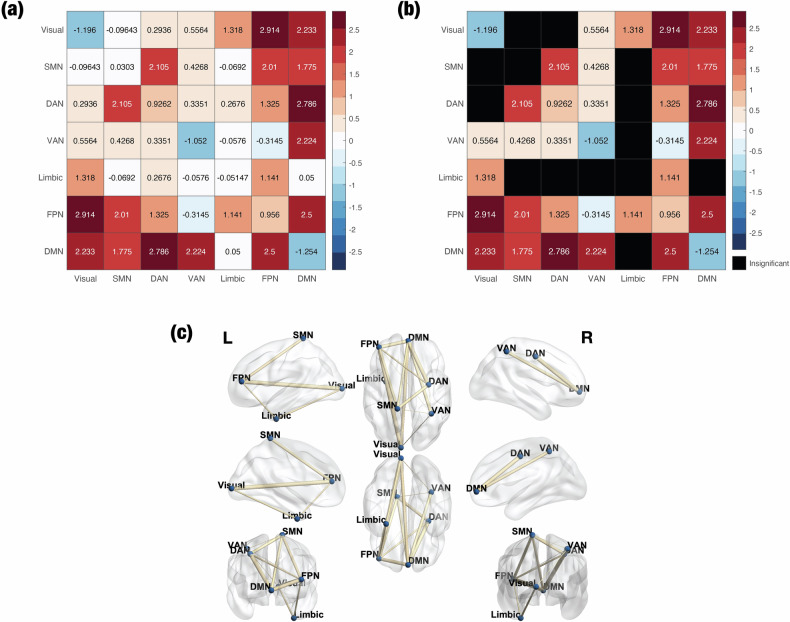
Figures–display the results of our meta-analysis on the FC of subcortical regions. Because several studies did not measure subcortical FC, most of the subcortical-to-subcortical and subcortical-to-cortical edges in the aggregate FC matrix are insignificant. Nevertheless, the significant edges indicate that psychedelics elevate connectivity from two regions in the subcortex – the anterior thalamus and cerebellum – to cortex, as well as from the anterior thalamus to some other subcortical structures. Compared to the other psychedelics, LSD vastly elevated the FC between the anterior thalamus and both the cortex and subcortex. S6 S8
Finally, there was no significant association between our results and any of the methodological covariates in the literature that we identified a priori: the width of the Gaussian kernel used to smooth the data, the use of FSL or SPM, the technique used to regress out white matter, the use of scrubbing to correct head motion, and route (oral or intravenous) and relative timing of drug administration. The results of our risk-of-bias assessment for individual studies are shown in Table. Because of the moderate-to-serious risk of bias, our certainty in the body of FC literature is low. S6
![Meta-analysis of the functional connectivity (FC) data indicates that psychedelics potently increase between-network FC. To perform a meta-analysis on the FC data, we determined the Yeo networks that contained each pair of functionally connected regions of interest (ROIs) in the literature and then performed a weighted sum of the number of significant connections between Yeo networks. We included = 12 studies in this meta-analysis, after excluding studies that did not measure pairwise FC and secondary analyses of identical datasets.The aggregate FC matrix shows the overall connectivity between pairs of Yeo networks.Several connections were deemed to be insignificant relative to a null distribution that was formed from an independent resting-state fMRI dataset collected by the Human Connectome Project.A rendering of () on the surface of the brain, created with the BrainNet Viewer []. n a b c b [141]](https://europepmc.org/articles/PMC11618481/bin/41398_2024_3187_Fig3_HTML.jpg "Click to view full size")
Meta-analysis of the functional connectivity (FC) data indicates that psychedelics potently increase between-network FC. To perform a meta-analysis on the FC data, we determined the Yeo networks that contained each pair of functionally connected regions of interest (ROIs) in the literature and then performed a weighted sum of the number of significant connections between Yeo networks. We included = 12 studies in this meta-analysis, after excluding studies that did not measure pairwise FC and secondary analyses of identical datasets.The aggregate FC matrix shows the overall connectivity between pairs of Yeo networks.Several connections were deemed to be insignificant relative to a null distribution that was formed from an independent resting-state fMRI dataset collected by the Human Connectome Project.A rendering of () on the surface of the brain, created with the BrainNet Viewer []. n a b c b [141]

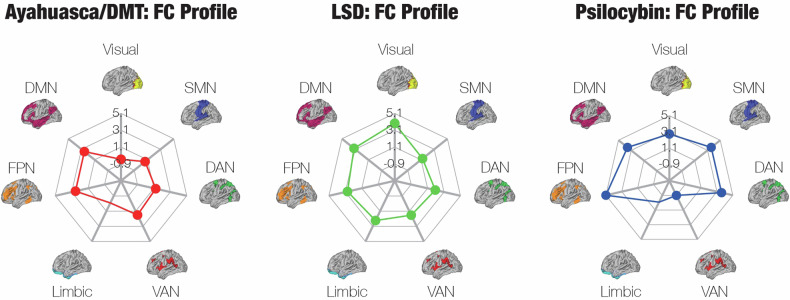
Functional connectivity (FC) profiles show unique FC patterns for each psychedelic. Out of the = 12 studies that we examined in our quantitative FC meta-analysis, = 3 were studies on ayahuasca/DMT (ayahuasca: = 2; DMT: = 1), = 3 on LSD, and = 6 on psilocybin. Each FC profile contains the total FC of each network, which was obtained by taking the sum of the rows of the corresponding aggregate FC matrices (Fig.). (The units of the profiles are arbitrary.) The psychedelics display distinct FC profiles; for instance, LSD strongly elevates the total FC of the limbic network, whereas FC between the limbic network and all other networks was insignificant for ayahuasca/DMT and psilocybin (hence there is no point on the limbic network for the respective spider plots). n n n n n n S5
Pharmacology
We performed two separate meta-analyses on the pharmacology of psychedelics. The first assessed the selective affinity of DMT, LSD, and psilocin for the 5-HT2A, 5-HT2C, and D2 receptors, relative to 5-HT1A, as well as selective affinity for the 5-HT1A, 5-HT2C, and D2 receptors, relative to 5-HT2A. The second examined the relative functional activity of the psychedelics at the 5-HT2A receptor, as captured in three different assays of GPCR signalling.
Affinity
We first present our meta-analysis of the selective affinity data. Selectivity is defined as the ratio between the Ki of each psychedelic for a receptor of interest, relative to a reference receptor. Ki refers to the inhibition constant, which reflects the concentration of a drug that is needed to inhibit the binding of another ligand, for instance a radioactively-labelled ligand (radioligand), to the receptor of interest; it is inversely related to binding affinity [64]. We initially chose 5-HT1A to be the reference receptor. We decided to analyse selectivity rather than absolute Ki because the latter is biased by the potency of the drug. Since LSD is much more potent than DMT and psilocin [65], the meta-analysis would have simply revealed that LSD has higher affinity for all receptors if we were to examine the absolute Ki instead.
We constructed another random-effects model in which the radioligand for the receptor of interest was included as a covariate; we refer to this as the "full" model and the previous one, in which the influence of the radioligand was not modelled, as the "reduced" model. For 5-HT2A, the use of the radioligands [3H]-ketanserin (p = 0.0141) and [3H]-spiperone (p = 0.0271) significantly influenced the pooled selectivity estimates. Use of [3H]-mesulgerine (p = 0.0292), but not [3H]-ketanserin (p = 0.0872), significantly affected our estimates of selectivity for 5-HT2C. According to the corrected Akaike's information criterion, the full model performed significantly better than the reduced model for 5-HT2A selectivity (p < 0.0001), whereas the reverse was true for 5-HT2C selectivity (p = 0.0024).
We assessed publication bias due to small study effects and found significant evidence for bias in the 5-HT2A (p = 0.0001) and 5-HT2C (p = 0.0004) affinity data. (There were not enough studies on D2 affinity to measure bias.) In Section S6.3, we qualitatively describe some major confounders in the affinity literature. Due to the large imprecision of the results and high probability of publication bias, our certainty in the body of evidence about selectivity is low.
However, when selectivity was measured relative to the 5-HT2A receptor, there were significant between-drug differences (Fig.S9; numerical results shown in Table S8). (Note that there were three additional studies, one for DMT and two for LSD.) In particular, DMT was significantly more selective for the 5-HT2C receptor than both LSD (p = 0.001) and psilocin (p = 0.0035). In addition, selectivity for the D2 receptor was significantly higher for DMT than for psilocin (p = 0.001). Heterogeneity was once again high for the 5-HT2C selectivity data (I2 = 98.56%) and for the 5-HT1A selectivity (I2 = 99.91%). Surprisingly, there was no evidence for small-study bias in either the 5-HT1A (p = 0.1683) or the 5-HT2C case (p = 0.3604).
![Pharmacology meta-analysis reveals that there are no significant differences in selectivity between psychedelics relative to 5-HTand that LSD induces significantly higher relative activity at the inositol phosphate (IP) formation pathway. 1A For both the selectivity and relative activity data, we created random-effects models that modelled between-study variance.Selectivity is the ratio between the binding affinity (measured as K) for a receptor of interest and the affinity for a reference receptor. We measured selectivity for three different receptors – 5-HT, 5-HT, and D– relative to 5-HT. Our literature search identified = 14 studies on selectivity, including = 6 studies on DMT, = 9 studies on LSD, and = 5 studies on psilocin. We did not find any significant between-drug differences in selectivity for any of the three receptors.Relative activity is a measure of the cellular signalling that is elicited when a drug binds to a receptor. It is calculated here as ∆log(E/EC), where Eis the maximal effect of the drug relative to a reference ligand and ECis the concentration needed to elicit 50% of the maximal effect []. We found = 18 studies on functional activity, including = 6 studies on DMT, = 13 studies on LSD, and = 6 studies on psilocin. We measured relative activity at three different signalling pathways: calcium mobilisation, IP formation, and β-arrestin2 recruitment. IP formation was the only pathway that exhibited any significant between-drug differences; LSD elicited significantly higher activity than both DMT and psilocin. * < 0.05, ** < 0.01, *** < 0.001. a b i 2A 2C 2 1A max 50 max 50 n n n n n n n n p p p [142]](https://europepmc.org/articles/PMC11618481/bin/41398_2024_3187_Fig5_HTML.jpg "Click to view full size")
Pharmacology meta-analysis reveals that there are no significant differences in selectivity between psychedelics relative to 5-HTand that LSD induces significantly higher relative activity at the inositol phosphate (IP) formation pathway. 1A For both the selectivity and relative activity data, we created random-effects models that modelled between-study variance.Selectivity is the ratio between the binding affinity (measured as K) for a receptor of interest and the affinity for a reference receptor. We measured selectivity for three different receptors – 5-HT, 5-HT, and D– relative to 5-HT. Our literature search identified = 14 studies on selectivity, including = 6 studies on DMT, = 9 studies on LSD, and = 5 studies on psilocin. We did not find any significant between-drug differences in selectivity for any of the three receptors.Relative activity is a measure of the cellular signalling that is elicited when a drug binds to a receptor. It is calculated here as ∆log(E/EC), where Eis the maximal effect of the drug relative to a reference ligand and ECis the concentration needed to elicit 50% of the maximal effect []. We found = 18 studies on functional activity, including = 6 studies on DMT, = 13 studies on LSD, and = 6 studies on psilocin. We measured relative activity at three different signalling pathways: calcium mobilisation, IP formation, and β-arrestin2 recruitment. IP formation was the only pathway that exhibited any significant between-drug differences; LSD elicited significantly higher activity than both DMT and psilocin. * < 0.05, ** < 0.01, *** < 0.001. a b i 2A 2C 2 1A max 50 max 50 n n n n n n n n p p p [142]
![Pharmacology profiles primarily reveal the distribution of 5-HTreceptors in the Yeo networks, as well as the (insignificantly) higher selectivity of psilocin for the 5-HTreceptor compared to DMT and LSD. 2A 2A Based on an available PET atlas of the 5-HTand Dreceptors [], we created the pharmacology profile of each psychedelic. The profiles show the expression of those two receptors in the Yeo networks, weighted by the selectivity of the corresponding psychedelics for those receptors. Because the selectivity for 5-HTis two orders of magnitude higher than the selectivity for D, the profiles are dominated by 5-HTreceptor expression. Since psilocin has the most selectivity for 5-HT(relative to 5-HT), followed by LSD then DMT, psilocin's pharmacology profile is the "largest.". 2A 2 2A 2 2A 2A 1A [66]](https://europepmc.org/articles/PMC11618481/bin/41398_2024_3187_Fig6_HTML.jpg "Click to view full size")
Pharmacology profiles primarily reveal the distribution of 5-HTreceptors in the Yeo networks, as well as the (insignificantly) higher selectivity of psilocin for the 5-HTreceptor compared to DMT and LSD. 2A 2A Based on an available PET atlas of the 5-HTand Dreceptors [], we created the pharmacology profile of each psychedelic. The profiles show the expression of those two receptors in the Yeo networks, weighted by the selectivity of the corresponding psychedelics for those receptors. Because the selectivity for 5-HTis two orders of magnitude higher than the selectivity for D, the profiles are dominated by 5-HTreceptor expression. Since psilocin has the most selectivity for 5-HT(relative to 5-HT), followed by LSD then DMT, psilocin's pharmacology profile is the "largest.". 2A 2 2A 2 2A 2A 1A [66]
Functional activity
Binding affinity is only one facet of the pharmacology of psychedelics. Another key aspect is their functional activity: the responses that they elicit in receptors after binding to them. While there are many ways to measure functional activity, we focused on GPCR signalling through three different pathways: (1) IP formation, (2) calcium mobilisation, and (3) β-arrestin2 recruitment. We limited our analysis to functional activity at specifically the 5-HT2A receptor, as there was much more data about this receptor in humans. The variable of interest in our analysis was ∆log(Emax/EC50).
We found n = 18 relevant studies on functional activity, including n = 6 studies on DMT, n = 13 studies on LSD, and n = 6 studies on psilocin. We performed a random-effects meta-analysis. For the IP formation and calcium mobilisation assays, the reference ligand was serotonin; for the β-arrestin2 recruitment assays, the reference ligand was chosen to be mescaline, as this was the only reference ligand used in experiments on all three psychedelics. The pooled relative activity values indicate that LSD induces significantly more IP formation than DMT (p < 0.0001) and psilocin (p = 0.0002) (Fig. 5b; numerical data given in Table S8). Additionally, DMT elicits significantly more IP formation than psilocin (p = 0.0203). There were no significant between-drug differences for the other two pathways. Heterogeneity was very high for all three pathways (IP formation: I2 = 95.35%, calcium mobilisation: I2 = 92.66%, β-arrestin2 recruitment: I2 = 91.05%). There was no significant publication bias due to small study effects for the literature on IP formation (p = 0.3460). (There were too few studies on the other pathways to assess publication bias.) Because of the large standard errors of the pooled estimates and high unexplained heterogeneity, our certainty in the body of evidence about functional activity is low, despite the lack of evidence for publication bias.
Discussion
Here we examine the effects of psychedelics at three levels: (1) subjective experience (phenomenology), (2) functional connectivity (neuroimaging), and (3) the interaction of psychedelics with serotonin and dopamine receptors (pharmacology). At each level, we performed a quantitative meta-analysis and computed the alignment between the results and the seven Yeo networks. The latter network analysis enabled us to directly compare the effects of three psychedelics – ayahuasca/DMT, LSD, and psilocybin – within and between levels.
Unifying the levels of analysis
For the phenomenology literature, we conducted a meta-analysis of both the 5-dimensional and 11-dimensional versions of the Altered States of Consciousness (ASC) scale, a common questionnaire for measuring changes in subjective experience on psychedelics. At both medium and high doses, LSD ranked significantly higher than psilocybin in "visionary restructuralisation," a dimension capturing the quality and intensity of visual hallucinations. Additionally, at medium doses, LSD was associated with significantly higher scores in the "oceanic boundlessness" dimension, which captures feelings of interconnectedness.
The whole-brain neuroimaging data consisted of three subsets of data: BOLD activation, entropy, and FC. We did not report a meta-analysis of the BOLD activation or entropy literature due to the heterogeneity of experimental procedures and analysis methods, respectively; however, we did conduct a qualitative review of the entropy literature (Section). To perform a meta-analysis on the FC data, we essentially re-parcellated the published data into the Yeo networks and then calculated a weighted sum of the connections between Yeo networks. LSD strongly elevated FC between the visual network and the other networks, whereas ayahuasca/DMT increased FC most between transmodal networks (specifically, the FPN and DMN) and other networks. S4
For pharmacology, we conducted two meta-analyses: one of selectivity and another of relative functional activity. There were no significant differences between psychedelics in selectivity for the 5-HT2A, 5-HT2C, or D2 receptors relative to the 5-HT1A receptor. Compared to both DMT and psilocin, LSD elicited significantly more relative activity in IP formation assays. We did not observe any significant between-drug differences for the calcium mobilisation and β-arrestin2 recruitment assays.
On a superficial level, there do appear to be some direct correspondences between the phenomenology, neuroimaging, and pharmacology. Phenomenologically, we only found one significant difference between psychedelics that was consistent across medium and high doses: LSD induces more visionary restructuralisation than psilocybin does. Neurobiologically, LSD enhanced connectivity between the visual network and all other networks more than the other psychedelics.
The relationship between the pharmacology results and the above findings is more difficult to establish. Our results show that LSD increases IP formation, whereas DMT and psilocin decrease it. IP formation occurs whenever Gαq proteins are recruited to initiate cellular signalling. Furthermore, there is evidence that Gαq activation is necessary for 5-HT2A agonists to bring about hallucinogenic effects. When administered the psychedelic (±)1-(2,5-dimethoxy-4-iodophenyl)-2-aminopropane (DOI), mice that lack the gene for Gαq proteins do not exhibit behaviours (head twitches) that typically indicate hallucinations [68]. More recently, activation of Gαq pathways by 5-HT2A agonists has been shown to predict head-twitch behaviour, whereas 5-HT2A agonists that are biased for the β-arrestin2 pathway do not induce head twitches [69]. There appears to be a threshold level of Gαq activation that must be surpassed in order for a 5-HT2A agonist to induce hallucinogenic effects [69]. Intriguingly, the pro-psychotic properties of drugs can be predicted from the extent to which they increase Gαq activation (relative to a different G-protein pathway) when these drugs interact with a complex formed between the 5-HT2A receptor and a metabotropic glutamate receptor [70]. In other words, the more that a drug upsets the normal balance of Gαq signalling, the more likely it is to engender hallucinations. However, these studies only establish the presence of hallucinations elicited by Gαq signalling. They do not indicate whether Gαq signalling induces visual hallucinations in particular. Thus, based on the available evidence, we cannot yet conclude that the pharmacology, neuroimaging, and phenomenology literature all convergently indicate that LSD has a uniquely strong effect on visual awareness, compared to the other psychedelics.
There do not appear to be any tools at the moment for relating the pharmacology of drugs to the precise nature of the subjective experiences that they produce. Methods for examining the relationship between neuroimaging and phenomenology are currently limited to correlations and linear regressions [58, 71], which do not capture causality. There is a need to develop techniques for elucidating the causal relationships between phenomenology, neuroimaging, and pharmacology.

Our multi-level analysis of psychedelic effects highlights the nonlinear relationship between their pharmacology, neuroimaging, and phenomenology. The effects of psychedelics form a tripartite hierarchy, consisting of subjective experience (, phenomenology), functional connectivity (, neuroimaging), and their selective affinity for receptors (, pharmacology). Here, we show the neural correlates of each level of the hierarchy in the seven Yeo networks. In brief, each profile was derived from () neural correlates of the subjective dimensions of the ASC scale, () summing the aggregate FC between each network and other networks, and () the distribution of each receptor, weighted by each psychedelic's selectivity for that receptor. Clearly, there is a very weak correspondence between the different levels of the hierarchy, revealing the highly non-linear relationship between phenomenology, neuroimaging, and pharmacology. Note: we analysed data on both DMT and ayahuasca in our FC meta-analysis, but only on DMT for the other meta-analyses. We examined data on psilocin in our pharmacology meta-analysis and on psilocybin in both of the other meta-analyses. a b c a b c
Relating the results of the meta-analysis to the literature
Phenomenology
We sought to verify the results of our phenomenology meta-analysis by comparing them to the two experimental studies that measured ASC ratings of LSD and psilocybin in the same group of participants. Holze et al. [13] gave a medium (15 mg) and a high (30 mg) dose of psilocybin, as well as a medium (0.01 mg) and a high (0.02 mg) dose of LSD, and then compared both 5D- and 11D-ASC scores. It is worth noting that the doses of psilocybin and LSD in this study are not equivalent, since 0.01 mg LSD = 20 mg psilocybin [14]. When comparing 15 mg psilocybin to 0.01 mg LSD, mean 5D-ASC and 11D-ASC scores tended to be higher for LSD than psilocybin. However, the only differences that reached significance were in the OB and VR scales for the 5D-ASC analysis, and in the complex imagery and audio-visual synaesthesia subscales for the 11D-ASC analysis. In our meta-analysis, LSD and psilocybin were significantly different in both OB and VR ratings, as well as in complex imagery and audio-visual synaesthesia ratings, at medium doses. Ley et al. [14] compared the subjective effects of medium doses of LSD (0.01 mg) and psilocybin (20 mg). Here, the doses are equivalent, unlike in the previous study. The study found no significant differences between LSD and psilocybin in any of the dimensions, both in the 5D and 11D analyses. Therefore, the results of our meta-analysis are not entirely supported by studies that conducted direct comparisons between psychedelics.
Neuroimaging
One major finding in the neuroimaging literature is that psychedelics desegregate and disintegrate brain networks. Segregation is defined as the lack of FC between brain regions, while integration denotes FC within a network. Carhart-Harris et al. [58] found that LSD led to disintegration and desegregation for most RSNs. This finding has been independently confirmed in several other studies [72 –78]. In a review of three studies, Müller, Liechti, et al. [79] found good convergence in reports of desegregation. A recent study, which was published after our meta-analysis was completed, utilised a novel logitudinal precision functional mapping approach, in which participants were scanned 18 times before, during, and after psilocybin administration [80]. It also reported massive decreases in anticorrelations between networks (desegregation), as well as in correlations within networks (disintegration).
Our meta-analysis corroborates the desegregation hypothesis and provides mixed support for the disintegration hypothesis. Psychedelics significantly elevated FC between all non-identical pairs of brain networks except the FPN and VAN. Within-network FC significantly decreased for the visual network, VAN, and DMN, yet it significantly increased for the DAN and FPN. The reduction in within-VAN FC and amplification of within-DAN FC may be consistent with the behavioural neurophysiology and phenomenology of psychedelics, respectively. Broadly speaking, the VAN redirects attention to salient stimuli, whereas the DAN is responsible for sustaining attention [81]. In agreement with the VAN FC results, there is some evidence, albeit mixed, that psychedelics reduce mismatch negativity, or the brain's response to surprising stimuli [82 –84], though the MMN is primarily generated by regions outside the VAN [85]. Whereas closed-eyes mental imagery tends to be very fleeting when people are sober, it is often much more stable and vivid on psychedelics [12, 86, 87]. We speculate that this increase in stability could be attributed to a vast enhancement of the ability to freely allocate attentional resources on psychedelics, as has been proposed in the past [88]. That is, external stimuli typically demand attention, which limits the brain's capacity to freely allocate attention to spontaneously generated, closed-eyes mental imagery. Psychedelics may reduce the competition between external stimuli and closed-eyes mental imagery for sustained attention, which could explain an increase in the within-network FC of the DAN. Intriguingly, ayahuasca and DMT are the only psychedelics to reduce FC between the visual network and the DAN. This could be consistent with the fact that only ayahuasca and DMT appear to give rise to open-eye "breakthrough" experiences, which feature extraordinarily rich and realistic visual hallucinations [87]. Indeed, the loss of connectivity from the visual network, and consequently of visual input from the environment, may make it possible to sustain attention on complex visual hallucinations even while the eyes are open.
Meanwhile, increases in connectivity within the FPN could account for the therapeutic effects of psychedelics. The FPN is a network that initiates and flexibly adjusts cognitive control in response to feedback from the environment [89]. Depression compromises executive control and cognitive flexibility [90, 91]; hence, it reduces FC within the FPN [92, 93]. Psilocybin has shown promise for treating depression [94 –98], and while this meta-analysis was only conducted on data from healthy participants, our finding that psychedelics elevate within-FPN FC may still be able to explain their antidepressant effects.
The significant increases in within-FPN and within-DAN FC indicate that the effects of psychedelics on within-network FC are more nuanced than total disintegration across the whole brain. Furthermore, the explanatory power of desegregation and disintegration remains unclear. While there is a correlation between desegregation/disintegration and the subjective experience of ego dissolution [99], there is no evidence for a causal link. There appear to be parallels between the conscious experience of interconnectedness and the "interconnectedness" of the brain on psychedelics, but further research is needed to demonstrate that the connection between the two is more than merely semantic.
Another common finding in the literature is that psychedelics decrease activity and connectivity within the DMN, a network that is generally implicated in self-awareness, self-reflection, and other self-referential cognitive processes [100 –103]. This popular 'meme' likely has its origin in the first resting-state fMRI study of a psychedelic, where decreased blood flow and BOLD signal were observed in a pattern of regions resembling the DMN [20]. Eleven years later, evidence continues to indicate that psychedelics potently affect the regularity of population brain activity in DMN regions [104]. Since a commonly reported experience on psychedelics is the dissolution of the self, a phenomenon known as "ego death" [105 –107], it would superficially make sense that psychedelics dysregulate the DMN. Many studies have found significant correlations between subjective ratings of ego dissolution and DMN disintegration [63, 76, 78, 99, 108 –113], though other analyses did not find evidence for a relationship between the two [75, 77].
However, claims of "de-activation" or worse, "shutting-off" of the DMN as signatures of psychedelic action are wrong and misleading. Other neuroimaging studies by Carhart-Harris et al. [58, 114] and Roseman et al. [78] discovered that psychedelics affect the connectivity of the DMN, decreasing within-DMN FC ("disintegration") while increasing DMN coupling with other resting-state networks (RSNs) ("desegregation"). Our neuroimaging meta-analysis confirms that psychedelics significantly decrease connectivity within the DMN while significantly elevating its connectivity with all other networks. Furthermore, the reduction in within-network FC was greater for the DMN than for any other network, though it was not that much larger than that of the visual network. Although we found that LSD increased within-DMN FC, this result is likely attributable to connectivity between regions that are not key hubs of the DMN. Our phenomenology meta-analysis revealed that all psychedelics induced positive experiences of depersonalisation and derealisation, as captured by the oceanic boundlessness dimension of the 5D-ASC scale; these experiences are related to the feeling of ego death.
Nevertheless, there are many cases in which within-DMN connectivity may decrease without giving rise to the subjective effects that characterise psychedelics. Several other drugs such as amphetamines and alcohol, as well as drug addiction in general, reduce within-DMN connectivity in humans [115 –117], even though they typically do not lead to ego dissolution [118]. Certain psychological states that exacerbate self-rumination, such as maladaptive self-focused attention, are not associated with hyperconnectivity in the DMN [119], and one study found that some tasks requiring self-related judgments were associated with a suppression of within-DMN connectivity [120]. That being said, a recent meta-analysis of 14 studies did endorse an association between rumination and the DMN [121].
Finally, it is worth noting that a recent systematic review of the neuroimaging literature on psychedelics concluded that it was not possible to perform a meta-analysis due to the heterogeneity of the studies, as well as other methodological concerns [122]. Overall, we agree that it is challenging to perform a standard meta-analysis on the psychedelic neuroimaging literature. However, several steps were taken in our analysis to overcome the concerns that Linguiti and colleagues raised. Unlike Linguiti and colleagues, we separated studies on functional connectivity from studies on entropy and BOLD activation. As stated above, the BOLD activation studies subjected participants to such a wide variety of tasks that it was impossible to conduct a meta-analysis on this segment of the literature. However, almost all of the functional connectivity studies that we included in our meta-analysis conducted resting-state recordings. Linguiti and colleagues correctly note that, even among the resting-state recordings, there experimental procedures and analysis methods are very heterogeneous. We ran subgroup analyses to confirm that these covariates, such as route of administration (oral or intravenous), timing of drug administration relative to the duration of the drug's acute effects, and various preprocessing techniques, did not impact the results of our meta-analysis. Linguiti and colleagues also observed that there is a high sample overlap in the published neuroimaging studies; that is, there are many studies that reused or re-analysed data from previously published research. In our meta-analysis, we ensured that we included only one analysis of each unique dataset in the literature. Because of this and other exclusion criteria, we entered data from only 12 studies into our quantitative meta-analysis, whereas Linguiti and colleagues included 91 studies. We do agree with Linguiti and colleagues that at least one of our included studies failed to adequately control for Type I error [123] and that at least another one did not sufficiently report head motion correction [124]. Nevertheless, overall, we believe that there is enough consistency among some studies in the neuroimaging literature to conduct a meaningful meta-analysis.
Pharmacology
The results of our affinity meta-analysis aligned well with studies that performed direct comparisons of selectivity between different psychedelics [65, 125 –128]. In line with our findings, all of these studies showed that LSD is more selective than DMT for 5-HT2A, relative to 5-HT1A. Two studies also observed that psilocin is more selective than LSD for 5-HT2A [65, 127]. Our meta-analysis demonstrated that DMT is more selective than LSD for 5-HT2C, a conclusion that is supported by three of four studies [125 –127]. Note that none of these studies measured the statistical significance of between-drug differences in selectivity.
Our findings about functional activity were also congruent with studies that measured the effect of multiple psychedelics on IP formation at the 5-HT2A receptor [125 –127, 129]. We found that LSD's relative activity at this pathway was significantly greater than that of psilocin, which was in turn significantly larger than that of DMT. All four studies showed that LSD had higher relative activity at this pathway than DMT. Two studies also reported that psilocin's relative activity was lower than that of LSD, but larger than that of DMT [127, 129].
Recommendations for future research
We encourage researchers to develop tools for modelling the nonlinear relationships between the pharmacology, neuroimaging, and phenomenology of psychedelics, the three hierarchical levels of analysis that are at the heart of this meta-analysis. While some researchers have attempted to examine the associations between each level [15, 130], their techniques are model-free and only measure correlations between the effects of psychedelics, rather than elucidating the causal mechanisms that underpin them.
Recent whole-brain models have made significant advances in discovering these causal mechanisms (see [131] for a general review). Whole-brain models consist of nodes that approximate local or mesoscopic neuronal dynamics through mean field models of coupled excitatory-inhibitory interactions [132, 133] or Hopf models of bifurcations into and out of sustained oscillatory activity [134, 135]. Crucially, whole-brain models have enabled researchers to identify the specific regions that should be stimulated in order to force transitions between different states of consciousness, such as from sleep to wakefulness [136]. Whole-brain models have also been applied to psychedelics; in particular, the 5-HT2A receptor density in each area of the brain was used to fit a mean field model of fMRI data on LSD, capturing the nonlinear interactions between connectivity and the distribution of 5-HT2A receptors [137]. This model was recently extended to determine the associations between global brain connectivity on LSD and categories of subjective experience [71]. The model has also been applied to the relationship between neurotransmitters (namely, serotonin) and neuronal regions on psilocybin; in particular, Kringelbach et al. [67] coupled a mean field model of each neuronal region to the release-and-reuptake dynamics of serotonin concentration. Importantly, this coupled neuronal-neurotransmitter model exhibited a better fit to the empirical FC than a model of solely the neuronal activity. Overall, whole-brain models display great promise for linking neurotransmitter release, which is partly determined by pharmacology, to the brain regions that causally mediate, rather than merely correlate with, the effects of psychedelics. Most recently, whole-brain models have also been combined with another cutting-edge method, turbulence, to determine the susceptibility of the brain to external stimuli under psychedelics [138].
This meta-analysis was only performed on data from healthy participants, yet there is emerging research on the neuroimaging and phenomenology of psychedelics in clinical populations [21, 23, 139]. Future models that bridge the three levels of analysis should also be applied to the clinical data in order to shed light on the therapeutic mechanisms of psychedelics. It is essential to determine whether these models would be able to predict clinical outcomes. Recent research has succeeded in predicting treatment response to psilocybin for depression based on changes in the functional hierarchy of the brain [140]. These methods may be even more effective if they incorporated data on phenomenology and pharmacology. However, as mentioned in the Introduction, psychedelic treatments are always administered in conjunction with therapy or some form of "psychological support," which the models must also take into account.
Conclusion
This is the first meta-analysis of the literature on the phenomenology, neuroimaging, and pharmacology of psychedelics. We assess and compare these three hierarchical levels of analysis across three different classical psychedelics: DMT, LSD, and psilocybin. Thus, we performed comparisons not only between psychedelics, but also between the levels of the hierarchy.
We found that the different levels of the hierarchy exhibited a weak one-to-one correspondence with one another. This is not surprising, as the interactions between phenomenology, neuroimaging, and pharmacology are highly non-linear and complex. We encourage future research to develop tools for modelling these relationships in order to improve our scientific understanding of psychedelics.
Supplementary information
Supplementary Materials