
What this is
- This analysis examines the effects of tirzepatide on patients with obesity-related ().
- Participants were randomized to receive either tirzepatide or placebo, focusing on circulatory overload and end-organ damage.
- Key findings indicate that tirzepatide reduced blood pressure, blood volume, and markers of inflammation, suggesting mechanisms for its clinical benefits.
Essence
- Tirzepatide treatment significantly reduced blood pressure and estimated blood volume in patients with obesity-related , while also decreasing systemic inflammation and markers of cardiac injury. These changes suggest potential mechanisms for improved cardiovascular and kidney outcomes.
Key takeaways
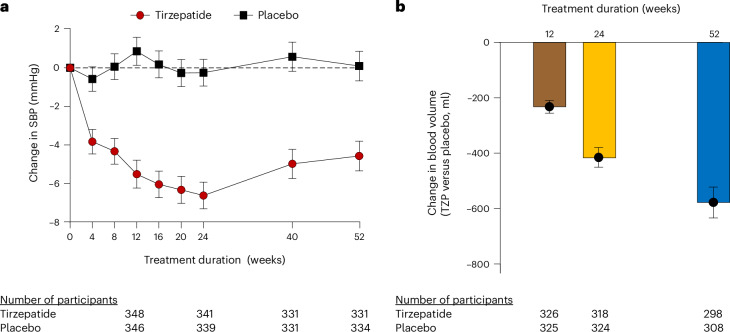
- Tirzepatide led to a reduction in systolic blood pressure by an estimated treatment difference of -5 mmHg compared to placebo. This reduction may alleviate circulatory overload in patients.
- Estimated blood volume decreased by 0.58 liters with tirzepatide, indicating a significant reduction in circulatory overload. This change correlates with improvements in kidney function and symptom severity.
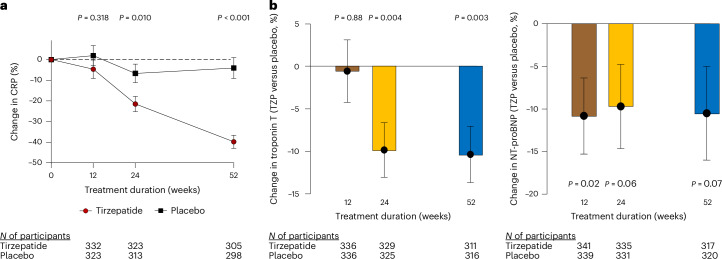
- Tirzepatide treatment resulted in a 37.2% decrease in levels, a marker of systemic inflammation, suggesting that it may mitigate inflammation-related cardiac injury.
Caveats
- The analysis relied on estimated blood volume calculations, which may overestimate changes due to weight loss. Alternative methods for measuring blood volume could provide more accurate results.
- The study's follow-up duration of 52 weeks limits the understanding of long-term effects of tirzepatide on heart failure outcomes.
Definitions
- heart failure with preserved ejection fraction (HFpEF): A type of heart failure where the heart pumps normally but is unable to fill properly, often associated with obesity and hypertension.
- C-reactive protein (CRP): A protein produced by the liver in response to inflammation; elevated levels indicate systemic inflammation.
Simplified
Main
Over half of patients with heart failure (HF) have a preserved ejection fraction (HF with preserved ejection fraction, HFpEF), and roughly two-thirds of these patients have obesity1–3. Obesity-related HFpEF represents the most advanced form of cardiovascular–kidney–metabolic disease, a syndrome recognized by the American Heart Association4. Individuals with obesity-related HFpEF have a high burden of hypertension and chronic kidney disease (CKD), which develops in response to marked blood volume (BV) expansion and chronic systemic inflammation5–8. Indeed, hypertension, CKD and BV expansion are the three features that best distinguish obesity-related HFpEF from asymptomatic individuals with obesity but no HF9. Endothelial dysfunction, inflammation and CKD in HFpEF can underlie the development of microalbuminuria, which is correlated with greater cardiac dysfunction and congestion, along with higher risk for HF hospitalization or death10–12. Patients with HFpEF also frequently display chronic low-grade myocardial injury as reflected by elevated levels of troponin13,14, and like albuminuria, this degree of myocardial injury in HFpEF is correlated with the severity of cardiac dysfunction, hemodynamic congestion, impairment in functional capacity and risk for HF hospitalization13,14. Notably, cardiac injury is greater in patients with obesity-related HFpEF compared with those without obesity15.
The Study of Tirzepatide in Participants with Heart Failure with Preserved Ejection Fraction and Obesity (SUMMIT) trial showed that the long-acting glucose-dependent insulinotropic polypeptide receptor and glucagon-like peptide-1 receptor agonist tirzepatide reduced the risk of worsening HF compared with placebo in patients with obesity-related HFpEF, while reducing HF symptom severity and improving exercise tolerance16. The mechanisms underlying these favorable effects of tirzepatide remain unclear. Here, we tested the hypothesis that tirzepatide may reduce cardiovascular–kidney end-organ damage while exerting favorable effects on circulatory volume–pressure overload and systemic inflammation in patients with obesity-related HFpEF participating in the SUMMIT trial.
Results
Patient characteristics
| Characteristic | Tirzepatide ( = 364)n | Placebo ( = 367)n |
|---|---|---|
| Age (years) | 65.5 ± 10.5 | 65.0 ± 10.9 |
| Women | 200 (54.9%) | 193 (52.6%) |
| Race | ||
| American Indian, Alaska Native or Pacific Islanders | 26 (7.1%) | 24 (6.5%) |
| Asian | 58 (15.9%) | 73 (19.9) |
| Black or African American | 22 (6.0%) | 14 (3.8%) |
| White | 256 (70.3%) | 256 (69.8%) |
| Other or mixed race | 2 (0.5%) | 0 (0.0%) |
| Ethnicity | ||
| Hispanic or Latino | 195 (53.6%) | 205 (55.9%) |
| Not Hispanic or Latino | 164 (45.1%) | 159 (43.3%) |
| Region | ||
| United States | 83 (22.8%) | 68 (18.5%) |
| Latin America | 193 (53.0%) | 197 (53.7%) |
| Asia | 58 (15.9%) | 73 (19.9%) |
| Other | 30 (8.2%) | 29 (7.9%) |
| Measures of adiposity | ||
| Body weight (kg) | 102.9 ± 21.7 | 103.1 ± 22.7 |
| BMI (kg m)−2 | 38.3 ± 6.4 | 38.2 ± 7.0 |
| Waist circumference (cm) | 120 ± 15 | 120 ± 14 |
| HFpEF severity and phenotyping | ||
| NYHA Class II | 262 (72.0%) | 268 (73.0%) |
| NYHA Class III–IV | 102 (28.0%) | 99 (27.0%) |
| NT-proBNP, median (IQR), ng l−1 | 196 (56, 488) | 169 (64, 476) |
| KCCQ-CSS score | 53.9 ± 17.9 | 53.2 ± 19.0 |
| 6MWD (m) | 305.0 ± 80.0 | 300.6 ± 83.5 |
| Left ventricular ejection fraction (%) | 61.0 ± 6.5 | 60.6 ± 6.2 |
| High-sensitivity troponin T, median (IQR), (ng l)−1 | 11 (7–19) | 12 (8–19) |
| Elevated troponin T (>14 ng l),(%)−1n | 151 (42.2%) | 147 (40.6%) |
| Current atrial fibrillation,(%)n | 95 (26.1%) | 91 (24.8%) |
| Cardiovascular history | ||
| Hospitalization for HF within 12 months | 171 (47.0%) | 172 (46.9%) |
| Diabetes mellitus | 174 (47.8%) | 178 (48.5%) |
| Coronary artery disease | 111 (30.9%) | 106 (29.1%) |
| Cardiovascular medications | ||
| Diuretics | 267 (73.4%) | 271 (73.8%) |
| RAS and neprilysin inhibitors | 293 (80.5%) | 295 (80.4%) |
| Beta blocker | 245 (67.3%) | 263 (71.7%) |
| Mineralocorticoid receptor antagonist | 131 (36.0%) | 125 (34.1%) |
| Sodium–glucose cotransporter 2 inhibitor | 69 (19.0%) | 57 (15.5%) |
| Characteristic | Tirzepatide ( = 364)n | Placebo ( = 367)n |
|---|---|---|
| Baseline hemodynamics and volume status | ||
| Systolic BP (mmHg) | 127.9 ± 13.1 | 128.2 ± 13.7 |
| Diastolic BP (mmHg) | 75.7 ± 9.6 | 76.9 ± 10.0 |
| Pulse pressure (mmHg) | 52.1 ± 12.7 | 51.2 ± 12.4 |
| Estimated total BV (l) | 5.77 ± 0.96 | 5.74 ± 0.94 |
| Estimated PV (l) | 3.34 ± 0.58 | 3.32 ± 0.57 |
| Baseline kidney indices | ||
| eGFR, ml min 1.73 m−1−2 | 55.5 ± 23.1 | 55.1 ± 21.7 |
| Stage 3 or greater CKD,(%)n | 212 (58.2%) | 229 (62.4%) |
| Cystatin C, median (IQR) (mg l)−1 | 1.26 (1.04–1.63) | 1.29 (1.07–1.60) |
| UACR, median (IQR), (g kg)−1 | 17 (8–47) | 20 (8–65) |
| Microalbuminuria (UACR 30–300),(%)n | 96 (26.5%) | 105 (28.9%) |
| Macroalbuminuria (UACR >300),(%)n | 22 (6.1%) | 39 (10.7%) |
| Systemic inflammation | ||
| High-sensitivity CRP, median (IQR), mg l−1 | 3.1 (1.6–6.5) | 3.4 (1.4–6.4) |
| Elevated CRP (>2 mg l),(%)−1n | 233 (66.6%) | 227 (65.6%) |
Tirzepatide effects on hemodynamic load and inflammation
As compared with placebo, tirzepatide resulted in a reduction in estimated BV at 12 weeks and 24 weeks, which further decreased at 52 weeks (estimated treatment difference (ETD) −0.58 l, 95% confidence interval (CI) −0.63 to −0.52, P < 0.001; Table 3 and Fig. 1b). Tirzepatide resulted in similar reductions in estimated PV at each time point (Table 3).

Effects of tirzepatide on pressure overload and volume expansion. , Least-squares mean changes from baseline in systolic BP (SBP) plotted as a function of duration of treatment in participants randomized to tirzepatide (red circles) or placebo (black squares)., The estimated mean treatment difference in the change in BV versus baseline with tirzepatide (TZP) compared with placebo plotted as a function of duration of treatment. The error bars represent s.e.m. for both panels; two-sided < 0.001 for each time point comparison forandbased upon comparing the least-squares means calculated from a mixed-model repeated-measures model incorporating baseline value, sex, history of HF decompensation within 12 months, diabetes status, baseline BMI group (<35, ≥35 kg m), treatment assignment, time, and treatment × time interaction. No correction was made for multiple hypothesis testing. a b a b P −2

Effects of tirzepatide on systemic inflammation, cardiac injury and natriuretic peptide levels. , Least-squares mean changes from baseline in CRP plotted as a function of duration of treatment in participants randomized to tirzepatide (red circles) or placebo (black squares)., The estimated mean treatment difference in the change in troponin T and NT-proBNP with tirzepatide (TZP) to baseline compared with placebo plotted as a function of duration of treatment. The error bars represent the s.e.m. for all panels;values are two-sided for each time point comparison forandbased upon comparing the least-squares means calculated from a mixed-model repeated-measures model incorporating baseline value, history of HF decompensation within 12 months, diabetes status, baseline BMI group (<35, ≥35 kg m), treatment assignment, time, and treatment × time interaction. No correction was made for multiple hypothesis testing. a b a b P −2
| Variable and duration of treatment | Change with tirzepatide from baseline | Change with placebo from baseline | ETD | 95% CI | P |
|---|---|---|---|---|---|
| Systolic BP (mmHg) | |||||
| 12 weeks | −5.5 | 0.9 | −6.4 | −8.4 to −4.4 | <0.001 |
| 24 weeks | −6.6 | −0.3 | −6.4 | −8.3 to −4.5 | <0.001 |
| 52 weeks | −4.6 | 0.1 | −4.7 | −6.8 to −2.5 | <0.001 |
| Diastolic BP (mmHg) | |||||
| 12 weeks | −1.1 | −0.5 | −0.7 | −1.9 to −0.6 | 0.313 |
| 24 weeks | −1.7 | −0.5 | −1.3 | −2.5 to 0.0 | 0.054 |
| 52 weeks | −1.2 | −0.3 | −0.9 | −2.3 to 0.5 | 0.189 |
| Pulse pressure (mmHg) | |||||
| 12 weeks | −4.4 | 1.4 | −5.8 | −7.4 to −4.1 | <0.001 |
| 24 weeks | −4.9 | 0.3 | −5.2 | −6.8 to −3.7 | <0.001 |
| 52 weeks | −3.5 | 0.4 | −3.9 | −5.6 to −2.2 | <0.001 |
| Estimated BV (l) | |||||
| 12 weeks | −0.27 | −0.04 | −0.23 | −0.26 to −0.21 | <0.001 |
| 24 weeks | −0.49 | −0.07 | −0.42 | −0.45 to −0.38 | <0.001 |
| 52 weeks | −0.68 | −0.11 | −0.58 | −0.63 to −0.52 | <0.001 |
| Estimated PV (l) | |||||
| 12 weeks | −0.17 | −0.03 | −0.13 | −0.16 to −0.11 | <0.001 |
| 24 weeks | −0.27 | −0.04 | −0.23 | −0.26 to −0.19 | <0.001 |
| 52 weeks | −0.39 | −0.08 | −0.32 | −0.36 to −0.27 | <0.001 |
| High-sensitivity CRP (% change from baseline) | |||||
| 12 weeks | −4.7 | 1.9 | −6.5 | −18.0 to 6.7 | 0.318 |
| 24 weeks | −21.5 | −6.7 | −15.9 | −26.4 to −4.0 | 0.01 |
| 52 weeks | −39.8 | −4.1 | −37.2 | −45.7 to −27.3 | <0.001 |
| eGFR (ml min 1.73 m)−1−2 | |||||
| 12 weeks | −0.6 | 0.5 | −1.1 | −2.7 to 0.4 | 0.148 |
| 24 weeks | 0.3 | 0.1 | 0.2 | −1.4 to 1.8 | 0.818 |
| 52 weeks | 2.6 | −0.3 | 2.9 | 0.9 to 4.9 | 0.004 |
| UACR (% change from baseline) | |||||
| 24 weeks | −26.4 | −1.9 | −25.0 | −35.5 to −12.7 | <0.001 |
| 52 weeks | −14.7 | 0.4 | −15.1 | −28.0 to 0.1 | 0.051 |
| NT-proBNP level (% change from baseline) | |||||
| 12 weeks | −8.9 | 2 | −10.8 | −19.1 to −1.5 | 0.024 |
| 24 weeks | −10.2 | −0.6 | −9.7 | −18.9 to 0.5 | 0.063 |
| 52 weeks | −7.2 | 3.7 | −10.5 | −20.7 to 1.0 | 0.072 |
| Troponin T level (% change from baseline) | |||||
| 12 weeks | −1.3 | −0.8 | −0.6 | −7.5 to 7.0 | 0.881 |
| 24 weeks | −8.6 | 1.4 | −9.8 | −16.0 to −3.3 | 0.004 |
| 52 weeks | −9.6 | 0.9 | −10.4 | −16.7 to −3.6 | 0.003 |
Effects of tirzepatide on cardiac injury and kidney function
Treatment with tirzepatide resulted in a significant reduction in myocardial injury reflected by high-sensitivity troponin T as compared with placebo at both 24 and 52 weeks (ETD 24 weeks −9.8% (95% CI −16.0 to −3.3), P = 0.004, 52 weeks −10.4% (95% CI −16.7 to −3.6), P = 0.003), with no significant effect at 12 weeks (Fig. 2b). Tirzepatide also reduced N-terminal prohormone B-type natriuretic peptide (NT-proBNP) levels compared with placebo, P = 0.02–0.07 (Fig. 2), even as baseline levels were near normal on average (Table 1).

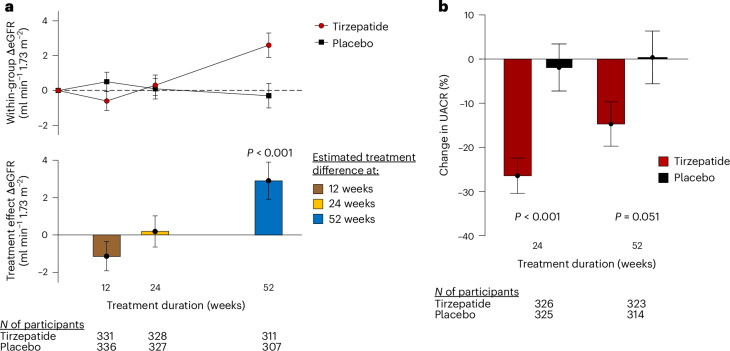
Effects of tirzepatide on kidney function and albuminuria. , Top: least-squares mean changes from baseline in eGFR plotted as a function of duration of treatment in participants randomized to tirzepatide (red circles) or placebo (black squares). Bottom: the estimated mean treatment difference in the change in eGFR with tirzepatide versus baseline compared with placebo plotted as a function of duration of treatment., The least-squares mean change in UACR in participants treated with tirzepatide (red) and placebo (black) as a function of duration of treatment. The error bars represent the s.e.m. for all panels;values are two-sided for each time point comparison forandbased upon comparing the least-squares means calculated from a mixed-model repeated-measures model incorporating baseline value, sex, history of HF decompensation within 12 months, diabetes status, baseline BMI group (<35, ≥35 kg m), treatment assignment, time, and treatment × time interaction. No correction was made for multiple hypothesis testing. a b a b P −2
Changes in circulatory load, inflammation and end-organ damage
In a linear regression model adjusted for baseline value, treatment allocation and interaction between treatment and covariates, at 52 weeks, the reductions in estimated BV with tirzepatide were correlated with decreases in systolic BP (slope 6.12, 95% CI 3.47 to 8.78; P < 0.001) and decreases in albuminuria (slope 46.7, 95% CI 11.48 to 81.87; P = 0.009), but there was no correlation with changes in eGFR (Extended Data Table 2). These relationships were not observed in patients randomized to placebo. There was a modest direct correlation between changes in BV and eGFR at 12 weeks (Extended Data Table 3).
There was a direct correlation between changes in systolic BP and changes in eGFR on treatment with tirzepatide at 52 weeks (slope 0.256, 95% CI 0.127 to 0.386; P < 0.001) (Extended Data Table 2). The direct relationship between change in eGFR and change in BP was also observed at 12 weeks (Extended Data Table 3). There was no significant relationship between changes in systolic BP and changes in log UACR at 52 weeks on treatment with tirzepatide.
There were no significant correlations between changes in CRP with tirzepatide and changes in systolic BP, eGFR or log UACR (Extended Data Table 2). Changes in systolic BP and BV with tirzepatide were not correlated with changes in troponin T. However, the decrease in CRP with tirzepatide at 52 weeks was correlated with reduction in log troponin T (slope 0.239, 95% CI 0.029 to 0.450; P = 0.026).
Correlations with clinical outcomes
As previously reported16, treatment with tirzepatide improved KCCQ-CSS score at 52 weeks compared with placebo (ETD 6.9 points, 95% CI 3.3 to 10.6; P < 0.001), reduced body weight (ETD 11.6%, 95% CI −12.9% to −10.4%; P < 0.001) and increased 6MWD (ETD 18.3 m, 95% CI 9.9 to 26.7; P < 0.001). In the tirzepatide group, reductions in systolic BP had no significant relationship with clinical outcomes, but decreases in estimated BV were correlated with improvements in KCCQ-CSS (slope −6.287, 95% CI −8.091 to −4.482; P < 0.001) and increases in 6MWD (slope −1.175, 95% CI −1.810 to −0.539; P < 0.001) (Extended Data Table 4). Decreases in CRP with tirzepatide were associated with improvement in 6MWD (slope −0.002, 95% CI −0.004 to 0.000; P = 0.016), but not changes in KCCQ-CSS.
Discussion
In this mechanistic analysis of the SUMMIT trial, we found that, compared with placebo, treatment with the long-acting glucose-dependent insulinotropic polypeptide receptor and glucagon-like peptide-1 receptor agonist tirzepatide reduced BP and estimates of circulatory volume expansion in patients with obesity-related HFpEF. These effects were observed early and were sustained with longer duration of treatment. Tirzepatide reduced systemic inflammation, but this effect was observed later than the hemodynamic effects. Tirzepatide resulted in an early trend to reduction in eGFR at 12 weeks, but this was followed by an improvement in eGFR compared with placebo with longer duration treatment, and reduction in microalbuminuria. Tirzepatide reduced myocardial injury compared with placebo, reflected by a significant decrease in troponin T, along with a reduction in NT-proBNP. Reductions in estimated BV with tirzepatide were correlated with decreases in systolic BP, reduction in UACR and improvements in both KCCQ-CSS score and 6MWD, suggesting that mitigation of circulatory volume expansion (or factors responsible for volume expansion) may play a central role in mediating the benefits of tirzepatide. Conversely, decreases in systemic inflammation with tirzepatide were correlated with reductions in cardiac injury with tirzepatide, along with a modest correlation with improvements in 6MWD. These findings provide new insights into the mechanisms by which tirzepatide leads to clinical improvement in HFpEF.
Obesity-related HFpEF is the most common phenotype of this disorder3,9, and its emergence is causally related to the growing burden of cardiovascular–kidney–metabolic disorders observed worldwide4. As compared with nonobese HFpEF, patients with obesity-related HFpEF display distinct pathophysiologic features, including greater volume expansion5,17, more severe inflammation6,7, increases in visceral and paracardiac adipose tissue5,15,18,19 and more severe myocardial injury15. Indeed, volume expansion, CKD and greater burden of hypertension best distinguish individuals from obesity-related HFpEF from age, sex and BMI-matched patients with obesity but no HF9. Collectively, these observations suggest that novel treatments that reduce circulatory volume–pressure overload (or its determinants), improve kidney function, reduce inflammation and mitigate cardiac injury may improve clinical status in people with obesity-related HFpEF.
In the SUMMIT trial, tirzepatide reduced the combined risk of cardiovascular death or worsening HF, and improved health status and exercise tolerance in patients with obesity-related HFpEF16. These results are consistent with findings observed in the STEP-HFpEF program, where the glucagon-like peptide receptor-1 agonist semaglutide was also shown to improve health status and exercise capacity20,21. The magnitude of improvements in health status and exercise tolerance with semaglutide were correlated with the degree of body weight reduction22, but the mechanisms underlying clinical improvement with incretins such as tirzepatide and semaglutide in patients with obesity-related HFpEF have remained unclear.
Here, we show that tirzepatide reduced circulatory volume expansion using estimates of BV and PV, an effect that was evident after just 12 weeks of treatment and that further increased at 24 and 52 weeks. It is noteworthy that adipocytes release factors that promote sodium retention and volume expansion, including leptin and aldosterone, and the reduction in adipocyte mass with tirzepatide may reduce these influences23. Volume expansion in obesity-related HFpEF exacerbates elevation in cardiac filling pressures that develop due to impairments in left ventricular distensibility3, and thus, reducing circulating volume may decrease cardiac filling pressures. This finding could partly explain the direct correlation observed between reductions in BV and improvements in KCCQ-CSS score and exercise capacity.
Tirzepatide also decreased systolic BP, an effect that was evident after just 4 weeks, and was also associated with reductions in estimated BV and PV. Effects on diastolic BP were not apparent, and thus, there was a significant reduction in pulse pressure. Pulse pressure is inversely correlated with arterial compliance, which is frequently impaired in patients with HFpEF, where increases in aortic stiffness contribute to elevation in cardiac filling pressures, especially during exercise24. Treatment with the sodium–glucose cotransporter 2 inhibitor dapagliflozin was recently shown to reduce aortic stiffness, systolic BP and pulse pressure during exercise after just 24 weeks, and these changes were correlated with reductions in left ventricular filling pressures25. The magnitude of improvement in arterial compliance with dapagliflozin was correlated with the magnitude of weight loss. Further study using more direct measures is indicated to determine whether tirzepatide also improves arterial compliance, which would be consistent with the effects on systolic and pulse pressure observed here.
Obesity can contribute to CKD through multiple mechanisms including volume expansion (leading to glomerular hyperfiltration) and the effect of adipocytokines (leptin and aldosterone) to cause renal injury and fibrosis23,26. Leptin is an important determinant of the decline in eGFR in the general population, and mineralocorticoid receptor antagonists ameliorate the progression of CKD23,27. In the SUMMIT trial, decreases in estimated BV at 52 weeks (potentially related to the suppression of adipocytokines) were associated with reduction in albuminuria, but we observed no relationship with the improvements in eGFR. Tirzepatide tended to worsen eGFR estimated using cystatin C compared with placebo at 12 weeks, but this was reversed by 52 weeks, an effect that was consistently observed across all formulas used to determine eGFR. This pattern of an early worsening of eGFR followed by favorable improvements with longer-term follow-up was also observed in the tirzepatide versus insulin glargine in type 2 diabetes and increased cardiovascular risk (SURPASS-4) trial with tirzepatide28 and the Evaluate Renal Function with Semaglutide Once Weekly (FLOW) trial with semaglutide29, as well as other renoprotective drugs such as sodium–glucose cotransporter 2 inhibitors30. The present study suggests that the bimodal relationship may be explained by a relatively early-onset reduction in systolic BP and estimated BV, resulting in short-term decline in eGFR at 12 weeks. This is then superseded by a favorable effect on eGFR and UACR, potentially mediated by long-term decrease in fat mass and the suppression of adipocytokines.
Improvements in kidney function with incretins have been postulated to be related to a decrease in systemic inflammation, but we observed no correlation between changes in CRP and changes in eGFR. Systemic hypertension has been linked to the development of obesity-related CKD26, but we observed a direct relationship between decreases in systolic BP and decreases in eGFR at multiple time points. This may reflect the impact of reductions in renal perfusion pressure that have been associated with reduction in eGFR in both acute and chronic HF30,31. Tirzepatide reduced albuminuria compared with placebo, with a significant effect at 24 weeks, preceding the improvement in eGFR, which is also consistent with a decrease in glomerular hypertension as a key mechanism.
Tirzepatide reduced cardiac injury, reflected by decreases in troponin T, and reduced wall stress, reflected by decreases in NT-proBNP. The latter is notable because weight loss in the absence of HF leads to increases in NT-proBNP32,33. We did not require elevated NT-proBNP as an eligibility criterion, and thus, NT-proBNP levels in SUMMIT were only slightly elevated on average (median 175 ng l−1), and accordingly, there was little margin for further reduction. Circulating troponin levels are commonly elevated in HFpEF, where they are associated with greater risk for HF hospitalization or death14. The low-grade myocardial injury in HFpEF as observed at baseline in SUMMIT is believed to be related to cardiomyocyte loss due to repetitive elevations in cardiac filling pressures during stress, along with adverse loading conditions caused by ventricular–vascular stiffening13,34. Patients with HFpEF and elevated troponin have more severe elevation in filling pressures, reduced myocardial stress reserve and poorer exercise capacity compared with those without injury13, and individuals with the obesity phenotype have higher troponin levels than those without obesity15. We observed a modest but significant correlation between decreases in CRP and reductions in troponin with tirzepatide, suggesting that anti-inflammatory effects may contribute to cardiac benefits. It is noteworthy that the temporal sequence of anti-inflammatory effects and the changes in troponin were similar, and these were delayed compared with effects on circulatory volume and pressure, further supporting a distinct mechanism. The favorable effects of tirzepatide on myocardial injury may contribute to reduced risk for worsening HF seen in the SUMMIT trial16. Reduction in CRP with tirzepatide was also associated with greater improvement in 6MWD. This may relate in part to myocardial benefits, as noted above, or potentially improvements in skeletal muscle function and peripheral oxygen uptake, which are more dramatically impaired in patients with HFpEF and more severe inflammation35.
The major limitation of this analysis centers on the fact that we estimated PV using a weight-based formula (the Kaplan–Hakim equation)36, and according to this formula, the weight loss produced by tirzepatide would be mathematically expected to reduce PV. However, such an effect is physiologically inescapable, since PV/BV is inherently linked to body weight37, and thus, PV/BV necessarily declines as weight is lost. The mechanism that mediates this effect is probably due to a decrease in fat mass to reduce the secretion of adipocytokines that have antinatriuretic effects. However, in the case of tirzepatide, it is noteworthy that glucagon-like peptide-1 receptor agonism produces a direct effect itself to promote urinary sodium excretion, independent of changes in adipose tissue volume38,39. We understand that weight-independent formulas to estimate changes in PV have been proposed40, but these are relevant only for short-term interventions and are not applicable when there are meaningful changes in weight over months. Nevertheless, it is possible that we may have overestimated the magnitude of BV and PV reduction with tirzepatide in our analysis, as the relationship between BV and body weight may change as people lose weight. An alternative and more quantitative approach would be to directly measure PV/BV using the indicator-dilution method, but that would not be practical in a large-scale, international, multicenter randomized trial, leaving us no viable alternatives to explore this potential mechanism. All outcomes and analyses were prespecified, with the exception of the estimated BV and PV, as well as the regression analyses used to explore potential mechanisms, so these data should be treated as hypothesis-generating. Patients with active chronic noninflammatory myopathy and myositis may have mild elevation in troponin T independent of myocardial injury41. However, patients with significant musculoskeletal disease were excluded from SUMMIT by protocol. Reductions in body weight with tirzepatide would be expected to reduce skeletal muscle to some extent, which could influence creatinine dependent of changes in kidney function, and for this reason, we calculated eGFR using cystatin C in place of creatinine. Importantly, the findings showing kidney benefits were consistently observed across all formulas used to calculate eGFR. The duration of follow-up assessments for most measures was 52 weeks, reducing our ability to reach conclusions about longer-term effects.
In this mechanistic analysis from the SUMMIT trial, we show that tirzepatide reduced circulatory volume–pressure overload and systemic inflammation in patients with obesity-related HFpEF, while mitigating cardiovascular–kidney end-organ injury and loss of function. These data provide new insights into the mechanisms of benefit from tirzepatide in patients with obesity-related HFpEF.
Methods
The SUMMIT primary results, trial protocol and statistical analysis plan have been published, and the protocol and statistical analysis plan are included in Supplementary Information16. The ethics committee at each investigative site approved the trial, and all patients provided written informed consent. The registration identifier on clinicaltrials.gov is NCT04847557↗. The sponsor was Eli Lilly and Company. In collaboration with the sponsor, the steering committee developed and amended the protocol, oversaw the recruitment of patients and the quality of follow-up, and supervised the analysis of data; the academic members provided an independent interpretation of the results.
Study patients
Participants with HFpEF aged ≥40 years with chronic class II–IV HF, left ventricular ejection fraction ≥50% and a BMI ≥30 kg m−2 were enrolled. Patients were required to have exercise limitation and high symptom severity due to HFpEF reflected by a 6MWD of 100–425 m and a KCCQ-CSS ≤80 at baseline, along with objective evidence of HF, as demonstrated by at least one of the following: (1) elevated NT-proBNP (≥200 pg ml−1 in sinus rhythm or ≥600 pg ml−1 in atrial fibrillation); (2) structural heart disease, defined by left atrial enlargement by two-dimensional echocardiography; or (3) elevated filling pressures at rest or with exercise (by invasive hemodynamic measurement or echocardiography). To enrich for greater risk of HF events, participants were also required to have either (1) HF decompensation in the preceding 12 months or (2) eGFR <70 ml min−1 1.73 m−2. Full inclusion and exclusion criteria are summarized in Supplementary Appendix 1.
Study procedures
Following screening, eligible patients were randomized double blind (1:1) to receive placebo or tirzepatide 2.5 mg per week subcutaneously, in addition to usual therapy. Randomization was stratified by (1) HF decompensation within 12 months; (2) type 2 diabetes; (3) BMI ≥35 kg m−2 or <35 kg m−2. The dose of the double-blind study medication was increased by 2.5 mg every 4 weeks as tolerated until a dose of 15.0 mg per week of tirzepatide or matching placebo could be achieved after 20 weeks, which was maintained until the end of the trial. Double-blind treatment was to be continued until the last randomized patient was followed for 52 weeks.
The outcomes for this secondary mechanistic analysis from SUMMIT were identified on the basis of pathophysiologic understanding of obesity-related HFpEF as variables that we hypothesized would change with tirzepatide treatment, including measures of BP, estimated BV and PV, kidney function, albuminuria, cardiac injury, inflammation and cardiac distention (reflected by NT-proBNP). These variables were obtained on the basis of either physical examination (for BP) or laboratory tests (from blood and urine samples). All of the outcomes assessed were prespecified as exploratory outcomes, with the exception of estimated BV and PV, which were post hoc and not prespecified.
Patients were evaluated in a clinical setting at prespecified intervals to assess body weight, BP, New York Heart Association (NYHA) class, worsening HF events, KCCQ-CSS, 6MWD and biomarkers of end-organ function or injury. Cystatin C was determined using a turbidimetric assay (Roche Cobas Chemistry Analyzer). Because weight loss with tirzepatide is expected to reduce both fat and skeletal muscle mass, creatinine could be less accurate as a measure of kidney function. Therefore, for the primary analysis, eGFR was calculated from cystatin C level alone, using the 2012 chronic kidney disease-epidemiology (CKD-EPI) cystatin C formula, at baseline and 12, 24 and 52 weeks42. Sensitivity analyses were also performed using eGFR calculated determined using the 2021 creatinine-based CKD-EPI formula43, and separately using the combined creatinine-cystatin C CKD-EPI formula (Supplementary Appendix 2)19. Urine albumin was measured using a turbidimetric assay and urine creatinine by colorimetric assay (both Roche Cobas Chemistry Analyzer), and UACR was calculated at baseline, 24 weeks and 52 weeks. Systemic inflammation was assessed by high-sensitivity CRP, measured by turbidimetric assay (Roche Cobas Chemistry Analyzer) at baseline and 12, 24 and 52 weeks. Myocardial injury was assessed by high-sensitivity troponin T, measured by chemiluminescent immunoassay (Roche Cobas Elecsys) at baseline, 12 weeks, 24 weeks and 52 weeks. Hematocrit was measured at baseline, 24 weeks and 52 weeks. Estimated PV was calculated from these variables as (1 − hematocrit) × (a + (b × weight in kg)), where a = 1,530 for men and 864 for women and b = 41 for men and 47.9 for women5. Estimated total BV was then determined by PV/(1 − hematocrit).
Statistical methods
Data are reported as mean (standard deviation, s.d.), median (interquartile range, IQR) or number (%) unless otherwise specified. All analyses presented were prespecified, with the exception of estimated BV and PV, and the results of linear regression analyses exploring correlations between changes in different variables, which are exploratory and post hoc. Analyses were guided by the treatment policy estimand that represents the efficacy irrespective of adherence to study intervention. A mixed-effects model repeated-measures analysis was used to analyze measurements taken at multiple scheduled visits. The mixed-effects model repeated-measures model included treatment, time, treatment-by-time interaction, stratification factors (HF decompensation within 12 months of screening (yes/no), diagnosed type 2 diabetes (yes/no) and baseline BMI (<35, ≥35 kg m−2) as fixed effects, and baseline value as a covariate. Restricted maximum likelihood was used to obtain model parameter estimates, and the Kenward–Roger option was used to estimate the denominator degrees of freedom. An unstructured covariance structure was used to model the within-patient errors.
A linear regression was used to analyze potential relationships between continuous dependent and independent variables, and included baseline value, treatment, specified covariate and treatment-by-covariate interaction. Given that the focus was on mechanistic understanding rather than clinical indications, adjustment for multiple hypothesis testing was not performed. Logistic regression was used to analyze the potential relationship of independent variables with a binary dependent variable, and included baseline value, treatment and stratification factors (HF decompensation within 12 months of screening (yes/no), diagnosed type 2 diabetes (yes/no) and baseline BMI (<35, ≥35 kg m−2) as covariates.
Reporting summary
Further information on research design is available in thelinked to this article. Nature Portfolio Reporting Summary
Online content
Any methods, additional references, Nature Portfolio reporting summaries, source data, extended data, supplementary information, acknowledgements, peer review information; details of author contributions and competing interests; and statements of data and code availability are available at 10.1038/s41591-024-03374-z.
Supplementary information
Supplementary Information Supplementary Appendices 1 and 2, trial protocol and statistical analysis plan. Reporting Summary