
What this is
- This research investigates the associations between trimethylamine-N-oxide (), choline, and with non-alcoholic fatty liver disease () in adults.
- It includes a case-control study with 60 patients and 35 controls, and a cross-sectional study with 1,628 community-based adults.
- Findings indicate that higher levels correlate with increased severity, while shows a favorable association.
Essence
- Higher circulating levels are associated with increased presence and severity of , while levels show an inverse relationship with severity.
Key takeaways
- levels are positively correlated with severity. In the case-control study, higher ln-transformed levels were linked to worse steatosis and activity scores.
- levels are inversely associated with severity. The cross-sectional study found that higher concentrations correlate with lower severity.
- No significant association was found between choline levels and , suggesting that may mediate the relationship between choline and liver health.
Caveats
- Causality cannot be inferred due to the observational nature of the studies. The associations observed may be influenced by unmeasured confounding factors.
- The reliance on ultrasonography for diagnosis may limit sensitivity compared to liver biopsy. This could affect the accuracy of the severity assessments.
- Variability in plasma metabolite levels over time could dilute the strength of the observed associations, complicating interpretations of the findings.
Definitions
- TMAO: Trimethylamine-N-oxide, a metabolite produced by gut bacteria from dietary choline, associated with various health risks.
- NAFLD: Non-alcoholic fatty liver disease, a condition characterized by excess fat accumulation in the liver not due to alcohol consumption.
- Betaine: A compound derived from choline that serves as a methyl donor in various metabolic processes, potentially protective against fatty liver.
Simplified
Participants and Methods
Study participants
We conducted a case-control study (CCS) and cross-sectional study (CSS). For the CCS, we recruited 60 adults (age: 18–60 years) with biopsy-proven NAFLD from outpatients with NAFLD evaluated firstly by ultrasonography, in addition to 35 controls with the same age rage at the Affiliated Dongnan Hospital of Xiamen University and Sun Yat-Sen Memorial Hospital from April 2012 to June 2013. The controls were patients who had undergone partial hepatectomy due to hepatic hemangioma or hepatolithiasis and had normal liver histopathology. Subjects with the following conditions were be excluded: confirmed heart diseases, stroke, cancer, excessive alcohol consumption, autoimmune liver disease or other conditions19 that may result in fatty liver. For the CSS, participants were drawn from a community-based cohort, from which 3,169 participants (40–75 years) were recruited among apparently healthy residents of Guangzhou, China between July 2008 and June 201020. Of them, 1,996 participants without the following exclusion criteria underwent testing to determine the plasma TMAO, choline and betaine levels: a history of excessive alcohol consumption, the use of steatogenic medication, autoimmune liver disease, chronic viral hepatitis, and hepatic carcinoma or decompensation. In addition, 1,628 of the 1996 subjects underwent further NAFLD testing by ultrasonography between April 2011 and January 2013. Baseline data, including general information, plasma levels of TMAO, choline and betaine, and NAFLD measurements at follow-up were used in the CSS. The abovementioned exclusion criteria were used in both studies. The study protocol complied with all provisions of the 1975 Declaration of Helsinki and its current amendment, and was approved by the Ethics Committee of the School of Public Health of Sun Yat-sen University. Written informed consent was obtained from all participants.
Data collection
For both the CCS and CSS, we collected general information using the same structured questionnaires and performed body measurements and biochemical tests of fasting serum lipid and glucose levels and plasma levels of TMAO, choline and betaine. Histopathological evaluation of liver biopsy samples and blood AST and ALT tests were conducted for the CCS, and ultrasonographic evaluation of NAFLD was performed in the CSS.
Questionnaire interview and Anthropometric measurements
Face-to-face interviews were conducted to collect the following information: socio-demographic characteristics (e.g., age, gender, level of education, occupation and other factors), lifestyle habits (e.g., consumption of alcohol, tobacco and tea), physical activities, and history of chronic diseases and medication20. Body weight and height and waist circumferences (WC) were measured while the participants were barefoot and wearing light clothing. Body mass index (BMI, kg/m2) was also calculated. Two consecutive blood pressure (BP) measurements were performed on the right arm after the participant had been sitting for at least 10 min, and the mean value was used in the further analyses.
Laboratory analysis
Fasting serum was isolated and stored at −80 °C until analysis. Serum concentrations of TMAO, choline and betaine were quantified by high-performance liquid chromatography with online electrospray ionization tandem mass spectrometry (HPLC-MS/MS) (Agilent 6400 Series Triple Quad LCMS; CA, USA)20. A volume of 60 μl of either the serum sample or standards was combined with 100 μl of acetonitrile containing 10 μM of internal standards [d9-choline, d9-betaine (Sigma-Aldrich, St. Louis, USA) and 9-TMAO (Toronto Research Chemicals Inc, Toronto, Canada)], and the sample was centrifuged at 13,000 × g for 10 min to precipitate the proteins. Finally, after an additional centrifugation step, the supernatant was analyzed after injection into a normal-phase silica column (2.1 mm × 100 mm, 5 μm) and equilibrated with 30% solution A (15 mmol/L ammonium formate in water, pH 3.0) and 70% solution B (acetonitrile) under isocratic elution with the flow rate of 0.2 mL/min. The coefficients of variation for the between-run assays were 6.0%, 4.91% and 6.21% for TMAO, choline and betaine, respectively.
Overnight fasting serum total cholesterol (TC), triglyceride (TG), LDL cholesterol (LDLc), HDL cholesterol (HDLc) and fasting blood glucose were measured by colorimetric methods using a Hitachi 7600-010 automated analyzer.
Histopathologic evaluation
Liver biopsy samples were stained using both hematoxylin and eosin (H&E) and Masson’s trichrome methods. Histological assessment was performed according to the nonalcoholic steatohepatitis (NASH) Clinical Research Network Scoring System21 by two experienced pathologists who were unaware of the participants’ information. Fatty liver was categorized as follows, according to the proportion of steatosis22: grade 0 (<5%), 1 (5%–33%), 2 (33%–66%), or 3 (>66%). Hepatocellular ballooning was graded as none (grade 0), few balloons (grade 1), and many cells/prominent (grade 2). According to the number of inflammatory foci per field of view at a magnification of 200×, lobular inflammation was classified as grade 0 (none), 1 (<2 foci/field), 2 (2–4 foci/field) and 3 (>4 foci/field). The total NAFLD activity score (NAS) was calculated as the sum of the scores for steatosis, hepatocellular ballooning and lobular inflammation and was then categorized as no NASH (<3), borderline NASH (3−4) and NASH (≥5).
Abdominal ultrasonography and Diagnosis of NAFLD
Ultrasonography of the upper abdominal organs was performed using a color Doppler ultrasound (Sonoscape SSI-5500, Shenzhen, China) with a 3.5 MHz probe by experienced physicians who blinded to the participants’ information. Fatty liver disease was diagnosed according to Graif’s criteria23, which has been adopted by the Chinese Society of Herpetology24. The degree of steatosis was assessed semi-quantitatively based on fatty-fibrotic patterns as described by Graif et al.23, and reported in our previous article25. In brief, the ultrasonic diagnosis was based on follows25: 1) diffuse enhancement of the near-field echo in the hepatic region (stronger than in the kidney and spleen regions) and gradual attenuation of the far-field echo; 2) unclear display of intra-hepatic lacuna structures; 3) mild to moderate hepatomegaly with a round and blunt border; 4) color Doppler ultrasonography showing a reduction of the blood flow signal in the liver or a difficult-to-display signal with a normal distribution of blood flow; and 5) unclear or non-intact display of the envelope of the right liver lobe and diaphragm. Subjects were graded into: absent (none of above items); mild (1 and any one of item 2–4); moderate (1 and any two of item 2–4); and severe (1, 5 and any two of item 2–4). NAFLD was then confirmed after excluding the following conditions: significant alcohol consumption for hepatic steatosis and chronic liver disease1.
Statistical analysis
All analyses were conducted using SPSS statistical software (version 13.0, SPSS Inc., Chicago, IL), and P values of below 0.05 (two-tailed) were considered significant in all the statistical analyses. Skewed variables were natural logarithm (ln)-transformed before subsequent analyses. Analyses of variance (ANOVA) and covariance (ANCOVA) and t-tests were used to compare mean differences in the participants’ characteristics, and chi-square (or Fisher’s exact) tests were used to analyze differences in the frequencies of categorical variables among the NAFLD groups. ANOVA and ANCOVA were used to compare mean differences, and the sub-command of “Polynomial contrasts” was used to test the linear trend across the serum levels of TMAO, choline and betaine across the NAFLD groups in the CCS and CSS. Bonferroni t test was used for the multiple comparisons between the NAFLD groups. For the multivariate models, we adjusted for age, sex (in total men and women), waist circumference, SBP, blood cholesterol, triglyceride, HDLc, LDLc, glucose, uric acid, education levels (secondary or below, high school, college or above), job (light, moderate and heavy, in physcial labor work), household income (<4000, 4000-6000, >6000, yuan/month/person), smoking (current or /no), alcohol intake statuses (current or /no), physical activity (in MET h/week, excluding sleeping and sitting), and dietary intakes of total energy, fat, and fiber (continous variables except those defined). Logistic regression analyses were used to calculate the odds ratios (OR) and their 95% confidence interval (CI) of NAFLD (or related indices) for the quartiles of serum values of TMAO, betaine, and choline in the CSS, and for each one unit increase in ln-transformed serum values of TMAO, betaine and choline in the CCS.
Results
Case-control study
The NAFLD patients included 48 men and 12 women, with a mean (SD) age of 34.8 (10.2) years. There were 22 men and 13 women in the control group, with a mean age of 44.8 (10.8) years. The NAFLD patients had a younger mean age and higher levels of BMI, WC, DBP, and blood lipids (TC, TGs, LDLc, and HDLc) compared with the controls (all p < 0.05) (Table 1). The ln-transformed levels of TMAO were positively associated with the corresponding values of choline (pearson correlation coefficient (r) = 0.487, 0.203) and betaine (r = 0.294, 0.159) in the CCS and CSS (all p < 0.05) (data not shown).
ANOVA showed significantly higher scores for steatosis, NAS, and lobular inflammation in association with greater ln-transformed levels of TMAO, choline and betaine, except for the steatosis scores associated with betaine. The ratio of betaine to choline was inversely associated with the steatosis and NAS (all p < 0.05) (STable 1). After adjusting for the potential covariates (age, sex, smoking status, alcohol intake status, physical activity and WC), the associations were attenuated. However, significant associations remained between the serum ln-transformed level of TMAO, betaine/choline ratio, choline level, and steatosis and NAS (ANCOVA). The serum levels of betaine and choline were positively correlated with the lobular inflammation score. To determine whether the associations between the choline level and the scores for steatosis, NAS and lobular inflammation were mediated by TMAO, we further adjusted for TMAO in analysis of choline. The associations of choline with the steatosis, NAS and inflammation scores were attenuated to non- or marginally significant levels. (Table 2).
ORs (95%CI) of high score (≥1 vs. 0) of NAFLD indices for each one unit inrease in ln-transformed values of TMAO (μM) were 3.58 (1.38–9.26) for the statosis score, 3.34 (1.44–7.78) for the NASH score, and 2.37 (1.10–5.09) for the lobular inflammation score, respectively. Higher choline values were also associatied with greater risks of having high scores of statosis, NASH, and lobular inflmmation. (STable 3).
In consistent with the results NAFLD, ln-TMAO and ln-choline were positively and significantly correlated to serum levels of TC, TG and HDLc (all p < 0.05), but not to LDLc after adjusted for age and sex. (data not shown).
| Normal subjects (n = 35) | NAFLD patients (n = 60) | P | Adjusted P 1 | AdjustedP2 | |
|---|---|---|---|---|---|
| General characteristics | |||||
| Age, years | 44.8 ± 10.8 | 34.8 ± 10.2 | <0.001 | – | – |
| Male/female, n | 22/13 | 48/12 | 0.067 | – | – |
| BMI, kg/m2 | 22.6 ± 3.2 | 27.9 ± 3.1 | <0.001 | <0.001 | – |
| Waist circumference, cm | 84.6 ± 9.1 | 95.6 ± 7.4 | <0.001 | <0.001 | – |
| SBP, mmHg | 120.8 ± 11.4 | 125.4 ± 13.5 | 0.117 | 0.18 | 0.892 |
| DBP, mmHg | 78.0 ± 9.3 | 82.6 ± 10.9 | 0.044 | 0.131 | 0.472 |
| Current smoker, n(%) | 10(30.3) | 17(29.8) | 0.962 | 0.47 | – |
| Passive smoker, n(%) | 17(56.67) | 30(56.60) | 0.996 | 0.393 | – |
| Physical activity, MET | 37.7 ± 21.1 | 35.3 ± 23.4 | 0.619 | 0.269 | – |
| Biochemical characteristics | |||||
| AST, U/L | 26.0(20.7,44.5) | 30.1(22.6,42.1) | 0.871 | 0.049 | 0.951 |
| ALT, U/L | 41.8(24.0,73.6) | 56.5(31.1,87.7) | 0.206 | 0.321 | 0.807 |
| Blood glucose, mg/dL | 5.30(4.97,5.85) | 5.09(4.76,5.95) | 0.502 | 0.215 | 0.344 |
| Triglycerides, mmol/L | 1.15(0.76,1.69) | 1.79(1.18,2.71) | 0.005 | 0.039 | 0.925 |
| Cholesterol, mmol/L | 3.95 ± 1.50 | 5.22 ± 1.13 | <0.001 | <0.001 | 0.062 |
| HDLc, mg/dL | 1.00 ± 0.31 | 1.25 ± 0.26 | <0.001 | 0.001 | 0.14 |
| LDLc, mg/dL | 2.49 ± 1.02 | 2.92 ± 0.83 | 0.028 | 0.025 | 0.152 |
| HBV( + ), n(%) | 12(35.3) | 16(27.1) | 0.659 | 0.122 | – |
| n | mean | SE | n | mean | SE | n | mean | SE | ANCOVA | ||
|---|---|---|---|---|---|---|---|---|---|---|---|
| P-Diff | P-trend | ||||||||||
| Steatosis score | 0 | 1 | 2–3 | ||||||||
| Ln(TMAO, μM) | 35 | 2.2 | 0.2 | 31 | 3.09 | 0.18 2 | 25 | 2.95 | 0.22 | 0.011 | 0.026 |
| Ln(Betaine, μM) | 35 | 3.553 | 0.77 | 31 | 3.552 | 0.071 | 25 | 3.566 | 0.085 | 0.99 | 0.92 |
| Ln(Choline, μM) | 35 | 2.209 | 0.087 | 31 | 2.444 | 0.08 | 25 | 2.543 | 0.096 | 0.072 | 0.025 |
| Ln(Choline, μM) 2 | 2.308 | 0.082 | 2.371 | 0.075 | 2.496 | 0.088 | 0.346 | 0.174 | |||
| Betaine/Choline | 35 | 1.344 | 0.083 | 31 | 1.107 | 0.076 | 25 | 1.023 | 0.091 | 0.063 | 0.023 |
| Betaine/Choline 2 | 1.313 | 0.086 | 1.131 | 0.078 | 1.038 | 0.091 | 0.16 | 0.058 | |||
| NAFLD activity score | 0 | 1–2 | 3–5 | ||||||||
| Ln(TMAO, μM) | 23 | 1.767 | 0.245 | 28 | 2.963 | 2 | 40 | 3.068 | 0.157 2 | <0.001 | <0.001 |
| Ln(Betaine, μM) | 23 | 3.384 | 0.098 | 28 | 3.625 | 0.071 | 40 | 3.608 | 0.063 | 0.16 | 0.089 |
| Ln(Choline, μM) | 23 | 1.929 | 0.103 | 28 | 2.488 | 0.075 2 | 40 | 2.566 | 0.066 2 | <0.001 | <0.001 |
| Ln(Choline, μM) 2 | 2.166 | 0.109 | 2.474 | 0.081 | 2.435 | 0.066 | 0.104 | 0.065 | |||
| Betaine/Choline | 23 | 1.455 | 0.106 | 28 | 1.137 | 0.077 | 40 | 1.041 | 0.068 2 | 0.016 | 0.004 |
| Betaine/Choline 2 | 1.419 | 0.116 | 1.147 | 0.078 | 1.055 | 0.071 | 0.071 | 0.022 | |||
| Lobular inflammation score | 0 | 1 | 2–3 | ||||||||
| Ln(TMAO, μM) | 30 | 2.196 | 0.216 | 33 | 3.169 | 0.193 2 | 26 | 2.667 | 0.194 | 0.015 | 0.128 |
| Ln(Betaine, μM) | 30 | 3.338 | 0.079 | 33 | 3.662 | 0.07 2 | 26 | 3.64 | 0.071 2 | 0.015 | 0.009 |
| Ln(Choline, μM) | 30 | 2.058 | 0.09 | 33 | 2.6 | 0.082 | 26 | 2.469 | 0.0812 | 0.001 | 0.002 |
| Ln(Choline, μM) 2 | 2.18 | 0.088 | 2.507 | 0.082> 2 | 2.428 | 0.075 | 0.054 | 0.042 | |||
| Betaine/Choline | 30 | 1.28 | 0.092 | 33 | 1.062 | 0.082 | 26 | 1.172 | 0.083 | 0.303 | 0.407 |
| Betaine/Choline 2 | 1.239 | 0.094 | 1.101 | 0.085 | 1.169 | 0.082 | 0.647 | 0.595 | |||
Cross-sectional study
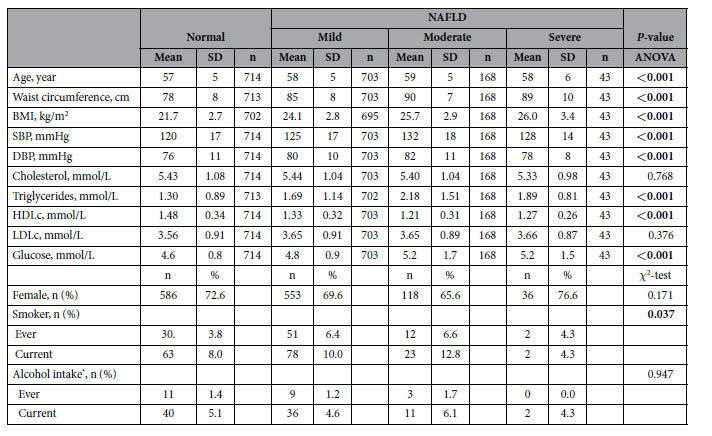
Table 3 shows the characteristics of the participants. Among 1628 participants, 43.2%, 10.3% and 2.6% had mild, moderate and severe NAFLD, respectively, and 79.4% were women. The severity of NAFLD was positively associated with age, BMI, WC, blood pressure, TGs, LDLc and glucose, but negatively correlated with HDLc in both the males and females (all p < 0.05). More NAFLD patients than normal subjects were smokers.
Table 4 shows that a higher concentration of ln-transformed TMAO and a lower concentration of ln-transformed betaine and betaine to choline ratio were associated with a greater severity of NAFLD after adjusting for age, sex, WC, metabolic risk factors, socioeconomic factors, smoking status and physical activity for all participants and for the women (all p-trend < 0.05). The associations were similar in women and in men. Univariate analysis resulted in more pronounced associations (STable 2). We did not observe any significant differences in ln-transformed the plasma choline concentration among NAFLD groups by either univariate or multivariate analysis of variance (Table 4, STable 2).
ORs (95%CI) of NAFLD (none vs. moderate or severe) for the highest (vs. lowest) quartile of TMAO, betaine and choline were 3.25 (1.61-6.56) , 0.13 (0.06-0.26) , and 0.47 (0.25–0.89), respectively. Similar trends were observed for the different cutoffs of NAFLD. (STable 4).
Positive association of ln-TAMO were observed with serum levels of TC, TG and LDLc (p < 0.05); while ln-betaine were inversely associated with TC, TG and LDLc (p < 0.05). No significant associations between ln-choline and lipids were observed . (data not shown).
| NAFLD | |||||||||||
|---|---|---|---|---|---|---|---|---|---|---|---|
| Normal | Mild | Moderate & Severe | ANCOVA | ||||||||
| n | Mean | SE | n | Mean | SE | n | Mean | SE | P-Diff | P-trend | |
| Total | |||||||||||
| Ln(TMAO, μM) | 643 | 0.104 | 0.04 | 643 | 0.16 | 0.038 | 197 | 0.434 | 0.073, 4 4 | <0.001 | <0.001 |
| Ln(Betaine, μM) | 662 | 3.84 | 0.017 | 671 | 3.809 | 0.016 | 208 | 3.667 | 0.03, 4 4 | <0.001 | <0.001 |
| Ln(Choline, μM) | 662 | 3.179 | 0.018 | 671 | 3.169 | 0.017 | 208 | 3.092 | 0.032 | 0.065 | 0.026 |
| Betaine/Choline | 662 | 2.156 | 0.037 | 671 | 2.096 | 0.035 | 208 | 1.987 | 0.065 | 0.104 | 0.034 |
| Women | |||||||||||
| Ln(TMAO, μM) | 457 | 0.096 | 0.049 | 437 | 0.134 | 0.047 | 135 | 0.382 | 0.089 4 | 0.021 | 0.007 |
| Ln(Betaine, μM) | 470 | 3.792 | 0.021 | 453 | 3.755 | 0.02 | 140 | 3.601 | 0.038, 4 4 | <0.001 | <0.001 |
| Ln(Choline, μM) | 470 | 3.165 | 0.022 | 453 | 3.158 | 0.022 | 140 | 3.071 | 0.041 | 0.12 | 0.053 |
| Betaine/Choline | 470 | 2.084 | 0.042 | 453 | 2.01 | 0.041 | 140 | 1.93 | 0.077 | 0.243 | 0.106 |
| Men | |||||||||||
| Ln(TMAO, μM) | 186 | 0.118 | 0.075 | 206 | 0.222 | 0.066 | 62 | 0.539 | 0.13 4 | 0.032 | 0.009 |
| Ln(Betaine, μM) | 192 | 3.948 | 0.028 | 218 | 3.925 | 0.025 | 68 | 3.822 | 0.048 | 0.096 | 0.035 |
| Ln(Choline, μM) | 192 | 3.208 | 0.03 | 218 | 3.188 | 0.027 | 68 | 3.154 | 0.051 | 0.699 | 0.399 |
| Betaine/Choline | 192 | 2.325 | 0.074 | 218 | 2.287 | 0.064 | 68 | 2.116 | 0.124 | 0.377 | 0.175 |
Discussion
Main findings
In the present study, we found consistently adverse associations between the plasma TMAO level and the presence and severity of NAFLD in both the CCS and CSS and a favorable betaine-NAFLD association in the CSS. To our knowledge, the present study is the first to report the adverse association of TMAO with NAFLD in humans. Our findings suggest that TMAO, an intestinal microbiota-dependent metabolite of phosphatidylcholine (PC)/choline, may be an independent risk marker (possible risk factor) for NAFLD.
TMAO and NAFLD
In recent years, a few studies have examined the association between TMAO and cardiovascular risk in both animals and humans. Wang et al.14 have identified a novel pathway (dietary PC/choline → gut-flora-formed TMA → hepatic-flavin monooxygenase-formed TMAO) linking the dietary intake of PC/choline, intestinal microflora and atherosclerosis in mice, in which TMAO promotes the upregulation of multiple macrophage scavenger receptors involved in atherosclerosis. This association has been further confirmed in humans13,18. Tang et al.18 have found that an increased TMAO level is correlated to an increased risk of incident MACE (HR for quartile 4 vs. 1: 2.54, 95%CI: 1.96-3.28) in a 3-year follow-up study of 4007 patients who underwent elective coronary angiography. In addition, an elevated plasma TMAO level has been associated with a 2.2-fold (95%CI, 1.42–3.43) increased risk of mortality after adjusting for traditional risk factors in 720 patients with stable heart failure26. Similar results have been observed in other studies27,28. Further, TMAO may decrease long-term survival in stable subjects with chronic kidney disease, and contribute to progressive renal fibrosis and dysfunction in a murine model29. However, limited data are available for NAFLD. Dumas et al.30 have found that a high urinary excretion of TMAO is associated with insulin resistance and NAFLD in mice (129S6) prone to these diseases. In agreement with these previous studies, we showed an adverse association of the plasma TMAO level with the presence and severity of NAFLD in both clinical patients and community-based participants. The findings of our study and previous studies suggested that TMAO might play diverse adverse roles in the development and progression of various chronic diseases.
The increased risk of fatty liver disease might be caused by TMAO due to its effect on decreasing the total bile acid pool size16 via the following mechanisms: 1) by decreasing the synthesis of bile acids due to the inhibition of the key enzymes CYP7A1 and CYP27A116; and 2) by limiting the enterohepatic circulation of bile acids between the liver and intestines due to the repression of organic anion transporter (oapt) and multidrug resistance protein (MRP) family protein expression16. In addition to their well-established roles in dietary lipid absorption and cholesterol homeostasis, bile acids also act as metabolically active signaling molecules to modulate glucose and lipid metabolism. Therefore, it is possible that TMAO may affect hepatic TGs levels, and reverse the directions of cholesterol transport and glucose and energy homeostasis by altering the synthesis and transport of bile acids, indicating that it is potential risk factor for fatty liver disease.
Choline and NAFLD
Choline is a constituent of cell and mitochondrial membranes. Choline deficiency may affect liver from steatosis to carcinomas via diverse processes, including abnormal phospholipid synthesis, defective very-low-density lipoprotein (VLDL) secretion, aberrations in the methylation-dependent biosynthesis of molecules and the enterohepatic circulation of bile and cholesterol, etc.8. A large number of studies have demonstrated that a choline-deficient diet may cause NAFLD in animals and humans8,31,32. It has been reported that a low dietary choline intake is associated both with a higher risk of NAFLD in normal-weight Chinese women33 and with worse liver fibrosis in postmenopausal US women with NAFLD9. On the other hand, high plasma choline levels have been associated with an unfavorable cardiovascular risk factor profile11 and higher MACE risk12,13. To our knowledge, only one study has examined circulating choline levels and NAFLD, showing that plasma free choline levels are positively related to the severity of liver steatosis, fibrosis and NASH in Japanese10. In this study, we observed an unfavorable association in the hospital-based patients, but not in the community-based adults. The adverse association between circulating choline and NAFLD detected in the CCS may have been due to the TMAO level because this significant association was almost attenuated to null after analysis was adjusted for TMAO.
Betaine and NAFLD
Betaine is an important methyl donor that may be obtained from dietary sources or synthesized endogenously from choline. It may supply its methyl group for the remethylation of homocysteine (Hcy) to methionine and the further regeneration of S-adenosylmethionine (SAM). SAM may subsequently facilitate the metabolic conversion of phosphatidylethanolamine (PE) to form Phosphatidylcholine (PC). Plenty of betaine may partially spare choline34 which is a basic component for the synthesis of PC. PC is necessary for the packaging of VLDL and then promoting lipid exportation from the liver35, subsequently attenuating fatty liver36. Several animal studies have shown that betaine supplementation protects the liver from fat accumulation in rodent models induced by high-fat diets37,38. A small number of randomized controlled trials (RCT) have also reported such beneficial effects of betaine. In a short-term RCT, betaine supplementation for 8 weeks has been found to reduce hepatic steatosis by 25% and attenuate the hepatic concentrations of AST and ALT in 191 patients with NASH39. Another RCT has shown that betaine treatment (20 g/d vs. placebo) for 12 months improves hepatic steatosis and may protect against the worsening of steatosis in 55 patients with biopsy-proven NASH40. Consistent with these results, we observed a significantly inverse association between the plasma betaine concentration and the severity of NAFLD in 1628 community-based adults. Due to the limited evidence in humans, further prospective studies are needed to confirm the potential benefits of betaine in NAFLD.
Strengths and limitations
The strengths of our study include the following: we examined the associations of the plasma levels of TMAO, choline and betaine with NAFLD in both clinical patients with/without biopsy-proven NAFLD and in community-based adults evaluated by ultrasound. In addition, this is the first report of a consistently adverse association between TMAO and NAFLD. Liver biopsy, which was performed in the CCS, is the gold standard for evaluating hepatic steatosis. In addition, the relatively large study size allowed us to have higher power to determine these associations in the CSS, and a variety of covariates including various cardio-metabolic risk factors were adjusted for to avoid potential confounding biases in both studies. However, some residual confounders might be existed due to unmeasured covariates or the potential measurement errors in our studies.
Several limitations should be acknowledged. First, we could not infer a causal relationship between TMAO and NAFLD due to the limitations associated with the study designs used. In addition, we measured the plasma levels of choline and its metabolites in samples obtained at baseline and assessed NAFLD at the follow-up in the CSS. The reported associations are dependent on the stability of the blood levels of TMAO, choline and betaine over an interval of 3.2 years. However, the potential changes in the relevant blood concentrations over the 3.2 years tended to dilute (and not increase) the reported associations, and the delayed evaluation of the dependent variable decreased the possibility of inverse causality in the CSS. Third, liver tissue evaluation is the gold standard method for the assessment of fatty live. Ultrasonography conducted in our CSS may be less sensitive than magnetic resonance spectroscopy in comparison to histology41. A meta-analysis in 2011 reported that liver ultrasound has acceptable sensitivity (84%, 95%CI: 0.79%−0.89%) and excellent specificity (94%, 95%CI: 0.87%−0.97%) compared with liver biopsy42. The misclassification caused by relatively low sensitivity of ultrasound at a low liver fat content41 was unlikely to overestimate the observed association in this study. Fourth, a limited study size was used for the biopsy-proven NAFLD cases and controls due to the difficulty in obtaining such samples. Fifth, inconsistent results for the betaine and choline levels were observed in the CCS and CSS, likely due to the different populations assessed. Lastly, we could not determine whether TMAO was a risk factor or just a marker of co-existing risk factor(s). Howevr, our findings provided a useful clue for further studies of identification of NAFLD causes in humans.
Conclusions
Our findings showed an inverse association of circulating TMAO level with the presence and severity of NAFLD in both the clinical patients and community-based adults, and a favorable relationship between the blood betaine concentration and the severity of NAFLD in the community-based participants but not in the clinical patients. Further studies, particularly inventional human studies or animal models, are needed to clarify if there is a causal relationship between TMAO and NAFLD.
Additional Information
How to cite this article: Chen, Y.-m. et al. Associations of gut-flora-dependent metabolite trimethylamine-N-oxide, betaine and choline with non-alcoholic fatty liver disease in adults. Sci. Rep.6, 19076; doi: 10.1038/srep19076 (2016).
Supplementary Material
Acknowledgments
This study was jointly supported by the National Natural Science Foundation of China (No. 81472966, 81273050, and 81472965) and the 5010 Program for Clinical Studies of Sun Yat-sen University, Guangzhou, China (No. 2007032).