
What this is
- This research investigates how the target residence of the Cas9-sgRNA complex affects () repair pathways in CRISPR/Cas9 genome editing.
- The study finds that varying interactions between Cas9-sgRNA and target DNA influence the choice between classical (c-) and ().
- The findings provide insights into the mechanisms behind mutational heterogeneity in CRISPR/Cas9 applications.
Essence
- Target residence of Cas9-sgRNA influences repair pathway choices, determining the balance between c- and . Weakened target interactions promote c-, increasing off-target mutational risks.
Key takeaways
- Target residence duration of Cas9-sgRNA affects repair pathway choices. Weaker interactions with target DNA lead to increased c- engagement, while stronger interactions favor .
- Local DNA replication can dislodge Cas9-sgRNA from cleaved targets, generating three-ended DSBs that are unsuitable for c-, potentially resulting in chromosomal rearrangements.
- Inactivation of c- enhances off-target effects in CRISPR/Cas9 genome editing, as the weaker binding at off-target sites results in more frequent engagement with c-.
Caveats
- The study primarily uses mouse embryonic stem cells, which may not fully represent repair dynamics in other cell types or organisms.
- The effects of varying Cas9-sgRNA target interactions on repair pathways may differ based on the specific genomic context and cellular conditions.
Definitions
- DNA double-strand break (DSB): A break in both strands of the DNA helix, which can lead to genomic instability if not properly repaired.
- Nonhomologous end joining (NHEJ): A repair pathway that directly ligates the ends of DNA breaks without requiring a homologous template, often leading to mutations.
- Homology-directed repair (HDR): A precise DNA repair mechanism that uses a homologous sequence as a template to repair DSBs, resulting in accurate genomic edits.
Simplified
Introduction
CRISPR/Cas9 genome editing relies on the binding of the Cas9 nuclease, in complex with a single-guide RNA (sgRNA), to a DNA target to induce a site-specific DNA double-strand break (DSB) and its subsequent repair [1, 2]. Upon DSB induction by Cas9, different repair pathways compete for DSB repair, generating the desired DNA edits including substitutions, insertions, deletions, or translocations among varieties of repair products [3]. The two major DSB repair mechanisms in mammalian cells include nonhomologous end joining (NHEJ) and homology-directed repair (HDR). While classical NHEJ (c-NHEJ) is the primary NHEJ pathway, alternative end joining (a-EJ) could also be employed to re-ligate the ends of DSBs if either of the core NHEJ factors including DNA-PKcs, Ku70/Ku80, and XRCC4/DNA ligase 4 is deficient or not engaged [4, 5]. If the ends of DSBs are readily ligatable, such as Cas9-induced blunt ends and I-SceI-induced 3′-overhanging ends, c-NHEJ generates largely accurate end-joining products whereas a-EJ remains mostly mutagenic [6 –9]. Additionally, using homologous sequences as a template, HDR is the preferred pathway for accurate substitutions and insertions in CRISPR/Cas9 genome editing.
The DSB repair pathway choice is governed by a host of factors, including cell cycle stage, DNA end configurations, surrounding chromatin context, and local DNA metabolism [10]. Uniqueness in DSB induction by CRISPR/Cas9 may also participate in this regulation [11, 12]. In CRISPR/Cas9 genome editing, targeting Cas9 to a given site is mediated by several interactions, including the contacts between Cas9 and the protospacer adjacent motif (PAM) of the target, the base pairing of the sgRNA spacer with target strand and non-specific interactions between Cas9 and target DNA [2]. In vitro and in vivo studies have indicated that these interactions entail strong and persistent binding of the Cas9-sgRNA complex to its target and help maintain its target residence for hours (h) even after Cas9-induced DNA cleavage [13 –17]. Repair kinetics reveals that repair of Cas9-induced DSBs is generally slow and often lasts for more than 20 h in mammalian cells; this is likely due to the concealing of DSBs by the Cas9-sgRNA complex retained at the cleaved DNA [17, 18]. Owing to intrinsic disparity in the interactions that mediate the binding of Cas9-sgRNA to its target, the binding affinity of Cas9-sgRNA varies at different sites along with altered target residence. It is likely that Cas9-sgRNA could be spontaneously released from its target or may encounter local DNA replication, transcription, or chromatin remodeling, leading to release of Cas9-sgRNA from cleaved DNA and exposure of Cas9-induced DSBs [11, 12, 19 –22]. These DSBs are subsequently recognized and engaged with repair factors that determine a pathway choice. Therefore, Cas9-sgRNA target residence may regulate DSB repair pathway choices in CRISPR/Cas9 genome editing, as this residence can persist even after DNA cleavage. However, this hypothesis has yet to be tested. Even if target residence of Cas9-sgRNA affects repair of Cas9-induced DSBs, it is unclear what effect it has on repair of Cas9-induced DSBs and how.
Here, we find that the extent of c-NHEJ involvement varies between different target sites in repair of Cas9-induced DSBs in a population of asynchronous mammalian cells. We demonstrate that weakening target interaction of Cas9-sgRNA promotes the repair bias towards c-NHEJ at the same Cas9-induced DSBs. In vitro binding assays reveal that the weakened target interaction increases target dissociation and shortens target residence of Cas9-sgRNA at cleaved and uncleaved DNA. The c-NHEJ inhibition, which is often used to increase HDR-mediated CRISPR/Cas9 genome editing, elevates off-target effects of CRISPR/Cas9, as the interaction between Cas9-sgRNA and off-target sites is weaker. Local DNA replication, not transcription, suppresses c-NHEJ and promotes a-EJ and HDR by dislodging Cas9-sgRNA that remains bound to its cleaved target and generating three-ended DSBs unsuitable for c-NHEJ. Repair of three-ended DSBs could result in palindromic fusion of sister chromatids, a key step in chromosomal breakage-fusion-bridge cycles and a potential source for on-target gross chromosomal rearrangements in CRISPR/Cas9 genome editing. As CRISPR/Cas9 genome editing generates highly heterogeneous repair products, the effects of Cas9-sgRNA target residence on DSB repair pathway choices at both on-target sites and off-target sites may significantly contribute to this mutational heterogeneity.
Results
Inactivation of c-NHEJ induces varying stimulation of Cas9-induced HDR among targets

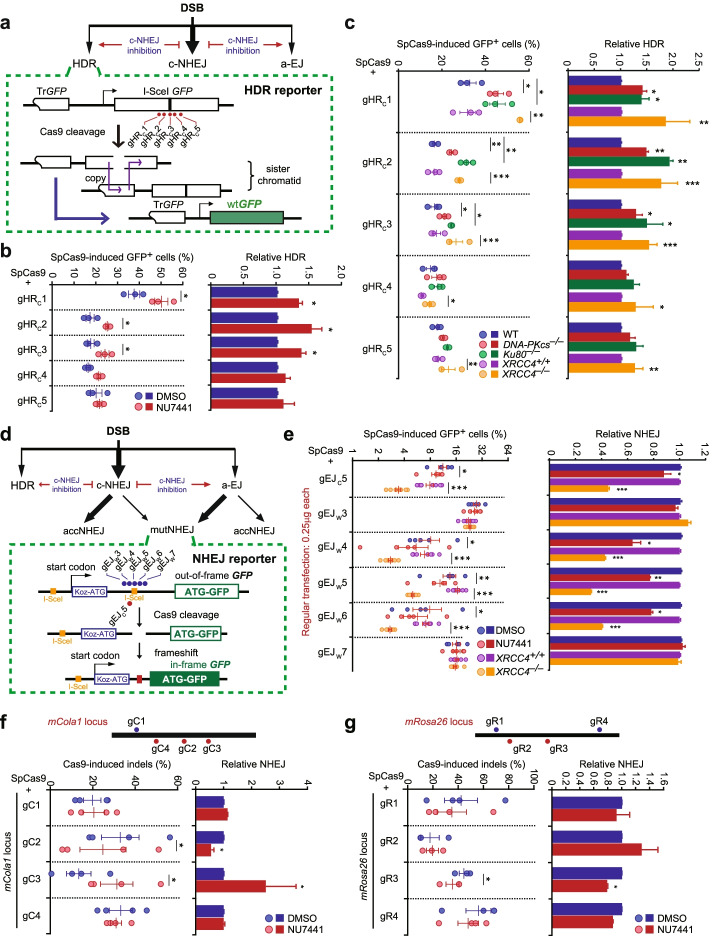
Involvement of c-NHEJ varies widely in repair of Cas9-induced DSBs.Schematic of the HDR reporter with 5 sgRNAs. Repair of Cas9-induced DSBs by HDR between sister chromatids can generatecells. Inhibition of c-NHEJ is expected to promote HDR.Effects of DNA-PKcs inhibition on SpCas9-induced HDR in mESC transfected with individual Cas9-sgRNA. Left: Frequencies of SpCas9-inducedcells; Right: Relative HDR after normalizing DMSO treatment to 1.0.Effects of,, ordeficiency on SpCas9-induced HDR in mESC transfected with individual Cas9-sgRNA. Left: Frequencies of SpCas9-inducedcells; Right: Relative HDR after normalizing both WT cells andcells to 1.0.Schematic of the NHEJ reporter with 6 sgRNAs and their target sites indicated. Repair of Cas9-induced DSBs by c-NHEJ or a-EJ generates accurate NHEJ (accNHEJ) products indistinguishable from undamaged targets and mutagenic NHEJ (mutNHEJ) products represented bycells. Inhibition of c-NHEJ promotes a-EJ.Effect of DNA-PKcs inhibition anddeletion on SpCas9-induced NHEJ in mESC transfected with individual Cas9-sgRNA. Left: Frequencies of SpCas9-inducedcells; Right: Relative NHEJ after normalizing both DMSO treatment andcells to 1.0.,Cells were transfected with SpCas9-sgRNA expression plasmids and treated with DMSO or NU7441. Four different sites of the() and() locus were targeted by 4 sgRNAs indicated. The efficiency of SpCas9-induced genome editing (left) was calculated as ratios of edited reads to total reads from targeted Illumina sequencing and normalized by transfection efficiency. Relative SpCas9-induced NHEJ (right) was calculated by normalizing the editing efficiency with DMSO treatment to 1.0. Each circle indicates one independent experiment, each in triplicates. Columns indicate the mean ± S.E.M of at least three independent experiments. Significance was detected by two-tailed Student'stest and indicated by * for<0.05, ** for<0.01 and *** for<0.001 a b c d e f g f g GFP GFP DNA-PKcs Ku80 Xrcc4 GFP Xrcc4 GFP Xrcc4 GFP Xrcc4 Cola1 Rosa26 t P P P + + + +/+ + + +/+
Repair of Cas9-induced DSBs involves c-NHEJ to varying degrees at different targets
To directly analyze the extent of c-NHEJ involvement in repair of Cas9-induced DSBs at different target sites, we used Cas9-sgRNA to induce site-specific DSBs in an NHEJ reporter integrated in the genome of mESC as done before [28] and analyzed the effect of c-NHEJ inactivation on the frequencies of Cas9-induced insertion or deletion mutations (indels) (Fig. 1d and Additional file 1: Fig. S2a). In this NHEJ reporter, no wild-type GFP is translated due to an upstream, out-of-frame translation start site (Koz-ATG), which is flanked by two I-SceI sites sequentially positioned [29]. When a DSB is induced by Cas9-sgRNA at a site between "Koz-ATG" and the ATG-GFP coding region, repair by either c-NHEJ or a-EJ can generate indels at the repair junction. In general, because of a 34-bp interval between "Koz-ATG" and ATG for GFP, indels with net addition of "3n+2" bp or net loss of "3n-1" bp can change the 34-bp frame-shift to in-frame, leading to production of GFP+ cells. The frequency of Cas9-induced GFP+ cells thus represents the relative efficiency of Cas9-induced indels [28] (Fig. 1d and Additional file 1: Fig. S2a). As c-NHEJ and a-EJ generate different proportions of accurate NHEJ (accNHEJ) products and indel-based mutagenic NHEJ (mutNHEJ) products [4], inactivation of c-NHEJ would channel more Cas9-induced DSBs towards error-prone a-EJ in addition to HDR, increasing the frequencies of mutNHEJ. We found that neither DNA-PKcs inhibition by NU7441 nor Xrcc4 deletion changed the frequencies of mutNHEJ represented by Cas9-induced GFP+ cells at the two sites targeted by the sgRNA gEJW3 or gEJW7, suggesting little involvement of c-NHEJ at these two sites (Fig. 1e). However, inactivation of c-NHEJ inhibited the level of Cas9-induced GFP+ cells at the four sites targeted by gEJC5, gEJW4, gEJW5, and gEJW6 to different extents, varying from 16.6 to 69.2% (Fig. 1e). Consistently, junction analysis by targeted PCR amplicon deep sequencing revealed that NU7441 had little or modest effect on the editing efficiency, the length distribution of deletions, and the MH usage at the gEJw7 site, but significantly altered the editing efficiency, the length distribution of deletions, and the MH usage at the gEJc5 site (Additional file 1: Fig. S2b-d). As a dominant type of Cas9-induced indels [6, 18, 30 –32], 1-bp templated insertions (TIs), which do not generate GFP+ cells in NHEJ reporter cells, occurred much more frequently at the gEJw7 site than at the gEJc5 site (Additional file 1: Fig. S2e). Together, these results indicate that the participation of c-NHEJ varies in repair of Cas9-induced DSBs at different targets in mESC.
Using targeted PCR amplicon deep sequencing, we also measured the frequencies of Cas9-induced indels at two natural genome loci Cola1 and Rosa26 in mESC. We found that NU7441 reduced the editing efficiency at the sites targeted by Cola1 gC2 and Rosa26 gR3, stimulated by more than 2-fold at the sites by Cola1 gC3, and had minimal effect at the rest of the sites including gC1 and gC4 for Cola1 and gR1, gR2, and gR4 for Rosa26 (Fig. 1f, g). Generally, DNA-PKcs inhibition had little or modest effect on the length distribution of deletions and the MH usage at the target sites where c-NHEJ involvement is limited, but increased deletion length and the MH usage at the target sites where c-NHEJ is engaged (Additional file 1: Fig. S3a-c). Together with varying stimulation of Cas9-induced HDR at different targets by inactivation of c-NHEJ, these results suggested variable involvement of c-NHEJ in CRISPR/Cas9 genome editing at different sites or even no involvement of c-NHEJ at some sites in mESC.
Target recleavage by Cas9 amplifies the mutagenicity of c-NHEJ
Like I-SceI, CRISPR nucleases generate DSBs with directly ligatable ends. Previous studies have demonstrated that c-NHEJ is intrinsically accurate for these ends [6, 7, 29]. In each round of repair during CRISPR/Cas9 genome editing, about a half of NHEJ products are accurate in repair of Cas9-induced DSBs and the remaining half generate indels [6, 8, 9]. Thus, inactivation of c-NHEJ would increase the use of a-EJ in each round of CRISPR/Cas9 genome editing. Since a-EJ is more error prone, inactivation of c-NHEJ would elevate Cas9-induced indels. It is unexpected that the frequency of Cas9-induced indels was instead inhibited at many Cas9-sgRNA target sites by inactivation of c-NHEJ (Fig. 1e–g). To determine whether this was unique to repair of Cas9-induced DSBs, we used the same NHEJ reporter cells but with the first I-SceI site being deleted to ensure that I-SceI induces single cleavage as Cas9 does and compared the effect of c-NHEJ inactivation on the frequency of Cas9- and I-SceI-induced indels represented by GFP+ cells (Additional file 1: Fig. S4a). In consistent with previous findings that inactivation of c-NHEJ stimulates production of I-SceI-induced GFP+ cells [28, 33], inhibition of c-NHEJ with NU7441 increases I-SceI-induced GFP+ cells by more than 2-fold (Additional file 1: Fig. S4b,c). Given the fact that inactivation of c-NHEJ suppresses Cas9-induced indels at many Cas9-sgRNA target sites, this appears to suggest a difference between Cas9- and I-SceI-NHEJ.
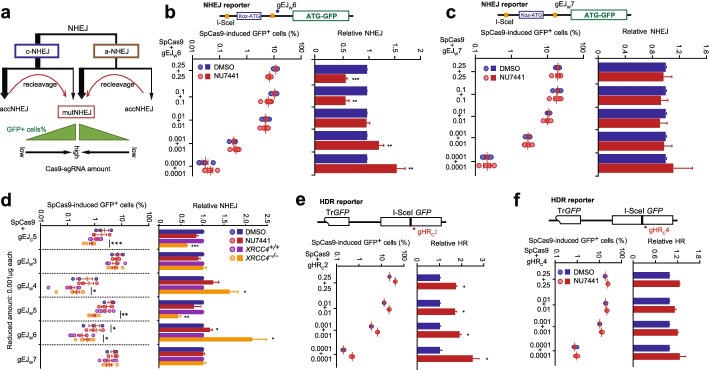
We then reassessed the c-NHEJ engagement at the 6 Cas9-sgRNA target sites when Cas9 recleavage of the regenerated target is prevented by lowering the transfection amount of Cas9-sgRNA. At the two sites targeted by gEJW4 and gEJW6 with the transfection amount of Cas9-sgRNA at 0.001 μg, Cas9-induced indels were also reduced as expected (Fig. 2d). DNA-PKcs inhibition and Xrcc4 deletion did not suppress production of Cas9-induced GFP+ cells any more or even reversed to stimulation at the gEJW4 and gEJW6 targets but remained to exert no effect on the level of Cas9-induced GFP+ cells at the gEJW3 or gEJW7 site (Fig. 2d). In fact, Xrcc4 deletion elevated the frequency of Cas9-induced GFP+ cells by 59.6 ± 14.2% (P<0.05) at the gEJW4 target and 81.5 ± 24.5% (P<0.05) at the gEJW6 target with 0.001 μg of Cas9-sgRNA (Fig. 2d), a reverse from reduction of Cas9-induced GFP+ cells by 58.1 ±3% and 60.4 ± 2.4% respectively at these two targets with 0.25 μg of Cas9-sgRNA (Fig. 1e). These results again indicate that limiting Cas9 recleavage could elicit the stimulatory effect of c-NHEJ inactivation on Cas9-induced indels in mESC.
Differently, at the gEJC5 or gEJW5 target, with the transfection amount of Cas9-sgRNA at 0.001 μg, DNA-PKcs inhibition and Xrcc4 deletion still inhibited the generation of Cas9-induced GFP+ cells; but this inhibition was reduced (Fig. 2d). At the gEJC5 target, Xrcc4 deletion reduced Cas9-induced GFP+ cells by 37.0 ±3.2% (P<0.001) with 0.001 μg of Cas9-sgRNA, a smaller reduction than 55.8 ± 2.6% (P<0.001) with 0.25 μg of Cas9-sgRNA (Figs. 2d vs. 1e). At the gEJW5 target, this reduction of GFP+ cells by Xrcc4 deletion is 57.6 ± 7.5% (P<0.001) with 0.001 μg of Cas9-sgRNA but 69.2 ±1.5% (P<0.01) with 0.25 μg of Cas9-sgRNA (Figs. 2d vs. 1e). This suggests that Cas9 recleavage could still abrogate the stimulatory effect of c-NHEJ inactivation on Cas9-induced indels at the gEJC5 or gEJW5 target sites where limiting Cas9 recleavage does not fully abolish the suppression of Cas9-induced indels by c-NHEJ inactivation. Similar to the gEJW7 target, no effect by c-NHEJ inactivation was detected at the gEJW3 target with neither 0.001 nor 0.25 μg of Cas9-sgRNA (Figs. 2d and 1e), suggesting no engagement of c-NHEJ at these two sites. Taken together, these results not only indicate that target recleavage by Cas9 amplifies the mutagenicity of c-NHEJ in CRISPR/Cas9 genome editing in mESC, but also confirm that the involvement of c-NHEJ varies significantly at different targets in repair of Cas9-induced DSBs after target recleavage by Cas9 is partially or fully prevented. Of note, DNA-PKcs inhibition by NU7441 elicited weaker manifestation of c-NHEJ engagement than deletion of Xrcc4. This is possible due to different functions of these two factors in NHEJ.
Since minimizing Cas9 recleavage helps maintain a higher proportion of accurate NHEJ products among NHEJ events if c-NHEJ is engaged in repair of Cas9-induced DSBs, inactivation of c-NHEJ would stimulate HDR more strongly. Indeed, at the gHRC2 site, the HDR stimulation by NU7441 was enhanced after the transfection amount of Cas9-sgRNA was reduced (Fig. 2e), confirming c-NHEJ engagement in repair of Cas9-induced DSBs at this site. In contrast, at the gHRC4 site, HDR was not stimulated by NU7441 regardless of the transfection amount of Cas9-sgRNA (Fig. 2f), again indicating that c-NHEJ is little involved at this site.

Cas9 recleavage increases c-NHEJ-mediated mutations.Model for enrichment of mutNHEJ products promoted by frequent SpCas9 recleavage with increased amount of Cas9-sgRNA transfected. With sufficient amount of SpCas9-sgRNA, accNHEJ products could be recleaved until mutNHEJ products are generated, resulting in enrichment of mutNHEJ products.,Effect of DNA-PKcs inhibition on NHEJ induced by varying amount of SpCas9-sgRNA. NHEJ reporter mESC were transfected with varying amounts of expression plasmids for SpCas9-gEJ6 () or SpCas9-gEJ7 () as indicated and treated with DMSO or NU7441. Frequencies of SpCas9-induced GFPcells were measured by FACS at 3 days post-transfection and relative SpCas9-induced NHEJ was calculated by normalizing DMSO treatment to 1.0.Frequencies ofcells (left) and relative NHEJ (right) induced by SpCas9-sgRNA at 0.001 μg each, 1/250 of the regular amount (0.25 μg each) transfected into mESC. Each circle indicates one independent experiment, each in triplicates, and the mean of at least three independent experiments is also indicated.,Effect of DNA-PKcs inhibition on HDR induced by varying amount of SpCas9-sgRNA. HDR reporter mESC were transfected with varying amounts of expression plasmids for SpCas9-gHR2 () or SpCas9-gHR4 () as indicated and treated with DMSO or NU7441. Frequencies of SpCas9-induced GFPcells were measured by FACS at 3 days post-transfection and relative SpCas9-induced NHEJ was calculated by normalizing DMSO treatment to 1.0. For NHEJ and HDR assays in, more than 200,000 cells were usually harvested to ensure at least 100cells counted for reliable calculation. Columns indicate the mean ± S.E.M. Statistical significance was detected by two-tailed Student'stest: *<0.05; **<0.01; and ***<0.001 a b c b c d e f e f b–f W W C C + + + + GFP GFP t P P P
Weakening target interaction of Cas9-sgRNA biases repair of Cas9-induced DSBs towards c-NHEJ
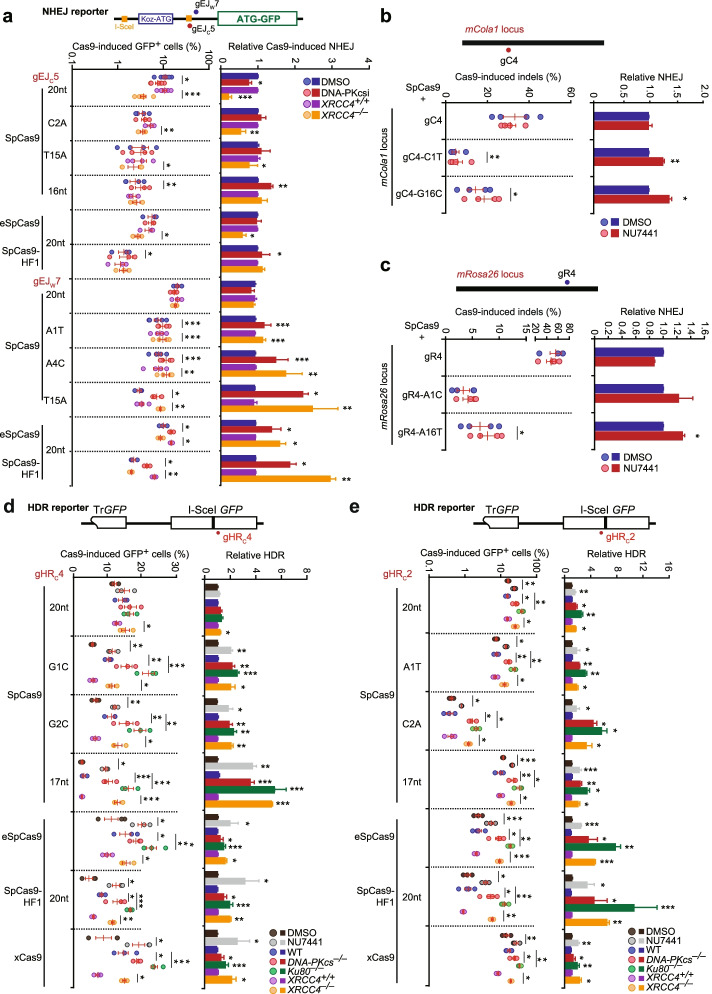
Using endogenous genomic loci, we also found that the editing efficiency with the mismatch variants of Cola1 gC4 (i.e., C1T and G16C) and Rosa26 gR4 (i.e., A1C and A16T) was reduced due to weaker target interaction (Fig. 3b, c and Additional file 1: Fig. S5b). Consistently, DNA-PKcs inhibition by NU7441 had minimal effect on Cas9-induced indels at the sites targeted by Cola1 gC4 and Rosa26 gR4 (Fig. 1f, g), but stimulated Cas9-induced indels with the gC4 variant G16C and the gR4 variants A1C and A16T (Fig. 3b, c and Additional file 1: Fig. S5b). This again indicates that reducing Cas9-sgRNA target interaction promotes c-NHEJ. Taken together, these results suggest that weakened target interaction of Cas9-sgRNA increase bias towards c-NHEJ in repair of Cas9-induced DSBs in mESC.

Reduced target binding affinity of Cas9-sgRNA shifts the pathway bias towards c-NHEJ in repair of Cas9-induced DSBs.Effects of DNA-PKcs inhibition anddeletion on SpCas9-induced NHEJ in mESC transfected with individual SpCas9-sgRNA and its variants as indicated. Left: Frequencies of SpCas9-inducedcells; Right: Fold change of NHEJ alteration induced by NU7441 ordeletion relative to the SpCas9-20nt control, i.e., the ratio of NHEJ change induced by NU7441 ordeletion for each SpCas9-sgRNA variant to that for the SpCas9-20nt control.,Effects of DNA-PKcs inhibition on NHEJ-mediated genome editing at endogenous loci() and() in mESC transfected with individual SpCas9-sgRNA and its variants as indicated. The frequencies of Cas9-induced indels (left) were calculated as ratios of edited reads to total reads from targeted Illumina sequencing and normalized by transfection efficiency. The fold change of NHEJ alteration induced by NU7441 relative to the SpCas9-20nt control (right) was calculated as the ratio of NHEJ change induced by NU7441 for each SpCas9-sgRNA variant to that for the SpCas9-sgRNA control.,Effects of DNA-PKcs inhibition and,, ordeficiency on Cas9-induced HDR in mESC transfected with Cas9-gHR4 (), Cas9-gHR2 (), and its variants as indicated. Left: Frequencies of Cas9-inducedcells; Right: Fold change of HDR stimulation induced by NU7441 or deletion of,, orrelative to the SpCas9-20nt control. This fold change was calculated as the ratio of HDR stimulation induced by NU7441 or deletion of,, orfor each SpCas9-sgRNA variant to that for the SpCas9-20nt control. Each circle indicates one independent experiment, each in triplicates, and the mean of at least three independent experiments is also indicated. Columns indicate the mean ± S.E.M. Statistical significance was detected by two-tailed Student's pairedtest for frequencies of Cas9-inducedcells or Cas9-induced indels and by one-way ANOVA followed by post hoc Dunnett's test for fold changes of NHEJ alteration or HDR stimulation: *<0.05; **<0.01; and ***<0.001 a b c b c d e d e Xrcc4 GFP Xrcc4 Xrcc4 Cola1 Rosa26 DNA-PKcs Ku80 Xrcc4 GFP DNA-PKcs Ku80 Xrcc4 DNA-PKcs Ku80 Xrcc4 t GFP P P P + + + C C
Weakening target interaction of Cas9-sgRNA enhances stimulatory effect of c-NHEJ inactivation on Cas9-induced HDR
Consistently with previous studies [23 –25], inactivation of c-NHEJ stimulates HDR induced by CRISPR nucleases as well as I-SceI (Fig. 1b, c and Additional file 1: Fig. S1d). We expected that this stimulatory effect would be further enhanced if HDR were induced by Cas9-sgRNA variants with reduced target interaction, because reducing Cas9-sgRNA target interaction promotes c-NHEJ. We thus compared HDR induced by mutated Cas9-sgRNA between cells proficient and deficient in c-NHEJ. Due to reduced efficiency of DNA cutting, Cas9-induced HDR was generally less efficient with mismatched or truncated sgRNA variants (i.e., G1C, G2C, and 17nt for gHRC4, and A1T, C2A, and 17nt for gHRC2) and SpCas9 variants eSpCas9, SpCas9-HF1, and xCas9 (i.e., xCas9-3.7), except eSpCas9-gHRC4, SpCas9-gHRC2 17nt, and xCas9-gHRC2 20nt (Fig. 3d, e and Additional file 1: Fig. S5c).
At the site targeted by gHRC4, as in Fig. 1c, Cas9-induced HDR was not affected by DNA-PKcs inhibition, DNA-PKcs deletion, or Ku80 deletion, but modestly stimulated by deletion of Xrcc4, Cas9-induced HDR with the sgRNA variants G2C and 17nt was elevated by NU7441 (Fig. 3d). Similarly, deletion of DNA-PKcs or Ku80 elicited stimulatory effect on Cas9-induced HDR with gHRC4 G1C and 17nt, as well as with SpCas9-HF1 (Fig. 3d). In addition, Xrcc4 deletion stimulated Cas9-induced HDR with the gHRC4 variants (i.e., G1C, G2C, and 17nt) and the SpCas9 variants SpCas9-HF1 and xCas9 by up to 4.3-fold (Fig. 3d). At the site targeted by gHRC2, where Cas9-induced HDR was increased by DNA-PKcs inhibition or deletion of DNA-PKcs, Ku80, or Xrcc4 as in Fig. 1c, stimulation of Cas9-induced HDR by NU7441 was further enhanced with the SpCas9 variants such as eSpCas9 and SpCas9-HF1 (Fig. 3e). This HDR stimulation for the SpCas9 variants increased by 1.2- to 2.2-fold as compared to the SpCas9 control (Fig. 3e). Deletion of DNA-PKcs, Ku80, or Xrcc4 caused more stimulation of Cas9-induced HDR for SpCas9-gHRC2 C2A, eSpCas9-20nt, and SpCas9-HF1-20nt as this HDR stimulation were enhanced by up to 4.9-fold (Fig. 3e).
However, neither DNA-PKcs inhibition nor genetic inactivation of c-NHEJ by deletion of DNA-PKcs, Ku80, or Xrcc4 stimulated more HDR induced by eSpCas9-gHRC4 20nt, SpCas9-gHRC2 A1T, SpCas9-gHRC2 17nt, or xCas9-gHRC2 20nt than that induced by their respective SpCas9-20nt controls (Fig. 3d, e). It appeared that HDR induced by these Cas9-sgRNA variants is as efficient as that by their SpCas9-20nt controls at their target sites (Fig. 3d, e). It is possible that little is changed in the strength of target interaction or the efficiency of target cleavage between the SpCas9-20nt control and Cas9-sgRNA variants at these sites despite modification of SpCas9 or sgRNA. Taken together, these results above confirm that reducing target interaction of Cas9-sgRNA promotes c-NHEJ in mESC, providing the basis for the enhanced stimulatory effect of c-NHEJ inactivation on Cas9-induced HDR.
Mismatched or truncated sgRNAs reduce Cas9-sgRNA target binding and residence
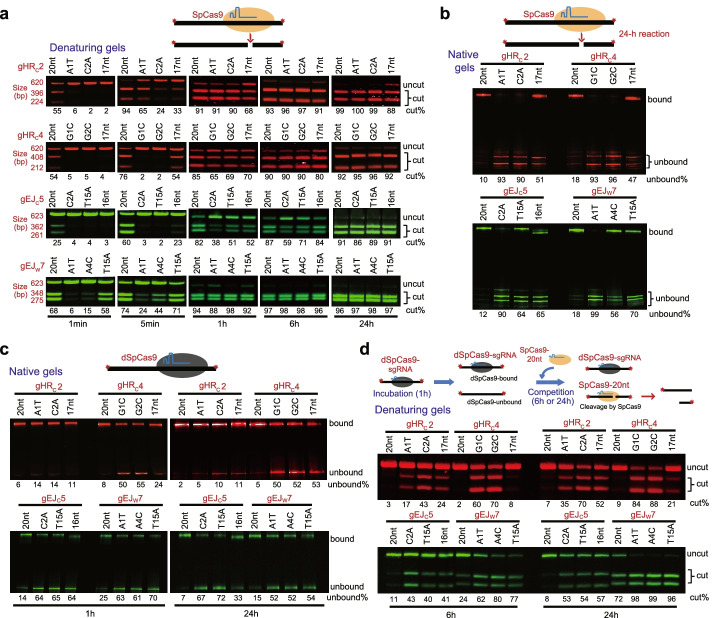
For fully matched 20-nt sgRNAs, dSpCas9, sgRNA, and its target DNA at the molar ratio of 5:5:1 assembled nearly all target DNA into dSpCas9-sgRNA-DNA ternary complex in vitro at 1 h and 24 h of the reaction, leaving little unbound DNA (Fig. 4c). By comparison, a significant level of target DNA remained unbound by dSpCas9-sgRNA variants at 1 h and 24 h of the in vitro assembly (Fig. 4c). This again suggests that reducing target interaction could either lessen initial target binding or facilitate target dissociation of SpCas9-sgRNA. To determine whether uncleaved target DNA could be released from the dSpCas9-sgRNA-DNA ternary complex, we added SpCas9-20nt into the mix of the in vitro assembly reaction immediately after the dSpCas9-sgRNA-DNA complex was assembled for 1 h, allowing the competing SpCas9-20nt to cleave the initially unbound DNA or the DNA newly released from the dSpCas9-sgRNA-DNA complex for 6 h and 24 h (Fig. 4d). Little or modestly some target DNA from the dSpCas9-20nt-DNA complex was cleaved by SpCas9 at all 4 target sites, i.e., the gHRc2, gHRc4, gEJc5, and gEJw7 sites, indicating target protection by persistent target residence of dSpCas9 complexed with fully matched 20-nt sgRNA (Fig. 4d). In contrast, a portion of target DNA from the in vitro dSpCas9-sgRNA-DNA ternary complex assembly containing mismatched or truncated sgRNAs was cleaved by SpCas9 at 6 h of the cleavage reaction (Fig. 4d). The level of cleavage by SpCas9 increased further at 24 h for all mismatched or truncated sgRNAs (Fig. 4d), indicating continuous dissociation of target DNA from the dSpCas9-sgRNA-DNA complex with mismatched or truncated sgRNAs. These results again suggest that reducing target interaction of Cas9-sgRNA promote target dissociation and shorten target residence of SpCas9-sgRNA.

Mismatched or truncated sgRNAs reduce target residence of Cas9-sgRNA in vitro at the gHR2, gHR4, gEJ5, and gEJ7 sites. The schematics for the target binding, cleavage, and dissociation reaction were shown on the top.DNA cleavage by SpCas9-20-nt perfectly matched sgRNAs and SpCas9-sgRNA variants at different time points of the reaction as indicated. Fluorescence-labeled DNA targets were 620 bp or 623 bp as shown. DNA cleavage from the reaction was detected on 2% denaturing agarose gel.Residence of SpCas9-sgRNAs including SpCas9-20-nt control and its variants on cleaved DNA. SpCas9-sgRNAs were incubated with fluorescence-labeled target DNAs fromfor 24 h. DNA bound with SpCas9-sgRNAs and unbound DNA were resolved by 4–20% native PAGE gel.Target residence of dSpCas9-sgRNAs including dSpCas9-20nt control and its variants. dSpCas9-sgRNAs were incubated with fluorescence-labeled target DNAs fromfor 1 and 24 h. DNA bound with dSpCas9-sgRNAs and unbound DNA were resolved by 4–20% native PAGE gel.Cleavage of DNA released from the dSpCas9-sgRNA-DNA ternary complex by competing SpCas9-20nt sgRNA. The preassembled dSpCas9-20-nt sgRNA and dSpCas9-sgRNA variant complexes were incubated with fluorescence-labeled target DNAs fromfor 1 h. The preassembled SpCas9-20nt perfectly matched sgRNA complex was added to compete for binding to DNA targets released from the dSpCas9-sgRNA-DNA complex and cleave DNA for 6 and 24 h. DNA cleavage from the reaction was detected on 2% denaturing agarose gel. The efficiency of target cleavage and target dissociation was calculated as the intensity ratio of cut DNA to total DNA inandand the intensity ratio of unbound DNA to total DNA inand, respectively. The values of these ratios were shown in percentages under each DNA gel C C C W a b a c a d a a d b c
Inactivation of c-NHEJ increases off-target activity of CRISPR/Cas9
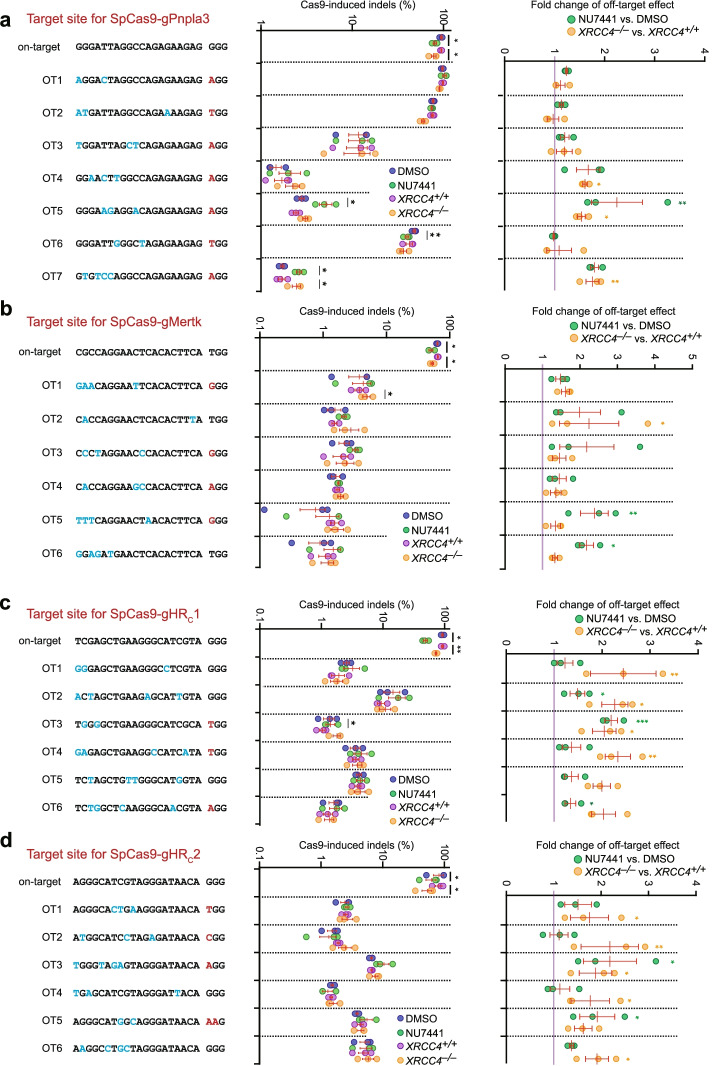
Chemical inhibition and genetic inactivation of c-NHEJ are often used to increase the efficiency of Cas9-induced HDR-mediated gene knock-in or replacement [40 –45]. Given that DNA-PKcs inhibition by NU7441 stimulated Cas9-induced HDR in the HDR reporter at the targets by gHRC1 and gHRC2 (Fig. 1b), we also performed off-target analysis for 6 potential off-target sites for Cas9-gHRC1 and Cas9-gHRC2 in mESC, respectively. After NU7441 treatment, the frequencies of on-target indels induced by Cas9-gHRC1 and Cas9-gHRC2 were slightly lowered by 20–40%, again indicating significant on-target DNA recleavage. Unlike on-target editing, the frequencies of Cas9-induced indels at the 6 off-target sites were not reduced by NU7441. Instead, these frequencies were stimulated by DNA-PKcs inactivation or Xrcc4 deletion (Fig. 5c,d), and the fold change of off-target effect was elevated up to 2.5 (Fig. 5c,d). This again suggests that both chemical inhibition and genetic inactivation of c-NHEJ exacerbate off-target effects in CRISPR/Cas9 genome editing in mESC.

DNA-PKcs inhibition anddeletion aggravate off-target effect in CRISPR/Cas9 genome editing.HDR reporter mESC were used for transfection with SpCas9 in complex with gPnpla3 targeting(), gMertk targeting(), gHR1 (), and gHR2 () both targeting the HDR reporter. At 6 h post-transfection, cells were treated with DMSO or NU7441. At 72 h post-transfection, gDNA was isolated and the indel frequency at on-target and selected off-target sites was measured by amplicon deep sequencing and calculated as the ratio of edited reads to total reads normalized by transfection efficiency. In an independent set of experiments, isogenicandHDR reporter mESC were transfected and the indel frequency at on-target and selected off-target sites was similarly measured. Fold change of off-target effect after treatment of NU7441 or deletion ofwas calculated as the ratio of the indel frequency with treatment of NU7441 or incells to that with DMSO or incells at each off-target site, respectively. Each circle indicates one independent experiment, and the mean of these independent experiments is also indicated. Error bars indicate S.E.M. Statistical analysis was performed by two-tailed Student's pairedtest for frequencies of Cas9-induced indels and by one-way ANOVA followed by post hoc Dunnett's test for fold changes of off-target effect between NU7441 and DMSO, and betweenand. *<0.05 and **<0.01 Xrcc4 Xrcc4 Pnpla3 Mertk Xrcc4 Xrcc4 Xrcc4 Xrcc4 Xrcc4 t Xrcc4 Xrcc4 P P +/+ +/+ –/– –/– +/+ +/+ –/– a b c d C C
Local transcription does not prevent c-NHEJ engagement in repair of Cas9-induced DSBs
To further determine whether lack of c-NHEJ engagement in repair of Cas9-induced DSBs at some sites is caused by transcription-mediated Cas9-sgRNA target dissociation generating ends unsuitable for c-NHEJ, we analyzed the effect of local transcription blockage on the state of c-NHEJ engagement at a given site where c-NHEJ is little involved. We thus used catalytically dead Staphylococcus aureus Cas9 (dSaCas9)-sgRNA to block the translocating RNA polymerase (RNAP), preventing downstream dissociation of SpCas9-sgRNA from its cleaved target (Fig. 6e). Among 6 sgRNAs tested for transcriptional blockage, only gSaGW1 and gSaGW2, in complex with dSaCas9, efficiently reduced gene expression by 26.7±4.5% (P<0.05) and 47.4± 7.3% (P<0.01) respectively, indicating a strong capability of blocking RNAP (Fig. 6e). As in Fig. 6b, the frequency of GFP– cells induced by SpCas9-gGC4 and SpCas9-gGW5 at a transfection amount of 0.125 or 0.0005 μg for each plasmid was not altered by DNA-PKcs inhibition with NU7441, indicating little c-NHEJ involvement in repair of Cas9-induced DSBs at these two sites (Fig. 6f). This lack of c-NHEJ engagement was little changed by co-transfection with either dSaCas9-gSaGW1 or dSaCas9-gSaGW2 that could block local transcription (Fig. 6f). This indicates that transcription blockage upstream by dSaCas9-sgRNA (e.g., dSaCas9-gSaGW1 and dSaCas9-gSaGW2) would not promote c-NHEJ engagement in repair of SpCas9-induced DSBs at sites where c-NHEJ is little engaged and further excludes the possibility that transcription-mediated Cas9-sgRNA target dissociation prevent c-NHEJ engagement in repair of Cas9-induced DSBs in mESC.

Transcription has no effect on c-NHEJ in repair of Cas9-induced DSBs.dSpCas9-mediated transcriptional silencing in mESC containing pPGK-GFP expression cassette. The mean fluorescence intensity of GFP indicates relative transcription.Involvement of c-NHEJ in SpCas9-induced DSBs in mESC containingexpression cassette. Cells were transfected with a low amount of individual SpCas9-sgRNA expression plasmids (0.001 μg SpCas9, 0.001 μg sgRNA, 1/500 of total DNA each) as shown and treated with NU7441 at 6 h post-transfection. Relative NHEJ (=3) was calculated by normalizing DMSO treatment to 1.0.Analysis of strand bias in transcriptional silencing (top) and c-NHEJ involvement (bottom) between transcription template strand and transcription non-template strand targeted by dSpCas9-sgRNA or SpCas9-sgRNA. Transcriptional silencing and c-NHEJ involvement were defined as the percentage of GFP fluorescence intensity reduced by dSpCas9-sgRNA and the percentage of SpCas9-induced NHEJ stimulated by NU7441, respectively.Correlation between dSpCas9-mediated transcriptional silencing and c-NHEJ involvement in repair of SpCas9-induced DSBs. Each circle indicates the level of dSpCas9-mediated transcriptional silencing and stimulation of SpCas9-induced NHEJ by NU7441 at the same target. Two sgRNAs gG5 and gG4 are indicated by arrows for their strong effect on transcriptional silencing.dSaCas9-mediated transcriptional silencing in mESC containingexpression cassette. The mean fluorescence intensity of GFP indicates relative transcription. Transcription blockage by dSaCas9-gSaG1 and dSaCas9-gSaG2 induced significant transcription silencing. Positions of the targets by dSaCas9-sgRNAs are indicated in the reporter.Little effect of transcription blockage by dSaCas9-gSaG1 and dSaCas9-gSaG2 on DNA-PKcs involvement in SpCas9-mediatedgene editing.cells were co-transfected with SpCas9-sgRNA (SpCas9 and sgRNA at 0.125 μg and 0.0005 μg respectively) and dSaCas9-sgRNA (0.125 μg each), and frequencies of SpCas9-inducedcells measured by FACS at 4 days post-transfection. Each circle indicates one independent experiment, and the mean of these independent experiments is also indicated. Error bars indicate S.E.M. Two-tailed Student's paired or unpairedtest is indicated by * for<0.05, ** for<0.01, *** for<0.001, and n.s. for not significant. Correlation between transcription silencing and the NHEJ increase was determined by linear regression analysis a b c d e f pPGK-GFP n pPGK-GFP GFP GFP GFP t P P P W C W W W W + –
Local replication abolishes c-NHEJ engagement at Cas9-induced DSBs
We also wondered whether a collision with local DNA replication would favor HDR over c-NHEJ in repair of Cas9-induced DSBs by blocking c-NHEJ engagement, thus removing the stimulatory effect of DNA-PKcs inhibition on Cas9-induced HDR. Using U2OS cells containing an integrated single-copy HDR reporter (Fig. 7b), in which an SV40 origin is located between TrGFP and I-SceI-GFP, we analyzed the effect of DNA-PKcs inhibition by NU7441 on HDR induced by I-SceI and SpCas9. In consistent with the results from mESC (Fig. 1b), NU7441 stimulated HDR induced by SpCas9 in complex with gHRC1, gHRC2, gHRC3, gHRC4, and gHRC5 to different degrees, as well as by I-SceI (Fig. 7b and Additional file 1: Fig. S7a), indicating variable but detectable engagement of the competing c-NHEJ pathway in repair of these I-SceI- or Cas9-induced DSBs. After expression of SV40 LT, HDR induced by I-SceI, Cas9-gHRC2, Cas9-gHRC3, and Cas9-gHRC4 were repressed in a gradual and dose-dependent manner (Fig. 7b and Additional file 1: Fig. S7b,c). NU7441 stimulated I-SceI- or Cas9-induced HDR, and the expression of SV40 LT attenuated this stimulation of I-SceI-induced HDR from 4.9-fold to 2.5-fold or even abolished the NU7441-induced stimulation of Cas9-induced HDR at a transfection amount of 0.032 μg (1/25 of total DNA transfected) for Cas9-gHRC4 and 0.16 μg (1/5 of total DNA transfected) for Cas9-gHRC2 (Fig. 7b and Additional file 1: Fig. S7b,c). This suggests that local DNA replication driven by SV40 LT could collide with both I-SceI and SpCas9-sgRNA after DNA cleavage to dislodge I-SceI and Cas9-sgRNA from its cleaved target and restrict the engagement of c-NHEJ in repair of exposed DSBs.
By restricting c-NHEJ due to a collision with replication fork, DSB repair pathway choice would be biased towards HDR. To test this possibility, we used the HDR reporter to measure the bias between HDR and NHEJ in repair of the same DSB induced by SpCas9-sgRNA that was tightly bound with its target and by SpCas9-sgRNA variants with weakened target interaction. In the HDR reporter, repair of the same Cas9-induced DSBs around the I-SceI site of I-SceI-GFP by HDR generates the "WT GFP," whereas NHEJ generates "mutant GFP" due to disruption of the I-SceI site (Fig. 7c). We can separate these two repair outcomes in mESC by nested PCR and evaluate the HDR bias (i.e., the ratio of HDR to total edited) by deep sequence analysis. After HDR and NHEJ induced by SpCas9-gHRC4 in mESC, we found the HDR bias was nearly 3-fold lower with gHRC4 variants (G1C and 17nt) than with gHRC4 (Fig. 7d), indicating a reduced HDR preference when the interaction of SpCas9-sgRNA to its target is weakened. At the site targeted by gHRC2, where the HDR stimulation by DNA-PKcs inhibition was fully abolished in U2OS cells by the expression of SV40 LT at a transfection amount of 0.16 μg (Fig. 7b), SV40 LT expression at the same transfection amount increased the HDR bias by nearly 2-fold (Fig. 7d), indicating a shift of the repair pathway from NHEJ to HDR. Therefore, for Cas9-sgRNA target sites where c-NHEJ is disfavored in repair of Cas9-induced DSBs, it is likely that Cas9-sgRNA at these sites may have a higher probability for collision with local DNA replication after DNA cleavage due to persistent target interaction. Cas9-induced replication-coupled DSBs are subsequently generated with particular end configurations in S phase and favor HDR over c-NHEJ for their repair.

Replication adjacent to targets of Cas9-sgRNA suppresses c-NHEJ in repair of Cas9-induced DSBs.Impact of local replication on DNA-PKcs involvement in NHEJ. SV40 LT can bind to the SV40 origin in a Firefly luciferase-based NHEJ reporter (Luc: Firefly luciferase; SV40 ori: SV40 DNA replication origin) to initiate replication during DNA cleavage by I-SceI or SpCas9-gEJ10 in 293 cells. NHEJ is represented as relative luciferase activity (i.e., ratio of Firefly luciferase activity to Renilla luciferase activity). Percentage of NHEJ reduction is indicated above each column.Impact of local replication on DNA-PKcs involvement in HDR induced by I-SceI (left) or SpCas9-gHR2 (right) in HDR reporter U2OS cells. SV40 LT expressed can bind to the SV40 origin in the HDR reporter to initiate replication. SV40was titrated as indicated. The fold of the increase is shown above each column.Analysis schematic for SpCas9-induced HDR and NHEJ at the same site of the HDR reporter. HDR bias: HDR reads/ (HDR and NHEJ reads).Effect of Cas9-sgRNA target binding on HDR bias in repair of Cas9-induced DSBs in HDR reporter mESC (left) and U2OS cells (right).Detection schematic for three ends generated by a collision between a DNA replication fork and Cas9-sgRNA at cleaved target. Three primers with different distance to the end, TF1, TF2, and TF3, were screened in pairs for PCR as indicated.PCR detection of palindromic sister chromatid ligation in HDR reporter mESC and U2OS cells. Expression of SpCas9-gHR4, empty vector control, and SV40is indicated. PCR was performed with the primer pair of TF1 and TF2 on gDNA.Repair junction of sister chromatid ligation by subcloning of PCR products and Sanger sequencing. Only two types of products (#1 and #2) were detected with the size and position of deletion (del) and insertion (ins) as indicated. *T: insertion of a thymidine nucleotide.Impact of Cas9-sgRNA target residence on local repair pathway choice. Each circle indicates one independent experiment, each in triplicates, and the mean of at least three independent experiments is also indicated. Columns indicate the mean ± S.E.M. Statistical significance was detected by two-tailed Student'stest: *<0.05; **<0.01; and ***<0.001 a b c d e f g h W C C LT LT t P P P
Palindromic fusion of sister chromatids arises from collision of Cas9-sgRNA at cleaved targets with DNA replication
While spontaneous dissociation of Cas9-sgRNA from cleaved DNA results in a conventional two-ended DSB, DNA replication that releases Cas9-sgRNA from its cleaved target may generate a three-ended DSB, with the leading strand likely forming a blunt end on one sister chromatid and the lagging strand a 3′-overhanging end with long ssDNA on the other sister chromatid (Fig. 7e). These two ends each can rejoin with the other blunt end of the DSB, or have a potential to directly ligate with each other, the latter generating a palindromic chromosome from sister chromatid fusion (SCF) and potentially promoting chromatid breakage-fusion-bridge (BFB) cycles [46 –49] (Fig. 7e). Because neither DNA-PKcs nor Ku80 is engaged at Cas9-induced DSBs at the gHRC4 target site for repair in the HDR reporter in mESC (Fig. 1b, c), it is likely that Cas9-gHRC4 at this site may collide with a replication fork after DNA cleavage, generating a three-ended DSB and allowing subsequent fusion of two sister chromatids and production of a palindromic chromosome. Because the product contains palindromic DNA sequence surrounding the junctions, a single primer could in theory be annealed to both the leading strand template and the newly synthesized lagging strand in the repair product for PCR amplification. However, no PCR products were detected from repair of Cas9-induced DSBs at the gHRC4 target site in the HDR reporter in mESC and U2OS cells with a single primer, e.g., TF1, TF2, or TF3 (data not shown), likely due to replication slippage of Taq DNA polymerase over a hairpin structure formed by palindromic DNA sequences in PCR amplification [50, 51]. We thus paired a distal primer to the break (TF2 or TF3) with the most proximal primer TF1 to minimize the length of palindromic DNA sequence in PCR amplification of repair products induced by SpCas9-gHRC4 in the HDR reporter and detected PCR bands over 250 bp in mESC (Fig. 7f and Additional file 1: Fig. S8a). In U2OS cells, these PCR bands were detected only after expression of SV40 LT, suggesting replication-coupled generation of three-ended DSBs and fusion of newly duplicated sister chromatids at the SpCas9-gHRC4 cleavage site (Fig. 7f and Additional file 1: Fig. S8a). This is consistent with the observation that DNA-PKcs inhibition stimulates HDR induced by Cas9-gHRC4 in U2OS cells, but neither in mESC nor in U2OS cells highly expressing SV40 LT.
To further confirm that the PCR bands for these repair products were indeed fusions of sister chromatids via end ligation of Cas9-induced DSBs, we first cloned PCR products into a plasmid for Sanger sequencing. Among 40 clones for PCR bands with TF1 and TF2, 17 were from mESC and the rest from U2OS cells. Among 31 clones for PCR bands with TF1 and TF3, 29 were from mESC and the rest from U2OS cells. Sanger sequencing revealed only two sequence variations in each PCR band: DL251R6 and DL268R1 for the PCR band with TF1 and TF2 and DL231R5 and DL386R45 for the PCR band with TF1 and TF3 (Fig. 7g and Additional file 1: Fig. S8b). They all contained some GFP sequences inverted around the break site but no palindromic GFP sequences, indicating that SCF occur but palindromic sequences may be lost during repair or may not be amplified by PCR [50 –54] (Additional files 2, 3 and 4: Table S1-S3). The deletion length in each sequence was distinctly asymmetric surrounding the break point, long at 231bp, 251bp, 268bp, or 386bp at one direction and short at 1bp, 5bp, 6bp, or 45bp at the other direction (Fig. 7g and Additional file 1: Fig. S8b). Lack of palindromic sequences in these PCR products is consistent with previous studies [47, 52 –54]. It is likely that the collision between DNA replication and Cas9-sgRNA could generate long ssDNA at the lagging strand end and little or no ssDNA overhang at the leading strand end. Long ssDNA could be easily degraded, generating long deletion and loss of palindromic sequences. It is also possible that one half of palindromic sequences is lost in the first-round PCR due to replication slippage of Taq DNA polymerase over a hairpin structure formed by palindromic sequences [50, 51]. PCR targeted amplicon sequencing also confirmed inverted GFP sequences with no palindromic fragments around Cas9-induced DSBs, but with more junction sequence variations (Additional file 1: Fig. S9a,b). Taken together, these results suggest that three-ended DSBs could be generated from release of Cas9-sgRNA at some cleaved targets upon encountering local DNA replication, resulting in inverted duplication via end-joining of sister chromatids.
Discussions
In in vitro biochemical assays, the target binding affinity of Cas9-sgRNA is primarily determined by the interactions of Cas9-sgRNA with its target [2, 13, 55]. As Cas9-sgRNA binds DNA targets with varying affinities and remains bound for variable time even after DNA cleavage, one key issue often ignored in the development and application of CRISPR/Cas9 genome editing is possible effects of Cas9-sgRNA target residence on DSB repair pathway choice in repair of Cas9-induced DSBs. These effects could hamper our efforts in predicting and improving the efficiency and specificity of CRISPR/Cas9 genome editing. In this study, we demonstrate that target residence of Cas9-sgRNA modulates c-NHEJ involvement in repair of Cas9-induced DSBs, shaping the choices of repair pathway that differ among targets with varying strength of Cas9-sgRNA target interaction (Fig. 7h). It also helps explain why inactivation of c-NHEJ by chemical or genetic approaches enhance HDR-mediated CRISPR/Cas9 genome editing at some sites [40 –45], not at others [56, 57]. Even at a same target, due to different strength and persistence of Cas9-sgRNA target residence, Cas9-sgRNA could be dissociated from cleaved DNA either spontaneously or by local transcription or DNA replication (Fig. 7h), exposing Cas9-induced DSBs with different end configurations for specific repair pathways. Shorter target residence may permit more frequent, spontaneous dissociation or transcription-mediated dissociation of Cas9-sgRNA from its cleaved targets. DSBs exposed in this way can readily engage c-NHEJ. In contrast, stronger and more persistent target residence delays DSB exposure and increases the probability of a collision between Cas9-sgRNA and local replication forks, generating DSB ends that disfavor c-NHEJ and potentially inducing inverted ligation of sister chromatids (Fig. 7h). This may lead to extensive structural abnormalities in chromosomes. Therefore, this regulation of DSB repair pathway choice not only provides insight into how on-target gross chromosomal rearrangements is generated in CRISPR/Cas9 genome editing, but also is potentially a new source for the heterogeneity of mutation profiles in CRISPR/Cas9 genome editing (Fig. 7h).
Like any other types of DSBs, a pathway choice for repair of Cas9-induced DSBs is influenced by many factors such as cell cycle stage, nucleotide composition and configuration of DNA ends, surrounding chromatin structure, and local DNA metabolism [10]. Owing to the innate complexity of DSB repair pathways and the interplay of the factors that regulate DSB repair pathway choice, repair products in CRISPR/Cas9 genome editing are highly heterogeneous in mammalian cells, making it difficult to accurately predict mutation profiles or readily isolate favorable genomic edits in genome editing. Structural and biochemical studies have demonstrated that DSB induction by Cas9-sgRNA is distinct as compared to ionized radiation (IR), radiomimetic drugs, and other DNA endonucleases [2, 13 –17, 58, 59]. Prior to DNA cleavage, Cas9-sgRNA binds to its target via the base pairing of sgRNA with target DNA strand and the interactions of Cas9 with both sgRNA and target DNA and initiates the R-loop formation. The R-loop formation in turn activates cleavage of target DNA strand and non-target DNA strand by Cas9. After DSB induction, Cas9-sgRNA remains bound to the cleaved DNA products, concealing the DSBs from access by the DDR and repair machineries [13 –18]. In this case, exposure of DSBs is a prerequisite for DSB recognition and repair. Previous studies indicate that Cas9-sgRNA could be released from cleaved targets either spontaneously or by forces such as DNA replication, transcription, or chromatin remodeling in eukaryotic cells, exposing DSBs [11, 12, 19 –22]. Because different forms of Cas9-sgRNA dissociation after DNA cleavage may modify Cas9-induced DSBs with different end configurations, it is possible that target residence of Cas9-sgRNA may modulate DSB repair pathway choices by influencing the residence duration of Cas9-sgRNA at cleaved DNA and dissociation of Cas9-sgRNA from it. This regulation may add a new layer of control over DSB repair pathway choices and additional complexity into generation and prediction of mutations in CRISPR/Cas9 genome editing.
It has been previously shown that dSpCas9-sgRNA could block translocating RNAP at some targets, thus repressing gene expression [60]. Further, sgRNAs targeting the non-template DNA strand of transcription generally demonstrate better gene silencing than sgRNAs targeting the template strand [21, 60]. This raises a possibility that Cas9-sgRNA bound to its cleaved target could encounter translocating RNAP and be removed from cleaved DNA by a collision with transcription in a strand-biased manner. While the collision with transcription on template strand might facilitate genome editing more efficiently than on the non-template strand [21, 60], this bias was not apparent in our study possibly due to a limited number of Cas9-sgRNA target sites we tested and a different cell type we used. Also, considering different target binding affinities of Cas9-sgRNA at different target sites, it is still possible that target dissociation of Cas9-sgRNA by transcription is affected not only by the sgRNAs that anneal to either the template or non-template strand of transcription but also by Cas9-sgRNA target binding affinities. Nevertheless, it was proposed that target dissociation of Cas9-sgRNA at cleaved DNA by local transcription could expose Cas9-induced DSBs for c-NHEJ repair and facilitate recleavage of accurate NHEJ products by Cas9 as a multi-turnover enzyme to increase the level of editing [21]. Our data indicate that c-NHEJ involvement is not altered by the collision of Cas9-sgRNA with transcription no matter which strand the sgRNA is paired with. In particular, it appears that lack of c-NHEJ engagement in repair of Cas9-induced DSBs is not caused by target dissociation of Cas9-sgRNA by local transcription. It is likely that throughout the cell cycle, transcriptional collision, like spontaneous dissociation, may expose DSBs with clean ends that can be recognized and rejoined easily by c-NHEJ factors. Mechanical perturbations such as DNA torsion and DNA stretching imposed by chromatin remodeling may also destabilize the Cas9-sgRNA-DNA complex and dislodge Cas9-sgRNA from the cleaved DNA [61 –63]. Assuming the cell cycle would not be altered by these mechanical perturbations, the end configurations of Cas9-induced DSBs exposed in these cases would remain unchanged and not alter DSB repair pathway choice.
However, replication-coupled dissociation of Cas9-sgRNA from cleaved DNA is restricted to the S phase of the cell cycle and generates three-ended DSBs, which appear to reject c-NHEJ for repair. In these three-ended DSBs, the staggered end with a long 3′-ssDNA overhang may not engage c-NHEJ factors such as Ku70/Ku80, and the availability of sister chromatids can further promote HDR, antagonizing c-NHEJ. Therefore, when using Cas9-induced DSBs at individual sites to study regulation of DSB repair pathway choices, we should avoid generalization unless it is taken into consideration how Cas9-sgRNA interacts with its target and is released from it after DNA cleavage. In addition, repair of the three-ended DSBs provides an opportunity for the DNA ends of two sister chromatids to rejoin, not only creating a palindromic chromosome with two centromeres or no centromere [48, 49], but also leaving the third end for potential translocation. Both dicentric and acentric palindromic chromosomes are unstable and serves as a potential source for chromothripsis and complex chromosomal rearrangements including large deletions and insertions at the target site [46 –49, 64]. Therefore, this study identifies a potential mechanism underlying on-target chromosomal rearrangements previously detected in CRISPR/Cas9 genome editing [65 –69] and suggests that Cas9-sgRNA variants with shorter post-cleavage target residence might be a strategy to reduce the occurrence of dangerous chromosomal rearrangements such as palindromic SCF. In contrast to forced dissociation by DNA replication in S phase, spontaneous dissociation might occur in different stages of the cell cycle, where the DSB repair pathway choice differs partly due to availability of repair factors or substrates for different repair pathways. However, in a population of asynchronous cells, the effect of the cell cycle stage offsets one another among different cells and does not appear to be significant. Although it remains poorly understood how Cas9-sgRNA is spontaneously released from cleaved targets, the strength and duration of target residence of Cas9-sgRNA may affect spontaneous dissociation of Cas9-sgRNA from cleaved DNA and residence duration of Cas9-sgRNA. Taken together, target residence of Cas9-sgRNA should be integrated with a network of regulators into a decision point for final DSB repair pathway choices at different targets or even at a same target, generating different sets of repair products and contributing to the heterogeneity of mutation profiles in CRISPR genome editing.
Off-target effects are a serious problem in CRISPR/Cas9 genome editing and have greatly limited clinical use of this technology [36]. Due to single or multiple mismatches between sgRNA and off-target DNA, the interaction of Cas9-sgRNA with off-target sites is weaker than that at the on-target site. As a result, the DNA binding affinity of Cas9-sgRNA at an off-target site is much weaker in general, and the residence duration could be shorter [36]. Thus, Cas9-sgRNA at off-target sites, despite being less efficient in DNA cleavage, is dissociated from the cleaved DNA more frequently in a spontaneous manner, exposing DSBs that are more likely to engage c-NHEJ. In addition, because DNA recleavage occurs less at off-target sites than at on-target sites, c-NHEJ, which is innately accurate in repair of Cas9-induced DSBs, generates even less mutagenic repair events at off-target sites. Therefore, while inactivation of c-NHEJ by chemical or genetic approaches is often used to enhance HDR-mediated CRISPR/Cas9 genome editing [40 –45], our study revealed that this strategy generate more off-target mutations and cause stronger off-target effects. However, this stimulation of off-target effect was often ignored in CRISPR/Cas9 genome editing [40 –44], and should be addressed when we use the strategy to enhance HDR-mediated CRISPR/Cas9 genome editing.
Because the tight target binding of Cas9-sgRNA is excessive for genome editing at some sites, reducing this target binding to some degree may not affect on-target activity but help significantly mollify off-target effects [37]. Various strategies have been designed to remove the excessive target binding and improve the specificity of the modified Cas9-sgRNA [36]. These strategies include truncating 20-nt spacer of a sgRNA to 17-18 nt and mutating the Cas9 residues that are important for non-specific interactions of Cas9 with non-target strand of DNA and the RNA-DNA hybrid [37 –39]. We found that when these truncated sgRNA or Cas9 variants such as SpCas9-HF1 and eSpCas9, as compared with wild-type SpCas9, are used in CRISPR/Cas9 genome editing, inactivation of c-NHEJ by chemical inhibitors or genetic modifications may enhance genome editing including NHEJ-mediated gene KO or HDR-mediated knock-in. However, these c-NHEJ inactivation approaches still exert their effects globally in genome editing mediated by these variants, thus increasing off-target activities. Therefore, in either case of Cas9-sgRNA or its high-fidelity variants, a better strategy is needed to locally inhibit c-NHEJ while causing no additional off-target effects in CRISPR/Cas9 genome editing.
Conclusions
Herein, we demonstrated that target residence of Cas9-sgRNA is a new regulator of DSB repair pathway choice in CRISPR/Cas9 genome editing. Indeed, involvement of c-NHEJ varies in repair of Cas9-induced DSBs at different target sites in mESC. Weakening target interaction of Cas9-sgRNA biases the repair pathway choice towards c-NHEJ. Thus, inactivation of c-NHEJ elicits more stimulatory effect on Cas9-induced HDR at a target where target interaction of Cas9-sgRNA is weakened. In addition, due to weaker binding at off-target sites, the off-target activity of Cas9-sgRNA is exacerbated by c-NHEJ inactivation, which is often used to promote HDR-based CRISPR genome editing. Our study also revealed a mechanism by which target interaction of Cas9-sgRNA influences DSB repair pathway choices at Cas9-induced DSBs. Weakened target interaction of Cas9-sgRNA increases spontaneous target dissociation and reduces target residence of Cas9-sgRNA at cleaved and uncleaved DNA in vitro, suggesting that target residence may control c-NHEJ engagement in repair of Cas9-induced DSBs in cells. In particular, at sites with stronger target interaction or by extension, faster target dissociation and longer target residence of Cas9-sgRNA, a collision of Cas9-sgRNA with local DNA replication would dislodge Cas9-sgRNA from cleaved DNA, generating three-ended DSBs unsuitable for c-NHEJ repair. During repair of these three-ended DSBs, palindromic ligation of sister chromatids could occur at the break site in mESC and human U2OS cells, potentially leading to on-target gross chromosomal rearrangements, an editing outcome that has been widely reported as a serious concern in applications of CRISPR/Cas9 genome editing [65 –69]. Therefore, target residence of Cas9-sgRNA could be an important contributor to significant on-target and off-target mutation variations in CRISPR/Cas9 genome editing by modulating repair pathway choices in repair of Cas9-induced DSBs.
Materials and methods
Plasmids
The expression plasmids for truncated and mismatched sgRNAs were constructed as described [37], and the expression plasmids for SpCas9, SpCas9 variants eSpCas9, SpCas9-HF1 and xCas9-3.7, and d SpCas9 were constructed previously [38, 39, 70]. The sgRNA target sequences and respective mutations for SpCas9 and SaCas9 are listed in Additional file 5: Table S4. The HDR reporter plasmid was previously constructed [26, 71]. To generate the reporter plasmid GFP-P2A-FLuc for replication fork-SpCas9 collision assays, the P2A-Firefly luciferase (FLuc) gene was fused to C-terminal of GFP in the sGEJ reporter previously established [29]. Due to an SV40 replication origin originally present in the sGEJ reporter, DNA replication can be induced by expression of SV40 LT in the GFP-P2A-FLuc collision reporter.
Cell lines
HEK293 cells were cultured in Dulbecco's modified Eagle's medium (DMEM) containing 10% fetal bovine serum, 1% penicillin-streptomycin, and 2 mM L-glutamine. mESC were cultured as described before [71]. Isogenic Xrcc4+/+ and Xrcc4–/– mESC containing the NHEJ reporter and the HDR reporter were established previously [27, 29]. Using a different line of HDR reporter mESC [26], DNA-PKcs–/– and Ku80–/– HDR reporter mESC along with isogenic wild-type clones were generated by the paired Cas9-sgRNA method as previously described [6]. Briefly, 2×10⁵ mESC were transfected with the expression plasmids for paired sgRNAs and Cas9 in a 24-well plate and were seeded on mouse embryonic fibroblast (MEF) feeder cells for single clones without any antibiotic selection. Knock-out clones were verified by PCR along with Sanger sequencing and Western blot. The HDR reporter U2OS cells were generated as previously described [72]. To generate the GFP+ cell lines for GFP KO experiments, mESC harboring the NHEJ reporter were transfected with expression plasmids for SpCas9-gI-SceI site and GFP+ cells were cloned, expanded, and determined by fluorescence-activated cell sorting (FACS) using the Beckman Coulter CytoFLEX flow cytometer.
Transfection and DSB repair reporter assays
Transfection of mESC was done with Lipofectamine 2000 (Invitrogen) in 24-well plates as previously described [28, 71]. Total 2×10⁵ mESC harboring the HDR/NHEJ reporter in 200 μL culture medium were transfected with the expression plasmids for Cas9 (0.25 μg) and sgRNA (0.25 μg) or for the pcDNA3β control (0.5 μg). Transfection efficiencies were measured by parallel transfection of 0.05 μg pcDNA3β-GFP expression vector together with 0.45 μg the empty vector pcDNA3β. We excluded experiments in poor transfection efficiencies that were less than 50%. The HDR/NHEJ frequencies were calculated after being corrected by background readings (the pcDNA3β control) and normalized by the transfection efficiencies (the pcDNA3β-GFP vector). Cells were analyzed for the frequencies of induced GFP+ cells at least 3 days post-transfection but the transfection efficiencies were determined at no more than 3 days post-transfection. For U2OS or HEK293 cells transfection, 1.0×10⁵ cells were seeded on a 24-well plate and grown to 80–95% confluence. 0.8 μg total DNA were transfected by Lipofectamine 2000. Cells harboring the NHEJ or HDR reporter were transfected with pcDNA3β-I-SceI or the expression plasmids for SpCas9-sgRNA or SaCas9-sgRNA as previously described [28, 71].
In dSaCas9-sgRNA transcription blockage experiments, GFP+ mESC were transfected with the expression plasmids for SpCas9-sgRNA, together with the expression plasmids for dSaCas9-sgRNA. In replication fork-dSpCas9 collision experiments, cells were transfected with the expression plasmids for I-SceI or SpCas9-sgRNA and the SV40 LT, together with the GFP-P2A-FLuc reporter plasmid as needed. If necessary, cells were treated with DNA-PKcs inhibitor NU7441 (TopScience Cat# T6276) at 6 h post-transfection. NU7441 was replaced with a fresh addition of the drug the next day. GFP+ and GFP– cells were determined by FACS at 72 h and 96 h respectively post-transfection. The frequencies of NHEJ, HDR, and genome editing were calculated after being corrected with background readings and normalized with transfection efficiencies as described before [28].
To evaluate the effect of Cas9 dosage on NHEJ, NHEJ reporter cells were transfected with a varying amount of Cas9-sgRNA each at 0.25 μg, 0.1 μg, 0.01 μg, 0.001 μg, and 0.0001 μg. Cells transfected were treated with 2.5 μM NU7441 and analyzed by FACS 3 days post-transfection.
In vitro DNA cleavage reaction and EMSA
The in vitro DNA cleavage and EMSA were performed as described previously [13, 14, 55]. SpCas9 nuclease (Z03386, 0.2 μg/μL) was purchased from GenScript Biotech. The dSpCas9 nuclease (PC1351, 0.5 μg/μL) was purchased from Inovogen Biotech. All sgRNAs used for SpCas9 and dSpCas9 were synthesized by GenScript Biotech and transported in powder packages. The sgRNAs were dissolved in RNA-free water and diluted to 1 μM before use. The primers labeled with either 5′-DyLight-680 or 5′-DyLight-800 were purchased from Takara BioMed (Additional file 6: Table S5). PCR was performed to generate 600–700 bp fluorescence-labeled DNA fragments. For a standard DNA cleavage reaction, 0.5 pmol SpCas9 was mixed with 0.5 pmol sgRNA in Cas9 nuclease reaction buffer (GenScript) and was incubated for 10 min at 37 °C. Then 0.1 pmol target DNA fluorescently labeled was added subsequently, making a total volume of 10 μL with RNA-free water. The reaction was performed at 37 °C and quenched by the addition of 2 μL of denatured loading dye. The cleaved DNA was resolved by 2% agarose gel electrophoresis for fluorescence-imaging analysis.
Similarly, in the EMSA assays, the binding reaction with target DNA was performed with 0.1 pmol target DNA after the dSpCas9-sgRNA complex was assembled with 0.5 pmol dSpCas9 and sgRNA each for 1 h or 24 h. The samples were resolved on 4–20% SurePAGE non-denatured gel (GenScript) in 0.5×TBE buffer at 200 V for 150 min in 4 °C cooling water for fluorescence-imaging analysis. To analyze turnover of dSpCas9-sgRNA and its variants, we preassembled the dSpCas9-sgRNA-DNA complex by incubating 0.5 pmol dSpCas9, 0.5 pmol 20-nt sgRNA or sgRNA variants, and 0.1 pmol target dsDNA for 1 h. We then added 0.5 pmol SpCas9-20-nt sgRNA into the reaction solution to cleave unbound DNA or dissociated DNA from preassembled dSpCas9-sgRNA-DNA for 6 h and 24 h at 37 °C. The reaction was quenched by the addition of 2 μL of denatured loading dye and the cleaved DNA resolved by 2% agarose gel electrophoresis.
The fluorescence imaging of gel electrophoresis was captured by Licor Odyssey infrared scanner and quantified by ImageJ. As both ends of target DNA substrates were labeled, the percentages of cut DNA or unbound DNA were calculated as the ratios of the combined intensity of two cut DNA bands to the combined intensity of total uncut and cut DNA or the ratios of the intensity of unbound DNA bands to the combined intensity of total bound and unbound DNA, respectively.
GFP fluorescence measurement for CRISPRi in mESC
GFP+ reporter cells were transiently transfected with 0.25 μg each of dCas9 and sgRNA expression plasmids in 24-well plates. Cells were analyzed at 96 h post-transfection for GFP fluorescence intensity using Beckman Coulter CytExpert 2.0 normalized with mCherry transfection efficiency (TE). The GFP fluorescence intensity of cells transfected with each dCas9-sgRNA was calculated as below:\documentclass[12pt]{minimal} \usepackage{amsmath} \usepackage{wasysym} \usepackage{amsfonts} \usepackage{amssymb} \usepackage{amsbsy} \usepackage{mathrsfs} \usepackage{upgreek} \setlength{\oddsidemargin}{-69pt} \begin{document}$$I\ \left(\mathrm{sgRNA}\right)=\frac{I\ \left(\mathrm{sgRNA}\mathrm{measured}\right)-I\ \left(\mathrm{CTRLmeasured}\right)\times \left(1-\mathrm{TE}\right)}{\mathrm{TE}}$$\end{document}IsgRNA=IsgRNAmeasured-ICTRLmeasured×1-TETEwhere I (sgRNA): GFP intensity of cells expressing dCas9-sgRNA; I (sgRNAmeasured): GFP intensity of cells after transfecting with dCas9-sgRNA; and I (CTRLmeasured): GFP intensity of cells after transfecting with dCas9-control sgRNA.
Luciferase assay
HEK293 cells were transiently transfected with GFP-P2A-Luciferase-based NHEJ reporter plasmids together with the expression plasmids for I-SceI or Cas9-sgRNA. The reporter was supplied at 0.025 μg in each well of 24-well plates. At 48 h post-transfection, cells were harvested and analyzed with the Dual Luciferase Reporter Assay system (Promega). All assays were done in triplicates and all values normalized for transfection efficiency against Renilla luciferase activities as internal control.
PCR targeted amplicon sequencing
For analysis of targeted genome editing at endogenous genome loci, cells were collected after NHEJ was induced by Cas9-sgRNAs. Genomic DNA (gDNA) was isolated from these cells using a gDNA purification kit (Axygen). The targeted regions were PCR-amplified with Taq DNA polymerase (TsingKe Biological Technology). Respective primers for PCR are listed in Additional file 6: Table S5. The Illumina deep sequencing was performed at Novogene Co. Ltd, and subsequent data analysis was performed as previously described [28].
Off-target analysis
Potential off-target sites were identified using the latest version of the CRISPR Off-Target prediction website (http://crispor.tefor.net/↗). All potential sites were ranked by an off-target hit score, and high-ranked potential sites were selected. Off-target sites were amplified by PCR with primers listed in Additional file 6: Table S5 after gDNA extraction from cells transfected with Cas9-sgRNA at 3 days post-transfection. Off-target editing efficiency was determined by Illumina deep sequencing. The off-target rate was determined as the ratio of off-target to on-target mutagenesis levels.
Three-ended DSB repair analysis
HDR reporter mESC were transfected with Cas9-sgRNA and harvested 2 days post-transfection. For HDR reporter U2OS cells, 0.008 μg of the SV40 LT plasmid in 0.8 μg of total DNA was simultaneously transfected to initiate replication. gDNA was collected and the palindromic DNA sequences were amplified by touchdown PCR with primers listed in Additional file 6: Table S5. PCR amplicons were subcloned into CE Entry vector (Vazyme C114-02) and analyzed by Sanger sequencing. Deep sequencing of PCR amplicons was also performed, and their repair junctions were characterized by bioinformatics analysis.
Statistical analysis
Two-tailed Student's paired or unpaired t test was used for statistical analysis of repair frequencies, i.e., the frequencies of Cas9- and I-SceI-induced GFP+ cells, Cas9-induced GFP– cells or Cas9-induced indels. Two-tailed Student's unpaired t test also allowed statistical analysis of comparison between two groups of sgRNAs targeting template strand of transcription or non-template strand, respectively. One-way ANOVA with post hoc Dunnett's multiple comparison test was performed for fold change of NHEJ alteration and HDR stimulation by inactivation of c-NHEJ between Cas9-sgRNA variants and their respective SpCas9-sgRNA controls and for fold change of off-target effect between NU7441 and DMSO, and between Xrcc4+/+ and Xrcc4–/– cells. Correlation between transcription silencing and the NHEJ increase was determined by linear regression analysis.
Supplementary Information
Additional file 1: Figure S1. Generation of DNA-PKcs–/– and Ku80–/– HDR reporter mESC clones. Figure S2. The effect of DNA-PKcs inhibition on the patterns of Cas9-induced NHEJ analyzed by targeted PCR amplicon Illumina sequencing. Figure S3. The effect of DNA-PKcs inhibition on the patterns of Cas9-induced NHEJ at the Cola1 and Rosa26 locus. Figure S4. Effect of DNA-PKcs inactivation on I-SceI-induced mutNHEJ. Figure S5. Sequences of mismatched or truncated sgRNAs used for weakening target interaction of Cas9-sgRNA. Figure S6. Effect of DNA-PKcs inhibition on SpCas9-mediated gene knockout (KO) at GFP gene. Figure S7. Replication locally disengages c-NHEJ at Cas9-induced DSBs. Figure S8. Analysis of palindromic sister chromatid ligation. Figure S9. Junctions of palindromic sister chromatid NHEJ products.Additional file 2: Table S1. Junction sequences of sister chromatid fusion by Sanger sequencing.Additional file 3: Table S2. Junction sequences of sister chromatid fusion products in mESC by PCR targeted amplicon sequencing.Additional file 4: Table S3. Junction sequences of sister chromatid fusion products in U2OS cells by PCR targeted amplicon sequencing.Additional file 5: Table S4. List of sgRNAs used in this study.Additional file 6: Table S5. List of PCR primers used in this study.Additional file 7. Review history.