
What this is
- This research investigates the interplay between and cell cycle regulation in human placental tissue.
- It focuses on the expression patterns of key clock genes and the , which regulates cell division.
- The study utilizes bioinformatics analysis and experimental validation to explore the effects of melatonin on gene expression.
Essence
- Melatonin treatment suppresses the rhythmic expression of key circadian and cell cycle genes in human placental explants. The placenta autonomously produces melatonin, suggesting a feedback loop with its circadian clock.
Key takeaways
- Melatonin reduces the amplitude of circadian gene expression in placental tissue. This effect was observed in the expression of BMAL1, PER2, and WEE1 when placental explants were treated with 10 nM melatonin.
- The human placenta exhibits rhythmic expression of clock and cell cycle genes over a 36-hour culture period. Genes such as BMAL1 and WEE1 showed significant temporal variation, indicating a functional circadian clock.
- Endogenous melatonin production occurs in the placenta, which may play a role in regulating and cell cycle dynamics. This suggests potential implications for placental health and fetal development.
Caveats
- The study primarily evaluates gene expression at the tissue level rather than in isolated cell types. This limits understanding of specific cellular responses to melatonin.
- Only a single concentration of melatonin (10 nM) was tested, which may not capture the full range of its effects on placental gene expression.
- Functional outcomes related to cell cycle progression were not measured, preventing direct links between transcriptional changes and proliferation indices.
Definitions
- circadian rhythms: Biological processes that follow a roughly 24-hour cycle, influencing various physiological functions.
- WEE1 kinase: A protein that regulates the cell cycle by inhibiting the transition from G2 to M phase, thereby controlling cell division.
Simplified
Introduction
The coordinated function of the circadian system and the cell cycle is critical for cell development, homeostasis (1 –3), and tissue regeneration (1, 4 –7). The disruption of circadian rhythms elevates the cancer risk (8) due to the impaired expression of the target genes from the cell cycle, i.e., cyclins, proto-oncogenes, and tumor suppressor genes (7, 9 –15).
The central clock of the circadian system resides in the suprachiasmatic nucleus (SCN) (16 –21), which synchronizes the peripheral oscillators through neural and humoral pathways. The primary humoral signal used by the body is the pineal hormone melatonin, a hormone synthesized during dark hours and playing a central role as a systemic timekeeping (22 –30).
At the molecular level, circadian oscillations depend on a transcriptional/translational feedback loop involving a group of clock genes, namely, BMAL1 (also known as ARNTL), CLOCK, PER1-3, and CRY1-2 (31, 32). The CLOCK/BMAL1 heterodimeric complex initiates the circadian transcription by binding to conserved promoter sequences, namely, E-box (CACGTG) from clock genes PER1–3 and CRY1-2 (31), thereby giving the circadian output signals to clock-controlled genes. One such target is the kinase WEE1, which can inhibit Cdc2-cyclin B complexes, delaying G2/M transition and modulating cell proliferation in a time-dependent manner (1, 7).
Like the circadian system, the cell cycle is a finely timed and temporal process capable of generating a coordinated series of cell divisions, regulated by cyclin-dependent protein kinases (Cdk) essential for the stage transition (33 –35). WEE1 is of particular interest because its promoter contains E-box motifs responsive to CLOCK/BMAL1, positioning it at the interface between circadian clock and cell cycle regulation (1, 7, 36 –39).
The placenta is an endocrine tissue with a circadian production of hormones essential for pregnancy maintenance (40 –43). The disruption of these temporal events has been linked to altered trophoblast proliferation, differentiation, and invasion (44, 45). All those temporal events are hallmarks of placental pathologies during pregnancy (31) and placental tumors (46 –49).
Studies in trophoblast cells, previously stimulated by serum shock, have shown the circadian expression of the clock gene PER2 (50, 51) and the ex vivo expression of CLOCK, BMAL1, and PER1-2 (52 –55). Moreover, maternal melatonin can cross the placental barrier, exhibiting a diurnal rhythm during pregnancy, suggesting that it can give a chronobiotic signal to the placenta (31, 56 –60). Interestingly, shift work modifies the temporal production of melatonin, which increases cancer incidence, suggesting an association between melatonin secretion, oncogenesis, and cell proliferation (61 –66).
Recent transcriptomic datasets available in the Gene Expression Omnibus (GEO) provide the opportunity to explore temporal data of differentially expressed genes (DEGs) in the placenta, showing potential targets critical for placental physiology. DEG analysis can provide insight into the crosstalk between the circadian system and the cell cycle. We found common pathways modified by time hours and further investigated using placental culture and quantitative PCR. In this context, we speculated that the human placenta clocks can be modified by melatonin supplementation. These can determine the circadian output of critical signals to clock-controlled genes like the cell cycle regulator WEE1.
The placenta expresses melatonin-synthesizing enzymes such as AANAT and ASMT, as well as melatonin receptors, and maternal melatonin can cross the placental barrier (57, 67, 68). These findings provide a biological rationale for testing the effects of exogenous melatonin on placental circadian gene expression.
Materials and methods
Data source and bioinformatics analysis
The bioinformatics analysis was designed to identify time-dependent placental DEGs enriched for circadian and cell cycle pathways across independent GEO datasets. We analyzed datasets from the Gene Expression Omnibus (http://www.ncbi.nlm.nih.gov/geo↗) similar to what was reported previously (69, 70) for the terms "placenta and clock", "placenta and circadian", and "trophoblast and culture" (n = 139). We excluded platform data without temporal samples or incomplete incoming data. "GSE86171", "GSE60433", and "GSE40182" include temporal samples between 0 and 48 hours that were visualized using GEO Profiles graphics and the parameter Benjamin and Hochberg false discovery rate methodology with significance thresholds set at log2 fold change (logFC) ≥1 and adjusted p-value <0.05. We utilized the Kyoto Encyclopedia of Genes and Genomes (KEGG) for the functional analysis of cell cycle and circadian rhythms. In the present study, we collected, combined, and identified the gene expression profile using a Venn diagram. p < 0.05 was considered a significant difference by employing DAVID Bioinformatics 6.8, released Oct. 2016. The GO terms were "circadian rhythms", "circadian regulation of gene expression", "regulation of circadian rhythm", "entrainment of the circadian clock by photoperiod", and "cell cycle".
Human placental tissue collection and culture
Term placentas from uncomplicated vaginal deliveries were obtained at approximately 07:00 hours at Herminda Martín Hospital (Chillán, Chile) after written informed consent was provided. The Ethics Committee approved the protocols of the Hospital and the University of the Bío Bío. Placentas were maintained at 4°C and processed at 07:00 hours. The tissue was washed three times with ice-cold phosphate-buffered saline (PBS) to eliminate red blood cells and trimmed to obtain a fetal portion of the placenta (chorion). Fifty-four explants of approximately 2 mm (L) × 2 mm (W) × 2 mm (H) and a mass of 45 ± 0.841 mg (wet mass) were used, according to the protocol of Cemerikic et al. (71).
Explants were cultured individually following previously described protocols (71 –73). They were preincubated in M-199 medium (pH 7.2) and maintained in a humidified environment at 37°C and 5% CO2 for 4 hours. Then, they were transferred to fresh medium either alone (control) or supplemented with 10 nM melatonin (treatment group). The concentration of 10 nM melatonin was selected as a physiologically relevant dose, within the range used in previous studies on peripheral tissues (e.g., 10–100 nM) (74 –79). This lower concentration was chosen to avoid potential pharmacological effects while maintaining biological activity. A sampling of three explants and the supernatant was conducted every 4 hours. All explants were weighed and stored with 1 mL TRIzol reagent (Invitrogen, Invitrogen Corporation, Carlsbad, California, USA). Explants and supernatant were stored frozen at −20°C.
Extraction of total RNA and reverse transcription (RT-PCR)
Explants of the human placenta were extracted in two stages: i) by the TRIzol method modified following the manufacturer's instructions (80) (phase separation, precipitation, and washing RNA) to the ethanol phase and later and ii) extraction using Kit SV Total RNA Isolation System modified following the instructions of the manufacturer (Promega Corporation, Madison, Wisconsin, USA) (purification of RNA). The absorbance was measured at 260 and 280 nm using a spectrophotometer to determine the concentration of RNA. Reverse transcription of 20 ng of extracted RNA was performed using the Improm Kit II Reverse Transcription System (Promega, Promega Corporation, Madison, Wisconsin, USA) in a final volume of 20 µL. The reverse transcription was at 70 °C for 5 minutes, 4°C for 5 minutes, 25°C for 5 minutes, 42°C for 60 minutes, and 70°C for 15 minutes.
Quantitative real-time PCR
The relative expression of the mRNAs of clock genes BMAL1, PER1-2, and WEE1 was measured in samples of total cDNA. The PCR was performed in a final volume of 10 µL containing 0.33 µL of primers, forward and reverse primers of the genes studied, 3.8 µL of nuclease-free H2O, and 5.5 µL of Master Mix II SYBR Brilliant Green (Agilent Technologies, Santa Clara, California, USA). The following primers were used: BMAL1, forward, 5′-CTGCATCCTAAAGATATTGCCAAAG-3′, and reverse, 5′-GTCGTGCTCCAGAACATAATCG-3′; PER1, forward, 5′-GGGCAAGGACTCAGAAAGAA-3′, and reverse, 5′-AGGCTCCATTGCTGGTAGAA-3′; PER2, forward, 5′-TGGATGAAAGGGCGGTCCCT-3′, and reverse, 5′-ACTGCAGGATCTTTTTGTGGA-3′; WEE1, forward, 5′-CGCGATGAGCTTCCTGAGCCG-3′, and reverse, 5′-CAGCGCACCGGCGAGAAAGAG-3′; cyclophilin, forward, CTCCTTTGAGCTGTTTGCAG-3′, and reverse, 5′-CACCACATGCTTGCCATCC-3′. For expression from quantitative real-time PCR (qPCR) data, all expression was normalized with cyclophilin for calculating relative gene expression by double delta Ct (ΔΔCt) and transformed to 2−ΔΔCt.
Melatonin measurement
The supernatant was cleaned with activated charcoal and measured by spectroscopic imaging using Fourier transform infrared (FTIR) spectroscopy associated with Attenuated Total Reflectance (ATR) (ATR–FTIR). Spectral measurements of the melatonin standard curve at 0.3–3,000 nM (Sigma-Aldrich, St. Louis, Missouri, USA.) were conducted, and supernatant samples were measured in triplicate using ATR–FTIR. The sample spectrum of 10 μL was recorded at room temperature in the region 1,000–4,000 cm−1 directly on a JASCO FT/IR-4100 Fourier transform infrared spectrophotometer with a 4.0 cm−1 resolution. A linear relationship was found for melatonin measurement at 1,492 cm−1. The melatonin content was calculated following the methodology described by Filali et al. (81). The inter-assay and intra‐assay coefficients of variation were less than 18%. Endogenous melatonin was quantified in explants maintained without supplementation. Exogenous melatonin levels were evaluated in explants supplemented with 10 nM melatonin. Paired untreated controls and the standard curve were used to differentiate between the hormone secreted by the tissue and the exogenous melatonin added to the medium.
Statistical data analysis
Data were expressed as mean ± SEM and analyzed using repeated-measures ANOVA, followed by Newman–Keuls post-hoc test, or Student's t-test as appropriate. Rhythmicity in gene expression was evaluated using non-linear regression of the sine-wave function expressed as Y = Baseline + Amplitude * Sine (Frequency X + Phase shift). All data were normalized between 0 and 1; the data were analyzed using the GraphPad Prism 5 software, and p < 0.05 was considered statistically significant.
Results
Identification and functional classification of differentially expressed genes
To explore whether circadian and cell cycle pathways were consistently represented in placental gene expression, we first analyzed publicly available transcriptomic datasets (GEO). We first asked whether time of day-dependent transcriptional changes in placental tissue preferentially involve circadian and cell cycle pathways across independent datasets. The expression profiling dataset of mRNA (GEO database) gives the tools for bioinformatics analysis of molecular pathways modified by time hours in the placenta. We performed the identification of DEGs via GO term enrichment and functional classification using DAVID. We selected the GO classification related to the circadian system and cell cycle. We used terms such as "cell cycle", "circadian rhythms", "circadian regulation of gene expression", "regulation of circadian rhythm", and "entrainment of the circadian clock by photoperiod". We detected three complete microarray experiments for analysis: "GSE86171", "GSE60433", and "GSE40182". The periods studied in the microarrays were 0, 3, 12, 24, and 48 hours.
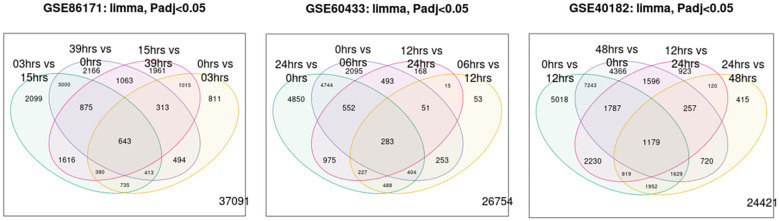
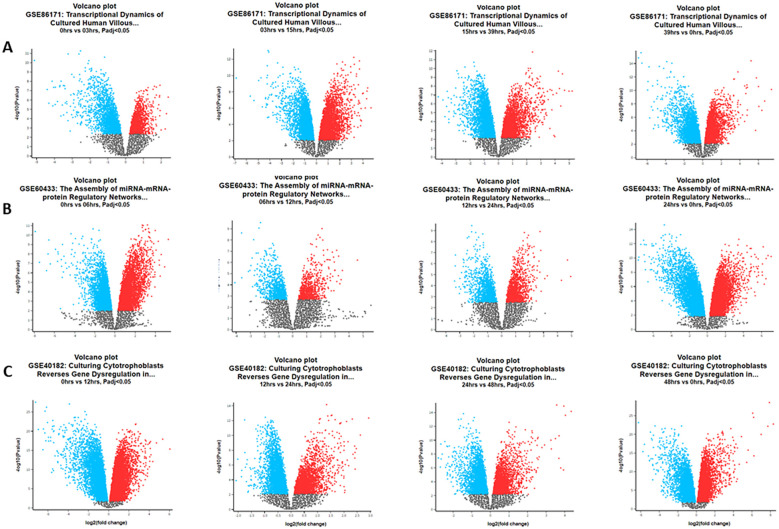
Functional annotation using DAVID identified 391 common DEGs (60.9%) during all time hours studied. Functional enrichment analysis (DAVID/KEGG) of the 391 common DEGs revealed significant overrepresentation of the "circadian rhythm" and "cell cycle" pathways (adjusted p < 0.05). Additional enriched terms included apoptosis and DNA repair, consistent with the central role of circadian regulation in cell proliferation and survival. Figure 1 shows the Venn diagram demonstrating the intersections of genes at different times of the day. Approximately 643, 283, and 1,179 common genes changed their expression level over all the time hours studied. Volcano plots for each dataset (Figures 2A–C) display the distribution of DEGs over time, and the pattern is visualized at every time studied in "GSE86171", "GSE60433", and "GSE40182". Similarly, the data of clock genes and regulators of the cell cycle for log2(fold change) and −log10(p-value) are shown in Table 1 for every time hour. The relative expression values suggest the time variation of clock gene expression in the placenta for at least 24 hours, with a peak for PER2 and CRY1 during the first half of the day. BMAL1 shows a peak early in the morning, and the cell cycle genes TP53, CIPC, and WEE1 show a peak during the interval between early in the morning and noon, suggesting a temporal variation of genes of circadian and cell cycle clocks.

A Venn diagram of genes between Gene Expression Omnibus (GEO) and the time of day.

Volcano plots of differentially expressed genes in the Gene Expression Omnibus (GEO) datasets during the hour of the day.Data GSE86171: at 0 vs. 3 hours, we detected 2,381 upregulated and 2,418 downregulated genes. At 3 vs. 15 hours, we detected 4,583 upregulated and 5,162 downregulated genes. At 15 vs. 39 hours, we detected 3,385 upregulated and 4,474 downregulated genes. At 39 vs. 0 hours, we detected 4,701 upregulated and 4,250 downregulated genes.Data GSE60433: at 0 vs. 6 hours, we detected 4,523 upregulated and 4,344 downregulated genes. At 6 vs. 12 hours, we detected 824 upregulated and 949 downregulated genes. At 12 vs. 24 hours, we detected 1,407 upregulated and 1,356 downregulated genes. At 24 vs. 0 hours, we detected 6,286 upregulated and 6,224 downregulated genes.Data GSE40182: at 0 vs. 12 hours, we detected 10,932 upregulated and 10,019 downregulated genes. At 12 vs. 24 hours, we detected 3,426 upregulated and 5,483 downregulated genes. At 24 vs. 48 hours, we detected 3,215 upregulated and 3,875 downregulated genes. At 48 vs. 0 hours, we detected 10,017 upregulated and 8,755 downregulated genes. (A) (B) (C)
| GEO dataset | Gene | 0–3 hourslog2(fold change) and −log10(p-value) | 3–15 hourslog2(fold change) and −log10(p-value | 15–39 hourslog2(fold change) and −log10(p-value) | 39–0 hourslog2(fold change) and −log10(p-value) |
|---|---|---|---|---|---|
| GSE86171 | Per1 | n.d | n.d | n.d | n.d |
| Per2 | −0.492 | 2.623 | 0.767* | 3.558* | |
| Per3 | n.d | n.d | n.d | n.d | |
| BMAL1 | −0.88 | 2.479 | 0.990* | 2.884* | |
| BMAL2 | n.d | n.d | −1.794* | 6.259* | |
| Clock | n.d | n.d | n.d | n.d | |
| Cry1 | −1.942 | 9.112 | 1.673 | 8.208 | |
| Cry2 | n.d | n.d | n.d | n.d | |
| TP53 | 0.498* | 2.848* | −1.099 | 6.48* | |
| CIPC | n.d | n.d | 0.95 | 5.198 | |
| WEE1 | n.d | n.d | n.d | n.d | |
| GSE60433 | Per1 | 3.12 | 6.69 | n.d | n.d |
| Per2 | 3.114* | 6.844* | −2.719* | 6.002* | |
| Per3 | 1.957 | 4.331 | −1.868 | 3.939 | |
| BMAL1 | 1.468 | 5.996 | 1.226 | 4.895 | |
| BMAL2 | n.d | n.d | n.d | n.d | |
| Clock | n.d | n.d | n.d | n.d | |
| Cry1 | 2.433 | 9.05 | n.d | n.d | |
| Cry2 | 1.602 | 6.211 | −1.115 | 4.262 | |
| TP53 | n.d | n.d | n.d | n.d | |
| CIPC | n.d | n.d | n.d | n.d | |
| WEE1 | n.d | n.d | n.d | n.d | |
| GSE40182 | Per1 | n.d | n.d | n.d | n.d |
| Per2 | 0.219 | 1.833 | n.d | n.d | |
| Per3 | n.d | n.d | n.d | n.d | |
| BMAL1 | n.d | n.d | n.d | n.d | |
| BMAL2 | −2.048* | 16.226* | n.d | n.d | |
| Clock | 0.408* | 4.975* | −0.403* | 3.20* | |
| Cry1 | n.d | n.d | n.d | n.d | |
| Cry2 | n.d | n.d | n.d | n.d | |
| TP53 | −0.336 | 2.587 | n.d | n.d | |
| CIPC | 0.938 | 7.955 | n.d | n.d | |
| WEE1 | 0.552 | 1.95 | n.d | n.d |
expression of clock gene and the WEE1 gene in human placental explants In vitro
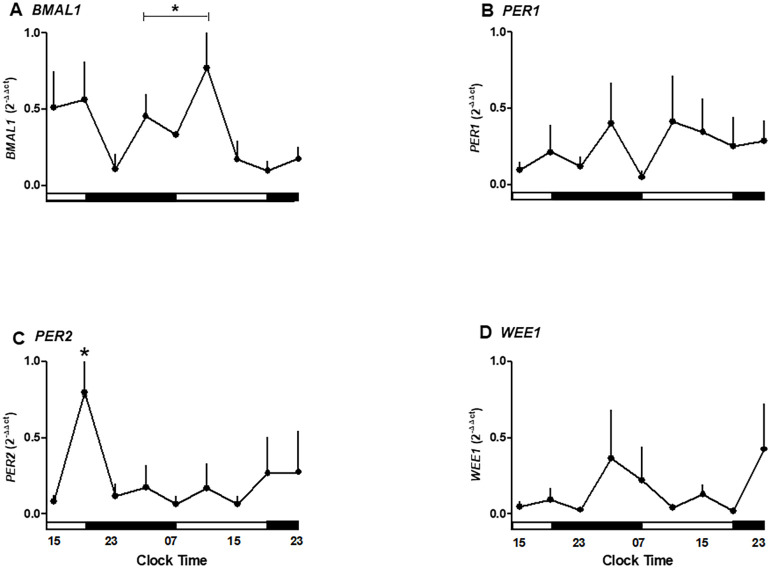
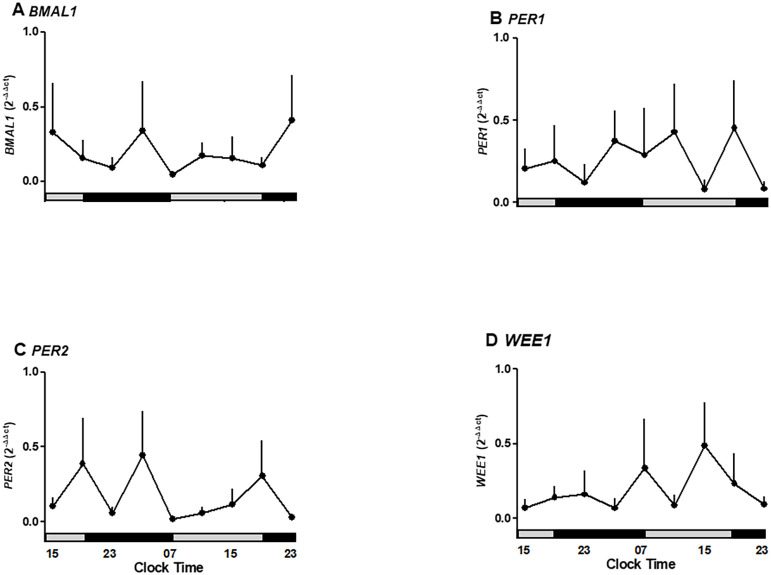
We next examined whether placental explants maintained circadian oscillations of core clock genes and the cell cycle regulator WEE1 in culture. To validate the in silico observations associated with temporal variations observed in the microarray of the placenta, we cultured human placental explants and measured gene expression every 4 hours for 36 hours. We observed that the BMAL1, PER1, PER2, and WEE1 genes maintain their mRNA expression in the culture of the human placenta for at least 36 hours (Figure 3).
As shown in Figure 3A, clock gene BMAL1 expression increases during daylight hours, showing a rise between 03:00 and 11:00 hours. Also, BMAL1 showed a local peak at 11:00 hours (range 03:00–11:00 hours is different from 15:00–23:00 hours of the second day of culture; p < 0.05, one-way ANOVA and Newman–Keuls post-test), whereas this expression showed a local minimum at 23:00 hours. The relative mRNA expression of PER1 showed no significant changes during the hours studied but exhibited a trend toward higher expression in the evening (Figure 3B).
PER2 expression changed during the hours of culture, showing a peak expression at 19:00 hours on the first day (p < 0.05 ANOVA and Newman–Keuls) and low expression levels in the following hours studied (Figure 3C). Wee1 expression showed no significant differences but trended upward during nighttime hours (Figure 3D).
The temporal data suggest an endogenous oscillation in BMAL1 and PER2 occurring in antiphase with a ~12-hour interval, indicative of a functional circadian clock in placental tissue.

Temporal expression of clock and cell cycle genes in human placental explants cultured for 36 hours.BMAL1 mRNA expression showing significant variation between 03:00–11:00 h and 15:00–23:00 h.PER1 mRNA expression showing no significant oscillation but a trend toward higher levels in the evening.PER2 mRNA expression peaking at 19:00 h during the first day of culture (p < 0.05).WEE1 mRNA expression showing a mild, non-significant increase during nighttime hours.Data are expressed as mean ± SEM (n = 3 per timepoint). Statistical analysis by one-way ANOVA followed by Newman–Keuls post hoc test; p < 0.05 considered significant. (A) (B) (C) (D)
Melatonin inhibits the expression of clock genes and the WEE1 gene
Given that the placenta expresses the capacity to synthesize melatonin and receptors, we tested whether exogenous melatonin modulates the oscillations of BMAL1, PER2, and WEE1. The exposure of placental explants to 10 nM melatonin suppressed the rhythmic peaks of BMAL1 and PER2 expression observed in untreated cultures. Although PER1 and WEE1 did not show statistically significant changes, BMAL1 expression was reduced between 07:00 and 19:00 hours under melatonin treatment (Figures 4A–D). These results suggest that exogenous melatonin can reduce the amplitude of circadian gene expression in placental tissue.

Oscillatory expression of clock genes BMAL1, PER1-2, and WEE1, a cell cycle gene in human placenta explants cultured for 36 hours in medium alone or plus melatonin.BMAL1 expression under control and melatonin showing suppression of rhythmic peaks.PER1 expression unaffected by melatonin treatment.PER2 expression showing inhibition of oscillatory peaks by melatonin.WEE1 expression showing a non-significant reduction under melatonin treatment.Profiles are representative of three placentas and expressed as Mean ± SE from 2-ΔΔCt. The bars on the X-axis indicate the relative hours of light (gray) and the hours of darkness (black). (A) (B) (C) (D)
Oscillatory ratios reveal phase relationships between clock genes
To further capture phase relationships among clock genes, we calculated BMAL1/PER1 and BMAL1/PER2 ratios across timepoints. To further evaluate gene oscillations, we calculated the expression ratios BMAL1/PER1 and BMAL1/PER2 (Figure 5). The circadian oscillation circuits are dependent on the transcriptional/translational feedback loop of clock genes, which act as positive and negative regulators, inducing/inhibiting their expression. BMAL1/PER1 ratios showed non-significant variation but tended to peak at 15:00 and 23:00 hours on the second day of incubation (Figure 5A).
Moreover, BMAL1/PER2 ratios exhibited significant oscillation, peaking between 03:00 and 11:00 hours and declining between 15:00 and 23:00 hours (p < 0.05; Figure 5B), fitting a sine-wave function (r2 = 0.7368). In contrast, melatonin treatment inhibited the BMAL1/PER2 peaks (Figures 5C, D).
These findings support the existence of an antiphase rhythm between BMAL1 and PER2, a circadian pattern that is disrupted by melatonin.

The ratio for expression of clock genes,, and, a cell cycle gene, in human placental explants cultured for 36 hours in medium aloneor medium plus melatonin. Profiles are representative of three placentas and expressed as mean ± SE from 2. The dashed line in panel B represents the theoretical sine-wave function determined by equation Y = Baseline + Amplitude * Sine (Frequency X + Phaseshift), where Baseline = 0.39, Amplitude = 0.3, Frequency = 0.26, and Phaseshift = −0.8 for(r= 0.7368). The data were normalized, considering the highest individual value within the experiment as 1 and the lowest value as 0. The bars on the X-axis indicate the hours of light (white), the hours of darkness (black), and relative hours of light (gray,. * Different from other hours, one-way ANOVA, n = 3. BMAL1 PER1-2 WEE1 BMAL1/PER-2 (A, B) (C, D) A, B) −ΔΔCt 2
BMAL1/WEE1 ratio suggests a circadian regulation of the cell cycle
To assess circadian gating of the cell cycle, we analyzed the ratio of BMAL1 to WEE1 expression across the culture period. The BMAL1/WEE1 expression ratio revealed a peak at 03:00–11:00 hours, followed by a decline during the night hours of the second day of culture (p < 0.05; Figure 6A). This antiphase relationship between BMAL1 and WEE1 was lost in melatonin-treated explants (Figure 6B). The pattern is consistent with the transcriptional regulation of WEE1 by the CLOCK/BMAL1 complex.

The ratio for expression ofin medium aloneor medium alone plus melatoninin human placental explants cultured for 36 hours. The dashed line in panel A represents the theoretical sine-wave function determined by equation Y = Baseline + Amplitude * Sine (Frequency X + Phaseshift), where Baseline = 0.26, Amplitude = 0.22, Frequency = 0.25, and Phaseshift = −0.08 for(r= 0.5304). Profiles are representative of three placentas and expressed as mean ± SE from 2. The data were normalized, considering the highest individual value within the experiment as 1 and the lowest value as 0. The bars on the X-axis indicate the hours of light (white), the hours of darkness (black), and the relative hours of light (gray, in panel B). * Different from other hours, one-way ANOVA, n = 3. BMAL1/WEE1 BMAL1/WEE1 (A) (B) 2 −ΔΔCt
Sustained melatonin production in placental explants
Finally, it was assessed whether placental explants produce melatonin endogenously and whether supplementation alters secretion levels. Endogenous melatonin was quantified in supernatants from untreated cultures (Figure 7A), while apparent exogenous levels were assessed in melatonin-supplemented cultures (Figure 7B). Values in treated conditions were interpreted relative to the standard curve and to paired untreated controls to distinguish secretion from supplemented hormone.
These findings confirm that the human placenta can produce melatonin autonomously and suggest a regulatory feedback loop between melatonin and the placental clock.

Melatonin production in medium aloneor medium alone plus melatoninin human placental explants cultured for 36 hours. The average of each bar represents the average measurement of the melatonin concentrations obtained from the supernatant of each explant. The bar at the upper side of the graph indicates the hours of light (white), the hours of darkness (black), and relative hours of light (gray, in panel B). * Different from other hours, t-test, n = 3. N.S., non-significant difference. (A) (B)
Discussion
The placenta exhibits a circadian production of critical hormones required for a healthy pregnancy (41 –43, 68, 82, 83). In agreement with these findings, Diallo et al. (68) demonstrated that the human placenta displays circadian oscillations in its metabolism and is capable of synthesizing the melatonin hormone, suggesting the presence of a functional circadian clock in the placenta. Importantly, impaired circadian rhythms in the placental physiology due to the inhibition of melatonin production (e.g., shiftwork and night-time light exposure) have been associated with pregnancy complications and adverse outcomes (31, 84 –89). We selected a low nanomolar concentration (10 nM) of melatonin, consistent with prior studies in several tissues, where nanomolar doses are biologically active while avoiding potential pharmacological effects (74 –79). Using bioinformatics analyses, we detected time-dependent variation in the expression of cell cycle genes TP53, CIPC, and WEE1 and clock genes PER2, PER3, CRY1, and BMAL1. These results suggest that such genes may serve as markers to study the intrinsic oscillatory capacity of placental tissue in vitro. To further explore this capacity, we performed culture experiments with human placental explants. Also, we provided complementary in silico and ex vivo evidence that human placental tissue displays intrinsic circadian dynamics involving BMAL1, PER2, and WEE1 and that melatonin reduces the amplitude of these rhythms.
In culture, explants of the placenta can maintain the cellular function between 24 and 72 hours, synthesizing critical factors such as human placental lactogen (72, 90), human chorionic gonadotropin (CG) (71), prorenin (91), angiogenin (92), placental 24,25(OH)2D3 (93), and NO (94), and also showing the capacity of l-tryptophan transport and indoleamine 2,3-dioxygenase activity (95). Similarly, in our explants of the human placenta, we detected the expression of clock genes BMAL1 and PER1-2. We observed a peak for BMAL1 between 03:00 and 11:00 hours, with a local peak at 11:00 hours on the second day of culture, like that observed in rat liver (96), which was delayed 4 hours to the lungs and adrenal glands of rats (97, 98), or 9 hours in the adrenal gland of monkeys (17). The antiphase of approximately 12 hours observed for BMAL1 and PER2 is similar to that of trophoblasts synchronized by serum shock (51). Alternatively, the circadian expression of the clock gene PER1 is not detected during culture. Despite the above, we speculated that the expression of PER1 must be high during the hours of the night and at the end of the day, different from what was reported in rat liver (96) or vascular smooth muscle cells (99), where maximum expression was observed during the night.
Our data suggest that the human placenta shows the same expression pattern as the peripheral oscillator-like lung (97) and a delay of 5–7 hours from the adrenal (17, 98). However, we observed an advanced phase of approximately 4 hours from the rat's liver (96), and PER2 expression is similar to that of the mouse placenta ex vivo. This pattern, after serum shock, is maintained in the culture of trophoblast cells (51). These data show the oscillation of the clock genes BMAL1 and PER2 in antiphase, which is related to the detected expression ratios of the BMAL1/PER2 genes, and suggest that in the human placenta, there is an endogenous circadian clock with an autonomous capacity to work.
We showed the effect of melatonin on clock gene expression in the human placenta, similar to that reported over BMAL1 and PER2 in the pars tuberalis (100) and the adrenal gland (17, 101). Thus, our results suggest that melatonin has early effects on the expression of the clock genes as a chronobiotic agent, possibly via BMAL1 inhibition and the posterior decrease of PER1 and PER2 expression. Another limitation of this approximation is that only a single concentration of melatonin (10 nM) was tested. Although this dose was selected based on its reported physiological relevance in placental and adrenal models, further dose–response studies will be necessary to fully establish the modulatory role of melatonin on placental circadian gene expression.
The circadian clock regulates the osteogenic potential by inhibiting BMAL1 expression (102), and the impaired expression of BMAL1 and PER1–2 causes tumor growth in mouse embryonic tissue (103). Alternatively, the knockdown of the clock gene BMAL1 in carcinoma cells induces tumor growth when cells are injected subcutaneously, which may be mediated by the inhibition of apoptosis and reduction in the time that the cells remain in the G2/M phase (39). These antecedents suggest that the circadian system is closely related to the cell cycle in several peripheral tissues.
The BMAL1/WEE1 ratio suggests that the circadian expression of WEE1 increases at 03:00 hours, similar to a negative regulator of clock genes. The antiphase expression of BMAL1 and WEE1 detected here has been reported previously in the liver, with a peak for WEE1 expression during the day/night transition and a peak for BMAL1 during the night/day transition (96). Our results showed an antiphase of expression in the placenta for approximately 8 hours, suggesting the interplay of both clocks.
A limitation of our study is that clock gene expression was evaluated in whole placental explants rather than in isolated cells. While this approach allowed us to identify rhythmicity at the tissue level, it does not exclude the possibility that specific placental cell types, such as cytotrophoblasts or syncytiotrophoblasts, may exhibit distinct circadian dynamics. Future studies using isolated cell populations will be required to define cell type-specific rhythms and to clarify how melatonin modulates these cellular clocks.
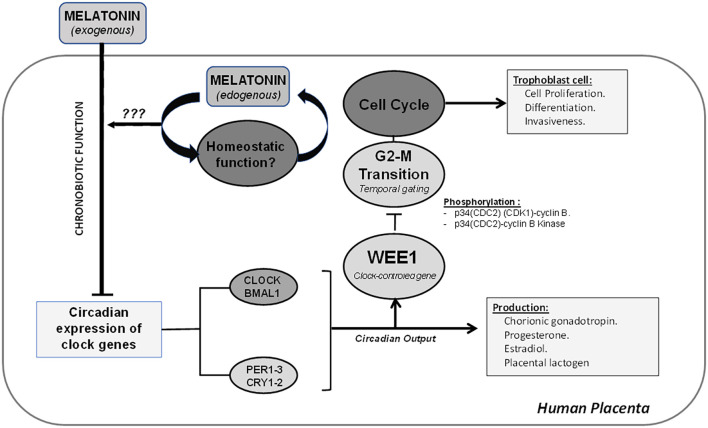
Our data suggest that variations in the expression levels of the clock genes BMAL1, PER1-2, and the cell cycle gene WEE1 would correspond to a self-sustained placental capacity. The entry into mitosis by human placenta cells would be regulated by the clock genes, which would modulate WEE1 expression levels by inhibiting the cell cycle. Furthermore, we showed an agonist role of melatonin in the cell cycle, decreasing the expression of clock genes BMAL1, PER1, and PER2 and lowering the expression of WEE1. Similar to what was previously reported by Lanoix et al., we detected melatonin production in the human placenta (67). However, our results show that this production is sustained for at least 36 hours, suggesting a homeostatic role or protector against oxidative stress (31, 104) in the placenta that requires further investigation. These results support the existence of a circadian system–cell cycle interaction, modulated by the melatonin hormone. A graphical summary of the proposed mechanism is shown in Figure 8. This model may help explain how chronodisruption or the disruption of melatonin secretion could impact placental development and fetal health during pregnancy.
Our experimental limitation is that the explant culture-based approach assessed gene expression at the tissue level and did not directly measure functional cell cycle outcomes, such as those that occur with measurements of proliferation indices, BrdU incorporation, and flow cytometry. Future work should incorporate these readouts and include validation in human placental cell lines (e.g., BeWo and JEG-3) to define cell type-specific responses and determine whether melatonin suppresses clock gene expression at the cellular level. Another limitation is that we did not directly evaluate cell cycle progression or proliferation indices. This prevents us from linking the transcriptional changes of WEE1 and other genes to functional outcomes. Future work should address this gap to strengthen the biological interpretation of our findings.

The placenta shows a circadian expression of clock genes, which can regulate the temporal gating of the cell cycle via modulation of mRNA expression ofand inactivation of transition G2–M by phosphorylation of p34(CDC2) (CDK1)–cyclin B and p34(CDC2)–cyclin B kinase complex. The disruption of the circadian system of the placenta can modify critical processes, such as cell proliferation, differentiation, and invasiveness from trophoblast cells. Additionally, the placenta has the endogenous ability to produce melatonin, and it may play a homeostatic and antioxidant role in the placenta. WEE1