
What this is
- Over 2 million SARS-CoV-2 genome sequences have been generated, aiding public health responses.
- The Pango nomenclature system classifies SARS-CoV-2 lineages based on complete or near-complete genomes.
- This research investigates the classification of SARS-CoV-2 lineages using spike-only nucleotide sequences.
- The authors propose a '' concept to represent multiple Pango lineages associated with a given spike sequence.
Essence
- Many SARS-CoV-2 lineages, including key variants of concern, can be identified using only spike nucleotide sequences. The study introduces 'lineage sets' to capture the range of Pango lineages corresponding to observed mutations in spike sequences.
Key takeaways
- Spike-only sequences can reliably identify many Pango lineages, especially variants of concern. However, some sequences are shared among numerous lineages, complicating precise lineage assignment.
- The concept of 'lineage sets' allows classification of spike sequences into groups of related Pango lineages. This approach acknowledges the uncertainty in lineage designation when using partial genomic data.
- The findings support the development of software tools for assigning spike sequences to lineage sets, enhancing genomic surveillance and outbreak response capabilities.
Caveats
- Not all Pango lineages can be distinguished by spike sequences alone, particularly those defined by mutations outside the spike protein. This limitation may affect the accuracy of lineage assignments.
- The study relies on existing genomic data, which may not capture all relevant mutations or lineages, potentially biasing the findings.
Definitions
- lineage set: A group of Pango lineages that share similar spike mutations, reflecting classification uncertainty.
Simplified
Background
During the SARS-CoV-2 pandemic virus genome sequences have been generated and shared in unprecedented numbers. More than 2.2 million SARS-CoV-2 sequences have been deposited in the online database GISAID [14], as of 5th June 2021. Analyses of virus genomes from the COVID-19 pandemic have revealed the international dissemination of the virus (e.g. [7, 11]), been used to support contact tracing and outbreak control (e.g. [3, 9]), and enabled the discovery and surveillance of variants of concern (e.g. [2, 13, 17]) or other lineages of virological or epidemiological interest.
Systems of nomenclature are common throughout biology. In virology they are used to organise and simplify observed virus genetic diversity at different taxonomic levels, and allow virologists, epidemiologists and public health officials to communicate precisely and unambiguously (e.g. [16, 18]). In the case of the COVID-19 pandemic, at least four naming systems have been developed and used to identify and name genetically-distinct SARS-CoV-2 types and lineages [1, 6]. The Pango dynamic nomenclature system was developed and published in early 2020 ([12]; https://pango.network↗) and has since become a widely-used tool worldwide for SARS-CoV-2 classification. Each Pango lineage aims to define an epidemiologically relevant phylogenetic cluster, for instance an introduction into a distinct geographic area with evidence of onward transmission, or recrudescence of a previously observed lineage, or rapid growth of a lineage with notable phenotypes, etc. Pango lineages are fine-scaled phylogenetic labels that are designed to be suited to outbreak investigations at national or regional scales. The exact meaning of "epidemiologically-relevant" can change depending on the current nature of the pandemic and levels of genomic sampling. It differs from other SARS-CoV-2 nomenclature systems (such as GISAID and NextStrain) in that it (i) aims to capture the ongoing, leading edge of pandemic transmission, (ii) its lineages are intended to represent epidemiologically-relevant events, and (iii) it examines the phylogenetic structure of the pandemic at high resolution. The Pango nomenclature therefore contains a large number of lineages (currently > 1300; https://cov-lineages.org↗) covering the entire genetic diversity of SARS-CoV-2, some of which are genetically very similar to each other. In contrast, the 'Greek letter' system recently proposed by the WHO Virus Evolution Working Group [6] is intended for public communication purposes and provides labels only for a small number of variants of concern (VOCs) and variants of interest (VOIs). The WHO variant of concern labels Alpha, Beta, Gamma and Delta correspond to the Pango lineages B.1.1.7, B.1.351, P.1, and B.1.617.2, respectively.
The Pango nomenclature was designed to classify complete or near complete SARS-CoV-2 genomes. New Pango lineages are designated only if the lineage contains a sufficient number of sequences with high genome coverage – specifically, if < 5% of nucleotides sites across the whole genome (excluding UTRs) are missing or represented by IUPAC ambiguity codes [13]. Genome sequences that are less complete than this do not get included in the designation set and for large lineages only a representative sample is included. Remaining genomes, not included in the designation set, can be "assigned" to a lineage using the software tool pangolin [10]. Thus sequence "designation" is a formal, definitive statement about lineage membership of a genome, whereas "assignation" is an estimate or inference of the lineage to which a sequence most likely belongs (https://pango.network↗). Tools for lineage assignation, such as the machine learning approach implemented in pangolin are important because it takes time for new sequences to be evaluated and designated by the Pango team, and because only a subset of of SARS-CoV-2 sequences available on GISAID meet the strict coverage criterion above. Also, there are many identical and near-identical genomes on GISAID, especially for the common VOCs such as Alpha and Delta. The training data set (of designated sequences) that Pangolin uses to assign lineages to new sequences does not need to include every representative of every lineage to be accurate. Adding 10s of thousands more Alpha and Delta sequences to the sequence designation list won't notably improve designation accuracy.
One notable class of incomplete SARS-CoV-2 sequences comprise the complete nucleotide coding sequence of the spike glycoprotein. The spike protein is of particular biological importance because it is the primary target of natural and vaccine-elicited humoral immunity, it is the target of most therapeutic and prophylactic monoclonal antibodies, and it contains the virus' receptor binding domain, which binds the human host cell receptor ACE2 with high affinity (e.g. [4]). Spike-only nucleotide sequences, rather than complete genomes, may be generated by researchers for several reasons. For example, many immunological investigations do not require information about the remainder of the virus genome, and a sub-genomic sequencing approach may sometimes generate higher quality spike sequences from high Ct samples. Further, some laboratories may generate spike-only data using a Sanger sequencing approach because they lack access to next-generation sequencing or because the former is more cost-effective. Lastly, it is known that coronaviruses can undergo recombination and that the resulting mosaic genomes often contain an alternative spike gene whose ancestry is different to that of other genomic regions. This trend is also observed in those SARS-CoV-2 recombinant genomes that have been discovered so far [5]. One consequence of such recombination is that the genetic ancestry of the spike gene may be different to that of the rest of the virus genome. For instance, the recombinant lineage described in Jackson et al. [5] has a spike protein sequence of lineage B.1.1.7, so by defining lineage sets on spike alone, this particular sequence may be indistinguishable from non-recombinant B.1.1.7. This is a limitation if the full ancestry of the virus is of concern, however if antigenicity is of interest, lineages that share the same spike sequence through recombination will be correctly grouped together in a spike-only classification scheme.
It is therefore valuable to consider how to assign Pango lineages using SARS-CoV-2 spike-only nucleotide sequences. This question is particularly relevant to the variants of concern (VOC) and variants of interest (VOI), as the specific genomic surveillance of VOC/VOIs is important for outbreak control decisions made by public health agencies. Further, several of the current VOCs contain (and to some extent are defined by) unusually large numbers of distinct mutations in their spike genes that may affect virus antigenicity and molecular diagnostic tools.
The machine learning model in the assignment tool pangolin is trained on a data set of genomes that have been designated to Pango lineages using whole genome information [10]. These lineage designations cannot be applied directly to a training data set of spike-only sequences because, as we show here, some lineages share identical spike sequences. This would result in the training data containing conflicting or non-identifiable information and would lead to poor model performance. It is therefore important to designate spike-only sequences to a set of taxonomic groups that is appropriate for the information content of spike-only sequences.
Here, we determine the degree to which Pango lineages are distinguishable using spike-only nucleotide sequences, with a focus on current variants of concern. We explore how unique or shared spike mutations observed at differing frequencies may be used to support the classification of spike-only sequences. We introduce the concept of a "lineage set" to represent the range of Pango lineages that are compatible with a given SARS-CoV-2 sequence and we show how each spike-only sequence can be designated to a lineage set using a pre-defined consensus haplotype for each lineage. The resulting lineage set designations provide a platform for the development of Pango lineage assignment tools suitable for spike-only sequences.
Results
Analysis of SARS-CoV-2 genome and spike gene variation
The extent to which SARS-CoV-2 lineages can be assigned to spike-only nucleotide sequences will depend on the level of genetic variation within and among spike sequences that have been designated to different Pango lineages. Genetic variation within spike can be categorised as (i) non-synonymous single nucleotide changes (i.e. amino acid changes), (ii) synonymous nucleotide changes, and (iii) insertions and deletions (indels).

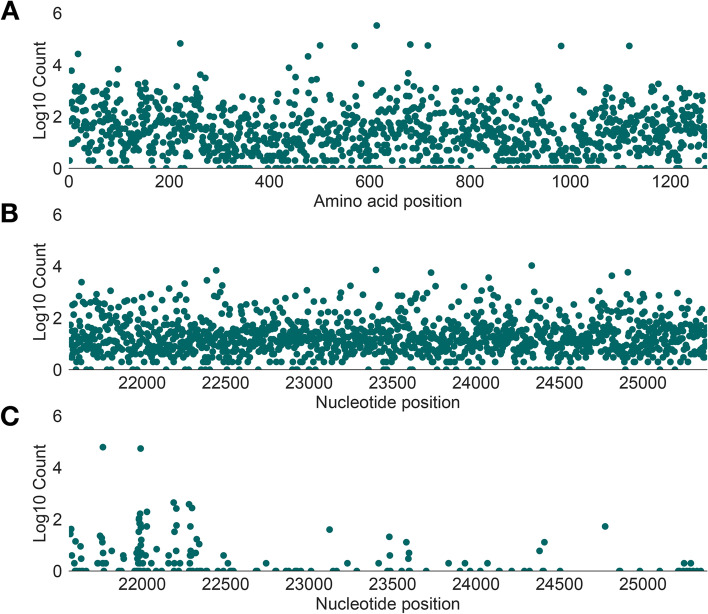
Genetic diversity in the spike protein of all available SARS-CoV-2 genome sequences. The vertical axis of each plot shows the number of designated sequences that exhibit mutations at each amino acid position (log10-scaled).Distribution of non-synonymous variation across amino acid positions of the spike protein (horizontal axis).Distribution of synonymous variation across nucleotide sites in the spike protein (horizontal axis).Distribution insertion and deletion variation (indels) across nucleotide sites in the spike protein (horizontal axis). Each point represents the 5′ nucleotide site at the start of each indel. In each plot, genetic variation is determined by comparison with a lineage A reference sequence (Wuhan/WH04/2020, EPI_ISL_406801) A B C

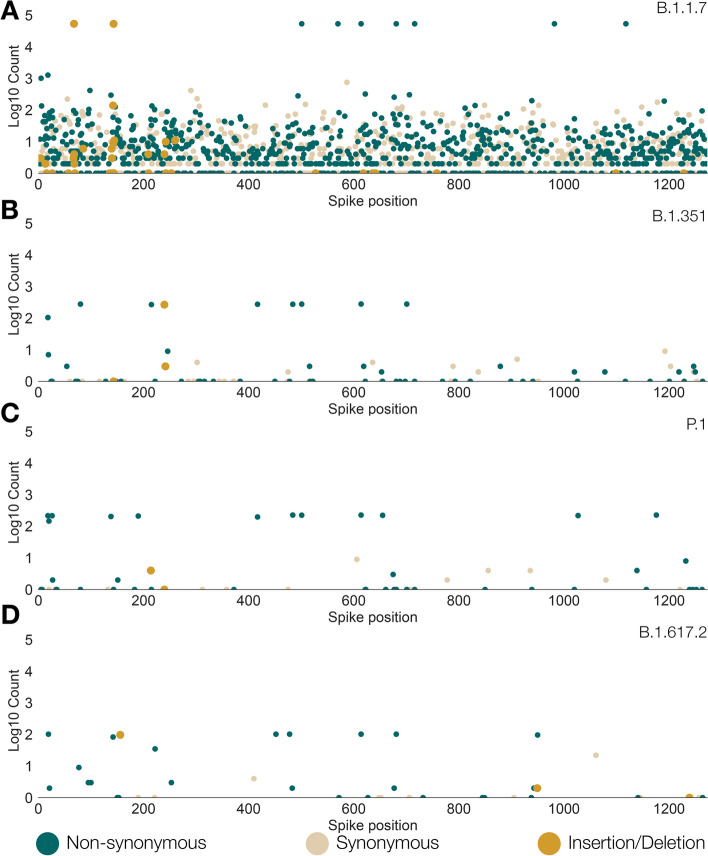
Genetic diversity in the spike protein of SARS-CoV-2 sequences for each of the Pango lineages that correspond to the four main variants of concern. Each coloured dot shows the genomic position of a non-synonymous (green), synonymous (beige), or indel (orange) mutation. The vertical axis shows the number of designated sequences that exhibit non-synonymous variation at each amino acid position (log10-scaled). In each plot, mutations were defined by comparing sequences with a common reference strain, Wuhan/WH04/2020 (EPI_ISL_406801).Lineage B.1.1.7 (alpha).Lineage B.1.351 (beta).Lineage P.1 (gamma).Lineage B.1.617.2 (delta) A B C D

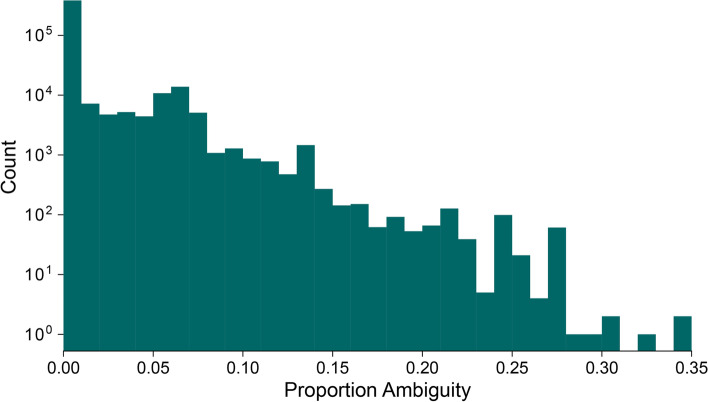
Histogram of the proportion of spike protein nucleotide sites that are ambiguous (i.e. contain at least one IUPAC ambiguity code). The distribution is calculated for all SARS-CoV-2 sequences in GISAID that (i) have been designated to a Pango lineage, and (ii) have N at < 5% of sites across the whole genome, excluding UTRs

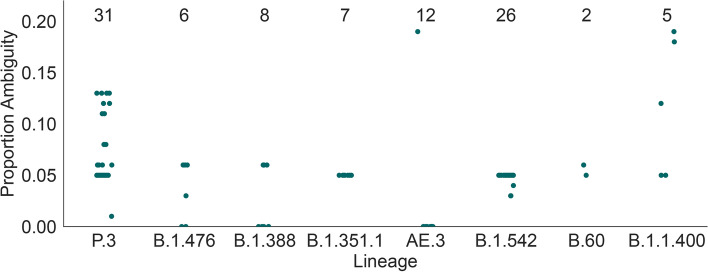
We observed 8 Pango lineages in which every designated sequence contains at least one ambiguity code in its spike nucleotide sequence. The number of sequences designated to these lineages is typically small (range 6-31). For each sequence in these 8 lineages, the y-axis shows the proportion of spike nucleotide sites in that sequence represented by an IUPAC ambiguity code (i.e. not A, C, G, T, or a gap)
Spike nucleotide sequences

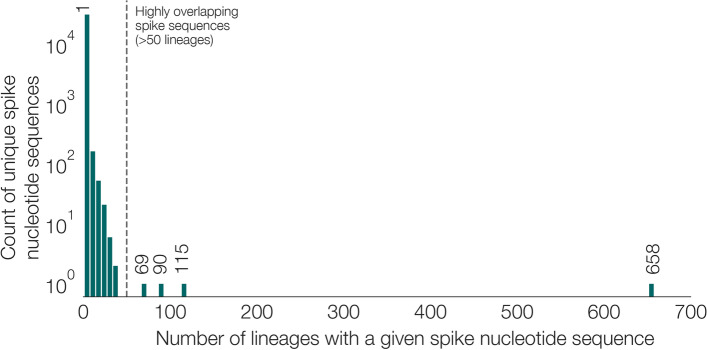
Distribution of the number of lineages that a given SNS is observed in. Most SNS are found in only one lineage. However, a few SNSs can be found in many lineages

Number of distinct spike nucleotide sequences (SNS) in designated Pango lineages with complete spike sequences. Some of the very large lineages, for instance B.1.1.7 (count = 3893), B.1.177 (count = 2974), and B.1 (count = 2763) have many SNS, whereas the majority of lineages have few
Consensus spike haplotypes
The above analysis of SNSs shows that spike-only sequences cannot unambiguously determine the Pango lineage to which a genome belongs, and that some lineages contain large numbers of distinct spike sequences. Further, the number of SNS within a lineage will increase as the lineage diversifies and as new genomes are generated and reported through time. Therefore it will be challenging to maintain a stable and complete list of SNSs for each lineage.
We therefore considered an alternative approach to evaluating the information about Pango lineage in spike-only sequences. Specifically, we analysed the spike sequence diversity within each Pango lineage, then determined which mutations/indels best represent that diversity. This approach is related to the definition of a consensus haplotype for a group of sequences. Given a mutation frequency threshold, X, and a specified lineage Y, we can seek to identify all the mutations/indels that are observed in at least X% of the spike sequences belonging to lineage Y. This set of sites can be then used to define a "X% consensus spike haplotype" for lineage Y. Like SNSs, the consensus spike haplotypes (CSH) will not be unique to a Pango lineage, but will be easier than SNSs to curate, and simpler to interpret because they define a set of common characteristic spike mutations for each lineage. Further, CSH will be more robust to the presence of sequencing errors and low-frequency deleterious mutations.
Many CSHs will be unique to a one Pango lineage, however others will be shared among multiple lineages. We therefore introduce the concept of a "lineage set", which comprises the set of lineages that share the same CSH. Lineage sets are dependent on the mutation frequency threshold X% used to define the consensus spike haplotype for each lineage. Lineage sets further capture the degree of uncertainty in the process of designating Pango lineages using spike-only sequences.

Distribution of the number of Pango lineages in each lineage set, using a mutation frequency threshold of X = 95%. Three hundred thirty-seven sets contain only a single lineage and so are uniquely distinguishable by their consensus spike haplotype. Twenty-eight sets contain two Pango lineages, and so on
Nomenclature for lineage sets
A complete list of the 393 lineage sets obtained using a 95% mutation frequency threshold is available online at https://github.com/cov-lineages/hedgehog/blob/main/hedgehog/data/set_names.95.csv↗.

Phylogeny consisting of a single tip per designated Pango lineage. Shading represents lineage sets, coloured by major lineages they represent. Significant lineages or those with many sublineages shown in the central panel. Lineage sets containing more than 10 lineages are indicated on the right, with their respective spike constellation described
Choice of mutation frequency threshold

Plot showing the number of mutations in the CSH for a given lineage as a function of the mutation frequency threshold (X) used to define the CSH. Lineages shown are those that contain > 20 designated sequences with complete spike nucleotide sequences and > 5 spike mutations. The lineages that correspond to the four main VOCs are coloured individually, whilst all other included lineages are shown in green

Plot showing the trade-off arising from the choice of mutation frequency threshold, X.The mean number of lineages in each lineage set increases as X increases from 0 to 100% (pink). The mean is calculated across all spike-only sequences that can be designated to a lineage set. The mean is dominated by one very large lineage set; green dots show the actual set sizes for all lineage sets.The total number of sequences that can be designated to a lineage set increases as X increases from 0 to 100% (orange). The mean percentage of sequences per lineage that cannot be designated to a lineage set is also shown in order to normalise the effect of lineage size (green). Error bars represent 95 percentiles of this distribution A B
Discussion
Spike-only SARS-CoV-2 nucleotide sequences constitute an important source of genetic information about the virus, which are of particular relevance to host receptor binding, humoral immune responses, and current variants of concern. The initial waves of the SARS-CoV-2 pandemic have established genomics as a vital tool for epidemic surveillance. As we move towards longer-term ("endemic") surveillance of SARS-CoV-2, surveillance priorities may change and may shift from tracking transmission to identifying antigenic change. Provisions must be in place for understanding how spike-only sequences relate to the current whole genome nomenclature system. We're not necessarily endorsing a move to sub-genomic sequencing, but given the possibility that it may become increasingly common, it's important to have a system in place beforehand and understand the limitations that this will entail. Here we explore how such sequences can be classified within the Pango lineage nomenclature, which was developed initially for complete virus genome sequences. Despite the significant amount of genetic variation among the spike genes of available SARS-CoV-2 genomes, we do not find a one-to-one mapping between spike nucleotide sequences/haplotypes and Pango lineages. Although most spike nucleotide sequences (SNS) are observed in only one Pango lineage, many SNS are observed in multiple lineages, and one sequence is found in > 600 different lineages. The same is true for consensus spike haplotypes (CSH), which are defined for each lineage by the set of mutations that are observed above frequency X% in that lineage.
We therefore developed a system by which spike-only sequences can be designated to a "lineage set" that contains all of the Pango lineages consistent with the CSH of that sequence. In many instances, the lineage set will contain only one Pango lineage, but in others it may contain tens or hundreds of lineages. These lineage sets reflect our uncertainty in Pango lineage designation from partial sequences, and this interpretation extends readily to sequences that contain ambiguous or missing bases. We note that lineage sets could in theory be applied to SARS-CoV-2 sub-genomic regions other than spike.
In order to ensure that lineage set designations are robust to common minor sequence variants within each lineage, our results indicate that lineage sets should be designated using CSHs that are defined with a mutation frequency threshold (X) lower than 100% (Fig. 10b). Training a custom pangoLEARN model on spike-only sequences that have been designated to such lineage sets will circumvent the conflicting information (and consequent errors in assignment) that would arise if the model were to be trained on spike-only sequences designated to Pango lineages. Training the pangoLEARN model on lineage set designations avoids the issue of missing data outside of the spike gene and will allow all spike sequence variation (not just the mutations that contribute to the CSH) to inform the assignment. Once a reference set of spike sequences has been designated to lineage sets using the CSH approach outlined here, it is relatively straightforward to apply these designations to pangolin [10] and consequently assign spike-only sequences to the lineage sets. For convenience, we have written a python-based script that can output lineage set assignments based on a custom pangoLEARN model trained on spike sequences. This tool is freely-available at https://github.com/cov-lineages/hedgehog↗. Other approaches to lineage, or lineage set assignment, and parsimony placement approaches, such as UShER, or SNP-based assignment may also be used.
SARS-CoV-2 genomes have diversified and diverged as the pandemic has unfolded, and large numbers of mutations in the spike gene are reported in the VOCs that have emerged since late 2020. We expect spike sequences to continue to diverge, so that in the future we expect that it will become easier to assign Pango lineage using spike-only sequences. Virus genomes sampled at the start of the pandemic were genetically similar to each other, hence the SNS and CSH shared among many lineages tend to be those genetic types that were present early in the pandemic. If we wish to reduce the size of the large lineage sets, then it will be necessary to use information about virus genomes other than their spike nucleotide sequences. In theory, the sequence sampling date and/or location could be used; if certain lineages are known to have been highly prevalent or absent from a region at different times, then that information could be used, in a Bayesian framework, to inform the assignment inference. However, such an approach might be suitable only for those regions or countries that have undertaken consistently high levels of unbiased population-level genomic sampling and surveillance.
Conclusions
Our analysis indicates that many lineages, including the main variants-of-concern, can be reliably identified using spike-only nucleotide sequences alone. The generation of such sequences may be undertaken or preferred when only the spike sequence is relevant to the question at hand, e.g. assessment of the host-receptor binding domain or antibody binding sites. We also conclude that many Pango lineages cannot be distinguished by spike alone, particularly lineages designated early in 2020 and/or those defined by mutations outside of the spike protein. To maintain utility of lineage nomenclature in this context, we define lineage-sets, which represent the taxonomic precision that can be achieved using spike-only nucleotide sequences. Many lineage-sets contain a single lineage, including those that correspond to the variants-of-concern identified thus far. In contrast some lineage-sets contain a large number of lineages, such as the lineage set defined by the spike D614G amino acid mutation. Our study provides a foundation for the development of software tools that can assign newly-generated spike nucleotide sequences to Pango lineage sets.
Methods
Data set collation and analysis
We downloaded all SARS-CoV-2 genomes with Pango designations (v1.2.32) available on GISAID on 05th July 2021 (n = 458,622). The genomes were aligned against a reference genome for SARS-CoV-2 (Genbank accession ID = NC_045512; Wuhan-Hu-1) using minimap2 v2.17 [8] and were scaffolded and padded to full-length genome alignments using gofasta (https://github.com/cov-ert/gofasta↗). Using the Genbank features annotations (accession ID: NC_045512; gene ID: 43740568), we extracted the spike gene nucleotide sequences from the full alignment (genome positions 21,562 to 25,384), resulting in alignments of length 3822 nucleotides. For each spike nucleotide sequence (SNS) in the alignment, spike ambiguity content was calculated as the proportion of bases present in the spike sequence that was not A, C, G, T, or a gap, and so includes both N and non-N ambiguities in the calculation. Only genomes with complete spike proteins (i.e. no ambiguous bases) were included in subsequent analysis, resulting in 345,356 sequences being included in the analysis (78% of designated sequences). Of the Pango lineages in the dataset, 8 of these lineages had no representative sequences with complete spike protein sequences and were not included in subsequent analysis, leaving 1296 lineages with complete representative spike proteins, GISAID accession numbers supplied in Additional file 1.
Identification of consensus spike haplotypes
To identify consensus spike haplotypes and lineage sets, we first mapped the whole genome sequences of the 345,356 genomes identified above against the Wuhan/WHO4/2020 genome (GISAID accession = EPI_ISL_406801) which is a high quality, early, example of lineage A. Using the resulting output alignment file, we identified all non-synonymous mutations, synonymous nucleotide mutations, and insertions and deletions using gofasta (https://github.com/cov-ert/gofasta↗). We subsequently retained only mutations in the spike protein from these records. Using the Pango sequence designation list (v1.2.32; https://github.com/cov-lineages/pango-designation/blob/master/lineages.csv↗) we recorded the list of spike mutations observed in each lineage, and the relative frequency of each mutation within each lineage. These lists were then used to calculate a consensus spike haplotype (CSH) for each lineage. Specifically, spike mutations were included in the CSH if they were observed in >X% of the sequences designated to that lineage. Finally, we used the CSHs for each lineage to create lineage sets. These were generated by placing all lineages with the same CSH in the same lineage set. Finally, a unique alphanumeric identifier was generated for each set using the MD5 hash algorithm to allow concise and accurate referencing of the sets.
Supplementary Information
Additional file 1.